


Kazakhstan VAT Registration and Compliance Guide
Provinces
Goods
Provinces
Goods
About
Goods
About
Goods
Goods
Goods
Introduction to VAT in Kazakhstan
The country operates a 12% value-added tax system governed by the Tax Code of the Republic of Kazakhstan (adopted 2008, with subsequent amendments). VAT in Kazakhstan runs through the State Revenue Committee (SRC) — every enrolled operator charges 12% on each taxable sale, files Form 300.00 quarterly, and issues all invoices electronically through the SRC's ESF portal. Goods brought in from outside carry the same 12% at Customs or as a self-assessed charge, depending on whether they arrived through the EAEU trade corridor or from a third country. For goods businesses specifically — importers, manufacturers, distributors — the Form 300.00 quarterly deadline, the mandatory ESF electronic invoice, and the separate Form 328.00 obligation for EAEU-origin goods are the three compliance obligations that shape day-to-day operations. Membership in the Eurasian Economic Union (EAEU) shapes how indirect taxation in Kazakhstan works for cross-border goods. Supplies to EAEU partners (Russia, Belarus, Armenia, Kyrgyzstan) are zero-rated and the destination state collects the import levy. Non-EAEU imports pay at Customs. This guide covers physical goods only. VAT in Kazakhstan rules for electronically supplied digital services involve a separate non-resident registration pathway — that framework sits outside this guide.VAT Rate Kazakhstan — Standard and Zero Rates
Kazakhstan VAT Rate — Current Level
The Kazakhstan VAT rate is 12% for all standard-rated supplies of goods. No reduced tier sits below the standard rate — supplies are either standard at 12%, zero-rated at 0%, or exempt with no recovery right. The Kazakhstan VAT rate has held at 12% since 2009 and has not been adjusted through any subsequent Finance Act. Kazakhstan's levy rate is lower than Russia's 20% or Ukraine's 20%, and on par with Kyrgyzstan's 12%.| Supply category | Rate | Input credit recovery | Examples for goods |
| Standard-rated | 12% | Full | Manufactured goods, consumer products, electronics, vehicles |
| Zero-rated | 0% | Full | Goods exported from customs territory, EAEU cross-border supplies, international transportation |
| Exempt | None | None | Financial instruments, certain medical supplies, educational materials |
Kazakhstan VAT Rate Versus the Region
| Country | Standard VAT rate | Registration threshold (USD equiv.) | Filing frequency |
| Kazakhstan | 12% | ~USD 150,000 | Quarterly |
| Russia | 20% | ~USD 20,000 | Quarterly |
| Uzbekistan | 12% | ~USD 45,000 | Monthly |
| Kyrgyzstan | 12% | ~USD 30,000 | Monthly/quarterly |
| Belarus | 20% | ~USD 100,000 | Monthly/quarterly |
VAT Registration Threshold in Kazakhstan
For Local Businesses
The enrollment trigger is 20,000 MCI (Monthly Calculated Index) measured across any rolling 12-month window. In 2024, the MCI sits at 3,692 KZT, putting that threshold at approximately 73,840,000 KZT — about USD 150,000. Businesses that cross this line must file with the SRC within 30 calendar days of doing so. Zero-rated sales count in the calculation; exempt sales sit outside it. Enrolling voluntarily while still below 20,000 MCI is a commercially rational move for any importer: each Customs clearance generates a 12% levy charge that only becomes recoverable once an active registration is in place.For Remote Sellers Selling Goods
Foreign businesses bringing goods into the country from outside the EAEU sit in a different compliance position from domestic operators. A foreign operator that creates a permanent establishment on local soil — a warehouse, branch office, or distribution arrangement — is measured against the same 20,000 MCI annual threshold as any local entity. Those without a permanent establishment who nonetheless deliver taxable goods inside the country face a non-resident enrollment obligation; they must also have a locally registered tax representative in place before the SRC will open their registration file.Who Must Register for VAT in Kazakhstan
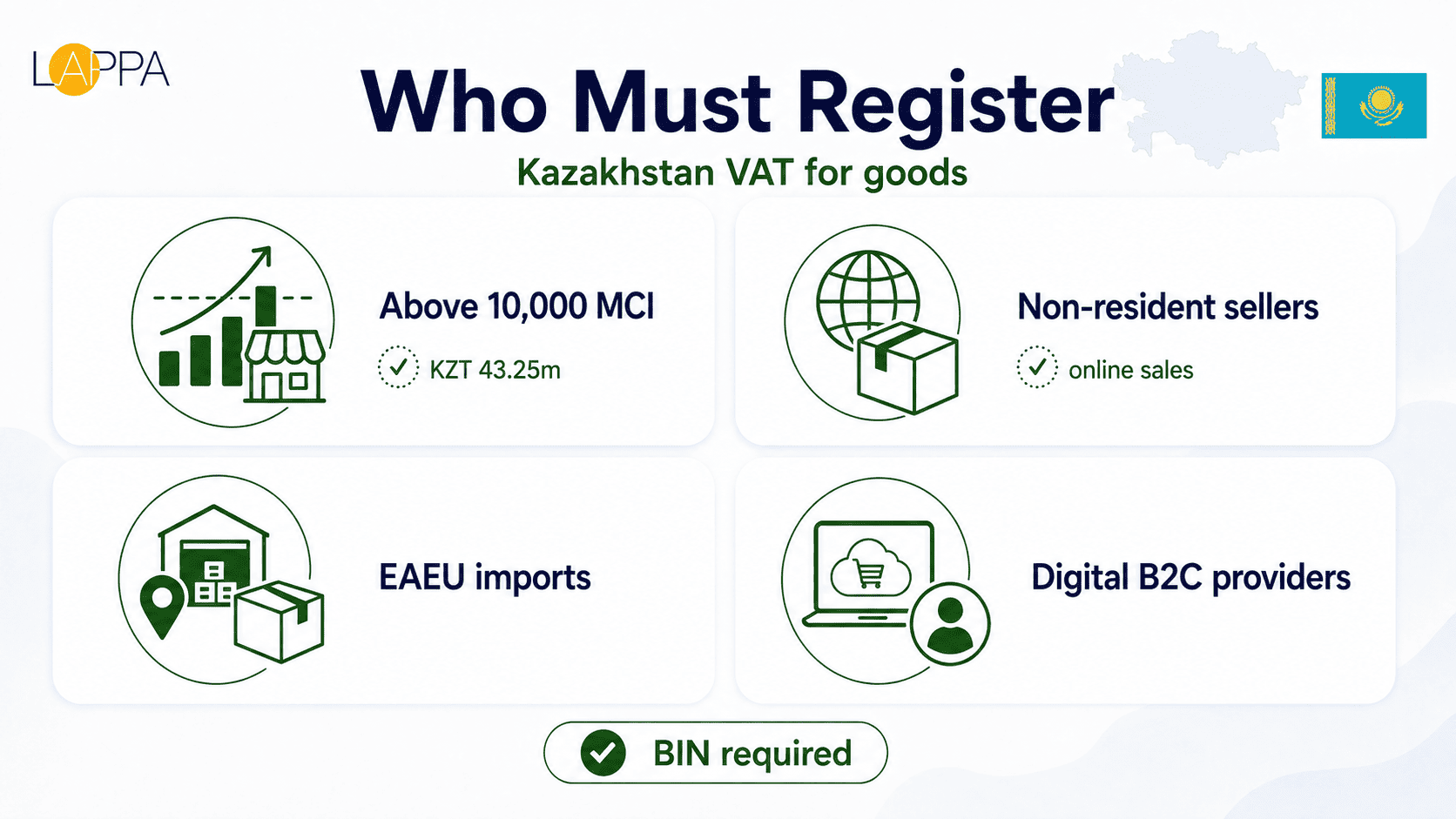
VAT Kazakhstan Obligations for Goods Operators
Levy registration is mandatory for:- Domestic operators whose taxable turnover in any rolling 12-month window reaches or looks likely to reach 20,000 MCI
- Businesses that choose to enroll voluntarily while still below the threshold
- Foreign businesses with a permanent establishment whose Kazakhstan-sourced turnover exceeds 20,000 MCI
- Foreign businesses without a permanent establishment that deliver taxable goods inside the country
- Importers of goods from non-EAEU countries, for whom the 12% levy is charged and collected at Customs clearance
VAT Number Kazakhstan — Format and Verification
The levy registration identifier used locally is the Business Identification Number (BIN) for legal entities or the Individual Identification Number (IIN) for sole traders. Both are 12-digit numeric identifiers assigned by the SRC at the time of entity incorporation — there is no separate levy registration number issued in addition. The BIN/IIN format: 12 consecutive digits (example: 180340020348). Levy enrollment adds the obligation to the existing BIN/IIN profile in the SRC registry; the number itself does not change. Every sale must be documented through the SRC's ESF portal — the supplier's BIN/IIN appears on each electronic invoice alongside the business name and address. Buyers run the supplier's BIN/IIN through taxpayer.gov.kz before forwarding any invoice for credit recovery; an inactive or non-registered BIN/IIN means the invoice fails at SRC desk audit and the credit is disallowed. The SRC's own data links each ESF invoice to its issuer's registration record, so discrepancies between a filed return and the ESF archive surface automatically. Kazakhstan's taxpayer identifier — the BIN/IIN — carries no visual signal of levy registration status; only the real-time registry lookup provides that confirmation.VAT Registration Procedure in Kazakhstan
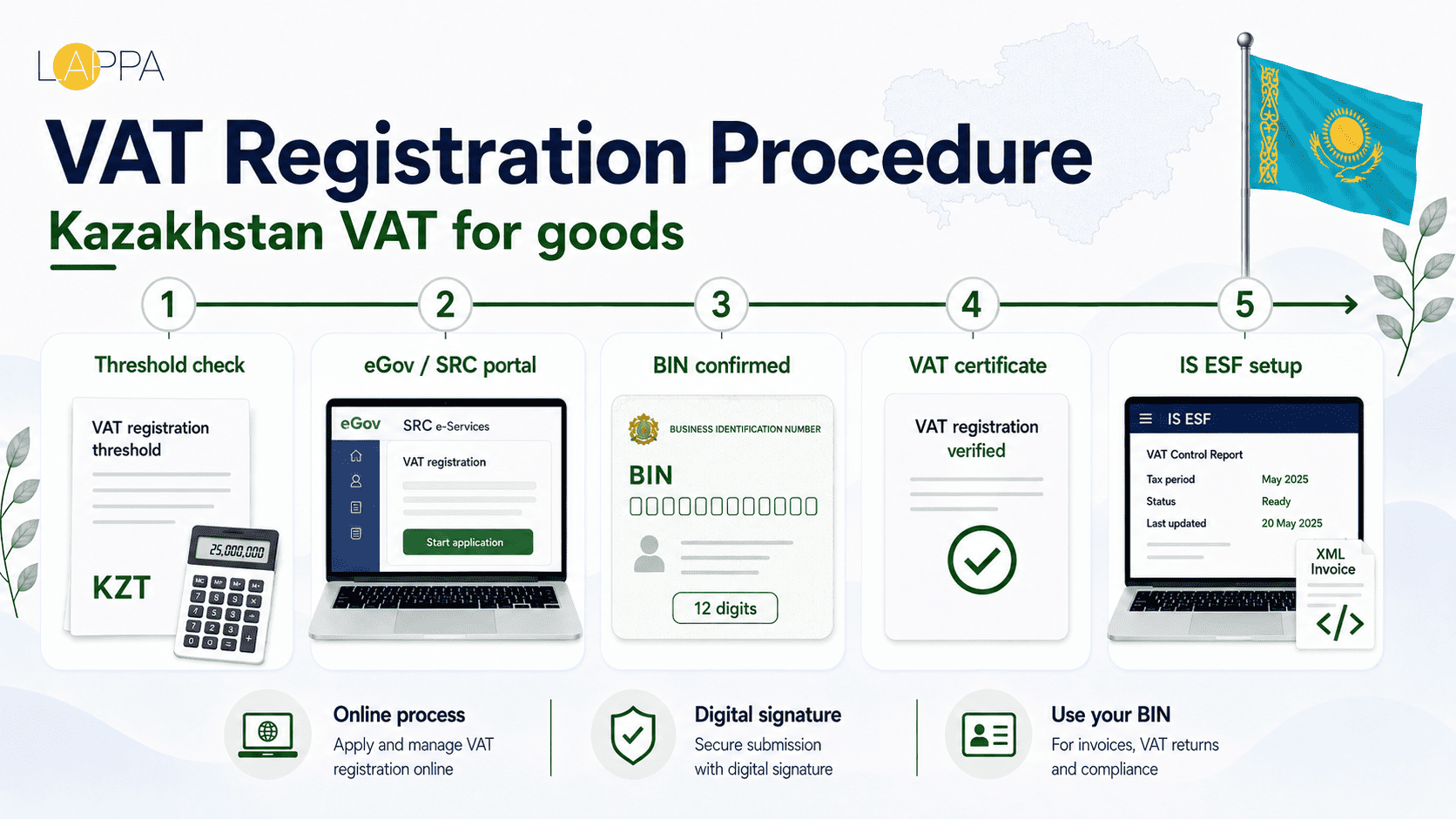 The Taxpayer Cabinet at cabinet.salyk.kz is where every enrollment application begins and ends. Locally incorporated businesses work through these steps:
- Access Taxpayer Cabinet with the entity's EDS (electronic digital signature)
- Open the Tax Obligations menu and add the levy obligation for goods activities
- State the taxable goods activity type, forecast annual turnover, and the date from which the levy obligation should start
- Wait for SRC confirmation — fully documented applications clear the queue within 3 business days
- Connect ESF portal access at esf.gov.kz to begin issuing electronic invoices — this second step sits outside the enrollment flow and must be completed before the first sale
Tax Representative in Kazakhstan
Any foreign business without a permanent establishment must have a locally registered tax representative in place before the SRC will open an enrollment file. That representative holds an active BIN, a working EDS, and a formal mandate letter from the overseas principal. The arrangement functions as an administrative proxy: quarterly return preparation, ESF invoice oversight, and all SRC written correspondence run through the representative rather than through the overseas entity directly. Filing errors attract penalties against the representative personally — not against the foreign principal. Joint liability for unpaid levy does not automatically attach to the representative the way it does in certain EU fiscal representative regimes. However, persistent errors or late filings can generate penalties reaching 300 MCI per incident. The representative mandate should be signed and the enrollment completed before the first shipment crosses any border into the country — the obligation cannot be set to begin earlier than the date the SRC processes the application.VAT E-Invoices in Kazakhstan
The country's Electronic Invoice system — ESF (Электронные счета-фактуры) — became compulsory for every registered business from the start of 2017. A paper invoice on its own carries no legal standing for levy purposes; each taxable supply needs an ESF generated through esf.gov.kz to satisfy both the seller's output reporting obligation and the buyer's input credit entitlement. Issuance windows depend on the type of transaction:- Goods sold domestically — ESF must be issued within 15 calendar days of the supply date
- EAEU imports — ESF must be issued by the 20th of the month following the import date, alongside the Form 328.00 declaration
- Non-EAEU imports — ESF issued upon customs clearance, reflecting the customs value and import duty paid
VAT Returns in Kazakhstan
All registered businesses file quarterly returns (Form 300.00). The deadline is the 15th day of the second month following the reporting quarter — Q1 (January–March) due May 15, Q2 due August 15, Q3 due November 15, Q4 due February 15. Payment falls on the same date. Four document types support the quarterly compliance cycle:- Form 300.00 (quarterly levy return) — the primary quarterly filing showing output levy charged on sales, input credits earned on purchases and imports, and the net levy owed to or by the SRC
- EAEU import declaration (Form 328.00) — filed separately by the 20th of the month following each EAEU import month; payment due simultaneously; not consolidated into Form 300.00
- ESF electronic invoice records — every e-invoice issued and received through the SRC's ESF portal during the quarter; the SRC cross-references these automatically against the Form 300.00 figures to detect discrepancies
- Customs clearance declarations (CD) — border clearance forms and levy payment receipts for non-EAEU shipments; each CD maps to a specific input credit line on Form 300.00
Deductible VAT in Kazakhstan
The recovery logic in Kazakhstan's system centres on use: what was purchased to generate a taxable sale creates a credit against that sale's output levy; what was purchased for an exempt activity or private withdrawal generates nothing. Where a single purchase served both taxable and exempt purposes, the SRC requires an apportionment calculation — the eligible portion of the credit must be documented. Specific blocked categories for goods operators:- Passenger vehicles: Input levy on passenger cars is not recoverable for most operators; goods-handling vehicles and trucks used in distribution qualify for full recovery
- Entertainment expenses: Levy on entertainment is blocked unless the documented connection to a specific taxable supply activity is clear
- Written-off or destroyed goods: Input levy previously recovered on goods subsequently written off or destroyed must be reversed — the operator repays through the quarterly return at the time of write-off
VAT Record Keeping Requirements in Kazakhstan
The Tax Code sets five years from the close of the tax period as the floor for document retention. Records held in ESF electronic format meet this requirement without the need for paper backup. A goods operator's minimum document set covers:- Every ESF document issued and received, with the reference linking it to the corresponding quarterly Form 300.00 line
- Customs clearance forms (CD) for each non-EAEU goods shipment that crossed the border
- Form 328.00 declarations and associated payment records for each month in which EAEU imports occurred
- Filed quarterly Form 300.00 returns together with the SRC payment receipts for each period
- Annual accounts that reconcile back to the figures declared in the quarterly levy returns
VAT Penalties in Kazakhstan
| Violation | Penalty | Notes |
| Failure to register above threshold | 50 to 300 MCI (~185,000–1,107,000 KZT) | Plus retrospective levy assessment from when registration was due |
| Late filing of quarterly Form 300.00 | 5 to 30 MCI per late return | Applies even on nil-balance returns; higher bracket for repeat offences |
| Late payment of levy | 1.25 × National Bank base rate, daily | Calculated from the due date on the outstanding balance |
| Failure to file Form 328.00 for EAEU imports | 30 to 100 MCI per missed filing | Separate from the quarterly return penalty; applies per import month missed |
| Issuing a non-compliant ESF | 2 to 10 MCI per incorrect invoice | Includes invoices issued outside the 15-day window or with incorrect data fields |
Kazakhstan VAT Compliance — How Lappa Can Help
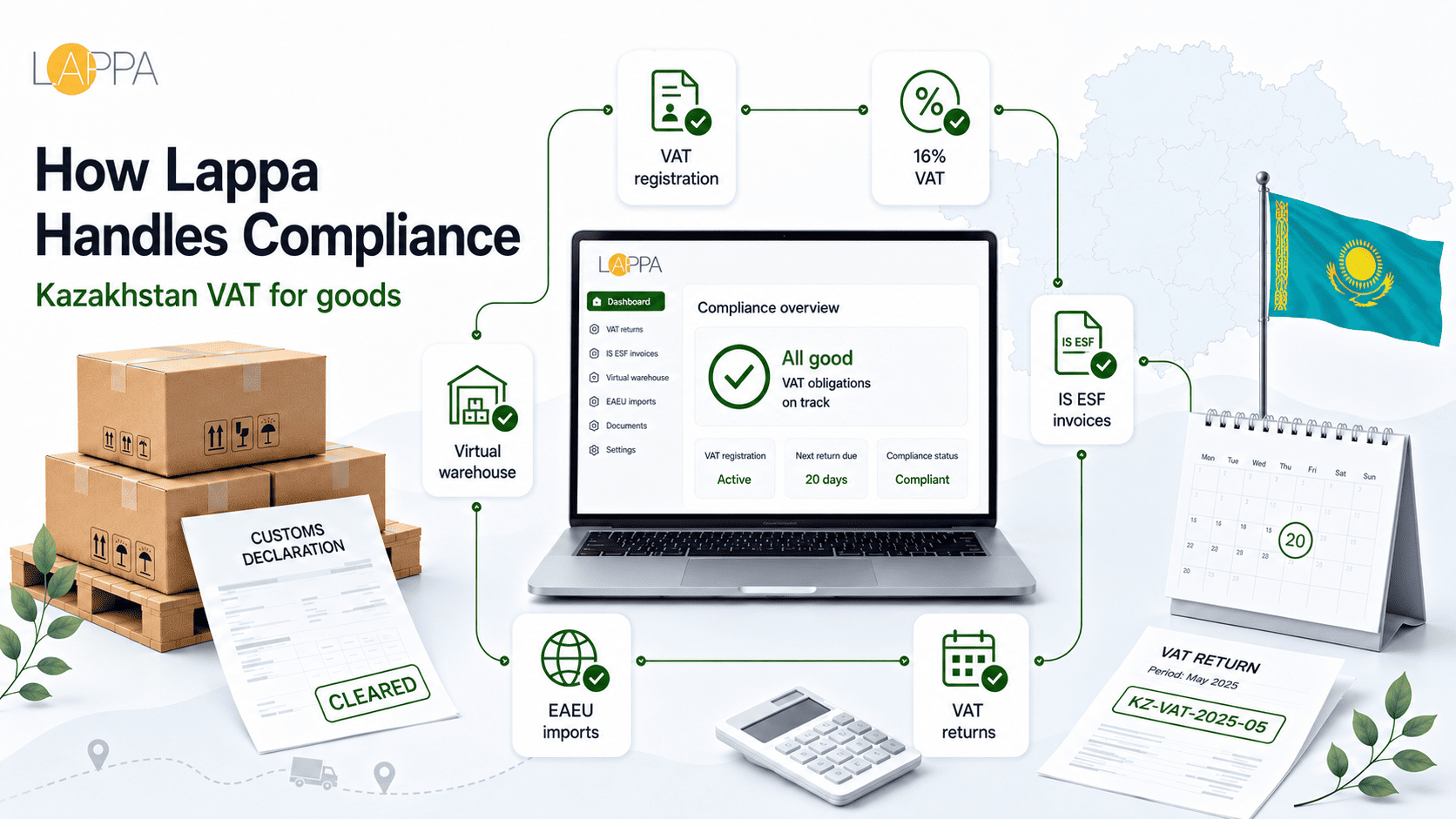 Goods compliance in this market means quarterly Form 300.00 filings across two import tracks (EAEU and non-EAEU), mandatory ESF invoice management, monthly Form 328.00 for EAEU importers, customs documentation reconciliation, and SRC desk audit responses. Lappa covers the full cycle from registration through ongoing quarterly obligations for Kazakhstan VAT compliance:
- SRC registration and ESF setup — handling the Taxpayer Cabinet application and activating ESF portal access for goods importers and manufacturers
- Quarterly Form 300.00 preparation and filing — reconciling ESF data, customs records, and EAEU import declarations before the 15th-of-second-month deadline
- Monthly Form 328.00 management — EAEU import self-assessment, payment coordination, and SRC filing
- Export zero-rate documentation — maintaining customs export records and ESF invoices substantiating 0% treatment on outbound goods
- Refund claim handling — preparing and submitting input levy refund applications with SRC-required documentation
FAQ for VAT Goods Kazakhstan
What is the VAT rate in Kazakhstan
The standard rate is 12%, applied to all taxable goods and services. There is no reduced rate tier. Exports and supplies to EAEU member states carry 0%. Exempt categories — financial instruments, certain medical goods, educational supplies — carry no levy and no input recovery right.Who needs VAT registration in Kazakhstan
Any business whose annual taxable turnover crosses 20,000 MCI in a rolling 12-month period — approximately 73,840,000 KZT or USD 150,000 in 2024. Voluntary registration below the threshold is available. Non-residents with a permanent establishment are treated the same as local businesses; those without one must appoint a tax representative.What is the VAT number format in Kazakhstan
The VAT number Kazakhstan is the entity's Business Identification Number (BIN) for companies — 12 consecutive numeric digits (example: 180340020348). Individual entrepreneurs use their 12-digit IIN. No separate levy registration number is issued. Buyers verify a supplier's VAT number Kazakhstan at taxpayer.gov.kz. Kazakhstan's taxpayer identifier — the BIN/IIN — appears on all ESF electronic invoices.What is the current VAT rate Kazakhstan
Current VAT rate Kazakhstan: 12% standard, applied uniformly since 2009. Zero rate applies to exports, EAEU cross-border goods, and qualifying international transport. The current VAT rate Kazakhstan has not changed through any Finance Act amendment since introduction. Kazakhstan's current levy rate is among the lowest in the post-Soviet region, sitting below Russia's 20% and Belarus's 20%.How often are VAT returns filed in Kazakhstan
Quarterly — Form 300.00 is due by the 15th of the second month following each quarter. For EAEU importers, Form 328.00 is filed separately by the 20th of each month following any month in which EAEU imports occurred. Both the filing and the payment fall on the same deadline date.VAT Calculator
VAT Standard rate
16%
VAT Reduced rate
5%,10%
Thresholds
From 1 January 2026, the registration threshold is 10,000 Monthly Calculation Indices, equal to KZT 43,250,000 for 2026.