


Cyprus VAT Registration Requirements Every Business Should Know
Provinces
Goods
Provinces
Goods
About
Goods
About
Goods
Goods
Goods
Introduction to VAT in Cyprus
The island's indirect tax framework dates to Law 95(I)/2000, enacted ahead of EU accession in 2004. The Tax Department administers the system under the Ministry of Finance. VAT in Cyprus works as a chain-wide charge: each enrolled operator collects it on outgoing sales, deducts it on inbound purchases, and remits the net gap to the authority quarterly. VAT Cyprus compliance is subject to threshold rules, enrollment mechanics and quarterly filing cycle. Miss one element and retroactive assessments stack up fast — the Tax Department cross-references intra-EU trade data against domestic enrollment records, so hidden exposures rarely stay hidden long. This guide covers physical goods only.Cyprus VAT Rates — Standard and Reduced
Four rate tiers plus a zero rate. The standard Cyprus VAT rate is 19% — if a product doesn't land on a specific reduced-rate schedule, 19% is the answer.| Rate | Category | Typical goods |
| 19% | Standard | Electronics, vehicles, clothing, construction materials, cosmetics, most imports, machinery |
| 9% | Reduced | Hotel accommodation (goods component), newspapers, restaurant food portion |
| 5% | Reduced | Basic foodstuffs, books, medicines, water supply, agricultural fertilizers, animal feed |
| 0% | Zero | Exports outside EU, intra-community supplies of goods, international transport |
VAT Threshold Cyprus — Registration Rules
For Local Businesses
The VAT threshold Cyprus sets at €15,600 in taxable turnover over any rolling 12-month period. Once an operator projects that threshold will be crossed, enrollment must happen in advance — the Tax Department does not permit backdating as a routine fix. Voluntary enrollment below the threshold is often worthwhile: operators importing goods pay the levy at customs on every shipment, and without enrollment that amount is unrecoverable. Once enrolled, it becomes an input credit. The VAT threshold Cyprus figure has held steady for several years, but confirm the current figure on the official portal before planning around it.For Remote Sellers Selling Goods
Overseas sellers dispatching into the island from other EU member states share the EU-wide €10,000 distance-selling threshold across all member states combined. Operators storing goods in local warehouses — including third-party fulfillment — trigger enrollment regardless of sales volume. Cyprus's VAT threshold protection does not extend to those holding local stock; they enroll from day one.Who Must Register for VAT in Cyprus
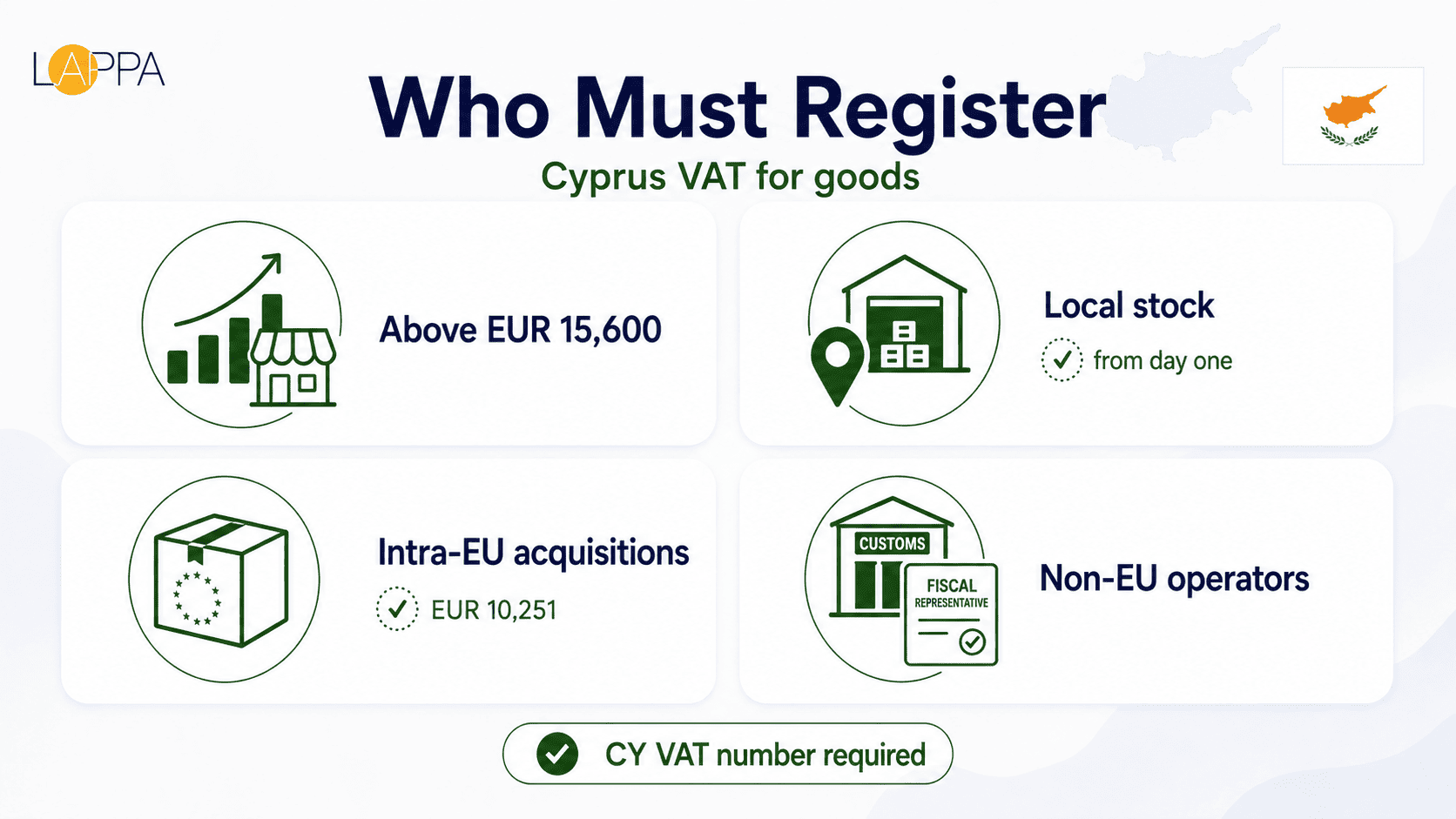 VAT registration Cyprus law makes enrollment mandatory for the following — no threshold protection covers several of them:
- Locally established operators whose taxable goods turnover exceeds €15,600 in any 12-month period
- Foreign firms storing goods in local warehouses or running a fixed establishment here, regardless of sales volume
- Any enterprise receiving intra-community acquisitions exceeding €10,251 in a calendar year from EU suppliers
- Operators of fiscal warehouses and customs warehouses moving goods into domestic circulation
VAT Number Cyprus — Format and Validation
Every enrolled entity receives a unique VAT number Cyprus in the format CY + 8 digits + 1 letter — for example, CY12345678L. Eleven characters total. This identifier appears on all commercial invoices, intra-community supply declarations, and Tax Department correspondence. Counterparty verification is available free via the EU VIES portal. A purchase invoice from a supplier with an invalid or lapsed number creates an immediate deduction problem regardless of how genuine the underlying transaction is. The VAT number Cyprus assigns ties to the legal entity, not to individual branches — a company running multiple warehouses under one structure uses a single number for all locations. Separate legal entities each need their own. The Cyprus VAT number format is distinct from the local TIN used for corporate income tax. The TIN starts with the same numeric sequence but lacks the CY prefix and letter suffix. Always use the full CY-prefixed format on invoices and EU trade declarations. Cyprus VAT numbers issued before EU accession in 2004 were reissued with the CY prefix at that point; the old format is no longer accepted.VAT Registration Procedure in Cyprus
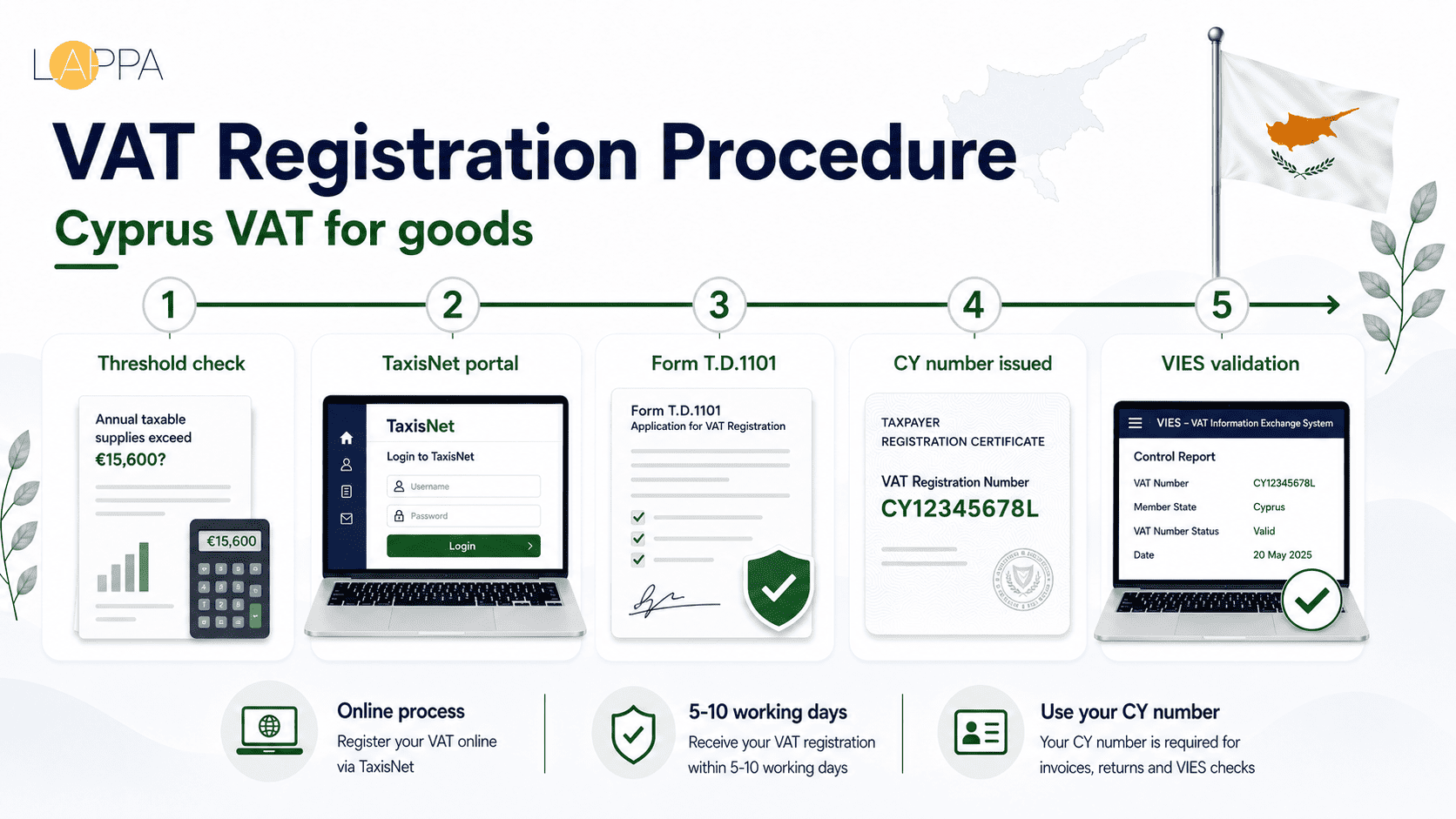 Enrollment runs through the Tax Department's TaxisNet portal (taxisnet.mof.gov.cy). For locally established entities, five steps:
- Create a TaxisNet account using the company's tax identification number
- Complete Form T.D.1101 — the enrollment application as a taxable person
- Upload supporting documents: certificate of incorporation, proof of taxable activity, bank account details
- For operators at or above threshold — include evidence of taxable supplies: contracts, invoices, customs documentation
- Receive the VAT Cyprus enrollment confirmation and assigned number, typically within 5–10 working days
Tax Representative in Cyprus
Non-EU operators must appoint an accredited local fiscal representative who assumes joint and several liability for the company's tax obligations. Finding a willing, qualified individual is a genuine precondition of enrollment — not a step to handle after registration is submitted. The representative must be a resident with a clean compliance record. Most accounting firms and tax advisors require a formal engagement letter, an indemnity from the foreign principal, and a financial guarantee covering two to three months of estimated liability before signing. EU-established operators are not required to appoint one, though many use a local agent voluntarily for authority queries and audit correspondence. The agent also ensures Cyprus VAT numbers appear correctly on all filings the entity issues.VAT E-Invoices in Cyprus
No mandatory B2B e-invoicing requirement currently exists in the island. Paper invoices remain fully valid, and there is no real-time transmission obligation. One exception: Directive 2014/55/EU requires public-sector entities to accept structured electronic invoices meeting EN 16931 — operators supplying government bodies must be capable of issuing them. For private B2B and B2C goods transactions, no such requirement exists. The Tax Department has flagged that mandatory e-invoicing may arrive as part of the EU's ViDA initiative, but no firm implementation date for the island has been confirmed.VAT Returns in Cyprus
Most enrolled operators file quarterly on Form T.D.4. Large taxpayers designated by the Tax Department file monthly. The deadline is the 10th of the month following the reporting period — a Q1 return falls due April 10. Three reporting streams run in parallel for operators with intra-EU goods activity:| Report | Who files | Frequency | Deadline |
| Form T.D.4 | All enrolled operators | Quarterly (large: monthly) | 10th of following month |
| EC Sales List (T.D.8) | Operators making intra-EU supplies | Quarterly | 15th of month following quarter |
| Intrastat Declaration | Operators exceeding arrival/dispatch thresholds | Monthly | 26th of following month |
Deductible VAT in Cyprus
Input credits are recoverable when goods or services purchased feed into taxable outputs. The recovery right activates on receipt of a valid tax invoice. There are three key restrictions for goods operators:- Passenger cars: Input tax credits on purchase, lease and running costs are completely blocked, regardless of whether the car is used for business purposes. Vans, trucks and forklifts are usually eligible for full recovery
- Entertainment costs: The tax on food, drink and accommodation for hospitality purposes is not recoverable
- Partially exempt operators: Entities with a mix of taxable and exempt outputs are required to carry out a partial exemption calculation — only the taxable proportion of input tax credits is recoverable
VAT Record Keeping Requirements in Cyprus
Six years from the end of the relevant tax year — that is the statutory minimum retention window. Paper and electronic formats both work, provided records can be produced on demand. What a goods operator must hold:- All issued and received invoices — sales invoices, purchase invoices, credit notes, debit notes
- Import documentation — customs entry declarations (SADs), bills of lading, packing lists, certificates of origin
- Export documentation — customs declarations, transport documents, proof of receipt outside the EU
- Quarterly T.D.4 returns and payment receipts for every filed period
- EC Sales List submissions and Intrastat declarations where applicable
- Inventory and stock movement logs for input-output reconciliations
VAT Penalties in Cyprus
Late filings, non-enrollment, underpayments, and evasion each sit in their own penalty bracket — and when several occur in the same audit period, the total exposure stacks.| Violation | Penalty | Notes |
| Late filing of T.D.4 | €51 per return | Flat fee, hits even nil returns |
| Late payment | 10% of unpaid amount | Kicks in the day after the deadline |
| Late payment interest | ~3.5% per annum | Accrues on top of the 10% surcharge |
| Non-enrollment penalty | Up to €8,543 | Discretionary; retroactive assessment on top |
| Negligent underpayment | 10% surcharge | Identified in review or audit |
| Evasion / fraud | Up to 3× evaded tax + prosecution | Serious cases go to the Attorney General |
Cyprus VAT Advice and Compliance from Lappa
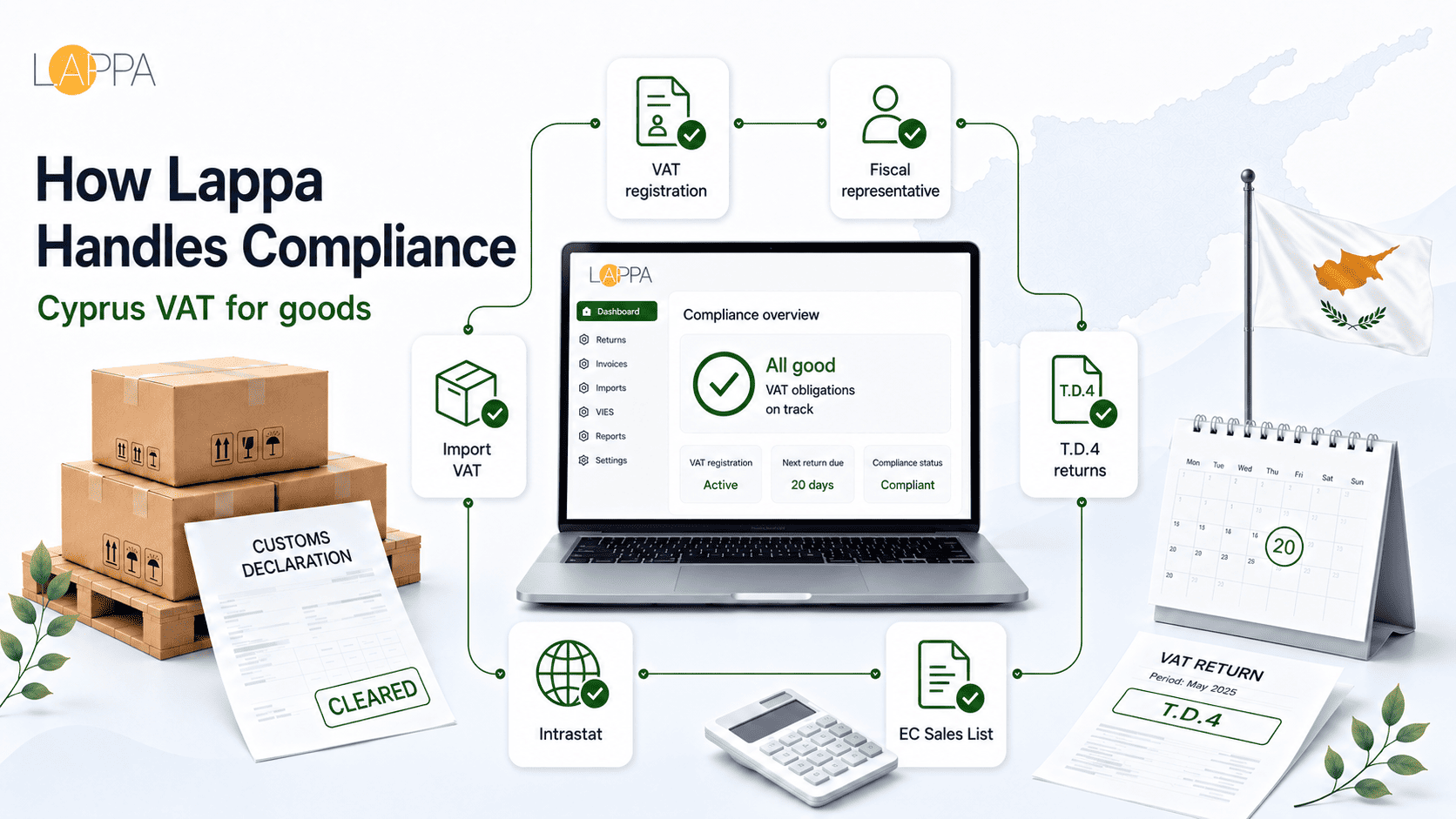 Running goods compliance in the island means quarterly returns, EC Sales Lists, potential Intrastat filings, and a customs stream that must align with Tax Department records — against a backdrop where the authority actively cross-checks EU trade data. Lappa provides Cyprus VAT advice and compliance support across the full cycle: initial enrollment, return preparation and submission, EC Sales List management, and Intrastat filing where applicable. For non-EU operators that need a fiscal representative before enrollment can proceed, Lappa coordinates that appointment and handles the guarantee requirements.
Where Lappa adds specific value for goods operators:
Running goods compliance in the island means quarterly returns, EC Sales Lists, potential Intrastat filings, and a customs stream that must align with Tax Department records — against a backdrop where the authority actively cross-checks EU trade data. Lappa provides Cyprus VAT advice and compliance support across the full cycle: initial enrollment, return preparation and submission, EC Sales List management, and Intrastat filing where applicable. For non-EU operators that need a fiscal representative before enrollment can proceed, Lappa coordinates that appointment and handles the guarantee requirements.
Where Lappa adds specific value for goods operators:
- HS code rate review — verifying that product classifications map to the correct levy rate before they cause problems on import documentation or customer invoices
- Export zero-rate documentation — building and archiving the customs and transport evidence the Tax Department needs to approve zero-rate treatment on outbound shipments
- Input credit recovery — managing the refund claim process and authority review correspondence for exporters holding consistent credit positions
- Audit response — formal replies to Tax Department reviews, document packages, and exchange management through to resolution
FAQ for Cyprus VAT Goods
What are the VAT Rates Cyprus Applies
- The standard Cyprus VAT rate is 19%, covering most commercial goods — electronics, vehicles, construction materials, general imports. Reduced rates of 9% and 5% cover specific categories — newspapers and some accommodation at 9%, basic foodstuffs, books, medicines, and agricultural inputs at 5%. Exports and intra-community supplies carry 0%. The Cyprus VAT rate structure has held steady for several years, though the authority reviews reduced-rate schedules periodically.
VAT Registration Cyprus — Who Must Apply
- Locally established operators exceeding €15,600 in taxable turnover over any 12-month period must enroll. Overseas firms storing goods locally enroll regardless of sales volume. Entities receiving intra-community acquisitions above €10,251 annually must also enroll. Voluntary enrollment is available below the threshold and is typically worthwhile for importers. VAT registration Cyprus requirements follow the activity, not the entity's country of incorporation.
What is the Cyprus VAT Number Format
- The Cyprus VAT number follows the format CY + 8 digits + 1 letter — CY12345678L for example — giving eleven characters in total. The VAT number Cyprus issues is distinct from the corporate TIN; always use the CY-prefixed format on invoices and EU declarations. Counterparty verification is free through the EU VIES portal.
What is the VAT Threshold in Cyprus
- The VAT threshold Cyprus applies is €15,600 in taxable turnover over any rolling 12-month period for locally established operators. No threshold protects overseas firms storing goods locally — they enroll from day one. EU distance sellers share the EU-wide €10,000 combined threshold. Cyprus's VAT threshold for intra-community acquisitions is €10,251 per calendar year.
How Often Are VAT Returns Filed in Cyprus
- Most operators file quarterly on Form T.D.4, due by the 10th of the following month. Large taxpayers file monthly on the same deadline. Cyprus VAT filers with intra-EU supplies also submit quarterly EC Sales Lists by the 15th of the following month, and monthly Intrastat declarations where thresholds are met. Cyprus VAT refund positions are processed against the quarterly return.
VAT Calculator
[Calculator Component]
VAT Standard rate
19%
VAT Reduced rate
9%, 5%, 3%, 0%
Thresholds
€15,600 (resident businesses); €0 (non-resident businesses); €10,000 EU OSS threshold for cross-border B2C sales