


Bosnia and Herzegovina VAT Compliance and Registration Guide
Provinces
Goods
Provinces
Goods
About
Goods
About
Goods
Goods
Goods
Introduction to Bosnia and Herzegovina VAT
VAT Bosnia and Herzegovina runs through a single federal framework — which surprises many practitioners given how fragmented the country's administrative structure is. Bosnia and Herzegovina has two entities: the Federation of Bosnia and Herzegovina and Republika Srpska. Then there is the Brčko District on top. Three separate administrations, yet indirect taxation sits entirely at state level. That centralisation was deliberate when the system was built. The Law on Value Added Tax was adopted in 2003 and came into force on 1 January 2006, replacing a patchwork of entity-level sales taxes that had made cross-border trade within BiH needlessly complicated. The Indirect Taxation Authority — Uprava za indirektno oporezivanje, or UIO, also referred to as ITA — has administered the levy from day one. Headquarters are in Banja Luka; regional offices cover Sarajevo, Mostar, Tuzla, and Doboj. What distinguishes Bosnia and Herzegovina VAT from most European systems is non-EU status. No OSS. No VIES. No intra-Community supply rules. Everything — registration, verification, filing, correspondence — runs through the ITA's own systems. Foreign businesses accustomed to EU compliance frameworks often underestimate how different the practical mechanics are here.Bosnia and Herzegovina VAT Rate 17%
Bosnia and Herzegovina VAT Rate 17% — Official Legal Basis
The Bosnia and Herzegovina VAT rate 17% is a flat rate with no carve-outs. No reduced band for food. No exemption for medicines. No special category for children's goods or educational materials. Everything taxable carries the same 17% charge — that is the Bosnia and Herzegovina VAT rate 17% official position, established in the original 2003 legislation and unchanged since. That single-rate design was a conscious policy choice. The drafters wanted a system simple enough to administer across a fragmented public administration, and rate differentiation would have added complexity neither entity was prepared to manage at launch. The Bosnia and Herzegovina VAT rate 17% official framework has remained intact through two decades of political turbulence, which itself says something about how embedded the structure has become.| Category | Rate | Notes |
| Standard goods and services | 17% | All taxable supplies without exception |
| Food and beverages | 17% | No reduced rate applies |
| Medicines and medical equipment | 17% | No blanket exemption |
| Digital and electronic services | 17% | Applies to non-resident suppliers |
| Exports outside BiH | 0% | Zero-rated; input credit recoverable |
VAT Registration Threshold in Bosnia and Herzegovina
Threshold for Domestic Businesses
Domestic entities hit a registration obligation once annual taxable turnover exceeds 50,000 BAM. The Bosnian Convertible Mark is pegged to the euro at 1 EUR = 1.95583 BAM — a fixed rate that has held since 1997 — so 50,000 BAM works out to roughly €25,600. Once that figure is crossed in any rolling 12-month period, registration must be completed within 15 days. Not from year end. From the moment the threshold breaks. Voluntary registration below 50,000 BAM is available. The trade-off is straightforward: register early and gain input credit recovery, but take on monthly filing obligations from day one.Threshold for Non-Resident Businesses
Foreign companies get no equivalent relief. There is no de minimis threshold, no wait-and-see period, no EU-style €10,000 distance selling allowance. A non-resident entity making taxable supplies on Bosnian territory — goods physically here, services performed here, digital products delivered to local consumers — must register before the first such supply. The obligation is pre-emptive, not retroactive.Who Must Register for VAT in Bosnia and Herzegovina
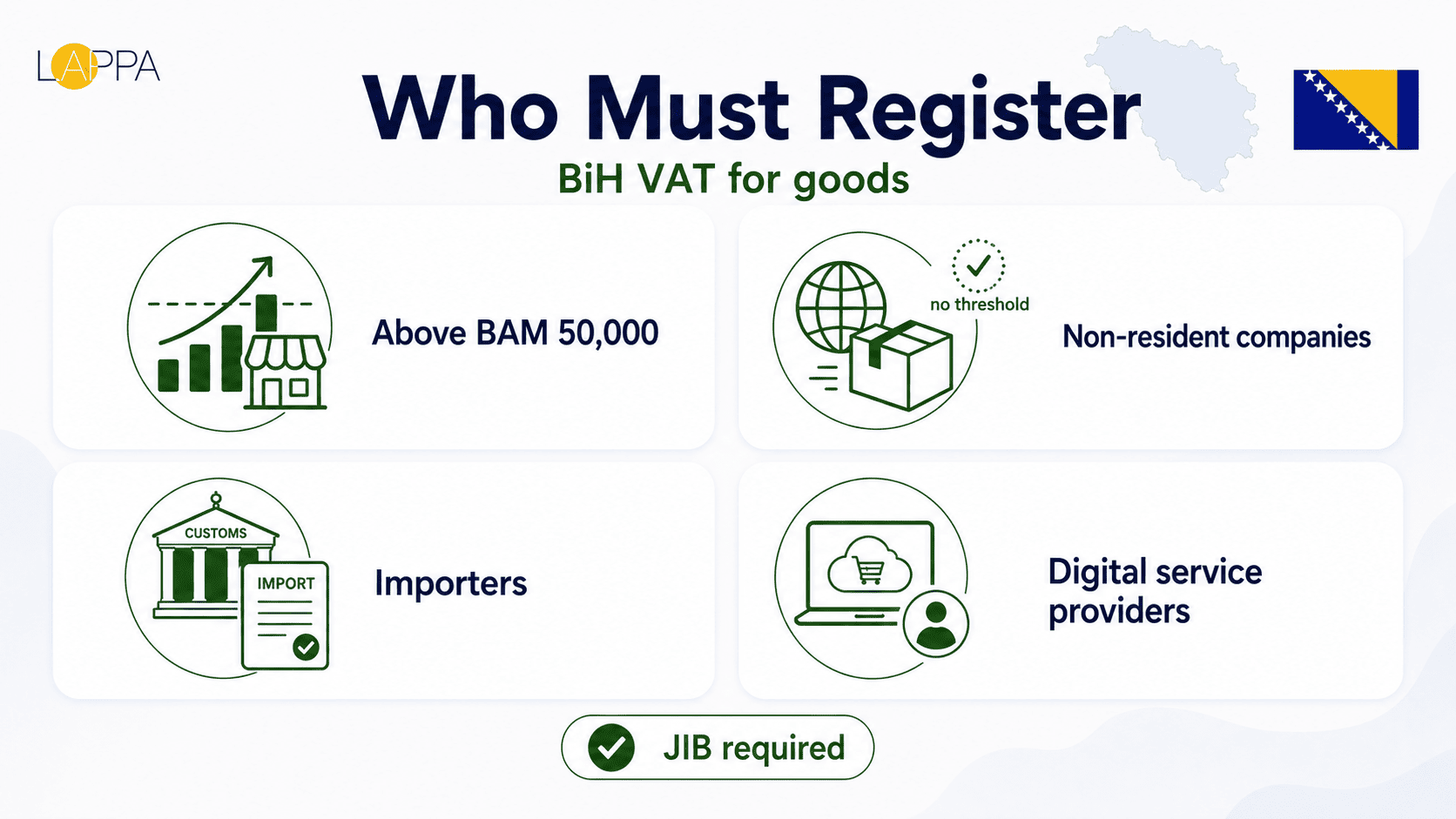 Registration under the Bosnian indirect tax system is mandatory for the following:
- Domestic taxable persons: Domestic taxable persons
- Non-resident foreign companies: Non-resident foreign companies
- Importers: Importers
- Digital service providers: Digital service providers
| Criterion | Domestic Company | EU-Established | Non-EU Established |
| Turnover threshold | 50,000 BAM | No threshold | No threshold |
| Fiscal representative | Not required | Required | Mandatory |
| Pre-registration | No | Before first supply | Before first supply |
| Filing currency | BAM | BAM | BAM |
VAT Number Bosnia and Herzegovina
Bosnia and Herzegovina VAT Number Format
Registration produces a VAT number Bosnia and Herzegovina in the form of the JIB — Jedinstveni Identifikacioni Broj, the Unique Identification Number. The Bosnia and Herzegovina VAT number format is 13 consecutive digits. No letters. No dashes. No country code prefix. BiH sits outside the EU tax system, so there is no "BA" equivalent to the "DE" or "FR" prefixes used in EU member states. Structure: the first digit is 4 for legal entities. Digits 2 through 12 carry the unique identifier assigned during registration. Digit 13 is a check digit, calculated algorithmically from the preceding 12. A valid example: 4300000000005. Verification of any VAT number Bosnia and Herzegovina runs through the ITA's online taxpayer portal at uino.gov.ba. That is the authoritative lookup — there is no VIES or equivalent EU-wide registry for Bosnian registrations. Anyone conducting due diligence on a Bosnian counterparty should use the UIO portal directly. The JIB does double duty as both the company's enterprise registration number and its tax identifier. Foreign companies that go through the registration process receive a JIB issued by the ITA, together with a formal PDV certificate — PDV standing for porez na dodatu vrijednost, the Bosnian term for the levy.VAT Registration Procedure in Bosnia and Herzegovina
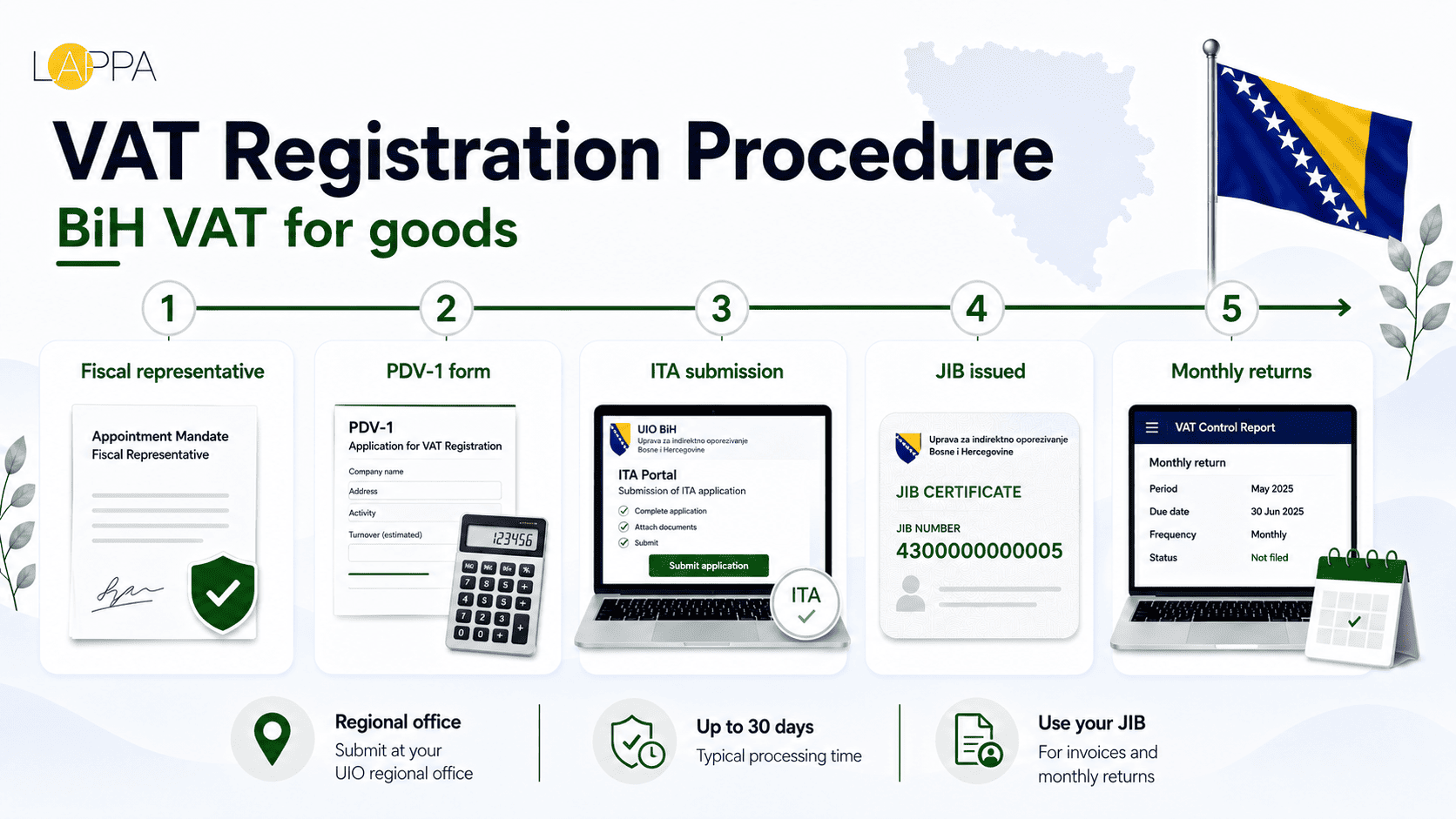
Step-by-Step Process for Foreign Companies
- Step 1 — Appoint a fiscal representative. Appoint a fiscal representative first.
- Step 2 — Prepare the registration file. Prepare the registration file.
- Completed Obrazac PDV-1 registration form
- Certificate of incorporation — apostilled, with certified translation into Bosnian, Croatian, or Serbian
- Proof of the company's registered address in its home jurisdiction
- Written description of the taxable activities planned in Bosnia and Herzegovina
- Sample invoice, purchase order, or contract showing the intended supply
- Signed mandate from the fiscal representative
- The representative's own ITA registration proof
- Step 3 — Submit and wait. Submit and wait.
- Step 4 — Receive JIB and PDV certificate. Receive JIB and PDV certificate.
Fiscal Representative Requirements in Bosnia and Herzegovina
Every non-resident registering for VAT Bosnia and Herzegovina needs a local fiscal representative. Not recommended — required. The representative must be a Bosnian-incorporated entity. They handle returns, correspondence with the ITA, and payment coordination on behalf of the foreign registrant. One distinction worth understanding: the Bosnian fiscal representative does not carry the same joint and several liability that, say, a Belgian fiscal representative does. The primary tax liability stays with the foreign company as the registered taxpayer. What the ITA does hold the representative to is administrative performance — late returns, missing declarations, procedural gaps. A representative who fails on those fronts will hear from the ITA directly. Choosing someone with active accreditation and genuine BiH compliance experience is not a formality.VAT Returns and Filing Obligations
Monthly Filing Cycle
Everything is monthly under Bosnia and Herzegovina VAT. No quarterly option exists. Returns are due by the last day of the month following the reporting period — January's return is due by the end of February, February's by the end of March, and so on. Payment falls due on the same deadline as the return. Form PDV-1 covers four things:- Output tax — the full charge on all taxable supplies made during the month
- Input credit — recoverable tax on eligible purchases and imports
- Net position — the difference, either payable or refundable
- Export summary — zero-rated supplies listed separately
Annual Obligation
No separate annual return exists in BiH. Twelve monthly PDV-1 filings complete the periodic obligation for a calendar year. The ITA does run annual reconciliation reviews, and it can request supporting documents for any monthly period that falls within the audit window — which is not limited to the most recent year.Input VAT Deduction in Bosnia and Herzegovina
Right to Recover Input Credit
Registered taxable persons recover input tax on purchases used for taxable business activity. Three conditions must all hold:- The purchase is used for taxable — not exempt — purposes
- The supplier issued a valid PDV invoice in the ITA-prescribed format
- The registrant holds the original invoice when the deduction is claimed
Non-Deductible Categories
Several categories are blocked regardless of how the purchase is used. Entertainment costs sit outside recovery entirely. Personal vehicle expenses above ITA-defined limits are blocked. Accommodation and meal costs for owners or employees beyond what the ITA guidelines permit are also excluded. The BiH Law on VAT sets out the blocked list; the ITA supplements it with periodic guidance notes.VAT Penalties in Bosnia and Herzegovina
Penalties under the Law on VAT and the Law on Tax Procedure cover the following:- Late filing: Late filing:
- Late payment: Late payment:
- Errors and understatements: Errors and understatements:
- Fraud and deliberate evasion: Fraud and deliberate evasion:
- Operating without registration: Operating without registration:
How Lappa Can Help with VAT Compliance in Bosnia and Herzegovina
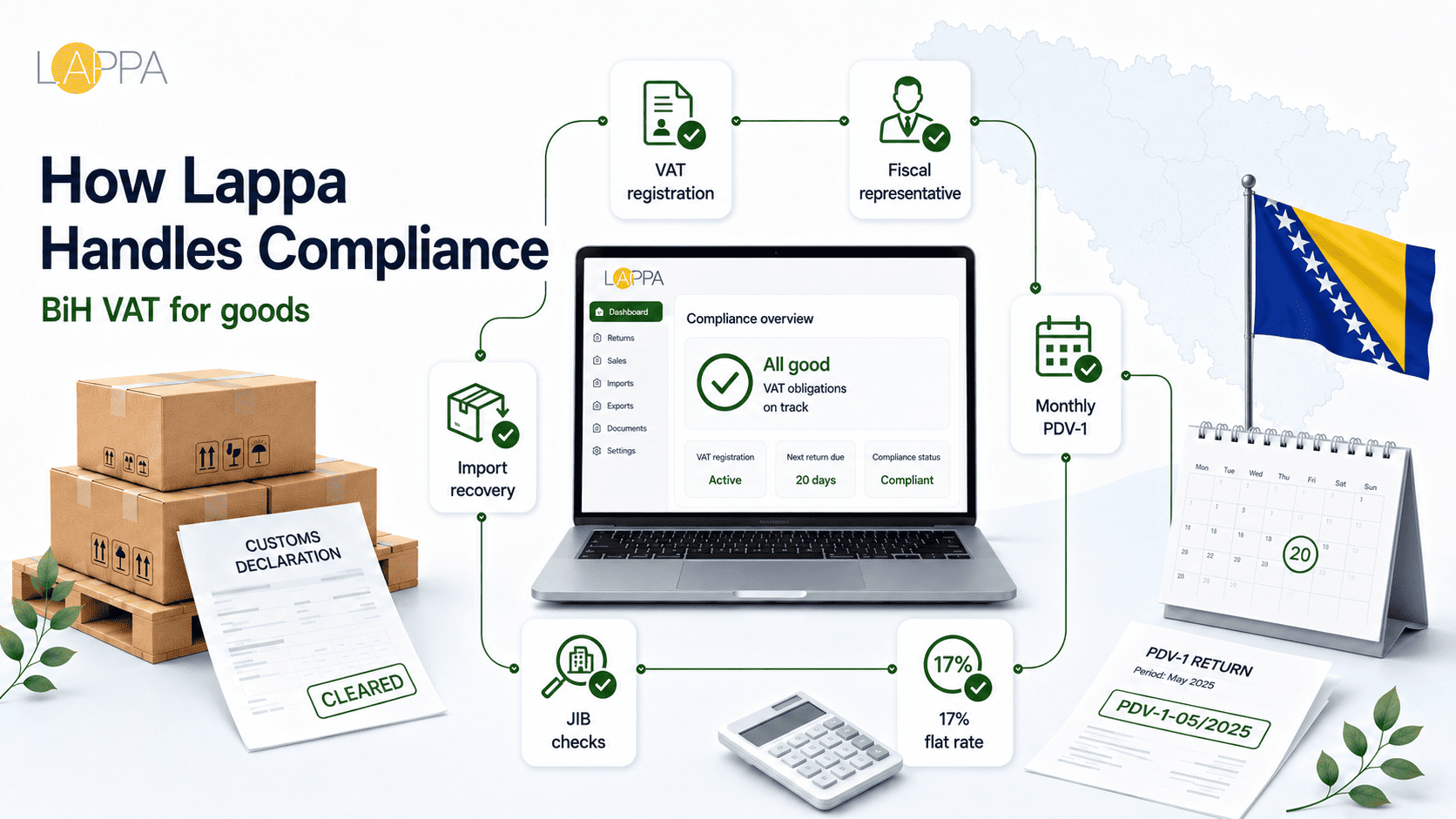 Lappa (formerly Lovat) provides indirect tax services for foreign businesses with Bosnian registration and filing obligations:
- VAT registration in Bosnia and Herzegovina — full application coordination including document preparation, apostille guidance, translation management, and ITA liaison through an established representative network.
- Fiscal representation — Lappa arranges or directly provides fiscal representative services, with a qualified Bosnian-incorporated entity in place before registration proceeds.
- Monthly PDV-1 return preparation and filing — returns prepared, reviewed, and submitted to the ITA each month with BAM payment coordination.
- Import tax recovery — assistance identifying and claiming recoverable input credit on goods entering BiH through Bosnian customs.
- Compliance advisory — supply classification, place of supply analysis for cross-border services, and blocked input category assessments.
FAQ for Bosnia and Herzegovina VAT Goods
What is the VAT rate in Bosnia and Herzegovina
- A single flat Bosnia and Herzegovina VAT rate 17% applies to all taxable goods and services without exception. No reduced rate exists for food, medicines, books, or digital services. The Bosnia and Herzegovina VAT rate 17% official position has been unchanged since the system launched in 2006. The only departure from 17% is the zero rate on exports of goods outside the country.
What is the VAT number Bosnia and Herzegovina format
- The VAT number Bosnia and Herzegovina is a 13-digit numeric code — the JIB (Jedinstveni Identifikacioni Broj). The Bosnia and Herzegovina VAT number format carries no country prefix letters; it starts with digit 4 for legal entities and ends with a check digit. Example: 4300000000005. Verification is through the ITA's portal at uino.gov.ba.
Who needs to register for VAT Bosnia and Herzegovina
Domestic businesses with annual turnover above 50,000 BAM must register. All non-resident foreign companies making taxable supplies on Bosnian territory must register before their first supply — no minimum threshold applies. Importers and B2C digital service providers are also in scope. VAT Bosnia and Herzegovina registration for non-resident entities requires a locally based fiscal representative to be in place before the application is filed.How often are returns filed under Bosnia and Herzegovina VAT
Monthly — no exceptions. All entities registered for Bosnia and Herzegovina VAT file Form PDV-1 by the last day of the month following the reporting period. No quarterly filing option is available, and there is no separate annual return. Payment is due on the same date as the return.What documents are required for VAT registration in Bosnia and Herzegovina
Foreign companies registering for VAT Bosnia and Herzegovina must submit the following to the ITA:- Completed Obrazac PDV-1 registration form
- Certificate of incorporation from the home country — apostilled and translated into Bosnian, Croatian, or Serbian by a certified translator
- Proof of the company's registered address in its home jurisdiction
- Description of the taxable activities to be conducted on Bosnian territory
- Sample invoice, contract, or purchase order evidencing the intended supply
- Signed mandate from the appointed fiscal representative
- Proof of the fiscal representative's own ITA registration
VAT Standard rate
17%
VAT Reduced rate
0% (zero-rated exports only)
Thresholds
BAM 100,000 annual taxable turnover (mandatory VAT registration)