


Jersey VAT Registration and Compliance Guide
The local name for VAT in Jersey is Goods and Services Tax (GST).
Provinces
Goods
Provinces
Goods
About
Goods
About
Goods
Goods
Goods
Introduction to VAT in Jersey
Search for "Jersey VAT" and two distinct problems collapse into one search bar. The first is practical: UK and EU businesses supplying goods to this island want to know exactly how the local consumption tax system works. The second is conceptual: the island has no value-added tax at all in the strict sense — it operates a Goods and Services Tax (the levy) instead. VAT in Jersey is what importers and exporters colloquially call the local indirect tax system, and this guide uses that terminology throughout. The actual levy — Jersey GST — was introduced in May 2008, sits at a flat 5%, and is administered by the authority — the island's tax authority. This guide covers physical goods only. The island is a Crown Dependency — not part of the UK, EU, or EU Customs Union. UK businesses exporting goods here zero-rate their UK VAT; the island charges its own levy on arrival. Jersey's GST rules are entirely separate from UK VAT legislation — assuming UK rules extend here creates compliance problems.Jersey UK VAT Rate — The GST System Explained
The Jersey UK VAT comparison starts from a fundamental difference: the UK operates VAT at 20% standard rate, while the island operates a simpler levy at 5% flat with no reduced tier. A transaction can attract UK VAT rules on the supply side and the local levy on the import side simultaneously.| Feature | Jersey GST | UK VAT |
| Rate | 5% standard (no reduced rate) | 20% standard, 5% reduced, 0% zero-rated |
| Registration threshold | GBP 300,000 annual turnover | GBP 90,000 annual turnover |
| Authority | Revenue Jersey | HM Revenue & Customs (HMRC) |
| Filing frequency | Quarterly (default) | Quarterly (default) |
| Part of UK VAT territory | No | Yes |
| Part of EU VAT territory | No | No (since 2021) |
VAT Registration Threshold in Jersey
For Local Businesses
The registration trigger for island-established businesses sits at GBP 300,000 annual taxable turnover — more than triple the UK's GBP 90,000 VAT threshold. Many businesses trading at UK VAT scale never approach the local obligation. Voluntary registration below GBP 300,000 is commercially sensible for importers. Every shipment cleared at Customs generates the levy at 5% — without registration that charge is a sunk cost, not a recoverable credit.For Remote Sellers Selling Goods
UK and EU businesses selling goods into the island face a different framework. The authority has introduced an obligation for overseas businesses supplying goods directly to local consumers to register once their supplies exceed a specified annual threshold — revised as the island has closed the gap left by abolition of Low Value Consignment Relief (LVCR). LVCR historically exempted low-value goods. That regime ended for UK-bound shipments in 2012 and has since been phased out for island-destined goods too. Operators that relied on LVCR need to reassess.Who Must Register for VAT in Jersey
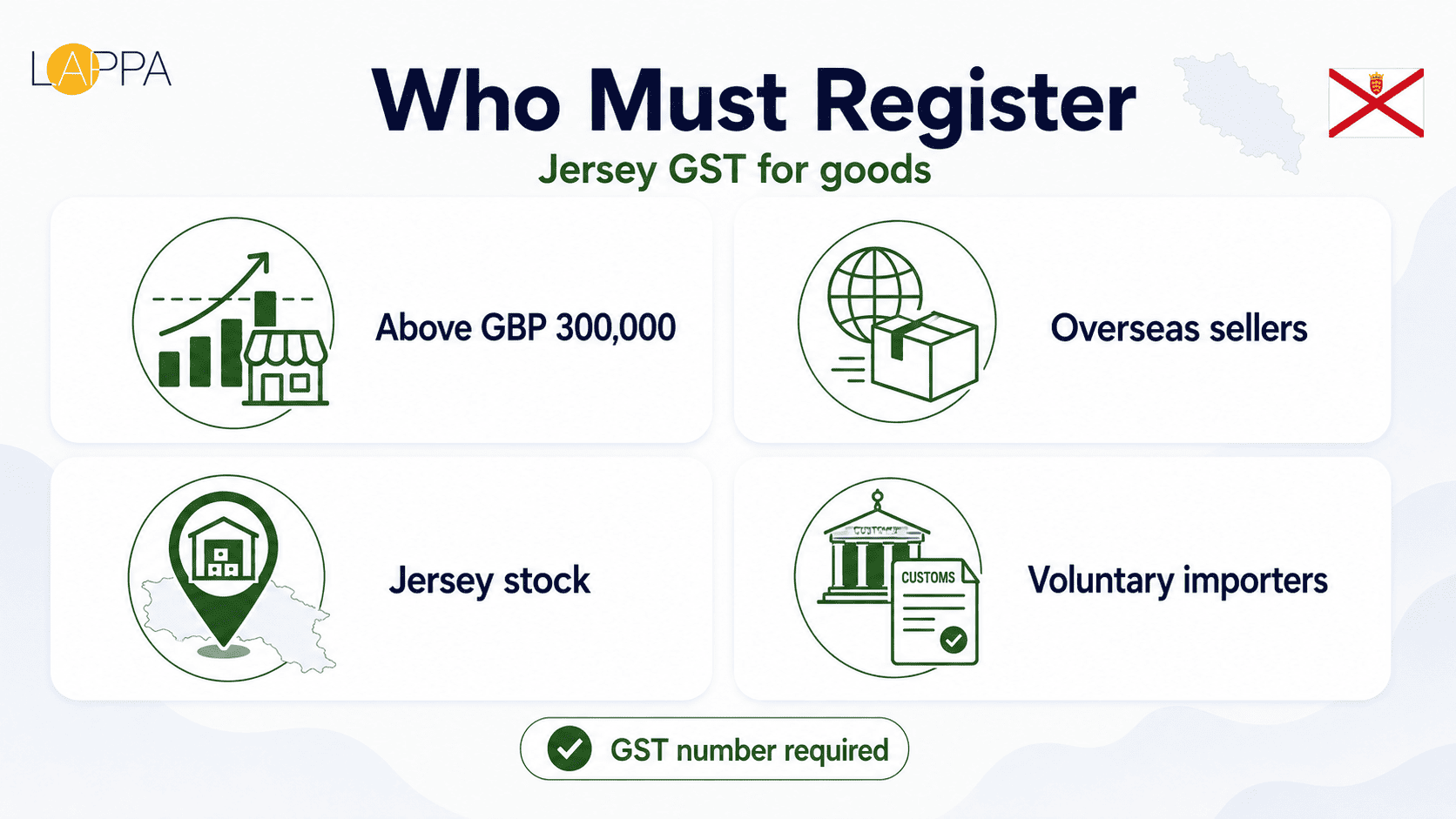 Levy registration is required for these categories:
- Locally established businesses with annual taxable turnover above GBP 300,000
- Overseas businesses supplying goods directly to local consumers above the applicable overseas trader threshold
- Any business voluntarily applying below the threshold to recover import levy
- Businesses with goods in local warehouses or any fixed establishment here
VAT Number in the island
Registered businesses receive a levy registration number from the authority. It appears on all levy-compliant invoices issued to customers. Unlike UK or EU VAT number formats, the island uses its own Business Registration Number (BRN) system — a 6-digit number from the Jersey Financial Services Commission that Revenue Jersey uses as the basis for the levy registration identifier. For UK businesses that also hold a local levy registration, the two numbers are entirely separate — the UK VAT number has no standing locally and vice versa. Buyers on the island verify supplier GST registration through Revenue Jersey directly. An invoice from an unregistered supplier cannot support an input credit claim regardless of whether the supplier informally charged the levy. Check counterparty registration status through Revenue Jersey's online services before processing supplier invoices for input credit purposes.VAT Registration Procedure in the island
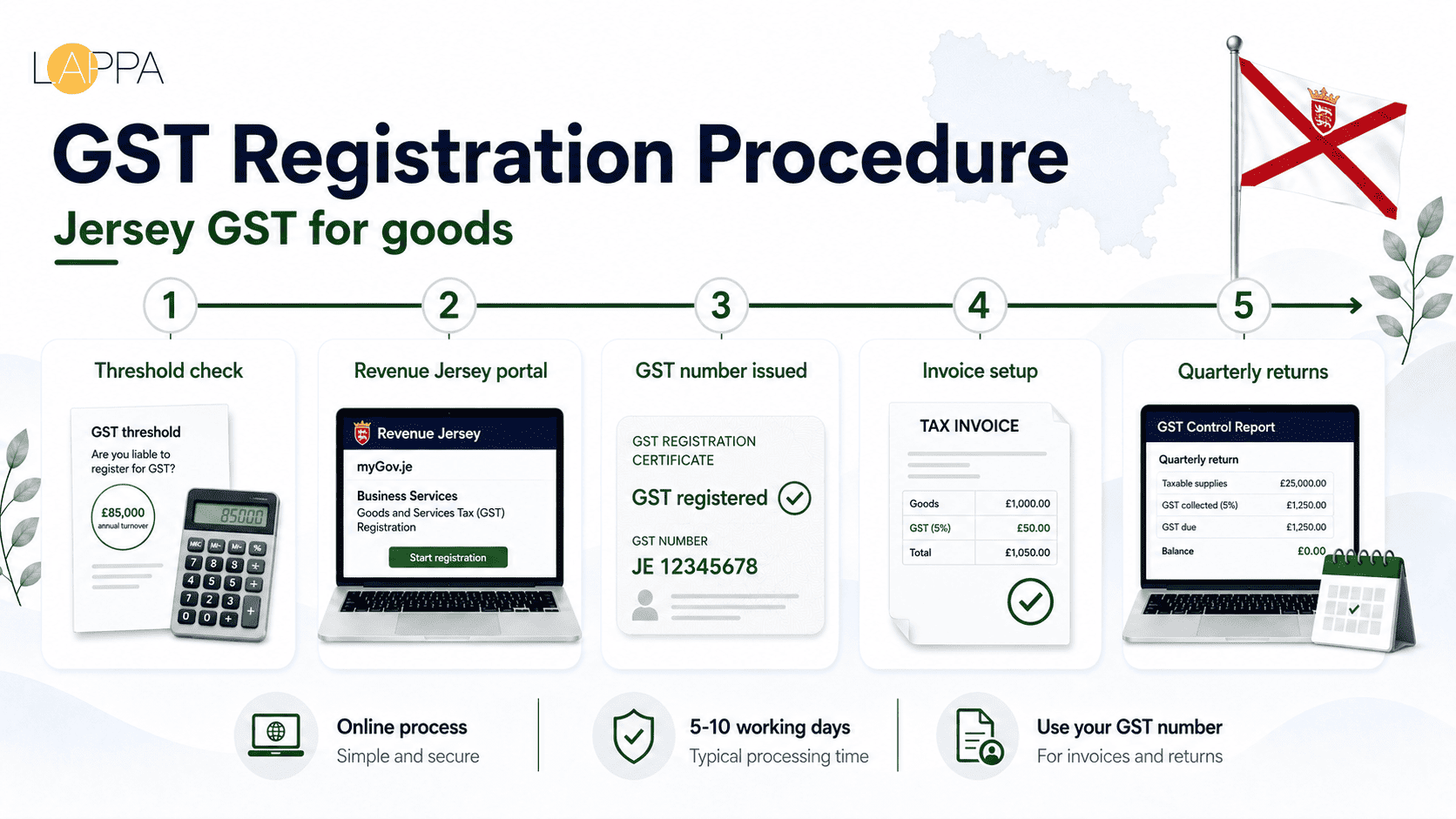 Levy registration runs through the online portal (gov.je/taxesmoney). For locally incorporated businesses:
- Access the portal at gov.je/taxesmoney using the business's registration credentials or myGov.je login
- Complete the GST registration application, declaring the nature of goods activity, expected annual turnover, and the date from which registration is sought
- Provide incorporation documents from the local Financial Services Commission for companies
- For overseas businesses registering without a local establishment — provide home-country documents and evidence of supplies made to local customers
- Receive the levy registration confirmation and assigned number — the equivalent of a VAT in Jersey identifier for all invoicing and return purposes
Tax Representative in the island
Overseas businesses registering without a local establishment may need to appoint a locally based tax representative recognized by the authority. The representative handles return filing and correspondence with the authority on behalf of the foreign entity. Unlike EU fiscal representative models where joint liability for unpaid tax can attach, the Jersey arrangement is primarily administrative — the representative acts as the local liaison without necessarily bearing personal financial liability for the overseas operator's unpaid GST.VAT E-Invoices in the island
There is no mandatory e-invoicing system here equivalent to those seen in some EU member states or in Indonesia. Paper and PDF invoices remain fully valid for GST purposes, provided they contain all required invoice fields: supplier name and GST registration number, date, description of goods, net amount, GST rate, GST amount, and total. Digital invoicing is widely adopted in practice — many operators use cloud-based accounting systems generating compliant invoices automatically. Revenue Jersey does not require pre-approval of invoices or real-time transmission, distinguishing the island's approach from jurisdictions like Indonesia or Brazil where e-invoicing carries legal validity requirements. There are no current Revenue Jersey announcements indicating mandatory e-invoicing is imminent, but operators building systems for the island should check the latest Revenue Jersey guidance before deployment.VAT Returns in the island
Registered businesses file quarterly returns. Submission and payment both fall on the last day of the month after each quarter closes — April 30 for Q1, July 31 for Q2, October 31 for Q3, January 31 for Q4. Large businesses designated by the authority may file monthly; smaller ones may qualify for annual returns. Three document types support the quarterly compliance cycle:- Quarterly GST return — covers output GST collected on local sales, input GST on purchases made in the island, import GST paid at Jersey Customs on goods brought into the island, and the net balance payable or creditable
- Import documentation — Customs Entry forms and accompanying commercial invoices confirming the GST value declared and paid at the port of entry; these support the import GST credit claimed in the quarterly return
- Purchase and sales records — the underlying transaction registers from which return figures derive; maintained in electronic or paper format and available for Revenue Jersey inspection on request during audit periods
Deductible VAT in the island
Input levy is recoverable where purchases feed into taxable supplies. The underlying logic matches most consumption tax systems: purchases directed at taxable outputs earn a credit; purchases for exempt activities or private use do not. Specific restrictions for goods operators:- Passenger cars: Input GST on the purchase of passenger cars is not recoverable for most operators. Commercial vehicles used directly in goods handling and distribution generally qualify for full recovery
- Entertainment and hospitality: GST on entertainment and meals is generally not recoverable unless directly tied to a documented business purpose with taxable supply connection
- Mixed-use assets: Where an asset serves both taxable and private or exempt purposes, only the taxable proportion of input GST is recoverable — a pro-rata calculation based on use
VAT Record Keeping Requirements in the island
Seven years from the accounting period end is the minimum retention window the authority enforces. Paper and electronic formats both satisfy the requirement, provided records remain complete and accessible on demand. What a goods operator must maintain:- All issued sales invoices showing GST registration number, date, goods description, net amount, GST rate, and GST amount separately
- All purchase invoices received with equivalent content fields
- Customs entry documentation for every goods import
- Export documentation confirming goods left the island's customs territory
- Quarterly GST returns and payment receipts for every filed period
VAT Penalties in the island
| Violation | Penalty | Notes |
| Late filing of quarterly return | GBP 250 fixed penalty | Nil-balance returns are not exempt; a second late return within the same 12-month window doubles the charge to GBP 500 |
| Late payment of GST | Interest at Revenue Jersey's published rate | Daily accrual from the missed payment date; rate reset and published annually |
| Non-registration above threshold | Up to GBP 10,000 | Plus backdated levy assessment covering the entire period since registration was due |
| Inaccurate return (careless error) | 30% of potential lost revenue | Revenue Jersey can reduce on prompt disclosure and cooperation |
| Inaccurate return (deliberate) | Up to 100% of potential lost revenue + referral | Deliberate understatement can escalate to criminal investigation alongside the financial assessment |
How Lappa Handles VAT Jersey Compliance
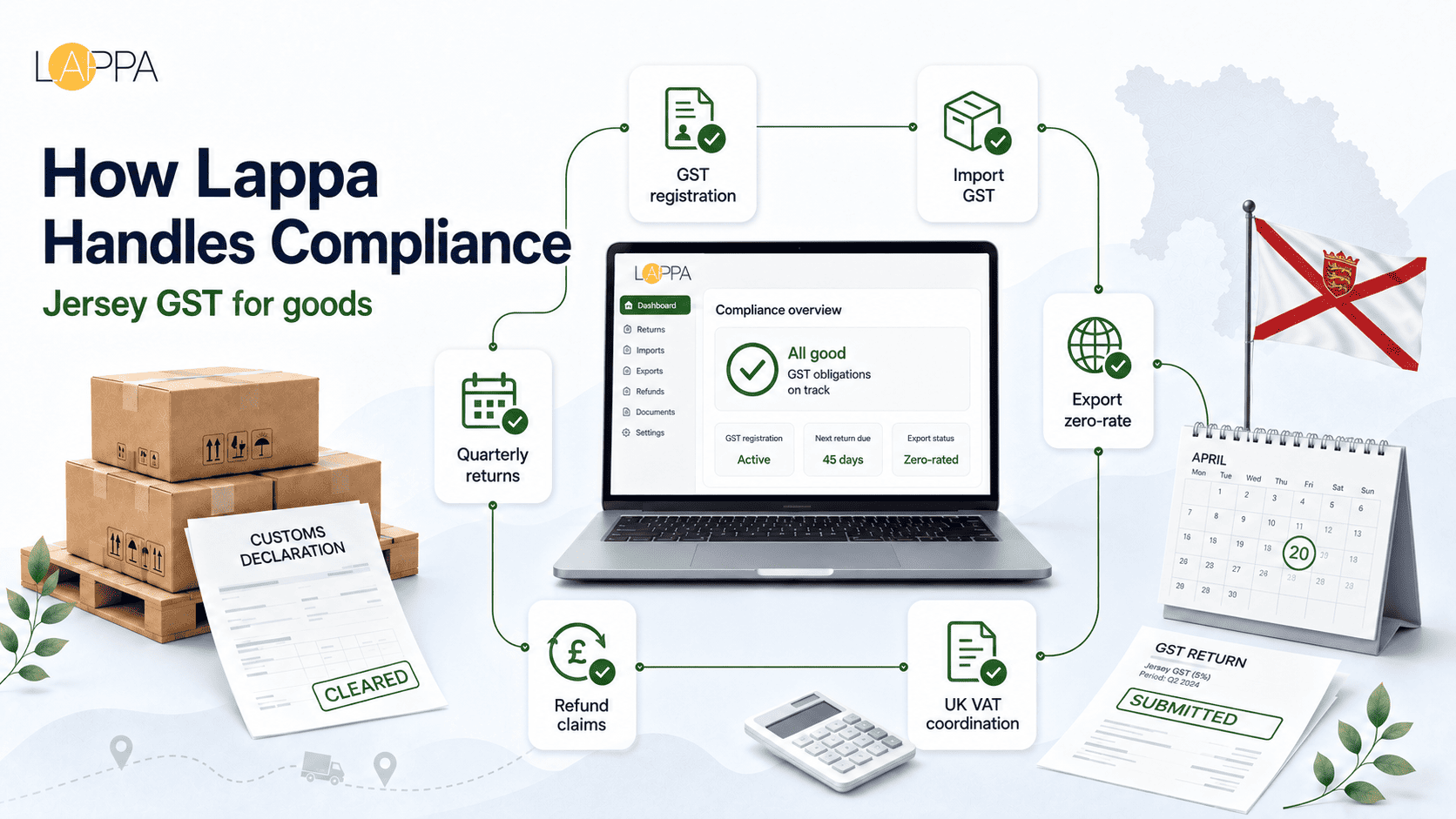 Running goods compliance on this island means quarterly GST returns, import documentation reconciliation, an authority that monitors compliance closely given the small size of the registered business population, and the added layer of managing the UK VAT position on the UK side simultaneously. VAT Jersey compliance from Lappa covers the full cycle from levy registration through ongoing quarterly filing:
- GST registration — handling the Revenue Jersey application for locally incorporated operators and overseas businesses, including representative appointment where required for non-resident businesses
- Quarterly return preparation and filing — preparing returns with reconciliation of customs import GST records against purchase ledger figures before submission to the authority
- Export zero-rate documentation — maintaining customs export records substantiating 0% GST treatment on goods dispatched from the island
- Refund claim management — tracking and submitting input GST refund claims for businesses accumulating credit positions from export activity
- UK VAT coordination — for UK-based businesses managing both systems, Lappa aligns the UK VAT zero-rating on exports with the local levy import treatment
FAQ for Jersey VAT Goods
What is the VAT Rate in the island
The island does not have VAT — it operates GST (Goods and Services Tax) at 5%. VAT in Jersey as commonly searched refers to this GST system. The 5% rate applies uniformly to all taxable goods with no reduced rate categories. Exports carry 0%. Jersey's indirect tax rate at 5% is low compared to most European rates (UK: 20%, Denmark: 25%, Ireland: 23%) a flat-rate structure simplifies Jersey VAT classification considerably.Who Needs VAT Registration in the island
The registration obligation kicks in at GBP 300,000 annual taxable turnover for island-based businesses. Overseas businesses supplying goods into the island above the applicable overseas trader threshold must also register. Voluntary registration is available below the threshold and worthwhile for importers wanting to recover the 5% levy paid at local Customs on every shipment rather than absorbing it as a cost.Is Jersey Part of the UK for VAT Purposes
Is Jersey part of the UK for VAT purposes is one of the most commonly searched questions about the island's tax position — and the answer is no. Jersey is a Crown Dependency with its own independent tax system. UK businesses exporting goods to the island zero-rate their UK VAT on the transaction; the goods are treated as an export from the UK VAT perspective. Jersey then charges its own GST at 5% when the goods enter Jersey customs. Is Jersey part of the UK for VAT purposes from an operational standpoint means UK businesses need to maintain two separate registrations (UK VAT and Jersey GST) if they supply goods both within the UK and into the island. The island's independent tax status makes it a genuinely distinct compliance jurisdiction despite its geographic proximity to the UK.How Does VAT Jersey Channel Islands Apply to Goods
VAT Jersey Channel Islands is a search that often blends two separate jurisdictions — both islands are Channel Islands Crown Dependencies but each has its own distinct tax system. the island has GST at 5%; Guernsey operates its own GST at 5% but administered separately by the Guernsey Revenue Service. Any business with VAT Jersey Channel Islands obligations needs separate registrations in each island if it operates in both — there is no unified Channel Islands indirect tax registration. Jersey's levy framework is the one covered in this guide; Guernsey's equivalent is administered entirely independently and requires a separate registration and filing obligation.How Often Are VAT Returns Filed in the island
Four quarterly periods run the cycle: January–March, April–June, July–September, October–December. Each is due by the last day of the month that follows. Large businesses may file monthly; smaller ones may qualify for annual filing. Nil-balance returns still attract the GBP 250 fixed penalty if late — rising to GBP 500 on a second offence within 12 months — so the quarterly calendar warrants attention even when no balance is owed.VAT Calculator
VAT Standard rate
5% GST
VAT Reduced rate
-
Thresholds
GBP 300,000 taxable turnover in any 12 months