


Germany VAT Guide for Foreign Businesses
Provinces
Goods
Provinces
Goods
About
Goods
About
Goods
Goods
Goods
Introduction to VAT in Germany
VAT in Germany goes by two names: Umsatzsteuer (USt) officially, and Mehrwertsteuer (MwSt) in everyday usage. Both refer to the same consumption tax. The Bundeszentralamt fur Steuern (BZSt) -- Federal Central Tax Office -- handles registrations for foreign businesses. Local German businesses deal with their regional Finanzamt instead. Germany VAT obligations start the moment a foreign business makes its first taxable supply in Germany. There's no grace period for non-EU sellers. EU sellers benefit from the EUR 10,000 EU-wide distance selling threshold before German MwSt kicks in. Miss the threshold and fail to register -- and penalties follow. Germany applies the reverse charge (Steuerschuldumkehr) on B2B cross-border services. A German-registered business receiving a service from a non-resident supplier self-assesses MwSt and reports it on the Voranmeldung. The output tax and input tax often cancel out. But the reporting obligation is real, regardless of whether any net tax is due. The Kleinunternehmerregelung is Germany's small-business exemption. Businesses below the threshold issue invoices without MwSt and note: Gemass Paragraph 19 UStG wird keine Umsatzsteuer erhoben. Since January 1, 2025, the thresholds are EUR 25,000 for the prior year and EUR 100,000 for the current year. Non-resident businesses don't qualify. The exemption is for German resident entities only.Germany VAT rate
The Germany VAT rate structure is simpler than France's -- two active tiers plus zero and exempt categories. The standard rate of 19% covers most commercial transactions. The reduced rate of 7% targets essential goods and specific service categories defined by German law. Getting the right rate on every invoice is the baseline requirement.VAT Tax Germany -- Standard and Reduced Rates
VAT tax Germany applies at 19% to the vast majority of supplies: electronics, software, advertising, professional services, telecoms, most B2B transactions. The 7% bracket is narrower. It covers basic foodstuffs (not restaurant food), books and printed press, local public transport, hotel accommodation, some medical devices, and select cultural events. Restaurants charge 19% on food -- the reduced rate doesn't extend to meals served on premises.| MwSt Rate | Category | Common Examples |
| 19% (standard) | All goods and services not assigned to a reduced tier | Electronics, clothing, software, professional services, advertising, telecoms, most B2B supplies |
| 7% (reduced) | Essential goods and specific service categories designated by law | Basic foodstuffs, books, newspapers, local public transport, hotel accommodation, some medical devices, cultural events |
| 0% / Exempt | Exports, intra-EU B2B supplies, and specific exempt sectors | Exports outside EU, international freight, healthcare, insurance, financial services, education, certain residential property |
VAT Rate Germany - Zero Rating and Exemptions
The VAT rate Germany applies at zero to exports leaving the EU and to intra-EU B2B goods supplies where the buyer holds a valid German or other EU VAT ID. Zero-rated means MwSt is charged at 0% -- the supply is taxable, but the rate is zero. Exempt supplies are different: they fall entirely outside the MwSt system, meaning no MwSt is charged but input tax on costs related to those supplies is also not recoverable. Exempt categories include financial services, insurance, most healthcare, education, and certain real estate transactions. Businesses making exclusively exempt supplies can't recover input MwSt on their costs. This creates a real cost disadvantage. Mixed businesses -- those making both taxable and exempt supplies -- use a partial deduction coefficient (Aufteilungsmassstab) to calculate recoverable input tax. Germany VAT rate for hotel stays is 7%, which surprises many foreign operators. A hotel invoice in Munich carries 7% MwSt, even if the room costs EUR 500 per night. Restaurant meals at the same hotel are 19%. Business travellers need to split the hotel bill correctly between accommodation (7%) and food and drink (19%) to recover the right amount of input MwSt.VAT Registration Threshold in Germany
Registration thresholds in Germany divide by seller category and supply type. Foreign businesses don't benefit from the Kleinunternehmerregelung. They register based on their turnover and the nature of their German supplies. The VAT rate Germany uses for those supplies -- 19% or 7% -- doesn't affect the registration trigger. The obligation to register comes first; the correct rate applies from the first registered invoice.| Seller Category | Threshold | Key Notes |
| German resident -- goods and services | EUR 25,000 (prior year) and EUR 100,000 (current year) | Kleinunternehmerregelung small-business exemption (effective Jan 1, 2025). Businesses below both limits can opt out of charging MwSt. |
| EU-based distance seller | EUR 10,000 EU-wide combined B2C turnover | EU-wide threshold covering all member states. OSS lets you file one return in your home country for all EU B2C sales instead of registering individually in Germany. |
| Non-EU seller (any goods or services) | No threshold -- from first taxable supply | Registration mandatory before first German B2C or taxable B2B supply. Fiscal representative may be required depending on the home country. |
| EU/non-EU digital service provider | EUR 10,000 EU-wide | Same threshold as distance goods. OSS covers digital services across all 27 EU states from a single home-country registration. |
For German businesses
German resident businesses below both thresholds -- EUR 25,000 in the prior year and EUR 100,000 in the current year -- can elect the Kleinunternehmerregelung exemption. It's a choice, not automatic. Once elected, it applies until the business actively switches to standard MwSt filing. Businesses below the threshold that incur significant input MwSt on purchases often benefit from voluntary registration. Recovering input tax on a large stock purchase can outweigh the administrative overhead of MwSt compliance. Voluntary registration is available at any time. It binds the business for at least two calendar years. During that period, the business charges and remits MwSt like any other registrant. Deregistering back to the Kleinunternehmerregelung requires a formal request to the Finanzamt and is only approved after two full years of standard filing.For foreign sellers
Non-EU sellers making taxable B2C or B2B supplies in Germany register directly with the BZSt. There's no turnover threshold. The moment the first German taxable supply happens, the registration obligation starts. The BZSt registration form for non-resident businesses is the USt 1 TI (application for a German MwSt number as a foreign entrepreneur). Processing runs four to eight weeks for a complete application. EU businesses selling goods to German consumers fall under the EUR 10,000 EU-wide OSS threshold. Below it, they charge their home country's VAT rate on cross-border B2C sales. Above EUR 10,000, they must charge the destination country's rate -- 19% for Germany -- and either register in Germany or file OSS in their home member state. Most EU businesses with any real volume go to OSS immediately.For digital service providers
Digital service providers -- SaaS, streaming, e-learning, online gaming, cloud storage -- follow the same EUR 10,000 EU-wide threshold as goods sellers. The threshold combines all cross-border EU B2C revenue across all service categories and all member states. A UK software company selling to German consumers is non-EU post-Brexit and has no threshold. It registers in Germany (or another EU state for OSS via the non-union scheme) before its first German B2C sale. IOSS (Import One Stop Shop) is separate from OSS and applies to goods imported into the EU from outside, with a value below EUR 150 per consignment. German consumers buying from non-EU sellers benefit when the seller is IOSS-registered -- the seller collects the destination country's VAT at checkout and the parcel clears customs without import VAT being collected. IOSS registration is through one EU member state; the single return covers all EU-wide IOSS-eligible sales.Who Must Register for VAT Germany
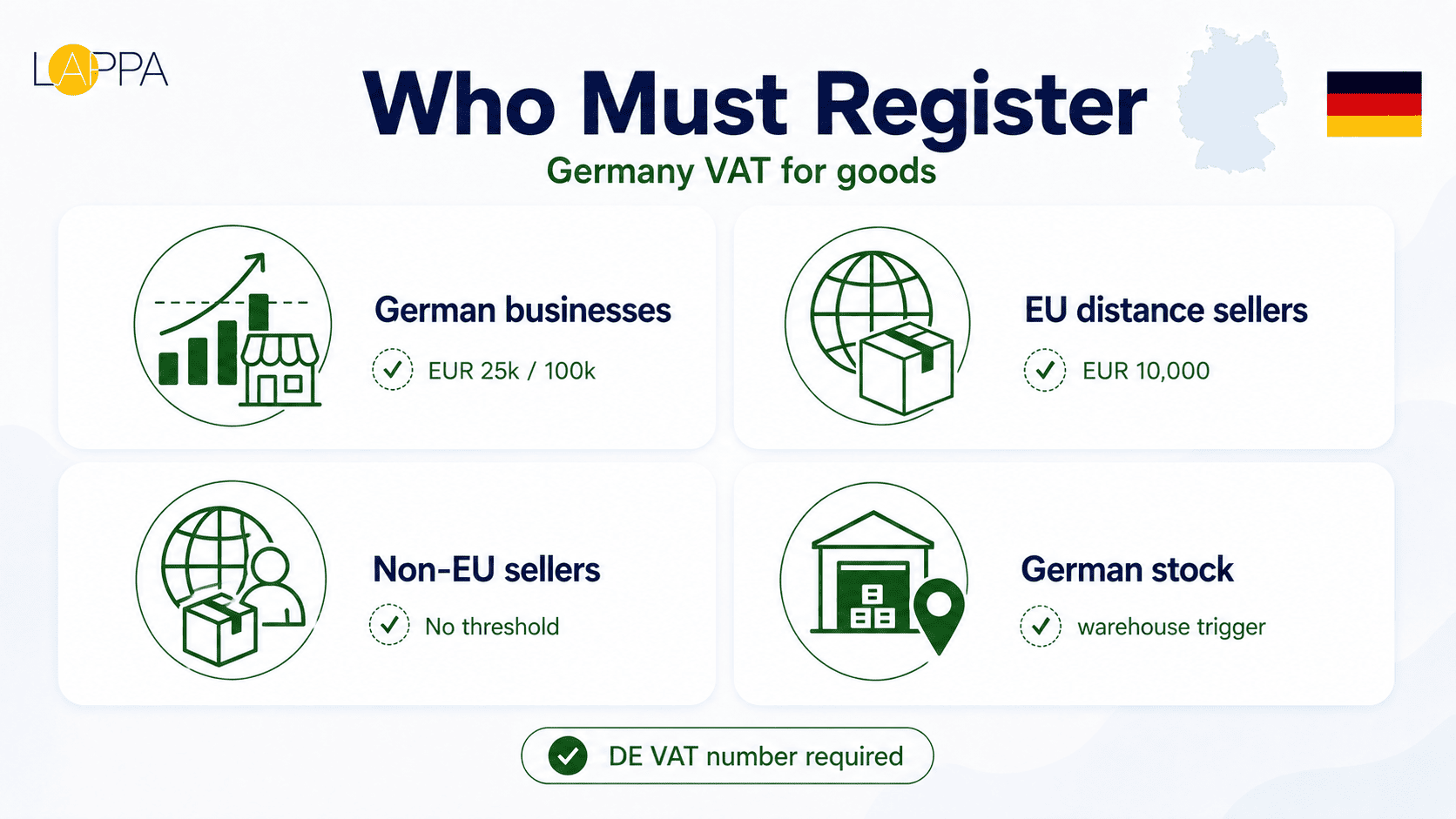 Mandatory registration for VAT Germany covers five categories. First: German resident businesses exceeding the Kleinunternehmerregelung thresholds. Second: non-resident businesses making any taxable German supply outside OSS or IOSS. Third: businesses receiving reverse-charge services -- the autoliquidation obligation means the German-registered recipient self-assesses MwSt. Fourth: entities making intra-EU goods acquisitions above EUR 10,000 per year. Fifth: businesses taking over a German MwSt-registered business as a going concern.
A foreign business can trigger a German registration obligation even without a physical presence. Running a German online marketplace, warehousing goods on German soil through a fulfillment centre, or making repeated B2C deliveries into Germany above the EUR 10,000 EU-wide threshold all create registration requirements. Amazon FBA sellers storing goods at German warehouses, for instance, are almost always required to hold a German MwSt number regardless of their home country.
Once registered, the business receives a VAT ID Germany issues in the format DE + 9 digits. This is the Umsatzsteuer-Identifikationsnummer (USt-IdNr.) used for all intra-EU B2B transactions, EC Sales List filings, and counterparty VIES verifications. It's separate from the Steuernummer -- the local tax number assigned by the Finanzamt, which is used for domestic filings and correspondence.
Mandatory registration for VAT Germany covers five categories. First: German resident businesses exceeding the Kleinunternehmerregelung thresholds. Second: non-resident businesses making any taxable German supply outside OSS or IOSS. Third: businesses receiving reverse-charge services -- the autoliquidation obligation means the German-registered recipient self-assesses MwSt. Fourth: entities making intra-EU goods acquisitions above EUR 10,000 per year. Fifth: businesses taking over a German MwSt-registered business as a going concern.
A foreign business can trigger a German registration obligation even without a physical presence. Running a German online marketplace, warehousing goods on German soil through a fulfillment centre, or making repeated B2C deliveries into Germany above the EUR 10,000 EU-wide threshold all create registration requirements. Amazon FBA sellers storing goods at German warehouses, for instance, are almost always required to hold a German MwSt number regardless of their home country.
Once registered, the business receives a VAT ID Germany issues in the format DE + 9 digits. This is the Umsatzsteuer-Identifikationsnummer (USt-IdNr.) used for all intra-EU B2B transactions, EC Sales List filings, and counterparty VIES verifications. It's separate from the Steuernummer -- the local tax number assigned by the Finanzamt, which is used for domestic filings and correspondence.
VAT number Germany
Every registered entity receives a VAT number Germany issues in the standardised format DE + 9 digits. An example: DE123456789. The DE prefix identifies Germany as the member state. The nine digits are the USt-IdNr. identifier, separate from and formatted differently to the Steuernummer used for domestic Finanzamt correspondence. Both numbers coexist in the German tax system; the DE-prefix number is the one used for EU transactions. The Steuernummer (StNr.) follows a different structure: typically 10 to 11 digits, state-specific, formatted as XXXX/XXXXX or XX/XXX/XXXXX depending on the federal state. The Steuernummer is your Finanzamt ID -- used on Voranmeldung returns, domestic correspondence, and annual declarations. The USt-IdNr. is your EU identity -- used on cross-border invoices and VIES lookups. Both are needed; confusing the two is a common error.What is VAT number in Germany and Who Needs One
What is VAT number in Germany? It's the Umsatzsteuer-Identifikationsnummer -- a unique EU-format tax identifier beginning with DE. Any business registered for MwSt in Germany receives one from the BZSt (for foreign businesses) or the regional Finanzamt (for domestic businesses). It's needed for issuing zero-rated intra-EU invoices, validating counterparties via VIES, and completing EC Sales List (ZM) filings. Businesses that only sell domestically within Germany -- no cross-border EU supplies -- technically operate with just the Steuernummer. But in practice, most businesses request the USt-IdNr. even if they don't immediately have intra-EU transactions. A single cross-border B2B customer triggers the need. Applying for the USt-IdNr. upfront is administratively easier than applying reactively when the first EU transaction happens.Germany VAT Number Format and VAT Number in Germany Validation
Germany VAT number format is fixed: two-letter prefix DE followed by exactly nine numeric digits, no spaces or separators. Total: eleven characters. The nine digits are verified through a Prufsummenverfahren (checksum algorithm) that validates the number's internal consistency. VIES at ec.europa.eu/taxation_customs/vies performs real-time validation of any active German USt-IdNr. The BZSt also operates a standalone validation service at evatr.bff-online.de -- useful for confirming the business name and address attached to a number. A VAT number in Germany is not reassigned. Once issued and then deregistered, it's archived. If a business deregisters and later reregisters, it receives a new number. This matters for businesses tracking historical counterparty records -- a supplier's DE number from three years ago may not appear in VIES even if the business is still active under a new registration. Always validate the current number, not a number from a prior contract. The VAT number Germany assigns to a foreign branch is based on that branch's legal presence in Germany. A German branch of an Irish company receives its own DE number, separate from the Irish parent's IE-prefix number. Each entity invoices, files, and pays independently. Using the parent company's foreign VAT number on a German branch invoice is a compliance error that creates issues for counterparties trying to recover input MwSt.VAT Registration Procedure in Germany
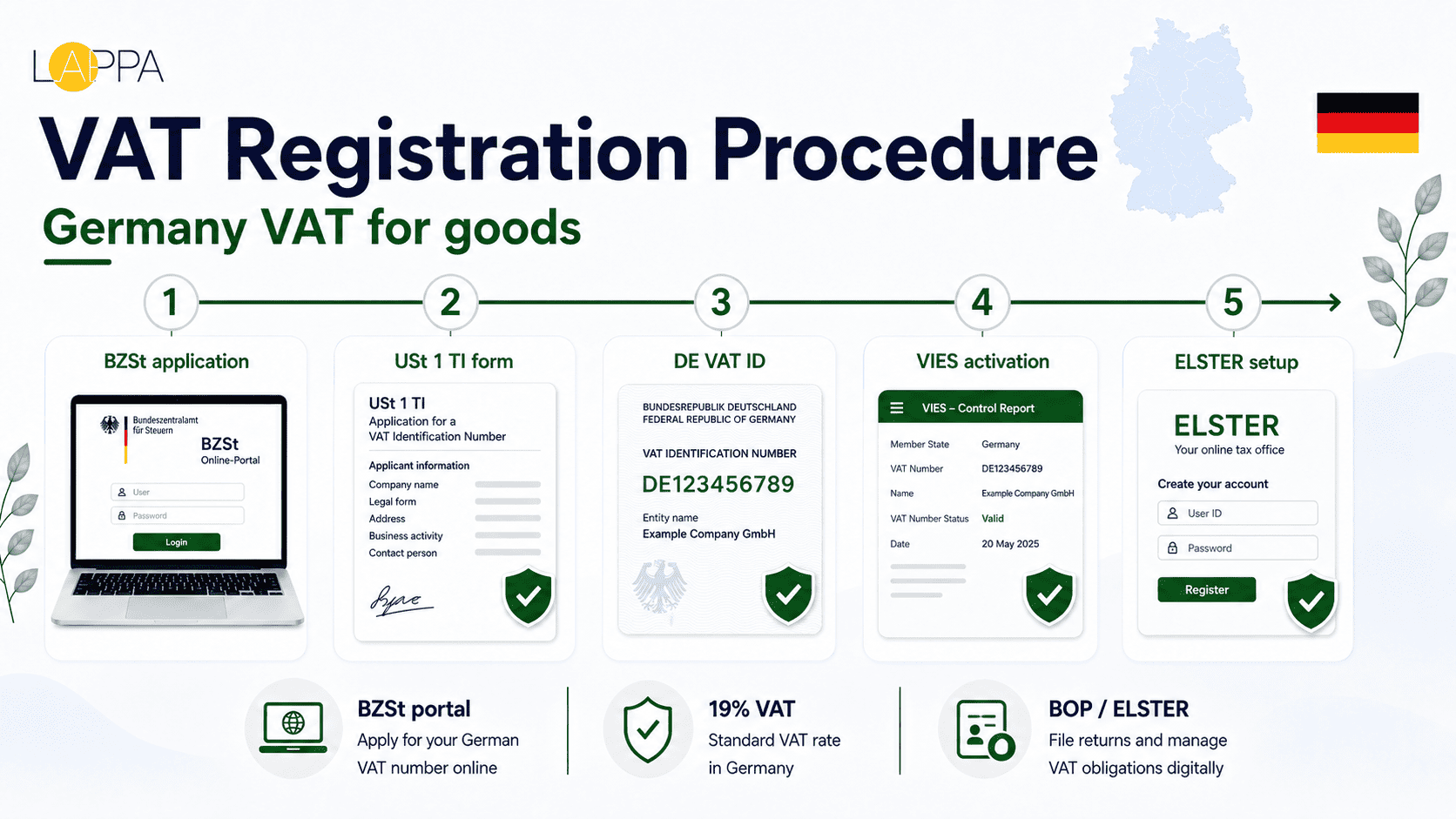 Applying for a VAT registration number Germany as a non-resident business goes through the BZSt in Bonn. The registration form is the USt 1 TI (Antrag auf Erteilung einer Steuernummer fur im Ausland ansassige Unternehmer). It's available on the BZSt website in German and English. German-resident businesses register through their local Finanzamt during company formation, which happens automatically through the Gewerbeanmeldung (trade registration) and subsequent questionnaire from the Finanzamt.
Documents required for a non-resident registration:
Applying for a VAT registration number Germany as a non-resident business goes through the BZSt in Bonn. The registration form is the USt 1 TI (Antrag auf Erteilung einer Steuernummer fur im Ausland ansassige Unternehmer). It's available on the BZSt website in German and English. German-resident businesses register through their local Finanzamt during company formation, which happens automatically through the Gewerbeanmeldung (trade registration) and subsequent questionnaire from the Finanzamt.
Documents required for a non-resident registration:
- Certificate of incorporation or equivalent registration document from the home country
- Proof of taxable activity in Germany: confirmed orders, contracts, warehouse agreements, or similar
- Completed USt 1 TI form (for non-resident businesses without a German establishment)
- Power of attorney if a tax advisor is submitting on your behalf
- Bank account details for MwSt refunds if the business expects input tax refund claims
- Identification documents for the authorised signatory
- Fiscal representative appointment letter if the home country requires one
VAT ID Germany
The VAT ID Germany -- the Umsatzsteuer-Identifikationsnummer (USt-IdNr.) -- is the DE-format number used exclusively for EU cross-border transactions. It differs from the Steuernummer in format, issuing authority, and purpose. The BZSt issues the USt-IdNr. The Finanzamt issues the Steuernummer. In practice, a German-registered business has both and uses each in the right context. Confusing the two on invoices creates processing errors for counterparties. Germany VAT number (USt-IdNr.) is validated in real time through VIES and through the BZSt's own evatr portal. The evatr service returns not just a valid/invalid result but also the registered business name and address associated with the number. This is useful for due diligence -- confirming that a counterparty's number matches their claimed identity. Run the check before zero-rating any significant invoice. German VAT identification numbers issued to non-resident businesses are maintained in the BZSt's central register. Changes to the registration -- address updates, legal form changes, or the addition of a fiscal representative -- must be reported to the BZSt rather than the local Finanzamt. The BZSt then updates the central register and propagates changes to VIES. Response times are typically faster for change notifications than for initial registrations. Germany's VAT numbers issued under OSS registrations carry a different format. An EU business filing OSS returns in Germany -- with Germany as its member state of identification -- uses a separate OSS registration number, not the standard DE-prefix USt-IdNr. The OSS number is used only for the OSS quarterly returns. Standard German domestic supplies still use the domestic DE-prefix USt-IdNr.Tax Representative in Germany
Germany doesn't have a mandatory accredited fiscal representative system like France does. EU and EEA businesses register directly with the BZSt without a representative. For non-EU businesses, the BZSt may require or strongly recommend appointing a German-resident tax representative (Steuerberater or Rechtsanwalt) as part of the registration process, particularly when the business's home country lacks a mutual assistance agreement with Germany. Unlike France's jointly-and-severally-liable fiscal representative, German Steuerberater act as professional agents without automatic co-liability for their client's unpaid MwSt. They prepare and submit returns, correspond with the Finanzamt or BZSt on the client's behalf, and manage ELSTER access. Liability for the tax stays with the registered business. This makes German fiscal representation less financially exposed for the service provider but also less of a guarantee for the tax authority. VAT Germany compliance for non-EU businesses generally works most smoothly with a German Steuerberater managing the filings. The ELSTER system requires a registered PIN and certified software -- navigating it in German without local support is technically possible but practically difficult. A Steuerberater familiar with the BZSt registration process also speeds up the initial approval timeline, since they know exactly which documents the BZSt requires in what format. UK businesses are non-EU post-Brexit and now follow the non-EU route for German registrations. Pre-Brexit UK businesses that already held a German USt-IdNr. generally kept it without needing to appoint a representative -- the BZSt didn't retroactively impose one. New UK businesses starting German operations after January 1, 2021 go through the BZSt non-resident process and may need to satisfy the representative question before registration is approved.VAT E Invoicing in Germany
VAT tax Germany e-invoicing obligations come from the Wachstumschancengesetz (Growth Opportunities Act), passed in March 2024. This law introduced mandatory B2B e-invoicing for domestic German transactions in stages. All German MwSt-registered businesses must be able to receive structured e-invoices as of January 1, 2025. The issuance mandate phases in by company size between 2027 and 2028. This is separate from Germany's already-active B2G e-invoicing requirement, which has been running since 2020. Accepted formats are XRechnung (a pure XML standard aligned with the EU EN 16931 norm) and ZUGFeRD (a hybrid format -- a PDF with embedded XML). Both carry the structured invoice data that Germany's mandate requires. XRechnung is the government standard for public-sector invoices and will be the dominant format for large-company B2B exchanges. ZUGFeRD is popular for smaller businesses because the PDF is human-readable while still carrying machine-readable XML.Timeline for business adoption
- January 1, 2025 -- ALL German MwSt-registered businesses must be able to RECEIVE structured e-invoices (XRechnung or ZUGFeRD). Paper and PDF invoices may still be issued for B2B domestic supplies until 2026, with recipient consent.
- January 1, 2027 -- Businesses with prior-year turnover above EUR 800,000 must ISSUE structured e-invoices for domestic B2B transactions. Paper/PDF to other large businesses no longer accepted.
- January 1, 2028 -- ALL remaining German MwSt-registered businesses must issue structured e-invoices for domestic B2B. Full mandate takes effect across all sizes.
- B2G via XRechnung on PEPPOL network -- Already mandatory since November 27, 2020 for federal suppliers. State-level adoption followed; all public-sector invoice recipients now require XRechnung.
- Cross-border B2B and B2C -- Not covered by the domestic mandate. Standard e-invoicing best practices apply, but there is no current legal mandate for cross-border e-invoice format.
VAT Returns in Germany
Types of reports
Germany's MwSt return system has five components: the Voranmeldung (advance return, monthly or quarterly), the Zusammenfassende Meldung (ZM -- EC Sales List), Intrastat, the annual Umsatzsteuererklarung, and for import-heavy businesses, customs-related filings. Each goes to a different authority through a different system. Missing one doesn't excuse the others.| Return Type | Frequency | Deadline | Filing System |
| Voranmeldung (monthly) | Monthly -- if prior-year MwSt liability exceeds EUR 7,500 | 25th of following month | ELSTER (elektronische Steuererklarung) |
| Voranmeldung (quarterly) | Quarterly -- if prior-year liability is EUR 1,001 to EUR 7,500 | 25th of the month after quarter end | ELSTER |
| Zusammenfassende Meldung (ZM -- EC Sales List) | Monthly if intra-EU supplies exceed EUR 50,000 per quarter; otherwise quarterly | 25th of following period | BZSt Online-Portal (BOP) |
| Umsatzsteuererklarung (annual return) | Annual -- required for all MwSt registrants | May 31 (July 31 with registered tax advisor) | ELSTER |
| Intrastat | Monthly -- above the annual threshold for dispatches or arrivals | 10th of following month | Destatis (Federal Statistical Office) via IDEV portal |
Deductible VAT in Germany
Input MwSt recovery (Vorsteuerabzug) follows the direct attribution principle: costs that relate exclusively to taxable supplies generate fully recoverable input tax. Costs related exclusively to exempt supplies are not recoverable. Mixed-use costs require apportionment. Germany's MwSt rate structure -- 19% or 7% -- determines how much input tax sits on a given invoice, but the recoverability depends on what the purchase is used for, not what rate it carries. Passenger cars in Germany are treated more generously than in France. Input MwSt on a car purchase or lease is recoverable to the extent of confirmed business use. A car used 70% for business generates 70% input MwSt recovery. The 1% method (Einprozentregelung) or a logbook (Fahrtenbuch) is used to determine the private-use percentage for income tax purposes; the same split applies to MwSt. Document the split carefully -- Finanzamt auditors ask for it. Business meals at German restaurants carry 19% MwSt. That input MwSt is recoverable when the meal is a genuine business expense with adequate documentation: date, venue, names of attendees, and business purpose. The separate income tax rule disallowing 30% of entertainment costs for corporate income tax purposes doesn't carry over to MwSt -- input MwSt on a documented business meal is 100% recoverable for MwSt purposes. Mixing up the income tax and MwSt rules is a common and costly error. Private use triggers an output MwSt obligation (Eigenverbrauchsbesteuerung). If a business uses goods or services it originally deducted input MwSt on for private purposes, it must charge output MwSt on the cost of that private use. Vehicles, mobile phones, and company accommodation are the most common flashpoints. Proper record-keeping separating business and private use prevents reassessment.VAT Record Keeping Requirements in Germany
Germany's MwSt registration and all records relating to it must be retained for ten years (Aufbewahrungspflicht). The ten-year clock runs from the end of the calendar year in which the document was created. A Voranmeldung filed for March 2025 must be retained until December 31, 2035. The Finanzamt can audit any year within the retention window. There's no statute of limitations defence if you can't produce the records when requested. Digital records are accepted and encouraged -- Germany no longer requires paper originals for most documents. But the digital records must be kept in the original format and be producible in a format the Finanzamt can read. Scanning paper invoices and then discarding the originals is acceptable if the scan is complete and legible. Storing records only in a now-obsolete proprietary software format that can't be opened ten years later is not acceptable. Records that must be kept include: all issued and received invoices, Voranmeldungen and annual returns, payment records, bank statements showing MwSt payments and refunds, import and export documentation, and the VAT journal (Aufzeichnungen) showing input and output MwSt by period. For e-invoices under the XRechnung/ZUGFeRD mandate, both the structured XML data and any PDF representation must be stored.VAT Penalties in Germany
Germany's MwSt taxation penalty structure combines percentage-based surcharges with monthly late-payment supplements. The Verspätungszuschlag (late filing surcharge) runs up to 10% of the MwSt due for the late period, capped at EUR 25,000. This applies when the Voranmeldung or annual return is filed after the deadline. Even a one-day delay triggers it. Finanzamter have discretion to waive the surcharge for a first-time late filing, but that's a favour, not a right. Late payment carries the Säumniszuschlag: 1% per started month on the unpaid MwSt amount. This is a compound monthly charge. Three months late on EUR 10,000 of MwSt costs EUR 300 in Säumniszuschlag plus the Verspätungszuschlag on the return itself. Additionally, interest on tax arrears (Nachzahlungszinsen) under Paragraph 233a of the Abgabenordnung (AO) runs at 1.8% per year on amounts due more than 15 months after the end of the relevant calendar year. Germany's VAT fraud cases escalate beyond civil penalties into criminal prosecution (Steuerhinterziehung under Paragraph 370 AO). Deliberate under-declaration of MwSt or systematic input tax fraud can result in fines up to five times the evaded amount or custodial sentences up to ten years in serious cases. Voluntary disclosure (Selbstanzeige) before authorities discover the fraud can prevent criminal prosecution, but the window for a successful Selbstanzeige is narrow and the conditions are strict. Get advice early if you discover historical non-compliance.How Lappa Can Help with VAT Compliance in Germany
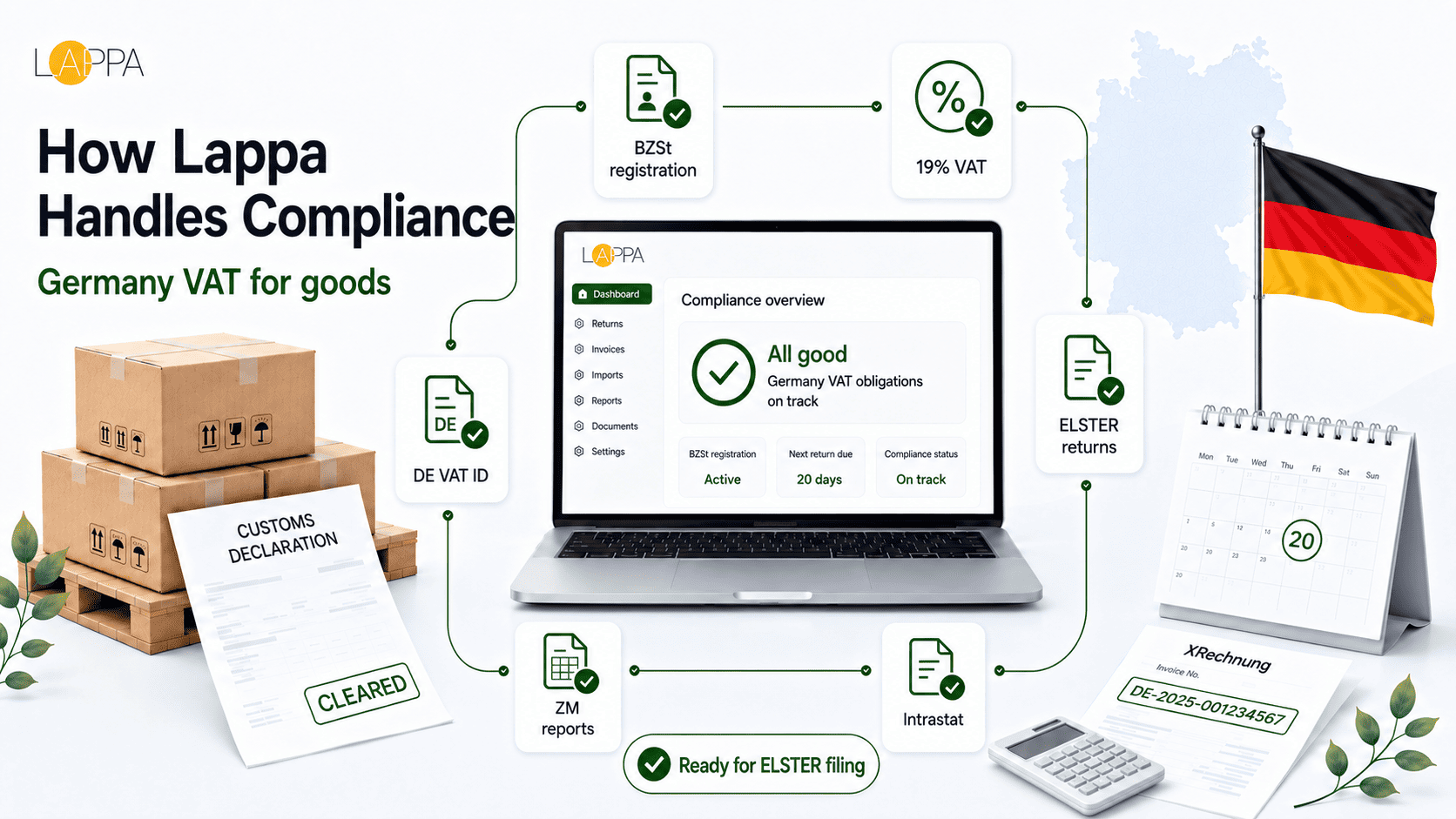 VAT in Germany for a foreign business involves navigating two registration authorities (BZSt and Finanzamt), two filing systems (ELSTER and BOP), three separate periodic filing types, and an e-invoicing transition running through 2028. Lappa handles the full stack: BZSt registration, USt-IdNr. application, ELSTER account setup, and the preparation and submission of Voranmeldungen, ZM, and Intrastat reports. Clients get a single point of contact rather than managing three separate government portals.
For non-EU clients, Lappa provides German Steuerberater representation during the BZSt registration process. Lappa prepares the USt 1 TI application, assembles the required supporting documents, and manages BZSt correspondence during the approval period. Once approved, Lappa sets up the ELSTER account and handles all ongoing filings from the first Voranmeldung.
VAT number in Germany issuance for new businesses goes faster with a complete application. Lappa's process includes a pre-submission document check to catch missing items before the BZSt receives them. A complete application with a German-speaking representative covering the BZSt correspondence typically runs three to five weeks to approval -- faster than the eight-week timeline common with unrepresented or incomplete applications.
Germany VAT e-invoicing preparation is something Lappa's clients start planning before the mandate deadlines. Lappa guides businesses through XRechnung and ZUGFeRD format selection, ERP or accounting system integration, and the PEPPOL-aligned infrastructure needed for B2G suppliers already within scope of the mandate. Starting that conversation in 2025 avoids a 2027 deadline scramble.
VAT in Germany for a foreign business involves navigating two registration authorities (BZSt and Finanzamt), two filing systems (ELSTER and BOP), three separate periodic filing types, and an e-invoicing transition running through 2028. Lappa handles the full stack: BZSt registration, USt-IdNr. application, ELSTER account setup, and the preparation and submission of Voranmeldungen, ZM, and Intrastat reports. Clients get a single point of contact rather than managing three separate government portals.
For non-EU clients, Lappa provides German Steuerberater representation during the BZSt registration process. Lappa prepares the USt 1 TI application, assembles the required supporting documents, and manages BZSt correspondence during the approval period. Once approved, Lappa sets up the ELSTER account and handles all ongoing filings from the first Voranmeldung.
VAT number in Germany issuance for new businesses goes faster with a complete application. Lappa's process includes a pre-submission document check to catch missing items before the BZSt receives them. A complete application with a German-speaking representative covering the BZSt correspondence typically runs three to five weeks to approval -- faster than the eight-week timeline common with unrepresented or incomplete applications.
Germany VAT e-invoicing preparation is something Lappa's clients start planning before the mandate deadlines. Lappa guides businesses through XRechnung and ZUGFeRD format selection, ERP or accounting system integration, and the PEPPOL-aligned infrastructure needed for B2G suppliers already within scope of the mandate. Starting that conversation in 2025 avoids a 2027 deadline scramble.
FAQ for VAT Germany
What is VAT in Germany
What is VAT in Germany? It's the Umsatzsteuer (USt) -- a consumption tax on goods and services applied at each stage of the supply chain. Businesses charge it, collect it, and remit the net amount (output tax minus input tax) to the Finanzamt or BZSt. Germany joined the European EEC in 1957 and has been applying a unified VAT since the EU Sixth VAT Directive came into force. The current standard rate of 19% has been in place since January 1, 2007. What is VAT in Germany for a business that has no German customers? Still potentially relevant. A German-registered business buying services from non-resident suppliers self-assesses MwSt on those purchases under the reverse charge. That self-assessed tax appears on the Voranmeldung as both output and input. The net position is zero, but ignoring the filing obligation because 'there's no tax to pay' is a common and punishable mistake. Germany's Umsatzsteuergesetz (UStG) is the primary legislation. It aligns with EU Directive 2006/112/EC but has national specifics -- the Kleinunternehmerregelung thresholds, the Dauerfristverlängerung system, and the specific reduced-rate categories are all defined at national level within the EU framework. The BMF (Bundesministerium der Finanzen -- Federal Finance Ministry) issues administrative guidelines (BMF-Schreiben) that expand on the statutory rules.How much is VAT in Germany
How much is VAT in Germany? The standard rate is 19%, applicable to most commercial transactions. The reduced rate is 7%, covering basic food, books, hotel accommodation, local public transport, and select other categories. Below those two tiers: zero-rated supplies (exports, intra-EU B2B) and exempt supplies (healthcare, finance, insurance). The correct answer to "how much" depends entirely on what the supply is and who the customer is. How much is VAT in Germany on imported goods from outside the EU? The standard 19% applies to most imports, collected by Zoll (German Customs). The import MwSt is paid at the customs border and can be recovered as input tax on the next Voranmeldung. Large importers apply for the Fiskalvertretung-free import deferral scheme -- Aufschubkonto -- which defers import MwSt from the customs payment to the Voranmeldung, eliminating the cash-flow drag of paying MwSt upfront at customs. Germany temporarily reduced the standard rate from 19% to 16% and the reduced rate from 7% to 5% between July 1 and December 31, 2020, as a COVID stimulus measure. That was a one-off. Both rates reverted on January 1, 2021. Some businesses with long-term contracts had to manage the transition carefully to avoid charging incorrect rates. The 19%/7% split has been stable since 2021 and no further rate change is currently planned.What is the VAT registration number Germany format
The VAT registration number Germany issues follows the EU-standard format: country code DE + nine numeric digits. Total eleven characters. Example: DE123456789. The nine-digit sequence must pass the BZSt's internal checksum validation. VIES accepts the full eleven-character string for validation. The BZSt's own evatr tool accepts the same format and returns the business name and registered address alongside the validity result. This DE-prefix number is the Umsatzsteuer-Identifikationsnummer (USt-IdNr.). It's distinct from the Steuernummer -- the local Finanzamt tax number in formats like 12/345/67890 or 1234567890. The Steuernummer is used on domestic Voranmeldung returns. The USt-IdNr. is used on B2B invoices to EU counterparties and on EC Sales List (ZM) filings. Businesses need both, and using the wrong one in the wrong context creates processing errors. Non-resident businesses that register with the BZSt receive a Steuernummer in a format specific to the BZSt's administrative region, plus the DE-prefix USt-IdNr. The USt-IdNr. is usually confirmed separately from the Steuernummer, sometimes arriving a few days later. Both must be on file before the business starts issuing German-compliant invoices.How often are VAT returns filed in Germany
Filing frequency for the Voranmeldung depends on the prior year's MwSt liability. Above EUR 7,500: monthly. Between EUR 1,001 and EUR 7,500: quarterly. Below EUR 1,001: the Finanzamt may exempt the business from advance returns entirely and require only the annual Umsatzsteuererklarung. New registrants always file monthly in the first two calendar years, regardless of liability level. Monthly filing means twelve Voranmeldungen per year plus the annual return -- thirteen filings in total. The Dauerfristverlängerung (permanent extension) shifts every Voranmeldung deadline forward by one month. A monthly filer's January return becomes due March 25 instead of February 25. The extension costs an advance payment of one eleventh of the prior year's MwSt liability, paid in February. Businesses with regular input tax refunds -- those whose purchases generate more input MwSt than their sales -- often don't use the extension because they want refunds processed quickly. Annual return deadlines depend on whether you have a Steuerberater. Without one: May 31 of the following year. With a registered Steuerberater: July 31. The Finanzamt can grant individual extensions beyond July 31 in exceptional circumstances. The annual return reconciles the year's advance returns. If the advance returns over-remitted, the business gets a refund. Under-remittance triggers a demand for the balance plus Zinsen (interest at 1.8% per year after a 15-month grace period).Do foreign companies need a tax representative in Germany
EU and EEA businesses don't need a fiscal representative to register with the BZSt -- they apply directly. Non-EU businesses fall into a different category. The BZSt has discretion to require a German-resident representative as a condition of approving the registration, particularly for businesses from countries without a mutual administrative assistance agreement with Germany. In practice, most non-EU operators appoint a Steuerberater anyway, because navigating ELSTER in German without local support is genuinely difficult. Post-Brexit UK businesses are non-EU from a German tax law perspective. New UK businesses starting German MwSt registrations after January 1, 2021 follow the non-EU BZSt process. UK businesses that held an existing German USt-IdNr. before Brexit were not retroactively required to appoint a representative when Brexit took effect, but their status depends on the BZSt's individual assessment of their compliance history and ongoing filing reliability. The representative -- a Steuerberater or Rechtsanwalt registered in Germany -- isn't jointly liable for the client's MwSt in the way France's accredited fiscal representative is. They act as an agent. Their professional indemnity insurance covers errors they make, not deliberate non-compliance by the client. Fees vary by firm and service scope. A typical package for a foreign business filing monthly Voranmeldungen and an annual return runs in the range of EUR 2,000 to EUR 6,000 per year depending on transaction volume and complexity.VAT Calculator
German MwSt arithmetic is straightforward. Add 19%: multiply net by 1.19. Extract from a gross: divide by 1.19. Add 7%: multiply by 1.07. Extract 7%: divide by 1.07. ELSTER's online tools include a basic calculator. Most German accounting software handles it automatically for domestic invoices. Example at 19%: a EUR 2,000 consulting invoice carries EUR 380 MwSt, grossing EUR 2,380. At 7%: a EUR 120 hotel stay carries EUR 7.85 MwSt (EUR 120 / 1.07 = EUR 112.15 net; EUR 7.85 tax). The gross always includes MwSt when the business is charging it. Invoices showing the net, the MwSt amount, and the gross separately are the standard format in Germany. Rounding on MwSt amounts follows commercial rounding (kaufmannisches Runden). Half-euro differences on a single invoice aren't typically flagged. But systematic rounding errors across thousands of invoices aggregate into material variances that Finanzamt auditors pick up. High-volume e-commerce businesses need well-calibrated systems from day one.
VAT Standard rate
19%
VAT Reduced rate
7%
Thresholds
he domestic turnover threshold is €25,000 for the previous calendar year. During the current year, the exemption can continue until turnover exceeds €100,000. Eligibility and application conditions differ for domestic and qualifying EU businesses.