


Hungary VAT Registration and Compliance Guide
Provinces
Goods
Provinces
Goods
About
Goods
About
Goods
Goods
Goods
Selling physical goods into Central Europe means budgeting for VAT in Hungary at a rate higher than anywhere else in the EU. This guide walks through what a goods seller needs to know: the current percentage, who has to register, how invoicing works, and the deadlines the National Tax and Customs Administration (NAV) actually enforces.
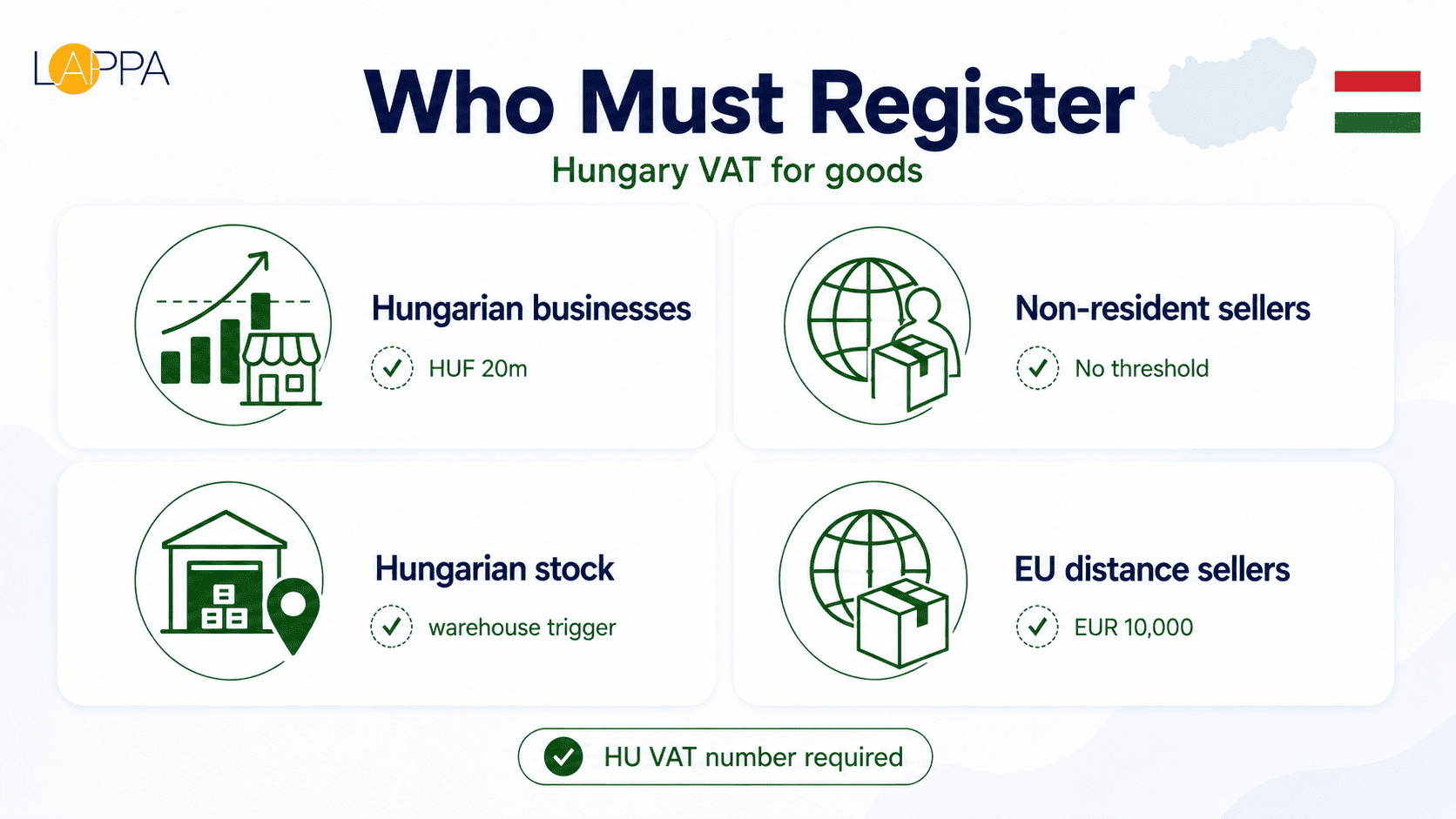 In practice, this obligation tends to land on:
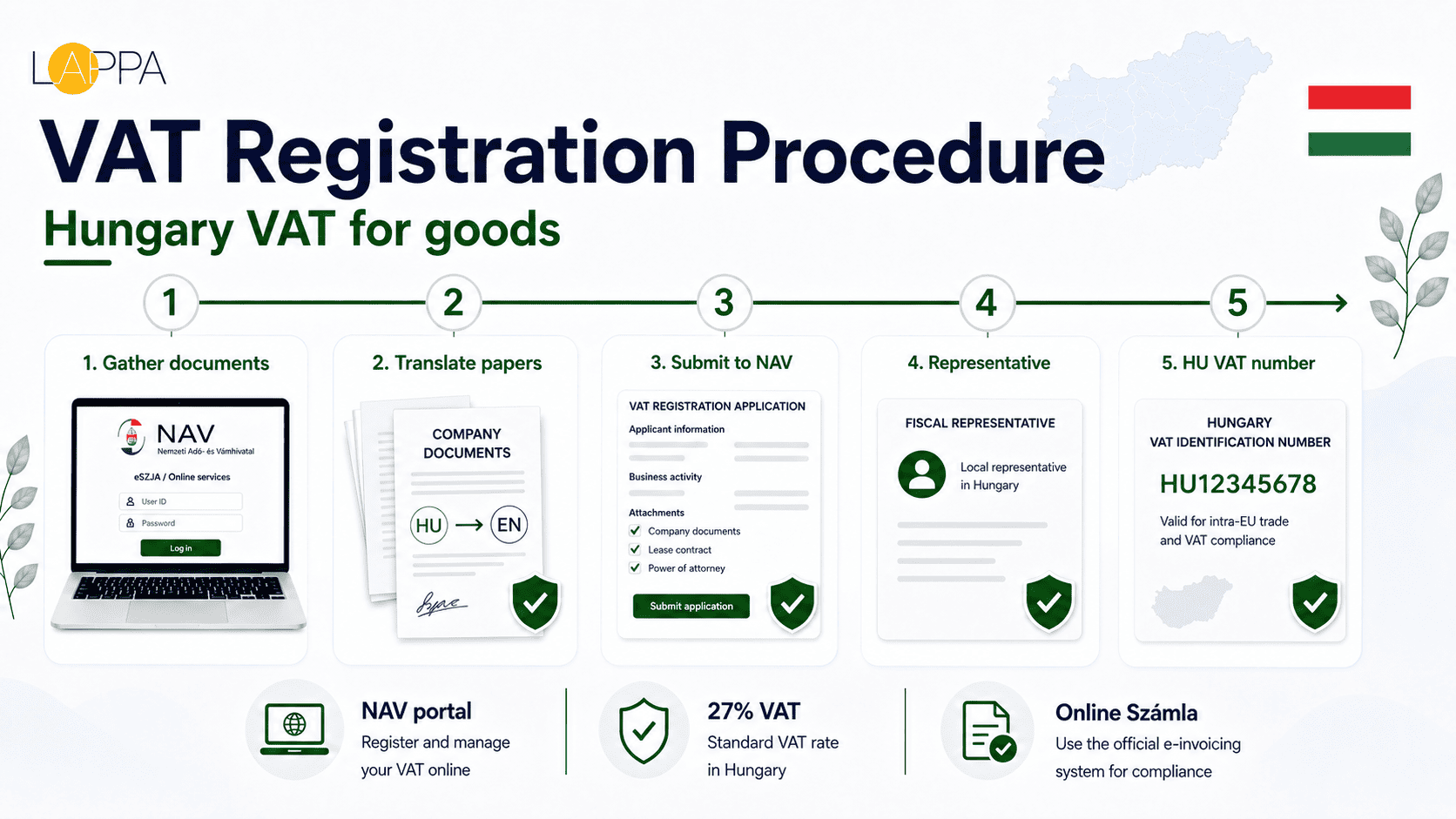 The application itself runs through NAV, though the exact route depends on whether a company already operates elsewhere in Hungary.
An invoice reported the instant it's issued doesn't leave much room to quietly patch an error afterward, so it pays to get every required field right the first time rather than treating the first draft as a rough one.
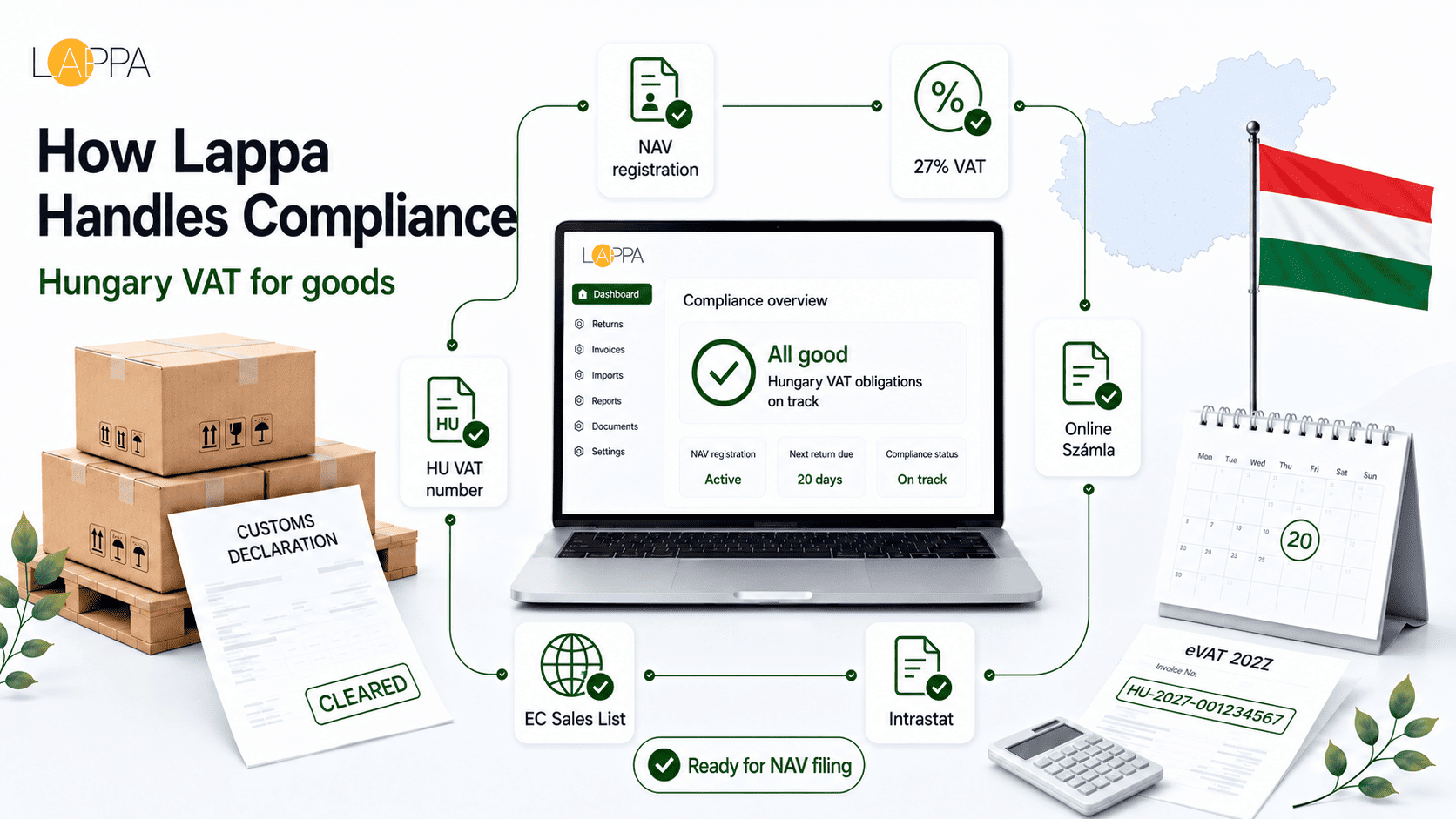 Real-time invoice reporting, translated registration paperwork, EC Sales Lists, and an eight-year record trail add up to a compliance load that catches plenty of newcomers off guard. Lappa handles the registration application with NAV, keeps invoice reporting current through Online Számla, and manages the shift toward the eVAT platform ahead of its 2027 deadline. Clients arrive asking what is VAT in Hungary compared with their home market surprisingly often, since the real-time reporting speed genuinely is unusual. Whichever paperwork a new client brings, sorting out VAT registration Hungary requires almost always starts with the translation step. Compliance looks different in every market — this Fiji compliance guide shows how the same underlying questions play out somewhere with a far simpler system.
Hungary VAT - What Goods Sellers Need to Know
Hungary VAT runs on stricter rules than most of the bloc, and the rate itself sits well above the EU average. A seller shipping stock into the country gains little from waiting to sort out registration, since NAV expects foreign businesses to sign up from the very first taxable sale rather than after crossing some grace threshold. Some suppliers still write the term the other way round, as VAT Hungary, and both versions mean the same obligation.VAT Hungary Terminology Note
Whichever order gets used on paperwork, VAT Hungary and the standard phrasing point to one identical registration duty.Introduction to VAT in Hungary
This consumption charge lands on nearly every sale of goods and services here, with a registered company doing the work of collecting it and handing it over to NAV on schedule. Hungary built its version on top of the EU VAT Directive, then layered in the domestic VAT Act (Act CXXVII of 2007) plus a real-time invoice reporting regime that goes further than most of its EU neighbours. VAT in Hungary reaches almost every commercial transaction, so getting the basics sorted early saves headaches for anyone new to the market.What Is VAT in Hungary
Strip away the legal language, and what is VAT in Hungary really comes down to a charge that gets added at every step of a supply chain but ultimately lands on whoever buys the finished product. The twist here is speed: a registered seller has to report nearly every invoice to NAV within moments of writing it, through the Online Számla platform, which is a far tighter loop than most other EU countries bother running.VAT Rates in Hungary
Three rates cover goods here, and the standard one happens to be the highest anywhere in the European Union.- Standard rate — 27%: most goods and general merchandise.
- Reduced rate — 18%: specific items including certain dairy products, flour, and hotel accommodation.
- Reduced rate — 5%: books, newspapers, prescribed medicines, and district heating.
| Rate | Percentage | Typical goods |
| Standard | 27% | Electronics, clothing, furniture, general merchandise |
| Reduced | 18% | Certain dairy, flour products, hotel stays |
| Reduced | 5% | Books, newspapers, medicines, district heating |
Hungary VAT Rate for Goods
The Hungary VAT rate attached to any one item comes down to how the VAT Act classifies it, which is worth remembering if a catalogue spans more than a handful of product types — nobody wants to discover mid-invoice that half the order actually sits at a different percentage. Exports and qualifying intra-EU dispatches to registered buyers generally carry a zero rate, while healthcare, education, and financial services sit outside the charge entirely as exempt supplies.VAT Registration Threshold in Hungary
Whether a threshold applies at all depends heavily on where the seller is actually established.For local businesses
A company with a seat or fixed establishment here can stay outside the system as long as yearly taxable sales stay under HUF 20 million — a ceiling that used to sit at HUF 12 million and is due to climb again, to HUF 22 million, in 2027. Below that line, a small business exemption applies automatically, though opting into registration voluntarily can still make sense if reclaiming input credit outweighs the appeal of tax-free pricing.For remote sellers selling goods
Non-resident companies get no such cushion: VAT registration Hungary authorities require begins from the first taxable transaction, whether that means holding inventory in a Hungarian warehouse, shipping from abroad once the EU-wide €10,000 distance-selling threshold is crossed, or simply making a single local sale. Storing goods here for later distribution triggers the same obligation even without any sales having occurred yet.VAT Registration Hungary Overview
Whatever the trigger, registration for this tax in Hungary follows the same online application route through NAV regardless of why the obligation arose.Who Must Register for VAT in Hungary
In practice, this obligation tends to land on:
- Domestic companies whose annual turnover exceeds HUF 20 million.
- Any non-resident business that sells taxable products with no minimum threshold.
- Foreign sellers holding goods in a local warehouse for distribution or fulfilment.
- Businesses importing goods for resale on a recurring commercial basis.
- Companies exceeding the EU-wide €10,000 distance-selling threshold for cross-border B2C goods.
VAT Number in Hungary
Register here and a company walks away with two identifiers rather than one: a domestic tax number for local invoicing, built from eight digits, a one-digit code, and a two-digit county marker, and a VAT number Hungary issues specifically for trading across EU borders.VAT Number Hungary Basics
Whichever of the two identifiers applies, every VAT number Hungary issues has to appear correctly on the matching type of invoice, domestic or cross-border, or a buyer's own recovery claim can stall.Hungary VAT Number Format and EU VAT Number Hungary Explained
The Hungary VAT number used inside the country isn't the one a partner in another member state will recognise. Cross-border paperwork calls for a different code entirely — the EU VAT number Hungary assigns starts with HU and adds eight digits after it, and that's the version VIES actually checks against. Slipping the domestic number onto an intra-EU invoice by mistake is one of the more common, entirely fixable errors sellers make here.VAT Registration Procedure in Hungary
The application itself runs through NAV, though the exact route depends on whether a company already operates elsewhere in Hungary.
- Gather corporate documents: incorporation papers, proof of business activity, and often a tax certificate from the home country.
- Have the key paperwork translated — NAV rarely accepts anything that isn't in Hungarian, or at least accompanied by a certified translation.
- Submit the application to NAV, either directly or through a fiscal representative where one is required.
- Non-EU businesses appoint a Hungarian fiscal representative as part of this step, since it's mandatory rather than optional for them.
Tax Representative in Hungary
Companies established outside the EU must appoint a local fiscal representative, and that representative doesn't just handle paperwork — if the tax bill goes unpaid, NAV can pursue them for it just as it would the foreign company itself. EU-based businesses face no such mandate, though many still bring one on given the language barrier and the demands of real-time reporting — a representative already fluent in NAV's systems tends to catch formatting errors before they become penalties.VAT Electronic Invoices in Hungary
Nothing about invoice reporting here is optional or occasional — the real-time system is simply how compliance works.| Business size | Typical e-invoicing obligation | Timing |
| All registered sellers | Real-time reporting via Online Számla for nearly every invoice | Ongoing, immediate upon issuance |
| Businesses using ÁNYK forms | Migration to newer data-based platforms | ÁNYK shuts down 31 December 2026 |
| All registered taxpayers | Mandatory use of the eVAT (eÁFA) platform for returns | Exclusive from 1 January 2027 |
VAT Returns in Hungary
A registered goods seller typically juggles several parallel obligations:- Periodic return: the core filing declaring output and input tax, generally monthly by default.
- EC Sales List: required for supplies of goods to registered customers in other EU states, sometimes needed even as a nil filing.
- Intrastat declarations: due once annual thresholds for intra-EU trade in goods are exceeded.
- Import documentation: customs paperwork for goods entering from outside the EU, since import tax is due at clearance.
Deductible VAT in Hungary
Tax paid on goods and services used for taxable business activity is generally recoverable against output tax collected on sales, provided the seller holds a compliant invoice showing the supplier's tax number. One upside of the real-time system: if a claimed credit doesn't line up with what's actually been reported, that gap tends to show up almost immediately rather than sitting unnoticed until an audit years later.VAT Record Keeping Requirements in Hungary
Eight years — that's the window a registered seller needs to hold onto invoices and the accounting trail behind them, in case NAV comes asking. Most of that trail already lives online anyway, given how much of the filing and reporting runs through Online Számla and eVAT rather than paper.VAT Penalties in Hungary
- A general tax shortfall penalty of up to 50% of the underpaid amount applies on assessment.
- Concealment or fraudulent underreporting can push that penalty as high as 200% of the tax due.
- Failing to report an invoice correctly under the real-time system can bring a fine of up to HUF 1,000,000 per invoice.
- Late payment accrues default interest calculated at the central bank base rate plus a statutory margin.
- Keep ignoring registration or filing duties, and NAV moves from fines toward broader enforcement action.
How Lappa Can Help with VAT Compliance in Hungary
Real-time invoice reporting, translated registration paperwork, EC Sales Lists, and an eight-year record trail add up to a compliance load that catches plenty of newcomers off guard. Lappa handles the registration application with NAV, keeps invoice reporting current through Online Számla, and manages the shift toward the eVAT platform ahead of its 2027 deadline. Clients arrive asking what is VAT in Hungary compared with their home market surprisingly often, since the real-time reporting speed genuinely is unusual. Whichever paperwork a new client brings, sorting out VAT registration Hungary requires almost always starts with the translation step. Compliance looks different in every market — this Fiji compliance guide shows how the same underlying questions play out somewhere with a far simpler system.
FAQ for Hungary VAT Goods
What is the VAT rate in Hungary
The standard rate is 27%, the highest anywhere in the European Union. A reduced rate of 18% applies to specific items such as certain dairy products and hotel accommodation, while a further reduced rate of 5% covers books, medicines, and district heating. Exports and qualifying intra-EU B2B dispatches are zero-rated. Certain supplies, including healthcare, education, and financial services, are exempt outright rather than merely reduced.Who needs VAT registration in Hungary
A domestic company needs to register once annual turnover exceeds HUF 20 million, though voluntary registration below that line is possible. Any non-resident business making a taxable sale must register immediately, since no threshold applies to foreign sellers at all. Holding goods in a Hungarian warehouse, importing for resale, or crossing the EU-wide €10,000 distance-selling threshold all trigger the same obligation. Non-EU businesses additionally need a local fiscal representative as part of that registration.What is the VAT number format in Hungary
Domestic invoicing uses a tax number formatted as eight digits, a one-digit VAT code, and a two-digit county code. This domestic Hungary VAT number works fine for local sales but stops being enough the moment a transaction crosses an EU border. Cross-border transactions with other EU states instead use an EU-prefixed identifier: the letters HU followed by eight digits, which is the format checked through the VIES database. Businesses should use the correct version depending on whether a transaction is domestic or intra-EU, since an EU VAT number Hungary counterpart expects looks nothing like the purely domestic one. Mixing the two up on an invoice is a common, avoidable source of processing delays. What is the current VAT rate in Hungary The current standard rate remains 27%, a figure that has held steady for several years and continues to be the highest in the EU. Reduced rates of 18% and 5% apply to specific categories of goods, while certain services stay exempt or zero-rated depending on classification. Tracking this Hungary VAT rate matters most for anyone pricing multi-year contracts across several EU markets at once. Companies should verify their current NAV advice before a big pricing adjustment, since real-time invoice reporting provides limited opportunity to fix a misclassified rate after the fact. Checking official sources periodically is a sensible habit given how strictly this system gets enforced.How often are VAT returns filed in Hungary
Most registered businesses file monthly by default, with payment due by the 20th of the month following the reporting period. Lower-turnover, lower-risk taxpayers can sometimes qualify for quarterly filing instead. Alongside the periodic return, EC Sales Lists and Intrastat declarations may also be due depending on the nature of a company's cross-border activity. Missing a filing deadline adds default interest and risks the broader penalty regime described earlier in this guide.VAT Calculator
Nothing complicated here, just two directions of the same sum: multiply to add the charge on top of a bare price, divide to pull it back out of one that already includes it.- Net to gross (standard rate): price × 1.27 = gross price including the charge.
- Net to gross (reduced rate): price × 1.18 or × 1.05, depending on the applicable reduced rate.
- Gross to net (standard rate): gross price ÷ 1.27 = net price before the charge.
VAT Standard rate
27%
VAT Reduced rate
18% and 5%
Thresholds
From 1 January 2026, the domestic small-business VAT exemption threshold is HUF 20 million in annual Hungarian turnover