


Chile VAT Compliance and Registration Guide
Provinces
Goods
Provinces
Goods
About
Goods
About
Goods
Goods
Goods
Introduction to VAT in Chile — IVA Framework and How VAT in Chile Works
- That's when Chile turned on its value-added tax — earlier than most Latin American neighbours, and built around a credit-invoice mechanism that replaced a cascading turnover tax which had been compounding costs across every supply chain stage since the colonial era. The local name is IVA, Impuesto al Valor Agregado. VAT in Chile is administered entirely by the SII — Servicio de Impuestos Internos — through its national portal at sii.cl. No regional fragmentation. No separate state-level tax authority. The SII runs the whole show, centrally.
VAT Rates in Chile — Chile VAT Rate and VAT rate Chile
19%. That's the whole answer. The Chile VAT rate is a single flat 19% — no reduced tier, no luxury surcharge, no intermediate band. The rate moved to 19% in 1990 and hasn't shifted since. Three decades and counting.| Rate | Category | Typical Supplies |
| 19% | Standard | Professional services, retail, construction, telecoms, most manufacturing |
| 0% | Zero-rated | Exports of goods, international freight, qualifying cross-border services |
| Exempt | No IVA | Education, healthcare, financial services, certain real estate |
VAT Registration Threshold in Chile — Local Businesses, Remote Sellers and Digital Services
For Local Businesses
No threshold. Zero. Chile's IVA — unlike EU VAT systems — applies from the first taxable transaction with no minimum revenue floor. Chilean-established entities — companies, individual traders, branches — register with the SII from the first taxable activity. Even a freelancer issuing their first boleta de honorarios triggers registration. Two distinct steps to get there. RUT assignment happens at legal formation — companies register through the Registro de Empresas y Sociedades and get a RUT automatically. But the IVA obligation doesn't activate until the business files an Inicio de Actividades with the SII. Formation and activation are separate events. Miss the second step and the IVA clock doesn't start — which sounds convenient until the SII spots the gap in an audit.For Remote Sellers
Non-residents shipping goods into Chile encounter IVA at the customs border. The DGA — Dirección General de Aduanas — collects import IVA on all incoming physical shipments. But a non-resident that holds stock in Chile, or operates through a dependent agent on Chilean territory, faces a direct SII registration obligation regardless of legal structure abroad.For Remote Digital Services
June 2020. That's when Ley 21.210 changed the landscape. Non-resident digital service providers supplying Chilean consumers must register for IVA at 19% and collect it. The SII built a simplified registration track specifically for foreign platforms — no local entity required, no fiscal representative mandated for this route. B2C: supplier charges and remits. B2B: reverse charge shifts the obligation to the Chilean business recipient. Streaming platforms, software vendors, advertising networks: the ones that waited to see if enforcement would arrive found out it did.Who Must Register for VAT in Chile
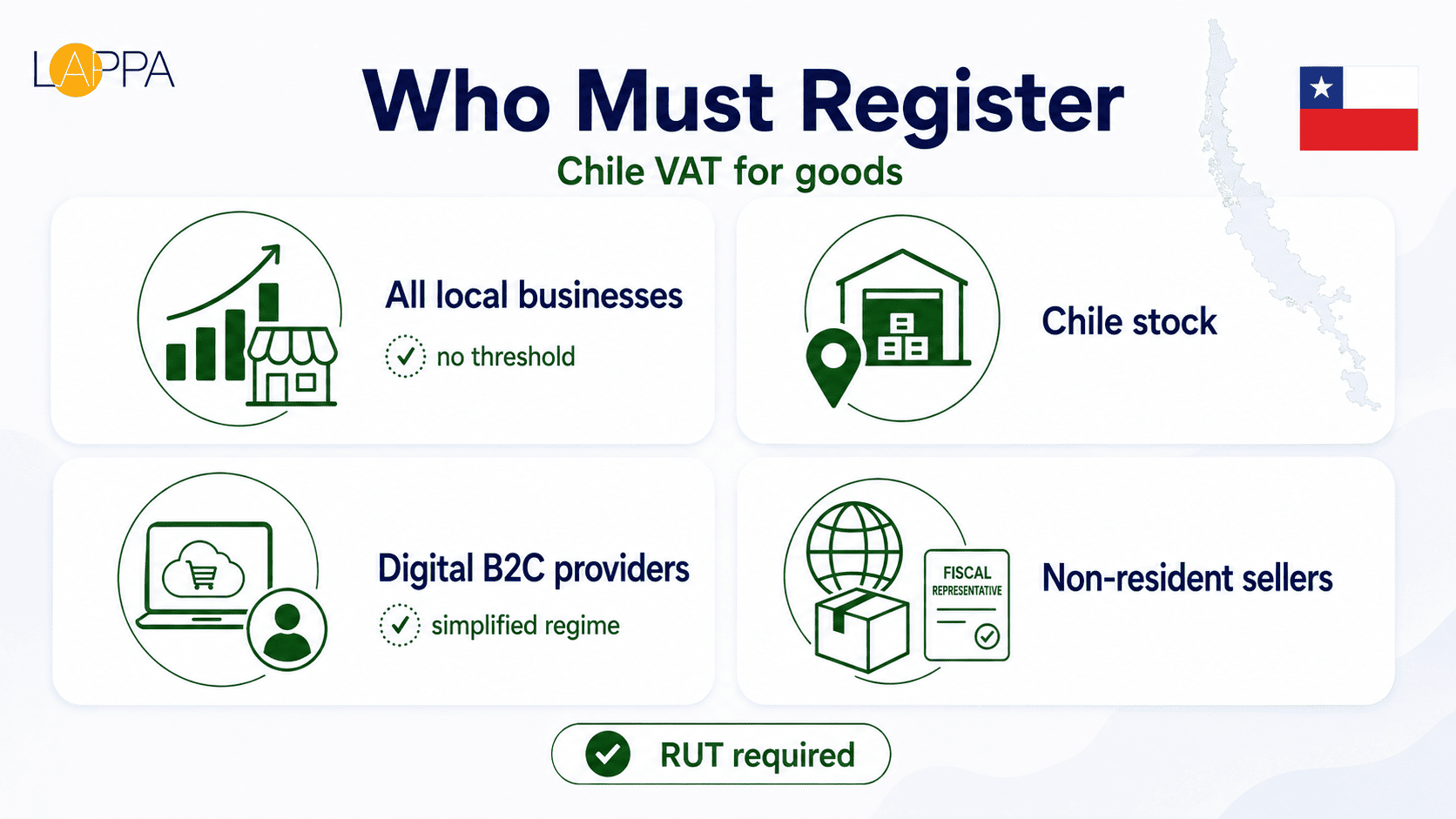 IVA registration covers:
- All Chilean-established businesses from their first taxable commercial activity — via Inicio de Actividades with the SII.
- Branches and permanent establishments of foreign companies from the date of establishment.
- Non-residents holding stock in Chile or operating through dependent agents on Chilean soil.
- Non-resident digital service providers supplying B2C electronic services to Chilean consumers — through the SII's simplified non-resident registration portal.
- Foreign businesses with a habitual presence in Chile even without a formally registered local entity.
VAT Number in Chile — VAT Number Chile, VAT id Chile and RUT Format
The VAT number Chile uses is the RUT — Rol Único Tributario. One number, all Chilean tax obligations: IVA, corporate income tax, payroll, customs. No separate VAT-only identifier exists alongside it. The RUT is assigned at company formation or, for individuals, at birth. RUT format: seven or eight digits, a separator, and a single verification character — 0 through 9, or the letter K. Companies run to 8 digits: 76.543.210-K as a typical example. Periods separate the digit groups in printed form. The check character comes from a modulo-11 algorithm. A typo almost always fails the checksum — which is the practical point.| Entity Type | Format | Example | Issuing Authority |
| Legal entity | XX.XXX.XXX-X | 76.543.210-K | SII / Registro Civil |
| Individual | X.XXX.XXX-X | 9.876.543-2 | Registro Civil |
| Foreign non-resident | Assigned on registration | Per SII simplified portal | SII |
VAT Registration Procedure in Chile
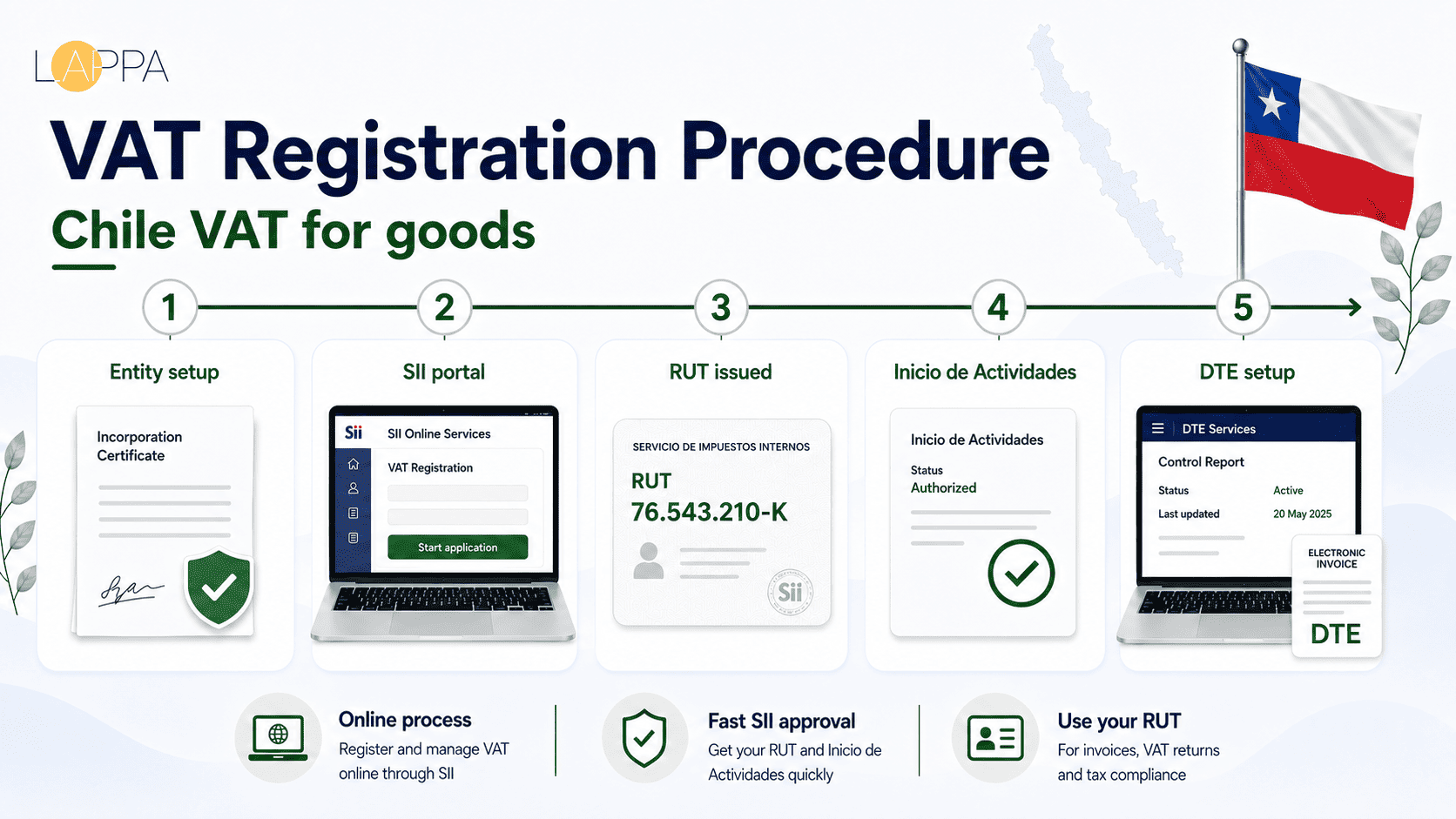 Two steps. Legal formation creates the RUT. The Inicio de Actividades filing activates IVA obligations. Both are doable online, but they are different processes at different stages.
For a Chilean-incorporated company:
Two steps. Legal formation creates the RUT. The Inicio de Actividades filing activates IVA obligations. Both are doable online, but they are different processes at different stages.
For a Chilean-incorporated company:
- Incorporate through the Registro de Empresas y Sociedades — online portal, issues RUT and legal existence simultaneously.
- File Inicio de Actividades at sii.cl — describe commercial activities, name the legal representative, confirm business address.
- SII activates the tax account. IVA billing rights open once the SII confirms the economic activity code.
- Apply for DTE authorisation — mandatory before issuing the first electronic invoice. The SII approves third-party DTE software or assigns the free in-house tool.
Tax Representative in Chile
Non-residents who don't qualify for the simplified digital regime — goods sellers, businesses with Chilean establishments, service providers outside the digital category — must appoint a Chilean fiscal representative before SII registration can proceed. The representative files IVA returns, handles all SII correspondence, manages audit responses, and receives official notices. And Chilean law creates joint liability in specific circumstances. Firms taking on the mandate are accepting that they stand behind the foreign client's IVA obligations if things go wrong. That's priced into the engagement. Businesses with messy prior compliance histories or unusual trading patterns find it harder — and more expensive — to secure a representative willing to take them on. Non-residents on the Ley 21.210 digital track register without a representative. The SII designed that pathway specifically to lower friction for foreign platforms. But it covers digital services to consumers. Physical goods, warehouse operations, dependent agents on the ground: all go through the standard route, representative required. One practical note worth repeating: SII correspondence is in Spanish. A representative who functions in both the client's language and Spanish isn't optional for most foreign businesses — it's the realistic minimum for managing audit requests within SII deadlines.VAT E-Invoices in Chile — DTE Timeline for Different Business Sizes
- That's when Chile started rolling out mandatory electronic invoicing — making it one of the earliest countries anywhere to do so. The system is the DTE, Documento Tributario Electrónico, and by 2017–2018 it had reached virtually every IVA-registered business in the country.
- Factura Electrónica — B2B IVA transactions
- Boleta Electrónica — consumer sales
- Liquidación-Factura — commissions and settlements
- Nota de Débito and Nota de Crédito — corrections and credit adjustments
| Business Segment | DTE Status | Platform Options |
| Large taxpayers (Grandes Contribuyentes) | Mandatory since 2003–2004 | SII portal or certified software |
| Medium taxpayers | Mandatory since 2014–2016 | SII portal or certified software |
| Small taxpayers and new registrants | Mandatory on Inicio de Actividades | Free SII-provided DTE tool (MIPYME) |
| Non-resident digital services registrants | Electronic invoicing not required for B2C | Simplified regime applies |
VAT Returns in Chile — Form 29 Filing and VAT Control Report
Form 29 — Formulario 29 de Declaración Mensual y Pago Simultáneo. Monthly. Every registered taxpayer. No quarterly option, no annual rollup. Due dates: 20th of the following month for paper filers. 28th for electronic filers — and since almost everyone files electronically through the SII portal, almost everyone gets the 28th. January IVA: due 28 February for electronic filers. Payment and declaration on the same date. Miss the return and you've automatically missed the payment deadline. Form 29 captures:- Output IVA on sales, broken down by transaction type
- Input IVA on purchases and imports claimed as credit
- Net IVA payable or credit carried forward
- Withholding taxes and other simultaneous charges
Deductible VAT in Chile
Input IVA on purchases offsets output IVA on sales. Three things need to hold simultaneously:- The supplier is IVA-registered with an active Inicio de Actividades
- A valid DTE — factura electrónica — supports the claim (paper invoices post-DTE mandate won't hold up)
- The purchase serves taxable IVA activity
- Personal use and expenses with no business connection
- Inputs exclusively tied to exempt supplies
- Entertainment above SII-published norms
VAT Record-Keeping Requirements in Chile
Six years. Statutory minimum under the Código Tributario, from 31 December of the relevant year. Chilean VAT record-keeping obligations run longer than most European equivalents — the standard EU floor is five years. Worth factoring into data retention policies from day one. Records in scope:- All issued and received DTEs — Facturas, Boletas, Notas de Crédito/Débito
- Import customs declarations
- Form 29 declarations as submitted, with SII portal receipts
- Libro de Compras y Ventas — maintained through the SII portal, pre-populated from DTE data
- Contracts with ongoing IVA implications
- Bank statements confirming IVA payments
VAT tax Chile — Penalties and VAT Chile Enforcement Costs
VAT tax Chile enforcement runs through the SII's audit and recovery divisions, under the Código Tributario penalty framework. Late filing: 10% of IVA owed for the first month late, rising to 20% from month two. Plus 1.5% monthly interest on unpaid IVA from the due date. Both charges apply at once. One month late on CLP 10 million: CLP 1 million filing fine, CLP 150,000 interest. That's before touching the underlying tax. Unregistered operation: Full backdated IVA liability on all qualifying turnover from the moment the obligation arose, plus fines and compounding interest from every missed filing date. The SII treats operating without registration as active evasion under Article 97. Criminal liability in serious cases — not just administrative penalties. Deliberate understatement: Article 97 No. 4 and No. 5. Fines up to three times the evaded amount, plus criminal prosecution and potential imprisonment for the legal representatives personally responsible. The SII does pursue these. VAT Chile audit risk concentrates in predictable places: exporters with large input IVA refund claims, businesses showing persistently high input-to-output ratios, first-year registrants, and non-resident digital services registrants where declaration volumes suggest B2C supplies are being mis-classified as B2B to avoid IVA altogether. Chile's indirect tax burden isn't light. 19% on most commercial transactions, no threshold relief, and an SII that holds real-time DTE data on every invoice ever issued. Cross-referencing Form 29 figures against DTE records against customs data happens automatically. Discrepancies surface fast.How Lappa Can Help with VAT Compliance in Chile
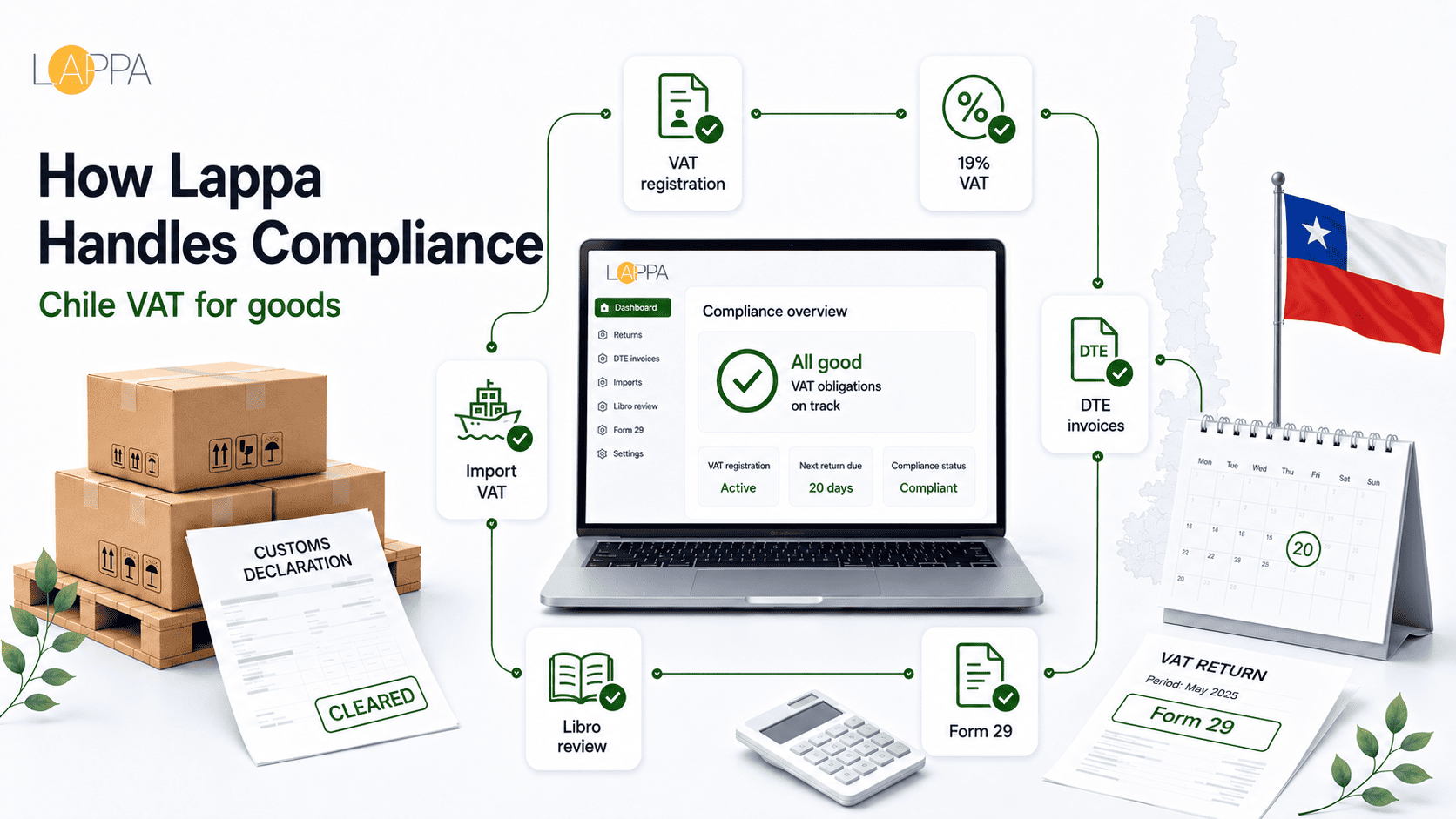 Lappa covers the full Chile IVA cycle: SII registration and Inicio de Actividades, monthly Form 29 preparation and filing, DTE setup and compliance management, and ongoing SII correspondence.
For non-resident businesses entering Chile, Lappa provides fiscal representative services — building the SII registration file, handling return filings and audit responses, and keeping compliance current through annual Finance Law updates.
Article 27bis capital goods IVA recovery, input prorata management for mixed taxable-and-exempt operations, and cross-border IVA management for LatAm, EU, and CEMAC multinationals with Chilean subsidiaries — all from a single workflow.
Lappa covers the full Chile IVA cycle: SII registration and Inicio de Actividades, monthly Form 29 preparation and filing, DTE setup and compliance management, and ongoing SII correspondence.
For non-resident businesses entering Chile, Lappa provides fiscal representative services — building the SII registration file, handling return filings and audit responses, and keeping compliance current through annual Finance Law updates.
Article 27bis capital goods IVA recovery, input prorata management for mixed taxable-and-exempt operations, and cross-border IVA management for LatAm, EU, and CEMAC multinationals with Chilean subsidiaries — all from a single workflow.
FAQ
What Is the VAT Rate in Chile
- The VAT rate in Chile is 19% — a single flat rate with no reduced tier. Stable since 1990, unchanged for 2026. Exports are zero-rated: no IVA charged, input IVA fully recoverable. Healthcare, education, and certain financial services sit outside the IVA net entirely.
Who Needs to Register for VAT in Chile
- Every Chilean-established business from its first taxable activity — no threshold exists. Branches and permanent establishments of foreign companies register from the date of establishment. Non-resident digital service providers supplying Chilean B2C consumers register through the SII's simplified foreign portal under Ley 21.210.
What Is the VAT Number Format in Chile
- Chile uses the RUT — Rol Único Tributario — as its universal tax identifier for IVA and all other taxes. Format: XX.XXX.XXX-X, verification digit 0–9 or K at the end. Companies typically run 8-digit RUTs; individuals 7 or 8. The VAT number Chile assigns through the SII is a single permanent identifier covering all tax types. Status is verifiable at sii.cl.
How Often Are VAT Returns Filed in Chile
- Monthly. Form 29, every month. Electronic filers get the 28th of the following month; paper filers get the 20th. Payment is due on the same date as the declaration.
Do Foreign Companies Need a Tax Representative in Chile
- Non-residents registering under the simplified Ley 21.210 digital services regime don't need a local representative. All others — goods sellers, businesses with Chilean establishments, service providers outside the digital category — must appoint a Chilean fiscal representative before SII registration proceeds.
VAT Calculator
At Chile's VAT rate of 19%: multiply the net by 1.19. CLP 1,000,000 net → CLP 190,000 IVA → CLP 1,190,000 gross. To pull IVA out of a gross figure: divide by 1.19, subtract. The arithmetic isn't complicated. Getting the invoice fields right is where businesses trip up. At 0% (exports): no IVA on the invoice, but the exporter recovers full input IVA on all production costs. A copper mining company exporting to Asian markets charges zero IVA at point of sale — but it claims back the IVA on every piece of equipment, contractor service, and consumable that went into the shipment. Those refunds are material. DTE invoices — Documentos Tributarios Electrónicos — must show net amount, rate, IVA amount, and gross as four distinct fields. A gross-only figure doesn't support a credit claim. The SII disallows. Not reduces — disallows.
VAT Standard rate
19%
VAT Reduced rate
0%
Thresholds
No VAT registration threshold (businesses carrying out taxable activities must register). Non-resident digital service providers must register from the first taxable supply unless the tax is collected through withholding.