


Slovakia VAT Guide for Businesses
Provinces
Goods
Provinces
Goods
About
Goods
About
Goods
Goods
Goods
Introduction to VAT in Slovakia
VAT in Slovakia is called DPH -- Dan z pridanej hodnoty. The Financna sprava (Financial Administration of the Slovak Republic) administers it. Slovakia is a eurozone member since 2009 and an EU member since 2004, so the standard EU VAT framework applies -- but Slovakia made a significant rate change in January 2025, raising the standard rate from 20% to 23% as part of a fiscal consolidation package. If you're working from older guides or spreadsheets that reference 20%, update them. VAT Slovakia rules include a control report mechanism -- the Kontrolny vykaz DPH -- that runs at invoice level alongside the standard DPH return. Every registered business files it at the same frequency as its periodic return, and it feeds the Financna sprava's automated cross-referencing system. It's closer in scope to Poland's JPK_V7 than to a simple return reconciliation, and getting it right matters for audit risk. This guide covers physical goods and digital services. Goods sellers with stock in or moving through Slovakia generally need direct Slovak DPH registration. Digital service providers can route EU B2C sales through the One Stop Shop without a separate Slovak number. Read the threshold section first -- which route fits depends on your turnover, your business location, and the type of supply.VAT Rates in Slovakia
| Rate Tier | Rate | Common Examples |
| Standard | 23% | Software, professional services, electronics, clothing, telecoms, advertising, construction, financial services not otherwise exempt, most commercial goods and services |
| Reduced | 5% | Basic foodstuffs, non-alcoholic beverages, medicines, hotel accommodation, restaurant services, books, newspapers, cultural and sporting event admissions |
| Zero / Exempt | 0% / Exempt | Exports to non-EU destinations, intra-EU B2B goods supplies to registered buyers, healthcare, financial services, education, insurance, postal services |
Slovakia VAT Rate -- Standard and Reduced Tiers
Slovakia VAT rate structure has two active tiers since the January 2025 reform. Standard at 23% covers most commercial transactions: software, consulting, electronics, construction, advertising. The 5% reduced rate applies to basic food and non-alcoholic beverages, medicines, hotel accommodation, restaurant services, books, newspapers, and admissions to cultural and sporting events. If you sold into Slovakia before 2025 and applied the old 20% standard rate to supplies that remain standard-rated, your historical pricing and invoice records are accurate -- but going forward, every standard-rated supply hits 23%. The 5% reduced rate covers a broader set of categories than the old 10% reduced rate did. Accommodation and restaurant services moved to 5% in the reform -- a meaningful reduction for hospitality operators. Essential goods like medicines and basic food are also at 5%. For most foreign businesses selling professional services or software into Slovakia, only the standard 23% rate is relevant. For food, hospitality, or publishing businesses, the 5% rate is what you need to apply correctly.Slovakia Standard VAT Rate Since January 2025
Slovakia standard VAT rate increased from 20% to 23% on January 1, 2025, under the government's fiscal consolidation measures. This is one of the higher standard VAT rates in the EU -- above Germany's 19%, above Poland's 23% (equal), and below Hungary's 27%. The rate applies to all supplies not explicitly covered by the 5% reduced rate or the zero/exempt categories. Software licences, SaaS subscriptions, consulting fees, advertising -- all at 23% on transactions subject to Slovak DPH. Zero-rated supplies in Slovakia follow the standard EU pattern: exports to non-EU destinations, intra-EU B2B goods supplies to registered buyers with valid EU VAT numbers, and certain transport services linked to international trade. Exempt supplies include healthcare services, financial products, insurance, education, and postal services. Exempt means no DPH charged and no input DPH recovery on related costs -- the distinction from zero-rated matters for your input tax position.VAT Registration Threshold in Slovakia
| Seller Category | Threshold | Key Notes |
| Slovak resident business | EUR 49,790 annual turnover | Established under Section 4 of the Slovak VAT Act. Once the threshold is exceeded mid-year, registration is mandatory from the first day of the following calendar month. Voluntary registration below the threshold is available at any point. |
| EU distance seller (goods) | EUR 10,000 EU-wide B2C turnover | Combined cross-border B2C across all EU member states. Above EUR 10,000: charge Slovak DPH or file via OSS from your home member state. The threshold resets each calendar year. |
| Non-EU seller (any taxable supply) | No threshold -- from first taxable supply | Register with the Financna sprava before your first taxable B2C or B2B supply in Slovakia. A fiscal representative is required for most non-EU businesses registering directly. |
| Digital service provider (EU or non-EU) | EUR 10,000 EU-wide B2C turnover | SaaS, streaming, gaming, digital downloads, e-learning. Non-union OSS covers all EU B2C digital revenue from one registration -- no separate Slovak DPH number needed for those supplies. |
For local businesses
Slovak businesses hit the EUR 49,790 threshold at the end of any calendar month and must register by the 20th of the following month, with the registration effective from the first day of that month. So if your turnover breaks EUR 49,790 in October, you register by November 20 and charge DPH on supplies made from November 1 -- not from the date of registration approval. That timing gap between the effective date and the actual approval can create retroactive DPH liability if you don't plan for it. Voluntary registration below the threshold is straightforward and worth doing if you're recovering significant input DPH on capital purchases or supplies from other VAT-registered businesses.For remote sellers
EU-based businesses selling goods B2C to Slovak customers apply the EUR 10,000 EU-wide threshold across combined B2C sales in all 27 member states. Under EUR 10,000 in a calendar year: charge home-country VAT. Over EUR 10,000: register for Slovak DPH and charge it on Slovak sales, or use OSS from your home member state. Non-EU sellers have no threshold -- register with the Financna sprava before your first B2C sale, or use IOSS for goods under EUR 150.For remote digital services
Digital service providers apply the same EUR 10,000 EU-wide threshold. SaaS, streaming, gaming, e-books, cloud services, online learning -- if your combined EU B2C digital sales exceed EUR 10,000, you charge Slovak DPH at 23% on Slovak consumer sales. Non-union OSS lets you cover all EU B2C digital revenue from one return in any EU member state. No Slovak DPH number, no Slovak filing, no Slovak representation required for those OSS-covered supplies.Who Must Register for VAT in Slovakia
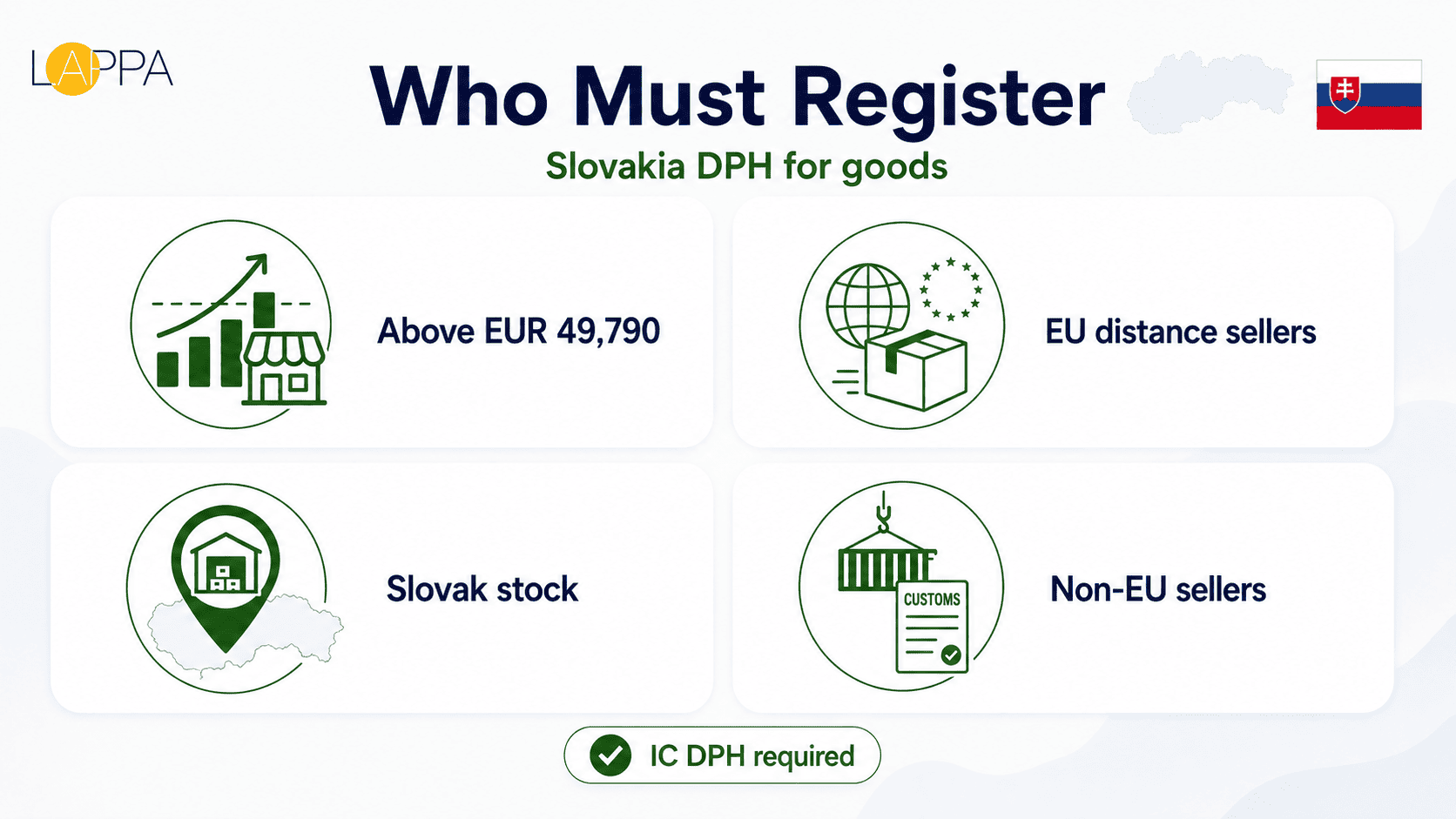 Direct Slovak DPH registration applies to: resident businesses above EUR 49,790 turnover; non-resident businesses making taxable Slovak supplies outside OSS or IOSS coverage; businesses making intra-EU goods acquisitions in Slovakia above EUR 14,000 per calendar year; and businesses receiving B2B services from non-Slovak suppliers where the reverse charge applies. The reverse charge on imported services catches foreign companies regularly -- a Slovak-registered business buying software licences or consulting from a German firm self-assesses DPH at 23%. The German firm doesn't register in Slovakia for that transaction, but the Slovak buyer's reporting obligation is real.
Slovakia VAT Registration for Non-Resident Businesses
Slovakia VAT registration for non-resident EU businesses runs directly through the Financna sprava without a fiscal representative requirement. You apply online through the Financna sprava portal (financnasprava.sk) or by submitting the registration application in paper form to the Tax Office for Selected Tax Subjects in Bratislava, which handles all non-resident registrations. Processing typically takes 30 days from a complete application. Once approved, the IC DPH (Identifikacne cislo pre dan z pridanej hodnoty) is issued -- the SK-prefixed EU VAT number you put on invoices. Non-resident businesses with no establishment in Slovakia but making taxable Slovak supplies -- construction work on a Slovak project, goods warehoused in a Slovak fulfilment centre -- register before the first supply occurs. Pre-registration means you can recover input DPH on setup costs from day one. Waiting until you've already made several supplies creates a retroactive liability and an input tax claim that has to go through a separate refund process rather than netting against output DPH in the normal return cycle.VAT Slovakia Obligations for Ecommerce and Digital Sellers
VAT Slovakia obligations for marketplace sellers fall under EU deemed supplier rules effective July 1, 2021. Platforms facilitating B2C goods sales from non-EU sellers -- or goods shipped from outside the EU valued under EUR 150 -- are the DPH-responsible party. The platform charges and remits DPH; the underlying seller makes a zero-rated supply to the platform. But sellers warehousing goods in Slovakia independently of a platform's deemed supplier arrangement still need direct DPH registration for imports, storage, and B2B supplies. Deemed supplier protection covers specific B2C transactions, not the full supply chain. Non-EU businesses making direct digital B2C sales into Slovakia without an EU establishment can use non-union OSS registered in any EU member state. Slovak B2C digital sales declared through OSS don't require a separate Slovak IC DPH number. The OSS quarterly return covers them. Non-EU sellers with mixed supply types -- some digital B2C covered by OSS, some physical goods or B2B supplies requiring direct registration -- end up managing both routes simultaneously. Slovak VAT treatment of cross-border services follows the standard EU B2B place-of-supply rule: the supply is taxable where the customer is established. A Slovak-registered company buying legal services from a UK firm receives an invoice without DPH, then self-assesses Slovak DPH at 23% in its next DPH return. The UK firm has no Slovak DPH obligation for that transaction. For B2C services from non-EU suppliers with no EU establishment, the non-union OSS or direct registration applies depending on the nature and volume of supply.VAT Number in Slovakia
Slovakia's DPH identification system is built on two tax identifiers. The DIC (Danove Identifikacne Cislo) is the general tax identification number assigned by the Financna sprava to every taxpayer. The IC DPH (Identifikacne cislo pre dan z pridanej hodnoty) is the VAT-specific identifier -- a ten-digit number prefixed with SK for EU purposes. The IC DPH is what goes on invoices and what customers validate through VIES. Not every entity with a DIC has an IC DPH; only those registered for DPH receive it.VAT Number Slovakia -- SK Prefix and DIC Format
VAT number Slovakia follows the format SK + 10 digits, giving a 12-character EU VAT number. The 10-digit section corresponds to the IC DPH. Examples: SK2020201503, SK4020001234. Unlike Portugal's variable-length CIF or France's SIREN-based format, every Slovak VAT number is exactly the same length: SK followed by exactly 10 digits. This makes format validation straightforward -- if a customer gives you a number that's not 12 characters or doesn't start with SK, it fails the basic structural check before you even run a VIES query. The Financna sprava assigns the IC DPH at the time of DPH registration -- it's different from the general DIC. A business might have been registered for income tax for years with a DIC, then register for DPH and receive a separate IC DPH. When validating a Slovak supplier, always validate the IC DPH through VIES -- the DIC alone doesn't confirm DPH registration status.Slovakia VAT number Assignment by the Financial Administration
Slovakia VAT number is issued by the Financna sprava after processing the DPH registration application. For resident Slovak businesses, the IC DPH is assigned within 30 days of the registration obligation arising (or sooner for voluntary registrations). For non-resident EU businesses, the Tax Office for Selected Tax Subjects processes the application and issues the SK-prefix IC DPH. The registration certificate (Rozhodnutie o registracii) confirms the IC DPH and its effective date. That effective date is what appears in VIES -- customers validating your number will see it. The IC DPH propagates to VIES within two to three business days of the Financna sprava registering it in its system. Don't zero-rate intra-EU B2B invoices before you've confirmed your SK-prefix number appears in VIES. Your customer will run a VIES check before processing the invoice -- an invisible number delays payment and creates a gap in your zero-rating justification.VAT id Slovakia and IC DPH Verification
VAT id Slovakia verification runs through VIES at ec.europa.eu/taxation_customs/vies or directly through the Financna sprava portal. VIES returns registration status, business name, and registered address. The Financna sprava portal provides additional detail on Slovak-registered entities. Use both for due diligence on new Slovak counterparties -- VIES confirms active DPH registration; the Financna sprava lookup confirms the company's current registered details and any outstanding tax status flags. An IC DPH that was valid at the time of a historic transaction may no longer appear in VIES if the business subsequently de-registered. Slovak businesses can de-register if turnover drops below EUR 49,790 and they request de-registration, or if the Financna sprava cancels the registration for non-compliance. Always verify IC DPH status at the time of each transaction -- not just when you first add a supplier to your system.VAT Registration Procedure in Slovakia
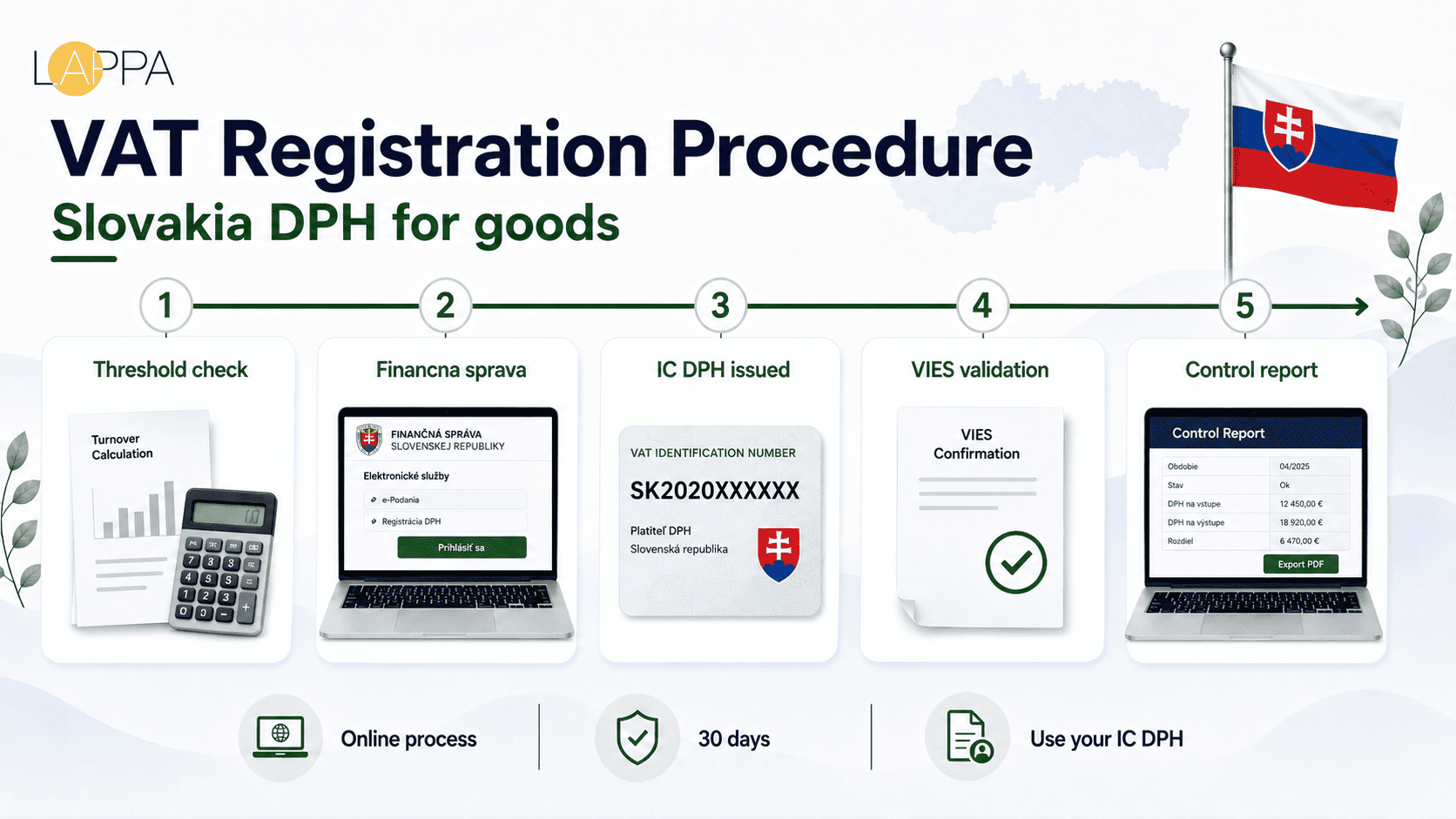 VAT number Slovakia registration for a non-resident EU business is filed with the Tax Office for Selected Tax Subjects (Danovy urad pre vybrane danove subjekty) in Bratislava. This office handles all non-resident DPH registrations regardless of where the business is established within the EU. The application can be submitted online through the Financna sprava portal using the form Ziadost o registraciu pre DPH, or in paper form by post. Online submission through the portal requires an electronic signature or a portal account.
Documents required for a non-resident EU business registration:
VAT number Slovakia registration for a non-resident EU business is filed with the Tax Office for Selected Tax Subjects (Danovy urad pre vybrane danove subjekty) in Bratislava. This office handles all non-resident DPH registrations regardless of where the business is established within the EU. The application can be submitted online through the Financna sprava portal using the form Ziadost o registraciu pre DPH, or in paper form by post. Online submission through the portal requires an electronic signature or a portal account.
Documents required for a non-resident EU business registration:
- Certificate of incorporation or equivalent business registration document from the home country, with a Slovak translation if the Financna sprava requests one
- Proof of planned taxable activity in Slovakia -- contracts, purchase orders, warehouse agreements, or other documentation of intended supply
- Completed registration application form, signed by an authorised representative or officer
- Power of attorney if the application is filed by an agent or tax adviser rather than by the company's own authorised person
- Bank account details for DPH refund payments from the Financna sprava
- For non-EU businesses: appointment of a fiscal representative authorised by the Financna sprava, including the representative's DIC and authorisation letter
Tax Representative in Slovakia
EU and EEA businesses register with the Financna sprava directly. No fiscal representative required. Non-EU businesses making taxable supplies in Slovakia -- physical goods in Slovak warehouses, construction projects, real estate transactions -- must generally appoint a fiscal representative registered with the Financna sprava. The representative holds joint and several liability for the client's DPH. Financna sprava has direct recourse against them for unpaid DPH. Slovakia VAT representative appointments are formalised through a power of attorney submitted to the Financna sprava as part of the non-EU registration application. The representative must hold Slovak authorisation (danovy poradca -- tax adviser, or similar qualified status). A representative who holds the authorisation but has no practical DPH compliance experience is a risk. The Kontrolny vykaz -- with its invoice-level data -- requires a representative who understands Slovak DPH mechanics, not just one willing to sign the appointment. Non-EU businesses that route all their Slovak exposure through non-union OSS don't need a Slovak DPH registration and don't need a fiscal representative for those OSS-covered supplies. A non-EU digital service provider filing non-union OSS from Ireland covers Slovak B2C digital sales through that OSS return. Only supplies outside OSS scope -- physical goods warehoused in Slovakia, B2B supplies to Slovak-registered buyers where the reverse charge doesn't apply, Slovak real estate -- bring the representative requirement into play.VAT E Invoices in Slovakia
Slovakia's e-invoicing infrastructure is built around two separate systems: eKasa for consumer-facing fiscal receipts, and a developing B2G e-invoicing framework for government procurement. eKasa is the older, more established system. B2B mandatory e-invoicing is not yet in force but is part of Slovakia's digital tax administration roadmap. eKasa (electronic cash register system) has been mandatory for retail and consumer-facing businesses since April 2019. Every sale subject to the fiscal receipt obligation must be registered in real time with the Financna sprava's central eKasa server. The system generates an OKP (Offline Control Code) and FPD (Fiscal Seal) that appear on each receipt. Consumers can verify receipts through the Financna sprava portal. For businesses, eKasa is the cash register compliance layer -- it's separate from invoice-level DPH reporting for B2B transactions.Timeline for different business sizes
- April 1, 2019 -- eKasa mandatory for existing electronic cash register users. All consumer-facing businesses using electronic fiscal devices must connect to the Financna sprava eKasa online system. Real-time receipt registration begins.
- July 1, 2019 -- eKasa extended to businesses previously using mechanical or paper-based fiscal registers. All retail and consumer-facing businesses now on the eKasa platform.
- 2019 -- B2G e-invoicing implemented for central government procurement. Suppliers to central government bodies submit invoices via the IS EVO (Electronic Public Procurement Information System) or compatible channels. B2B remains voluntary.
- 2022 -- EU e-invoicing directive transposed into Slovak law, expanding B2G e-invoicing obligations to a wider range of public sector bodies. Large taxpayers encouraged to adopt structured invoice formats.
- 2025 onwards -- Slovakia developing mandatory B2B e-invoicing framework as part of the wider digital tax administration programme. No mandatory B2B launch date confirmed as of early 2025; the Financna sprava has announced consultation on the implementation timeline.
VAT Returns in Slovakia
Types of reports
Slovak DPH-registered businesses manage the following reporting obligations:- DPH return (Danove priznanie k DPH -- D300 equivalent): the periodic VAT return. Monthly by default for all registered businesses. Quarterly allowed if registered for more than 12 consecutive months, prior-year turnover below EUR 100,000, and no serious tax violations in the preceding six months. Deadline: 25th of the month following the reference period. Filed electronically through the Financna sprava portal.
- Kontrolny vykaz DPH (VAT Control Report): mandatory filing at the same frequency as the DPH return. Contains invoice-level data for all supplies made and received -- the primary cross-referencing tool used by the Financna sprava. Deadline: same as the DPH return (25th of the following period). Errors or mismatches in the Kontrolny vykaz trigger Financna sprava queries faster than errors in the DPH return totals.
- Suhrny vykaz (EC Sales List / Summary Statement): covers intra-EU B2B goods supplies and cross-border services where the reverse charge applies. Monthly if goods are involved; quarterly allowed if only services. Deadline: 25th of the following period. Filed electronically through the Financna sprava portal.
- Intrastat: statistical declaration for goods physically crossing Slovak borders within the EU. Current thresholds: approximately EUR 400,000 for dispatches (Odoslanie) and EUR 200,000 for arrivals (Prijatie), reviewed annually by the Slovak Statistical Office. Filed monthly by the 15th of the following month through the Slovak Statistical Office portal.
Deductible VAT in Slovakia
Input DPH recovery in Slovakia follows direct attribution. Costs for taxable supplies: fully recoverable. Costs for DPH-exempt supplies: not recoverable. Mixed-use costs go through a pro-rata calculation based on the ratio of taxable to total turnover. The annual pro-rata coefficient is calculated from prior-year data, applied provisionally during the year, and reconciled in the final return. A significant shift in the taxable/exempt ratio mid-year can affect the final reconciliation significantly. Passenger vehicles with fewer than nine seats: input DPH recovery is based on actual percentage of business use. Slovak law doesn't impose a fixed 50% cap -- it requires you to document and apply the real business use percentage. A vehicle used 80% for business recovers 80% of input DPH on purchase, lease, fuel, and running costs. But 'documented' means records: mileage logs, journey purpose records, or equivalent. An undocumented claim of 100% business use on an executive car that goes home with an employee every evening doesn't survive a Financna sprava audit. Slovakia standard VAT rate at 23% is charged on the purchase of most vehicles subject to DPH. The 23% applies on the invoice, and the recoverable portion of that input DPH follows the business use percentage. A EUR 40,000 car purchased exclusively for business use: EUR 9,200 input DPH, fully recoverable if 100% business use is documented. The same car used 60% for business: EUR 5,520 recoverable, EUR 3,680 irrecoverable. Entertainment and hospitality expenses are generally not recoverable in Slovakia -- same position as most EU member states. Meals, drinks, and entertainment for clients or employees: DPH blocked. The exception is hospitality businesses whose core activity involves providing food and drink, where the costs relate directly to taxable supply. For everyone else, entertainment is a permanently irrecoverable DPH cost and should be budgeted accordingly.VAT Record Keeping Requirements in Slovakia
Slovakia requires VAT records to be retained for ten years from the end of the calendar year in which the tax obligation arose. That's a longer retention period than some EU members -- the ten years applies to all DPH-relevant records: issued invoices, received invoices, customs documents, Kontrolny vykaz data, import and export records, and bank statements supporting DPH payment transactions. Slovakia's VAT ID -- the IC DPH -- must appear on every stored invoice, both issued and received. Invoices without the IC DPH of the issuing business are non-compliant and don't support input DPH recovery. The Finansna sprava's Kontrolny vykaz cross-referencing will flag an invoice where the IC DPH you've recorded doesn't match the issuing business's actual registration. Store invoices in their original format -- paper or electronic -- with the IC DPH clearly legible. Electronic invoice storage is fully permitted under Slovak law, provided the authenticity of origin, integrity of content, and legibility of the stored document can be guaranteed throughout the retention period. eKasa receipts are stored centrally by the Financna sprava's systems -- businesses still need to retain their own copies. Kontrolny vykaz XML files should be retained in the original format submitted. Don't rely solely on reconstructed data from accounting software exports; the submitted file is the record. Switching accounting software during the ten-year retention period requires either migrating all historical data in original format to the new system or maintaining read access to the old system for the full period. In practice, many businesses retain the old system in read-only mode for legacy records. Plan the transition cost of keeping a legacy system accessible when evaluating software changes.VAT Penalties in Slovakia
Late filing of the DPH return carries a penalty of EUR 30 to EUR 16,000 per return, depending on how late it is and whether the Financna sprava initiated the filing through an enforcement notice. Voluntary late filing before a Financna sprava demand costs significantly less than filing after receiving a notice to comply. If you know you're missing the 25th deadline, file late on your own initiative rather than waiting. The Kontrolny vykaz DPH has its own separate penalty structure. Filing a Kontrolny vykaz with errors -- missing invoices, incorrect amounts, wrong IC DPH numbers -- can attract penalties up to EUR 10,000 per filing period, per error category. The Financna sprava runs automated matching between Kontrolny vykaz filings and issues queries for mismatches. Respond to queries within the deadline (usually 15 business days) -- ignoring them escalates to penalties and potentially a formal tax inspection. Slovakia's VAT rate error -- charging 5% on a supply that's standard-rated at 23% -- creates both an underpayment liability and a Kontrolny vykaz mismatch when your customer reports the supply at 5% and the Financna sprava expects it at 23%. The correction requires a supplementary DPH return and a corrected Kontrolny vykaz for the affected period. Both carry their own penalty exposure if the error is material and if the Financna sprava identified it rather than you. Late DPH payment generates interest at four times the National Bank of Slovakia's base rate, applied per day from the day after the payment deadline. The base rate changes periodically -- the effective daily interest rate varies accordingly. At current base rates, a one-month delay on a EUR 50,000 DPH liability costs approximately EUR 200-300 in interest. Larger liabilities and longer delays multiply proportionally.How Lappa Can Help with VAT Compliance in Slovakia
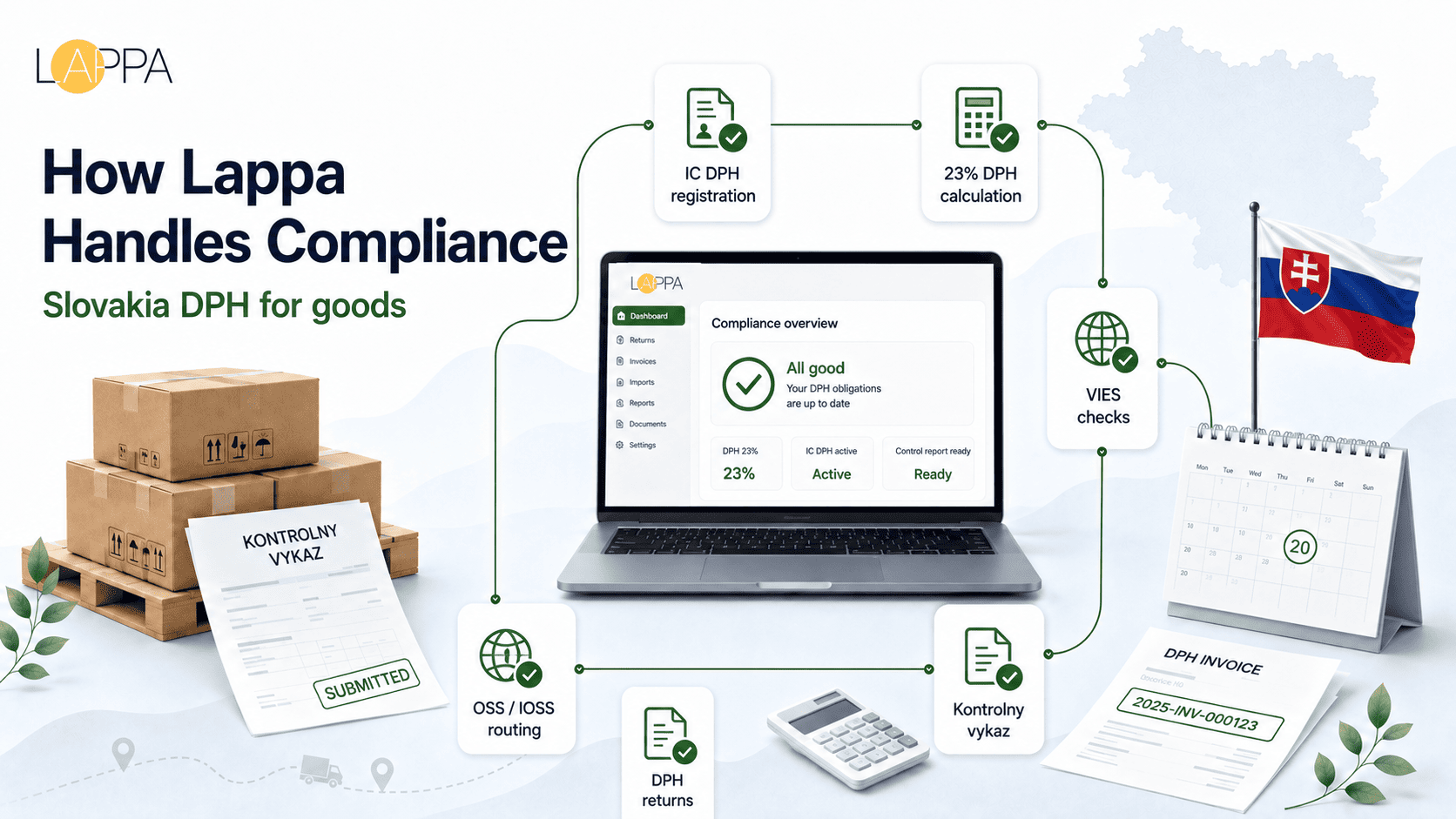 Slovakia's DPH compliance stack -- periodic DPH return, Kontrolny vykaz invoice-level filing, Suhrny vykaz EC Sales List, eKasa for consumer-facing operations, and Intrastat for goods -- runs on tight 25th-of-the-month deadlines with cross-referencing built in. Missing any one component generates queries from the others. Lappa manages the full compliance cycle for businesses registered in Slovakia, handling all Financna sprava submissions on the correct schedule.
For businesses entering Slovakia for the first time, Lappa handles DPH registration with the Tax Office for Selected Tax Subjects, covering both EU direct registrations and non-EU applications with fiscal representative appointment. We confirm the IC DPH and VIES visibility before you issue your first Slovak invoice. Registration errors or delays in non-EU applications are the most common cause of retroactive DPH liabilities -- getting the timeline right from the start avoids them.
Slovakia's standard VAT rate change from 20% to 23% in January 2025 required system updates for invoicing, pricing, and Kontrolny vykaz templates. Businesses already working with Lappa made that transition without compliance disruption. For businesses coming in now, Lappa configures the correct 23% rate from the outset -- no legacy rate errors in historical filings to clean up.
Lappa's Slovakia team generates monthly Kontrolny vykaz filings from your transaction data, handles DPH return preparation, Suhrny vykaz submissions, and responds to Financna sprava queries. For businesses already registered but struggling with the Kontrolny vykaz invoice-level reporting, Lappa offers a compliance review: we assess where you stand, correct outstanding issues, and set up the ongoing monthly process.
Slovakia's DPH compliance stack -- periodic DPH return, Kontrolny vykaz invoice-level filing, Suhrny vykaz EC Sales List, eKasa for consumer-facing operations, and Intrastat for goods -- runs on tight 25th-of-the-month deadlines with cross-referencing built in. Missing any one component generates queries from the others. Lappa manages the full compliance cycle for businesses registered in Slovakia, handling all Financna sprava submissions on the correct schedule.
For businesses entering Slovakia for the first time, Lappa handles DPH registration with the Tax Office for Selected Tax Subjects, covering both EU direct registrations and non-EU applications with fiscal representative appointment. We confirm the IC DPH and VIES visibility before you issue your first Slovak invoice. Registration errors or delays in non-EU applications are the most common cause of retroactive DPH liabilities -- getting the timeline right from the start avoids them.
Slovakia's standard VAT rate change from 20% to 23% in January 2025 required system updates for invoicing, pricing, and Kontrolny vykaz templates. Businesses already working with Lappa made that transition without compliance disruption. For businesses coming in now, Lappa configures the correct 23% rate from the outset -- no legacy rate errors in historical filings to clean up.
Lappa's Slovakia team generates monthly Kontrolny vykaz filings from your transaction data, handles DPH return preparation, Suhrny vykaz submissions, and responds to Financna sprava queries. For businesses already registered but struggling with the Kontrolny vykaz invoice-level reporting, Lappa offers a compliance review: we assess where you stand, correct outstanding issues, and set up the ongoing monthly process.
FAQ for Slovakia VAT Goods
What is the VAT rate in Slovakia
Slovakia standard VAT rate is 23% since January 1, 2025, when it increased from 20% under the government's fiscal consolidation package. The 5% reduced rate applies to basic foodstuffs, non-alcoholic beverages, medicines, hotel accommodation, restaurant services, books, newspapers, and admissions to museums, cinemas, sports events, and cultural performances. There's no intermediate rate -- everything is either 23%, 5%, zero-rated, or exempt. For digital services sold B2C to Slovak consumers, the 23% standard rate applies. There's no reduced rate for digital content -- a streaming service, a SaaS subscription, or an e-book platform all charge 23% on sales to Slovak consumers. The only exception is digital versions of books and newspapers, which qualify for 5% because the physical equivalents carry the reduced rate and digital format doesn't change the classification.Who needs to register for VAT in Slovakia
Slovak resident businesses above EUR 49,790 annual turnover. Non-resident businesses making taxable Slovak supplies outside OSS or IOSS scope. Businesses making intra-EU goods acquisitions in Slovakia above EUR 14,000 per year. Businesses receiving B2B services from foreign suppliers where the Slovak reverse charge applies -- even if the net DPH position is zero, the registration obligation is real and the Kontrolny vykaz reporting follows from it. Voluntary registration below EUR 49,790 is available and makes sense if you're recovering input DPH on capital equipment or significant business purchases. EU-based distance sellers apply the EUR 10,000 EU-wide threshold. Digital service providers apply the same EUR 10,000 threshold and can use non-union OSS to avoid direct Slovak registration. Non-EU sellers of physical goods have no threshold -- first Slovak B2C sale, you're in.What is the VAT number format in Slovakia
SK followed by exactly 10 digits. Total 12 characters. The 10-digit section is the IC DPH (Identifikacne cislo pre dan z pridanej hodnoty) assigned by the Financna sprava at DPH registration. Example: SK2020201503. Validate any SK-prefix number through VIES before zero-rating an intra-EU B2B invoice. Every Slovak VAT number is the same length -- SK + 10 digits. If you receive a Slovak number that doesn't fit that format, it's wrong before you even run VIES. Slovakia's VAT number is separate from the DIC (Danove Identifikacne Cislo), which is the general tax identifier. Not every entity with a DIC has an IC DPH -- only those registered for DPH. When verifying a Slovak supplier, always check the IC DPH through VIES, not the DIC. The DIC alone doesn't confirm active DPH registration.How often are VAT returns filed in Slovakia
Monthly by default for all DPH-registered businesses -- that's the standard filing frequency from the start of registration. After 12 consecutive months of registration, with prior-year turnover below EUR 100,000 and no serious tax violations, quarterly filing becomes available on application. Deadline for both: 25th of the month following the reference period. The Kontrolny vykaz DPH files on the same schedule and same deadline as the DPH return. The Suhrny vykaz (EC Sales List) is monthly for businesses with intra-EU goods transactions, quarterly if only services are involved. Intrastat is monthly for businesses above the threshold, due the 15th of the following month. For a monthly DPH filer with intra-EU goods transactions: DPH return, Kontrolny vykaz, and Suhrny vykaz all due the 25th; Intrastat due the 15th. Four filing obligations, two deadlines per month.Do foreign companies need a tax representative in Slovakia
EU and EEA companies: no -- they register directly with the Tax Office for Selected Tax Subjects in Bratislava using form Ziadost o registraciu pre DPH. No fiscal representative required. Non-EU companies making taxable Slovak supplies that fall outside OSS or IOSS: yes, a Financna sprava-authorised fiscal representative is required for the registration application and ongoing compliance. The representative holds joint and several liability for DPH. No representative, no registration for non-EU operators. Slovakia's VAT rules for OSS registrants are consistent with the rest of the EU: an OSS number from another member state covers Slovak B2C digital and distance goods sales -- no SK-prefix IC DPH needed for those supplies. Only direct Slovak supplies outside OSS scope bring the registration and representative requirements back. EU businesses with mixed supply types -- some OSS-covered, some requiring direct registration -- need to manage both tracks separately. The Slovak VAT number issued to a non-EU business via a fiscal representative is the same SK-prefix IC DPH format as any other DPH registration. The route to getting it differs; the number itself doesn't. Changing fiscal representatives doesn't change the IC DPH -- the number stays the same. Update the representative appointment documentation with the Financna sprava and ensure the transition is managed at the start of a filing period to avoid any gap in compliance.VAT Calculator
Slovakia VAT rate calculations are straightforward. Standard rate: multiply the net price by 1.23 to add DPH, or divide the gross by 1.23 to extract it. Reduced rate: multiply by 1.05, divide by 1.05. No regional rate variations in Slovakia -- one rate schedule, one country. Slovak invoices must display net amount, rate applied, DPH amount, and gross total per line item. If you're working with gross prices in a consumer-facing context and need to extract the DPH component, the formula is: DPH = Gross price / 1.23 x 0.23 for standard-rated supplies. For 5% supplies: Gross / 1.05 x 0.05. Automated invoicing tools handle this, but verify the rate applied to each line -- mixing standard and reduced rates on the same invoice is common for food distributors and hospitality businesses, and an error in rate assignment generates a Kontrolny vykaz mismatch.
VAT Standard rate
23%
VAT Reduced rate
19%,5%
Thresholds
Foreign businesses have no registration threshold when carrying out taxable transactions for which they must account for Slovak VAT