


Understanding France VAT for Foreign Companies
Provinces
Goods
Provinces
Goods
About
Goods
About
Goods
Goods
Goods
Introduction to VAT France
VAT France -- called TVA locally, from Taxe sur la Valeur Ajoutee -- is one of the EU's more complex VAT systems to navigate as a foreign operator. France joined the original EEC in 1957, and the TVA system has been evolving ever since. The Direction Generale des Finances Publiques (DGFiP) administers it. The standard rate has been 20% since January 1, 2014, and France maintains four separate tax tiers plus its own small business exemption scheme that many overseas sellers overlook entirely. The franchise en base de TVA is the part that trips up foreign businesses most often. It's a national small business scheme that allows French-resident businesses below set turnover thresholds to issue invoices without charging TVA. As of 2025, that threshold is approximately EUR 85,000 for goods and food, and EUR 37,500 for services. Businesses using it must note on every invoice: TVA non applicable, art. 293 B du CGI. Miss that and you're effectively collecting TVA without being registered -- which creates its own set of problems. What is VAT in France for a foreign business that starts making B2C sales to French consumers? The answer depends on your turnover and where you're based. EU sellers hit the EUR 10,000 EU-wide distance selling threshold before they need to collect French TVA directly. Non-EU sellers have no such threshold -- French TVA obligations start from the first euro of French sales. Understanding what France's TVA system covers -- beyond the standard 20% tier -- is where most operators find value in spending time. The four-tier rate structure is unusually granulated, and misclassifying a supply between the 10% and 5.5% brackets is a common and costly error. France's DGFiP doesn't automatically correct classification mistakes. That liability sits with the registered business.VAT rate France
The VAT rate France applies across four live tiers and one super-reduced tier, making it one of the most granular rate structures in the EU. Most businesses deal primarily with the 20% standard rate. The 10% and 5.5% tiers cover a wide range of everyday supplies, and the 2.1% rate applies to a narrow set of officially recognised categories. Getting these right from the first invoice is important -- DGFiP's audit process picks up rate misclassifications systematically.VAT Tax France -- Standard, Reduced, and Super-Reduced Tiers
The VAT tax France system divides supplies into five rate categories. The 20% standard rate applies to everything not explicitly reduced. The 10% bracket covers restaurant food, hotels, home renovation, and most passenger transport. The 5.5% rate targets essential foodstuffs, books, newspapers, cinema, museums, and domestic energy. The super-reduced 2.1% applies to press publications registered with the CPPAP, certain fully reimbursed medicines, and the first 140 performances of live theatrical shows.| TVA Rate | Category | Common Examples |
| 20% (standard) | All goods and services not assigned to a reduced tier | Electronics, clothing, software licences, advertising, professional services, telecoms |
| 10% (reduced) | Restaurant and catering food, hotel accommodation, passenger transport, home renovation, some agricultural products | Restaurant meals, hotel stays, bus and train tickets, construction work on existing homes |
| 5.5% (reduced) | Essential food, books, newspapers, cinema, museums, cultural events, domestic energy, social housing | Groceries, printed and e-books, newspapers, cinema tickets, museum entry, electricity, gas for domestic use |
| 2.1% (super-reduced) | Registered press publications, certain fully-reimbursed medicines, first 140 performances of live shows | Registered newspapers and magazines (CPPAP-listed), social security-reimbursed drugs, first-run theatre productions |
| 0% / Exempt | Exports, intra-EU B2B supplies, and specific exempt sectors | Exported goods, financial services, insurance, healthcare, education, some real estate transactions |
VAT Registration Threshold in France
France's registration thresholds split by seller type, residency, and supply category. The franchise en base scheme creates a genuine exemption for small French businesses, not just a delayed registration timeline. Non-resident businesses don't qualify for the franchise en base. For them, French TVA obligations trigger under EU distance selling rules or at the first taxable supply.| Seller Category | Threshold | Key Notes |
| French resident business (goods/food) | EUR 85,000 per year | Franchise en base de TVA: businesses below this threshold can trade without charging TVA under the small business exemption scheme |
| French resident business (services) | EUR 37,500 per year | Same franchise en base scheme; businesses below either threshold issue invoices without TVA and note "TVA non applicable, art. 293 B du CGI" |
| EU-based distance seller (goods) | EUR 10,000 EU-wide | Combined B2C turnover across all EU member states; OSS removes the need to register separately in each country |
| EU-based digital service provider | EUR 10,000 EU-wide | Same EU-wide threshold; OSS covers digital services too |
| Non-EU seller (any goods or services) | No threshold -- from first taxable sale | Accredited French fiscal representative (representant fiscal accredite) required before applying; IOSS for goods under EUR 150 |
For French businesses
French resident businesses below the franchise en base thresholds -- EUR 85,000 for goods and EUR 37,500 for services in 2025 -- can operate entirely without registering for TVA. They issue invoices, mention the franchise exemption on each, and collect no TVA. Once they cross the threshold in a calendar year, they must register and begin charging TVA immediately. The exemption doesn't run to the end of the year; it stops at the day the limit is breached. Voluntary registration is available below either threshold. It makes sense for businesses incurring significant input TVA on purchases -- equipment, stock, services from registered suppliers -- that they'd otherwise absorb as a cost. Once voluntarily registered, the commitment is for at least two full calendar years before deregistration is an option.For foreign businesses
Non-resident businesses making taxable supplies in France don't qualify for the franchise en base exemption. Registration is mandatory from the first taxable French supply. EU businesses can register directly with the Service des Impots des Non-Residents (SINR) in Noisy-le-Grand. Non-EU businesses must appoint an accredited French fiscal representative before the SINR will accept a registration application. The SINR is a dedicated centre for foreign business TVA registrations. All non-resident TVA returns, refund claims, and correspondence go through it. Your file is held there for the lifetime of the registration. If you're a non-EU business registering through a fiscal representative, the representative's accreditation number must appear on the application.For remote sellers
EU-based businesses selling goods B2C into France fall under the EUR 10,000 EU-wide distance selling threshold. That's your combined total cross-border B2C turnover across all 27 member states -- not just France. OSS lets you file a single quarterly return in your home country covering all EU B2C sales without registering in France directly. UK businesses are post-Brexit non-EU and don't have OSS access in the same way; they register through a French fiscal representative. The threshold mechanism means a business can sell from Germany to France, Italy, Spain, and Poland simultaneously, and if combined B2C turnover stays below EUR 10,000, it charges its home country's VAT on all of it. The moment it crosses EUR 10,000, OSS registration or individual country registrations become mandatory. Most businesses with any meaningful EU reach go to OSS immediately rather than tracking turnover by country.For digital services
Digital service providers -- SaaS platforms, streaming, e-books, online gaming, cloud storage, digital advertising -- follow the EUR 10,000 EU-wide threshold too. Below it, the provider charges its home country's rate. Above it, French TVA at the applicable rate (almost always 20%) applies to sales to French consumers. OSS handles the filings centrally. IOSS is for imported goods under EUR 150, not for digital services. The two systems are separate and don't overlap.Who Must Register for France VAT
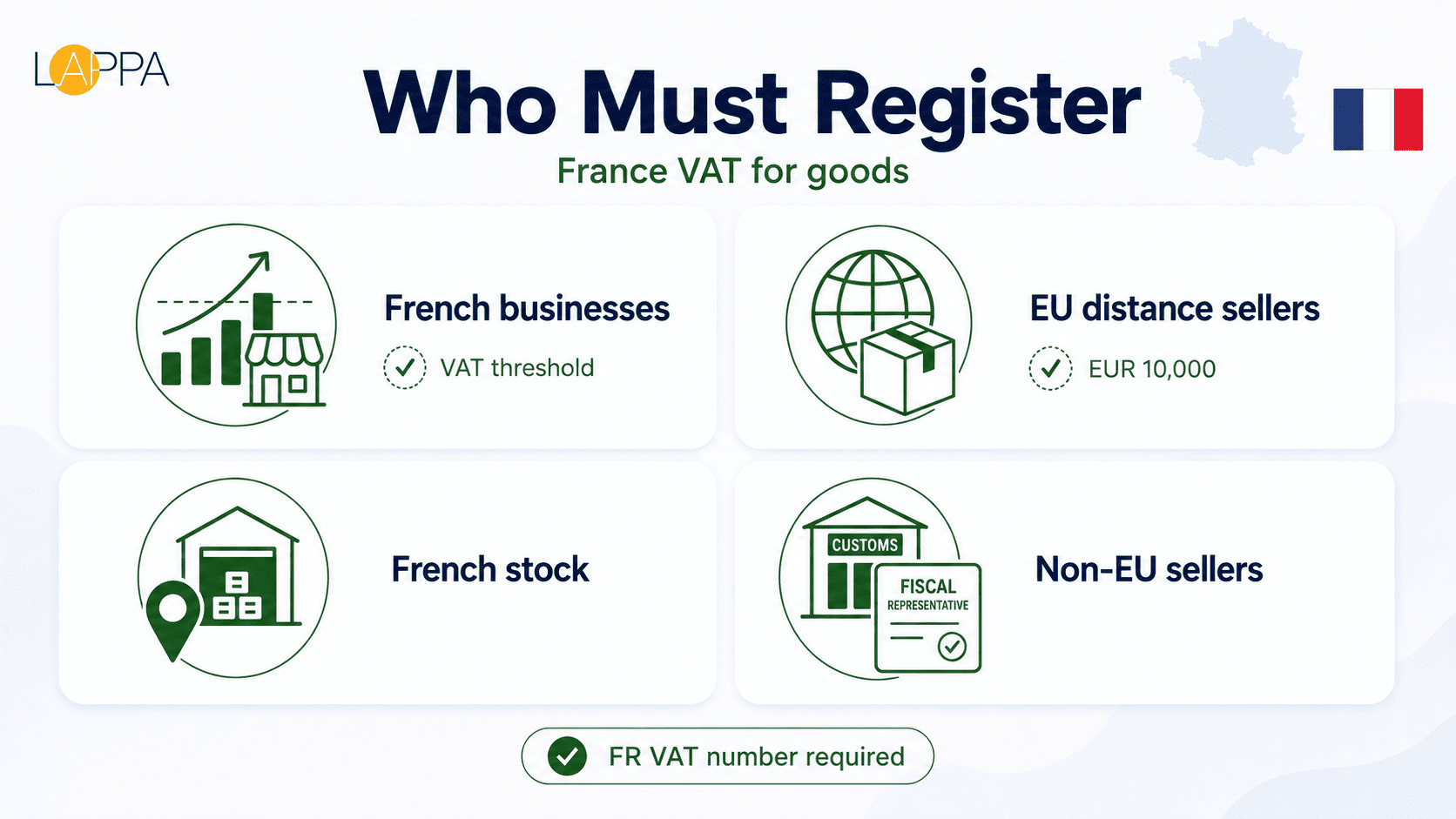 Mandatory registration for France VAT applies to four categories of business. First: French resident entities crossing the franchise en base thresholds (EUR 85,000 for goods or EUR 37,500 for services). Second: non-resident businesses making taxable supplies in France outside the OSS or IOSS framework. Third: businesses receiving reverse-charge B2B services from foreign suppliers -- the autoliquidation mechanism in French law means the recipient registers and self-assesses the TVA. Fourth: entities making intra-EU goods acquisitions above EUR 10,000 per year.
Specific transactions also trigger immediate mandatory registration. Real estate supply, disposal of a going concern, or taking over a TVA-registered French business can each force registration from day one regardless of turnover. If you're completing a French acquisition, merger, or branch setup, confirm the TVA position with a French tax adviser before any supply happens -- correcting a missed registration after the fact is administratively painful and expensive.
France VAT also applies through the reverse charge mechanism (autoliquidation) on services received from non-French suppliers. If a French-registered business receives a consulting invoice from a UK company, the French business self-assesses TVA on that supply and reports both output TVA (on the self-assessed amount) and input TVA (which it may recover) in the same return. The net TVA position is often zero, but the reporting obligation exists regardless.
France's VAT framework for real estate has its own chapter within the Code General des Impots. Land sales, new building sales, lease arrangements, and sale-leaseback structures each carry specific TVA treatment. Getting this wrong on a property transaction can mean a DGFiP reassessment of hundreds of thousands of euros in undeclared TVA. Property transactions in France almost always need specialist TVA advice.
Mandatory registration for France VAT applies to four categories of business. First: French resident entities crossing the franchise en base thresholds (EUR 85,000 for goods or EUR 37,500 for services). Second: non-resident businesses making taxable supplies in France outside the OSS or IOSS framework. Third: businesses receiving reverse-charge B2B services from foreign suppliers -- the autoliquidation mechanism in French law means the recipient registers and self-assesses the TVA. Fourth: entities making intra-EU goods acquisitions above EUR 10,000 per year.
Specific transactions also trigger immediate mandatory registration. Real estate supply, disposal of a going concern, or taking over a TVA-registered French business can each force registration from day one regardless of turnover. If you're completing a French acquisition, merger, or branch setup, confirm the TVA position with a French tax adviser before any supply happens -- correcting a missed registration after the fact is administratively painful and expensive.
France VAT also applies through the reverse charge mechanism (autoliquidation) on services received from non-French suppliers. If a French-registered business receives a consulting invoice from a UK company, the French business self-assesses TVA on that supply and reports both output TVA (on the self-assessed amount) and input TVA (which it may recover) in the same return. The net TVA position is often zero, but the reporting obligation exists regardless.
France's VAT framework for real estate has its own chapter within the Code General des Impots. Land sales, new building sales, lease arrangements, and sale-leaseback structures each carry specific TVA treatment. Getting this wrong on a property transaction can mean a DGFiP reassessment of hundreds of thousands of euros in undeclared TVA. Property transactions in France almost always need specialist TVA advice.
VAT number France
Every registered business receives a VAT number France authorities issue in the format FR + two alphanumeric characters + the nine-digit SIREN. The SIREN is the company registration number from the national business register (SIRENE). A typical example: FR40303265045. The two-character prefix after FR can be digits or letters -- but not the letters I or O, which are excluded to avoid confusion with 1 and 0. The prefix is calculated using a modulus-97 algorithm applied to the SIREN. This format makes French VAT numbers easy to validate but occasionally tricky to check manually because the two-character prefix isn't simply the first two digits of the SIREN. Accounting systems built for French business typically handle the calculation automatically. For a quick check, VIES at ec.europa.eu/taxation_customs/vies validates any EU country's VAT number in real time.France VAT Number Format and VAT Number in France Validation
France VAT number format adheres to the EU convention of country prefix + national identifier. The FR prefix signals France. The eleven characters that follow combine a computed check key (two alphanumeric characters, calculated from the SIREN) and the nine-digit SIREN itself. Format: FR + XX + 999999999 where XX is the check key and 999999999 is the SIREN. No spaces, no dashes, no separators. A valid VAT number in France always passes the SIREN check digit test and the modulus-97 prefix calculation. If a counterparty's number fails VIES, don't zero-rate the invoice -- the zero-rate applies only when VIES confirms the number as valid and active. Propagation from the SINR's internal register to VIES typically takes one to three working days after approval is issued. A France VAT number issued to a French branch of a foreign company uses the French branch's SIREN, not the parent's SIREN. Each legal entity and each registered branch has its own SIREN and therefore its own TVA number. A German parent company cannot use its German VAT number to cover transactions made by its Paris branch -- the branch files and pays independently through the French system. The VAT number France assigns is also the number used for the EC Sales List, EMEBI statistical declarations, and the TVA group filings introduced in France in January 2023. If your business joins a French TVA group (groupement TVA), a single consolidated TVA number covers the group's filings, while individual entities retain their own SIRENs for commercial purposes. VAT number in France registrations also produce a SIRET alongside the TVA number. The SIRET is the SIREN (nine digits) plus a five-digit establishment code (NIC -- Numero Interne de Classement). SIREN identifies the company; SIRET identifies a specific operating site. TVA returns use the SIREN/TVA number. Commercial contracts and employment documents typically use the SIRET. France's VAT number structure is stable across the life of a business. The SIREN doesn't change -- it's issued at company formation and stays fixed through ownership changes, address changes, and legal form conversions. The TVA prefix (the two alphanumeric characters) is fixed based on the SIREN. So France's VAT number for a company stays the same from first registration to final deregistration. TVA numbers issued in France for foreign branches are maintained in the SINR register rather than the main DGFiP business register. Foreign businesses can verify their own registration status through the SINR or via the European VIES system. If a number shows as invalid on VIES but the SINR has confirmed registration, contact the SINR directly -- the propagation lag can occasionally run longer than the usual few days.VAT Registration Procedure in France
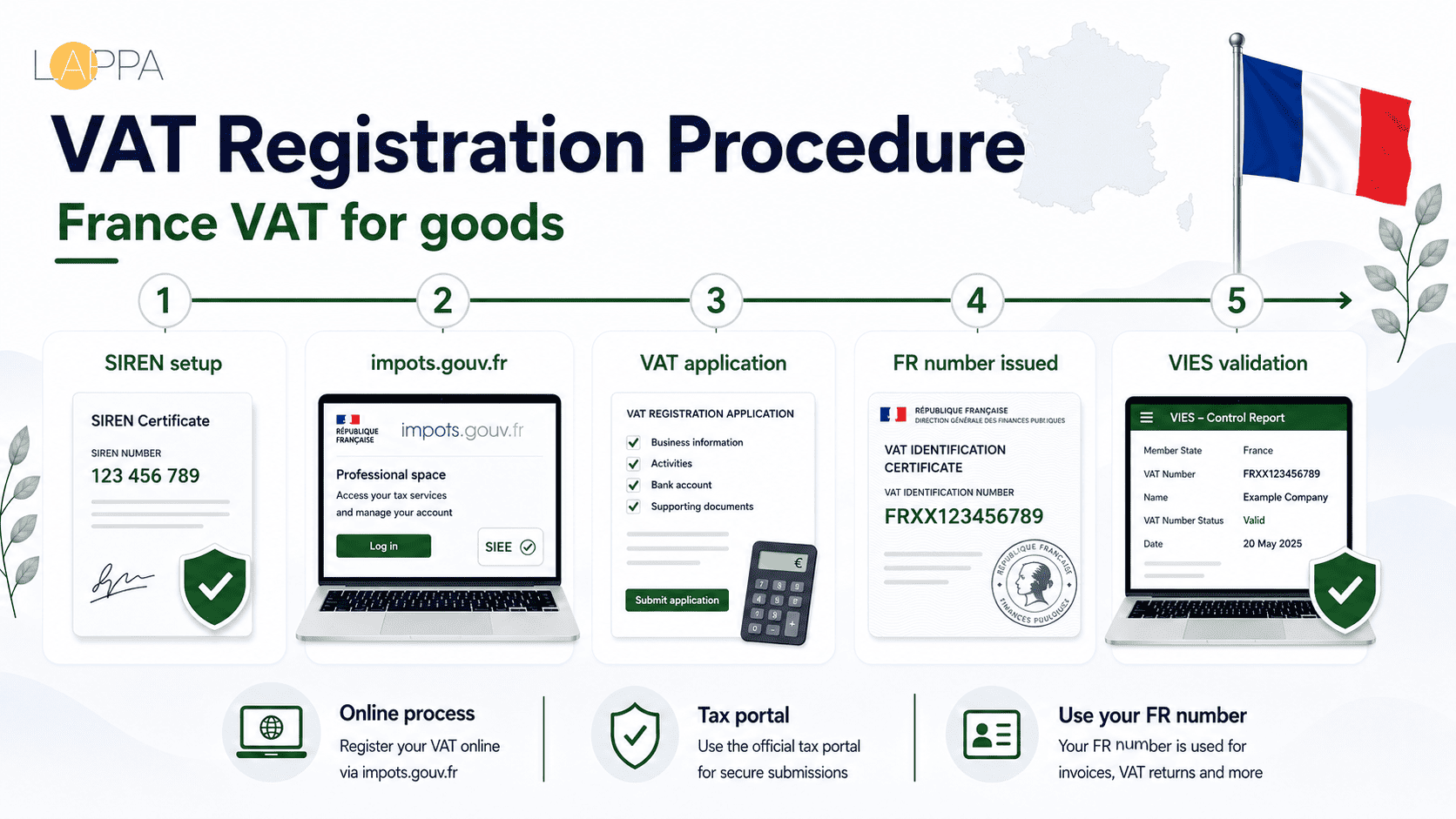 To register for a French TVA number, non-resident businesses file with the SINR in Noisy-le-Grand: Service des Impots des Non-Residents, 10 rue du Centre, 93465 Noisy-le-Grand Cedex. Applications go by post or, for some categories, through the secure DGFiP messaging system. French resident businesses register through the Guichet Unique portal (formalites.entreprises.gouv.fr) at company formation, which triggers both the SIREN assignment and TVA registration simultaneously. France's VAT numbers for new French companies are typically active within two to five working days of formation.
Documents required for a non-resident registration:
To register for a French TVA number, non-resident businesses file with the SINR in Noisy-le-Grand: Service des Impots des Non-Residents, 10 rue du Centre, 93465 Noisy-le-Grand Cedex. Applications go by post or, for some categories, through the secure DGFiP messaging system. French resident businesses register through the Guichet Unique portal (formalites.entreprises.gouv.fr) at company formation, which triggers both the SIREN assignment and TVA registration simultaneously. France's VAT numbers for new French companies are typically active within two to five working days of formation.
Documents required for a non-resident registration:
- Certificate of incorporation or equivalent business registration document -- apostilled if from a non-EU country
- Proof of taxable activity in France: contracts, confirmed orders, a lease agreement for French premises
- Completed TVA registration form (equivalent to Cerfa 3510-SD for non-residents)
- Fiscal representative appointment letter with the representative's accreditation number (non-EU businesses only)
- Bank account details for TVA refund payments
- Identification documents for the company's legal representatives
- Articles of association or equivalent constitutional document in French or with a certified French translation
VAT ID France
The VAT ID France -- officially called the numero de TVA intracommunautaire, or numero d'identification fiscale TVA -- is the same as the TVA registration number. It's used specifically for intra-community transactions: zero-rating exports to EU business partners, completing EC Sales List declarations, and being verified by counterparties in other EU member states through VIES. Every invoice for a B2B intra-EU supply must include both the seller's and the buyer's VAT IDs. A VAT ID France serves as the anchor for reverse charge transactions too. When a French-registered business receives a service from a non-resident supplier, the supplier must include the French business's TVA ID on the invoice and mark it as subject to autoliquidation by the recipient. The French business then self-assesses TVA using that same ID when filing its CA3 return. French TVA identification numbers appear on all VAT-related documents: registration certificates, TVA return acknowledgements, correspondence from the SINR, and refund payment notifications. Keep the confirmation letter from the SINR permanently on file -- it's the document you'll need when proving your French TVA registration status to French authorities or counterparties. The VAT registration number France issues to EU businesses is permanent while the registration is active. Deregistration applications go to the SINR and typically take four to six weeks to process. From deregistration, the number is archived but not reissued to another entity. If a business reregisters after a gap, it receives a new TVA number -- the old one is not reactivated. France's TVA registration has an additional layer for businesses making supplies that fall under the reverse charge: they must include their own TVA ID and the customer's TVA ID on every affected invoice. Omitting either number means the invoice is technically non-compliant for TVA purposes, which can block the customer's input tax recovery and trigger a DGFiP query on the supplier's return.Tax Representative in France
Non-EU businesses making taxable supplies in France must appoint a fiscal representative (representant fiscal accredite) before applying to the SINR. The representative must hold formal accreditation from the DGFiP -- not just any French accounting firm qualifies. The accreditation is application-based and involves demonstrating financial stability and professional competence. Accredited representatives publish their accreditation numbers publicly. The representative is jointly and severally liable for the non-EU client's TVA obligations. That's real legal exposure: DGFiP can pursue the representative directly for unpaid TVA if the foreign company defaults. Representatives consequently maintain strict due diligence processes and typically require advance payment deposits or bank guarantees from new non-EU clients. Fees reflect the liability. EU businesses don't need a representative and register directly with the SINR. EEA members in the same position. Post-Brexit, UK companies are non-EU and must appoint an accredited representative. Some UK operators that registered before Brexit and retained their French TVA numbers didn't need to act immediately, but any new UK business starting French operations post-2021 needs to go through the representative route from day one. A French fiscal representative typically manages the full TVA lifecycle: SINR registration, monthly CA3 preparation and filing through the impots.gouv.fr Espace Professionnel, EC Sales List submissions (DES for services, EMEBI statistical reports for goods), Intrastat filings above the threshold, and all DGFiP correspondence. Some representatives also handle SINR queries, refund claim submissions, and audit liaison.VAT E Invoicing in France
VAT France e-invoicing obligations are among the most ambitious in the EU. France announced its mandatory B2B e-invoice mandate years before most member states and has been refining the technical framework through successive rounds of consultation. The system requires all invoices between French TVA-registered businesses to pass through an accredited platform -- either the government's free Portail Public de Facturation (PPF) or a commercially certified Plateforme de Dematerialisation Partenaire (PDP). B2C and cross-border B2B transactions are handled through a parallel e-reporting obligation rather than the full e-invoice mandate. B2G e-invoicing on Chorus Pro is already mandatory for all suppliers to French public bodies. Any invoice directed at a French government entity, regional authority, hospital, university, or public institution must go through Chorus Pro in one of the accepted structured formats. Paper invoices to public sector clients haven't been accepted for years. This is separate from the B2B mandate -- Chorus Pro and the PPF/PDP ecosystem are different platforms.Implementation timeline
France's B2B e-invoicing implementation has been through multiple delays. The original 2024 date shifted following industry consultation. The current calendar:- September 1, 2026 -- Large enterprises (grandes entreprises): mandatory issuance of e-invoices AND mandatory ability to receive e-invoices for all registered French TVA businesses
- September 1, 2027 -- SMEs (ETI and PME) and microenterprises: mandatory e-invoice issuance
- September 1, 2026 onwards -- E-reporting obligation: all businesses with French TVA registrations must electronically report transactions with non-registered consumers (B2C) and cross-border B2B transactions not covered by the invoice mandate
- 2024-2025 -- Pilot programme: voluntary testing with selected businesses and PDPs; PPF beta testing
- B2G Chorus Pro -- Already mandatory for all suppliers to French public sector; separate from B2B mandate
Requirements for different business sizes
Large enterprises -- those classified as grandes entreprises under French company law (generally: more than 5,000 employees, or turnover above EUR 1.5 billion, or balance sheet above EUR 2 billion) -- must be both e-invoice issuers and receivers from September 2026. That means upgrading internal systems to connect to a PDP or the PPF, ensuring all outgoing invoices use Factur-X, CII (Cross Industry Invoice), or UBL 2.1 formats, and configuring accounts payable to receive and process incoming structured invoices. SMEs and microenterprises get an extra year -- September 2027 for mandatory issuance -- but must still be able to receive e-invoices from September 2026 when their large-enterprise counterparties go live. In practice, businesses that buy from or sell to large enterprises need to start their technical preparation in 2025 to be ready when those large-enterprise partners go mandatory in September 2026. Waiting for your own mandatory date is the wrong approach.VAT Returns in France
Types of reports
French TVA registrants deal with up to four separate periodic reporting obligations. The main TVA return, the EC Sales List (split by supply type), Intrastat statistical declarations, and -- if making intra-EU purchases above threshold -- an EC Purchase reporting obligation. Missing any one of these while getting the others right doesn't offset the penalty for the missed filing. The main TVA return comes in two forms: CA3 for the standard monthly regime, and CA12 for the annual simplified regime (Regime Simplifie d'Imposition -- RSI). New registrants always start on CA3. After two years of filing, established smaller businesses can elect the CA12 annually simplified scheme if their TVA liability stays below EUR 15,000 per year. The table below shows the key differences.| Feature | CA3 (Standard Regime) | CA12 (Simplified Regime -- RSI) |
| Filing frequency | Monthly (or quarterly for some smaller filers) | Annual declaration with two advance payments |
| Who uses it | All new TVA registrants; businesses with annual TVA liability above EUR 15,000; any business electing monthly filing | Established businesses below EUR 15,000 annual TVA liability electing simplified treatment |
| Advance payments | None -- full payment with each monthly return | Two payments: 55% of prior year TVA in July, 40% in December |
| Annual deadline | No separate annual filing; each period due 15th-19th of following month | CA12 annual balance due May 3 of following year (deadline varies slightly by year) |
| Best for | High-volume businesses, new registrants, businesses seeking monthly input TVA refunds | Smaller established businesses with stable TVA liabilities and no urgent refund claims |
Deductible VAT in France
French TVA deductibility follows the EU credit-invoice method but with stricter categorical exclusions than most member states. The passenger car rule is the most significant: TVA on the purchase or lease of voitures de tourisme is fully and permanently excluded from deduction, regardless of business use. This isn't a proportional restriction -- it's a complete block. Businesses that switch their fleet from passenger cars to commercial vehicles (camionnettes, vans) do so partly for this reason.| Expense Type | TVA Deductible | Notes |
| Business purchases for taxable supplies | Yes -- 100% | Standard rule: full recovery when expense relates exclusively to taxable business activity |
| Passenger car purchase or lease | No -- 0% | TVA on voitures de tourisme is fully excluded from deduction; one of France's strictest input tax restrictions |
| Fuel (diesel/petrol) for passenger cars | Partial -- 80% | 80% deductible for vehicles used partly for business; 100% for vehicles used exclusively for commercial purposes such as taxis or delivery |
| Business meals (client entertainment) | Yes -- 100% | TVA on restaurant meals for business purposes with clients or prospects is deductible; personal meals are not |
| Hotel accommodation (business travel) | Yes -- 100% | Fully deductible for genuine business travel; must be documented with business purpose |
| Personal entertainment / spectacles | No -- 0% | TVA on personal entertainment, leisure activities, and benefits-in-kind for employees is excluded from deduction |
| Mixed-use purchases | Partial | Apply the coefficient de deduction based on the ratio of taxable to total turnover; reconcile annually |
VAT Record Keeping Requirements in France
French law sets a six-year retention period for TVA records, running from the last day of the calendar year in which the document was issued. The Livre des Procedures Fiscales sets this standard. Practically, businesses retain for ten years because commercial law imposes a ten-year obligation on commercial documents, and separating TVA records from general commercial records creates unnecessary complexity. Records that must be kept include: all issued invoices, all received invoices, TVA returns (CA3 or CA12), TVA payment receipts, import and export customs documents, the TVA journal (livre de TVA) showing input and output TVA for each period, and bank records showing TVA payments to DGFiP. For e-invoices under the forthcoming mandate, the requirement is to preserve not just the PDF but the structured data file (Factur-X XML, UBL, or CII) in its original format. DGFiP has the right to audit TVA records for any period within the six-year retention window. Audits are typically notified three months in advance but can be shorter. A complete audit of a business's TVA records -- including cross-checking invoice amounts against TVA return figures and bank statements -- is conducted on-site or increasingly through remote data transfer. Digital records must be producible in a format DGFiP's systems can read.VAT Penalties in France
France's TVA system applies a tiered penalty structure based on the severity and reason for non-compliance. The baseline penalty for late TVA payment is a 5% surcharge on the unpaid amount, plus late interest at 0.20% per month (2.4% annualised) from the due date. The 5% applies even if the delay is just one day. Combined with the interest, a three-month payment delay costs approximately 5.6% of the unpaid TVA in penalties -- before any administrative fine. Late filing of a TVA return triggers a 10% surcharge on the TVA due for that period. If DGFiP has to send a formal notice before the taxpayer files, the surcharge increases to 20%. Deliberate non-filing -- where the business simply doesn't submit the return at all despite having taxable activity -- attracts a 40% surcharge. In fraud cases, penalties reach 80%, and the DGFiP can refer serious cases to the Parquet (criminal prosecution service). DGFiP has the power to assess TVA ex officio (evaluation d'office) when a business fails to file. It uses available third-party data -- banking information, Intrastat reports, counterparties' EC Sales List data, EMEBI records -- to estimate taxable turnover and issue a TVA assessment. Challenging an ex officio assessment is administratively complex, expensive, and rarely fully successful if the business genuinely had taxable activity. Penalties for Control Statement equivalent -- France doesn't have the Czech-style Kontrolni hlaseni, but DGFiP conducts systematic cross-checks using EC Sales List data from other EU countries. If a French registrant's TVA return doesn't match the intra-EU supplies declared by its foreign counterparties, DGFiP generates an automatic discrepancy request. Ignoring these requests within the response deadline adds penalties to the original discrepancy.How Lappa Can Help with VAT Compliance in France
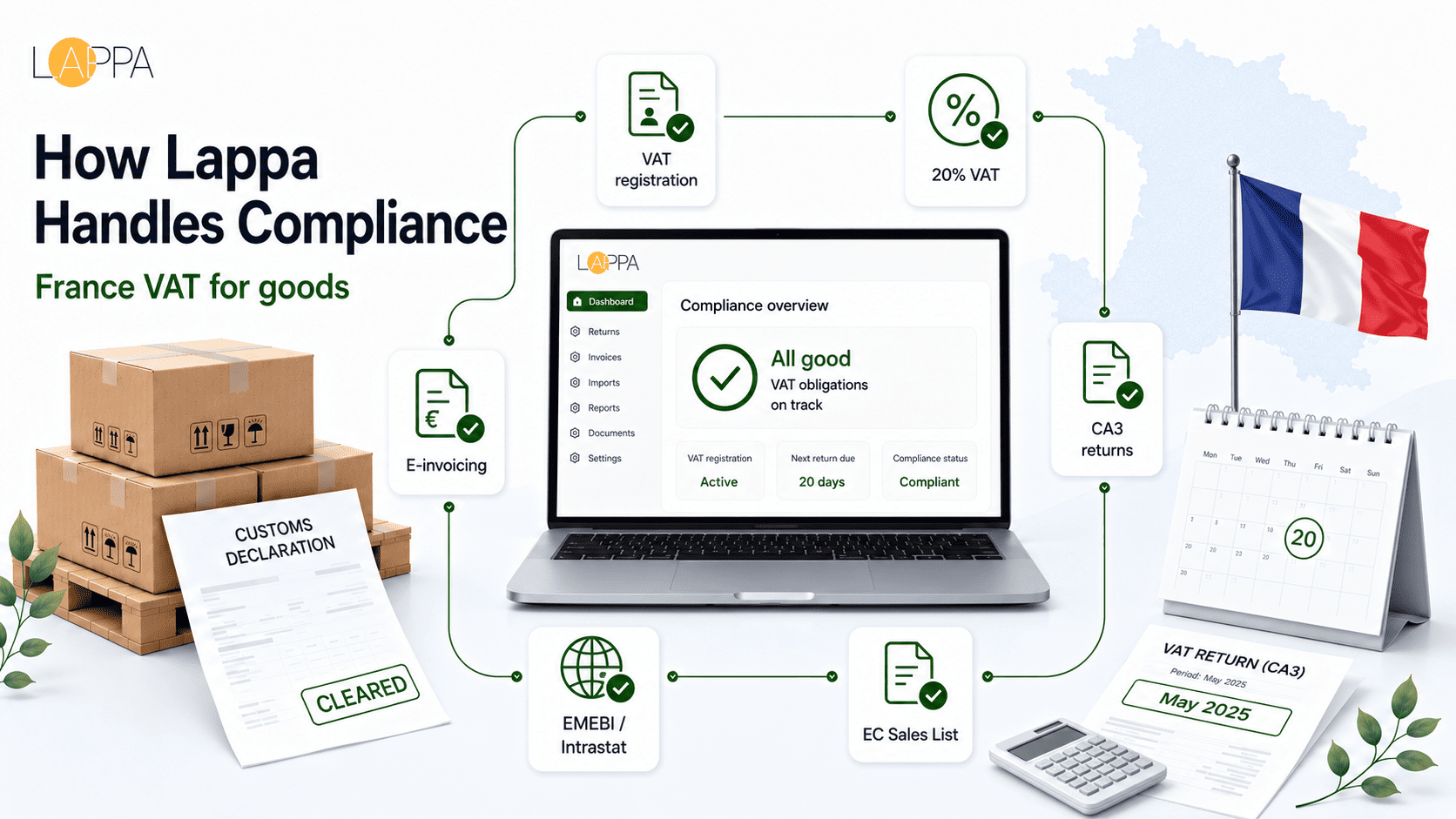 Lappa provides TVA registration, accredited fiscal representation, and ongoing compliance management for businesses entering France. The registration service covers preparation of all SINR application documents, submission through the appropriate channel (postal for non-EU, online for EU businesses), and monitoring VIES until the FR-prefix number goes live. For non-EU clients, Lappa holds DGFiP fiscal representative accreditation, meaning the accreditation number appears on the registration application.
For active filers, Lappa automates transaction data collection, prepares the monthly CA3 return, and submits it through the impots.gouv.fr Espace Professionnel on the correct deadline. DES (EC Sales List for services), EMEBI statistical reports, and Intrastat filings are included for clients with intra-EU trade flows. All records are stored digitally with a ten-year retention guarantee aligned with French commercial law.
France's e-invoicing mandate is something Lappa's clients are preparing for now, not in 2026. Lappa's compliance team guides businesses through PDP selection (or PPF onboarding for simpler setups), invoice format conversion to Factur-X or UBL 2.1, and e-reporting configuration for cross-border and B2C transactions that fall outside the invoice mandate itself. Getting the system architecture right ahead of September 2026 is significantly cheaper than emergency retrofitting when the mandate goes live.
Lappa provides TVA registration, accredited fiscal representation, and ongoing compliance management for businesses entering France. The registration service covers preparation of all SINR application documents, submission through the appropriate channel (postal for non-EU, online for EU businesses), and monitoring VIES until the FR-prefix number goes live. For non-EU clients, Lappa holds DGFiP fiscal representative accreditation, meaning the accreditation number appears on the registration application.
For active filers, Lappa automates transaction data collection, prepares the monthly CA3 return, and submits it through the impots.gouv.fr Espace Professionnel on the correct deadline. DES (EC Sales List for services), EMEBI statistical reports, and Intrastat filings are included for clients with intra-EU trade flows. All records are stored digitally with a ten-year retention guarantee aligned with French commercial law.
France's e-invoicing mandate is something Lappa's clients are preparing for now, not in 2026. Lappa's compliance team guides businesses through PDP selection (or PPF onboarding for simpler setups), invoice format conversion to Factur-X or UBL 2.1, and e-reporting configuration for cross-border and B2C transactions that fall outside the invoice mandate itself. Getting the system architecture right ahead of September 2026 is significantly cheaper than emergency retrofitting when the mandate goes live.
FAQ for VAT in France Goods
What is VAT in France
What is VAT in France? It's the TVA -- Taxe sur la Valeur Ajoutee -- a consumption tax applied at each stage of the supply chain, with businesses paying tax only on the value they personally add. DGFiP administers it under the Code General des Impots (CGI), aligned with EU Directive 2006/112/EC. The standard rate is 20%, with reduced tiers at 10%, 5.5%, and 2.1% for specific categories. France's franchise en base scheme allows small businesses below EUR 85,000 (goods) or EUR 37,500 (services) to operate without collecting or remitting TVA. What is VAT in France for a non-French business? Exactly the same tax, but with an administrative path that runs through the SINR in Noisy-le-Grand rather than the local Service des Impots des Entreprises. Non-EU businesses additionally need an accredited fiscal representative to access the French TVA system. The tax itself -- rates, deductibility rules, return obligations -- applies identically regardless of where the business is registered. France's TVA system also includes the reverse charge (autoliquidation) mechanism, which shifts the TVA liability from the supplier to the French business customer on a wide range of B2B purchases from non-French suppliers. Understanding autoliquidation is essential for any French-registered business buying services internationally, because self-assessed TVA must appear on the CA3 return even when it nets to zero.How much is VAT in France
How much is VAT in France? It depends entirely on what you're buying or selling. The standard 20% applies to most goods and services: tech products, clothing, professional services, advertising, software, telecoms. The 10% reduced rate covers restaurants, hotels, passenger transport, and home renovation. At 5.5%, you'll find essential food, books, newspapers, cinema, museum entries, and domestic energy. The super-reduced 2.1% is the narrowest tier, covering registered press and certain medicines. How much is VAT in France on imports from outside the EU? The standard 20% applies on the customs value plus any import duties. France collects this at the customs border through the Direction des Douanes et Droits Indirects (Douanes), not through the TVA return. Importers who are TVA-registered can recover the import TVA as input tax on their next CA3 return, but the cash must be paid at customs first unless the business has applied for the 'autoliquidation douaniere' regime (which allows import TVA to be deferred to the TVA return). France's autoliquidation douaniere -- customs TVA self-assessment -- is an approval-based scheme available to frequent importers. Instead of paying TVA at the customs office, the business self-assesses import TVA directly in the CA3 return. This eliminates the cash-flow cost of import TVA entirely. Application goes to the local customs service (Douanes). The benefit is meaningful for businesses importing regularly -- avoiding the float on TVA paid at customs before it's reclaimed.What is the VAT registration number France format
VAT registration number France format is FR + two alphanumeric characters + nine digits. The two characters are computed from the SIREN using a modulus-97 calculation. The nine digits are the SIREN itself. Total: thirteen characters. Example: FR40303265045. The two alphanumeric characters can be digits (0-9) or letters except I and O. Businesses without a French SIREN -- primarily non-EU entities -- receive a SIREN from the French business register as part of the registration process. The VAT registration number France uses is the same as the numero de TVA intracommunautaire printed on all intra-EU B2B invoices. Run any FR-format number through VIES to confirm it's active before zero-rating a cross-border invoice. The VIES result shows the registration status and the business name and address associated with the number -- useful for verifying that the counterparty is who they claim to be. France also uses the SIRET (SIREN + five-digit establishment code) on some administrative documents. The SIRET identifies a specific business location, not the company overall. On TVA returns and EC Sales Lists, the SIREN-based TVA number is used. On employment contracts, social security forms, and some commercial agreements, the SIRET appears instead. The two identifiers coexist but serve different legal functions.How often are VAT returns filed in France
Most businesses file monthly CA3 returns. That's mandatory for all new registrants and for any business with annual TVA liability above EUR 15,000. The deadline is the 19th of the following month for large enterprises; approximately the 15th-17th for others. The CA12 annual simplified scheme is available for established businesses below EUR 15,000 TVA liability, with two advance payments during the year (approximately 55% of the prior year's TVA in July and 40% in December) and a balance payment with the annual filing. The DES (EC Sales List for services) files monthly by the 10th of the following month. EMEBI statistical declarations for goods also file monthly. Intrastat reports above the threshold file monthly through Douanes. These deadlines are independent of the CA3 deadline. A business with the full suite of obligations -- CA3, DES, EMEBI -- is filing three separate forms every month to three separate systems. France has no equivalent of the Czech Control Statement, but DGFiP's cross-matching process between TVA returns and EC Sales List data from other EU member states is systematic and fast. Businesses that delay or omit EC Sales List filings discover the mismatch when a DGFiP query arrives a few weeks after the filing deadline. The resolution process -- providing invoice-level documentation to justify the discrepancy -- is time-consuming and best avoided.Do foreign companies need a tax representative in France
Non-EU companies do -- an accredited French fiscal representative (representant fiscal accredite) is a mandatory precondition for SINR registration. EU and EEA businesses register directly without a representative. UK companies lost direct-registration access when Brexit took effect on January 1, 2021. Any UK business starting French operations post-2021 goes through the representative route. Some UK operators that registered before Brexit retained their existing French TVA registrations without needing to appoint a representative, but they cannot change their representative status retroactively. The representative must hold formal DGFiP accreditation -- not just a French accounting qualification. Accreditation requires an application to DGFiP demonstrating financial stability, professional indemnity insurance, and operational capacity to handle TVA filings for foreign clients. The representative's accreditation number appears on the SINR application and on the registration certificate. You can verify an accreditation number through DGFiP. Finding a suitable accredited representative can take several weeks. The pool of accredited firms is smaller than the general pool of French accountants and tax advisers. Some specialise in specific industry sectors or specific countries. Fees for fiscal representation vary significantly: a setup charge, an annual accreditation fee, and a monthly per-filing cost. Budget for the representative's fees as an ongoing compliance cost before entering the French market.VAT Calculator
French TVA calculation is the same arithmetic as any EU country. To add TVA to a net price: multiply by 1.20 (standard), 1.10, 1.055, or 1.021 for reduced tiers. To extract TVA from a gross price: divide by the same multiplier and subtract. The DGFiP portal at impots.gouv.fr includes a calculation tool, though the manual method is faster when you're checking invoices line by line. Examples at the standard 20% rate: a EUR 1,000 consulting invoice carries EUR 200 TVA, grossing EUR 1,200. Examples at 10%: a EUR 800 restaurant bill contains EUR 72.73 in TVA when worked backward from the gross. At 5.5%: a EUR 55 book grosses EUR 58.03 with TVA included. Most invoices are simple. The multi-rate ones -- say, a hotel bill covering accommodation (10%), bar drinks (20%), and breakfast (10%) -- require careful per-line treatment. France requires that TVA amounts on invoices be shown in euros to two decimal places, with a clear breakdown by rate if multiple rates apply. Rounding errors accumulate over high-volume invoicing. Most accounting software handles this automatically for French-format invoices, but manually built spreadsheets regularly produce rounding mismatches that flag during DGFiP audits.
VAT Standard rate
10%
VAT Reduced rate
5.5%,2.1%
Thresholds
No turnover threshold for a foreign business carrying out taxable transactions that require it to account for French VAT