


Belarus VAT Compliance and Registration Guide
Provinces
Goods
Provinces
Goods
About
Goods
About
Goods
Goods
Goods
Introduction to VAT in Belarus — НДС Framework and How VAT in Belarus Works
January 1992. That's when Belarus introduced value-added tax — НДС, Налог на добавленную стоимость — shortly after independence. The system predates most of what the EU now considers standard VAT infrastructure by years. Today it runs under the Tax Code of the Republic of Belarus, and the МНС — Министерство по налогам и сборам, the Ministry of Taxes and Duties — administers everything. Portal: portal.nalog.gov.by. Here's the thing about VAT in Belarus that most foreign finance teams don't clock until they've already registered a subsidiary: Belarus is a member of the Eurasian Economic Union, the EAEU — Russia, Kazakhstan, Armenia, Kyrgyzstan are the other four. That membership changes cross-border VAT entirely. Goods moving between EAEU states skip customs duties. But VAT? VAT still applies, at destination. A Belarusian company importing from a Russian supplier self-assesses Belarusian VAT on the goods and puts it in the same monthly return as domestic transactions. Non-EAEU imports pay customs duty and VAT at the Belarusian border. Both calculations. Same shipment. But the structural fact that separates Belarus most sharply from European systems — the one that genuinely surprises people — is this: there's no revenue threshold below which VAT registration is optional for legal entities. None. Austrian companies get EUR 42,000 before VAT kicks in. German companies EUR 22,000. Belarusian companies get zero. An ООО or АО registers for VAT at incorporation unless it immediately elects a simplified regime (УСН). The system's default is registration. Exemption is the thing you have to actively choose. For non-residents providing electronic services B2C to Belarusian consumers, a separate registration pathway has been in place since 2018. It mirrors the EU's non-EU digital seller rules in structure — register from the first supply, no turnover threshold — but runs through the MNS's own process, not any regional scheme.Belarus VAT Rate — Standard Rate and Reduced Rates in 2026
Twenty percent. Standard rate. Most taxable goods and services. Below it: 10% for food, agricultural goods, children's products, medicines. Below that: zero for exports. Then exempt categories — banking, insurance, education, healthcare, residential housing — where no VAT moves in either direction.| Rate | Category | Examples |
| 20% | Standard | Professional services, telecoms, retail, construction, most manufacturing |
| 10% | Reduced | Food products, agricultural goods, children's products, medicines and medical devices |
| 0% | Zero-rated | Exports, international freight, some EAEU cross-border goods |
| Exempt | No VAT | Banking, insurance, education, certain medical services, housing |
VAT Calculator
At 20%: multiply net by 1.20 for gross. Divide gross by 1.20 and subtract to pull the VAT out. BYN 1,000 net carries BYN 200 VAT; buyer pays BYN 1,200. At 10%: multiply net by 1.10. BYN 500 net gives BYN 50 VAT, BYN 550 gross. Belarusian B2B VAT invoices — the ЭСЧФ, issued through AIS at e-vat.by — have designated fields for net amount, rate, and VAT amount. The platform records what the operator inputs. It won't flag a 10% rate applied to a 20% supply. Rate classification is on the business, not the system.VAT Registration Threshold in Belarus
For Local Businesses
No threshold for legal entities. A Belarusian ООО or АО registers for VAT at incorporation, automatically, unless it elects the simplified tax system (УСН). The УСН option is available below BYN 2,046,668 in annual gross revenue — that figure is indexed annually, so check the current МНС guidance each January. Below that ceiling: choose УСН flat-rate turnover tax, or standard VAT with full input credit. Above it: standard VAT only, no choice in the matter. Individual entrepreneurs (ИП) get more flexibility below the УСН ceiling. Once turnover crosses it, VAT registration becomes mandatory. Notification to the МНС is required — the transition isn't automatic — but the obligation starts from the moment the threshold is crossed, not from when the paperwork gets filed.For Remote Sellers
Non-residents supplying goods into Belarus face VAT at the border via customs. Ongoing local commercial activity — recurring sales from stock physically held in Belarus — creates a separate registration obligation regardless of volume. EAEU-based suppliers (Russian, Kazakh, Armenian, Kyrgyz entities) don't hit customs duties on goods sent to Belarusian buyers, but those Belarusian buyers self-assess VAT on the received goods through reverse charge under the EAEU protocol.For Remote Digital Services
Non-resident B2C electronic service providers register with the МНС from the first Belarusian supply. No threshold. Streaming, SaaS, online advertising, digital content, marketplace services — all in scope. B2B digital supplies from non-residents can shift the accounting to the Belarusian business recipient through reverse charge, but B2C is always on the foreign supplier. No exceptions.Who Must Register for VAT in Belarus
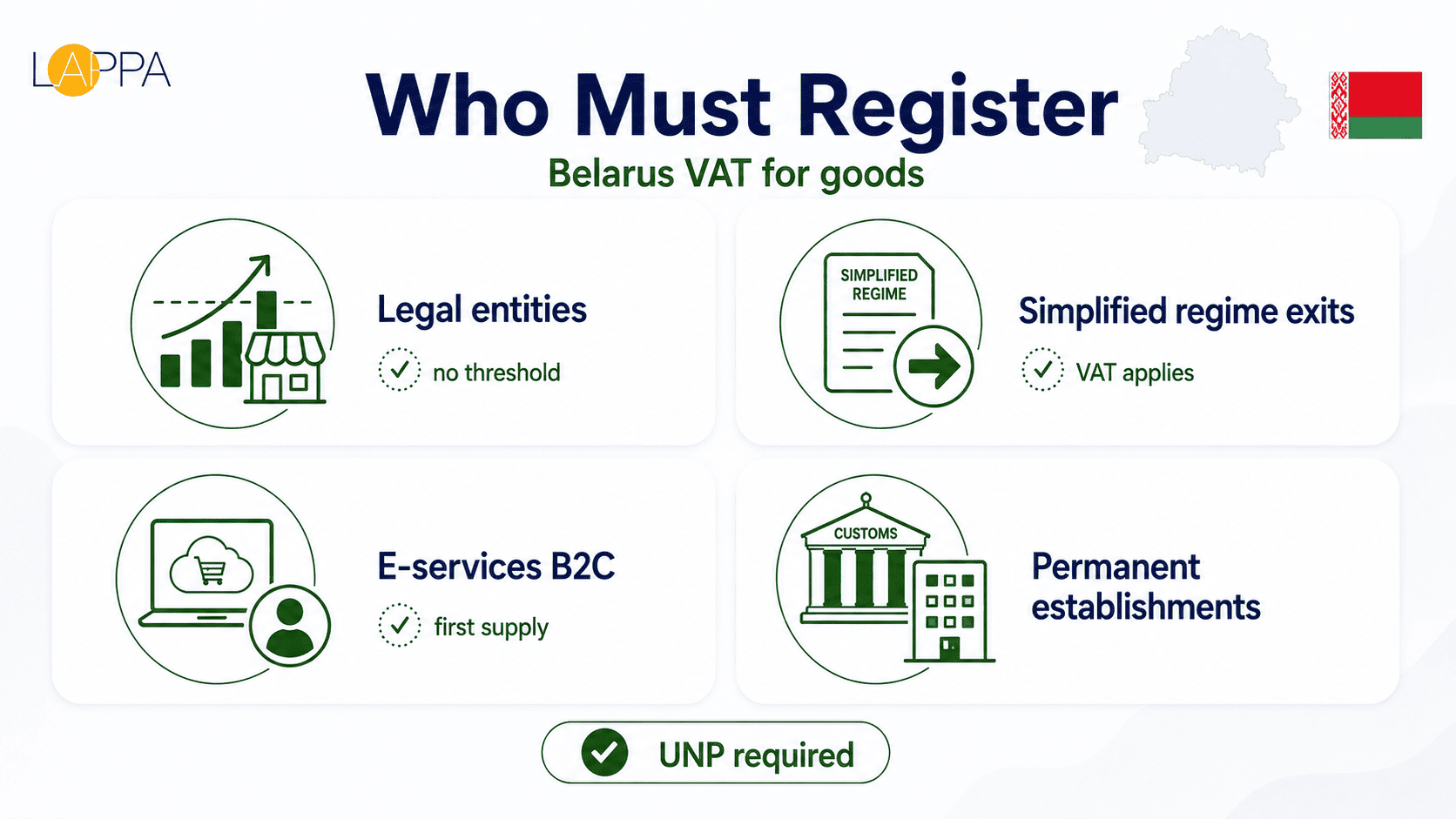 VAT Belarus registration lands on:
- All Belarusian legal entities not on a special tax regime — mandatory from incorporation.
- Individual entrepreneurs exceeding the УСН turnover ceiling — mandatory, МНС notification required.
- Non-resident organisations providing B2C electronic services to Belarusian consumers — from the first supply.
- Non-resident organisations with a permanent establishment in Belarus.
- Legal entities and entrepreneurs exiting the simplified tax system — VAT applies from the start of the next tax period.
VAT Number in Belarus — UNP Format and Structure
Every Belarusian taxpayer gets a UNP — Учётный номер плательщика — on registration. Nine digits. It works across all tax types: VAT, profit tax, property tax, customs. One number. Everything. Belarus VAT number in practice is the UNP. Belarus doesn't issue a separate VAT-specific identifier alongside a corporate registration number, unlike EU countries where an ATU or FR-prefix sits next to the company number. The 9-digit UNP goes on ЭСЧФ invoices, return submissions, customs declarations, and МНС correspondence. Always the same number. First two digits signal the region of registration for legal entities. Individual entrepreneurs have a different prefix structure. Counterparty UNP verification runs through the МНС public registry — checking it before processing large input tax claims is standard practice, because an invalid or deregistered UNP on an incoming ЭСЧФ means the deduction doesn't stand.VAT Registration Procedure in Belarus — VAT Belarus Filing Steps
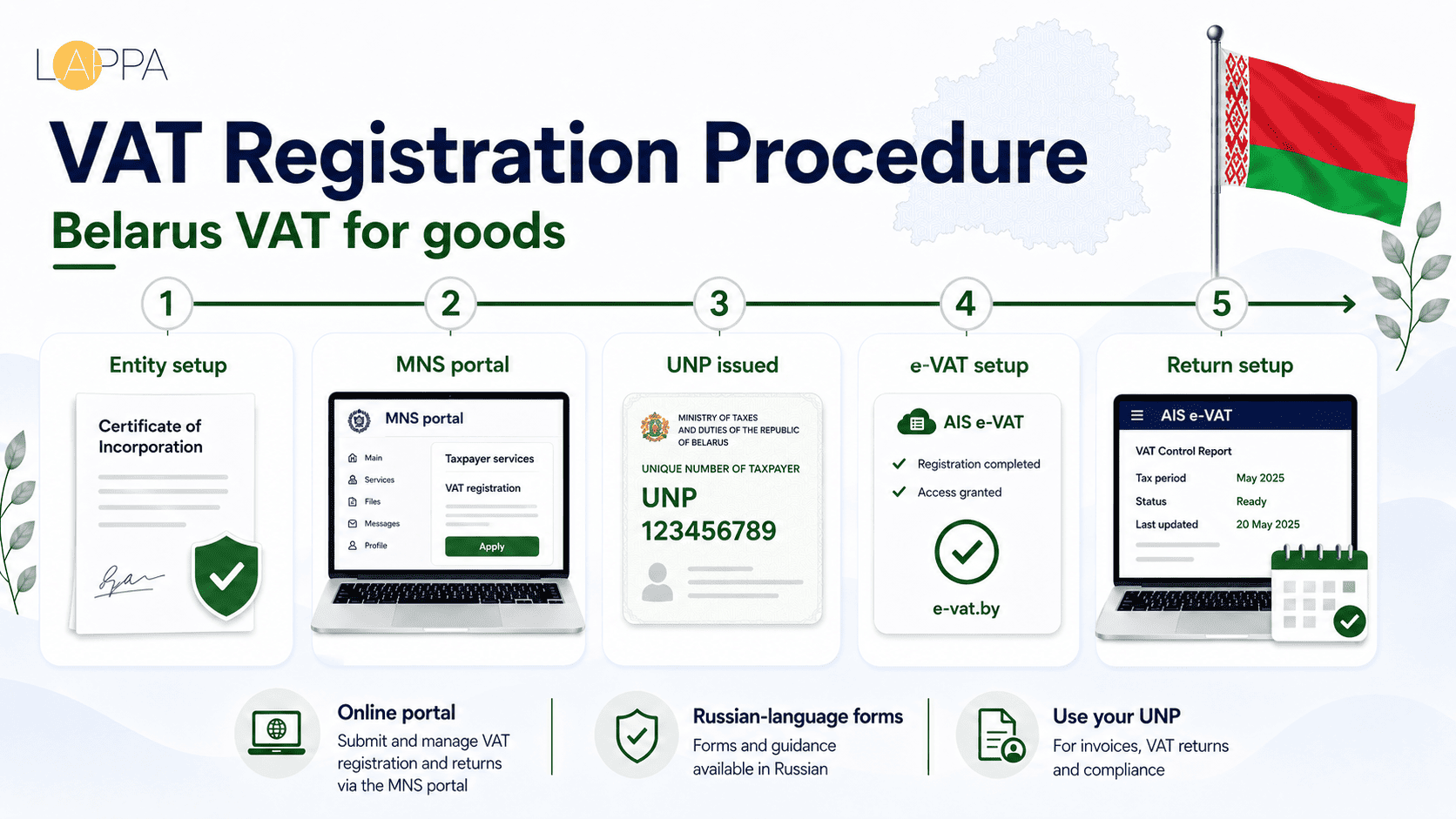 VAT Belarus registration for locally established entities isn't a separate step. It's embedded in company incorporation. When an entity registers in the Unified State Register (ЕГР) and data flows to the МНС, the МНС assigns a UNP and opens the tax account. No separate VAT application. No waiting period. VAT status follows automatically from entity registration and regime election.
For non-resident digital service providers:
VAT Belarus registration for locally established entities isn't a separate step. It's embedded in company incorporation. When an entity registers in the Unified State Register (ЕГР) and data flows to the МНС, the МНС assigns a UNP and opens the tax account. No separate VAT application. No waiting period. VAT status follows automatically from entity registration and regime election.
For non-resident digital service providers:
- Access the МНС portal at portal.nalog.gov.by — the non-resident e-services registration section. It's in Russian. Plan accordingly.
- Complete the registration form: company name, country of incorporation, legal address, type of electronic services, confirmation of B2C supply to Belarusian consumers.
- Upload: certificate of incorporation from the home jurisdiction, authorised representative identification.
- Submit. The МНС assigns a UNP to the foreign entity on approval.
- First return covers the quarter in which the first Belarusian B2C supply occurs.
Tax Representative in Belarus
Non-resident digital service providers registering under the Belarusian e-services framework aren't legally required to appoint a local representative. They file directly through the МНС portal. But here's the practical reality: "not legally required" and "manageable without local help" are completely different statements. The МНС portal is in Russian. Return formats bear no resemblance to EU or UK equivalents. Correspondence from the МНС arrives in Russian on short notice. Engaging a local accountant or tax adviser familiar with the system isn't a luxury for most foreign businesses — it's what competent compliance actually requires. Non-residents with a permanent establishment in Belarus need local bookkeeping to meet Belarusian accounting standards. That's effectively mandatory professional support regardless of what the statute calls it.VAT E-Invoices in Belarus — ЭСЧФ System and Timeline for Different Business Sizes
Belarus runs one of the most structured e-invoicing systems in the post-Soviet space. The ЭСЧФ — электронный счёт-фактура по НДС — is mandatory for VAT-registered entities on B2B taxable supplies. The platform is AIS ЭСЧФ at e-vat.by, МНС-supervised.| Business Segment | ЭСЧФ Obligation | Platform |
| Belarusian legal entities — all VAT payers | Mandatory for B2B taxable supplies | AIS ЭСЧФ at e-vat.by |
| Individual entrepreneurs on standard VAT | Mandatory | AIS ЭСЧФ at e-vat.by |
| Non-resident digital service providers (B2C) | Not applicable | МНС portal |
| Exporters | Required for zero-rated export supplies | AIS ЭСЧФ at e-vat.by |
VAT Returns in Belarus — Types of Report
Monthly. Always. The return — Налоговая декларация по НДС — is due by the 20th of the month following the tax period. January: filed by 20 February. Payment of net VAT is due by the 22nd. Two days after the return deadline. Two different dates, two different failure types if you miss either. Returns go through the МНС portal or via accounting software with МНС integration. The return captures output VAT by rate category, input VAT deductions, and corrections for prior periods or ЭСЧФ amendments. VAT control report: There isn't one, as a separate instrument. The ЭСЧФ platform itself is the cross-checking layer. Both sides of every B2B transaction sit in the same state system. A mismatch between what a supplier reported as output and what a buyer claimed as input registers automatically. No lag between the error and the detection.Deductible VAT in Belarus
Input VAT — налоговые вычеты — is deductible on purchases used for taxable supplies. One hard prerequisite: a valid, accepted ЭСЧФ from a VAT-registered supplier. Without an accepted ЭСЧФ, the deduction doesn't happen in the current period. Not reduced — blocked. Until acceptance occurs. What's blocked entirely:- Purchases for exempt supplies
- Entertainment and representation above statutory norms
- Personal consumption
- Purchases tied to activities outside VAT scope
VAT Record-Keeping Requirements in Belarus
Ten years. That's the Belarusian retention minimum for tax-relevant documents, from the end of the tax period they relate to. Longer than EU standards — most member states require 5–7 years. The 10-year clock covers VAT returns, ЭСЧФ records, primary accounting documents, customs declarations, contracts. One practical upside: ЭСЧФ records archive automatically within AIS e-vat.by. The platform keeps the B2B invoice history on the system side. Primary documents — contracts, delivery notes, customs clearance papers, CMR transport documents for EAEU cross-border supplies — the taxpayer holds independently, in physical or electronic form. Electronic storage is permitted throughout. Records must stay accessible, readable, and unaltered for the full 10 years.VAT Penalties in Belarus — Belarus VAT Non-Compliance Costs
The МНС enforces penalties under the Administrative Offences Code — КоАП. Four failure types: registration, filing, payment, evasion. Late or missing registration: Administrative fine of 20%–40% of the VAT that should have been declared during the unregistered period. Plus the full backdated VAT liability. Both. Late return filing: 10%–25% of the unpaid tax per month of delay. Floor: BYN 100 regardless of the balance. Late payment — пеня: 1/360 of the NBB (National Bank of Belarus) refinancing rate per day, on the unpaid amount. The NBB rate has moved significantly in recent years. When it's high, the daily пеня on a large unpaid balance compounds into serious money quickly. Understated output VAT or overstated deductions: 40% of the understated amount for deliberate misstatement. Lower rates for errors proactively corrected through voluntary amendment before the МНС finds them. Belarus VAT rate misapplication — applying 10% to goods the МНС reclassifies as 20% on audit — generates automatic reassessment of the rate gap plus interest from the original filing date. Food and medical product classification disputes produce more of these reassessments than any other category. And on evasion: criminal liability under the Criminal Code applies above statutory thresholds. The detection mechanism is unusually direct — because both sides of every B2B transaction are in the shared ЭСЧФ platform, a mismatch between a supplier's reported output and a buyer's claimed input registers as an automatic system flag. There's no window between the error occurring and the МНС seeing it.How Lappa Can Help with VAT Compliance in Belarus
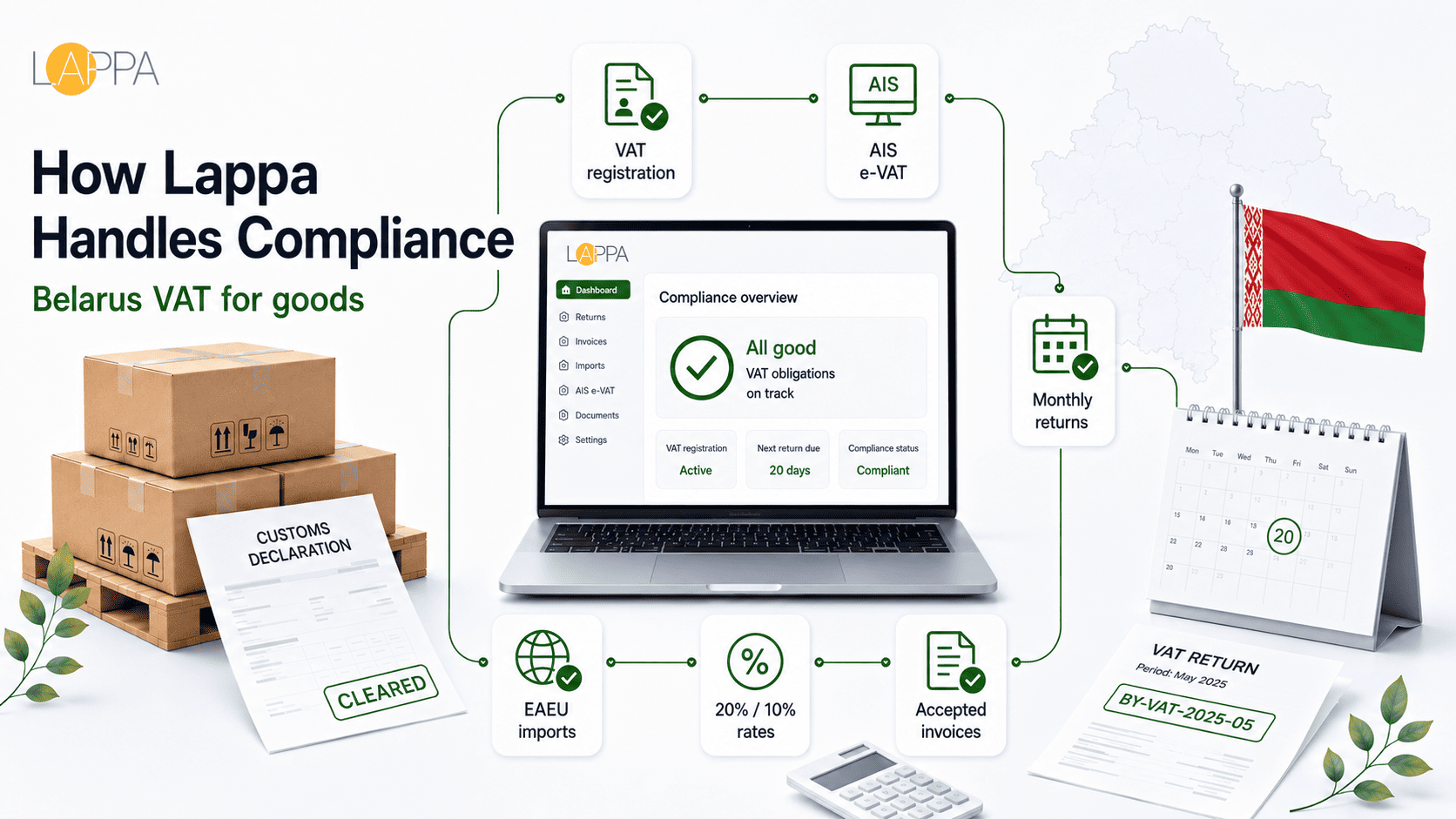 Lappa supports the full Belarus VAT cycle: МНС registration, UNP setup, ЭСЧФ invoice workflow management, monthly return preparation and submission, and ongoing compliance calendar management.
For non-resident digital service providers, Lappa manages the МНС portal registration process, Russian-language form requirements, and quarterly return filing from the first period of Belarusian B2C activity.
The platform monitors ЭСЧФ acceptance status in real time — tracking incoming invoices to ensure acceptance before the 20th-of-month cutoff — and handles input tax apportionment for businesses with mixed taxable and exempt activities.
Lappa supports the full Belarus VAT cycle: МНС registration, UNP setup, ЭСЧФ invoice workflow management, monthly return preparation and submission, and ongoing compliance calendar management.
For non-resident digital service providers, Lappa manages the МНС portal registration process, Russian-language form requirements, and quarterly return filing from the first period of Belarusian B2C activity.
The platform monitors ЭСЧФ acceptance status in real time — tracking incoming invoices to ensure acceptance before the 20th-of-month cutoff — and handles input tax apportionment for businesses with mixed taxable and exempt activities.
FAQ for Belarus VAT Goods
What Is the VAT Rate in Belarus
- Belarus applies a 20% standard VAT rate to most goods and services. A 10% reduced rate covers food products, agricultural goods, children's products, and medicines. Zero-rating applies to exports and qualifying EAEU cross-border supplies. Banking, insurance, education, certain medical services, and residential housing are VAT-exempt.
Who Needs to Register for VAT in Belarus
- All Belarusian legal entities not on a special tax regime are VAT payers from incorporation — no revenue threshold below which registration is optional. Individual entrepreneurs above the simplified tax system revenue ceiling register mandatorily. Non-resident digital service providers supplying Belarusian consumers B2C register from the first supply, no threshold.
What Is the VAT Number Format in Belarus
- Belarus uses the UNP — Учётный номер плательщика — a 9-digit numeric taxpayer registration number, as the universal tax identifier including for VAT. No separate VAT-specific number exists. The UNP appears on ЭСЧФ invoices, VAT returns, customs declarations, and all МНС correspondence. Counterparty UNP status is verifiable through the МНС public registry at portal.nalog.gov.by.
How Often Are VAT Returns Filed in Belarus
- Monthly. The VAT declaration is due by the 20th of the following month; payment is due by the 22nd. Some smaller businesses file quarterly by МНС agreement, but monthly is the standard for legal entities.
Do Foreign Companies Need a Tax Representative in Belarus
- Non-resident digital service providers registering under the Belarusian e-services framework aren't legally required to appoint a local representative — they file directly through the МНС portal. Non-residents with a permanent establishment in Belarus need local bookkeeping support to meet Belarusian accounting obligations. Engaging a local adviser is strongly advisable for all non-residents given that the МНС portal, all filing formats, and all correspondence operate entirely in Russian.
VAT Standard rate
20%
VAT Reduced rate
10%, 0%
Thresholds
No general VAT registration threshold (registration is generally required when carrying out taxable activities). Foreign suppliers of digital services must register from the first taxable supply.