


Complete Denmark VAT Guide
Provinces
Goods
Provinces
Goods
About
Goods
About
Goods
Goods
Goods
Introduction to VAT in Denmark
The Danish indirect tax system has one defining feature separating it from nearly every other EU member state: a single levy rate with no reduced categories. VAT in Denmark is called moms — merværdiafgift — and has run at a flat 25% since 1992. No lower charge for food, none for books or medicine. Every taxable supply of goods faces the same rate, which simplifies compliance but means every importer works with a high levy on every transaction. Momsloven (the VAT Act) is administered by Skattestyrelsen — the Danish Tax Agency — under the Ministry of Taxation. Denmark VAT compliance is primarily digital — registration, filing, and payment all run through TastSelv Erhverv, the authority's online platform. This guide covers goods only. Danish VAT rules for goods include standard import mechanics, quarterly reporting for most operators, and a low registration threshold — DKK 50,000, roughly €6,700 — that catches small importers earlier than expected.Denmark VAT Rates
The rate structure is the simplest in the EU: one standard rate, no reduced categories. Denmark VAT applies at 25% to all taxable supplies of goods with no legislative pathway to a lower rate for any product type.| Rate | Category | What it covers |
| 25% | Standard rate | All taxable goods — consumer goods, electronics, vehicles, construction materials, food, medicines, industrial equipment, imports |
| 0% | Zero rate | Exports outside EU, intra-community supplies to registered buyers in other EU member states, international transport |
VAT Registration Threshold in Denmark
For Local Businesses
The threshold for mandatory enrollment is DKK 50,000 in taxable turnover within any 12-month period — roughly €6,700. Once turnover is projected to cross that figure, registration must happen in advance. Skattestyrelsen does not permit backdating to the threshold breach date as a routine administrative fix. Voluntary registration below the threshold is available. Any operator importing goods pays the charge at customs on every shipment; without registration, that cost is unrecoverable. Once enrolled, it becomes a deductible input credit. Most importers register voluntarily from the outset to recover input tax on purchases. Straightforward applications are processed within a few working days.For Remote Sellers Selling Goods
Overseas sellers dispatching goods into the country from other EU member states fall under the EU-wide distance selling rules — the combined threshold is €10,000 across all EU member states. Operators must either register locally or use the One-Stop Shop (OSS) scheme once that threshold is crossed. Foreign operators storing goods in local warehouses must register regardless of sales volume; holding stock here creates a local taxable presence with no threshold protection.Who Must Register for VAT in Denmark
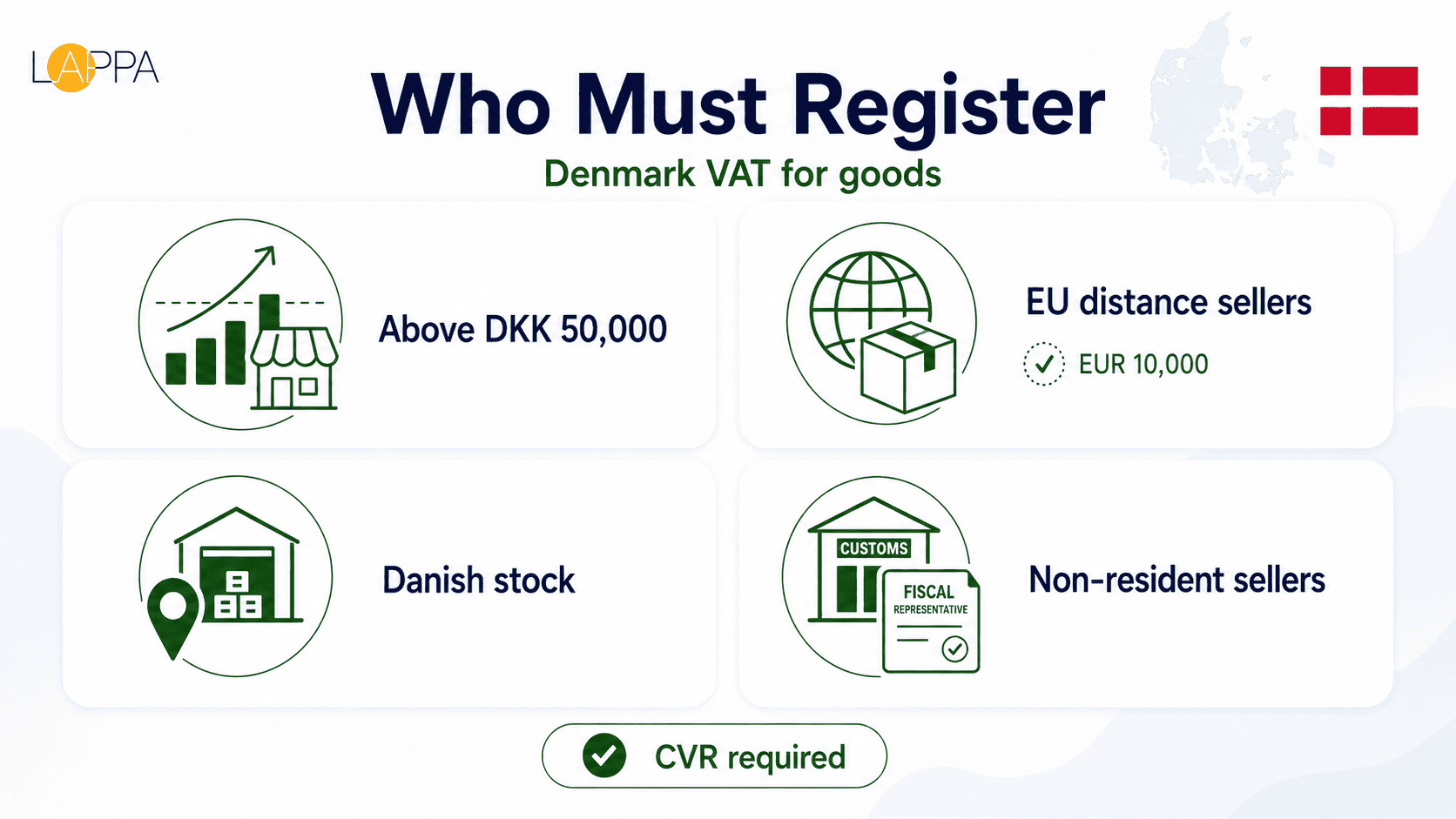 Registration is mandatory for the following categories — the DKK 50,000 threshold does not protect several of them:
- Locally established operators whose taxable goods turnover exceeds DKK 50,000 in any 12-month period
- Foreign operators storing goods in local warehouses or running a fixed establishment here, regardless of sales volume
- Any enterprise receiving intra-community acquisitions of goods exceeding DKK 80,000 per calendar year from EU suppliers
- Operators making occasional supplies of new vehicles or new buildings within the country
VAT Number Denmark — Format and Verification
Every enrolled entity receives a VAT number Denmark assigns in the format DK + 8 digits — for example, DK12345678. This identifier is the entity's CVR number (Central Business Register number) with the "DK" prefix added for EU purposes. Any entity already registered with the Danish Business Authority has its eight-digit base identifier; enrollment for indirect tax purposes simply adds the prefix. Buyers routinely check supplier numbers before processing invoices because an invalid or lapsed Denmark VAT number creates an immediate input credit recovery problem. A purchase invoice without a valid DK-prefixed number cannot support a deduction regardless of how genuine the underlying transaction is. Verification is available free through EU VIES or virk.dk. Denmark's VAT numbers issued to non-resident operators follow the same DK + 8-digit format, with the sequence assigned by Skattestyrelsen rather than the CVR register.VAT Denmark Registration Procedure
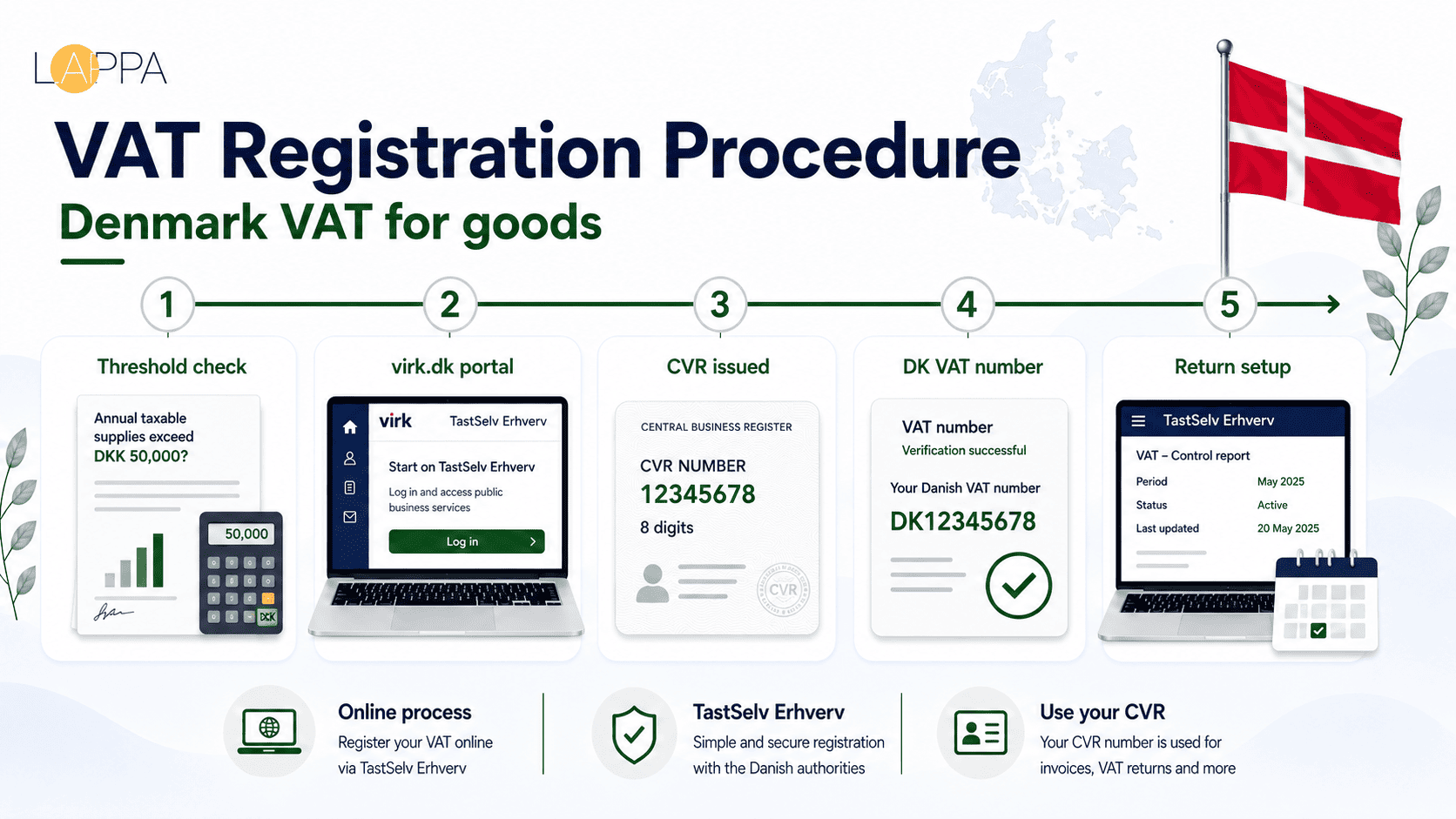 Enrollment runs through TastSelv Erhverv (skat.dk). For locally established entities, five key steps:
- Log into TastSelv Erhverv using NemID or MitID for the entity
- Select "Registrer virksomhed" and choose the indirect tax registration category
- Enter expected taxable turnover and projected registration start date
- Confirm bank account details for refund payments
- Receive the VAT Denmark confirmation and assigned DK number, typically within 1–5 working days
Tax Representative in Denmark
Non-EU operators registering for the indirect tax must appoint a Danish-resident fiscal representative who assumes joint and several liability for the operator's obligations. Finding a willing individual is a genuine precondition of enrollment. Most accounting firms and tax advisors require a formal engagement letter, an indemnity from the foreign principal, and a financial guarantee equivalent to several months of estimated liability before signing. EU-established operators are not required to appoint one and interact with Skattestyrelsen directly in Danish or English. Many use a local tax agent voluntarily for authority queries, Intrastat filings, and EU Sales List management. The agent must verify that Danish VAT registration details appear correctly on all filings and outgoing invoices.VAT E-Invoices in Denmark
The country was a world pioneer in mandatory e-invoicing for public sector transactions, requiring it for all government purchases since 2005. The B2G obligation now runs on the Peppol network under NemHandel infrastructure. Any operator supplying goods to public-sector buyers must issue structured electronic invoices — PDF by email does not qualify. For private-sector B2B goods transactions, no general e-invoicing mandate currently exists; paper and PDF invoices remain valid. The EU's ViDA initiative will bring phased digital reporting requirements across member states; given the existing B2G infrastructure, the transition here is expected to be smoother than in many other EU markets.VAT Returns in Denmark
Filing frequency depends on annual tax liability. Three schedules apply:| Filing period | Who it applies to | Due date |
| Monthly | Large operators — annual levy liability above DKK 50 million | 25th of following month |
| Quarterly | Mid-size operators — annual levy liability DKK 5–50 million | 10th of 2nd month following quarter |
| Semi-annual | Small operators — annual levy liability below DKK 5 million | 1st of 3rd month following period |
- EU Sales List (Listeangivelse) — covers zero-rated intra-community supplies to registered EU buyers. Due monthly by the 25th of the following month, regardless of the operator's regular filing frequency
- Intrastat — monthly statistical declaration for goods movements above the annual thresholds set by Statistics Denmark (dst.dk); filings due by the 25th of the following month
Deductible VAT in Denmark
Input credits are deductible when goods or services purchased are used to make taxable outputs. The recovery right activates on receipt of a valid invoice. Three main restriction categories apply:- Passenger cars: Input credits on purchase and running costs of passenger cars are blocked entirely — no partial recovery regardless of actual business use. Commercial vehicles (vans, lorries, forklifts) generally qualify for full recovery
- Hotel and restaurant costs: Levy on accommodation and meals is not deductible unless directly related to taxable commercial operations
- Mixed-use assets: Assets used partly for taxable and partly for non-taxable purposes require a pro-rata deduction based on the proportion of taxable use
VAT Record Keeping Requirements in Denmark
Momsloven requires accounting records, invoices, and supporting documentation to be retained for five years from the end of the calendar year in which they were prepared. Paper and electronic formats both qualify. What a goods operator must hold:- All issued and received invoices meeting the content requirements under Momsloven § 52a
- Import customs entry documents (toldangivelse) with supporting shipping documentation
- Export documentation substantiating zero-rate treatment — customs export confirmations, CMRs, bills of lading
- Filed momsangivelse returns and payment receipts for all periods
- EU Sales List submissions and Intrastat declarations where applicable
- Inventory records and stock movement logs for goods held locally
VAT Penalties in Denmark
Momsloven and Skattekontrolloven together establish the penalty structure. Administrative and substantive failures sit in separate brackets.| Violation | Penalty | Notes |
| Late filing | DKK 800 per return | Rises to DKK 1,600 if uncorrected; applies on nil returns |
| Late payment | 2% per month (min DKK 50) | Applied from the day after the payment deadline |
| Non-registration | Up to DKK 10,000 | Plus retroactive assessment covering full unregistered period |
| Negligent error | 25% surcharge on underpaid amount | Identified in review or audit |
| Deliberate evasion | Up to 100% surcharge + prosecution | Criminal referral possible under Straffeloven |
How Lappa Can Help with VAT Compliance in Denmark
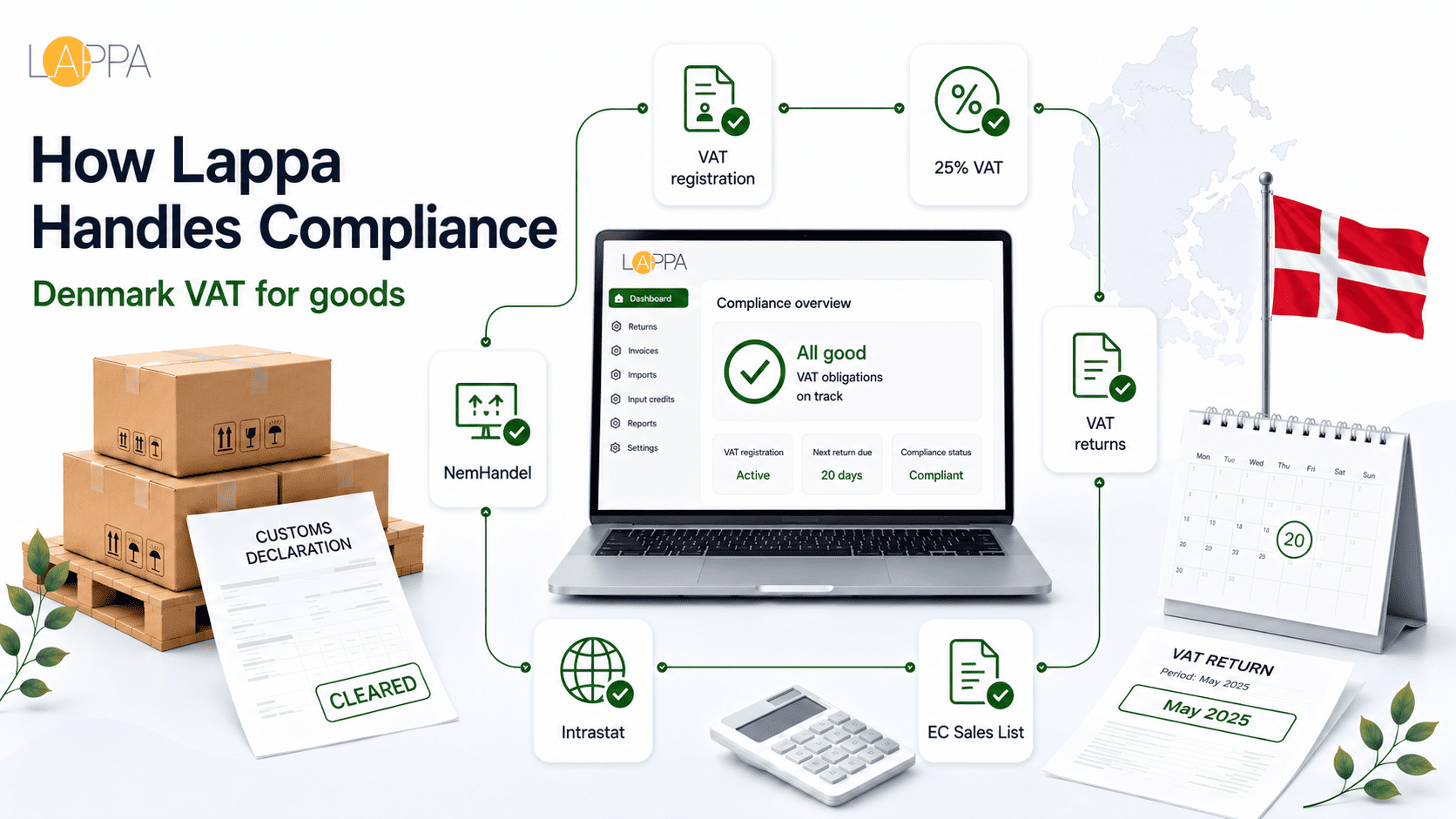 Goods compliance here means returns at the right frequency, EU Sales Lists filed monthly at any rate, potential Intrastat declarations and customs data that must reconcile with TastSelv Erhverv records. VAT in Denmark is operationally straightforward compared to markets with multiple rates, but the filing cadence and cross-system reconciliation still create meaningful overhead for operators entering the Scandinavian market.
Lappa covers the full cycle: enrollment, return preparation and TastSelv Erhverv filing, EU Sales List management, Intrastat filing where applicable, and customs-to-return reconciliation. The question of how much is VAT in Denmark for each product category is confirmed during onboarding — before the first shipment clears. For non-EU operators requiring a fiscal representative, Lappa coordinates that appointment and manages the guarantee arrangements.
Specific services for goods operators:
Goods compliance here means returns at the right frequency, EU Sales Lists filed monthly at any rate, potential Intrastat declarations and customs data that must reconcile with TastSelv Erhverv records. VAT in Denmark is operationally straightforward compared to markets with multiple rates, but the filing cadence and cross-system reconciliation still create meaningful overhead for operators entering the Scandinavian market.
Lappa covers the full cycle: enrollment, return preparation and TastSelv Erhverv filing, EU Sales List management, Intrastat filing where applicable, and customs-to-return reconciliation. The question of how much is VAT in Denmark for each product category is confirmed during onboarding — before the first shipment clears. For non-EU operators requiring a fiscal representative, Lappa coordinates that appointment and manages the guarantee arrangements.
Specific services for goods operators:
- Import credit reconciliation — matching customs entry records against return input credits before Skattestyrelsen's cross-reference checks run
- Export zero-rate documentation — building and archiving the exit evidence the authority requires to substantiate zero-rate treatment on outbound shipments
- Refund claim management — filing and tracking refund recovery for exporters holding consistent credit positions
- Audit response — formal replies to Skattestyrelsen reviews and exchange management through to resolution
FAQ for Denmark VAT Goods
What is the VAT Rate in Denmark
The rate is 25%, applied uniformly to all taxable goods — there are no reduced rates. Every product category from food to electronics faces the same charge. VAT Denmark applies at 25% on the taxable base, which for imports means the CIF value plus customs duties. Exports and intra-community supplies carry 0%. The Danish levy has been at 25% since 1992 — the highest single indirect tax rate in the EU.Who Needs VAT Registration in Denmark
Locally established operators exceeding DKK 50,000 in taxable goods turnover over any 12-month period must enroll. Foreign operators storing goods locally register from day one regardless of sales volume. Operators receiving intra-community acquisitions above DKK 80,000 annually must also register. Voluntary enrollment is available below the threshold and worthwhile for any importer.What is the Denmark VAT Number Format
The Denmark VAT number format is DK + 8 digits — for example DK12345678. The eight-digit sequence is the entity's CVR number. For non-resident operators, the same DK-prefix format applies. Verification is free via EU VIES or virk.dk. A supplier invoice without a valid VAT number Denmark cannot support an input credit claim. The DK-prefixed tax number must appear on all commercial invoices and EU trade declarations.How Much is VAT in Denmark
How much is VAT in Denmark has one answer: 25%. No reduced rates exist — the same charge applies to food, books, medicines, and every other product category. For importers calculating landed costs, it applies at 25% on CIF value plus customs duties. For domestic sales, the moms amount is always 25% of the pre-tax price.How Often Are VAT Returns Filed in Denmark
Filing frequency depends on annual levy liability: monthly for large operators (above DKK 50 million), quarterly for mid-size operators (DKK 5–50 million), and semi-annual for smaller operators (below DKK 5 million). The EU Sales List files monthly regardless — by the 25th of the following month. Intrastat declarations are also monthly where thresholds apply.
VAT Standard rate
25%
Thresholds
Thresholds: DKK 50,000 annual turnover