


Complete Dominican Republic VAT Guide
Provinces
Goods
Provinces
Goods
About
Goods
About
Goods
Goods
Goods
Shipping physical goods into the Caribbean market? Sooner or later, a working tax registration becomes essential, since this economy runs its own consumption system rather than a European-style VAT regime. This guide sticks to goods, skips services, and works through rates, sign-up, invoicing and fines in plain terms. Get the fundamentals sorted early, because the identifier a company receives ties into almost every step that follows, from invoicing to monthly paperwork.
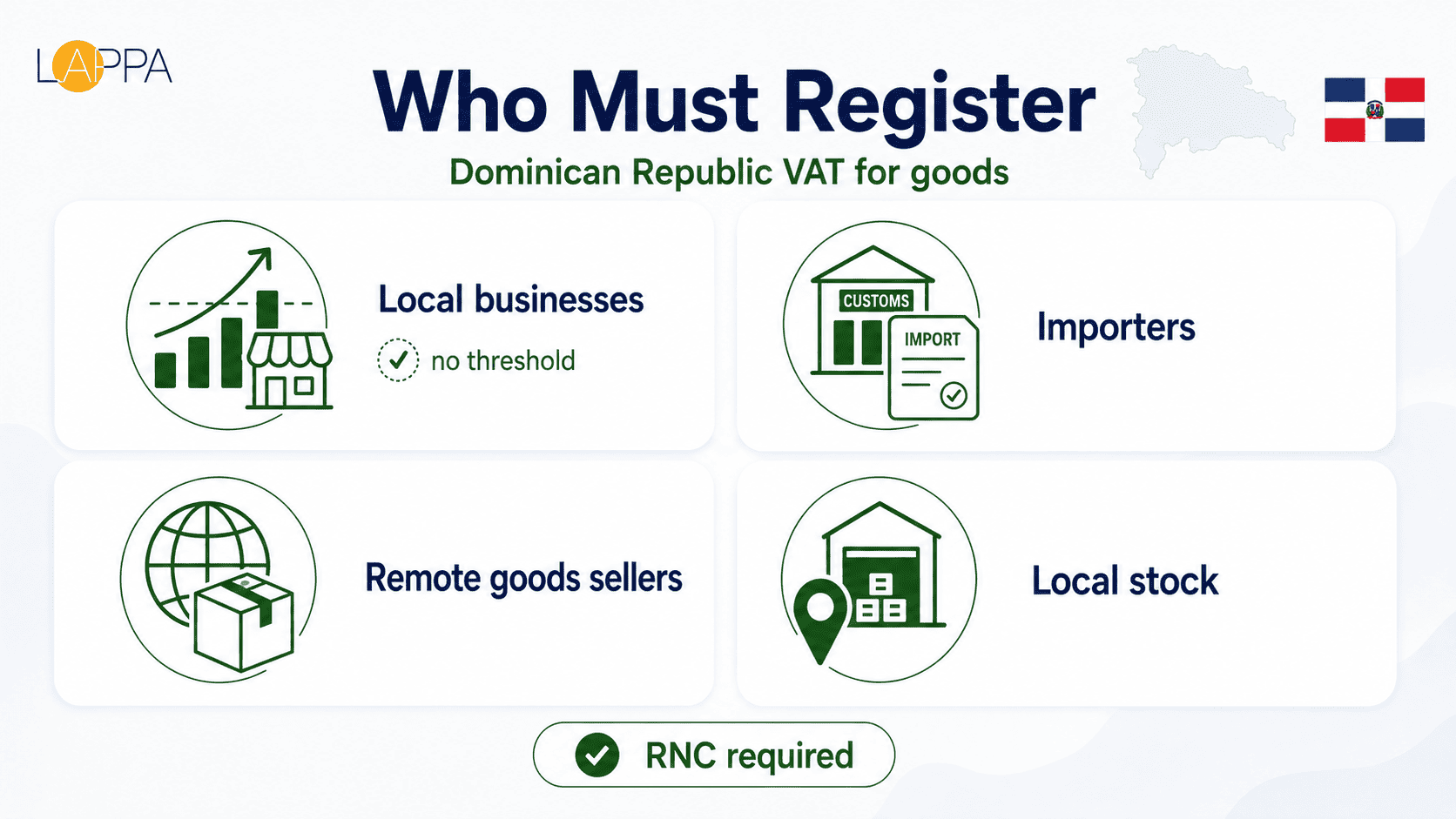 Practically any business engaged in taxable commercial activity falls under this rule, whatever its size or turnover happens to be. Importers, manufacturers, and retailers moving physical goods are all caught equally. A non-resident seller with any taxable footprint here faces the same obligation as a local company would.
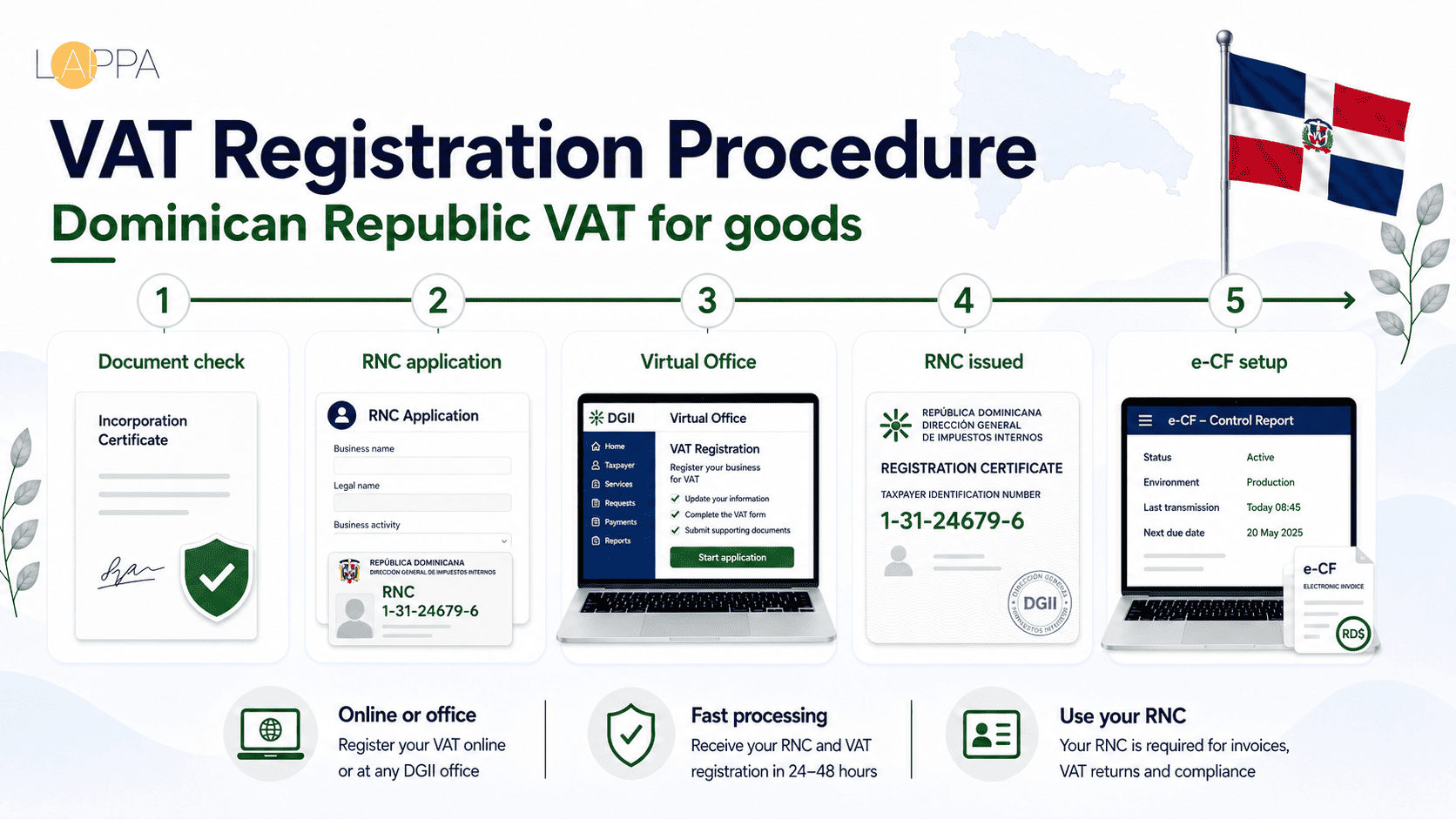 Signing up starts with filing the RNC application, either online through the Virtual Office portal or in person at a local branch. Applicants hand over incorporation papers, ID for whoever represents the company legally, and a registered address. Turnaround is generally quick — often just a handful of business days for a straightforward case. Once cleared, the certificate spells out the effective date and how the business gets classified for filing purposes going forward.
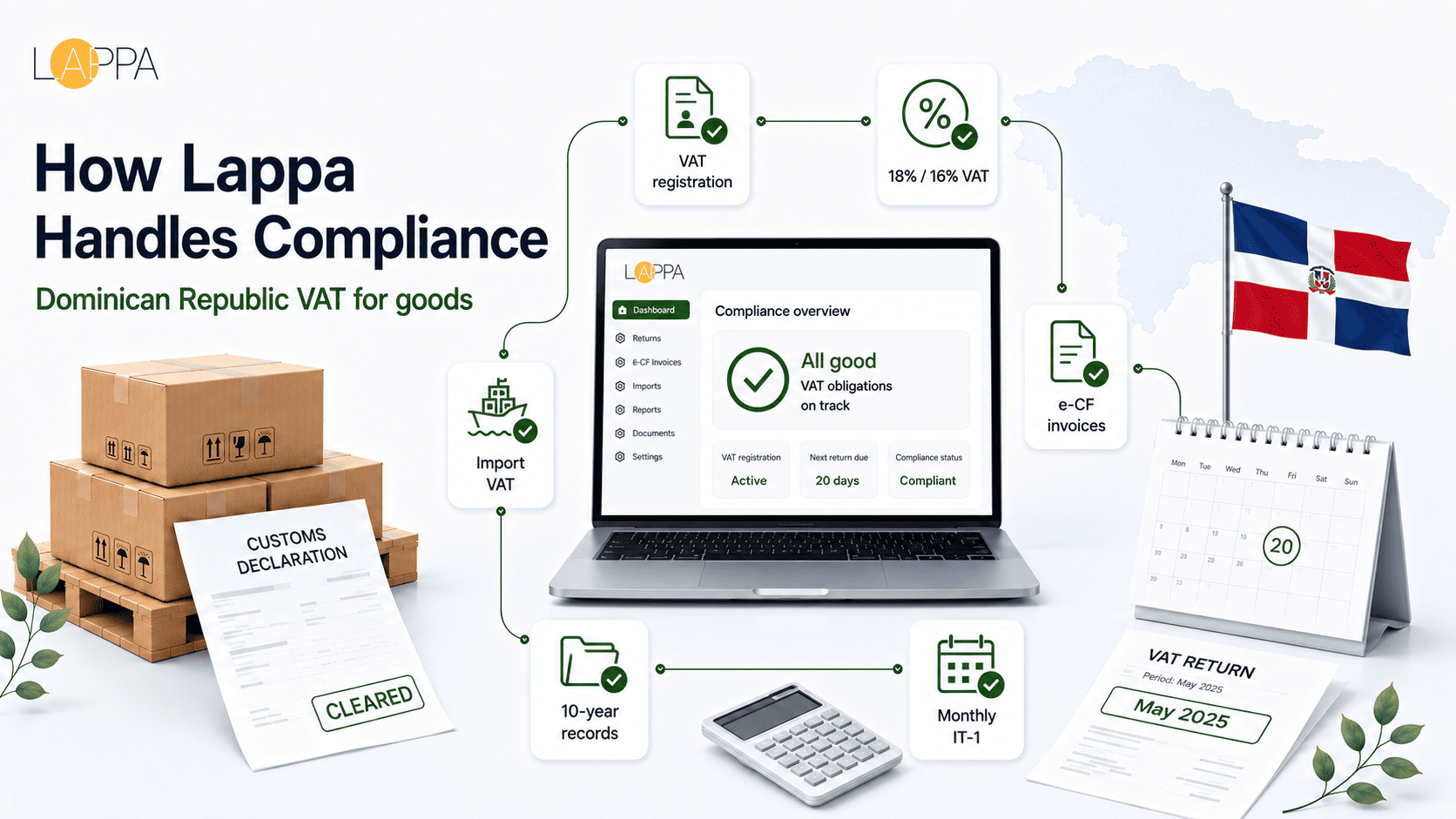 Lappa handles goods sellers from that first RNC application right through to ongoing monthly filing. Keeping e-CF invoicing lined up with current rules, and tracking deadlines so penalties never quietly pile up, is the daily work. Sellers based overseas get their cross-border paperwork sorted too, with Lappa liaising directly with local agents wherever that helps. Get in touch for an honest look at where your registration and filing calendar currently stand.
Introduction to VAT in Dominican Republic
Locally, this charge goes by ITBIS — short for Impuesto sobre Transferencia de Bienes Industrializados y Servicios. Anyone trading taxable goods here needs at least a rough sense of how the mechanics work. VAT in Dominican Republic traces its legal basis to the Tax Code and its later amendments, with the tax authority handling enforcement day to day. The charge lands at every step between factory floor and till receipt, much like similar systems elsewhere in the region. Sell abroad, bring in stock, or trade purely online: tax in the Dominican Republic follows that same chain no matter the channel. Sign-up works identically whichever route a seller takes. Whether the business is a one-person import operation or a large retailer, VAT in Dominican Republic law treats both the same way.Dominican Republic VAT Rate and Categories
Three bands cover goods sold locally. Standard, at 18%, is the default — electronics, clothing, furniture, and most manufactured items fall here. Reduced, at 16%, is a shorter list: sugar, coffee, cocoa, dairy, and cooking oils, among a handful of others. Zero, unsurprisingly, sits at 0% and covers anything leaving the country as an export. Which Dominican Republic VAT rate applies comes down to the product itself, never the size of the seller. A few essentials sit outside the system altogether — basic foodstuffs, medicine, books, and teaching materials carry no charge and generate no input credit either way. The country's VAT rate bands have barely moved in over a decade, so at least the pricing groundwork stays stable. Misjudging a category is one of the more common triggers for a closer look from tax officers. Get the right Dominican Republic VAT rate pinned down before a product goes on sale, since fixing a wrong classification later costs real time and money.VAT Dominican Republic Rates by Goods Category
Every product sits in one of three bands shown below, and VAT Dominican Republic classification decides which one fits a given item. Getting that call right the first time saves a repricing headache further down the road. Guidance on each band gets published and refreshed periodically by the tax authority, and checking VAT Dominican Republic rules before locking in a price list is worth the extra few minutes it takes. This matters more than it sounds, since a single miscoded item can throw off an entire product line's margins. Tax rules across the Dominican Republic don't treat an imported item any differently from something made two towns over.| Category | Rate applied | Typical examples |
| Standard rate | 18% | Electronics, furniture, clothing, most manufactured goods |
| Reduced rate | 16% | Sugar, coffee, cocoa, dairy, cooking oils |
| Zero rate | 0% | Exported goods |
| Exempt | None charged | Basic foodstuffs, medicine, books, educational materials |
VAT Registration Threshold
There's no minimum turnover to clear before sign-up becomes compulsory here. Any business running a taxable economic activity has to register with the tax authority from day one, picking up its identifying number before the first invoice ever goes out. That's a sharp break from the EU or UK model, where crossing a turnover line comes first.For local businesses
A locally formed company registers as part of setting up, well before any actual trading starts. The application runs alongside the usual incorporation paperwork, often at the very same government window.For remote sellers selling goods
Sellers based overseas but shipping stock in face the identical rule, with no volume-based grace period whatsoever. Holding inventory in a local warehouse, or working through a distributor on the ground, tends to trigger the sign-up requirement almost immediately.Who Must Register for VAT
Practically any business engaged in taxable commercial activity falls under this rule, whatever its size or turnover happens to be. Importers, manufacturers, and retailers moving physical goods are all caught equally. A non-resident seller with any taxable footprint here faces the same obligation as a local company would.
VAT Tax Dominican Republic Registration Checklist
Before applying, most businesses want the following ready ahead of time.- A completed application form submitted to the tax authority
- Proof of company incorporation or business registration
- Identification documents for owners or legal representatives
- A registered business address within the country
VAT Number Dominican Republic
What gets called a VAT number Dominican Republic issues is technically an RNC, not a VAT number in the strict European sense, though it does the same job. Companies get a 9-digit code, written as X-XX-XXXXX-X — 1-31-24679-6, say. Individuals skip a separate number entirely and just use their existing 11-digit national ID instead. Once issued, that VAT number Dominican Republic businesses hold has to sit on every invoice and receipt they raise. It also needs to line up with whatever trading name is on file, or a buyer's bookkeeper may well flag the paperwork later. Anyone can run a free check through the tax authority's online lookup to confirm a number is genuinely live. The tax identification number issued to Dominican businesses also carries a status flag — active, suspended, or cancelled — worth checking before an invoice gets paid.VAT Registration Procedure
Signing up starts with filing the RNC application, either online through the Virtual Office portal or in person at a local branch. Applicants hand over incorporation papers, ID for whoever represents the company legally, and a registered address. Turnaround is generally quick — often just a handful of business days for a straightforward case. Once cleared, the certificate spells out the effective date and how the business gets classified for filing purposes going forward.
Appointing a Tax Representative
Most sellers based abroad don't actually need a local fiscal representative purely to sign up for this charge. The tax authority is generally happy dealing straight with a foreign business or whoever it appoints locally. Even so, plenty hire a local accountant anyway, mostly because the filing software and monthly deadlines go smoother with someone on the ground handling it. That agent can file monthly returns, field questions, and deal with the paperwork on the seller's behalf.VAT Electronic Invoices
Electronic invoicing here — known as e-CF, or Comprobante Fiscal Electrónico — is mandatory, rolling out in stages by taxpayer size. Large national filers went first, required to switch over by May 2024. Large local and medium-sized businesses followed, with the deadline pushed to November 2025 for anyone already partway through onboarding. Small and micro businesses, plus anything unclassified, hit the final deadline in May 2026, after which paper receipts simply stop counting for tax purposes for that group.Timeline by Business Size
| Business size | e-CF deadline | What changes |
| Large national taxpayers | May 2024 | Mandatory e-CF, phased Jan to May 2024 |
| Large local and medium taxpayers | November 2025 | Mandatory e-CF, extended from May 2025 |
| Small, micro and unclassified | May 2026 | Final phase, mandatory for all remaining taxpayers |
VAT Returns and Filing
Registered sellers file monthly, using Form IT-1, covering everything sold and bought within the period. Both the filing and any payment land on the same date — the 20th of the month right after, with little room for weekend slippage in most cases. A handful of records typically sit behind each submission.- The monthly IT-1 return itself, filed through the online Virtual Office
- Import paperwork for goods entering the country
- Electronic invoices raised through the e-CF system
- Sales records supporting whatever's been collected
- Purchase records and supplier invoices backing input credits
Deductible VAT for Goods Sellers
A registered seller can generally claw back charges paid on stock, packaging, and equipment used for taxable trading. The purchase needs a proper receipt showing the amount charged, and it has to tie directly to taxable sales somewhere down the line. A few costs stay blocked regardless — most passenger cars and client entertaining chief among them.VAT Record Keeping Requirements
Books and supporting documentation need keeping for at least ten years under the Tax Code. Whatever gets stored has to hold enough detail for an auditor to rebuild any given return from scratch if asked. Electronic invoices, purchase ledgers, and past filings are best kept together for quick retrieval when needed.VAT Penalties and Fines
Filing or paying late brings a penalty worth 10% of what's owed for the first month overdue. Every month after that tacks on a further 4%, stacking on top of accruing interest. Persistent slippage can also stop a business validating its own receipts in the tax system, which then blocks its customers from claiming input credit too. Trading in taxable goods without a valid registration can expose a business to backdated assessments once the authorities spot the activity, on top of whatever standard penalties already apply.How Lappa Can Help with VAT Compliance
Lappa handles goods sellers from that first RNC application right through to ongoing monthly filing. Keeping e-CF invoicing lined up with current rules, and tracking deadlines so penalties never quietly pile up, is the daily work. Sellers based overseas get their cross-border paperwork sorted too, with Lappa liaising directly with local agents wherever that helps. Get in touch for an honest look at where your registration and filing calendar currently stand.
FAQ for VAT Dominican Republic Goods
What is the VAT rate in Dominican Republic
Standard sits at 18%, covering most goods and services sold within the country. Reduced comes in at 16%, reserved for a short list of foodstuffs such as sugar, coffee, and dairy. Zero applies to exports, and a further batch of essentials — basic food, medicine, books — carries no charge at all. Which band applies depends entirely on the product, not on how big the business selling it happens to be.Who needs VAT registration in Dominican Republic
Just about any business running a taxable commercial activity has to register, since there's no turnover floor to clear first. That covers local companies from the moment they incorporate, plus overseas sellers with any taxable presence on the ground. Importers and retailers moving physical goods are caught just as much as manufacturers are. Registration runs through the tax authority and results in an RNC number that ends up on every invoice.What is the VAT number format in Dominican Republic
For companies, it's a 9-digit code, usually written as X-XX-XXXXX-X — 1-31-24679-6, for instance. Individuals skip a separate business number and simply use their existing 11-digit national ID instead. The tax authority assigns the code once an application clears, and from there it has to appear on every invoice and receipt issued. A free lookup tool on the authority's website lets anyone confirm whether a given number is currently active.What is the current VAT rate in Dominican Republic
The standard band has held at 18% for several years running, without any change. Reduced-rate goods, a short list of foodstuffs, sit at 16%, and exports carry a 0% charge. These bands have stayed put for a while now, which at least gives sellers something stable to price against.How often are VAT returns filed in Dominican Republic
Filing happens monthly for every registered business, using Form IT-1. Both the return and any payment owed are due the 20th of the month right after the reporting period closes. There's no quarterly or annual option for standard filing here, unlike in some other markets. Miss the date and a penalty lands almost immediately, so the monthly rhythm genuinely matters for cash flow planning too.VAT Calculator
Working out the charge on a sale is just arithmetic once you know the band. Take a standard-rated item priced at RD$236 including the charge: divide by 1.18, and RD$200 is the net figure, leaving RD$36 as the tax portion. For something reduced-rated at 16%, divide the gross number by 1.16 instead. Most local accounting packages handle this instantly, so the maths below is really just for a quick gut check.- Adding the charge: net price × (1 + rate) = gross price
- Removing the charge: gross price ÷ (1 + rate) = net price
- Tax portion only: gross price − net price = amount due
VAT Standard rate
18%
VAT Reduced rate
16%
Thresholds
There is no universal turnover threshold that automatically exempts a foreign business carrying out taxable activities in the Dominican Republic.