


Cambodia VAT Registration and Compliance Guide
Provinces
Goods
Provinces
Goods
About
Goods
About
Goods
Goods
Goods
Introduction to VAT in Cambodia — How VAT in Cambodia Operates Under the LOT Framework
Ten percent. Lock that number in before anything else. VAT in Cambodia runs under the Law on Taxation — the LOT, 1997, updated through prakas and sub-decrees from the Ministry of Economy and Finance ever since. Day-to-day administration belongs to GDT. General Department of Taxation. tax.gov.kh. Phnom Penh. That's the counterparty you're filing with, corresponding with, and getting audited by. The mechanics: you charge 10% on taxable supplies, deduct the VAT you paid on your own purchases, remit the net monthly. Exporters often run in credit — inputs taxed at 10%, output charged at 0%, credit builds up. You carry it forward or apply for a refund. Refunds involve a GDT verification process. Not quick. Carry-forwards are simpler. Cambodia's VAT design covers supply of goods, supply of services, importation. Supplies consumed entirely outside Cambodia fall out of scope. Then there are two off-standard buckets — zero-rated and exempt — and this is where half the questions in a first meeting come from. Zero-rated means VAT charged at 0% but the supplier still recovers input VAT on costs. Exempt means no VAT on the supply and no input VAT recovery either. The difference is cash. Real cash. An exporter on 0% gets back all the input VAT paid on purchased goods and services. A hospital applying exempt treatment to its services also can't touch the VAT on its MRI equipment. Those are not the same situation — and conflating them is one of the most expensive misunderstandings in Cambodia VAT. Cambodia's VAT design follows the standard multi-stage consumption logic: tax lands on the final consumer, not on businesses in the supply chain — provided those businesses are registered and filing. When one breaks the chain, the whole mechanism shifts. 2021 is when non-resident digital platforms got pulled in. Prakas No. 542 MEF. Foreign streaming services, SaaS providers, digital marketplaces — if Cambodian residents are paying, Cambodian VAT applies. No office needed. No server in Phnom Penh needed. Just Cambodian users spending money. Cambodia VAT services from Lappa cover the full cycle for domestic operators and for the non-residents who've never had a GDT file before.VAT Rates in Cambodia — Cambodia VAT Rate and Rate Structure
The Cambodia VAT rate is 10%. That's been the number since the LOT first came in. Exports: 0%. Exempt categories — banking, insurance, healthcare, education, public postal services, certain land transactions — no VAT charged, no input credit recoverable. The Cambodia VAT rate of 10% is the default position. No explicit statutory basis for zero-rating or exemption? 10% applies. GDT auditors know this well. Applying zero-rate to a domestic software contract on the theory that it's "similar to an export" is one of the more reliably-flagged errors in desk audits. The statutory basis has to be there. It can't be inferred.| VAT Rate | Category | Representative Examples |
| 10% | Standard | Retail goods, professional services, SaaS, manufacturing, construction |
| 0% | Zero-rated | Goods exports, international freight, services consumed outside Cambodia |
| Exempt | No VAT — no input credit | Banking, insurance, healthcare, education, public postal, land sales |
VAT Registration Threshold in Cambodia — Local Businesses, Remote Sellers and Digital Services
Three separate frameworks. Which one applies to your business depends entirely on what GDT sees when it looks at your structure.For Local Businesses
KHR 250,000,000 per year in taxable turnover. That's the threshold — roughly USD 62,500 at current exchange. Cross it and mandatory VAT registration Cambodia obligations kick in immediately. Not at year-end. Not at the start of next year. Now. But the threshold test isn't the only trigger — and this is where new entrants consistently get caught. Cambodia VAT registration obligations arise regardless of turnover for: foreign-invested enterprises (from the date of incorporation, full stop), construction contractors on government and BOT projects (from project commencement), and any entity GDT classifies as real-regime by virtue of its activity type or ownership structure. The KHR 250,000,000 figure is for domestic businesses that aren't already caught by another rule. And one more thing about the threshold that's worth stating plainly: exempt supplies don't count. A firm generating KHR 200,000,000 from taxable consulting and KHR 80,000,000 from exempt residential rental sits at KHR 200,000,000 for threshold purposes. Below threshold. But if that firm diversifies into taxable commercial leasing on top of the existing activities, it crosses faster than the headline revenue number suggests. Threshold monitoring needs to account for the mix, not just the total.For Remote Sellers
Foreign businesses with stock in Cambodian warehouses, consignment arrangements, or agents authorised to conclude contracts on their behalf typically acquire taxable presence here and register under domestic rules. Purely remote exporters — delivering duty-paid with no retained local inventory or risk — don't generally need a standalone GDT registration. Import VAT hits at the border on every shipment regardless.For Every Remote Digital Company
No threshold. Zero. Not KHR 1. Not USD 1. The obligation starts from the first transaction. That's not a drafting oversight in Prakas 542. It's deliberate. The obligation arises from the first supply. A digital company providing video streaming, SaaS tools, or app downloads to Cambodian residents owes Cambodian VAT from transaction one — full stop. Services in scope under Prakas 542:- Video on demand, music streaming, online entertainment platforms
- Cloud computing — IaaS, PaaS, SaaS
- Mobile app stores and downloadable software
- Online advertising and programmatic ad networks
- E-books, online gaming, digital publications
- Web hosting and domain registration services
Who Must Register for VAT in Cambodia — Every Business Type and Foreign Operator
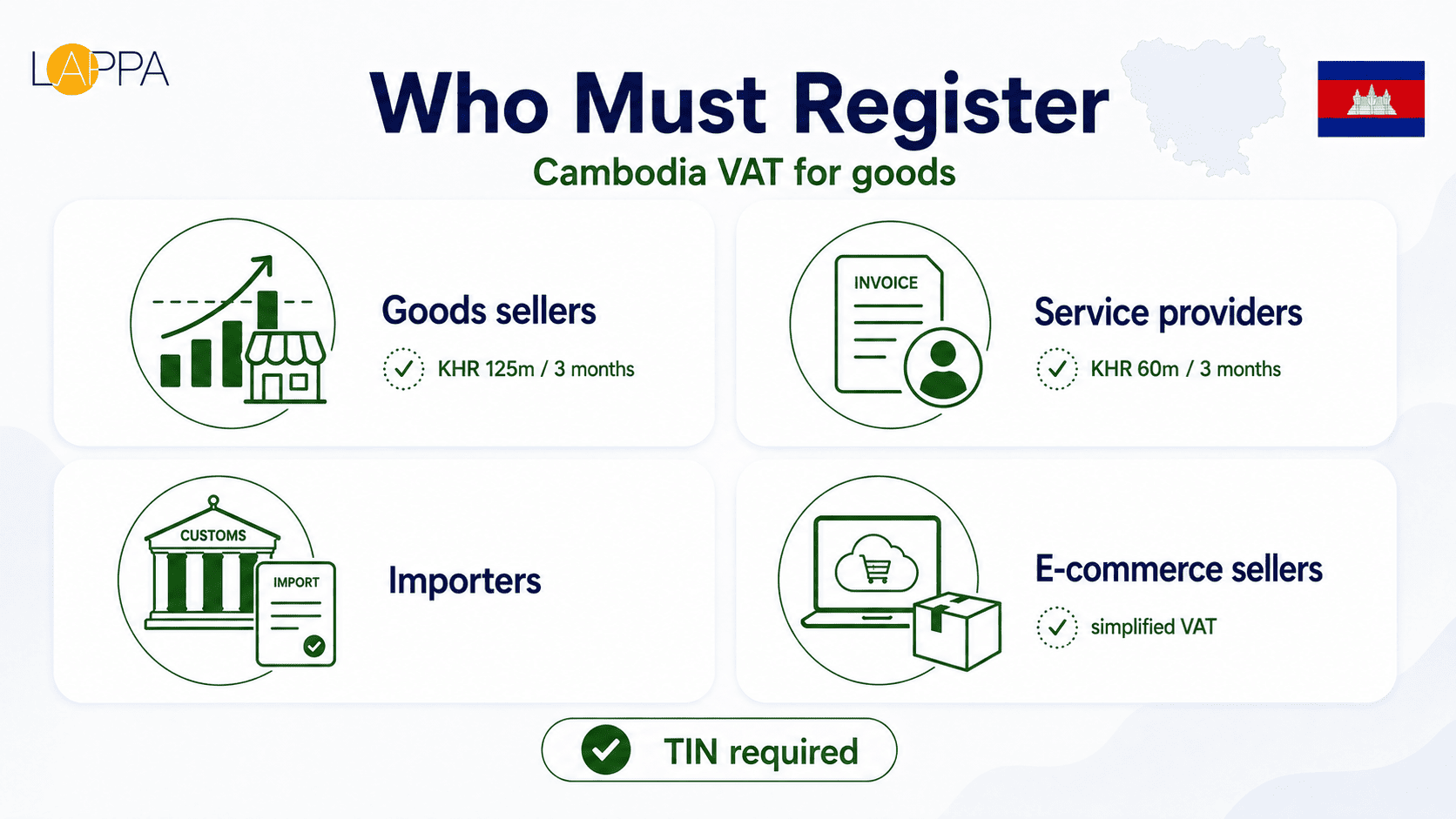 Mandatory registration. Here's who it catches:
Every business in one of these categories has to register:
Mandatory registration. Here's who it catches:
Every business in one of these categories has to register:
- Resident businesses with annual taxable turnover above KHR 250,000,000
- Foreign-invested enterprises — from incorporation, no turnover test applied
- Branch offices of foreign companies operating in Cambodia
- Construction contractors and sub-contractors on government and BOT projects
- Non-resident digital companies supplying electronic services to Cambodian B2C consumers under Prakas 542
- Any entity GDT classifies as real-regime through activity type or ownership structure
- Your VAT-registered business customers want to recover input VAT — being unregistered makes you a less attractive B2B supplier, particularly in sectors where purchasing decisions factor in recoverable tax
- You've carried heavy input VAT on startup costs and recovery is worth the compliance overhead
- You're going to blow past KHR 250,000,000 within the next 12 months anyway — building the compliance infrastructure now is less painful than scrambling to retrofit it later
VAT Number in Cambodia — VAT Number Cambodia Format and VAT Certificate Cambodia
Nine digits. That's it. The VAT number in Cambodia is the TIN — Tax Identification Number — issued by GDT when a business first registers. Nine digits, all numeric, no letters, no separators in the official format. And critically: there's no separate VAT identifier. The same 9-digit TIN covers every Cambodian tax obligation — VAT, corporate income tax, withholding tax, prepayment of minimum tax. One number, everything runs through it. Cambodia's VAT number system links directly to the Ministry of Commerce registration database. When a company incorporates with MORC and gets its business registration certificate, the TIN that appears there carries straight into GDT. Same number, same entity, same record. It doesn't split into separate identifiers for different taxes the way some jurisdictions do. The VAT number Cambodia authorities maintain in GDT's database is permanent for the life of the entity. Moving premises doesn't change it. Restructuring ownership doesn't change it. Adding new business activities doesn't change it. It follows the legal entity until formal dissolution and GDT deregistration. Foreign counterparties can verify any Cambodia TIN through GDT's online verification tool — confirms validity and current registration status in real time. For procurement teams processing significant supplier invoices, checking the TIN before payment is standard practice. One invalid TIN on a purchase invoice and the input VAT recovery is gone.| TIN Element | Details |
| Format | 9-digit numeric (e.g., 123456789) |
| Issuing authority | General Department of Taxation (GDT) |
| Scope | All Cambodian taxes — VAT, CIT, WHT, minimum prepayment |
| Permanence | One TIN per entity — permanent until formal deregistration |
| Display obligation | VAT certificate must be posted at all business premises |
VAT Registration Cambodia Procedure — GDT Application Steps and Documentation
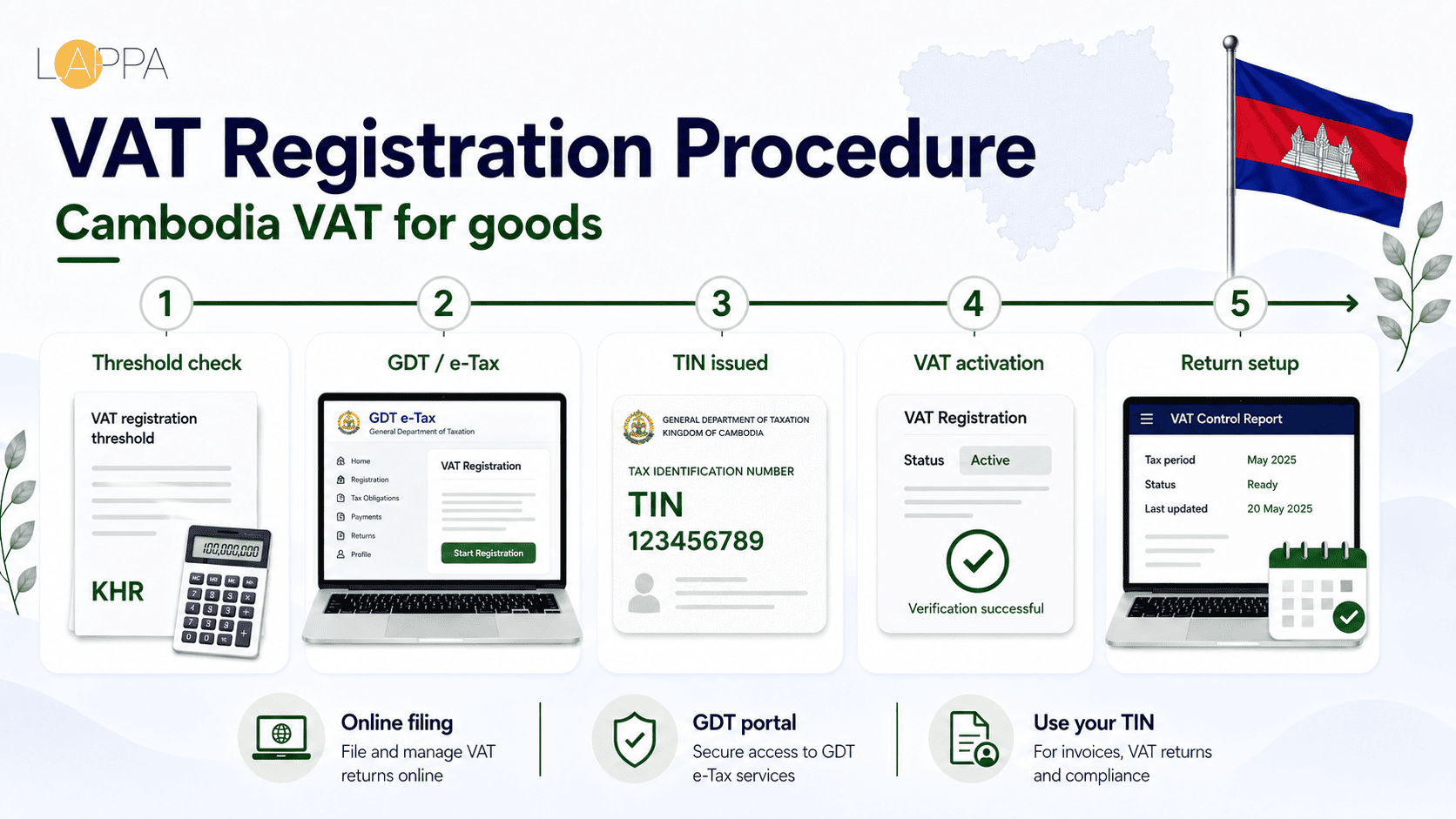 VAT registration Cambodia runs through GDT — locally at the district office or through the e-Filing portal at tax.gov.kh. Non-resident digital companies get a dedicated non-resident channel on the same platform. Fully online, no paper, designed specifically for operators who've never set foot in a Cambodian government office. GDT built it that way intentionally — they want Prakas 542 registrants in the system, and they reduced the friction to make it happen.
Domestic registration — step by step:
VAT registration Cambodia runs through GDT — locally at the district office or through the e-Filing portal at tax.gov.kh. Non-resident digital companies get a dedicated non-resident channel on the same platform. Fully online, no paper, designed specifically for operators who've never set foot in a Cambodian government office. GDT built it that way intentionally — they want Prakas 542 registrants in the system, and they reduced the friction to make it happen.
Domestic registration — step by step:
- Obtain a Business Registration Certificate from the Ministry of Commerce (MORC)
- Complete GDT Form TD-R
- Compile supporting documents
- Submit at the GDT district office or via e-Filing
- Wait — typically 15 to 30 business days for GDT review
- Receive TIN Certificate and VAT certificate from GDT
- Completed Form TD-R
- MORC Business Registration Certificate
- Memorandum and Articles of Association
- Lease agreement or title deed for the registered premises
- Passport or national ID for directors and shareholders holding ≥ 10%
- Cambodian bank account details
- Authorised signatory specimen
- Home-jurisdiction incorporation certificate — English or Khmer, certified translation if needed
- Description of electronic services supplied to Cambodian consumers
- Appointment letter for the Cambodian tax representative
- Company banking details for VAT remittance
Tax Representative in Cambodia
No Cambodian permanent establishment? You need a local tax agent. Under Prakas 542, GDT's position is clear. Non-resident digital companies supplying to Cambodian consumers are expected to appoint a licensed Cambodian tax representative before filing starts. Without one, official GDT notices arrive in Khmer to an address the company probably doesn't monitor. Deadlines pass. Penalties accrue. By the time a non-resident realises they've been non-compliant for 18 months, the interest alone is significant — and the back penalties can look alarming. What a Cambodian tax representative does for a non-resident:- Files monthly VAT returns on your behalf through GDT e-Filing
- Holds GDT power of attorney — signs off on all correspondence, handles audit responses
- Receives formal notices, assessment letters, audit requests on your behalf
- Facilitates VAT payment through Cambodian banking channels
- Manages direct communication with the relevant GDT branch office
VAT E-Invoices in Cambodia — VAT Invoice in Cambodia Timeline and Requirements
GDT started the e-invoicing rollout in 2023. Phased by taxpayer size — the same sequencing Cambodia's neighbours used when they made the same transition. Phase schedule:| Phase | Taxpayer Group | Period |
| Phase 1 | Large taxpayers (GDT Large Taxpayer Department) | From 2023 |
| Phase 2 | Medium taxpayers (Medium Taxpayer Branches) | 2024–2025 |
| Phase 3 | Small real-regime taxpayers | From 2025 onward |
| Non-resident digital providers | Non-resident portal | From registration date |
- Supplier's full registered name and address
- Supplier's 9-digit TIN
- Invoice date and sequential invoice number
- Buyer's name, address, and TIN — for B2B transactions
- Description and quantity of goods or services
- Unit price exclusive of VAT
- VAT rate — 10%, 0%, or exempt notation
- Total VAT amount
- Total payable inclusive of VAT
VAT Returns in Cambodia — Filing Types and VAT Control Report
Monthly. Every month. January's return: due February 20th. February's: March 20th. No quarterly filing. No annual simplified option. If you're registered — registered — you file every month. Including the months where nothing happened. Including December when your team was travelling. Including months when you were in the middle of an ERP migration and the data wasn't clean yet. File. What a monthly return covers:- Total output VAT on taxable sales during the period
- Total deductible input VAT on purchases and imports
- Net VAT payable — or excess credit to carry forward
- Prepayment of minimum tax (separate line, same form)
- GDT e-Filing (tax.gov.kh): mandatory for large and medium taxpayers
- Paper at GDT district office: still available for small real-regime businesses
Deductible VAT in Cambodia
The input VAT credit mechanism is what stops VAT from stacking up through the supply chain. You deduct the VAT you paid on your business inputs against the VAT you charge on your outputs. Only the margin you actually add gets taxed. What qualifies:- VAT on goods purchased for resale
- VAT on raw materials and production components
- VAT on services directly related to making taxable supplies
- Import VAT at customs
- VAT on capital equipment used in taxable activities
- Entertainment, hospitality, and restaurant expenses — unless your business is in hospitality
- Purchases used exclusively for exempt supplies
- Passenger vehicles — in most circumstances
- Any purchase without a compliant VAT invoice on file
VAT Record-Keeping Requirements in Cambodia
Ten years. Not five. Ten. Every document that feeds into a VAT return: kept for ten years from the transaction date. That's one of the longer retention requirements in ASEAN. It's also exactly aligned with Cambodia's fraud audit statute of limitations under the LOT — which isn't a coincidence. What needs to stay in the file:- All VAT invoices issued — your sales records
- All VAT invoices received — your purchases
- Import and export customs declarations
- Monthly VAT returns and GDT payment receipts for each period
- Bank statements showing VAT payments made
- Contracts underpinning significant service supplies
- Fixed asset register supporting capital goods input VAT claims
- All GDT correspondence — every assessment letter, every notice, every response, all of it
VAT Cambodia — Penalties and VAT Tax Cambodia Enforcement
VAT Cambodia enforcement shifted significantly around 2020 when GDT implemented risk-based audit selection. The system cross-references input/output VAT ratios against sector benchmarks, matches customs import records against VAT return figures, and flags non-filers automatically. Random audits still happen. But the majority of formal audit processes now begin with a specific data anomaly — which means clean businesses largely get left alone, and businesses with unexplained gaps in the data get looked at carefully. VAT tax Cambodia penalties:| Violation | Penalty |
| Late VAT return filing | 10% of VAT due for the period |
| Underpayment of VAT | 25% of the underpaid amount |
| Late payment interest | 2% per month on outstanding balance |
| Failure to register when required | KHR 5,000,000 (~USD 1,250) |
| Incomplete or invalid VAT invoice | KHR 2,000,000 per invoice |
| VAT certificate not displayed | Minor infraction, noted on audit record |
| Tax fraud — deliberate understatement | Criminal liability under LOT |
- Large taxpayers with input/output VAT ratios that sit outside sector norms
- Non-resident digital platforms that have been operating under Prakas 542 scope without registering
- Construction subcontractor chains where VAT charges break somewhere in the middle tiers
- Import businesses with customs declaration values that don't reconcile to VAT returns
How Lappa Can Help with Cambodia VAT Compliance — Cambodia VAT Services
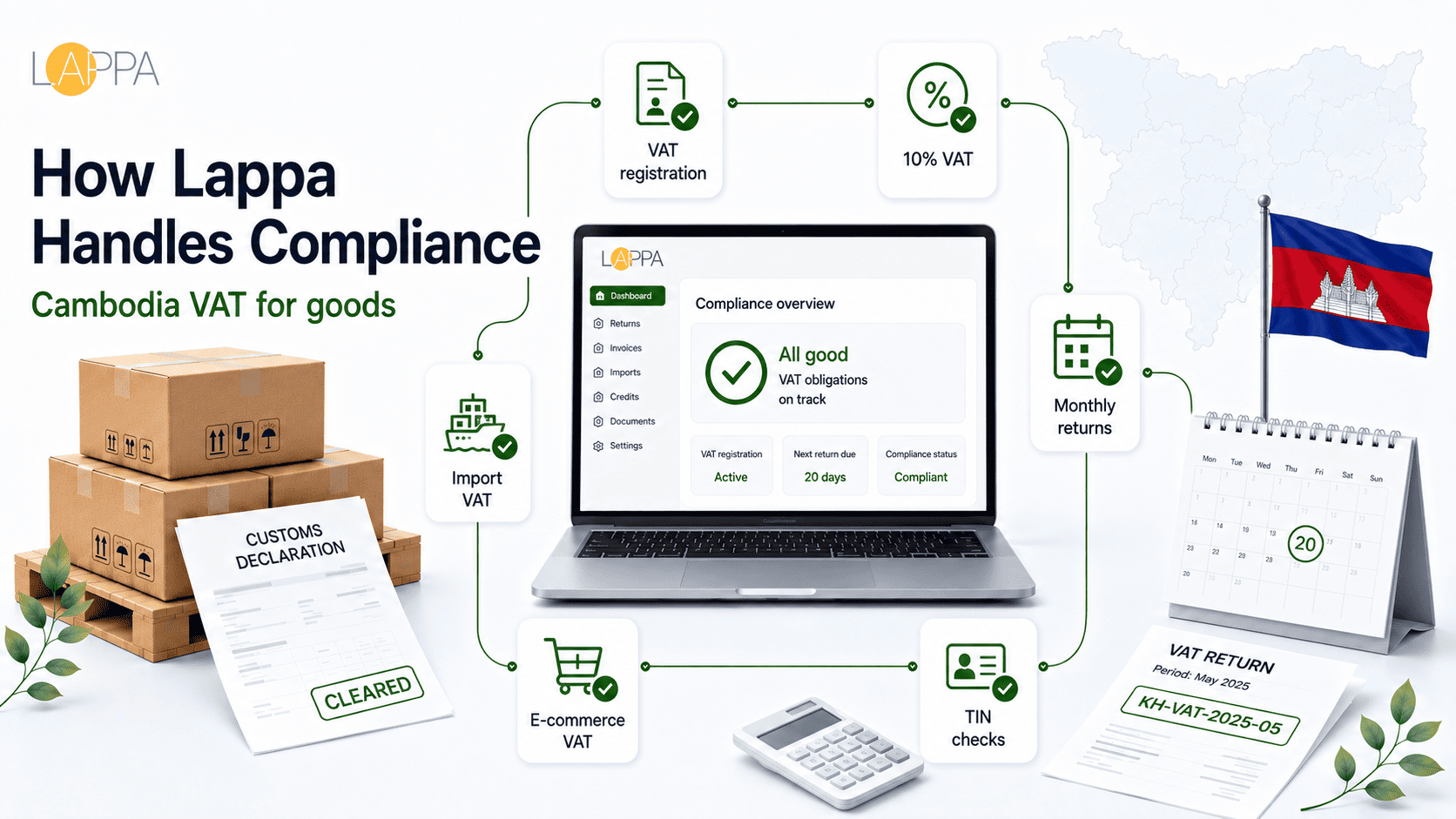 Cambodia VAT compliance is monthly deadlines in Khmer-language correspondence with a government department in Phnom Penh, a phased e-invoicing rollout still working through its second and third stages, and — for non-residents — a representative appointment that has to be in place before the first transaction, not after. The compliance framework is manageable. Set up properly, it runs. Set up poorly or ignored, it accumulates.
Lappa's Cambodia VAT services cover the full cycle:
Registration services
Cambodia VAT compliance is monthly deadlines in Khmer-language correspondence with a government department in Phnom Penh, a phased e-invoicing rollout still working through its second and third stages, and — for non-residents — a representative appointment that has to be in place before the first transaction, not after. The compliance framework is manageable. Set up properly, it runs. Set up poorly or ignored, it accumulates.
Lappa's Cambodia VAT services cover the full cycle:
Registration services
- End-to-end GDT VAT registration for domestic and non-resident businesses
- Tax representative appointment and ongoing licence management for non-resident digital operators
- Ministry of Commerce coordination for new foreign-invested entities needing MORC registration before GDT registration
- Monthly VAT return preparation and GDT e-Filing submission
- Input VAT reconciliation and credit tracking across periods
- VAT invoice review and TIN verification against GDT's database
- VAT control report preparation on GDT audit or review request
- Representation through GDT audit proceedings
- Voluntary disclosure filing for operators with historical compliance gaps
- Structure analysis for businesses operating on the taxable/exempt supply boundary
- Digital economy VAT guidance for non-resident platforms caught by Prakas 542
- Cross-border supply chain VAT analysis for importers and exporters
FAQ for Cambodia VAT Goods
What Is the VAT Rate in Cambodia
- 10%. Cambodia's standard VAT rate is 10%, applied to standard-rated domestic supplies of goods and services and to imported goods. Exports of goods and qualifying international services go to 0%. Financial services, insurance, healthcare, education, and certain other categories sit in the exempt bucket — no VAT charged, and no input VAT recovered by the supplier on costs attributable to those supplies.
Who Needs to Register for VAT in Cambodia
- Domestic businesses with annual taxable turnover above KHR 250,000,000 (around USD 62,500). Foreign-invested enterprises at incorporation, regardless of turnover. Non-resident digital service providers from the first supply — Prakas No. 542 MEF (2021) sets no minimum threshold. Construction contractors on government and BOT projects from project commencement. Any entity GDT classifies into the real-regime by activity type.
What Is the VAT Number Format in Cambodia
- Nine digits, numeric, no letters. The VAT number in Cambodia is the TIN — Tax Identification Number — issued by GDT at registration. One number covers all Cambodian tax obligations: VAT, corporate income tax, withholding tax, prepayment of minimum tax. A business's VAT number in Cambodia appears on its GDT certificate, every invoice it issues, every return it files.
How Often Are VAT Returns Filed in Cambodia
- Monthly. The 20th of the following month is the deadline — January's return is due February 20th, February's due March 20th. No quarterly option. No annual option. Nil returns required for months with zero activity — non-filing is treated as non-compliance regardless of whether any transactions occurred that period.
Do Foreign Companies Need a Tax Representative in Cambodia
- Non-resident digital service providers under Prakas 542 are expected — and GDT practice treats it as required — to appoint a licensed Cambodian tax agent before filing. The agent files monthly returns, holds GDT power of attorney, handles all official correspondence. Foreign entities with a Cambodian branch, representative office, or subsidiary file directly through that local structure without a separate representative appointment.
VAT Calculator
10% keeps the maths easy. Adding VAT to a net price: VAT = Net × 0.10 Total = Net × 1.10 Extracting VAT from a gross price: VAT = Gross ÷ 1.10 × 0.10 Net = Gross ÷ 1.10 KHR example: Net fee: KHR 10,000,000 → VAT: KHR 1,000,000 → Invoice total: KHR 11,000,000 USD example: Net: USD 2,500 → VAT: USD 250 → Total: USD 2,750 Cambodia's commercial and B2B transactions run heavily in USD. GDT accepts returns and invoices in both KHR and USD — that's fine. But here's what catches people: if you're invoicing in USD, the KHR equivalent you report on the monthly return must use GDT's published reference rate for that period. Not your bank's rate that morning. Not the street rate. The GDT rate, published and applied consistently. Using a different one creates a line-item mismatch that GDT's return-review system picks up. It's a small thing. It comes up constantly.
VAT Standard rate
10%
VAT Reduced rate
0%
Thresholds
KHR 250 million annual turnover (mandatory VAT registration for resident businesses); no threshold for many non-resident digital service providers required to register