


Complete Ecuador VAT Guide
Provinces
Goods
Provinces
Goods
About
Goods
About
Goods
Goods
Goods
Introduction to VAT in Ecuador
Something most importers notice quickly about this Andean market: it runs on US dollars. Ecuador dropped its own currency in 2000 and has used USD ever since, which removes the exchange rate layer that complicates landed cost calculations across most of Latin America. The IVA — Impuesto al Valor Agregado — is the indirect levy charged at 12% on most goods, administered by the Servicio de Rentas Internas. Ecuador VAT sits at 12% as the standard rate, though a temporary 13% was enacted in 2024 — check sri.gob.ec for the current figure before quoting landed costs. This is not an EU country. No OSS, no distance-selling threshold, no Intrastat. Foreign operators with goods activity here need either a local legal presence or a named tax representative. The legal framework is the LORTI (Ley Orgánica de Régimen Tributario Interno), periodically amended as fiscal priorities shift — the 2024 rate change showed how quickly that can happen. Ecuador's IVA is the only indirect levy on goods; there is no separate sales tax sitting alongside it.VAT Rates in Ecuador
Two rates. The Ecuador VAT rate is 12% on everything that does not qualify for zero. No reduced tier exists.| Rate | Category | Examples |
| 12% | Standard rate | Electronics, vehicles, construction materials, clothing, industrial equipment, general consumer goods, most imports |
| 0% | Zero rate | Exports, basic food basket (canasta básica), medicines, books, agricultural inputs, seeds, fertilizers |
VAT Registration Threshold in Ecuador
For Local Businesses
No minimum revenue floor exists here. From the moment a legal entity or individual starts taxable economic activity — importing, manufacturing, distributing — the RUC enrollment obligation exists. A company registers before its first transaction, not after reaching a threshold. The RUC (Registro Único de Contribuyentes) is the universal tax identifier used across IVA, income tax, and customs. Very small traders may qualify for the simplified RIMPE regime; commercial-scale importers operate under the standard general regime and file IVA normally.For Remote Sellers Selling Goods
Selling goods into the country from outside it does not trigger a threshold-based registration the way EU distance selling rules do. Physical goods clear customs here and IVA applies at that point — the importer of record handles it at the border. A foreign seller has no IVA registration requirement arising from the sale alone unless it has employees, a warehouse, or any physical footprint here. Stock in a local fulfilment centre changes everything — the moment goods are stored domestically, the foreign operator has a taxable presence and enrollment attaches immediately.Who Must Register for VAT in Ecuador
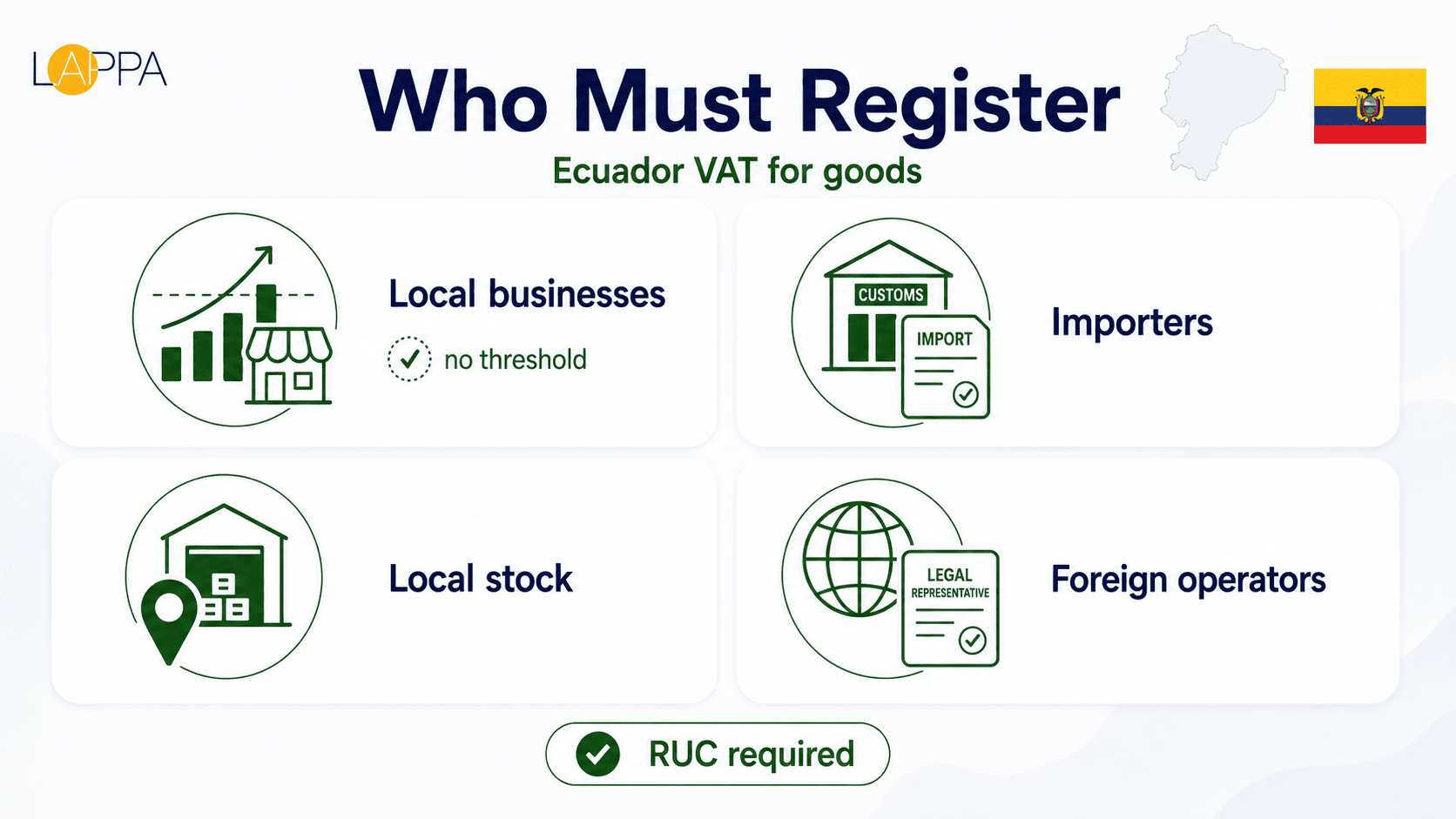 Enrollment applies from day one of commercial activity, with no turnover floor protecting any of these categories:
- Locally incorporated entities and individual business owners carrying out import, manufacturing, distribution, or retail — the obligation starts before the first invoice
- Foreign companies with a branch, staffed office, or inventory in a local warehouse
- Import consignees acting as importer of record — IVA obligation attaches at the customs border
- Customs agents and commercial brokers handling domestic taxable supplies for foreign principals
VAT Number Ecuador — Format and Structure
Ecuador does not issue a separate VAT identifier. The VAT number Ecuador assigns to each operator is the RUC — a 13-digit number covering IVA, income tax, customs, and all interactions with the revenue authority.- Individual business owners: 10-digit cedula de identidad + "001"
- Private companies: 2-digit province code + "9" + 9 further digits + one check digit
- Public entities: 2-digit province code + "6" + 8 digits + "0001"
VAT Registration Procedure in Ecuador
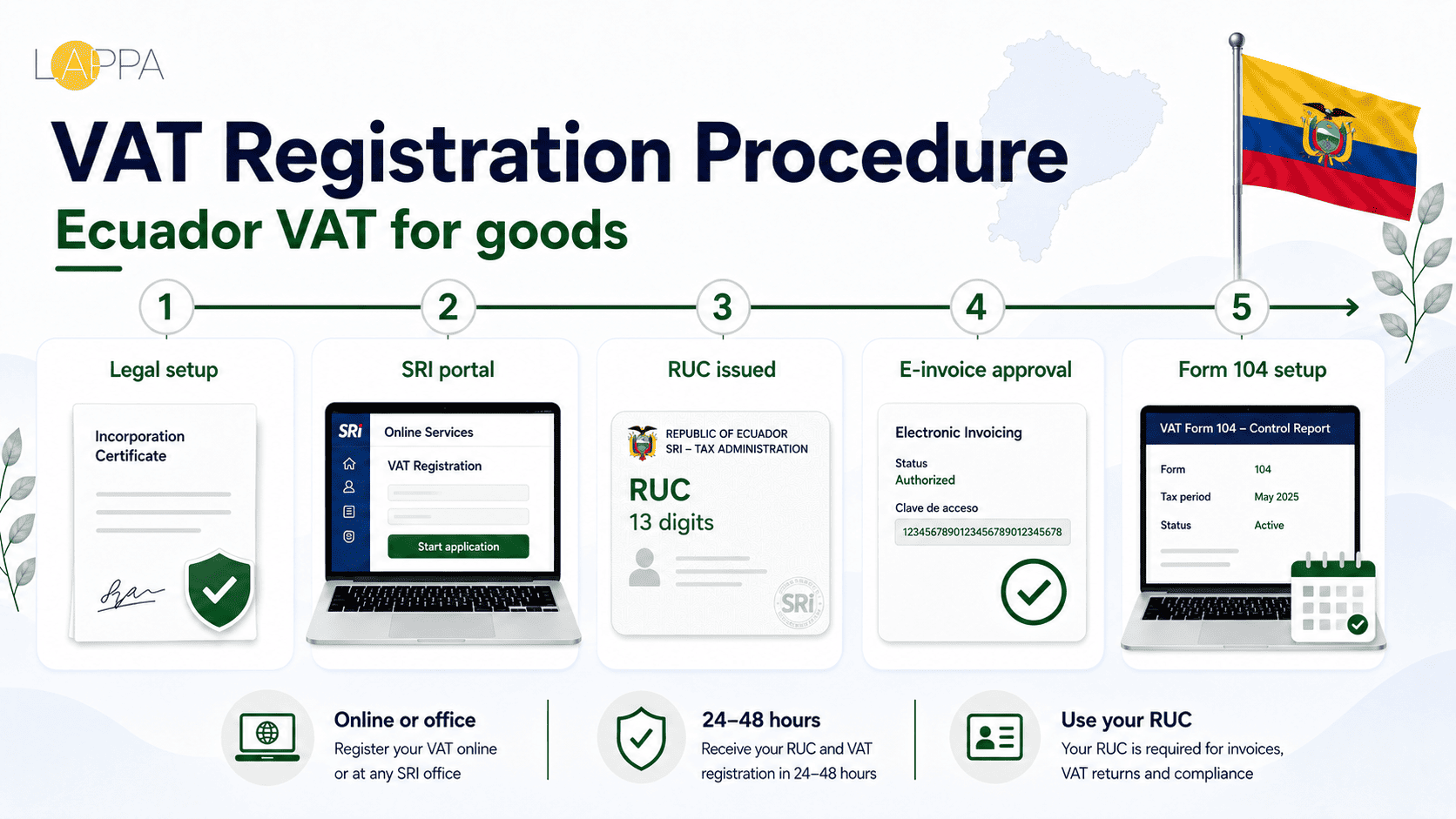 To register for RUC you can either go to the website of the revenue authority, sri.gob.ec, or visit one of its service offices. For a locally incorporated company, five steps:
- Log into sri.gob.ec or visit a Servicio de Rentas Internas office with the legal representative present
- Submit the escritura de constitución — notarized, with the commercial registry certificate confirming current standing
- Show proof of address for the registered premises — utility bill, lease, or property title
- Present the legal representative's cedula (or passport plus residency documentation for foreign nationals)
- Receive the assigned RUC — the VAT number Ecuador used on all filings — typically within 24 to 48 hours on complete applications
Tax Representative in Ecuador
A foreign entity without a local subsidiary must designate a legal representative personally accountable to the revenue authority for compliance. That person needs a valid Ecuadorian cedula or recognized foreign residency status, with a domestic registered address — remote representation is not an accepted model here. All formal communications from the authority — audit notices, payment demands, deadline reminders — go to this representative's address on file. An unreachable representative or one who resigns without a filed replacement results in non-compliant status, blocking customs clearance and invoicing authorization until resolved.VAT E-Invoices in Ecuador
Ecuador moved to mandatory electronic invoicing for all taxpayers by 2018, among the earliest adopters in Latin America. Paper invoices carry no legal standing for IVA purposes. The rollout ran in stages:- 2012: Large taxpayers (contribuyentes especiales) — mandatory
- 2014–2015: Medium and large private companies — mandatory
- 2017–2018: All remaining taxpayers — mandatory
VAT Returns in Ecuador
Monthly filing covers most operators. The submission deadline and payment date are the same, staggered based on the ninth digit of the RUC — somewhere between the 10th and 28th of the following month. RIMPE-registered small operators file semi-annually. Three reporting obligations make up the monthly cycle:- Form 104 (monthly IVA return) — declares total output IVA on sales and total input IVA recovered on purchases; the net difference is paid or carried forward as credit
- ATS annex (Annex of Transactions with Third Parties) — transaction-level report of all purchases and withholdings; submitted on the same deadline as Form 104
- Authorized e-invoice records — the authority holds a copy of every authorized XML invoice independently; declared figures must reconcile against this database
Deductible VAT in Ecuador
Input IVA recovery needs two things: a valid authorized electronic invoice from a supplier with an active RUC, and goods or services that feed into taxable outputs. No authorization code means no deduction — commercial legitimacy does not substitute for document validity. Three restrictions come up regularly:- Passenger vehicles: IVA on cars and light vehicles for personal use is blocked entirely; commercial trucks, vans, and forklifts used in operations generally qualify
- Hospitality and entertainment: Meals and events without a direct commercial purpose sit outside the recoverable category
- Exporter input credits: Selling at 0% does not restrict recovery of input IVA paid on purchases feeding those exports — exporters build consistent credit positions this way
VAT Record Keeping Requirements in Ecuador
Seven years from the relevant tax period. LORTI sets this window across invoices, import entries, export declarations, returns, and annexes. Paper or electronic format both work if documents can be produced on demand. Required records:- Authorized electronic invoices — XML source files with clave de acceso codes, not just RIDE printouts
- Import customs declarations with packing lists, bills of lading, and commercial invoices
- Export declarations (DAE) and transport documents supporting zero-rate treatment
- Monthly Form 104 returns and ATS annexes with payment confirmation records
- Stock and inventory logs for goods held domestically
VAT Penalties in Ecuador
The Código Tributario covers non-registration, late filing, late payment, and deliberate omission.| Violation | Penalty | Notes |
| Late filing of Form 104 | USD 47–375 per return | Applies on nil returns; varies by taxpayer size |
| Late payment | 3% per month on unpaid amount | From the day after the payment deadline |
| Omission of income | Up to 300% of omitted tax | Higher for repeat violations |
| Failure to obtain RUC | USD 62.50 per year | Plus retroactive IVA assessment |
| Non-authorized invoices | Closure of premises 3–7 days | Applies to failure to issue invoices too |
VAT Ecuador Compliance — How Lappa Helps
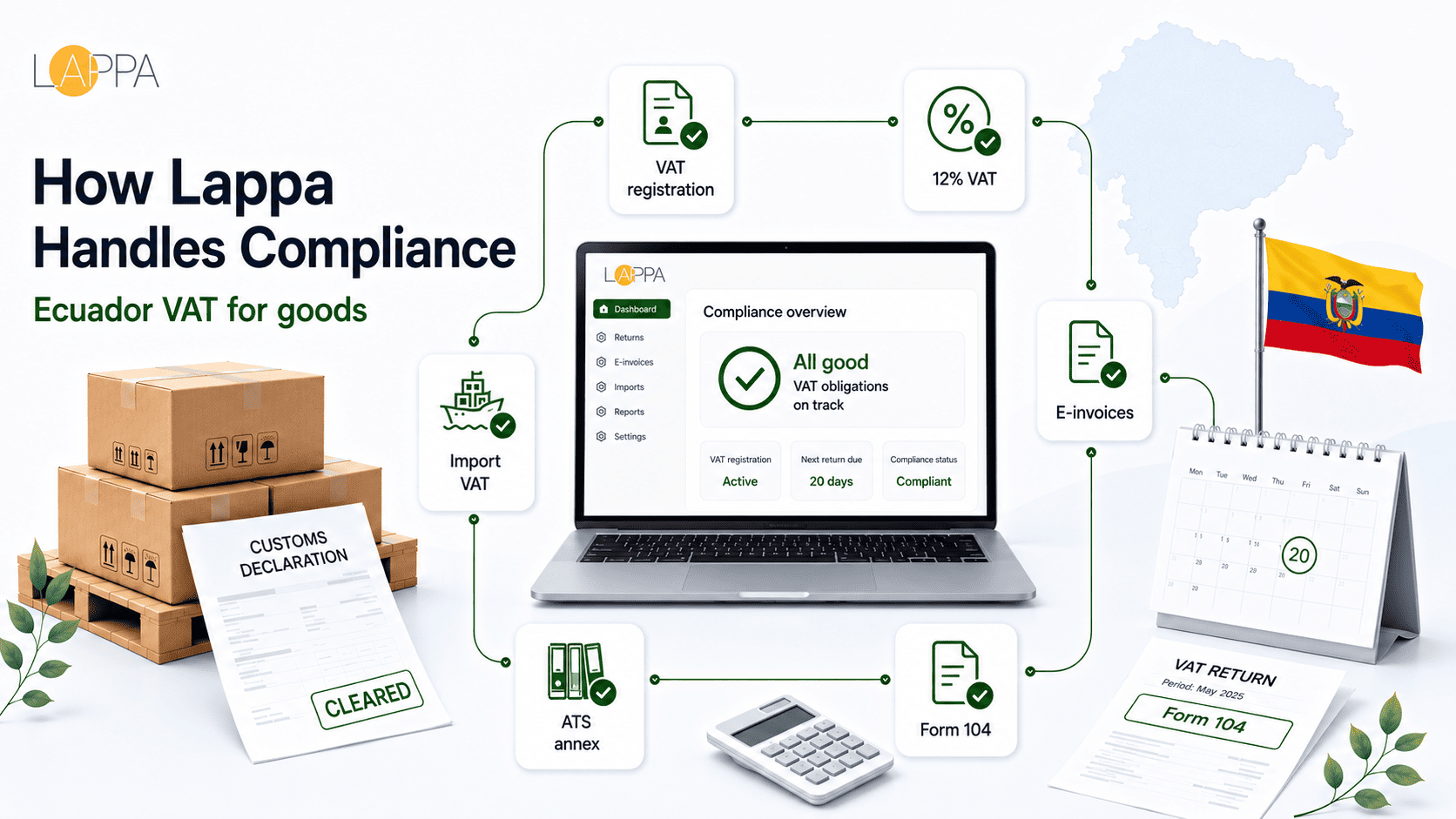 Getting set up before the first shipment clears requires more steps than most EU markets: no RUC means no invoicing rights, no invoicing rights means no valid sale, and mandatory e-invoicing means your billing system needs API integration with the authorization server before anything goes out. VAT Ecuador compliance from Lappa starts at that setup stage:
- RUC registration — documentation handling for local entities and foreign companies, including legal representative appointment for overseas operators
- E-invoicing integration — connecting your billing platform to the authorization API so every XML invoice receives its clave de acceso automatically
- Monthly Form 104 and ATS filing — preparation and submission with pre-filing reconciliation against the authority's invoice database
- Export IVA refund recovery — managing the refund claim cycle for exporters accumulating input credits against zero-rated shipments
FAQ for VAT Ecuador Goods
What is the Ecuador VAT Rate
Twelve percent is the standard Ecuador VAT rate on most commercial goods — electronics, vehicles, construction materials, general imports. Exports and canasta básica food items carry 0%, alongside medicines, books, and agricultural inputs. A temporary 13% was passed in 2024, so confirm the current figure at sri.gob.ec before any financial modelling. The IVA rate has no middle tier — a product is either fully taxable or zero-rated.Who Needs VAT Registration in Ecuador
Everyone conducting commercial or import activity, from the first transaction — there is no turnover floor. Set up the RUC before the first taxable sale, not after reaching any threshold. Foreign companies holding local stock face the same obligation. Most importers register immediately to recover input IVA on customs-paid levy rather than absorbing it as a cost.What is the VAT Number Ecuador Format
The VAT number Ecuador issues is the RUC — 13 digits. Private companies use a 2-digit province code + "9" + 9 further digits + one check digit. Individual business owners use their 10-digit cedula + "001." Any RUC is searchable for free at sri.gob.ec.What is VAT ID Ecuador
VAT ID Ecuador refers to the RUC — the same 13-digit identifier used across IVA, income tax, customs, and all interactions with the revenue authority. No separate VAT-only number exists. VAT ID Ecuador appears on every authorized e-invoice and customs declaration. The RUC identifier must be in active status for an operator to issue valid invoices or clear goods through customs.How Often Are VAT Returns Filed in Ecuador
Monthly for most operators — Form 104 and the ATS annex both file on the same staggered deadline based on the last digit of your RUC, between the 10th and 28th of the following month. Payment is due on the same date. Operators on the simplified RIMPE regime file semi-annually.
VAT Standard rate
15%
VAT Reduced rate
5%
Thresholds
No VAT registration threshold / taxable businesses must register