


A Complete Guide to Costa Rica VAT Rates and Tax Compliance
Provinces
Goods
Provinces
Goods
About
Goods
About
Goods
Goods
Goods
What is VAT in Costa Rica
The IVA — Impuesto al Valor Agregado — replaced the old general sales tax on July 1, 2019, through Law 9635. Before it, the 13% levy only activated at the final retail handoff. Wholesalers and manufacturers absorbed its cost silently, with no recovery right. What is VAT in Costa Rica now: a chain-wide indirect tax where each registered operator collects on outputs and deducts on inputs, remitting only the net to the Dirección General de Tributación (DGT). VAT Costa Rica scope covers manufacture, importation, wholesale, and retail of physical goods. Every link in the chain — from a small workshop in Heredia to a freight forwarder clearing containers at Puerto Limón — operates inside this framework. Your position in that chain determines both what you collect and what you recover.Costa Rica VAT Rate — Standard and Reduced
Four positive tiers plus a zero rate. The Costa Rica VAT rate of 13% is the default — if a product doesn't appear on the reduced-rate or zero-rate schedules the DGT and Ministry of Health publish, 13% applies with no exceptions.| Rate | Category | Typical goods |
| 13% | Standard | Electronics, vehicles, construction materials, beverages, cosmetics, industrial equipment, most consumer goods |
| 2% | Reduced | Basic food items outside the canasta básica, certain medicines |
| 1% | Reduced | Agricultural inputs — fertilizers, pesticides, seeds, veterinary products, machinery |
| 0% | Zero | Canasta básica alimentaria (~200 essential food items), exports |
VAT Registration Threshold in Costa Rica
For Local Businesses
No turnover floor exists for domestic operators. Any individual or legal entity running a commercial, industrial, or agricultural operation becomes a taxable person from day one. The obligation to enroll for VAT Costa Rica purposes arises before the first taxable sale — not after crossing some revenue ceiling. Enrollment goes through the ATV portal (atv.hacienda.go.cr) via Form D-140 as part of the Registro Único Tributario inscription. Operators who commence trading without registering are subject to retroactive assessments for the entire unregistered period, including penalties.For Remote Sellers
As for foreign operators shipping physical goods to buyers in the country, they don’t register for local IVA on the basis of sales volume.Imported goods face the levy at customs — whoever brings them in pays at the border, not the overseas seller. That changes when a foreign operator holds local stock: storing inventory in a warehouse here creates local presence, and enrollment follows immediately regardless of sales volume.For Remote Digital Services
This guide covers physical goods only. For digital and electronic service obligations, see the separate digital services compliance guide.Who Must Register for VAT Tax Costa Rica
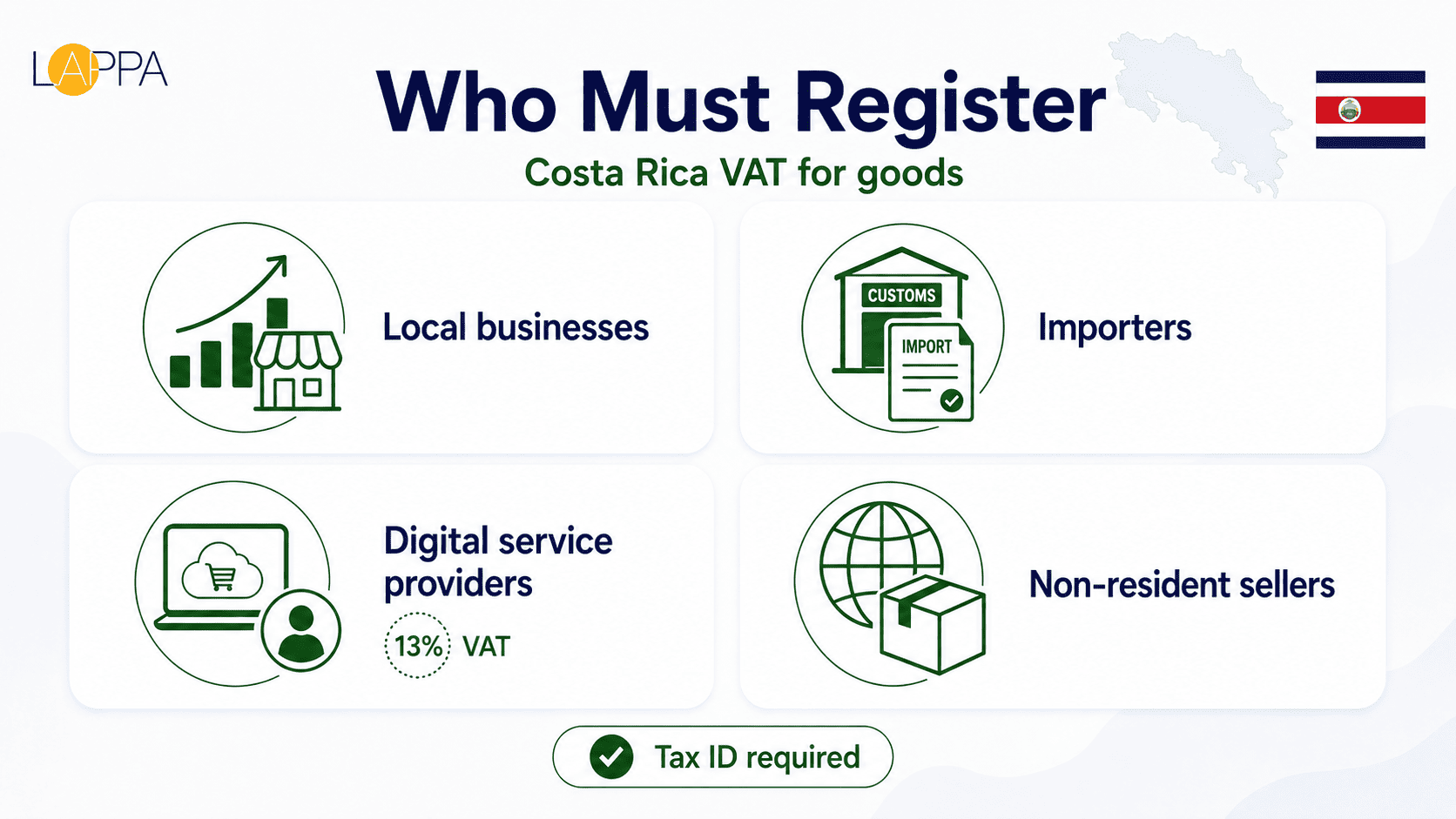 The VAT tax Costa Rica law imposes on goods operators creates mandatory enrollment for four categories, with no turnover minimum:
- All enterprises incorporated locally that manufacture, import, distribute, or retail physical goods
- Foreign companies holding a physical presence here — warehouse, office, local staff, or an agent authorized to bind contracts
- Import agents and customs brokers processing dutiable goods for third parties
- Operators running bonded warehouses or free trade zone facilities that funnel goods into the domestic market
VAT Registration Number Costa Rica
No dedicated IVA identifier exists separately from the general taxpayer number. The VAT registration number Costa Rica assigns to operators is the NIT — Número de Identificación Tributaria — the same reference on invoices, customs paperwork, and returns. For legal entities, the NIT is the cédula jurídica from the National Registry:- Sociedad anónima (S.A.): 3-101-XXXXXX
- Sociedad de responsabilidad limitada (S.R.L.): 3-102-XXXXXX
- Branch of a foreign company: 3-012-XXXXXX
VAT Registration Procedure in Costa Rica
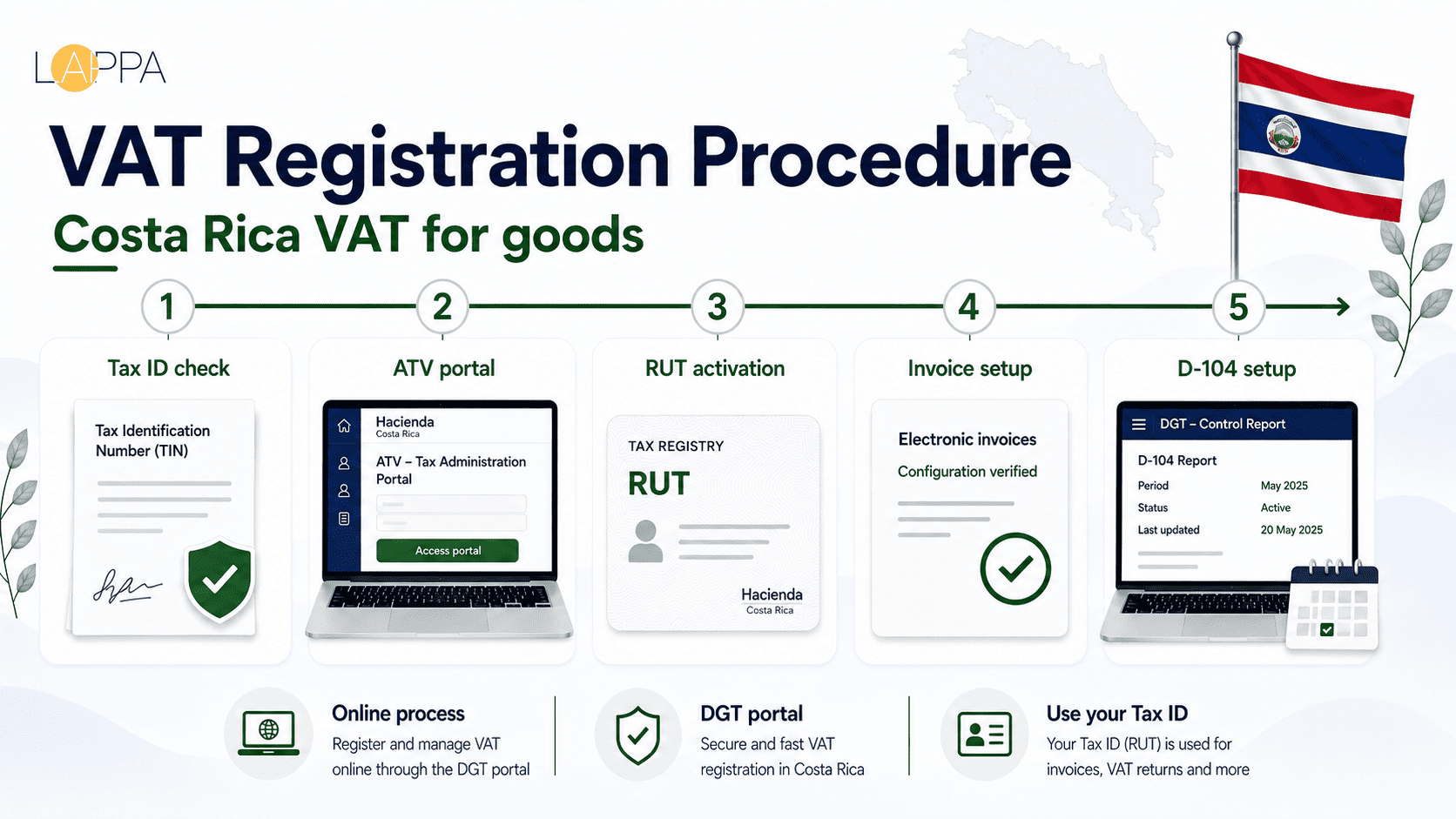 Resident operators enroll through the ATV portal in five steps:
- Create a user account at atv.hacienda.go.cr linked to the cédula jurídica or personal national ID
- Complete Form D-140 — Declaración de Inscripción in the Registro Único Tributario
- Select CIIU activity codes matching actual operations — manufacturing, importing, wholesale, retail
- Enter estimated annual turnover and intended start date for taxable activity
- Receive DGT confirmation — this activates the taxpayer record as the formal VAT Costa Rica enrollment acknowledgment
Tax Representative in Costa Rica
Foreign operators with a local subsidiary, branch, warehouse or employed staff must appoint a representante legal for DGT correspondence and filings.This person receives formal notifications, executes returns, and stands as the authority's primary contact. Three appointment structures are common:- A director of the local entity holding personal residency in the country
- A licensed local attorney (abogado) serving as corporate secretary
- A registered accounting firm holding a notarial power of attorney (poder notarial) with defined scope
VAT E-Invoices in Costa Rica
The Factura Electrónica system is mandatory for virtually all enrolled operators. Every invoice, credit note, and debit note must be generated in the DGT's standardized XML schema, transmitted to the validation server, stamped with an acceptance code (clave numérica), and only then delivered to the buyer. A document without that validation sequence isn't legally compliant — buyers can't recover input IVA credits against it. The rollout covered the entire business population in phases:| Operator category | Mandatory from |
| Large taxpayers (grandes contribuyentes) | November 2017 |
| Medium businesses and wholesale distributors | 2018 |
| Small businesses, retailers, sole traders | 2019 |
| Agricultural sector and manufacturing (all sizes) | 2020 |
VAT Returns in Costa Rica
Every enrolled operator files monthly. Operators new to the market often ask what VAT in Costa Rica requires operationally — the D-104 monthly declaration is the answer. Reporting period: full calendar month. Deadline: 15th of the following month. Form D-104 covers four data points:- Total IVA collected on outgoing goods sales during the period
- Total deductible IVA on inbound purchases and eligible acquisitions
- Net IVA payable to the DGT, or the credit available to carry forward
- Exempt or zero-rated supplies made during the period
Deductible VAT in Costa Rica
Input IVA is recoverable when goods or services purchased feed into taxable outputs. The recovery right activates when the purchase happens and a valid Comprobante Electrónico with a DGT acceptance code is in hand. No acceptance code means no deduction — the commercial reality of the purchase doesn't change that. Three restriction categories matter most:- Passenger vehicles: Input IVA on cars and light vehicles is blocked unless the business is an automobile dealer or the vehicle is documented exclusively for taxable operational use. Freight vehicles used in the field generally qualify; management company cars don't
- Mixed-use assets: A warehouse partly used for taxable and partly for exempt activity requires a pro-rata deduction based on the ratio of taxable to total annual revenue
- Free transfers: IVA on goods given away as samples or promotions is blocked unless the operator self-assesses output IVA on the transfer
VAT Record Keeping Requirements in Costa Rica
Five years from the filing date of the relevant monthly return — that's the statutory minimum the Código de Normas y Procedimientos Tributarios (CNPT) sets. In fraud investigations the DGT operates with broader windows, so high-value operators retain documentation well beyond the floor. Required records for a goods operation:- Original XML invoice files and DGT acceptance codes for every Comprobante Electrónico issued and received
- Customs entry declarations (Declaraciones Aduaneras) with full shipping documentation: bill of lading, commercial invoice, packing list, certificate of origin where applicable
- Monthly D-104 filings and payment receipts for every period
- Warehouse receiving records, delivery notes, and stock movement logs for inventory reconciliation
- Export documentation — outbound customs declarations, transport documents, delivery confirmation — substantiating zero-rate treatment on outbound goods
VAT Penalties in Costa Rica
Non-enrollment, late filing, and underpayment each carry their own consequence structure under the CNPT. When the DGT identifies an unregistered operator, ex officio registration follows immediately. The assessment covers the full unregistered window; a 50% penalty lands on top of the unpaid principal, with interest compounding from the date each monthly payment should have gone out. Late filing penalties:| Delay | Rate | Floor per return |
| 1 to 30 days late | 2% of IVA owed per month | ₡5,000 CRC (~USD 10) |
| 31 to 60 days late | 2.5% per month | ₡5,000 CRC (~USD 10) |
| Over 60 days late | 3% per month | ₡5,000 CRC (~USD 10) |
How Lappa Supports VAT Costa Rica Compliance
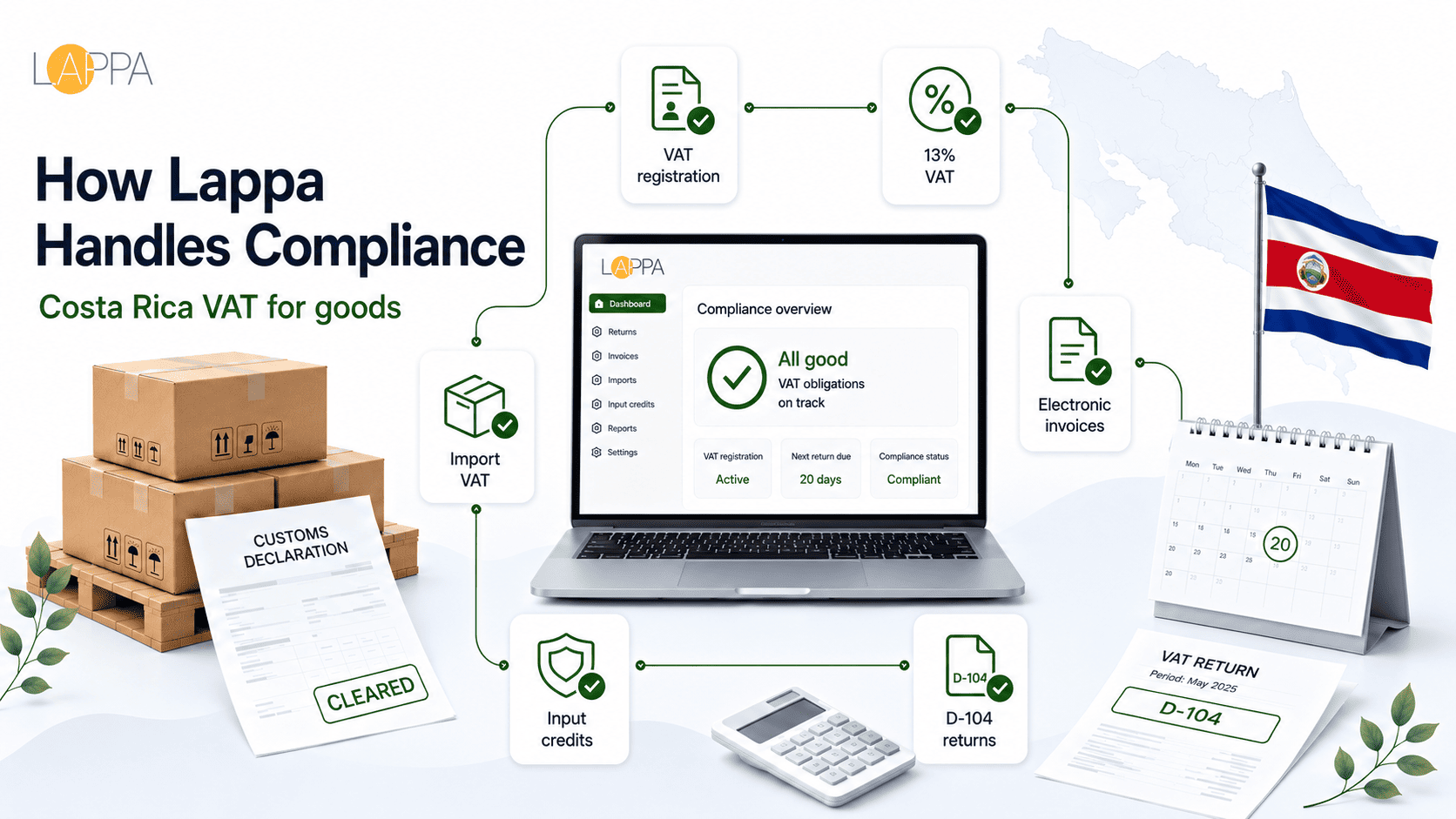 VAT Costa Rica compliance for goods operations involves monthly filing cadence, real-time electronic invoice validation, parallel customs reporting, and an authority that independently mirrors your invoice database. Getting any one of those wrong creates exposure that compounds monthly.
Lappa covers the complete compliance cycle. New entrants get taxpayer inscription, CIIU activity code selection, and ATV portal setup. Importers and distributors get monthly D-104 preparation, Factura Electrónica API integration, and customs-to-IVA reconciliation. Specific services:
VAT Costa Rica compliance for goods operations involves monthly filing cadence, real-time electronic invoice validation, parallel customs reporting, and an authority that independently mirrors your invoice database. Getting any one of those wrong creates exposure that compounds monthly.
Lappa covers the complete compliance cycle. New entrants get taxpayer inscription, CIIU activity code selection, and ATV portal setup. Importers and distributors get monthly D-104 preparation, Factura Electrónica API integration, and customs-to-IVA reconciliation. Specific services:
- Comprobantes Electrónicos integration — connecting your ERP directly to the DGT validation API so XML generation and acceptance codes run inside your existing workflow
- Canasta básica rate review — checking product classifications against the current Ministry of Health zero-rate schedule before an audit does
- Export zero-rate documentation — assembling the evidence package the DGT needs to approve zero-rate treatment on outbound shipments
- Input IVA refund management — handling refund claim filings and review correspondence for exporters accumulating credit balances
- Audit response — formal replies to DGT notifications and full information management during fiscal reviews
FAQ for Costa Rica VAT Goods
What is the VAT Tax Rate in Costa Rica
- Thirteen percent is the standard Costa Rica VAT rate, applied to most commercial goods — electronics, vehicles, construction materials, general consumer items, and most imports. Agricultural inputs carry 1%, basic food items outside the canasta básica carry 2%, and roughly 200 essential products in the canasta básica alimentaria are zero-rated, as are exports. The question of what is VAT in Costa Rica versus the old sales tax matters most to businesses that traded before 2019 — the IVA extended the levy to every supply chain stage, not just the final sale.
Who Needs to Register for VAT in Costa Rica
- Every operator incorporated in the country that manufactures, imports, distributes, or retails physical goods — no revenue floor applies. Foreign companies holding local inventory or running a warehouse here must also enroll from day one. Foreign sellers dispatching goods from abroad without local presence don't register, since IVA on imports settles at customs with the importer. Enrollment is required before the first taxable transaction.
What is the VAT Number Costa Rica Assigns
- The VAT number Costa Rica uses is the taxpayer NIT — no separate IVA identifier exists. Corporations (sociedad anónima) use 3-101-XXXXXX, limited liability companies 3-102-XXXXXX, and foreign company branches 3-012-XXXXXX. The VAT registration number Costa Rica issues is verifiable at hacienda.go.cr. For an input IVA recovery claim to be supported, a supplier invoice must have a valid, active NIT.
How Often Are VAT Returns Filed in Costa Rica
- Monthly (Form D-104) by the 15th of the following month. No separate annual reconciliation. Refund requests are filed through the ATV portal by exporters that have accumulated input IVA credit balances. This initiates a parallel DGT review that is independent of the monthly cycle.
Do Foreign Companies Need a Tax Representative in Costa Rica
- Foreign operators with a permanent establishment, local employees, or inventory held in the country must appoint a local resident as representante legal for DGT correspondence. Overseas sellers dispatching from abroad with no local presence have no such requirement — IVA settles at customs with the importer. Any foreign entity incorporating a subsidiary or registering a branch must name a representative before the DGT will process enrollment.
VAT Calculator
VAT Standard rate
13%
VAT Reduced rate
1%, 2%, 4%, 0%
Thresholds
No general VAT registration threshold. Businesses carrying out taxable activities must register.