


Bahrain VAT Registration and Compliance Guide
Provinces
Goods
Provinces
Goods
About
Goods
About
Goods
Goods
Goods
Introduction to VAT in Bahrain — How the Bahrain Tax System Works
1 January 2019. That's when Bahrain switched on its VAT system under Decree-Law No. 48 of 2018 — the second GCC state to do it after Saudi Arabia's January 2018 launch. The starting rate was 5%. Not 10. Not 15. Five percent, and it stayed there for three years until the government doubled it to 10% on 1 January 2022. The rate has sat at 10% since. VAT in Bahrain runs through the National Bureau for Revenue — the NBR. That's your registration authority, your return recipient, your auditor, and your enforcement body all in one. Everything goes through their portal at taxpayer.nbr.gov.bh. There's no paper track for routine compliance. If the portal's down, you wait. Now, the GCC angle is worth addressing upfront because it causes real confusion. Bahrain operates under the GCC VAT Framework Agreement — the same overarching document that governs Saudi Arabia, the UAE, and the other implementing states. Shared architecture, though. Not shared registration. A VAT number in Riyadh does nothing for your Bahrain obligations. The NBR runs its own queue, issues its own TRNs, and runs its own audits. Don't conflate the framework with the local administration. The Bahrain tax structure has a few features that distinguish it from a standard European setup. Financial services: exempt. Bare land: exempt. Local passenger transport: exempt. None of those carry input tax recovery rights for the supplier. Exports, international freight, crude oil, gas, education, and healthcare sit at zero — no output tax, but input tax is fully recoverable on costs that relate to those supplies. That zero-versus-exempt distinction will come up repeatedly in any business with a mixed portfolio. This compliance guide runs through every operational layer: rates, thresholds, registration procedure, TRN format, e-invoicing obligations, return filing, input tax rules, record keeping, and penalties.Bahrain VAT Rates — Standard Rate and Zero-Rated Supplies
Ten percent. One standard rate, applied to most goods and services in the country. Below that: zero for qualifying cross-border and specific domestic supplies. Then a block of exempt categories where no VAT moves in either direction.| Rate | Category | Typical Supplies |
| 10% | Standard | Retail goods, hospitality, telecoms, professional services, software, construction |
| 0% | Zero-rated | Exports, international transport, crude oil and gas, healthcare, education, first supply of new residential property |
| Exempt | No VAT charged or recovered | Financial services, bare land, local passenger transport |
VAT Registration Threshold in Bahrain
For Local Businesses
Two numbers. BHD 37,500 is the mandatory registration threshold — reach it and registration is compulsory. BHD 18,750 is the voluntary threshold — reach it and registration becomes an option. Below BHD 18,750: no registration at all, not even voluntary. VAT for business planning around the voluntary threshold typically comes down to one calculation: how much input tax would you recover, and does that outweigh the compliance cost of running a monthly or quarterly return? For a business importing equipment, fitting out a new premises, or buying significant taxable services before revenues build, the input tax recovery from early voluntary registration will usually exceed the cost of the filing obligation. Register at BHD 18,750. Claim those input taxes. Don't wait for BHD 37,500 and leave recoverable amounts sitting with the NBR. One constraint people miss: voluntary registration is not reversible on demand. Once you're in the NBR system, deregistration requires meeting their conditions — it's not a simple switch. Think through the medium-term picture before opting in early.For Remote Sellers
No threshold. None. A non-resident business supplying taxable goods into Bahrain registers from the first transaction. The NBR hasn't built in a BHD 37,500 grace period for cross-border sellers the way some jurisdictions have. First supply, registration obligation. That includes single-transaction importers who never planned to become regular Bahrain suppliers.For Remote Digital Services
Same position. Non-resident digital service providers — streaming platforms, SaaS, online marketplaces, digital content subscriptions — register from the first supply to a Bahraini consumer. No minimum threshold. B2B digital supplies can shift the accounting to the Bahraini recipient via reverse charge, but that's a supply-by-supply determination. It doesn't eliminate the registration question; it redirects who accounts for the tax.Who Must Register for VAT in Bahrain
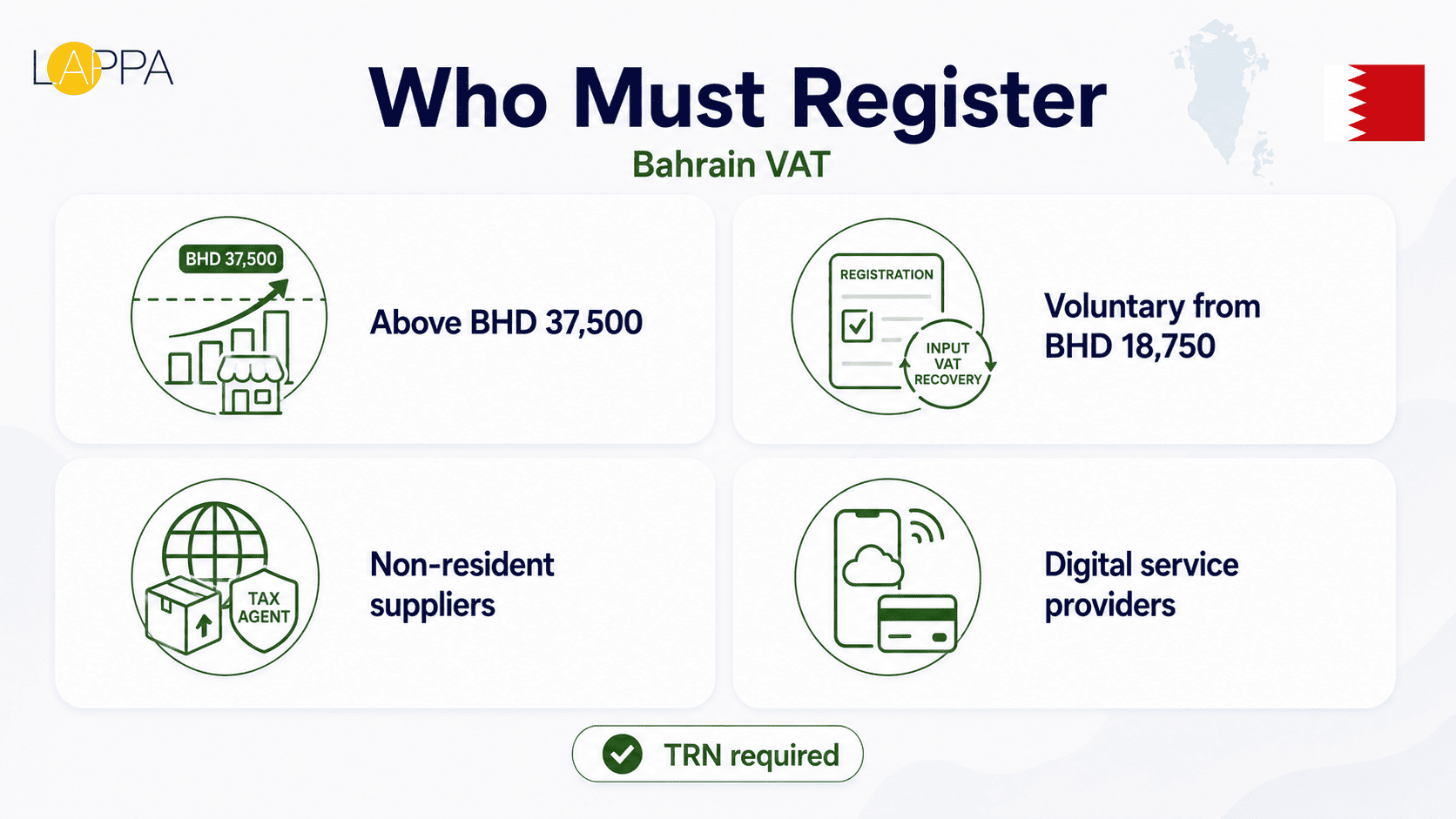 Registration lands on:
- Bahraini-established businesses with annual taxable supplies or imports above BHD 37,500 — mandatory.
- Bahraini-established businesses above BHD 18,750 — eligible for voluntary registration.
- Non-resident businesses making any taxable supply in Bahrain — from the first transaction, no threshold.
- Non-resident digital service providers to Bahraini consumers — same, no threshold.
- VAT groups: related entities under common control can apply for consolidated registration. One TRN, one return, intra-group supplies stripped of output VAT.
VAT Number in Bahrain
The NBR issues a Tax Registration Number — TRN — on successful registration. It's a numeric identifier generated by the portal and tied to the taxpayer's record. No letters. No country prefix in the way the EU's ATU or GB format works. A number, assigned sequentially within the NBR system. VAT in Bahrain invoices must display the supplier's TRN. No exceptions and no workarounds. An invoice without a TRN isn't a valid tax invoice under Bahraini VAT law — the recipient's input tax recovery claim on that document is exposed on audit. This isn't a technicality; NBR auditors specifically check TRN presence and validity on invoices during reviews. Counterparty TRN validation: use the public verification tool on the NBR portal before processing large input tax claims from unfamiliar suppliers. If the TRN search returns nothing — or returns a registration that has lapsed — the recovery on those invoices is at risk. Check before you file the return, not after.VAT Registration Procedure in Bahrain — VAT Registration Bahrain Steps
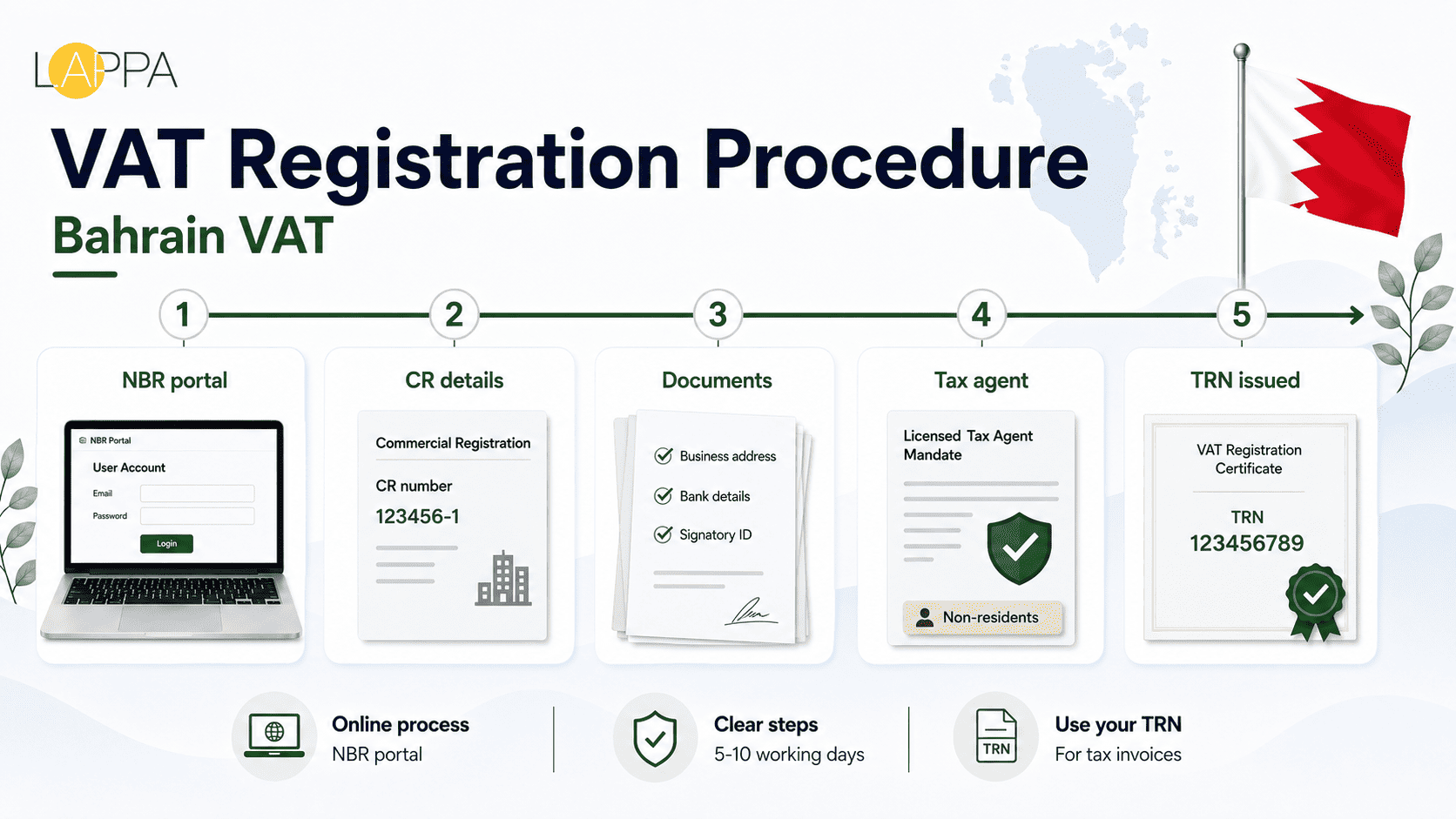 VAT Registration Bahrain is portal-only. No paper equivalent exists for new registrants.
The stages for a Bahraini-established entity are:
VAT Registration Bahrain is portal-only. No paper equivalent exists for new registrants.
The stages for a Bahraini-established entity are:
- Sign up for an NBR portal account using the company’s Commercial Registration (CR) number.
- Fill out the online form – firm information, ownership structure, categories of taxable supply, expected yearly turnover.
- Attach the relevant documents: CR certificate, evidence of business address, bank account data, identity of approved signatory.
- Submit. Standard applications are resolved in 5–10 working days. Applications with complicated ownership structures, non-resident directors or missing documentation take longer.
- TRN & registration certificate is received through portal.
- First return to be filed at the end of the month after the first reporting period.
Tax Representative in Bahrain
Non-residents must appoint an NBR-licensed tax agent before submitting the registration application. Before — not alongside it, not after. The agent's details go into the form as a mandatory field. The NBR rejects applications that arrive without one. What the agent actually does: files returns, receives and responds to NBR correspondence, manages the compliance calendar, and acts as the primary contact point for any audit or query. Bahraini law doesn't automatically make the agent jointly liable for the foreign entity's VAT debt — but agents carry their own regulatory obligations to the NBR and can lose their licence if they manage poorly. A competent agent is an operational necessity, not a formality. The NBR maintains a register of approved tax agents. Use it. Appointing someone who isn't on that register creates a defect in the registration itself — and fixing it requires re-filing. Bahraini-established businesses don't face a mandatory agent requirement. But when the internal finance team is small, when apportionment calculations are complex, or when NBR correspondence arrives in Arabic, having a local tax professional involved is practical rather than optional.VAT E-Invoices in Bahrain — Timeline for Different Business Sizes
The NBR began developing its e-invoicing framework in 2021. The model Bahrain has adopted is clearance-based: structured invoice data goes to the NBR system for validation before or at the point of issuance. The NBR clears it. Then it goes to the buyer. Rollout by segment:| Business Segment | Mandate Status | Format |
| Large taxpayers (above BHD 3,000,000 annual supplies) | Mandatory — phased rollout ongoing | Structured XML via NBR portal |
| Medium taxpayers (BHD 500,000–3,000,000) | Follows large taxpayer phase | Structured XML |
| Small taxpayers (below BHD 500,000) | Voluntary / later phase | To be confirmed |
| Non-resident registered suppliers | Per NBR guidance by registration type | To be confirmed |
VAT Returns in Bahrain — Types of Report
Monthly or quarterly. That's the filing frequency, and the split sits at BHD 3,000,000 annual taxable turnover. Above: monthly. At or below: quarterly. VAT Bahrain returns are due by the last day of the month following the period. Q1 (January–March): due 30 April. October monthly: due 30 November. Payment of net VAT due falls on the same date — there's no split between filing deadline and payment deadline. Miss one and you've missed both. Returns go through the NBR portal and capture output VAT by rate category, input VAT claimed on purchases and imports, and any adjustments for credit notes, bad debts, or prior-period corrections. Net VAT payable goes with the return; a credit balance carries forward to the next period or can be applied for refund — though refund processing takes longer than carrying forward. VAT control report: Bahrain doesn't operate a transaction-level control report. No SII-equivalent, no monthly invoice-level submission. Summary figures go in the return; the detail sits in your records and gets produced on audit request.Deductible VAT in Bahrain
Input tax is recoverable when three conditions are met at the same time: the purchase comes from a VAT-registered supplier; there's a valid tax invoice showing that supplier's TRN; and the purchase is used for making taxable — standard or zero-rated — supplies. What's blocked:- Entertainment — broadly non-recoverable, client hospitality included
- Employee personal expenses
- Vehicles used for non-business purposes
- Purchases attributable to exempt supplies
VAT Record-Keeping Requirements in Bahrain
Five years. That's the standard minimum retention period, running from the end of the tax period the documents relate to. Real estate is the exception: fifteen years there, because the input tax adjustment window on immovable property runs that long. Records within scope:- All issued tax invoices, standard and simplified formats
- All received tax invoices backing input tax claims
- Import declarations and customs clearance documents
- NBR portal return submissions and confirmation receipts
- Bank statements showing VAT payments and receipts
- Credit notes, debit notes, and adjustment paperwork
- Contracts and agreements with ongoing VAT implications
VAT Penalties in Bahrain
The NBR's penalty structure covers four failure types: registration, return filing, payment, and evasion. Late or missing registration: Up to BHD 10,000. The "up to" gives the NBR discretion, and they use it — a first-time registrant who's one month late on a small operation gets treated differently from a company that's been operating for two years without registering. Late return filing: BHD 1,000 per month of delay. Capped at BHD 10,000. File six months late and you've hit the maximum — the daily cost of delay drops to zero beyond that cap, which is the only silver lining. Late payment:- 5% of unpaid tax on the due date
- 1% for each additional month the balance stays unpaid
How Lappa Can Help with VAT Compliance in Bahrain
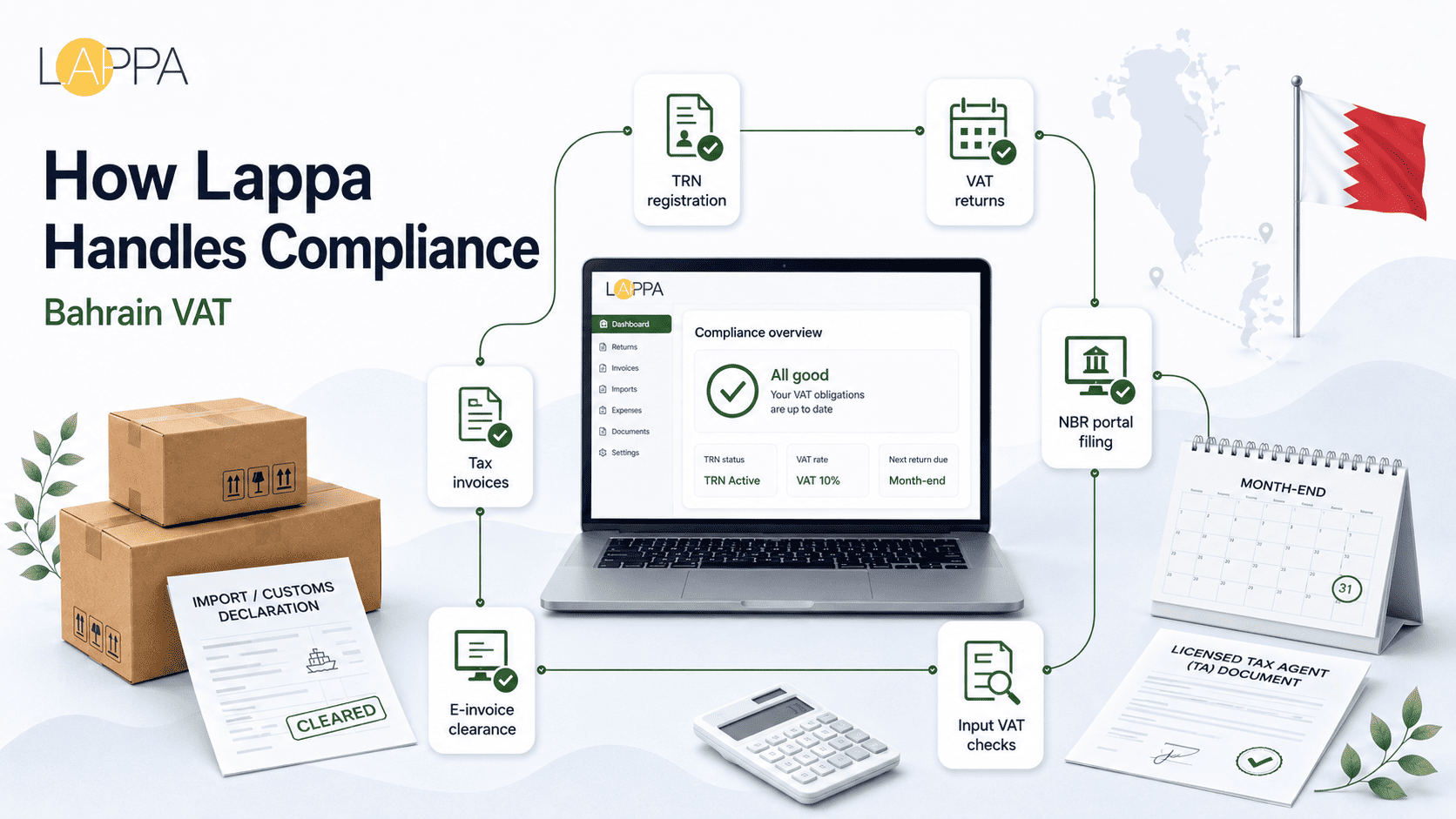 Lappa covers the full Bahrain VAT cycle — NBR portal registration, TRN setup, monthly and quarterly return preparation and submission, and ongoing compliance management across the full calendar.
For non-resident businesses entering Bahrain, Lappa provides licensed tax agent services under NBR requirements. That means taking on the representative role the NBR mandates for foreign registrants, removing the need to source a separate Bahraini-licensed agent before operations start.
The platform also handles input tax apportionment for mixed-supply businesses, voluntary disclosure preparation for prior-period corrections, and parallel VAT compliance for companies holding registrations across Bahrain, Saudi Arabia, and the UAE simultaneously.
Lappa covers the full Bahrain VAT cycle — NBR portal registration, TRN setup, monthly and quarterly return preparation and submission, and ongoing compliance management across the full calendar.
For non-resident businesses entering Bahrain, Lappa provides licensed tax agent services under NBR requirements. That means taking on the representative role the NBR mandates for foreign registrants, removing the need to source a separate Bahraini-licensed agent before operations start.
The platform also handles input tax apportionment for mixed-supply businesses, voluntary disclosure preparation for prior-period corrections, and parallel VAT compliance for companies holding registrations across Bahrain, Saudi Arabia, and the UAE simultaneously.
FAQ for Bahrain VAT
What Is the VAT Rate in Bahrain
- Bahrain applies a 10% standard VAT rate, in place since 1 January 2022 when it doubled from the original 5% rate that applied from the system's launch in January 2019. Zero-rating covers exports, international transport, crude oil and gas, healthcare, and education. Financial services, bare land, and local passenger transport are VAT-exempt — no output tax charged, no input tax recovered.
Who Needs to Register for VAT in Bahrain
- Bahraini-established businesses register once annual taxable supplies or imports reach BHD 37,500. Voluntary registration is available from BHD 18,750. Non-resident businesses supplying taxable goods or services in Bahrain must register from the first supply — no threshold applies. The same zero-threshold rule covers non-resident digital service providers supplying Bahraini consumers.
What Is the VAT Number Format in Bahrain
- The NBR assigns a numeric Tax Registration Number (TRN) upon successful registration. The TRN must appear on all tax invoices issued by the registered business. Counterparty TRNs can be verified through the public validation function on the NBR portal at taxpayer.nbr.gov.bh.
How Often Are VAT Returns Filed in Bahrain
- Monthly returns apply when annual taxable supplies exceed BHD 3,000,000. Quarterly returns apply at or below that level. Returns and payment are both due by the last day of the month following the reporting period — same date for both.
Do Foreign Companies Need a Tax Representative in Bahrain
- Yes. Non-resident businesses must name an NBR-licensed tax agent in their registration application before it's submitted. The NBR won't process the application without one. The agent handles return filing, NBR correspondence, and compliance management on behalf of the foreign entity.
VAT Calculator
To get from net to gross: multiply net by 1.10. To pull VAT out of a gross figure: divide the gross by 1.10, then subtract that result from the original. A BHD 110 gross invoice contains BHD 10 VAT on a BHD 100 net. Bahraini tax invoices must show three separate fields: net amount, 10% rate, VAT amount. A gross-only invoice — even a printed one with a clear total — is non-compliant. The recipient can't process an input tax claim from it. The NBR is specific about this.
VAT Standard rate
10%
VAT Reduced rate
0%
Thresholds
BHD 37,500 (mandatory registration); BHD 18,750 (voluntary registration)