


Bangladesh VAT Registration and Compliance Guide
Provinces
Goods
Provinces
Goods
About
Goods
About
Goods
Goods
Goods
Introduction to VAT in Bangladesh — VAT Tax in Bangladesh and the NBR Framework
Bangladesh got VAT in 1991. Not 2019 — that's when the new law finally went live after years of delays. The original Value Added Tax Act 1991 ran the system for nearly three decades, patched and amended repeatedly, before the government replaced it with the VAT and Supplementary Duty Act 2012. Which took until July 2019 to actually implement. Implementation dates had been announced and then quietly moved at least twice before that. If you're wondering why there's so much institutional muscle memory around the old 9-digit BIN system, that's why. The National Board of Revenue runs everything. Registration. Returns. Audit. Enforcement. The NBR operates through VAT Commissionerates — Dhaka has several; Chittagong, Sylhet, and Rajshahi have their own Circle offices. The online system is called VATIS, the VAT Automation and Technology Improvement System, at vat.gov.bd. Not the most intuitive portal in the region, but it's the one. VAT tax in Bangladesh doesn't travel alone on any invoice. Supplementary duty — SD — rides alongside it on goods the government has decided are luxury or socially problematic: tobacco, carbonated drinks, mobile airtime, imported luxury items. And the sequencing matters. SD applies to the base price first. VAT then applies to the SD-inclusive amount. That means the effective VAT cost is higher than the headline 15% on SD-affected goods. Businesses that calculate VAT on the pre-SD price are producing incorrect invoices, and the NBR auditors know exactly what to look for. Bangladesh VAT covers goods and services broadly. Exports at zero. Specified essentials exempt. But Bangladesh has something most other systems don't — truncated rates. Sectors that get assigned a fixed percentage (5%, 7.5%, 10%) on gross receipts with no input credit available. Not a reduced rate with normal credit rules. A closed system where what you collect is what you owe, full stop. Which changes the economics of VAT for those businesses quite fundamentally, and not always in their favour. This compliance guide covers all of it: the rate tiers, thresholds, BIN format, VAT software mandate, MUSHAK return types, input credit rules, record retention, and what non-compliance actually costs.Bangladesh VAT Rate — Standard Rate and Reduced Rates
Fifteen percent. Standard rate. Most goods, most services, most of the time. Below that: truncated rates for defined sectors. Below those: zero for exports. Then exempt categories where no VAT is charged or recovered at all.| Rate | Category | Examples |
| 15% | Standard | Professional services, telecoms, construction, retail, manufacturing |
| 10% | Truncated | Some transport services, specified professional services |
| 7.5% | Truncated | Advertising agencies, IT-enabled services, some repair services |
| 5% | Truncated | Rice milling, certain agricultural processing |
| 0% | Zero-rated | Goods exports, international freight |
| Exempt | No VAT | Essential food, medicines, some agricultural inputs |
VAT Calculator
Standard 15% rate: net × 1.15 = gross. To extract VAT from gross: divide by 1.15, subtract. BDT 10,000 net gives BDT 1,500 VAT, BDT 11,500 gross. Truncated 7.5%: apply 7.5% directly to gross receipts received. No input credit nets off against it. Receive BDT 10,000 in a 7.5% truncated sector and BDT 750 goes to the NBR — unconditionally. MUSHAK 6.3 invoice forms have designated fields for rate, taxable base, and VAT amount. Putting a truncated rate in a standard-rate field, or vice versa, is an error the NBR audit team specifically looks for. Get those fields right from the start.VAT Registration Threshold in Bangladesh
For Local Businesses
Three tiers. Not one threshold. Below BDT 30 lakh annual taxable turnover: no registration. Between BDT 30 lakh and BDT 80 lakh: Turnover Tax scheme — 4% flat on gross receipts, no input credit, simplified. Above BDT 80 lakh: full standard VAT, 15% output tax, full input credit available. VAT for business decisions at this threshold aren't just compliance decisions — they're cost decisions. The turnover tax scheme is simpler on paper. But a business with significant taxable input costs will often pay less net VAT under the standard scheme once credits start offsetting output tax. Run the numbers both ways before picking the scheme. And know that switching from turnover tax to standard VAT later requires a fresh registration process — it's not a box you can tick on next month's return.For Remote Sellers
No published threshold for non-residents supplying goods into Bangladesh. The NBR hasn't created a distance-selling grace period equivalent to the EU's EUR 10,000 OSS threshold. First taxable supply into Bangladesh: registration obligation. That includes one-off importers with no plans to carry on operations because the importation itself is a taxable event under Bangladeshi VAT rules.For Remote Digital Services
Bangladesh imposed requirements on non-resident digital service providers after 2021. Serving Bangladeshi consumers: streaming, SaaS, online markets, content subscriptions - all in scope. (2) Non-resident suppliers without a local establishment should register directly with the NBR or designate a local agent. The NBR’s enforcement capabilities in this area is growing. “Assuming there is no obligation because there is no formal requirement to register is an increasingly risky assumption.”Who Must Register for VAT in Bangladesh — VAT Registration Requirements
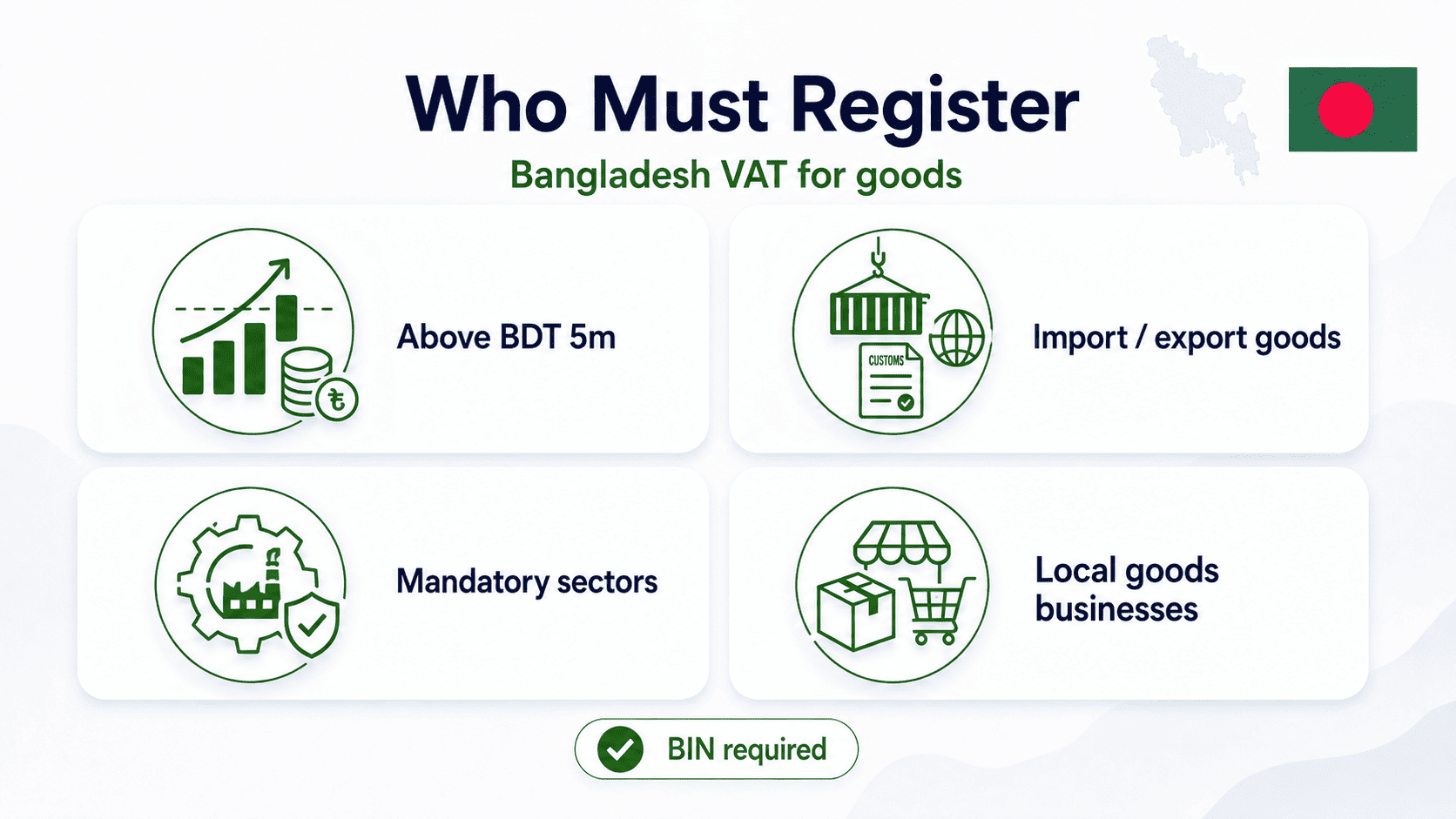 VAT registration in Bangladesh is mandatory for:
- Businesses above BDT 30 lakh annual taxable turnover — turnover tax scheme (BDT 30–80 lakh) or full standard VAT (above BDT 80 lakh).
- Exporters — registration is required even where all output is zero-rated, to access input tax recovery on costs.
- Importers of taxable goods — regardless of turnover. VAT collected at customs and recoverable only by registered businesses.
- Non-resident businesses making any taxable supply in Bangladesh — from the first transaction, no threshold.
- Non-resident digital service providers supplying Bangladeshi consumers.
- Businesses voluntarily registering below the threshold to recover input VAT on substantial startup capital purchases.
VAT Number in Bangladesh — BIN Format and Structure
The registration identifier in Bangladesh is the BIN — Business Identification Number. Thirteen digits. Numeric. Issued by the NBR through VATIS on successful registration. VAT number Bangladesh in the current format is that 13-digit code, introduced when the new VAT Act came into force in July 2019. The NBR doesn't publish a public breakdown of what each digit segment represents. Operationally, the full 13-digit string is what matters — it goes on MUSHAK 6.3 invoices, customs declarations, and any supplier verification queries. Old system: 9-digit BIN under the VAT Act 1991. Businesses registered before 2019 were migrated to the 13-digit format during the transition. Legacy 9-digit numbers are dead. If a supplier hands over an invoice showing a 9-digit BIN today, it's either unmigrated records or a data error — neither supports a valid input tax claim on your side. Verify counterparty BINs through the VATIS portal before processing large input credit claims from unfamiliar suppliers. An invoice from an unregistered or deregistered supplier carries input tax that won't survive audit scrutiny.VAT Registration Procedure in Bangladesh — Steps and Documents
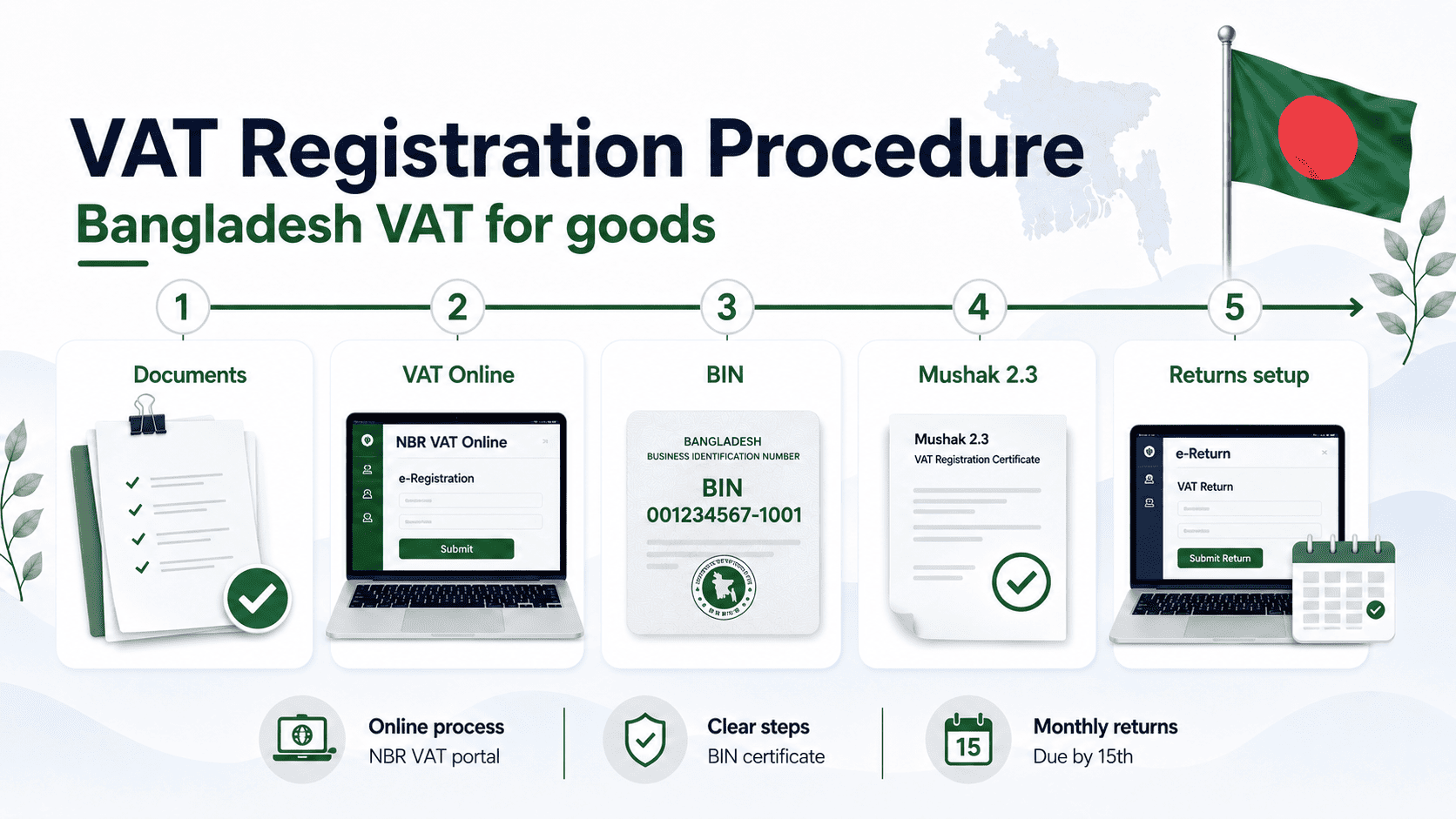 Registration for Bangladesh VAT runs online through VATIS at vat.gov.bd for most applicants. In-person registration at the local VAT Circle office still exists as an alternative — available, but slower.
For a Bangladesh-established entity:
Registration for Bangladesh VAT runs online through VATIS at vat.gov.bd for most applicants. In-person registration at the local VAT Circle office still exists as an alternative — available, but slower.
For a Bangladesh-established entity:
- Get a Trade Licence from the relevant city corporation, municipality, or local authority.
- Obtain a TIN (Taxpayer Identification Number) from the NBR income tax wing. The TIN has to come first — VAT registration doesn't advance without it.
- Open a business bank account in Bangladesh.
- Log into VATIS and complete Form VAT-1.
- Upload: trade licence, TIN certificate, NID (National Identity Card) of directors, bank account details, premises documents.
- Manufacturing businesses may face a premises inspection by the local VAT Circle before registration is confirmed.
- BIN issued on approval — 3–7 working days for clean applications. Complex structures take longer.
Tax Representative in Bangladesh — Service and Representation Requirements
Non-residents name a local representative before submitting the application. Before. Not after approval. The representative's details are a mandatory field in the registration form. Once appointed, the representative handles NBR correspondence, MUSHAK form preparation, return filing, and audit responses. The service quality of that representative directly determines compliance risk — a slow agent misses the four-month input credit window; an inexperienced one fills MUSHAK fields incorrectly; a non-responsive one lets audit notices go unanswered and turns a small query into an enforcement action. Businesses under the mandatory VAT software requirement often end up with two contacts: the approved software vendor's technical team for system questions, and a tax adviser for compliance judgment. Those aren't the same role. Don't assume they are. Domestic businesses don't legally need a representative. But larger manufacturers, importers with complex supply chains, and foreign-owned entities with Bangladeshi operations almost universally use one. The alternative is navigating formal NBR correspondence in Bengali on tight deadlines from overseas.VAT E-Invoices in Bangladesh — MUSHAK Forms and VAT Software in Bangladesh
Bangladesh doesn't run a Western clearance-model e-invoicing system. What it has is MUSHAK forms — NBR-prescribed standardised documents that govern how VAT is documented at every supply chain link. Some are paper. Some are electronic. The format is fixed. Key MUSHAK forms:| Form | Purpose | Who Uses It |
| MUSHAK 6.3 | Standard VAT invoice | All VAT-registered businesses making taxable supplies |
| MUSHAK 6.5 | Purchase register and input tax tracking | Businesses claiming input tax credit |
| MUSHAK 6.7 | Credit note for price adjustments or returns | Registered suppliers issuing adjustments |
| MUSHAK 9.1 | Monthly VAT return | All VAT-registered businesses |
VAT Returns in Bangladesh — Types of Report
Monthly. Always monthly for standard VAT registrants. There's no quarterly option. The form is MUSHAK 9.1, due by the 15th of the following month. October: due 15 November. Payment of net VAT due falls on the same date — not a separate deadline. The return captures output VAT across all rate categories, input VAT claimed from purchases and imports, and adjustments for credit notes, bad debts, and prior-period corrections. Credits carry forward or can be refunded — but NBR refund processing is slow enough that most businesses carry forward unless the balance is substantial. An annual reconciliation statement is required after the financial year ends — confirming that the twelve monthly returns and the annual totals align. VAT control report: No transaction-level submission in Bangladesh. Summary figures go into MUSHAK 9.1. The purchase register (MUSHAK 6.5) and sales records stay with the business and are produced during audit.Deductible VAT in Bangladesh
Input tax recovery is available under standard VAT registration. Not under turnover tax. That choice — turnover tax — came with the trade-off of no input credit. If the business is now seeing significant input VAT costs that it can't recover, that's the consequence of the scheme selection. Under standard VAT, three conditions must all be satisfied simultaneously: purchase from a VAT-registered supplier with a valid current BIN; a proper MUSHAK 6.3 invoice held on file; and the goods or services purchased are used for making taxable supplies. What's blocked — and this list matters:- Purchases for exempt supplies
- Entertainment and hospitality — blocked categorically
- Personal consumption by anyone connected to the business
- Purchases from unregistered suppliers — no valid BIN, no credit, no exceptions
- Imports where ASYCUDA World documentation is missing or incomplete
VAT Record-Keeping Requirements in Bangladesh
Five years. That's the standard minimum, running from the end of the tax period the documents relate to. Active audits extend it — records stay until the case closes, even past five years. What goes into the retained file:- All issued MUSHAK 6.3 invoices with sequential numbering maintained throughout
- Purchase registers (MUSHAK 6.5) documenting every input tax claim
- Monthly MUSHAK 9.1 returns and VATIS submission confirmations
- ASYCUDA World customs bills of entry and assessment notices for every import
- Bank statements and payment records showing VAT remittances
- MUSHAK 6.7 credit notes and debit notes
- Contracts with ongoing VAT implications
- For businesses under the software mandate: system audit logs and data exports
VAT Penalties in Bangladesh — Bangladesh VAT Non-Compliance Costs
Four failure types. Registration, filing, payment, evasion. Failure to register on time: BDT 10,000 to BDT 50,000 fine. Plus backdated VAT liability for the full period of unregistered operation. Not going forward only — everything owed from the point registration was required. Late return filing: BDT 10,000 per month. No cap. Six months late: BDT 60,000 in filing penalties alone, before anything else is calculated. Late payment: 2% per month interest on outstanding VAT. Compounding. On a BDT 500,000 unpaid balance, that's BDT 10,000 per month adding up while the return sits unfiled. Errors in filed returns: Up to the underpayment amount for negligent errors. Up to four times the underpayment for deliberate misstatement. Four times. Not double — four. Bangladesh VAT evasion — fabricated MUSHAK invoices, suppressed sales records, inflated input claims on purchases that never happened — carries criminal liability under the Act: prosecution and imprisonment for serious cases. The NBR's cross-referencing capability has expanded materially since 2022. VAT returns now get matched automatically against customs data, income tax filings, and bank transaction records. Supply chain audits — tracing a specific input claim backward through multiple supplier layers — are increasingly routine in manufacturing and trading. What survived undetected three years ago is being found today. Voluntary disclosure before an audit notice arrives: lower penalty treatment. After the notice: full regime applies, no reduction.How Lappa Can Help with VAT Compliance in Bangladesh
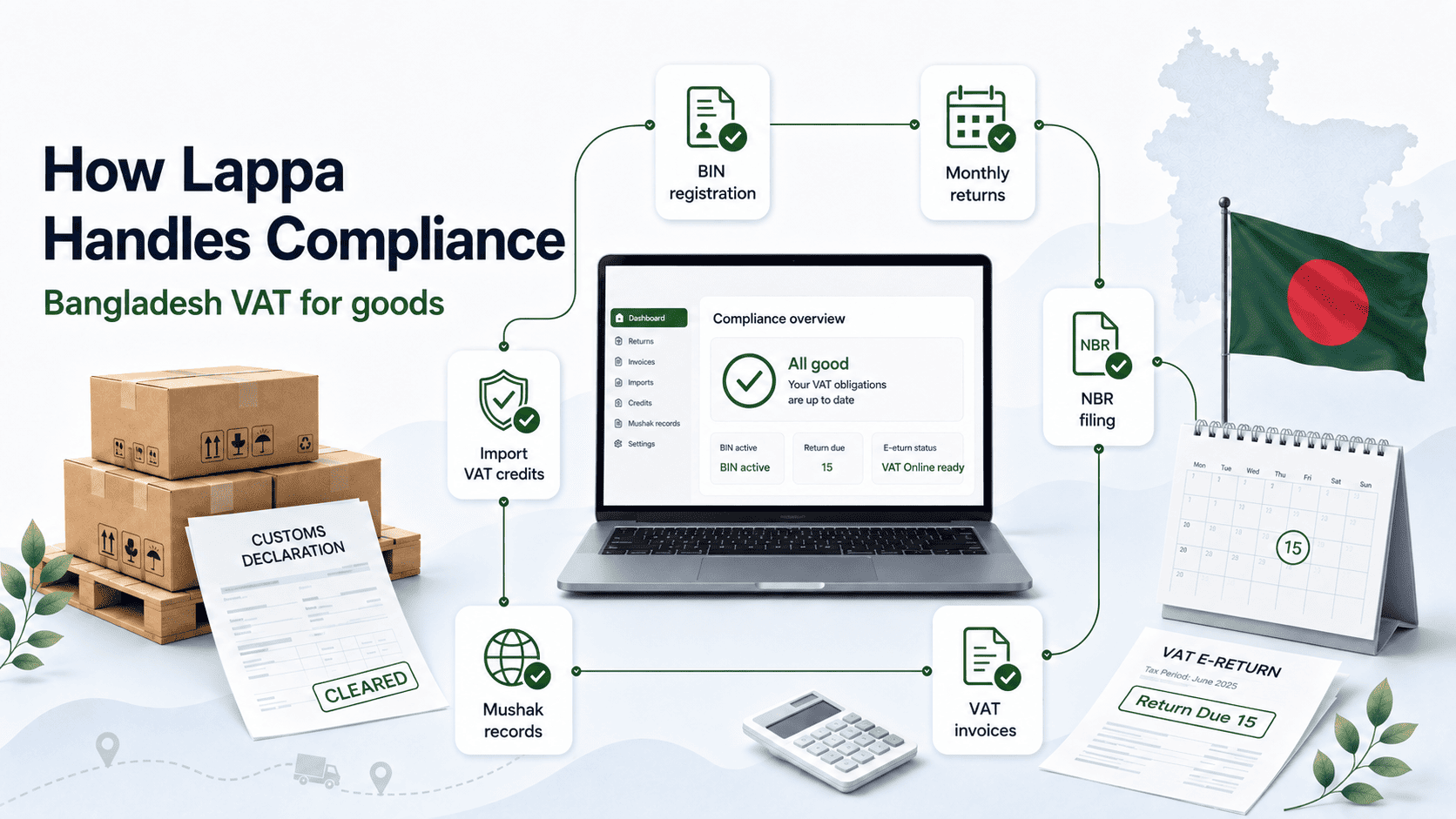 Lappa manages input tax reconciliation, monthly MUSHAK 9.1 return creation and submission, VATIS registration, BIN establishment, and continuing compliance over the whole calendar year for Bangladesh VAT compliance.
Lappa offers local representative services to non-resident enterprises that enter Bangladesh. These services include acting as an agent for the overseas entity, managing contact with the NBR, and conducting processes for MUSHAK forms.
For companies with a mix of taxable and exempt supplies, the platform keeps an eye on the four-month input credit window to make sure credits don't expire due to late invoice processing. It also takes care of the documentation needs for VAT software for companies that are required to use it by the NBR.
Lappa manages input tax reconciliation, monthly MUSHAK 9.1 return creation and submission, VATIS registration, BIN establishment, and continuing compliance over the whole calendar year for Bangladesh VAT compliance.
Lappa offers local representative services to non-resident enterprises that enter Bangladesh. These services include acting as an agent for the overseas entity, managing contact with the NBR, and conducting processes for MUSHAK forms.
For companies with a mix of taxable and exempt supplies, the platform keeps an eye on the four-month input credit window to make sure credits don't expire due to late invoice processing. It also takes care of the documentation needs for VAT software for companies that are required to use it by the NBR.
FAQ for Bangladesh VAT Goods
What Is the VAT Rate in Bangladesh
Bangladesh applies a 15% standard VAT rate to most goods and services. Truncated rates of 10%, 7.5%, and 5% apply to defined sectors — these don't allow input credit recovery. Exports carry a zero rate. Essential food, medicines, and certain agricultural inputs are exempt. Tobacco, carbonated beverages, mobile airtime, and some luxury goods are subject to extra supplemental duty, and VAT is deducted from the total sum that includes SD.Who Needs to Register for VAT in Bangladesh
If your company's yearly taxable revenue is more than BDT 30 lakh, you are required to register with either the turnover tax plan for revenues between BDT 30 lakh and BDT 80 lakh, or with full regular VAT for revenues above BDT 80 lakh. Whatever the turnover, importers must register. Exporters may get their hands on input tax recovery by signing up. Non-resident businesses supplying taxable goods or services in Bangladesh register from the first transaction, no threshold. Non-resident digital service providers face the same zero-threshold obligation.What Is the VAT Number Format in Bangladesh
Bangladesh issues a 13-digit numeric Business Identification Number (BIN) through the VATIS system on registration approval. The 13-digit format replaced the old 9-digit BIN from the 1991 VAT Act — legacy 9-digit numbers are no longer valid. The BIN must appear on all MUSHAK 6.3 invoices, customs declarations, and VAT returns.How Often Are VAT Returns Filed in Bangladesh
Monthly. Payment and the MUSHAK 9.1 return are both due on the same date—the 15th of the month after the tax period. For regular VAT-registered companies, there is no quarterly reporting option. Following the conclusion of each fiscal year, you must submit a reconciliation statement.Do Foreign Companies Need a Tax Representative in Bangladesh
Yes. Before filing their registration application to the NBR, non-resident enterprises are required to choose a local representative. The initial review step rejects the application without an identified representative. On behalf of the overseas company, the representative files returns, communicates with NBRs, and manages compliance continuously.VAT Calculator
VAT Standard rate
15%
VAT Reduced rate
5%, 7.5%, 10%,0%
Thresholds
BDT 5 million