


Bulgaria VAT Registration and Compliance Guide
Provinces
Goods
Provinces
Goods
About
Goods
About
Goods
Goods
Goods
Introduction to VAT in Bulgaria — НАП Framework and How VAT Bulgaria Works
April 1994. That's when Bulgaria introduced a value-added tax system for the first time, replacing a Soviet-era turnover tax that had covered the economy since the late 1980s. The system went through a structural overhaul in 1999, then transformed entirely on 1 January 2007 when EU accession locked Bulgaria inside the EU VAT Directive framework. Everything from that point runs under Directive rules — the local Act is the implementation vehicle, not an independent design. VAT Bulgaria runs under the Value Added Tax Act — Закон за данък върху добавената стойност, ЗДДС — administered by the National Revenue Agency, НАП (Национална агенция за приходите). The NRA's portal at nap.bg handles registrations, return submissions, VAT account management, and direct correspondence. There's no paper-only route for new applications. The digital portal is the primary channel and the only practical one. VAT in Bulgaria follows the EU VAT Directive structure but with several local specifics that catch foreign finance teams off guard. The registration threshold sits at BGN 100,000 since the 2025 revision — doubled from the BGN 50,000 floor that had been in place for over a decade. For intra-EU digital and distance sales, the pan-EU EUR 10,000 OSS threshold applies as a completely separate trigger. The two thresholds operate independently and don't aggregate. Bulgaria VAT law distinguishes four taxpayer categories: businesses established in Bulgaria, EU-established persons registering via OSS, non-EU businesses requiring full Bulgarian registration, and non-EU digital service providers. Each faces different registration mechanics, different documentation requirements, and different filing obligations. The sections below cover all four. Bulgaria uses the lev — BGN — pegged to the euro at BGN 1.95583 to EUR 1 since the currency board was established in 1997. The peg has held through multiple crises. Threshold calculations, penalty amounts, and return figures all run in BGN.VAT Rate Bulgaria — Standard Rate and Reduced Categories
Twenty percent. Standard VAT rate Bulgaria applies to most commercial goods and services. Below that: 9% reduced rate. The 9% bracket covers hotel and holiday accommodation, restaurant and catering services, baby foods and diapers, and books including e-books since 2021. The restaurant rate has had a turbulent history — temporarily cut to 9% during COVID, kept there through anti-inflation policy measures, and confirmed at 9% through 2026. Hospitality businesses track those changes closely because a rate move shifts margin materially. Zero-rating for exports, intra-EU supplies of goods, international transport, and qualifying logistics services connected to import and export operations. Exempt supplies — no output VAT charged, no input VAT recovered: financial services, insurance, healthcare, education, residential property rental, certain cultural services, certain postal services.| Rate | Category | Typical Supplies |
| 20% | Standard | Professional services, telecoms, retail, construction, most manufacturing |
| 9% | Reduced | Hotels, accommodation, restaurants, baby foods, books, e-books |
| 0% | Zero-rated | Exports, intra-EU goods supplies, international freight |
| Exempt | No VAT | Banking, insurance, healthcare, education, residential rental |
Bulgaria VAT Registration Threshold 2026 — Local Businesses, Remote Sellers and Digital Services
For Local Businesses
BGN 100,000 is the mandatory registration threshold for Bulgarian-established businesses — companies and individual traders alike. The Bulgaria VAT registration threshold 2026 sits at this level following the 2025 revision that doubled the previous BGN 50,000 floor. For businesses that had been just above the old limit and managing their compliance accordingly, that change mattered immediately. Below Bulgaria's 2026 VAT registration threshold, voluntary registration is available. It makes commercial sense when input tax recovery on purchases outweighs the compliance overhead — a business fitting out premises, importing equipment, or running heavy procurement before revenues build will typically recover more in input tax than the filing obligation costs. Timing is where most companies get tripped up. The 14-day registration window runs from the moment turnover crosses BGN 100,000 — not from the end of the tax period, not from the next calendar quarter. Mid-year, mid-month: whenever the crossing happens, the clock starts there.For Remote Sellers
EU-based distance sellers dispatching goods to Bulgarian consumers fall under the EU OSS regime once total cross-border distance sales to all EU member states collectively exceed EUR 10,000. Bulgaria-specific registration is one route; Union OSS in the home member state is the alternative most multi-country EU sellers prefer. Non-EU businesses physically importing goods into Bulgaria register from the first taxable import regardless of turnover.For Remote Digital Services
Non-EU digital service providers selling B2C to Bulgarian consumers: zero threshold. Register from the first supply. Streaming platforms, SaaS, gaming, digital downloads, online content subscriptions — all in scope. Route options: direct NRA registration or Non-Union OSS through any EU member state. EU-based digital sellers use Union OSS once their cross-border EU threshold triggers. B2B digital supplies apply reverse charge to the Bulgarian business recipient, who accounts for the tax through the NRA.Who Must Register for VAT in Bulgaria
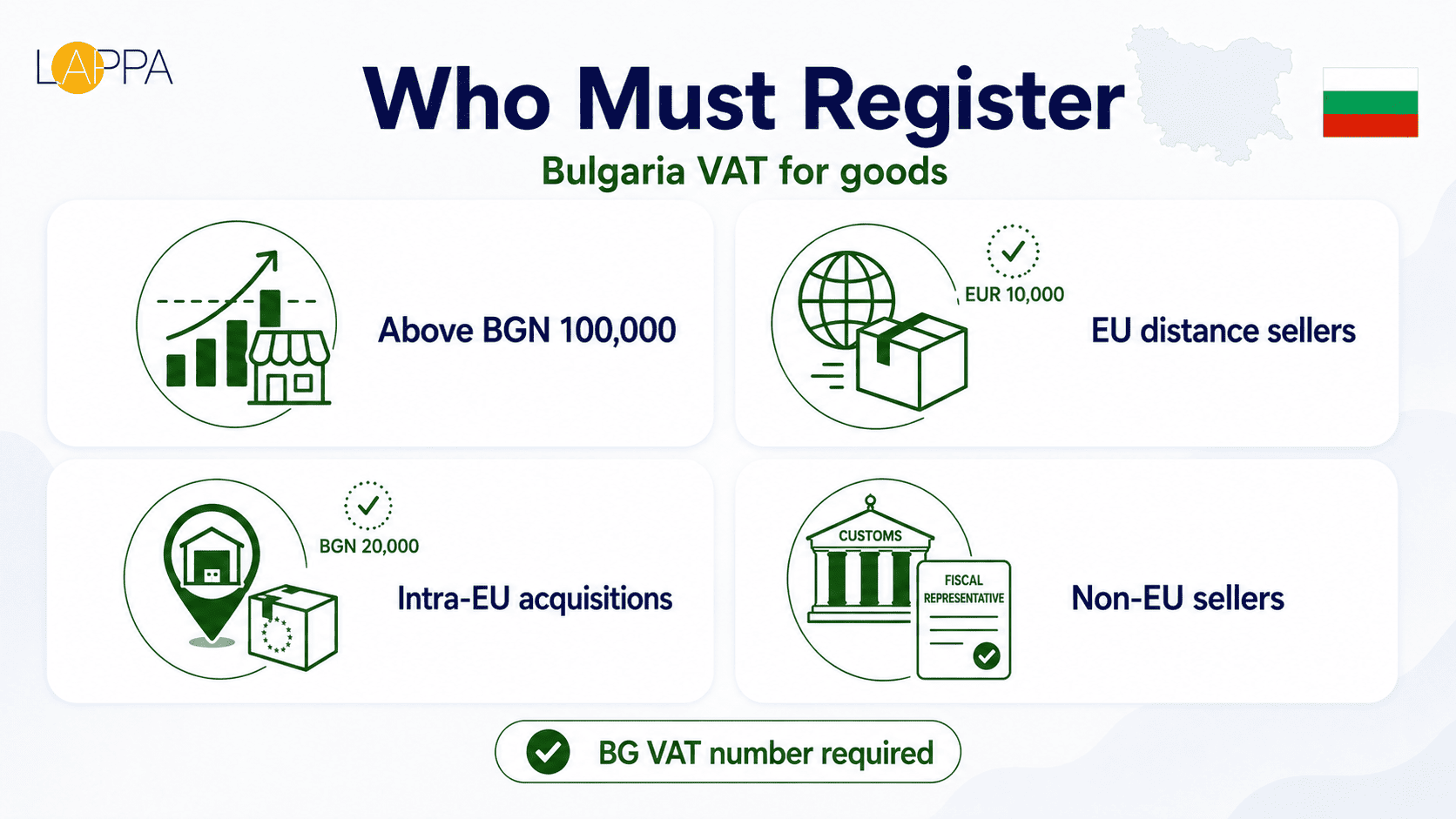 Registration falls on:
- Bulgarian-established businesses with taxable supplies exceeding BGN 100,000 in any rolling 12-month period — mandatory, application within 14 days of crossing.
- Bulgarian businesses voluntarily electing registration below BGN 100,000.
- Non-EU businesses making any taxable supply in Bulgaria — from the first transaction, no threshold.
- Non-EU digital service providers to Bulgarian B2C consumers — zero threshold, first supply triggers registration.
- EU-based businesses not using OSS who register directly with the NRA.
- Any entity acquiring goods from other EU member states above BGN 20,000 in a calendar year — the intra-EU acquisition threshold, a separate trigger from domestic sales.
- Bulgarian businesses receiving reverse-charge services from non-established suppliers, if not already VAT-registered.
VAT id Bulgaria — Bulgarian VAT Number Format and Structure
The VAT id Bulgaria assigns to registered taxpayers follows the EU country-code standard: the letters BG, followed by either 9 or 10 digits depending on the taxpayer type. Legal entities — companies, cooperatives, commercial entities — receive BG + 9 digits. The 9 digits correspond directly to the entity's Unified Identification Code, ЕИК (Единен идентификационен код), issued by the Commercial Register on incorporation. The Bulgarian VAT number is, in practice, the company's ЕИК with BG prepended. No separate VAT-specific identifier exists apart from this prefixed structure.| Taxpayer Type | Format | Digit Count | Example |
| Legal entity (company) | BG + ЕИК | 9 digits | BG123456789 |
| Individual trader / natural person | BG + ЕГН | 10 digits | BG1234567890 |
| Non-resident registrant | BG + NRA-assigned | 9 or 10 digits | BG987654321 |
Bulgaria VAT Registration Procedure — NRA Steps and Requirements
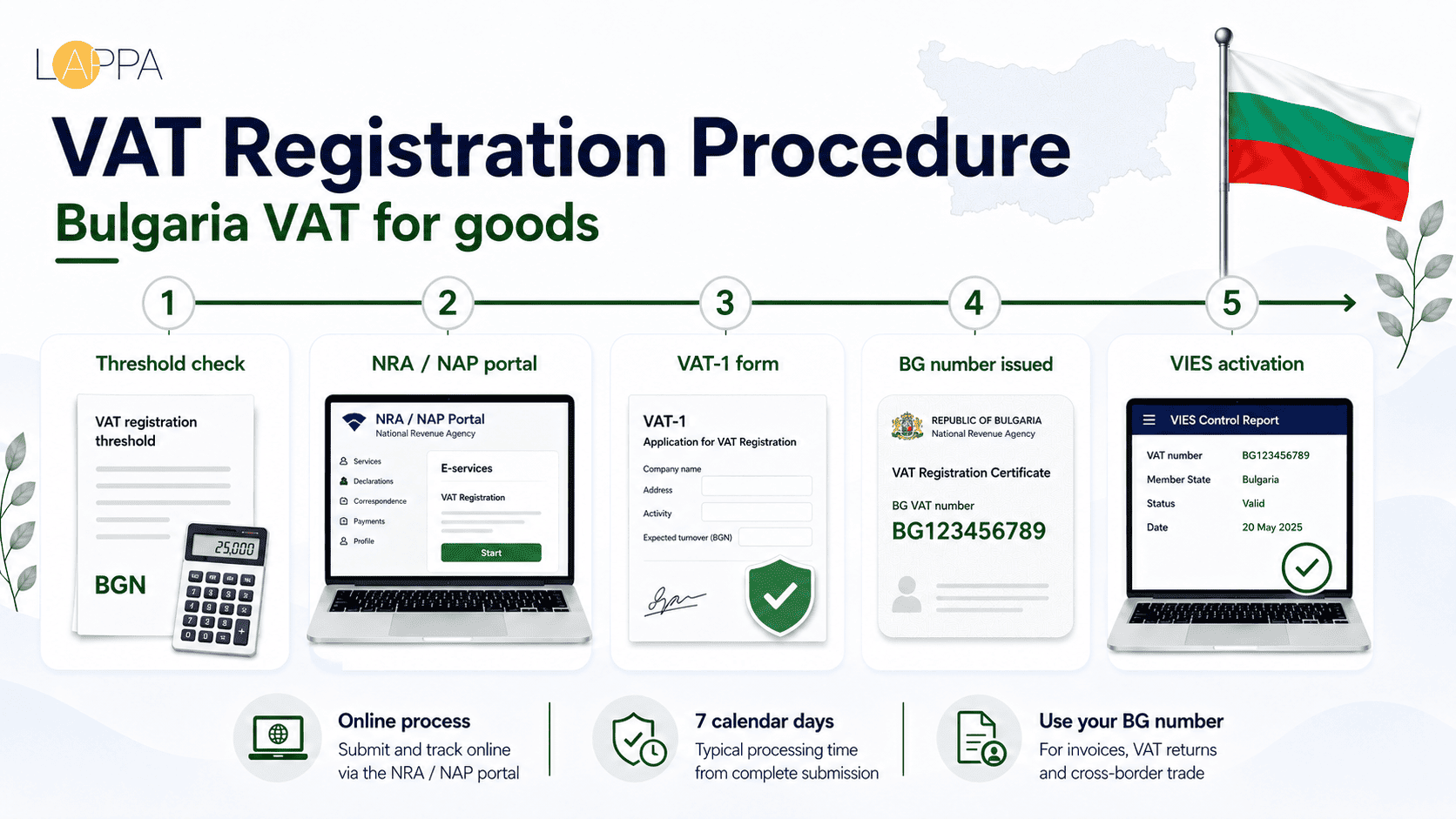 Bulgaria VAT registration for domestically established entities runs through the NRA portal at nap.bg, using the company's electronic certificate or NRA-issued portal access credentials.
For a Bulgarian-established legal entity the process runs:
Bulgaria VAT registration for domestically established entities runs through the NRA portal at nap.bg, using the company's electronic certificate or NRA-issued portal access credentials.
For a Bulgarian-established legal entity the process runs:
- Log in to the NRA portal and locate the VAT registration section.
- Complete Form VAT-1 — the standard registration application. Fields cover company identity, ЕИК, nature of taxable activities, estimated annual turnover, and anticipated intra-EU transactions.
- Attach: Commercial Register extract dated within the last 3 months, proof of registered business address, authorised signatory identification.
- Submit. The NRA processes standard applications within 7 calendar days. Complex ownership structures, non-resident directors, or missing documentation extend that timeline.
- On approval, the NRA issues a VAT registration certificate and activates the BG-prefixed number in the VIES system.
- First monthly return covers the period in which registration becomes effective.
Tax Representative in Bulgaria
Non-EU established businesses must appoint a Bulgarian fiscal representative before their registration application reaches the NRA. Before — not alongside, not after. The representative's name, Bulgarian VAT number, and written authorisation letter are mandatory fields in Form VAT-1. Without them, the application is rejected at initial review. The fiscal representative carries joint and several liability for the foreign entity's Bulgarian VAT obligations. That's not a formality. A Bulgarian firm accepting the representative role stands behind the foreign client's unpaid VAT if the foreign business defaults. Given that exposure, Bulgarian fiscal representatives are selective — irregular trading patterns, high-risk supply types, or poor prior compliance records make securing representation materially harder. EU-established businesses don't face a mandatory representative requirement. Registration directly with the NRA is available. But "not legally required" and "manageable without local support" aren't the same statement. NRA correspondence, Form VAT-1, filing formats, and the Bulgarian statutory framework all operate in Bulgarian. Most EU businesses without in-house Bulgarian language capability engage a local tax agent in practice, regardless of the legal position.VAT E-Invoices in Bulgaria — Timeline for Different Business Sizes
Bulgaria's mandatory e-invoicing is at the B2G stage. Business-to-government e-invoicing has been mandatory since 2019 — structured invoices in European Standard EN 16931 format, transmitted through the PEPPOL network, for all supplies to Bulgarian government contracting authorities. Any supplier to public sector entities: this obligation is live and non-negotiable. B2B mandatory e-invoicing is in preparation. The EU's ViDA (VAT in the Digital Age) package sets a 2030 framework for mandatory cross-border B2B e-invoicing across all EU member states, and Bulgaria is working toward that timeline. As of 2026, B2B e-invoicing is voluntary outside the public sector.| Business Segment | E-Invoicing Status | Format |
| Suppliers to Bulgarian government | Mandatory since 2019 | EN 16931 via PEPPOL network |
| Large B2B taxpayers | Voluntary (2026) | Structured XML or PDF acceptable |
| SME B2B suppliers | Voluntary (2026) | PDF or paper acceptable |
| Non-resident registered suppliers | Per NRA guidance | Standard invoice field requirements apply |
VAT Returns in Bulgaria — VAT Control Report and Filing Types
Monthly. That's the default for every VAT-registered entity in Bulgaria. Filing VAT in Bulgaria requires two separate monthly submissions, both due by the 14th of the month following the reporting period. January's return and payment: due 14 February. The NRA grants quarterly filing exceptions for very low-volume registrants on application, but monthly is the standard and exceptions aren't granted easily. Two distinct filings every month:- VAT return (Справка-декларация): output VAT by rate category, input VAT deductions claimed, adjustments for credit notes and prior-period corrections, net VAT payable or refundable.
- VIES declaration: intra-EU supplies reported by counterparty VAT number and transaction value. Mismatches between a Bulgarian supplier's VIES report and the EU buyer's declaration in their own member state generate automatic cross-border audit flags through the VIES exchange system.
Deductible VAT in Bulgaria
Input VAT is deductible when three conditions align simultaneously: the purchase is from a VAT-registered supplier; a valid tax invoice carries that supplier's BG VAT number; and the input relates to making taxable — standard or zero-rated — supplies. Blocked inputs in all circumstances:- Entertainment, hospitality, and representation expenses — non-recoverable regardless of business context
- Acquisition and running costs of passenger vehicles used partly for private purposes
- Inputs directly attributable to VAT-exempt supplies
- Inputs for non-business or private use
VAT Record-Keeping Requirements in Bulgaria
Five years minimum, from the end of the year in which the tax obligation arose. The exception: real property transactions — ten years, reflecting the longer input tax adjustment period for immovable capital assets under Bulgarian VAT law. Documents within scope:- All issued and received tax invoices, including credit and debit notes
- Import customs declarations and clearance documentation
- VAT returns and VIES declarations as filed with the NRA
- Contracts carrying ongoing VAT implications
- Accounting ledgers showing VAT account movements
- Bank statements confirming VAT payments and any refund receipts
VAT Penalties in Bulgaria — Bulgaria VAT Non-Compliance Costs
The NRA enforces penalties under the Tax and Social Insurance Procedure Code — ДОПК. Four main exposure categories cover the standard failure types.- Late or missing registration: BGN 500–5,000 administrative penalty for late registration, plus backdated VAT liability from when registration should have occurred, plus daily interest on that outstanding amount from the same date. The combination typically exceeds the face value of the registration penalty itself.
- Late return filing: BGN 500–10,000 per missing return. The upper range applies to repeat failures and larger-turnover entities. The NRA uses discretion within the range — first-time delays on small operations attract the lower end; patterns indicating deliberate avoidance attract the maximum.
- Late VAT payment: Daily interest at the Bulgarian National Bank base rate plus 10 percentage points, on the unpaid balance from the due date. When the BNB rate is elevated, interest on a large unpaid balance builds quickly.
- Errors and understatements: Up to 100% of the understated tax for deliberate or fraudulent misstatement. Lower percentages apply for negligence versus intent. Voluntary disclosure before an audit commences materially reduces the penalty level. Once the audit notice arrives, the voluntary disclosure window closes.
How Lappa Can Help with VAT Compliance in Bulgaria
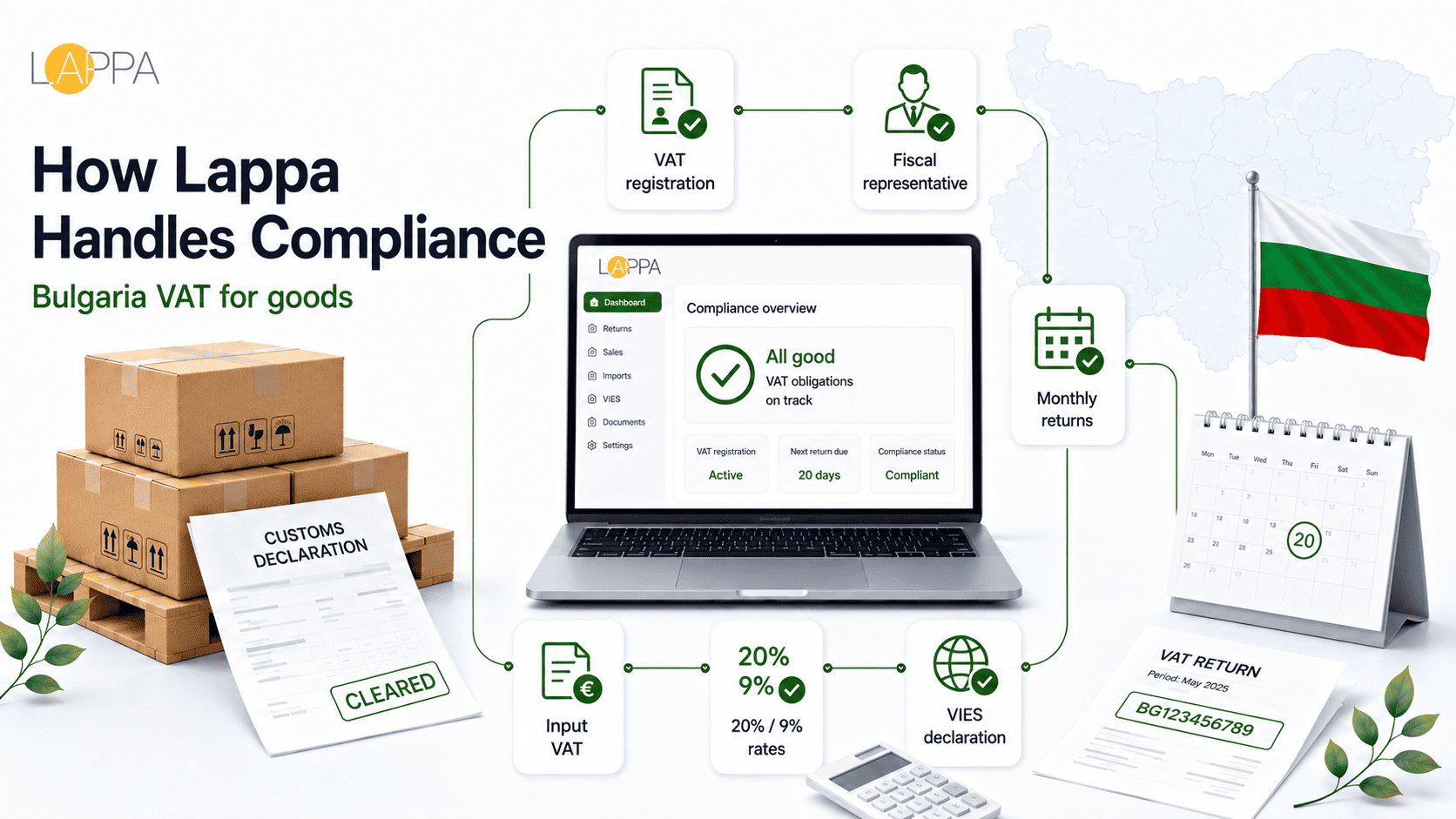 Lappa handles the full Bulgarian VAT cycle: NRA registration, Bulgarian VAT number setup, monthly return and VIES declaration preparation and submission, and ongoing compliance calendar management for every filing deadline.
For non-EU businesses entering Bulgaria, Lappa provides fiscal representative services — taking on the mandatory representative role, joint liability included, removing the need to source a Bulgarian-established representative independently before operations begin.
The platform manages input tax apportionment for businesses with mixed taxable and exempt activities, handles voluntary disclosure preparation for prior-period corrections, and supports parallel VAT compliance for businesses registered across multiple EU member states from a single integrated workflow. For businesses already using OSS for cross-border EU digital sales, Lappa manages Bulgaria-specific NRA reporting alongside the OSS returns.
Lappa handles the full Bulgarian VAT cycle: NRA registration, Bulgarian VAT number setup, monthly return and VIES declaration preparation and submission, and ongoing compliance calendar management for every filing deadline.
For non-EU businesses entering Bulgaria, Lappa provides fiscal representative services — taking on the mandatory representative role, joint liability included, removing the need to source a Bulgarian-established representative independently before operations begin.
The platform manages input tax apportionment for businesses with mixed taxable and exempt activities, handles voluntary disclosure preparation for prior-period corrections, and supports parallel VAT compliance for businesses registered across multiple EU member states from a single integrated workflow. For businesses already using OSS for cross-border EU digital sales, Lappa manages Bulgaria-specific NRA reporting alongside the OSS returns.
FAQ for Bulgaria VAT goods
What Is the VAT Rate in Bulgaria
- Bulgaria applies a 20% standard rate to most goods and services. A 9% reduced rate covers hotel and holiday accommodation, restaurant and catering services, books including e-books, and baby foods and diapers. Exports, intra-EU goods supplies, and international transport are zero-rated. Financial services, insurance, healthcare, education, and residential rental are VAT-exempt — no output tax charged, no input tax recovered.
Who Needs to Register for VAT in Bulgaria
- Bulgarian-established businesses register when taxable supplies over any rolling 12-month period exceed BGN 100,000. Voluntary registration is available below that level. Non-EU businesses making taxable supplies in Bulgaria register from the first supply regardless of volume. Non-EU digital service providers to Bulgarian B2C consumers register from their first supply, with no minimum threshold.
What Is the VAT Number Format in Bulgaria
- Bulgaria issues a BG-prefixed VAT number: BG + 9 digits for legal entities, corresponding to the entity's Unified Identification Code (ЕИК), or BG + 10 digits for individual natural person traders. Bulgaria's VAT number format is verifiable through the EU VIES system and the NRA registry at nap.bg.
How Often Are VAT Returns Filed in Bulgaria
- Monthly, for the vast majority of registered businesses. Both the VAT return and the VIES declaration are due by the 14th of the following month, with net VAT payment due on the same date. The NRA grants quarterly filing in exceptional cases for very low-volume registrants — monthly is the standard.
Do Foreign Companies Need a Tax Representative in Bulgaria
- Non-EU established businesses must appoint a Bulgarian fiscal representative before submitting their VAT registration application — before, not alongside. The representative carries joint and several liability for Bulgarian VAT obligations. EU-established businesses can register directly with the NRA without a mandatory representative, though Bulgarian-language NRA correspondence, Form VAT-1 requirements, and local statutory obligations make professional local support practically necessary for most.
VAT Calculator
At 20%: multiply net by 1.20 for gross. To extract VAT from a gross figure — divide by 1.20, then subtract. BGN 1,000 net carries BGN 200 VAT; buyer pays BGN 1,200. At 9%: multiply net by 1.09. BGN 500 net gives BGN 45 VAT, BGN 545 gross. Bulgarian tax invoices must show net amount, applicable rate, and VAT amount as three separate fields. A gross-only invoice doesn't support an input tax claim from the recipient. The NRA is explicit on this. Recipients who refuse to process an invoice without proper field separation aren't being difficult — they're protecting their own deduction.
VAT Standard rate
20%
VAT Reduced rate
9%, 0%9%, 0%
Thresholds
BGN 166,000 (resident businesses); BGN 0 (non-resident businesses); €10,000 EU OSS threshold for cross-border B2C sales