


Finland VAT Registration and Compliance
Provinces
Goods
Provinces
Goods
About
Goods
About
Goods
Goods
Goods
Introduction to VAT in Finland
This Nordic EU member state runs one of the more digitalized tax systems in the bloc, with virtually all registration and filing handled through OmaVero — the Verohallinto self-service portal. The levy here is called arvonlisävero (ALV), and its standard rate climbed to 25.5% on September 1, 2024, up from 24% following a legislative change aimed at closing a fiscal gap. VAT in Finland operates fully within the EU framework — intra-community supply rules, the One-Stop Shop, EC Sales Lists, and the €10,000 distance-selling threshold all apply exactly as they do across other member states. Three decades inside the EU framework have produced tight integration between Verohallinto's systems and those of other member state authorities. Most queries don't start with a human reviewer — they start with an automated cross-reference between your EC Sales List data and what your counterparties declared in their home country. Get the numbers right from day one and Finnish VAT compliance is genuinely streamlined; get them wrong and the queries arrive quickly. This guide covers physical goods only.Finland VAT Rates
Finland VAT applies at three positive rate levels. The 25.5% standard rate that arrived in September 2024 represents the highest rate this country has seen and places it among the higher-rate EU member states. Operators updating landed cost models after that change needed to revise any pricing that was calculated on the old 24% base.| Rate | Category | Examples |
| 25.5% | Standard rate | Electronics, vehicles, clothing, construction materials, industrial equipment, cosmetics, most consumer goods and imports |
| 14% | Reduced rate | Foodstuffs, animal feed, restaurant and catering services (food component) |
| 10% | Reduced rate | Books (print and digital), certain medicines, passenger transport, hotel accommodation, newspapers, cultural and sports events |
| 0% | Zero rate | Exports outside EU, intra-community supplies to registered EU buyers, international transport |
VAT Registration Threshold in Finland
For Local Businesses
Locally established operators must register once taxable turnover reaches €15,000 in a calendar year. That is one of the lower thresholds in the EU, so small importers and distribution operations hit the registration point earlier than they might expect coming from other markets. Voluntary registration below the threshold is available and routinely used by operators with meaningful import activity — it unlocks recovery of the 25.5% levy paid on every inbound shipment, which quickly outweighs the administrative cost of filing. Registration must happen before the transaction that pushes turnover over €15,000. The obligation cannot be backdated as a routine administrative fix — if the threshold is expected to be crossed, the application should precede the crossing transaction. Verohallinto processes complete applications typically within a few working days through OmaVero.For Remote Sellers Selling Goods
The EU-wide €10,000 combined distance-selling threshold applies here. A Swedish retailer selling €6,000 of goods to Finnish consumers and €5,000 to Danish consumers has crossed the combined threshold and must either register locally or use the One-Stop Shop (OSS) mechanism through their home country's portal. Goods stored in Finnish warehouses — including third-party fulfilment centre inventory — trigger a local registration obligation from day one, regardless of sales volume. Holding inventory here creates a fixed presence; the €10,000 threshold offers no cover once that footprint exists.Who Must Register for VAT in Finland
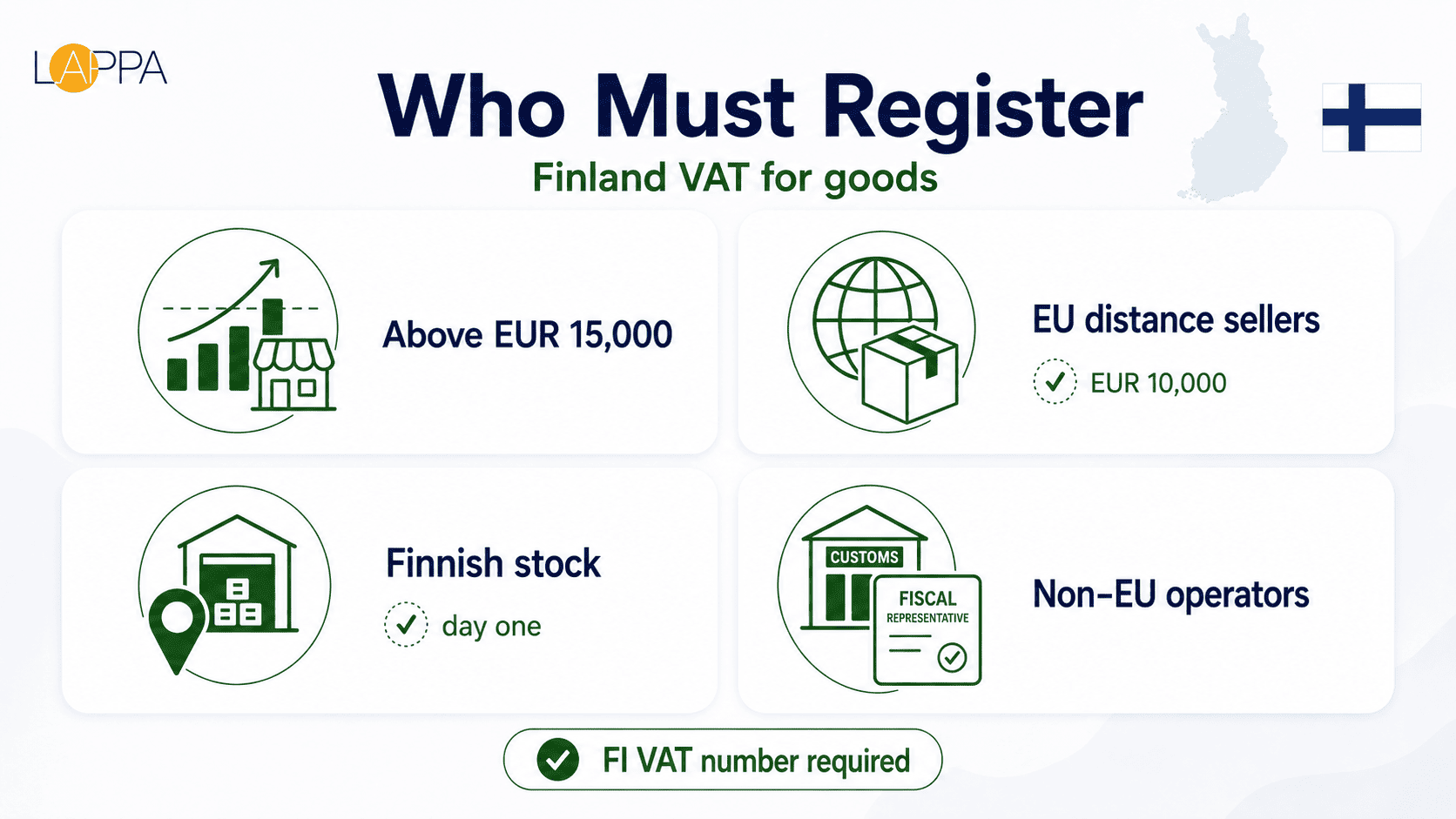 Registration is mandatory for these categories of goods operators:
- Locally established operators whose taxable goods turnover reaches or is projected to reach €15,000 in any calendar year — registration must precede the threshold-crossing transaction
- Foreign operators holding goods in local warehouses or operating a fixed establishment here, regardless of sales volume
- Any enterprise receiving intra-community acquisitions above €10,000 annually from EU suppliers
- Operators making occasional taxable supplies of new means of transport or new buildings within the country
VAT Number in Finland — Format and Verification
Every registered operator receives a VAT number in Finland based on the company's Y-tunnus (Finnish business ID). The Y-tunnus format is 7 digits plus a dash and a check digit — for example, 1234567-8. For EU VAT purposes, the dash is removed and "FI" is prefixed, producing the format FI + 8 digits: FI12345678. Verification of any counterparty's VAT number Finland status runs through the EU VIES portal at ec.europa.eu/taxation_customs/vies. Finnish buyers check supplier numbers routinely before processing invoices because an invalid or inactive number blocks input levy recovery on the receiving side. Verohallinto also maintains a public business information search at ytj.fi where the Y-tunnus, registration status, and company details are searchable. Finland's VAT numbers tie directly to the Y-tunnus entry — a company struck off the business register typically loses its tax registration at the same time.VAT Registration Procedure in Finland
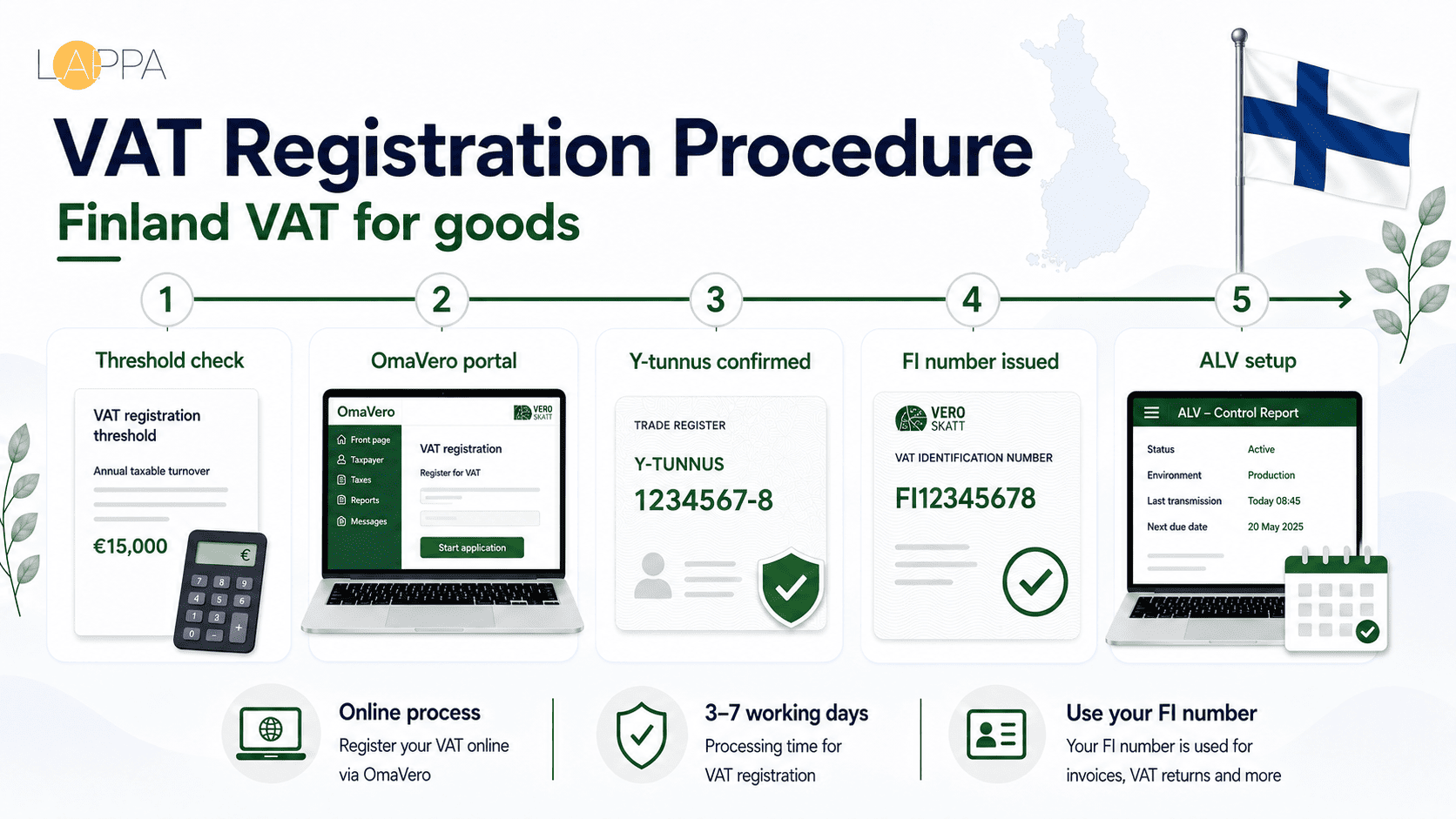 Registration runs through OmaVero (vero.fi/omavero). For EU-established operators, the process is fully digital — no physical office visits, no paper forms unless Verohallinto requests supplemental documentation. Five steps cover the standard flow:
- Log into OmaVero using Finnish bank credentials, a Finnish identity card, or an accepted EU electronic identity
- Complete the registration application, declaring expected taxable turnover, goods activity description, and the requested registration start date
- For foreign operators — attach home-country registration documents and evidence of Finnish taxable activity (warehouse lease, supply contracts, import records)
- Non-EU operators must additionally submit a signed fiscal representative appointment alongside the application
- Receive the VAT in Finland registration confirmation and assigned FI number — typically within 3 to 7 working days for complete applications
Tax Representative in Finland
Non-EU operators hit a specific requirement that EU-based operators do not: Verohallinto will not process a registration application without a named Finnish-resident fiscal representative attached. That representative — usually an accounting firm or licensed tax advisor based here — takes on personal exposure for the foreign operator's levy obligations. Personal exposure means most of them want a formal engagement letter, a signed indemnity from the foreign company, and a financial guarantee covering several months of estimated levy before agreeing to sign anything. EU-established operators have no mandatory representative requirement. Many use a local tax agent voluntarily for practical reasons — handling OmaVero filings in Finnish or Swedish, managing Intrastat declarations, and receiving Verohallinto query letters in the local language.VAT E-Invoices in Finland
This Nordic country has been among the leading EU adopters of electronic invoicing. Mandatory B2G (business to government) e-invoicing has been in place since 2010 — any operator supplying goods to public sector entities must issue structured electronic invoices. The Peppol network is the primary transmission infrastructure, and most Finnish software providers support it natively. For private-sector B2B goods transactions, no general mandate currently exists. Paper and PDF invoices remain valid between private parties, though e-invoicing adoption in Finnish B2B is notably high in practice — the country's digital business culture means many large buyers require structured e-invoices contractually even where no legal obligation exists. The EU's ViDA initiative will bring phased B2B digital reporting requirements across member states; given the existing infrastructure here, implementation is expected to proceed smoothly.VAT Returns in Finland
Monthly filing is the default for all registered operators. The ALV-ilmoitus (VAT return) covers output levy on sales and input levy on purchases, with the net difference paid to Verohallinto or carried forward as a credit. Filing and payment deadlines fall on the 12th of the second month following the reporting period — January's return is due March 12. Operators may apply for alternative filing frequencies:| Filing period | Who qualifies | Payment deadline |
| Monthly (default) | All registered operators | 12th of the 2nd month after period |
| Quarterly | Operators with annual ALV payable up to €25,000 | 12th of the 2nd month after quarter |
| Annual | Operators with annual ALV payable up to €3,000 | February 28 of the following year |
- EC Sales List (yhteenvetoilmoitus) — monthly report of zero-rated intra-community supplies to registered EU buyers; due by the 20th of the following month. Operators with annual EU supplies below a threshold may file quarterly
- Intrastat declaration — monthly statistical report for goods movements above the annual arrival and dispatch thresholds set by Statistics Finland (stat.fi); filings due by the 10th of the following month
- OSS return (where applicable) — operators using the One-Stop Shop for distance sales file a quarterly OSS return through their home country's portal rather than filing separately in each EU destination country
Deductible VAT in Finland
Recovery of input levy requires two things: goods or services that go into taxable outputs, and a valid invoice on file. Miss either condition and the deduction does not hold up. For goods operators, three specific restrictions come up regularly:- Passenger cars: Input levy on passenger car purchase costs and running expenses is blocked entirely — no recovery regardless of actual business use. Vans, lorries, and commercial vehicles used in operations qualify for full recovery
- Mixed-use assets: An asset used partly for taxable and partly for exempt or private purposes requires pro-rata deduction based on the taxable proportion
- Entertainment costs: Levy on hospitality and entertainment is generally not deductible unless tied to a specific documented taxable commercial purpose
VAT Record Keeping Requirements in Finland
Six years from the close of the fiscal year — that is the retention window the Kirjanpitolaki (Accounting Act) sets for all tax-relevant documentation. Verohallinto can ask for records at any point within that window, and the expectation is that files come in a format examiners can open without needing third-party software. What a goods operator actually needs in the archive:- All issued and received invoices meeting the content requirements under the ALV Act
- Import customs entry documents with supporting shipping documentation — bills of lading, packing lists, commercial invoices
- Export documentation substantiating zero-rate treatment — customs export confirmations and transport records
- Monthly ALV-ilmoitus returns, EC Sales List filings, and Intrastat declarations with payment receipts
- Inventory records and stock movement logs for goods held locally
VAT Penalties in Finland
Non-compliance costs in this market are not trivial. The Laki verotusmenettelystä (Tax Procedure Act) and the ALV Act split penalties across filing failures, payment delays, and substantive inaccuracies — and those brackets do not overlap, so hitting more than one in a single period stacks the exposure.| Violation | Penalty | Notes |
| Late filing of ALV-ilmoitus | Up to €15,000 | Assessed based on seriousness; applies on nil returns |
| Late payment of levy due | Annual interest rate set by Finnish Central Bank + 7% | Applied from the day after the payment deadline |
| Non-registration | Up to €15,000 + retroactive assessment | Verohallinto assesses back-levy for full unregistered period |
| Incorrect return (negligent) | Up to 30% surcharge on underpaid amount | Identified in review or audit |
| Deliberate evasion | Up to 100% surcharge + criminal referral | Serious cases referred to the prosecutor |
How Lappa Handles VAT Finland Compliance
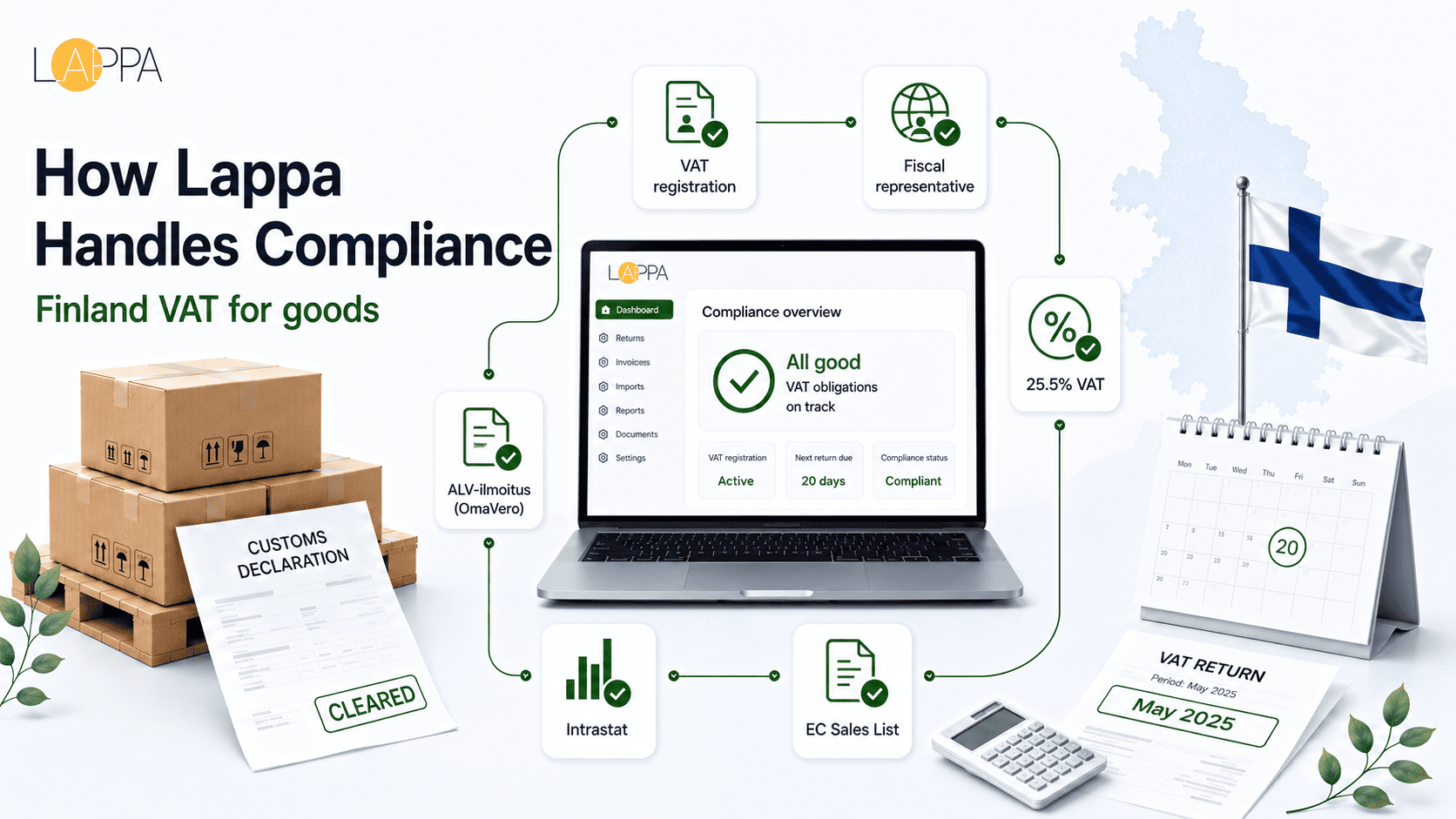 Running goods compliance here means monthly ALV-ilmoitus filings, EC Sales Lists at monthly or quarterly frequency, potential Intrastat declarations, and customs data that needs to reconcile with OmaVero records — all against a Verohallinto that cross-references EU trade data across member states. VAT number Finland registration through Lappa covers the full setup process, and ongoing support handles the compliance calendar end-to-end:
- Registration — handling the OmaVero application for EU and non-EU operators, including fiscal representative appointment and guarantee arrangements for non-EU businesses
- Monthly ALV-ilmoitus and EC Sales List filing — preparation and electronic submission through OmaVero, with pre-filing reconciliation to catch discrepancies before Verohallinto's automated cross-reference runs
- Intrastat — monthly declarations for operators above the arrival and dispatch thresholds, aligned with the ALV and EC Sales List calendar
- Export documentation — building and maintaining the customs exit evidence archive required to substantiate zero-rate treatment on outbound shipments
- Refund claim management — filing and tracking input credit refunds for exporters accumulating credits against zero-rated export outputs
FAQ for Finland VAT Goods
What is the VAT Rate in Finland
The standard rate is 25.5%, effective from September 1, 2024 — raised from the previous 24%. A reduced rate of 14% applies to foodstuffs and animal feed. A second reduced rate of 10% covers books, certain medicines, hotel accommodation, public transport, newspapers, and cultural events. Exports and intra-community supplies carry 0%. VAT in Finland at 25.5% applies to most commercial goods including electronics, vehicles, construction materials, and general consumer products. The Finnish levy at standard rate is among the higher rates in the EU after the 2024 increase.Who Needs a Finland VAT Number
A Finland VAT number is required for locally established operators whose taxable turnover reaches €15,000 in any calendar year, and for foreign operators holding goods in Finnish warehouses regardless of sales volume. Operators receiving intra-community acquisitions above €10,000 annually must also register. Finland VAT number registration is voluntary below the threshold but is widely used by importers to recover input levy on purchases. The registration obligation applies from the first transaction if the threshold will be crossed — not after the fact.What is the VAT Number Finland Format
The VAT number Finland assigns follows the format FI + 8 digits — for example FI12345678. The eight digits are derived from the company's Y-tunnus (Finnish business ID) by removing the dash. A company with Y-tunnus 1234567-8 has the VAT number FI12345678. Verification of any number is free through EU VIES or ytj.fi. The VAT number in Finland is derived from the Y-tunnus by removing the dash and adding the FI prefix — no separate VAT-specific sequence is issued.What is VAT ID Finland
The VAT ID Finland assigns to registered operators is the FI-prefixed VAT number — the same identifier used on all invoices, EC Sales List declarations, and formal Verohallinto correspondence. There is no separate VAT-specific identifier distinct from the Y-tunnus-based FI number. VAT ID Finland must appear on every commercial invoice for it to be valid for input levy recovery by the buyer. A Finnish VAT identifier without the FI prefix is simply the Y-tunnus business register number — always use the full FI-prefixed format on invoices and EU trade documents.How Often Are VAT Returns Filed in Finland
Monthly filing is the default, with the ALV-ilmoitus due by the 12th of the second month after the reporting period. Quarterly filing is available for operators with annual levy payable up to €25,000; annual filing for operators with annual levy payable up to €3,000. The EC Sales List files monthly or quarterly — typically on the same frequency as the main return. Intrastat declarations file monthly by the 10th where dispatch or arrival thresholds are exceeded.
VAT Standard rate
25.5%
VAT Reduced rate
14%, 10%
Thresholds
EUR 20,000 annual turnover