


Georgia VAT for International Businesses
Provinces
Goods
Provinces
Goods
About
Goods
About
Goods
Goods
Goods
VAT in Georgia Country — an Introduction
Two places share the same name: a southeastern American state and a Caucasus republic between the Black Sea, Russia, Azerbaijan, Armenia, and Turkey. Search queries about indirect taxes routinely mix them. This guide covers the republic — VAT in Georgia country, where the levy runs at 18%, is called dghg (დამატებული ღირებულების გადასახადი), and is overseen by the national Revenue Service. EU directives have no bearing here. A 2014 trade agreement brought EU regulatory alignment in some areas but not membership. Without membership: no OSS, no Intrastat, no EC Sales Lists, no €10,000 combined distance-selling floor. Georgia VAT answers to the Tax Code of Georgia, amended by Parliament as fiscal needs require. Operators arriving here with EU-built compliance programmes should plan on rebuilding from scratch. Georgian VAT rules land the same way on domestic companies and foreign operators with a local taxable footprint — no lighter treatment for either. Physical goods only are covered here.Georgia VAT Rates
The Georgia VAT rate structure uses a single standard rate with no reduced tiers. Unlike EU markets where food, books, and medicines often carry lower rates, this Caucasus market applies 18% to virtually all taxable goods supplies.| Rate | Category | Examples |
| 18% | Standard rate | Electronics, vehicles, clothing, construction materials, consumer goods, industrial equipment, most imports |
| 0% | Zero rate | Exports of goods outside the country, international transport of goods |
| Exempt | Exempt supplies (no input credit recovery) | Certain financial services, medical services, education, land sales |
VAT Registration Threshold in Georgia
For Local Businesses
One hundred thousand GEL — around $37,000 at current rates — is the crossing point. Reach that in any rolling twelve-month stretch and enrollment becomes mandatory; the clock does not wait for January 1. An operator accumulating 100,000 GEL between March and the following February triggers the obligation in February. Coming from markets where thresholds run at €35,000 or €85,000, most operators hit this limit sooner than expected. Voluntary enrollment below the threshold is available and widely used by importers. Every inbound shipment generates an 18% customs levy that is unrecoverable without enrollment — once enrolled, it becomes a deductible input credit. The authority processes complete applications within a few working days.For Remote Sellers Selling Goods
Foreign operators selling goods here without a local footprint do not face a distance-selling enrollment rule comparable to the EU's €10,000. Physical goods clear as imports and the importer of record handles the levy at the border. Enrollment becomes mandatory once a physical presence is established — a warehouse, branch, or local employees. That footprint triggers the obligation; sales volume alone does not.Who Must Register for VAT in Georgia
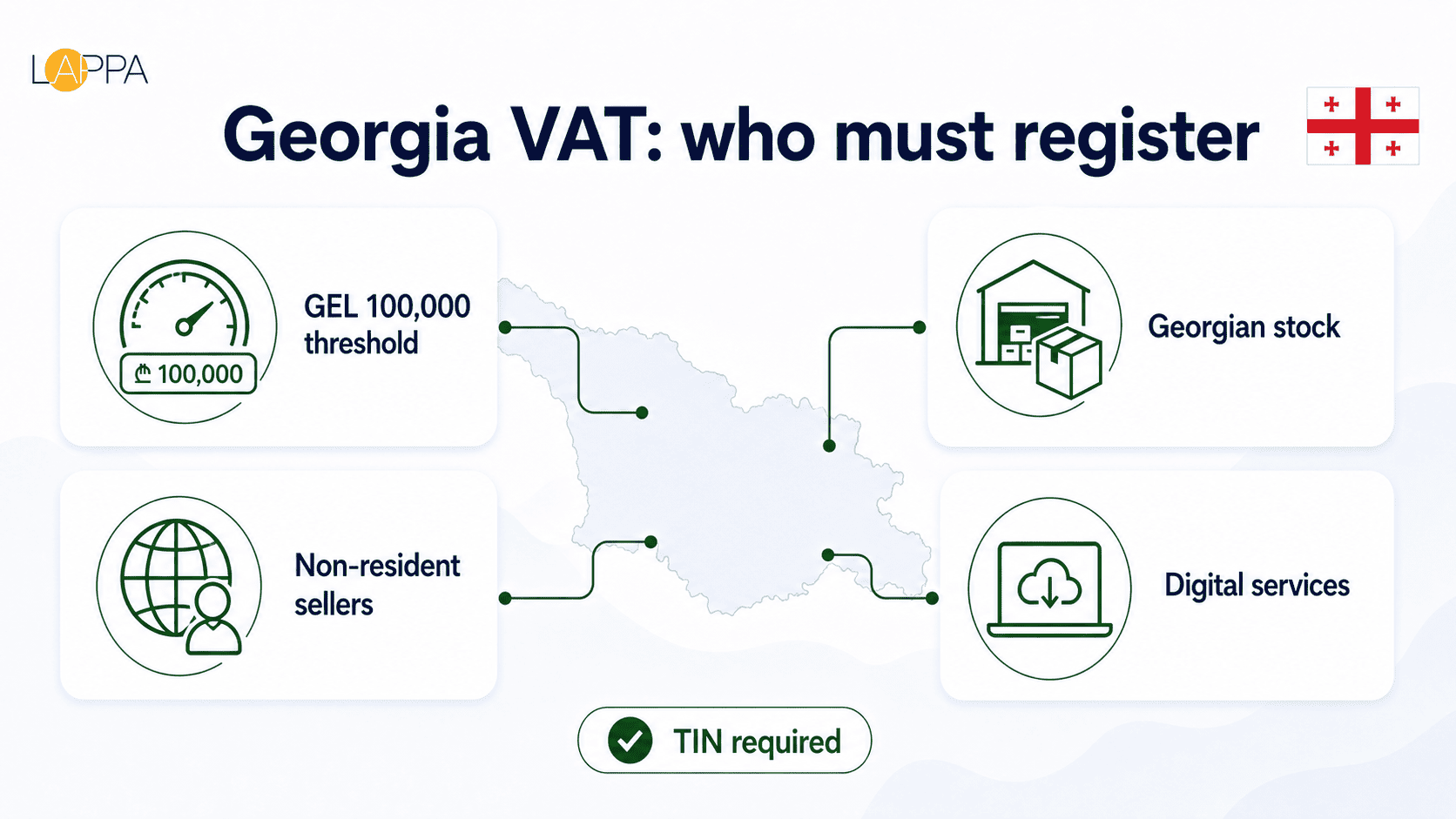 Hit 100,000 GEL in taxable turnover across any rolling twelve-month window — individual trader, partnership, or company — and enrollment is no longer optional. Several other categories carry a hard obligation regardless of how much they have sold:
- Operators importing goods for commercial resale — the import transaction itself creates a levy obligation even without domestic sales activity
- Foreign entities that have established a branch, warehouse, or fixed establishment through which taxable goods are supplied locally
- Operators choosing voluntary enrollment — permitted at any turnover level, irrevocable for 12 months
VAT Number Georgia — Format and Lookup
The Georgian system uses one number for everything, rather than issuing a separate levy identifier the way EU member states do with FI, DE, or FR-prefixed codes. The VAT number Georgia assigns is the nine-digit TIN that covers income tax, customs clearance, and all Revenue Service correspondence. No country prefix, no separate levy code.- Georgian companies: 9-digit code assigned at entity enrollment with the National Agency of the Public Registry — for example, 205010101
- Individual entrepreneurs: 11-digit personal ID number (national identity code)
- Foreign branches: Separate 9-digit code assigned by the Revenue Service upon branch enrollment
VAT Registration Procedure in Georgia
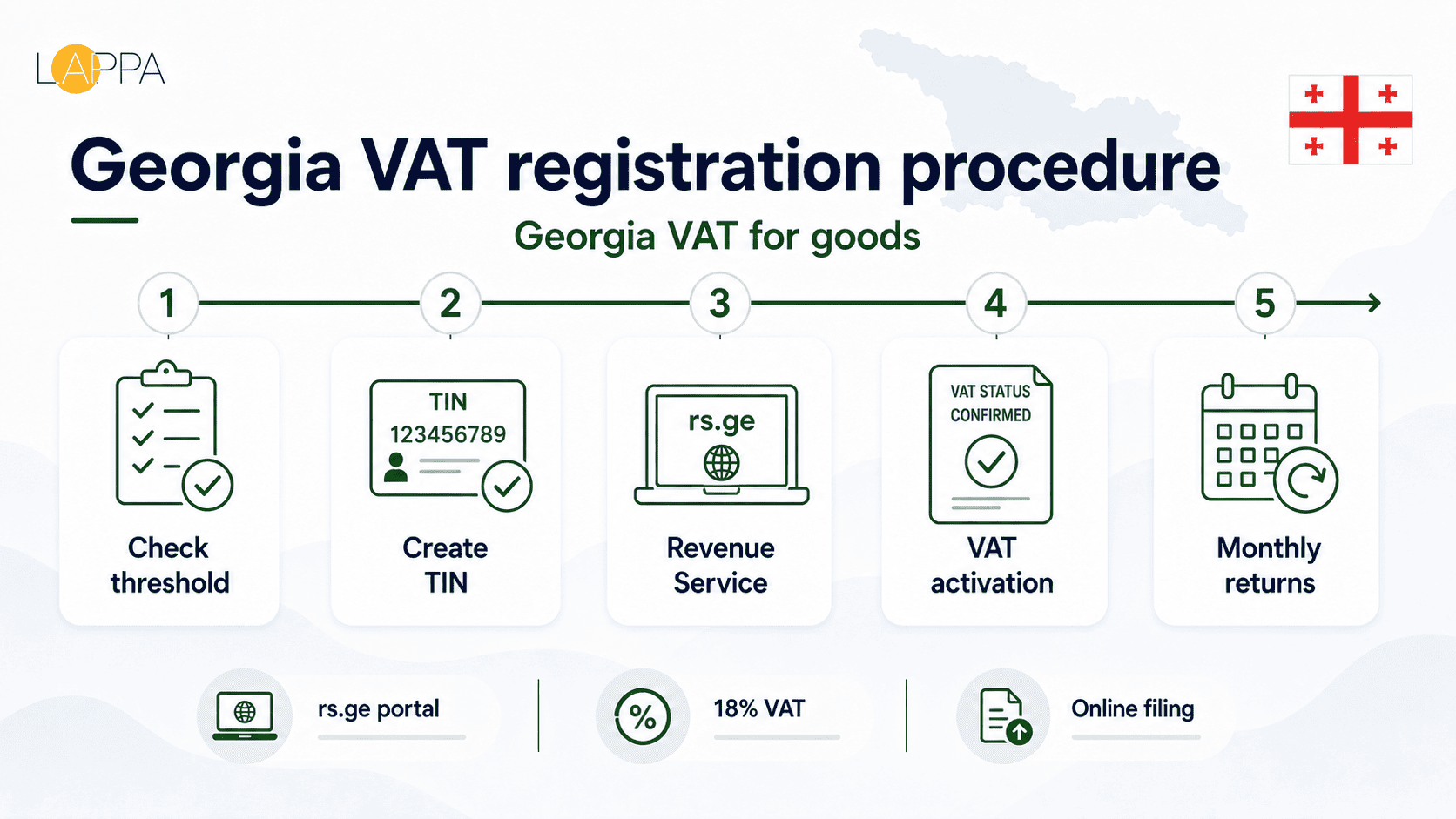 Enrollment runs through the Revenue Service e-portal at rs.ge. For locally incorporated entities, five steps cover the standard process:
- Log into rs.ge using the company's TIN and credentials established at entity enrollment
- Submit the levy enrollment application, declaring expected turnover and economic activity
- Confirm the enrollment date — threshold-crossing date for mandatory enrollments, application date for voluntary ones
- For foreign branch operators — attach branch enrollment certificate and parent company incorporation documents
- Receive confirmation and the assigned TIN — the VAT number Georgia appearing on all subsequent invoices and declarations — typically within 1 to 3 working days
Tax Representative in Georgia
Foreign operators with a locally enrolled branch handle Revenue Service matters through that entity's TIN directly. Georgian law carries no mandatory fiscal representative requirement comparable to EU member state rules for non-residents — a local branch is its own contact point. Where a foreign company has no local entity, it may appoint a Georgian-resident representative through a notarized power of attorney. Most commercial-scale operators prefer incorporating a local entity or registering a branch — cleaner liability management and full access to the input credit mechanism.VAT E-Invoices in Georgia
Georgia introduced compulsory e-invoicing ahead of most neighbouring markets. The platform — Rseli (რსელი), run by the Revenue Service — became universal across all enrolled operators by 2024. Every tax invoice must clear Rseli for authorization before it reaches the buyer. Skip that step and the document carries no standing for input credit recovery, regardless of what the invoice face value says. Phased rollout:- 2022: Large taxpayers and enrolled entities above the designated turnover threshold — mandatory
- 2023: Medium-size enrolled entities — mandatory
- 2024: All enrolled taxpayers, including newly enrolled entities from their enrollment date — mandatory
VAT Returns in Georgia
All enrolled operators file monthly, with the deadline on the 15th of the following month. No quarterly or annual alternatives exist — monthly is universal.| Document type | What it covers | Deadline |
| Monthly levy declaration | Output levy on sales, input levy on purchases and imports, net payable or refundable balance | 15th of following month |
| Import levy documentation | Customs declarations confirming levy paid at the border during the month | Filed with or prior to monthly declaration |
| Rseli invoice records | Authority holds independent copies; declaration figures must reconcile against this database | Continuous — authorization occurs at invoice issuance |
Deductible VAT in Georgia
Input levy recovery needs a Rseli-authorized invoice from an enrolled supplier, plus goods or services used in taxable outputs. Miss either and the deduction does not survive a review. Three restrictions matter most for goods operators:- Passenger vehicles: Input levy on passenger car acquisition and running costs is blocked at 50% — no full recovery regardless of usage. Commercial vehicles used in operations are not subject to this cap
- Mixed taxable and exempt activity: Operators supplying both taxable goods and exempt services must apply a pro-rata calculation — only the proportion attributable to taxable outputs is recoverable
- Purchases from unenrolled suppliers: A Rseli invoice from a supplier without active levy enrollment is not valid for input credit purposes, even if the supplier charged an informal levy
VAT Record Keeping Requirements in Georgia
Six years from the end of the tax year — that is the retention window. The Revenue Service can audit at any point within it; insufficient documentation means disallowed deductions and penalties. A goods operator must hold:- All Rseli-authorized invoices issued and received — digital copies with authorization codes as primary identifiers
- Customs import declarations with shipping documentation — bill of lading, commercial invoice, packing list, certificate of origin where applicable
- Export customs declarations confirming goods left the country — required to substantiate zero-rate treatment
- Monthly declarations and payment receipts for all periods
- Inventory and stock movement records for locally held goods
VAT Penalties in Georgia
Penalties stack — late filing, late payment, and underdeclaration compound within the same audit period.| Violation | Penalty | Notes |
| Late filing | GEL 500 per return | Flat fee; applies on nil returns |
| Late payment | 0.05% per calendar day (~18.25% per annum) | Applied from due date |
| Underdeclaration (negligent) | 25% of underdeclared amount | Identified in audit |
| Underdeclaration (deliberate) | 50% of underdeclared amount | Doubles on second offence |
| Non-enrollment | GEL 1,000 + retroactive assessment | Back-levy from when enrollment was required |
| Invoices outside Rseli | GEL 400 per invoice | Applied to each non-authorized invoice |
How Lappa Handles VAT Georgia Compliance
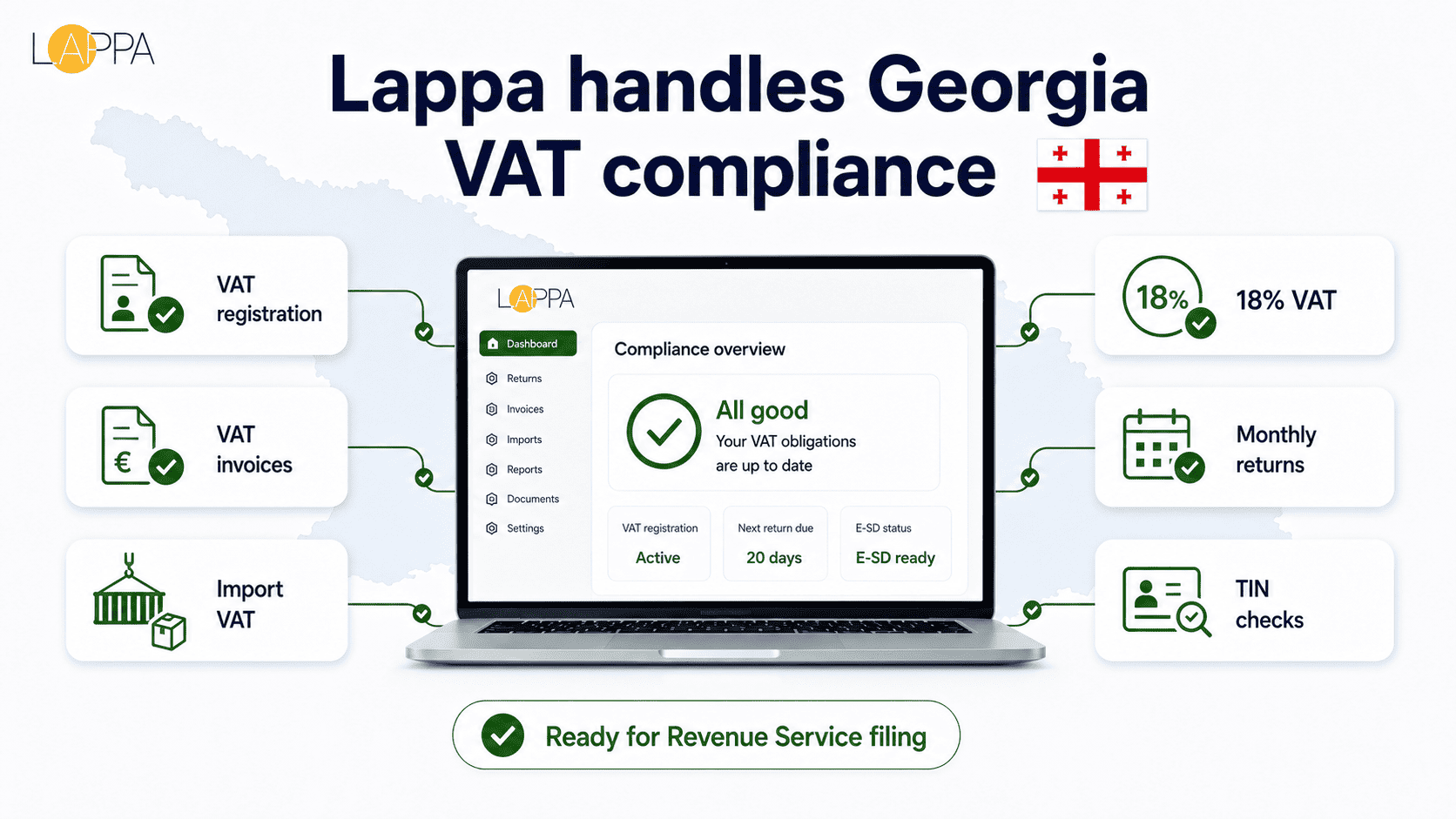 Running goods compliance here requires monthly declarations, Rseli invoice management, customs documentation matching, and counterparty verification. VAT Georgia compliance from Lappa covers setup and the ongoing cycle:
- Enrollment — handling the rs.ge application for local entities and foreign branches, including coordination with the National Agency of the Public Registry where branch enrollment precedes levy enrollment
- Rseli integration — connecting your billing platform to the e-invoicing API so every tax invoice receives its authorization code automatically at issuance
- Monthly declaration filing — reconciling Rseli records, customs import data, and purchase ledgers before submission to eliminate discrepancies the authority would otherwise catch post-filing
- Export zero-rate documentation — building and maintaining the customs exit evidence archive required to substantiate 0% treatment on outbound shipments
- Refund claim management — filing and tracking refund recovery for exporters accumulating input credits against zero-rated export outputs
FAQ for Georgia VAT Goods
What is the Georgia Country VAT Rate
The standard Georgia country VAT rate is 18%, applied uniformly to all taxable goods — electronics, vehicles, construction materials, clothing, industrial equipment, and most imports. There are no reduced tiers. Exports carry 0%, which lets exporters recover the full 18% input levy on purchases feeding those exports. Exempt supplies — financial services, medical care, education — generate no levy liability but also block input credit recovery on related costs. The Georgian tax rate on goods has held at 18% for several years.Who Needs VAT Registration in Georgia
Any operator whose taxable turnover in any consecutive 12-month period exceeds 100,000 GEL — approximately USD 37,000 — must enroll before or at the point that threshold is crossed. Foreign companies operating through a local branch face the same threshold. Voluntary enrollment is available at any turnover level and is worthwhile for any importer, since it unlocks recovery of the 18% customs levy on every inbound shipment rather than absorbing it as a cost.What is the VAT Number Format in Georgia
The VAT number Georgia assigns is a nine-digit taxpayer identification number (TIN). For companies incorporated locally, the TIN is the nine-digit code assigned at entity enrollment. For foreign branches, a separate nine-digit code is issued by the Revenue Service. There is no EU-style country prefix — invoices show the TIN directly. Verification of any TIN's active levy enrollment status is free through the public portal at rs.ge.What is VAT ID Georgia
VAT ID Georgia refers to the taxpayer identification number — the same nine-digit TIN used across levy, income tax, customs, and all Revenue Service interactions. There is no separate levy-specific identifier. VAT ID Georgia must appear on every Rseli-authorized invoice for input credit recovery to be valid on the buyer's side. A Georgian tax identification number without active levy enrollment status does not support input credit claims — verify counterparty enrollment at rs.ge before processing their invoices.How Often Are VAT Returns Filed in Georgia
Both declaration and payment are due by the 15th of the following month. There are no quarterly or annual filing alternatives — the monthly cycle applies to all enrolled operators regardless of size. Rseli invoice records update in real time as invoices are authorized, and the authority independently holds those records before the monthly declaration is filed. The declaration must reconcile with the Rseli database or the discrepancy generates an automated query.
VAT Standard rate
18%
VAT Reduced rate
-
Thresholds
GEL 100,000 annual turnover