


Colombia VAT Explained for Businesses and Online Sellers
Provinces
Goods
Provinces
Goods
About
Goods
About
Goods
Goods
Goods
Introduction to VAT in Colombia
Colombia's indirect tax system bites hard when you're not expecting it. VAT in Colombia — called IVA, short for Impuesto sobre las Ventas — touches almost every commercial transaction on Colombian soil. DIAN, the national tax and customs authority, runs the show. Sellers, importers, service providers, and now foreign digital platforms all fall within its reach. The tax has been around for decades, but Law 1819 of 2016 set the current 19% standard rate that's been in place since 2017. A bigger shift came with Law 2010/2019: as of January 1, 2020, foreign streaming services, SaaS vendors, and similar digital operators must collect IVA on sales to Colombian users. The VAT within Colombia's legal framework now extends far beyond the corner shop. How it works mechanically: registered businesses charge output IVA on sales, then subtract the input IVA they already paid on purchases. The net goes to DIAN. VAT in Colombia follows a credit-invoice model, so every valid factura electrónica in your system is both a sales document and a piece of your deduction claim for the period.VAT Rates in Colombia
Standard and Reduced Colombia VAT Rate by Category
Nineteen percent. That's the Colombia VAT rate that applies to the widest band of goods and services — manufactured items, most professional services, imports, restaurants. If something isn't specifically listed as reduced, zero-rated, or exempt in the Tax Statute, it's taxed at 19%. Below that sits the 5% tier, which the government carved out for socially or economically strategic goods. Solar panels and wind turbines are in here. So are pre-paid healthcare plans, agricultural machinery used directly in crop production, and housing construction under certain social programmes. The Colombia VAT rate at 5% rewards categories the government wants to encourage. Colombia's VAT rate structure also has a zero tier. Exports sit here, as do basic food staples (the canasta familiar), prescription medicines, books, and school notebooks. Zero-rated suppliers can reclaim their own input IVA — that's the key difference from exempt supplies, where the supplier absorbs the unrecoverable input cost. Exempt goods and services — mainly financial products and certain educational services — carry no output IVA at all. Suppliers of exempt outputs can't deduct input tax on the related costs, which means the IVA paid upstream becomes a permanent expense.| Rate | Category | Typical Examples |
| 19% | Standard | Electronics, clothing, consulting, restaurant meals, most imports |
| 5% | Reduced | Pre-paid health plans, agricultural equipment, solar panels, wind turbines |
| 0% | Zero-rated | Exports, prescription medicines, basic food basket items, books |
| Exempt | No IVA credit | Financial services, certain cultural and educational services |
VAT Registration Threshold in Colombia
For Local Businesses
Colombia lets small merchants off the hook — but only if they hit every single one of six conditions at once. Miss even one and registration as a responsable del IVA becomes mandatory. Here's the full list:- Gross income in the prior year stayed below 3,500 UVT. At the 2024 UVT value of COP 47,065, that ceiling sits at roughly COP 164.7 million — around USD 40,000.
- The business runs from a single commercial location. One shop, one office, one point of delivery.
- Payroll carries no more than one employee.
- No public-sector contracts have been signed during the year.
- No imports or exports have taken place.
- The business is not a legal entity — no SAS, limitada, or any incorporated form.
For Remote Sellers
Foreign companies sending physical goods into Colombia encounter IVA at the border. Customs assesses it on the declared customs value plus applicable duty, and the Colombian importer of record pays it. A foreign seller without a branch or permanent establishment (PE) in Colombia doesn't typically register separately for output VAT on those imports. But the moment a foreign entity sets up a local branch, representative office, or any kind of fixed Colombian presence generating taxable supplies, registration obligations kick in for everything flowing through that presence.VAT Tax Colombia Rules for Remote Digital Services
VAT Tax Colombia legislation pulled foreign digital platforms into the system on January 1, 2020, via Law 2010/2019. Streaming subscriptions, cloud software licences, online marketplace fees, gaming credits — any digital service consumed by a Colombian user is taxable at 19%, regardless of where the provider is headquartered. DIAN created a simplified registration path specifically for these offshore operators. The foreign platform registers through DIAN's international portal, collects IVA from Colombian subscribers at checkout, and remits monthly. No local entity required — at least under the simplified route. Colombia's VAT tax on digital services has no revenue floor. The obligation starts with the very first transaction involving a Colombian user. That said, VAT Tax Colombia rules give DIAN authority to demand a local representative from any platform that repeatedly misses remittance deadlines.Who Must Register for VAT Colombia
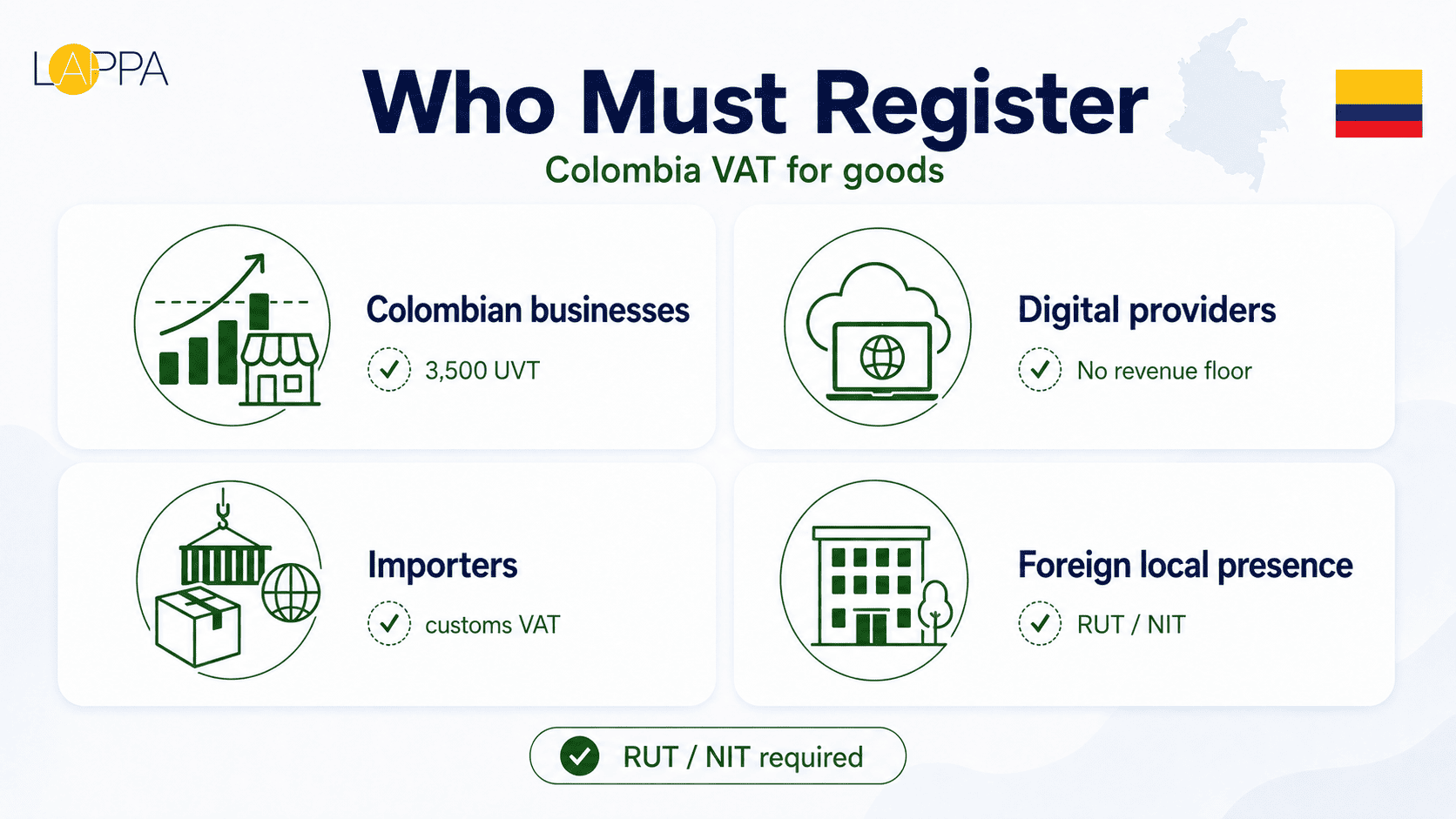 Every entity in the list below must register and remit VAT Colombia:
- Colombian businesses that exceed the 3,500 UVT income ceiling or fail any other non-responsible condition
- All companies incorporated under Colombian law — SAS, limitada, SA — regardless of annual revenue
- Freelancers and individual contractors whose services fall within a taxable category under the Tax Statute
- Importers bringing physical goods into Colombian territory under the standard customs regime
- Foreign digital service providers supplying Colombian users, through either the simplified or general DIAN registration route
- Foreign entities that have set up a Colombian branch, representative office, or any fixed place generating taxable local supplies
VAT Number in Colombia
Registration with DIAN produces a NIT — Número de Identificación Tributaria — which is the identifier you'll put on every invoice, return, and customs document for as long as the business exists. Obtaining a VAT number Colombia businesses and foreign operators need means enrolling in the RUT (Registro Único Tributario), DIAN's central taxpayer registry. The NIT covers all Colombian tax obligations — income tax, withholding, IVA — not IVA alone. Colombia's VAT number is a permanent assignment. DIAN doesn't reissue or reassign it. The NIT tracks every return filed, every payment made, and every audit interaction across the entity's entire commercial life inside the MUISCA electronic platform. Practical point: the VAT number Colombia authorities stamp onto the RUT must appear on invoices issued to and by the registered entity. A buyer can't claim input IVA deductions from an invoice that's missing or showing an incorrect NIT. Counterparties check these things — it slows down payments when something's off.Colombia VAT ID Format and Structure
The VAT ID Colombia issues to registered entities is nine base digits followed by a hyphen and a single verification digit — written as NNN.NNN.NNN-D. A real example: 900.123.456-7. That final digit is a weighted-sum checksum over the nine base digits. DIAN's systems reject any identifier that doesn't pass the calculation, so entering even one wrong digit causes an immediate error. Colombia's VAT ID shows up on facturas electrónicas, customs declarations, withholding certificates, and every piece of official DIAN correspondence. Both parties to a B2B sale exchange their NITs before any invoice is generated. Without a confirmed, valid NIT on the purchase invoice, the buyer's input IVA deduction claim won't hold up on audit. A full VAT ID Colombia can also be issued to foreign companies registering under the general (non-simplified) regime — same nine-digit format as domestic entities. Foreign digital providers using the simplified mechanism get a shorter DIAN reference code linked to their home-country details, though they can also request a full NIT.| Element | Detail |
| Identifier name | NIT — Número de Identificación Tributaria |
| Format | 9 digits + verification digit (NNN.NNN.NNN-D) |
| Registry | RUT — Registro Único Tributario |
| Administering body | DIAN (Dirección de Impuestos y Aduanas Nacionales) |
| Example | 900.123.456-7 |
| Required on | All invoices, VAT returns, customs declarations, withholding certificates |
VAT Registration Procedure in Colombia
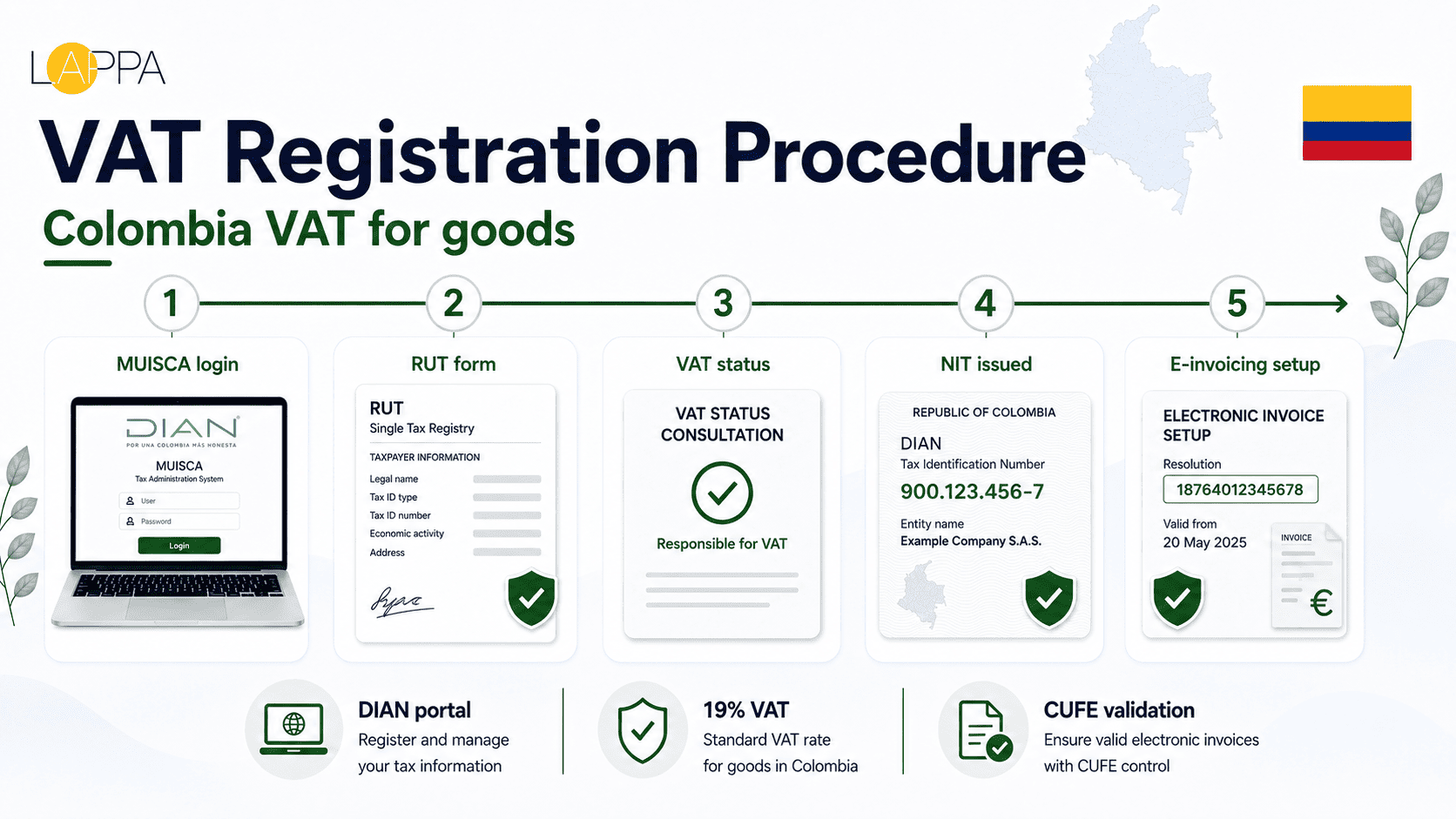 Registration — and the resulting NIT — comes through DIAN's MUISCA digital platform at www.dian.gov.co. Most cases complete entirely online. The sequence below covers local entities and foreign companies registering under the general regime:
- Log into MUISCA — create an account with a valid email address and the legal representative's identity credential.
- Fill out the RUT form — enter the business activity codes (CIIU), legal structure, registered address, and contact details.
- Declare IVA responsibility — select Responsable del IVA in the tax obligations section.
- Upload documents — national ID for individuals; chamber of commerce certificate and legal rep's ID for Colombian entities; apostilled incorporation documents for foreign companies.
- Receive the digital RUT — issued immediately in most online cases; DIAN branches handle situations requiring in-person verification.
- Set up electronic invoicing — contract an authorized e-invoice provider (proveedor tecnológico habilitado) before issuing the first factura electrónica.
Tax Representative in Colombia
A foreign company that has VAT obligations in Colombia but no permanent establishment here — no branch, no local office, no fixed operating base — and that registers under the general regime must appoint a local tax agent (apoderado tributario). This can be a Colombian resident individual or a Colombian-incorporated company with an active RUT. Not optional. The representative stands in for the foreign entity on all IVA matters: filing returns on time, remitting the tax balance, responding to DIAN queries, and correcting returns when discrepancies surface. Joint liability is real — if the foreign entity doesn't pay, DIAN can go after the representative. That's why selecting someone with genuine DIAN procedural experience matters far more than choosing the cheapest option on the market. Under the simplified digital services mechanism the representative requirement drops away — DIAN accepts direct registration by the foreign platform. But if a platform consistently misses monthly remittances or ignores official DIAN correspondence, the authority can impose a mandatory local agent regardless of which registration route was used.| Scenario | Tax Representative Required |
| Foreign company, general VAT regime, no Colombian PE | Yes — mandatory under the Tax Statute |
| Foreign digital provider using DIAN's simplified route | No — optional; DIAN may require for persistent non-compliance |
| Foreign entity with a Colombian branch or representative office | No — branch files and remits directly with DIAN |
| Importer of record is a Colombian entity | No — Colombian importer handles the levy at customs |
VAT E-Invoices in Colombia
Colombia's electronic invoicing mandate is one of the furthest-reaching in Latin America. Every VAT-registered entity must issue facturas electrónicas — structured XML documents transmitted to DIAN in real time. Each document carries a CUFE (Código Único de Factura Electrónica), a digital stamp DIAN's systems generate on receipt and validation. Paper invoices from covered entities have no legal standing for IVA deduction purposes. DIAN rolled out the mandate in stages based on taxpayer size, giving businesses time to integrate with an authorized e-invoice provider before obligations kicked in:| Business Category | Mandatory Start Date | Notes |
| Large taxpayers (grandes contribuyentes) | January 2019 | First wave; full real-time transmission to DIAN from day one |
| Medium businesses (mid-range NIT brackets) | 2020 | Phased by NIT bracket across the calendar year |
| Small businesses and self-employed professionals | 2021 — 2022 | DIAN set individual activation dates; gradual rollout |
| Foreign digital providers (simplified regime) | On registration | Invoice obligation begins with the first Colombian transaction |
VAT Returns in Colombia
All returns go through DIAN's MUISCA platform. How often you file depends on your taxpayer category — and this matters because the due dates stack up quickly if you're on the bimonthly cycle. Bimonthly (bimestral) — large taxpayers: Six returns a year, covering Jan–Feb, Mar–Apr, May–Jun, Jul–Aug, Sep–Oct, and Nov–Dec. The exact cut-off date within the month following each period is staggered by the last two digits of the NIT — the schedule runs from the 9th to the 28th of the month. Quadrimestral (cuatrimestral) — everyone else: Three returns a year: Jan–Apr, May–Aug, Sep–Dec. Deadlines fall within roughly 30 days after each period closes, again staggered by NIT. Monthly — foreign digital providers (simplified): One return per calendar month, due by the last business day of the following month. No annual IVA return exists in Colombia. Each period's declared balance is final on submission| Taxpayer Type | Frequency | Returns Per Year |
| Large taxpayers (grandes contribuyentes) | Bimonthly | 6 |
| Standard registered entities | Quadrimestral | 3 |
| Foreign digital providers (simplified) | Monthly | 12 |
Deductible VAT in Colombia
Registered entities cut their output IVA liability by subtracting input tax — impuesto descontable — paid on qualifying purchases. Three things have to be true for a deduction to stick:- The purchase must be backed by a valid factura electrónica showing correct NITs for both parties and the IVA amount at the applicable rate
- The goods or services acquired must be used directly in taxable activities — not in exempt operations, personal consumption, or activities unrelated to IVA-generating revenue
- The deduction must be claimed in the same period as the purchase, or within the two immediately following periods; after that, the credit lapses permanently
VAT Record-Keeping Requirements in Colombia
Five years. That's the minimum retention window for documents supporting any filed period — facturas electrónicas, customs declarations, accounting ledgers, bank remittance confirmations, DIAN correspondence. Transfer pricing cases get ten years. These aren't suggestions; DIAN's audit teams can and do reach back across the full window. Because Colombia's e-invoice system stores CUFE records directly in DIAN's own database, auditors start any review by pulling that mirror and checking it against what the taxpayer declared. Businesses that keep only PDF copies of invoices — without a structured accounting extract — end up in much longer audit resolution processes than those with properly indexed electronic archives. Accounting software should be able to export data in formats DIAN's tools can ingest — typically structured CSV or XML extracts mapped against DIAN's published schema. Getting this in place at registration, rather than retrofitting it under audit pressure, saves significant management time down the line.VAT Penalties in Colombia
DIAN's penalty framework under the Tax Statute (Estatuto Tributario) is straightforward but can escalate fast. These are the main sanctions: Late filing (Art. 641): 5% of the unpaid tax per month or fraction of delay, capped at 100% of the outstanding balance. No tax owed but the return is still late? A minimum penalty based on the year's UVT value applies anyway Late payment: Monthly interest at whatever rate the Superintendencia Financiera de Colombia sets for the period — typically between 1.5% and 2% per month — running from the legal due date to actual payment. Failure to register: Up to COP 20 million per infraction, plus potential suspension of commercial activity and seizure of goods held without valid tax documentation. Omitted or fraudulent return: When DIAN determines a return was skipped or deliberately falsified, the surcharge jumps to 10% of gross income for the relevant period — no ceiling. Systematic evasion can result in criminal referral.| Infraction | Penalty Under Tax Statute |
| Late filing | 5% per month of unpaid tax, max 100%; UVT-based minimum if no tax owed |
| Late payment | ~1.5–2% monthly interest from due date to payment date |
| Failure to register | Up to COP 20 million; possible goods seizure and activity suspension |
| Omitted / fraudulent return | 10% of gross period income, no cap; potential criminal referral |
How Lappa Can Help with VAT Compliance in Colombia
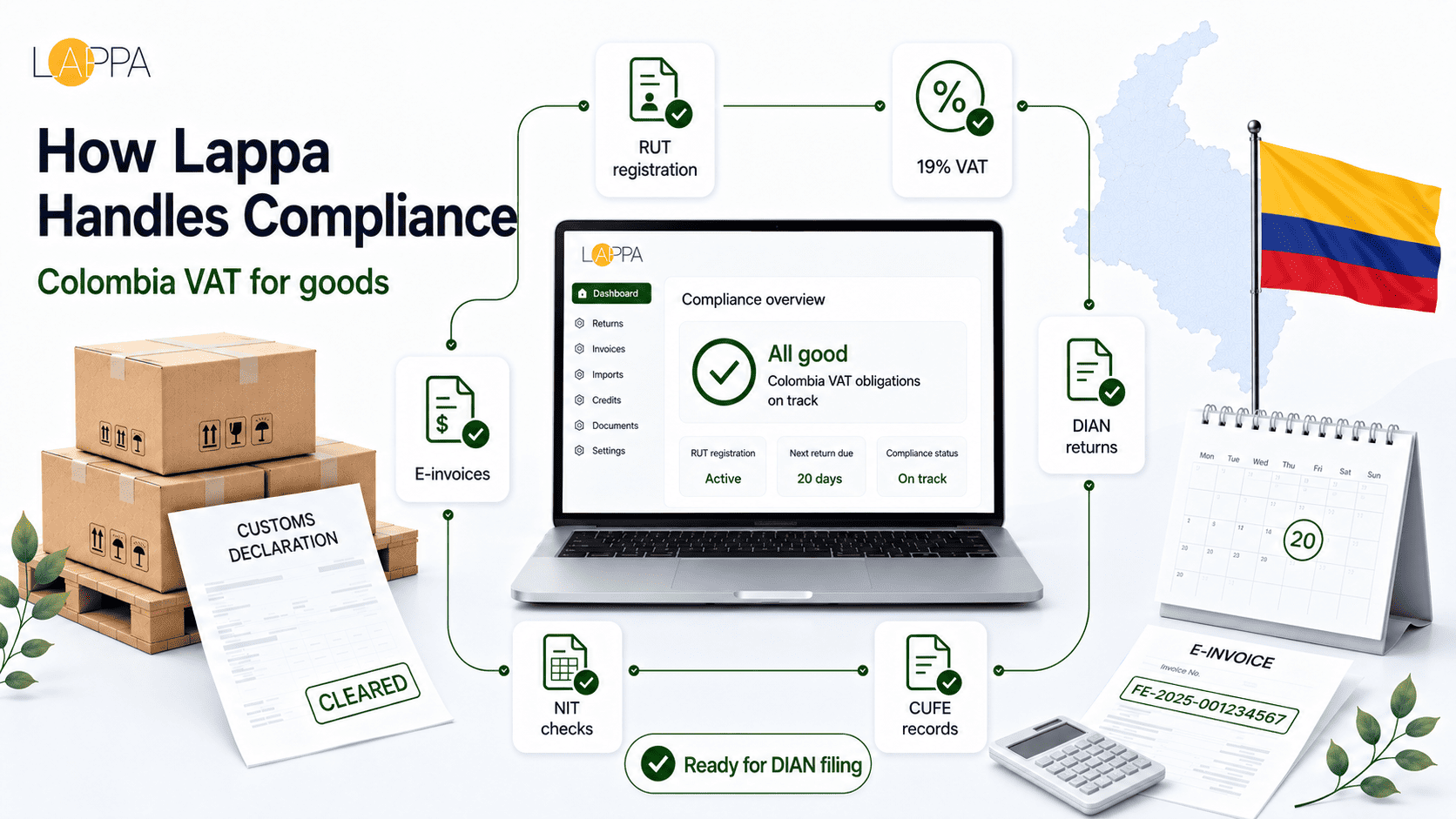 Lappa covers the full IVA lifecycle in Colombia — from the first RUT registration and NIT issuance through to ongoing period filings and DIAN audit support. The practical scope includes: determining whether your specific business model and transaction volumes trigger registration in the first place, selecting and configuring an authorized e-invoice provider, computing the net IVA position for each bimonthly or quadrimestral period, and navigating deductible IVA positions under the pro-rata rules.
For foreign digital platforms, Lappa manages the DIAN simplified registration process, handles monthly remittances, tracks regulatory updates and rate changes, and deals with DIAN queries directly. Getting the registration foundations right before the first invoice goes out costs a fraction of what it takes to sort out accumulated back-taxes, interest, and late-filing penalties after the fact.
Lappa covers the full IVA lifecycle in Colombia — from the first RUT registration and NIT issuance through to ongoing period filings and DIAN audit support. The practical scope includes: determining whether your specific business model and transaction volumes trigger registration in the first place, selecting and configuring an authorized e-invoice provider, computing the net IVA position for each bimonthly or quadrimestral period, and navigating deductible IVA positions under the pro-rata rules.
For foreign digital platforms, Lappa manages the DIAN simplified registration process, handles monthly remittances, tracks regulatory updates and rate changes, and deals with DIAN queries directly. Getting the registration foundations right before the first invoice goes out costs a fraction of what it takes to sort out accumulated back-taxes, interest, and late-filing penalties after the fact.
FAQ for Colombia VAT Goods
What Is the VAT Rate in Colombia
- The standard rate is 19%, covering most goods, services, and imports. A 5% reduced rate applies to specific items — pre-paid healthcare plans, agricultural machinery, and solar panels among others. Basic food staples, prescription medicines, books, and exports are taxed at 0%. Certain services, primarily financial, are exempt — meaning no output IVA is charged, but the supplier also can't recover any input IVA on related costs.
Who Needs to Register for VAT in Colombia
- Any Colombian merchant whose gross income exceeded 3,500 UVT in the prior year, or who fails any of the five other non-responsible conditions, must register. Every legal entity — SAS, limitada, SA — registers regardless of revenue. Foreign digital providers register separately through DIAN's simplified or general mechanism from the moment they first supply a Colombian user.
What Is the VAT Number Format in Colombia
- The NIT consists of nine base digits plus a single verification digit, written NNN.NNN.NNN-D. Example: 900.123.456-7. DIAN issues the NIT via the RUT registration process. It appears on all invoices, returns, customs documents, and official correspondence. The verification digit is a weighted-sum checksum — entering a wrong number causes an immediate system rejection.
How Often Are VAT Returns Filed in Colombia
- Large taxpayers (grandes contribuyentes) file bimonthly — six times a year. All other registered entities file quadrimestrally — three times a year. Foreign digital providers on the simplified regime file monthly — twelve times a year. Colombia has no annual IVA return; each period's declared position is final on submission.
Do Foreign Companies Need a Tax Representative in Colombia
- Foreign companies registering under the general IVA regime without a permanent establishment in Colombia must appoint a local tax representative with joint liability for filing, remittance, and DIAN correspondence. Foreign digital platforms using DIAN's simplified registration are exempt from this requirement — but DIAN can impose a mandatory agent on any platform that persistently fails to remit collected IVA on time.
VAT Standard rate
19%
VAT Reduced rate
5%, 0%
Thresholds
No fixed VAT registration threshold. Businesses meeting DIAN registration requirements or carrying out taxable activities must register. Non-resident digital service providers must register or collect VAT from the first taxable supply.