


Argentina VAT Registration and Compliance Guide
In Argentina, VAT is called “Impuesto al Valor Agregado”, abbreviated IVA.";s:
Provinces
Goods
Provinces
Goods
About
Goods
About
Goods
Goods
Goods
Introduction to VAT in Argentina
Value-added tax, or IVA (Impuesto al Valor Agregado) as it is called in the country, is governed by Law No. 23,349 and administered by AFIP (Administración Federal de Ingresos Públicos). The system applies a 21% headline rate across most commercial transactions, with two lower tiers for essential goods and a flat-rate simplified regime for small businesses.Understanding VAT in Argentina starts with recognising that the rate is only one part of the picture. IVA operates as a standard value-added mechanism: businesses charge tax on sales (débito fiscal) and recover tax on purchases (crédito fiscal). The monthly net difference is either remitted to AFIP or carried forward as a credit. What distinguishes Argentina from comparable systems is the operational infrastructure built around this mechanism — mandatory real-time electronic invoicing, monthly cross-referenced transaction registers, and a withholding regime that creates recurring credit positions across most industries. Businesses entering Argentina typically find the rate itself straightforward. The compliance architecture around it — CAE authorisation codes, CITI registers, staggered filing deadlines, and the withholding agent network — is where the real complexity sits.Businesses that underestimate Argentina VAT obligations typically do so not on rates but on operational setup.. Getting that infrastructure right before trading starts is substantially cheaper than correcting it retrospectively.VAT Rates in Argentina
Argentina operates three positive IVA rates and a full exemption category. The standard rate of 21% applies to the majority of goods, services, software licences, professional fees, and imports. Two reduced rates cover specific essential categories.| Rate | Percentage | What It Covers |
| Standard | 21% | General goods, services, software, professional fees, imports |
| Reduced | 10.5% | Basic food, medicines, books, housing construction, transport under 100 km, medical equipment |
| Minimum differential | 2.5% | Certain financial operations, specific agricultural inputs (decree-listed) |
| Exempt | 0% | Basic food basket, education, healthcare, cultural services |
VAT Registration Threshold in Argentina
For Local Businesses
Local businesses are also subject to the annual revenue cap of the Monotributo, which determines whether simplified or full IVA registration is applicable. Thresholds are activity specific. Service providers have a lower ceiling than those selling goods. AFIP updates both thresholds regularly in line with inflation and publishes them through regulatory decree.Once you pass that ceiling, VAT registration in Argentina is compulsory within 30 days If revenue exceeds the relevant threshold, registration as a Responsable Inscripto (full IVA registrant) is required within 30 days. . Missing that window exposes the business to backdated IVA assessment on all sales since the breach date, without the input tax offset that would have applied under timely registration. This is among the most commonly triggered compliance failures for growing Argentine businesses. Businesses below the threshold may register voluntarily as Responsable Inscripto where commercial relationships require it — typically because corporate buyers need Comprobante A invoices carrying recoverable IVA.For Remote Sellers
Foreign businesses selling physical goods into Argentina face IVA through the import mechanism. IVA is assessed at customs on the declared value of imported goods at the applicable rate (generally 21%), and paid at the point of entry. Remote sellers without a local legal presence do not register directly with AFIP for this purpose under standard import arrangements. Where a foreign business has established a permanent presence or Argentine subsidiary, full registration as Responsable Inscripto is effective from the beginning of taxable activities.For Remote Digital Services
The 2018 digital economy amendment included foreign provided digital services in the Argentine IVA net.This enlarged the scope of Argentina VAT tax obligations requirements to include streaming platforms, SaaS goods and online advertising services used locally . Streaming platforms, SaaS products, online advertising, and comparable digital services consumed in Argentina are subject to IVA regardless of where the supplier is based. For most non-resident digital service providers, IVA is withheld at source by Argentine banks and payment processors during transaction processing. The non-resident supplier does not register directly with AFIP in most cases under this mechanism. The actual structure though, depends on the service type and commercial arrangement – some configurations still require direct AFIP registration.The payment processors typically deduct the Argentina VAT and the supplier’s IVA responsibility in most standard configurations.Who Must Register for VAT in Argentina
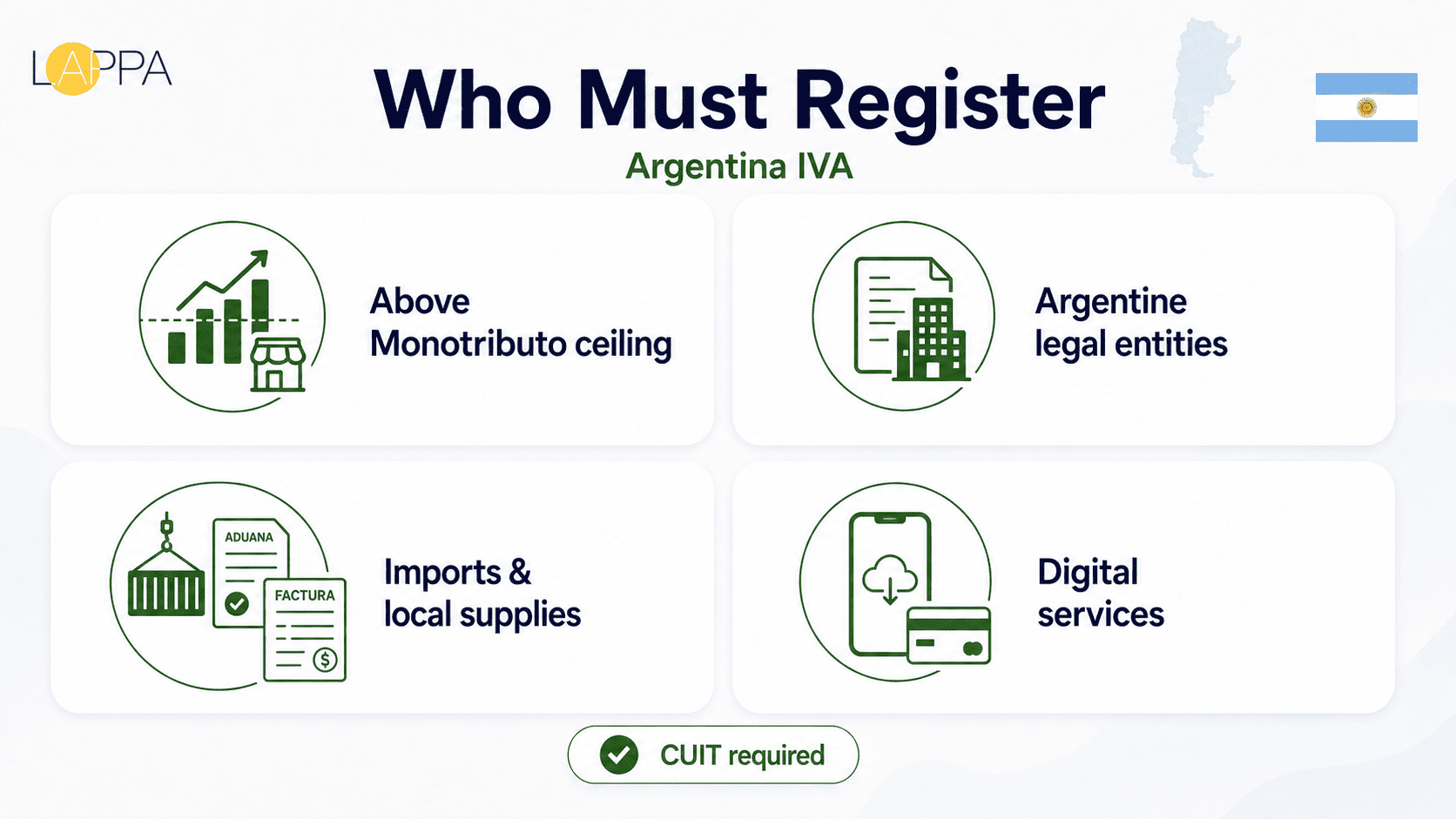 IVA registration requirements follow the structure of Argentina's taxpayer categories:
- The prerequisites to do the IVA registration are the following (considering the structure of the taxpayer categories in Argentina):
- All businesses whose yearly earnings above the Monotributo ceiling (which depends on whether the firm is service-oriented or sells products) must register as Responsable Inscripto.
- Responsible Inscripto registration for foreign corporations that create an Argentine legal entity (SA, SRL or branch) from the moment operations begin.
- The Argentine IVA net is extended to foreign firms who are not legally present in Argentina but provide digital services that are used locally through the payment processor withholding mechanism.
VAT Number in Argentina
Argentina does not issue a separate VAT identification number. All tax identification — IVA, income tax, customs, corporate filings, and banking — runs through a single identifier: the CUIT (Clave Única de Identificación Tributaria). This is the VAT number Argentina assigns to every taxpayer, from sole traders to multinational subsidiaries. The CUIT appears on invoices, customs declarations, AFIP returns, contracts, and bank accounts. It is assigned once and never changes. The VAT number Argentina system uses this same identifier across every regulatory interaction — there is no separate IVA-specific code.The format is fixed: XX-XXXXXXXX-X — two prefix digits identifying the taxpayer type, eight sequential digits, and a single check digit calculated using a modulo-11 algorithm. Common prefix codes:| Prefix | Taxpayer Type |
| 20 | Male natural person |
| 23 / 24 | Married individuals under shared fiscal responsibility regimes |
| 27 | Female natural person |
| 30 | Companies: SAs, SRLs, and other corporate forms |
| 33 | Foreign company branches and other entities |
| 34 | Fideicomisos (trusts) |
VAT Registration Procedure in Argentina
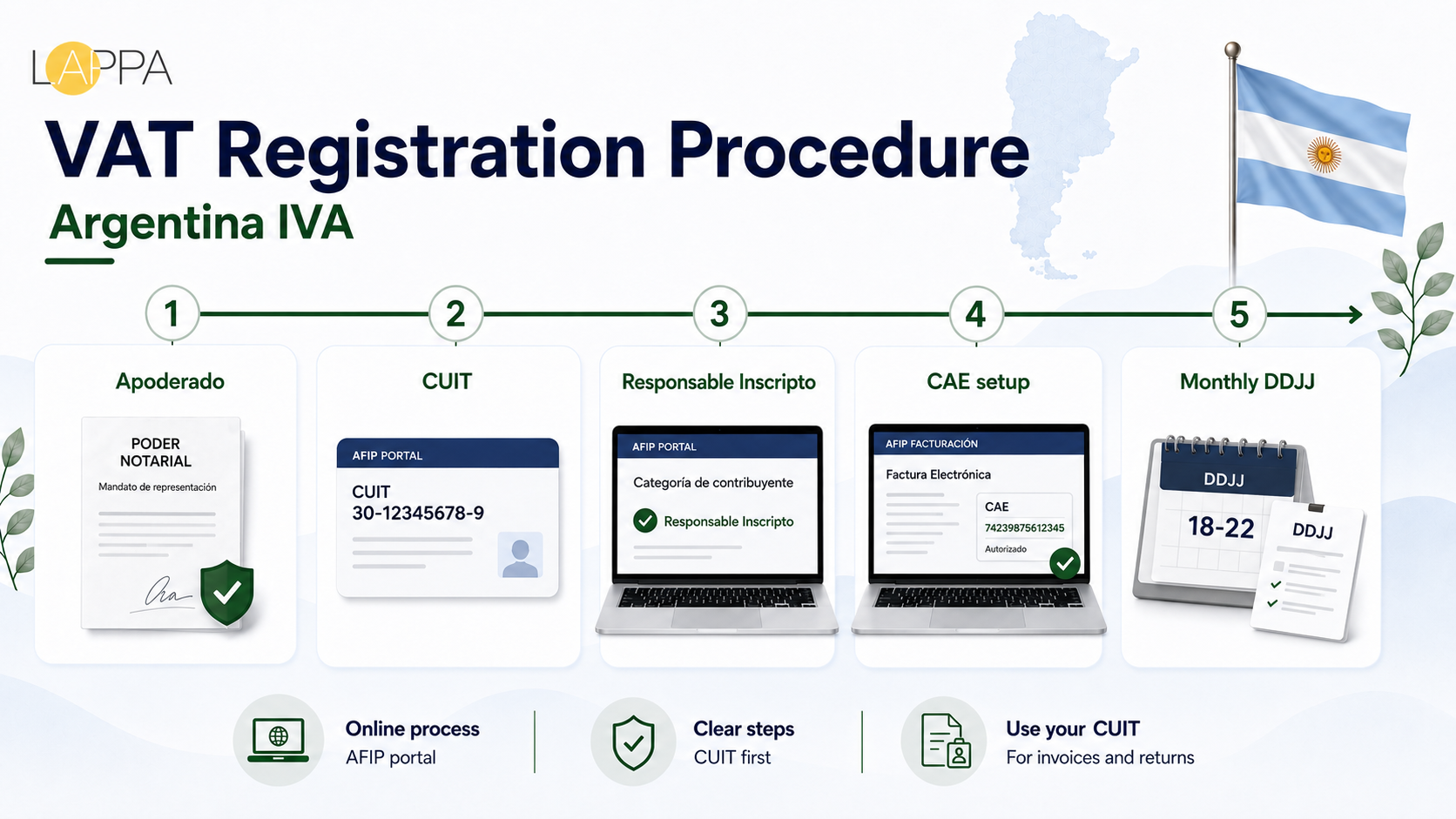 Registration of an entity incorporated in Argentina is through the AFIP’s Turnos web system or personally at the corresponding regional AFIP office. Standard documentation includes the certificate of incorporation, proof of registered address, and director identification. Processing typically takes a few working days under normal conditions.
The procedure involves two components: obtaining the CUIT and activating the relevant taxpayer category (Monotributista or Responsable Inscripto). These are separate steps in the AFIP portal.Both steps are required before Argentina VAT returns can be filed or invoices legally issued
For foreign entities, the registration process requires an apoderado to be appointed before AFIP will process any application. Full details are in the Tax Representative section below.
Upon activation as Responsable Inscripto, the business must also:
Registration of an entity incorporated in Argentina is through the AFIP’s Turnos web system or personally at the corresponding regional AFIP office. Standard documentation includes the certificate of incorporation, proof of registered address, and director identification. Processing typically takes a few working days under normal conditions.
The procedure involves two components: obtaining the CUIT and activating the relevant taxpayer category (Monotributista or Responsable Inscripto). These are separate steps in the AFIP portal.Both steps are required before Argentina VAT returns can be filed or invoices legally issued
For foreign entities, the registration process requires an apoderado to be appointed before AFIP will process any application. Full details are in the Tax Representative section below.
Upon activation as Responsable Inscripto, the business must also:
- Configure certified billing software or AFIP's portal for electronic invoice issuance with CAE authorisation.
- Establish processes for monthly DDJJ filing and CITI register compilation where applicable.
- Create mechanisms to record and reconcile withholding and perception credits earned by specified agents in the supply chain.
Tax Representative in Argentina
Foreign entities without Argentine legal presence must appoint an apoderado before AFIP will process any registration application. The apoderado is an Argentine resident authorised to manage AFIP interactions on the foreign company's behalf — filing returns, receiving official correspondence, and acting in formal AFIP proceedings. The appointment is executed via notarised power of attorney. Without it in place, no CUIT is issued, no IVA registration proceeds, and no legally valid invoicing in Argentina is possible.Without it, no VAT in Argentina registration can proceed and no legally valid invoicing is possible Unlike some jurisdictions where the local representative bears joint financial liability for the foreign entity's tax obligations, the apoderado relationship in Argentina is primarily administrative in nature. However, AFIP correspondence is addressed to the apoderado, and time-sensitive compliance actions fall to them. For international businesses, the apoderado requirement is often the step that takes longest to arrange — notarisation and apostille of foreign documents adds time that should be factored into market entry planning.VAT E-Invoices in Argentina
Electronic invoicing with real-time CAE (Codigo de Autorizacion Electronico) authorisation has been mandatory for Responsable Inscripto businesses since AFIP's phased rollout beginning in 2003. By 2026, all Responsable Inscripto entities must issue digital invoices. There is no paper alternative for covered taxpayers.This is a core component of Argentina VAT tax compliance infrastructure that distinguishes Argentina from most comparable systems. The CAE is a numeric authorisation code issued by AFIP when an invoice is submitted for validation through the web services API. The submission goes in, AFIP validates the data, and returns a code within seconds under normal conditions. That code is printed or encoded on the invoice. Without it, the document has no legal status for IVA purposes — the buyer cannot recover input tax, and the issuer faces per-document fines. Three comprobante types cover different supply relationships:| Type | Used When | IVA Treatment |
| Comprobante A | Between two Responsable Inscripto businesses | IVA shown separately; buyer recovers credito fiscal |
| Comprobante B | To consumers, Monotributistas, exempt entities | IVA embedded in total; not itemised |
| Comprobante C | Issued by Monotributistas and exempt sellers | No IVA content |
Timeline by Business Size
Large taxpayers (defined by AFIP revenue and sector criteria) were brought into mandatory electronic invoicing in the earliest phases, from 2003 onwards. Medium-sized businesses followed through successive AFIP resolutions between 2010 and 2016. Small businesses and Monotributistas were incorporated in later phases. From 2026, universal coverage applies — all Responsable Inscripto entities regardless of size. High-volume businesses require certified billing software integrated with AFIP's web services API. AFIP's own online portal is available for lower-volume operations but does not scale for hundreds of invoices per day.VAT Returns in Argentina
IVA returns are filed monthly. There is no quarterly option and no simplified annual filing for Responsable Inscripto businesses. Each DDJJ (declaracion jurada) covers a single calendar month. Filing deadlines fall between the 18th and 22nd of the month following the reporting period, with the exact date set by the last digit of the taxpayer's CUIT:| CUIT Last Digit | Filing Due Date |
| 0 or 1 | 18th of the following month |
| 2 or 3 | 19th of the following month |
| 4 or 5 | 20th of the following month |
| 6 or 7 | 21st of the following month |
| 8 or 9 | 22nd of the following month |
Transaction Registers: CITI Compras and CITI Ventas
Large taxpayers must file the CITI Compras (buy register) and CITI Ventas (sales register) along with the main DDJJ. These are transaction-level datasets covering every purchase and every sale within the period, with counterparty CUITs included. AFIP cross-matches the data between counterparties' filings. What a business declares as a purchase should correspond to what its supplier has declared as a sale. Systematic mismatches trigger automated AFIP queries before any human review takes place. Maintaining billing records in step with counterparty filings is an integral aspect of the system architecture, not an optional courtesy.Deductible VAT in Argentina
Credito fiscal recovery operates at the invoice level.Under the Argentina VAT framework, input tax recovery is available only where purchases feed directly into taxable sales A purchase invoice from a Responsable Inscripto supplier, issued as Comprobante A with a valid CAE, generates recoverable input IVA. Full recovery applies to expenditure directly attributable to taxable sales. Categories where recovery is restricted or blocked:- Passenger vehicles not used exclusively for commercial transport or resale.
- Entertainment and hospitality costs above AFIP-published de minimis thresholds.
- Costs exclusively attributable to exempt activities.
- Private portions of any mixed personal/business expenditure.
VAT Record-Keeping Requirements in Argentina
VAT Records in Argentina . Argentine tax law mandates A Responsable Inscripto should have sufficient records that support each monthly DDJJ filing and any eventual audit by the AFIP. Basic record-keeping duties include:- All sales invoices (Comprobantes A or B) with their CAE authorization codes, kept for at least 10 years.
- Record of all purchase invoices from suppliers (with CUIT, kind of comprobante and IVA amounts individually documented).
- Monthly working papers for credito fiscal, showing input IVA claimed and any blocked or proportionately limited amounts.
- Withholding and perception certifications issued by agents who have withheld IVA in source – these must agree with the credits claimed in the DDJJ.
- CITI Compras and CITI Ventas datasets for large taxpayers, aligned with the monthly DDJJ figures and counterparty filings.
VAT Penalties in Argentina
Argentina's IVA penalty framework distinguishes between procedural failures, substantive understatements, and criminal evasion. Formal procedural penalties — such as late filing where no tax was actually owed — are set at ARS 200 to ARS 400 per infraction. These figures have not kept pace with inflation and represent a minor financial exposure relative to the substantive risks. The primary financial risk is compound interest on late IVA payment. AFIP applies compound monthly interest from the original due date. As of early 2026, the rate runs at approximately 3% monthly. A payment six months late accumulates over 19% on top of the principal; twelve months adds more than 43%. The compounding mechanism is designed to capture the full economic cost of delayed payment regardless of prevailing inflation.Late payment is therefore one of the most expensive Argentina VAT ttax failures a business can allow to accumulate. Substantive penalties for understated IVA:- Omision (unintentional understatement): 50% of the unpaid tax amount.
- Defraudacion (intentional evasion): 200% to 400% of the unpaid amount.
- Criminal evasion above the Ley Penal Tributaria threshold: prosecution, with sentences up to nine years for aggravated cases.
How Lappa Can Help with VAT Compliance in Argentina
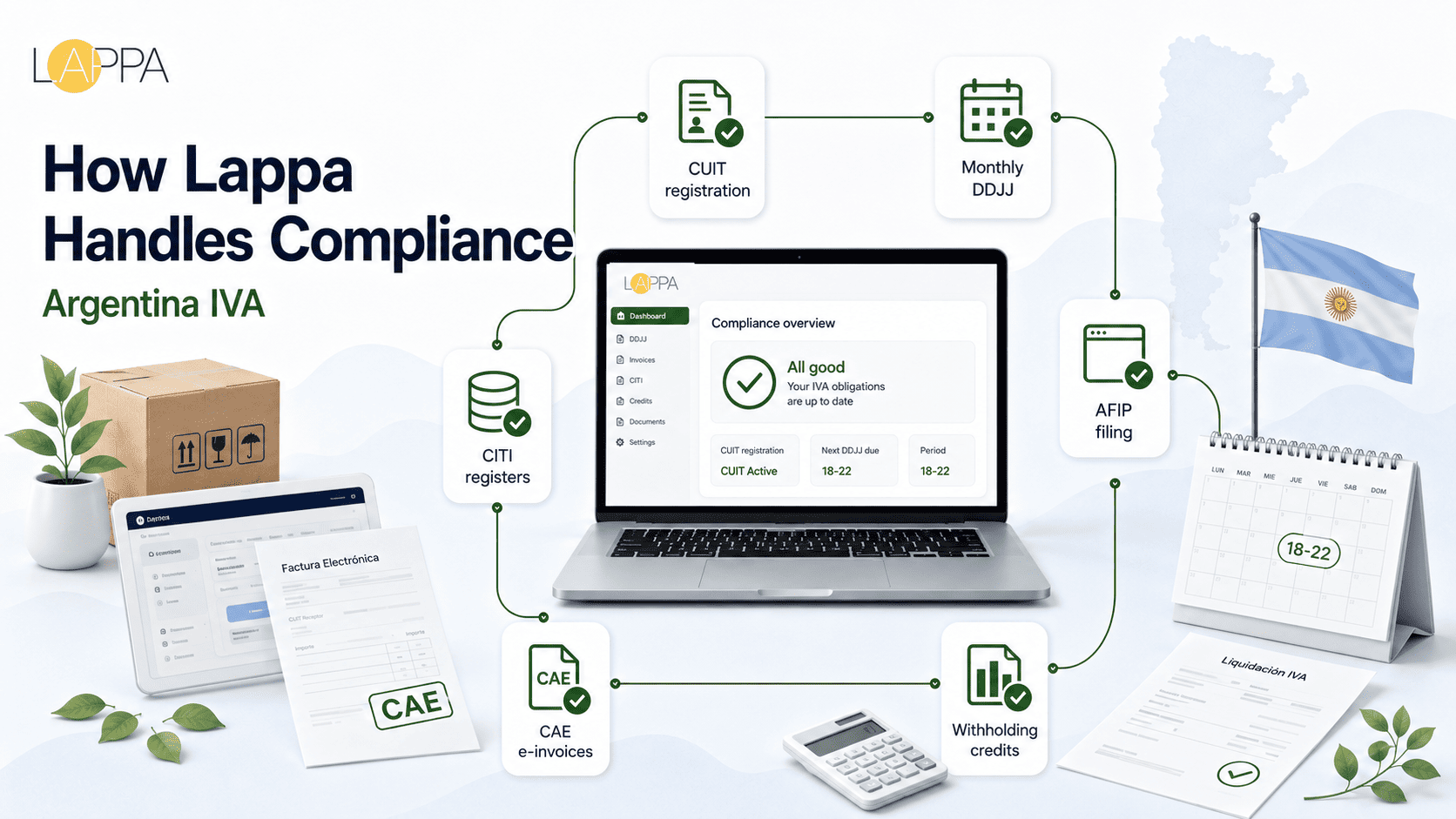 Lappa supports businesses operating in Argentina across the full IVA compliance cycle — from initial CUIT registration through to monthly return preparation, CITI register compilation, withholding credit reconciliation, and AFIP audit representation.Managing [vat in argentina] obligations end to end — from registration through monthly filings to audit defence — is what the Lappa team is structured to deliver.
For companies entering the Argentine market, services cover:
Lappa supports businesses operating in Argentina across the full IVA compliance cycle — from initial CUIT registration through to monthly return preparation, CITI register compilation, withholding credit reconciliation, and AFIP audit representation.Managing [vat in argentina] obligations end to end — from registration through monthly filings to audit defence — is what the Lappa team is structured to deliver.
For companies entering the Argentine market, services cover:
- CUIT registration and apoderado appointment for foreign entities.
- Responsable Inscripto registration and Monotributo-to-Responsable transition management.
- Preparation of monthly IVA return and submission on AFIP portal.
- Compilation of CITI Compras and CITI Ventas transactions registry for large taxpayers.• CAE Integration setup & Billing software setting.
- Credito fiscal recovery analysis and withholding/perception reconciliation.
- Voluntary disclosure quantification and AFIP submission management.
- Digital services IVA assessment for non-resident suppliers.
- Audit representation and formal AFIP proceedings.
FAQ
What is the VAT rate in Argentina?
The standard IVA rate is 21%, applying to most goods, services, software, professional fees, and imports. A reduced rate of 10.5% covers essential categories including basic food items, registered pharmaceutical products, books and periodicals, residential construction, and passenger transport under 100 kilometres. A narrow 2.5% rate applies to specific financial transactions and decree-listed agricultural inputs. The basic food basket, accredited educational services, and registered healthcare providers are fully exempt. The Argentina VAT rate 2026 figures are unchanged from prior years.Who needs to register for VAT in Argentina?
Any business whose annual revenue exceeds the Monotributo ceiling — which varies by activity type and is periodically updated for inflation — must register as Responsable Inscripto. Foreign companies establishing an Argentine legal presence register from commencement of activities. Non-resident suppliers of digital services consumed in Argentina are generally brought into the IVA net through the payment processor withholding mechanism rather than direct AFIP registration, though the specific structure depends on the service type and commercial arrangement.What is the VAT number format in Argentina?
Argentina does not issue a separate VAT number. All tax identification runs through the CUIT (Clave Unica de Identificacion Tributaria), which follows the format XX-XXXXXXXX-X: two prefix digits identifying taxpayer type, eight sequential digits, and a single check digit. Companies receive prefix 30; foreign entity branches receive 33. The CUIT is assigned once at registration and does not change. It is used across invoices, customs declarations, tax returns, and banking.How often are VAT returns filed in Argentina?
IVA returns are submitted every month. Each DDJJ corresponds to a calendar month and should be filed between the 18th and 22nd of the following month, depending on the final number of the taxpayer’s CUIT. Filing and payment on the same day. Large taxpayers must also submit the CITI Compras and CITI Ventas registers of transactions together with the main return. A quarterly filing option is not available for Responsable Inscripto enterprises.Do foreign companies need a tax representative in Argentina?
Yes. Foreign entities without Argentine legal presence must appoint an apoderado — an Argentine resident authorised to manage AFIP interactions, file returns, and receive official correspondence — before AFIP will process any registration application. The appointment requires a notarised power of attorney. Without an apoderado in place, no CUIT is issued, no IVA registration proceeds, and no legally valid invoicing in Argentina is possible. The apoderado relationship is primarily administrative; unlike some jurisdictions, the representative does not typically bear joint financial liability for the foreign entity's tax obligations.VAT Calculator for Argentina
VAT Standard rate
21%
VAT Reduced rate
10.5%, 3%, 0%, 27%
Thresholds
Non-residents: No registration threshold