


Greece VAT Compliance Services
Provinces
Goods
Provinces
Goods
About
Goods
About
Goods
Goods
Goods
Introduction to VAT in Greece
EU membership since 1981 means the country operates within the same harmonized framework as other member states — intra-community supply rules, the One-Stop Shop, EC Sales Lists, Intrastat. What distinguishes this particular market from most EU neighbours is the myDATA digital accounting platform. Since 2021, every registered entity must transmit income and expense data to the Independent Authority for Public Revenue (AADE — Ανεξάρτητη Αρχή Δημοσίων Εσόδων) in real time or near-real time. VAT in Greece compliance sits on top of that live data infrastructure, which means the authority effectively knows your numbers before you file. Trading companies entering this market need to account for both the levy cycle and the myDATA transmission requirement from day one. One feature that sometimes catches importers off guard: certain Aegean islands — including Lesbos, Chios, Samos, Ikaria, and a number of smaller islands — carry reduced levy rates compared to the mainland. The standard 24% applies on the mainland, but qualifying island transactions run at 17%. Operators with supply chains that touch island territories need to classify stock movements correctly from the outset. Greek VAT rules define which islands qualify and under what conditions the reduction applies — confirm with AADE guidance before applying reduced rates to any island shipment. This guide covers physical goods only.Greece VAT Rates
Four rate levels apply. The standard 24% sits at the higher end of EU member state rates, and the absence of a zero rate for domestic supplies (beyond exemptions) means most transactions carry a meaningful levy charge.| Rate | Category | Typical goods |
| 24% | Standard rate | Electronics, vehicles, clothing, construction materials, cosmetics, industrial equipment, most imports |
| 13% | Reduced rate | Fresh food, non-alcoholic beverages, energy supplies, certain pharmaceutical products, hotel accommodation goods component |
| 6% | Super-reduced rate | Books, newspapers, certain medicines, specific medical equipment, tickets to cultural events |
| 0% | Zero rate | Exports outside EU, intra-community supplies to registered EU buyers, international transport |
VAT Registration Threshold in Greece
For Local Businesses
Locally established entities conducting taxable economic activity are generally required to register for the levy from the start of operations. A small enterprise exemption scheme is available to businesses below €10,000 in annual taxable turnover — but it is optional, covers only certain activity types, and requires a formal election with AADE. Most commercially active trading companies register from day one because the exemption threshold is low enough that it is crossed quickly by anyone importing or distributing at scale, and unregistered status blocks input recovery on every customs clearance. Voluntary registration below the threshold is available and commonly used by importers. The 24% levy paid at customs on every inbound shipment is unrecoverable without active enrollment — for any importer handling meaningful volumes, the credit position recovered in the first quarter of registered activity typically outweighs months of administrative overhead.For Remote Sellers Selling Goods
The EU-wide €10,000 combined distance-selling threshold applies. A German retailer selling €6,000 of goods to Greek consumers and €5,000 to Italian consumers has crossed the combined threshold and must either register locally or use the One-Stop Shop mechanism through their home country's portal. Goods stored in local warehouses — including third-party fulfilment inventory — trigger a local enrollment obligation from the date stock first enters a domestic facility, regardless of sales volume.Who Must Register for VAT in Greece
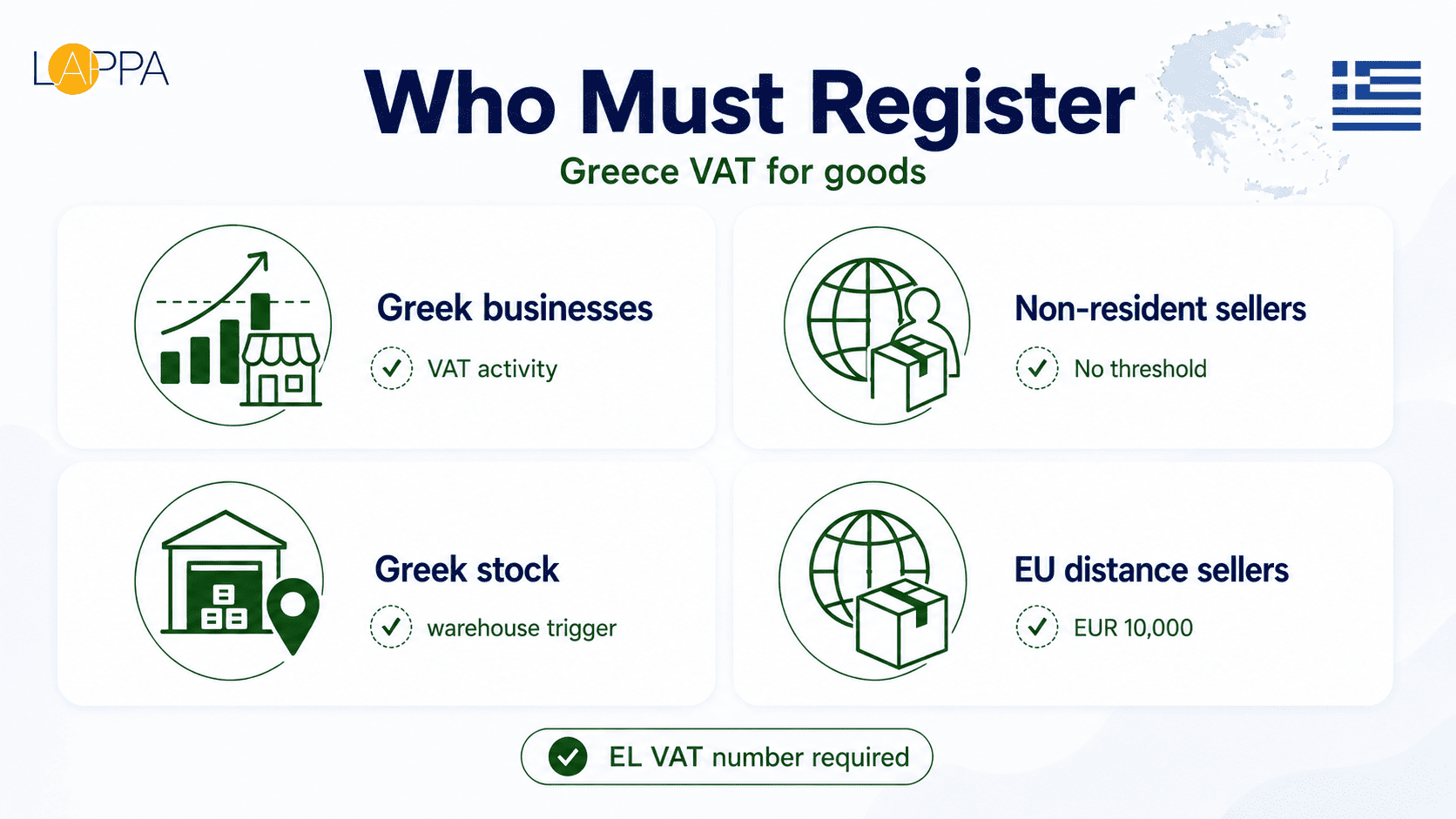 Enrollment is required for the following categories — the small enterprise exemption covers none of them:
- Locally established entities conducting any taxable activity, regardless of scale
- Foreign operators holding goods in local warehouses or running a fixed establishment here
- Any entity receiving intra-community goods acquisitions above €10,000 annually from EU suppliers
- Entities making occasional taxable supplies of new vehicles or new buildings within the country
VAT Number Greece — Format and Verification
Every registered entity receives a VAT number Greece issues in the format EL + 9 digits — for example, EL123456789. Note the "EL" prefix, not "GR." This is a common error on EU trade documentation. The ISO country code for the country is GR, but the levy identifier uses the Greek-language abbreviation ΕΛ (Ellas/Hellas), which transliterates to EL. Using GR on invoices or intra-community declarations is a classification error that invalidates the document. The VAT number Greece assigns is based on the ΑΦΜ (Αριθμός Φορολογικού Μητρώου) — the general taxpayer identification number assigned to every registered entity by AADE. The ΑΦΜ is a nine-digit number; the levy-specific identifier adds the EL prefix. Verification of any counterparty's number is available through EU VIES and through the public portal at aade.gr. Buyers check supplier numbers before processing invoices because an invalid EL-prefixed number blocks input levy recovery regardless of the commercial reality of the transaction. A Greek tax number without active levy registration does not support input credit claims.VAT Registration Procedure in Greece
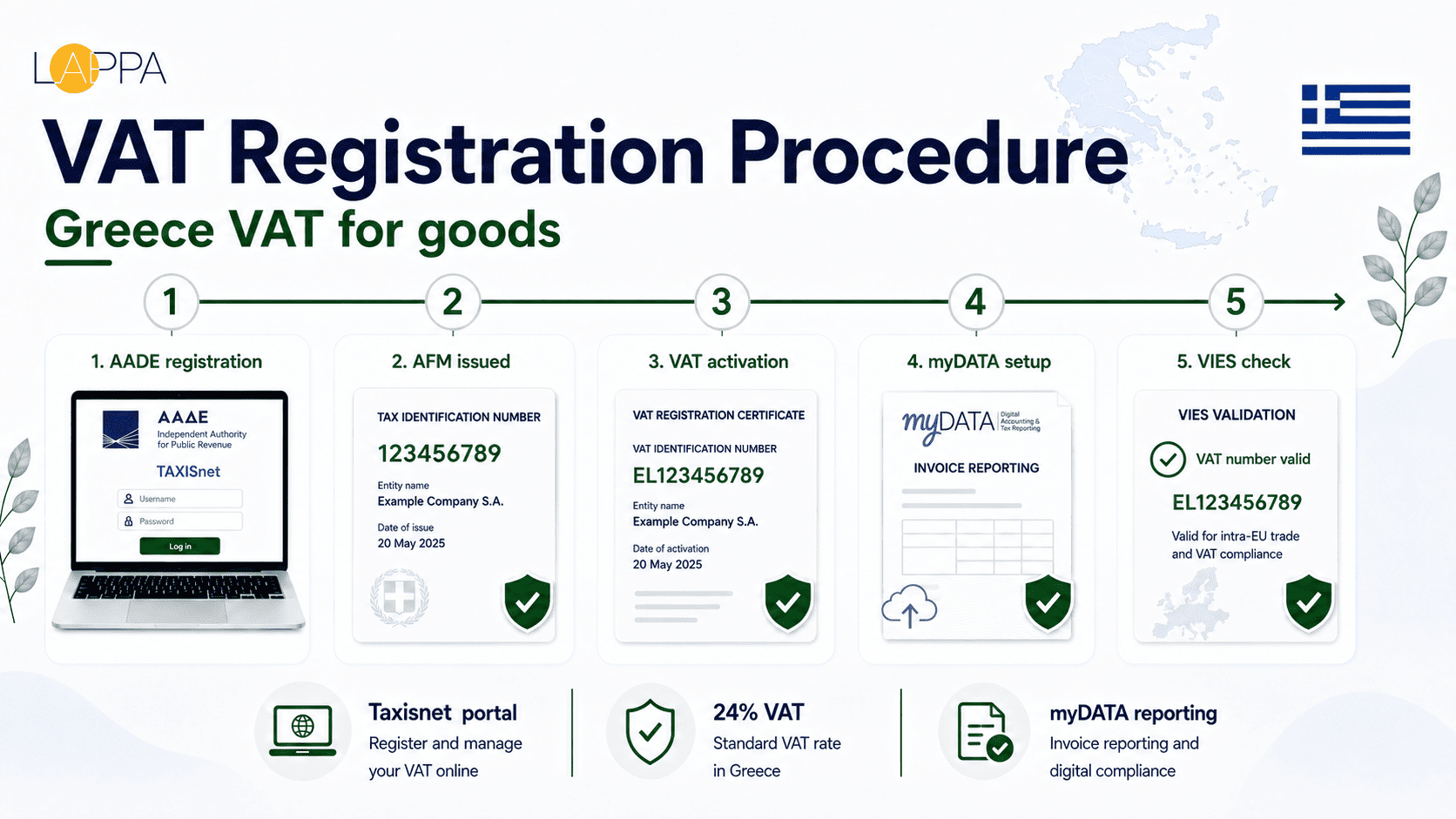 Registration runs through the authority's e-portal (myaade.gov.gr). For locally incorporated entities, five steps cover the standard process:
- Log into the myAADE portal using the entity's ΑΦΜ and assigned credentials
- Complete the levy registration application, declaring the expected activity type and start date
- For foreign EU operators — attach home-country registration documents and evidence of local taxable activity (warehouse lease, supply contracts, or customs import records)
- Non-EU operators must additionally submit the fiscal representative appointment signed by both parties before AADE will proceed
- Receive the VAT in Greece registration confirmation and assigned EL number — typically within 3 to 10 working days for complete applications
Tax Representative in Greece
Non-EU operators must appoint a Greek-resident fiscal representative before any registration application will be processed. The representative assumes joint and several liability for the operator's levy obligations — unpaid amounts can be pursued from the representative directly. That personal exposure means most representatives require a formal engagement agreement, a detailed indemnity from the foreign principal, and a financial guarantee covering several months of estimated levy liability before agreeing to sign the appointment. EU-established operators are not required to appoint a fiscal representative and interact directly through the myAADE portal in Greek or, increasingly, in English. Many EU operators use a local tax agent voluntarily for practical reasons — handling myDATA transmissions, managing Greek-language correspondence, and ensuring Intrastat and EC Sales List filings align with the main return.VAT E-Invoices in Greece
Mandatory electronic invoicing is being phased in alongside the existing myDATA digital reporting infrastructure. The timeline by business category:- Large taxpayers and publicly listed companies: mandatory e-invoicing from April 2024
- Medium-size enterprises: mandatory from July 2024
- Small businesses and professional service operators: mandatory rollout through 2025
- Micro-businesses and sole traders: 2025–2026 per AADE phasing schedule
VAT Returns in Greece
Most operators file quarterly returns. Large taxpayers designated by the authority file monthly. The main return deadline is the last working day of the month following the reporting period — Q1 is due April 30, Q2 is due July 31, and so on. Payment falls on the same deadline as the return. Four parallel reporting streams accompany the main return for companies with intra-EU activity:- myDATA reporting — all income and expense documents must be transmitted to AADE in real time or within deadline windows. This runs continuously alongside the quarterly return and is not a separate periodic filing but an ongoing data stream
- EC Sales List (VIES declaration) — monthly report of zero-rated intra-community supplies of goods to registered EU buyers; due by the last working day of the following month
- Intrastat declaration — monthly statistical declaration for stock movements above the annual arrival and dispatch thresholds set by ELSTAT (the Greek statistics authority); filings due by the 26th of the following month
- OSS return (where applicable) — operators using the One-Stop Shop for distance sales file a quarterly OSS return through their home member state's portal rather than filing separately in each EU destination
Deductible VAT in Greece
Input levy is deductible when goods or services purchased feed into taxable output supplies. The recovery right activates on receipt of a valid invoice that has been transmitted to myDATA. An invoice not transmitted to the myDATA platform has no standing for input credit claims — the transmission is a precondition, not an optional enhancement. Three restriction categories matter most for trading companys:- Passenger cars: Input levy on the purchase and running costs of passenger cars is blocked at 70% — only 30% of the levy on acquisition, fuel, and maintenance is recoverable, regardless of actual business use. Commercial vehicles are not subject to this cap
- Entertainment and hospitality: Levy on food, drink, and accommodation expenses is generally not deductible unless directly tied to a taxable commercial purpose with documented evidence
- Mixed-use assets: Assets used partly for taxable and partly for exempt or private purposes require a pro-rata deduction based on the taxable proportion of use
VAT Record Keeping Requirements in Greece
Ten years — that is the record retention window under Greek accounting law, longer than most EU member states. All accounting records, invoices, and supporting documents must be available to the authority on demand throughout that period. What a trading entity must maintain:- All issued and received invoices transmitted through myDATA, with transmission confirmation records as primary evidence of valid levy documentation
- Import customs entry documents (DAE) with full shipping documentation — bill of lading, commercial invoice, packing list, certificate of origin where applicable
- Export documentation substantiating zero-rate treatment — customs export confirmations and transport records confirming goods left the EU
- Quarterly levy returns, EC Sales List filings, Intrastat declarations, and payment receipts
- Inventory records and stock movement logs for goods held domestically
VAT Penalties in Greece
The penalty framework covers late filing, late payment, and substantive errors, with specific additional exposure for myDATA transmission failures.| Violation | Penalty | Notes |
| Late filing of levy return | Up to €2,500 | Assessed based on delay and taxpayer category |
| Late payment | 10% surcharge on unpaid amount | Applied from the day after the payment deadline |
| Late payment interest | Monthly rate published by AADE | Accrues on top of the 10% surcharge |
| Non-registration | Up to €10,000 + retroactive assessment | AADE assesses back-levy for full unregistered period |
| myDATA non-transmission | Up to €500 per document, capped annually | Applies to each invoice not transmitted within the required window |
| Deliberate evasion | Up to 100% of evaded tax + criminal referral | Serious cases referred to public prosecutor |
How Lappa Can Help with VAT Compliance in Greece
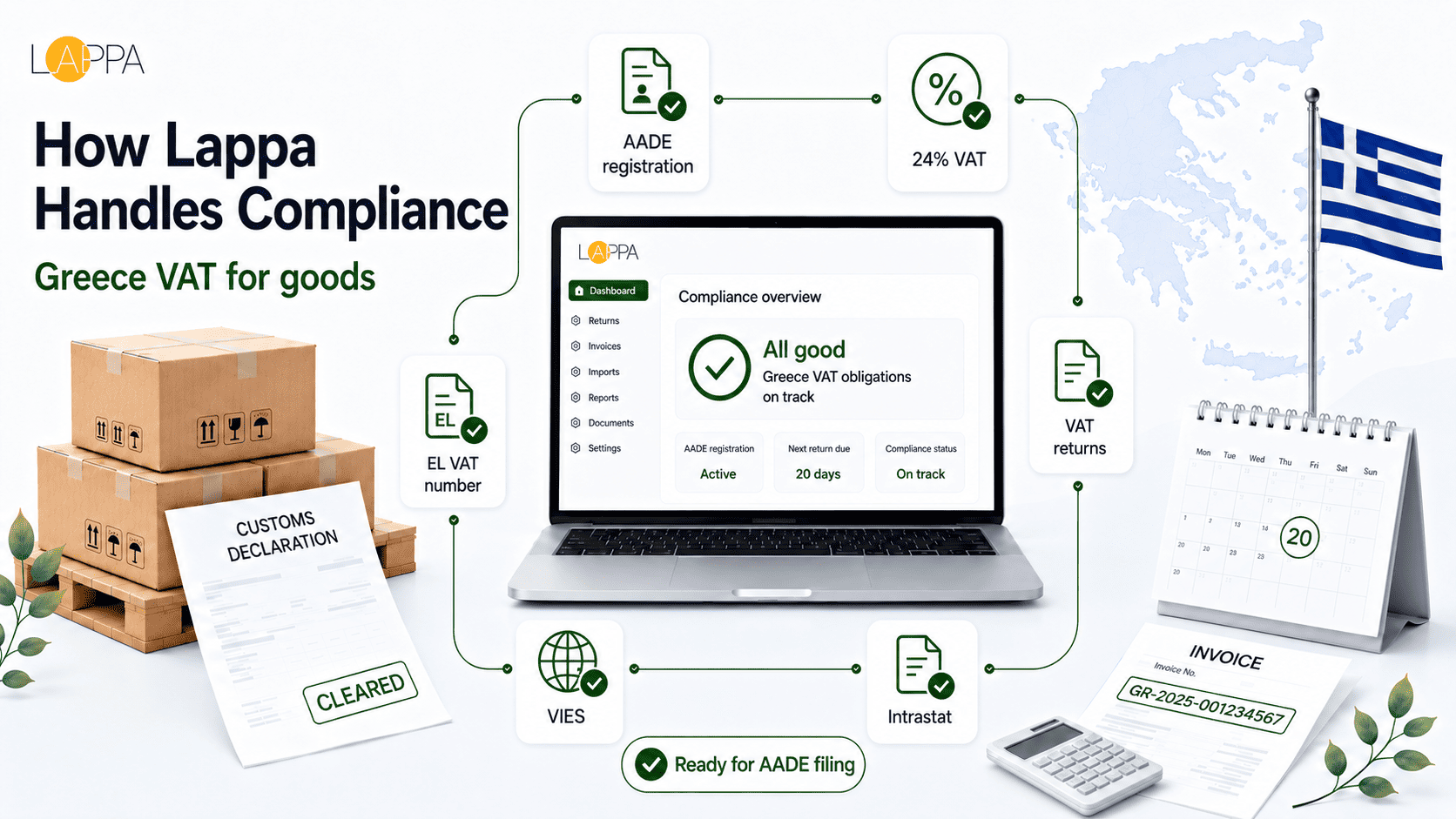 Running goods compliance here means quarterly returns, myDATA real-time transmissions, EC Sales Lists, Intrastat filings, and customs data reconciliation — against an authority that already holds your transaction data before you file. Registration through Lappa covers the complete setup process, and ongoing support handles the entire compliance calendar:
- Registration — handling the myAADE application for EU and non-EU operators, including fiscal representative appointment and guarantee arrangements for non-EU businesses
- myDATA integration — connecting your invoicing system to the AADE myDATA API so every issued and received invoice transmits automatically, eliminating the risk of penalties from missed transmission windows
- Quarterly return and EC Sales List filing — preparation and submission through myAADE, with pre-filing reconciliation against myDATA records to close any gaps before AADE's automated cross-reference runs
- Intrastat declarations — monthly filings for operators above the arrival and dispatch thresholds, aligned with the quarterly return calendar
- Export zero-rate documentation — building the customs exit evidence archive required to substantiate zero-rate treatment on outbound shipments
- Refund claim management — filing and tracking input credit refunds for exporters accumulating credits against zero-rated exports
FAQ for Greece VAT Goods
What is the VAT Rate in Greece
The standard rate is 24%, applied to most commercial goods. A reduced rate of 13% covers fresh food, non-alcoholic beverages, and certain pharmaceutical products. A super-reduced 6% applies to books, newspapers, and specific medicines. Exports and intra-community supplies to registered EU buyers carry 0%. On qualifying Aegean islands, all rates are reduced by 30% — the standard becomes 17%, the 13% becomes 9%, and the 6% becomes 4%. VAT in Greece has no flat single rate — operators must classify each product against the current AADE rate schedule before pricing any transaction. The Greek levy structure has seen adjustments over recent years, so confirming current rates through the AADE portal before each pricing cycle is standard practice.Who Needs VAT Registration in Greece
Locally established entities conducting taxable goods activity register from the start of operations — a small enterprise exemption exists but applies only below €10,000 in annual turnover and is rarely practical for any trading company. Foreign operators storing goods locally register regardless of sales volume. Operators receiving intra-community acquisitions above €10,000 annually must also register. EU-established operators register directly with AADE; non-EU operators must appoint a fiscal representative first.What is the VAT Number Format in Greece
The format is EL + 9 digits — for example EL123456789. The EL prefix represents the Greek-language country abbreviation (Ellas/Hellas), not the ISO country code GR. Using GR on invoices or EU trade declarations is a common error that invalidates the document. The nine-digit sequence corresponds to the entity's ΑΦΜ (Αριθμός Φορολογικού Μητρώου — taxpayer identification number). Verification is free through EU VIES or the AADE public portal.What is VAT Number Greece
VAT number Greece issues is the EL-prefixed nine-digit identifier assigned to every registered entity by AADE. It appears on all commercial invoices, intra-community supply declarations, EC Sales List filings, and official AADE correspondence. It must be validated before processing any supplier invoice — a supplier without an active EL-prefixed registration produces invoices that cannot support input levy recovery. A Greek VAT number that has been deregistered or suspended blocks all commercial invoicing rights for the operator that holds it.How Often Are VAT Returns Filed in Greece
Most operators file quarterly, with returns due by the last working day of the month following the period. Large taxpayers designated by the authority file monthly. The EC Sales List files monthly regardless of return frequency — by the last working day of the following month. Intrastat declarations file monthly by the 26th where dispatch or arrival thresholds are exceeded. myDATA transmissions run continuously throughout the period, not as a periodic batch — this is the most operationally distinctive feature of compliance here compared to other EU markets.VAT Calculator
VAT Standard rate
24%
VAT Reduced rate
13%, 6%
Thresholds
EUR 10,000 annual turnover