

PPWR Registration Solutions for Businesses
Nobody wants to open a folder of unfamiliar PPWR forms with no idea where to start. Whether you manufacture packaging, import it, distribute it, or sell online into the EU, Lappa takes the filing and the declaration of conformity off your plate from here.
- 40+ supportCompliance coverage
- 99.9% UptimePlatform reliability
- 24/7 SupportCompliance experts on call
PPWR registration gets complicated fast
Every business placing packaging on the EU market carries some registration duty, but the paperwork differs by role and by country. A producer, an importer, and a distributor can each face a different form, a different authority, and a different deadline for the exact same product, sometimes with three separate due dates in the same calendar year.
Lappa is built to handle PPWR registration end to end, preparing your declaration of conformity and keeping every filing current as rules phase in. One account covers every market, so a new country becomes a configuration step rather than a new project from scratch. Teams who used to hire a local advisor for every new market now handle the same expansion through a single dashboard instead.
What Lappa handles for your registration
A PPWR project touches legal, packaging design, and finance all at once. Lappa keeps all three working from the same information instead of three separate spreadsheets.
- Filing prepared and submitted in every country you sell in
- A declaration of conformity drafted and kept current for each SKU
- Technical documentation stored centrally and ready for any audit
- A PPWR compliance checklist tailored to your product categories
- Ongoing digital compliance tracking as rules extend through 2030

Lappa PPWR registration services include
Registration Filing and Submission
Declaration of Conformity Generation
Technical Documentation Storage
PPWR Compliance Software Dashboard
PPWR Compliance Statement Vault
Digitale PPWR Compliance Tools
EU PPWR Compliance Software Rollout
PPWR Compliance Digital Tools
How PPWR registration works with Lappa
Share your product and market details
One short intake tells us where you sell and what you're selling there.
We map exactly what's required
Registration, declaration, technical file — the mix depends on your role and category.
Filing happens on your behalf
We prepare the paperwork and submit it to the right authority.
Renewals take care of themselves
A shared calendar and automatic alerts do the remembering from there.
Core elements of PPWR registration


Obligation analysis and determination


Application and documentation preparation


Authority communication and submission


Certificate issuance and confirmation
Global compliance coverage under the EU Packaging and Packaging Waste Regulation
Lappa covers producers, importers, distributors, and online sellers across the EU, the UK, and other markets adopting similar packaging rules, all under the same eu packaging and packaging waste regulation obligations. One platform manages every jurisdiction instead of a separate provider per country.
You work from one shared calendar and one file per market, not a patchwork of local consultants. That consistency keeps fees, deadlines, and paperwork aligned no matter how many countries you add, since obligations under EU packaging and waste rules don’t reset from one market to the next.
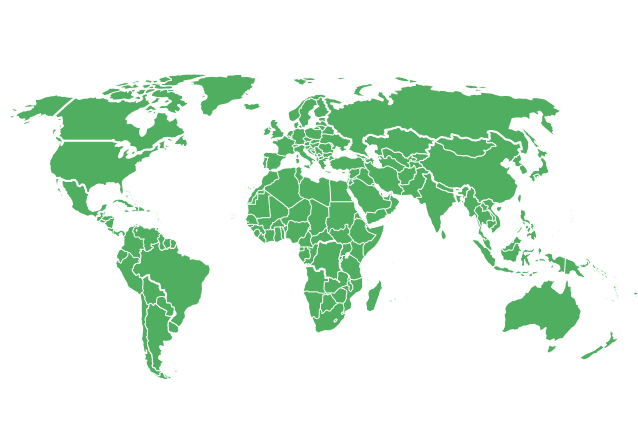

Multi Country Filing Coordination

Automated Compliance Calendar and Alerts

Centralized Document and Certificate Management
Why choose Lappa for PPWR registration
- One completed registration file for every market you sell in
- A declaration of conformity that refreshes itself whenever a product changes
- PPWR compliance software that ties filings to your existing EPR work
- Technical documentation stored centrally, not across five inboxes
- One flat rate, with no country-by-country surcharges buried in the invoice
Doing it yourself
- A new registration process to learn in every country you enter
- Declarations drafted by hand and rarely revisited
- Technical files scattered across whoever last touched them
- No single view of what's actually been filed where
Seamless PPWR integration for your business






Learn more about PPWR Registration

PPWR fee calculator: get your number
Select your packaging category and the countries you sell in — the calculator instantly estimates your eco-modulated fees under PPWR.
calculate now
Technical Documentation Requirements requirements by region
The specific records authorities want on hand, and how to keep that list current as your catalogue expands.
read more
Building a PPWR Compliance Checklist
See how growing brands turn scattered registration tasks into one repeatable process, with real examples from teams selling across a dozen markets.
read more
What our customers say about us

Nadia Kessler
Head of Compliance, cosmetics brand
Before Lappa, we treated PPWR registration as a once-a-year scramble. Whoever had spare time handled it. We sell in eleven EU countries. Every one wanted the declaration of conformity formatted slightly differently, with its own template and its own quirks. That meant constant rework for our small team. Nobody on staff had this as their actual job title, so it always got squeezed between other priorities. Once we moved onto Lappa, the whole process became something we barely think about. The platform mapped our product catalogue against what each country requires. It generated our declarations automatically, and flagged two SKUs where our technical documentation was out of date. Filing that used to eat a full week now takes an afternoon. Renewals happen without anyone chasing anyone else. We've since launched in three additional markets. We didn't add a single person to the compliance team to do it. For a five-person department, that leverage saved roughly twenty hours a month, well beyond what the subscription itself cost. Our auditor even commented that our files were the cleanest she'd seen from a team our size. That comment alone made the whole switch feel worth it to our leadership. We've referred two other portfolio brands to Lappa since, and both were fully registered within eight weeks.

Ben O.
Operations Manager, electronics distributor
We distribute other brands' electronics across Europe. Figuring out whether PPWR registration applied to us as a distributor took months of back and forth with lawyers. Every advisor we spoke to gave us a different answer, ranging from three months to no obligation at all. Lappa's team settled that question in a single call. They then handled the actual registration in six countries at once. Our declaration of conformity files were ready faster than our own legal team had quoted us. The technical documentation vault means we're not digging through email threads when a customs question comes up. What used to be a standing dread before every product launch is now a ten-minute checklist item. We've avoided at least one shipment delay our old process would likely have caused. The digitale ppwr compliance setup they built for us syncs straight into our existing EPR filings too. Every ppwr compliance statement we filed came back clean on the first try, which had never happened before. Their eu ppwr compliance software handles the whole filing without us touching a spreadsheet, start to finish. Our finance team can finally see the full compliance picture without asking three different people for an update. That alone has cut our month-end reporting time nearly in half. Six countries in, adding a seventh took less than two weeks of setup instead of the usual two months. We distribute other brands' electronics across Europe. Figuring out whether PPWR registration applied to us as a distributor took months of back and forth with lawyers. Every advisor we spoke to gave us a different answer, ranging from three months to no obligation at all. Lappa's team settled that question in a single call. They then handled the actual registration in six countries at once. Our declaration of conformity files were ready faster than our own legal team had quoted us. The technical documentation vault means we're not digging through email threads when a customs question comes up. What used to be a standing dread before every product launch is now a ten-minute checklist item. We've avoided at least one shipment delay our old process would likely have caused. The digitale ppwr compliance setup they built for us syncs straight into our existing EPR filings too. Every ppwr compliance statement we filed came back clean on the first try, which had never happened before. Their eu ppwr compliance software handles the whole filing without us touching a spreadsheet, start to finish. Our finance team can finally see the full compliance picture without asking three different people for an update. That alone has cut our month-end reporting time nearly in half. Six countries in, adding a seventh took less than two weeks of setup instead of the usual two months.

Claire D.
VP Operations, online marketplace
Running an online seller business across a dozen storefronts meant PPWR questions came from every direction. Nobody owned the answer, and three different regional managers each assumed someone else was tracking it. Every new market launch turned into an ad hoc research project handled by whoever had time that week. Lappa's team walked through our full catalogue. They identified exactly where registration was required. They built a ppwr compliance checklist we could hand to a new hire, no week of training needed. Onboarding our compliance workflow took about five weeks from first call to first filing. We now see every market's registration status, declaration, and renewal date on one screen. Our finance team leans on that view heavily during quarterly reviews. New storefronts launch in existing markets within days instead of months. The compliance groundwork already exists before we even flip the switch. We opened in Poland and Romania within the same quarter, something that would have taken most of a year before. Our leadership team now treats this readiness as a normal part of any expansion plan, not an afterthought raised in the final week. That shift came directly from watching our Poland launch clear registration in under three weeks. We now budget for a new market launch the same way we budget for anything else, with a known cost and a known timeline.
Peter L.
Packaging Director, beverage company
PPWR hit our category hard. Figuring out what our eu declaration of conformity actually needed to say felt like guesswork at first. Our own compliance lead admitted she was mostly copying language from a template she found online, hoping it held up. Lappa's team reviewed our full packaging portfolio. They drafted declarations for every format we sell. They flagged which technical documentation was missing before an auditor ever could. That early visibility gave our team months of runway. There was no scramble near an undocumented deadline, since every date now sits on one shared calendar. We rebuilt our whole registration process around their platform. Every renewal now has a clear owner and a clear date. Two years in, we've never missed a filing. Our legal spend on these questions has dropped by more than half. Tying the paperwork to actual product decisions changed how our department plans a whole year out. It also means a new product line starts its registration work on day one instead of after launch. Our packaging team now flags a new format the moment it's proposed, not after the artwork is already finalised. That single change saved an estimated forty thousand euros in redesign costs last year alone. Their ppwr compliance digital records now travel with every packaging file we open, so nothing gets approved without the compliance picture attached. Every ppwr compliance digital record we hold ties straight back to the same registration, so there's never a mismatch between what's filed and what's on file internally.
Sophia Marchetti
Finance Lead, direct-to-consumer apparel brand
Textile registration requirements started appearing in country after country. Our finance team had no reliable way to budget for what ppwr compliance would actually cost. We'd been setting aside a rough buffer every quarter and hoping it was enough. Lappa's platform gave us accurate, country by country projections instead of a rough guess carried over each year. It also caught a duplicate filing fee in one country within our first month. That single catch covered a meaningful share of the annual subscription. What is ppwr compliance in practice, for a small team like ours? Mostly it came down to knowing what's due and when. That part finally runs itself now. Board reporting on registration status takes a few minutes instead of a full afternoon. Every renewal, declaration, and filing ties back to the same underlying record now, not five separate ones. That single source of truth is what actually convinced our CFO to approve the switch in the first place. Six months later, she's the one who brings it up in board meetings before anyone asks. Our next finance hire won't even remember a time before digital compliance tracking was automatic, which is the real win. The whole migration took three weeks from contract signing to our first live filing.
Frequently asked questions about PPWR registration
What is PPWR compliance comes down to a simple idea. Any business placing packaging on the EU market has to prove it meets the rules set out in the regulation. That proof includes registering with the right authority. It also means holding a valid declaration of conformity and keeping technical documentation on file, whether you manufacture the packaging yourself or simply distribute someone else's. Getting registered under PPWR is usually the first step, covering a fraction of the ongoing work that follows across a typical three-to-five-year product lifecycle.
Many teams assume compliance ends at the registration certificate. In practice, it's an ongoing status maintained every time a product or a market changes. A packaging redesign, a new supplier, or an expansion into a new country can all reopen the question. Treating it as a single event rather than a maintained status is one of the most common gaps Lappa finds when reviewing a new client's setup. A business can hold a perfectly valid registration on the day it's issued and still fall out of compliance eighteen months later, simply because nobody updated the file when a packaging supplier changed. Most businesses budget for the registration fee itself and forget the maintenance work that follows it every year after. Some describe this simply as digitale ppwr compliance, since the whole record now lives in one digital system rather than a filing cabinet. Under the hood, that means ppwr compliance software handling the filing, ppwr compliance statement drafting, and an eu ppwr compliance software layer keeping every market's status current at once.