


Armenia VAT Registration and Compliance Guide
Provinces
Goods
Provinces
Goods
About
Goods
About
Goods
Goods
Goods
Introduction to VAT in Armenia
Armenia's value-added tax system runs under the Law of the Republic of Armenia "On Value Added Tax," enacted in 1997 and substantially revised several times since. The State Revenue Committee — SRC, or Հարկային Ծառայություն in Armenian — administers collection, registration, audit, and enforcement. For physical goods businesses, the framework covers domestic sales, imports through Armenian customs, and certain cross-border supply arrangements that bring goods onto Armenian territory. VAT in Armenia applies at a flat 20% standard rate. There's no reduced domestic rate for specific goods categories the way Argentina operates at 10.5% or the EU maintains at reduced rates for food and medicine. The rate structure here is simpler: 20% or zero. Zero applies to exports. Most everything else hits 20%. What complicates things in practice isn't the rate — it's the registration threshold and how it interacts with Armenia's position inside the Eurasian Economic Union. The EAEU membership means goods flowing between Armenia, Russia, Belarus, Kazakhstan, and Kyrgyzstan follow specific cross-border rules that don't match standard import procedures. A Russian supplier shipping goods to an Armenian buyer isn't making a customs import in the traditional sense; the IVA equivalent is handled through EAEU-specific declarations. Foreign companies not in the EAEU deal with standard customs clearance, which triggers IVA at the border. The compliance infrastructure is advancing. Armenia's Electronic Settlement Documents system — E-SD — now handles mandatory electronic invoicing for the majority of registered businesses. And the SRC has been expanding its data-matching capabilities, cross-checking supplier and buyer filings with a level of systematic detail that most businesses underestimate until the first query arrives.Armenia VAT Rates — Standard Rate and Zero Rating
The standard Armenia VAT rate is 20%. It applies to domestic sales of physical goods, to services rendered in Armenia, and to goods imported through Armenian customs. One rate, very few exceptions at the domestic level.| Rate | Percentage | What it covers |
| Standard | 20% | All domestic goods sales, most services, imports |
| Zero rate | 0% | Exports of goods outside Armenia, international transport |
| Exempt | — | Financial services, healthcare, education, cultural services |
| Goods or supply | Rate | Key condition |
| Domestic sale of manufactured goods | 20% | Standard rate, no exceptions |
| Import from non-EAEU country | 20% | Paid at customs on clearance |
| Import from EAEU member state | 20% | Declared via EAEU import declaration, not standard customs |
| Export to any country | 0% | Goods must physically leave Armenia |
| Medical equipment (sold locally) | 20% | No goods-specific reduced rate in Armenia |
| Educational textbooks | Exempt | If supplied by accredited educational institution |
VAT Registration Threshold in Armenia
For Local Businesses The mandatory registration threshold for Armenian-resident businesses is AMD 115 million in taxable turnover over any consecutive twelve-month period. At current rates, that's approximately USD 290,000 or EUR 270,000 — notably higher than many smaller economies set it. Businesses below this threshold may operate outside the IVA system entirely, paying only simplified flat taxes without separate VAT filings. Once a business crosses AMD 115 million in rolling turnover, registration with the SRC is required. The application goes in, the registration activates, and all subsequent invoices must comply with Armenian IVA documentation requirements. Voluntary registration below the threshold is available and used by businesses serving primarily IVA-registered clients who need recoverable invoices. For Remote Sellers Foreign businesses supplying physical goods to Armenian buyers typically encounter IVA at the customs border. Standard import clearance applies to shipments from non-EAEU countries, with 20% VAT calculated on the customs value and paid by the Armenian importer at clearance. The foreign seller typically has no direct Armenian IVA registration obligation in these straightforward cross-border scenarios — the Armenian buyer handles IVA at import. The calculation changes when a foreign company establishes a warehouse or fulfilment operation inside Armenia. Goods physically in Armenia at the point of sale create a supply deemed to occur in Armenia, which brings the foreign company into registration scope regardless of annual revenue. The threshold doesn't protect foreign businesses with stock on Armenian soil. For Remote Digital Services Armenia has been developing rules for taxing cross-border digital services, but the detailed treatment of non-resident digital service providers differs from the physical goods framework. For businesses selling both physical goods and digital products into Armenia, each supply stream needs to be assessed separately against the applicable rules. The goods threshold and digital service rules operate independently.Who Must Register for VAT in Armenia
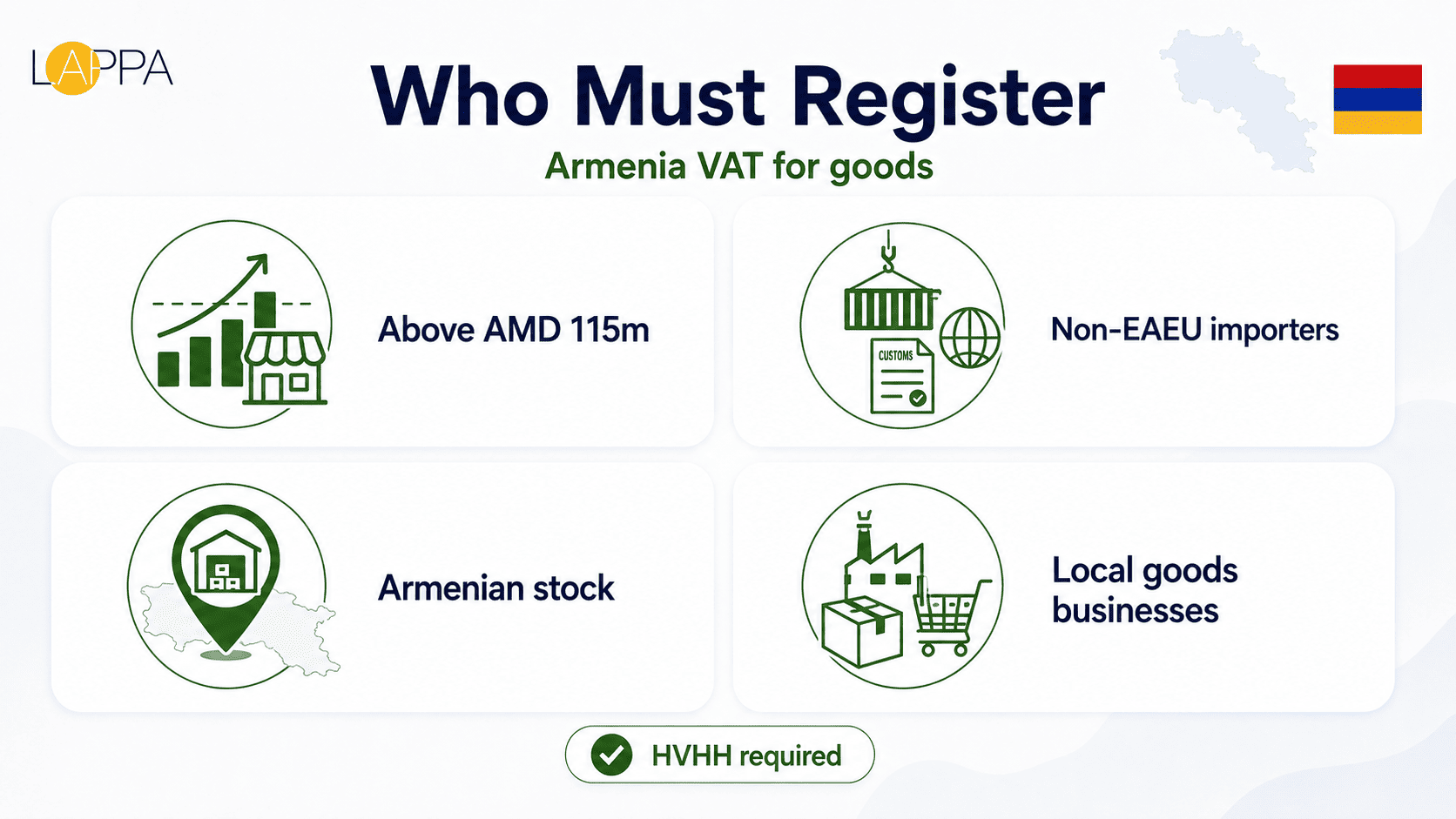 Registration for Armenian VAT is mandatory for:
- Armenian-resident businesses with taxable annual turnover above AMD 115 million
- Any business importing goods from non-EAEU countries into Armenia (the Armenian importer handles VAT at customs)
- Foreign companies with physical goods located in Armenia at the point of domestic sale
- Armenian businesses in all commercial sectors above the threshold, including manufacturing, retail, wholesale, and distribution
VAT Number in Armenia — HVHH Format and Structure
Armenia uses a single taxpayer identifier across all tax purposes: the HVHH — Հարկ Վճարողի Հաշվառման Համար, meaning Taxpayer Registration Number. This is the VAT number Armenia uses on all tax documents — invoices, IVA returns, SRC filings, customs declarations, and official correspondence. There is no separate VAT-specific number. The format is an eight-digit numeric code. Examples: 00000001 through to active registrations now running in the tens of millions. The SRC assigns the number sequentially at registration. No prefix distinguishes company type from individual, though the SRC's internal database carries the entity classification. The HVHH appears on:- Every VAT invoice issued or received
- Monthly VAT return filings with the SRC
- EAEU import declarations
- Armenian customs documentation for imports
- All correspondence and formal filings with the State Revenue Committee
Armenia VAT Number Format — HVHH Structure and Taxpayer Codes
The Armenia VAT number format follows a consistent eight-digit numeric structure with no separators. Written: XXXXXXXX. Example: 02345678. Unlike Argentina's CUIT, which encodes the taxpayer category in the first two digits, the Armenian HVHH carries no embedded classification information in the number itself. Individual entrepreneurs, limited liability companies, joint-stock companies, and branches of foreign entities all receive eight-digit codes assigned in the same sequential pool. Entity classification is held in the SRC registry, not encoded in the number format. The Armenia VAT number format matters operationally in two specific situations. First, in electronic invoice generation through Armenia's E-SD system: the HVHH validates against the SRC database before an invoice is accepted. An incorrectly entered HVHH fails submission. Second, in EAEU cross-border transactions: Armenian businesses buying from Russian or Belarusian suppliers must quote their HVHH on the import VAT declaration. Errors here cause the declaration to fail, delaying the input IVA credit that should appear on the next monthly return. Foreign companies that register for Armenian VAT receive an HVHH in the same eight-digit format as resident businesses. The number is then used on all Armenian invoices the foreign entity issues and on all SRC filings managed by its Armenian representative.VAT Registration Procedure in Armenia
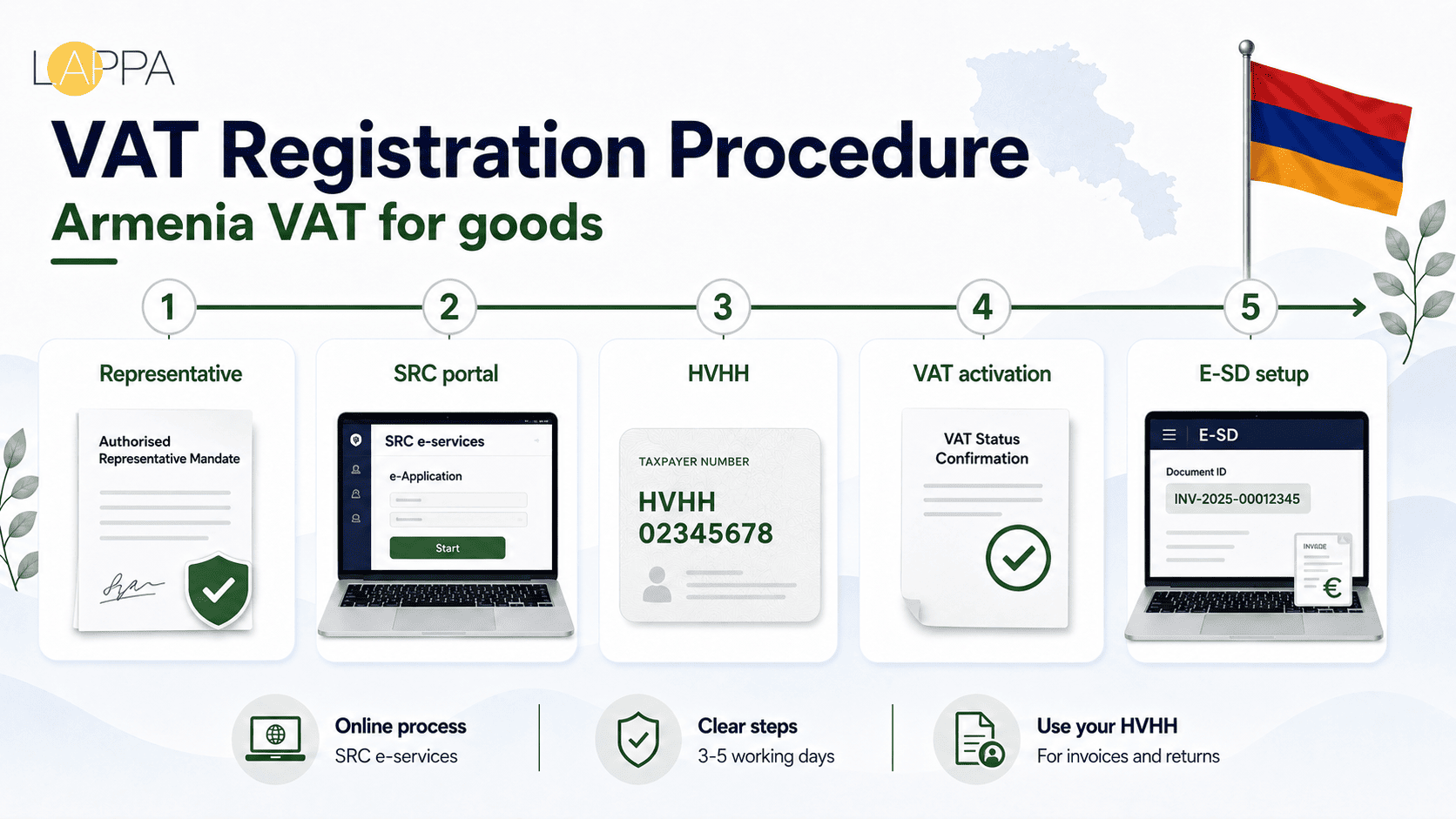 Registration runs through the SRC's e-services portal (e-services.taxservice.am) for resident businesses. Foreign entities without an Armenian establishment register through an authorised representative.
The standard process for an Armenian-resident company:
Registration runs through the SRC's e-services portal (e-services.taxservice.am) for resident businesses. Foreign entities without an Armenian establishment register through an authorised representative.
The standard process for an Armenian-resident company:
- Access the SRC e-services portal using the company's state registration credentials
- Submit the VAT registration application, confirming the taxable activity type and the expected first date of taxable supply
- The SRC reviews the application — processing typically completes within three to five working days
- The HVHH is confirmed as VAT-registered status; the business receives official notification
- Configure compliant invoicing software connected to Armenia's E-SD system for electronic invoice generation
- Issue the first E-SD compliant invoice from the registration effective date
Tax Representative in VAT Armenia
Armenia doesn't operate a mandatory fiscal representative system with joint and several liability in the way some EU member states do. But foreign businesses without an Armenian registered presence need an authorised representative — a locally resident individual or entity — to manage SRC interactions and filings on their behalf. What the representative handles:- VAT registration application and HVHH activation
- Monthly return preparation and SRC portal filing
- EAEU import declaration filing where applicable
- SRC audit notifications and formal query responses
- Record maintenance in Armenian or with SRC-accepted translations
VAT E-Invoices in Armenia
Armenia's electronic invoicing system — the Electronic Settlement Document (E-SD) system — handles mandatory digital invoice generation for VAT-registered businesses. All invoices between VAT-registered Armenian entities must be issued through the E-SD system, which connects to the SRC's central platform and generates a unique document identifier for each invoice. An invoice issued outside the E-SD system — a paper document or an electronic file not submitted through the SRC platform — is not a valid VAT document for input tax recovery purposes. The buyer cannot use it as a crédito fiscal equivalent. The seller has issued a non-compliant document and faces potential SRC penalties per occurrence. E-SD rollout timeline by business registration type| Business category | Annual turnover | E-SD mandatory from |
| Large taxpayers | Above AMD 3 billion | 2015 |
| Medium taxpayers | AMD 500 million – AMD 3 billion | 2017 |
| Standard VAT registrants | AMD 115 million – AMD 500 million | 2019 |
| Voluntary VAT registrants | Below AMD 115 million | 2021 |
VAT Returns in Armenia
Monthly filing. Each VAT return covers a calendar month and is due by the 20th of the following month. Payment of any net VAT owed accompanies filing on the same date. No separate payment grace period applies. Returns are submitted through the SRC's e-services portal. The return captures total output VAT on domestic sales, total input VAT on purchases and imports, EAEU import VAT where applicable, and the net position: payable to the SRC or credit to carry forward.VAT Control Report
The Armenian monthly return functions as a control declaration. Output VAT from all E-SD-issued invoices during the period is cross-referenced against the SRC's own E-SD database records — meaning the SRC already holds the underlying transaction data before the return is filed. Returns that diverge from the E-SD records generate automated SRC queries. Understated output VAT relative to issued invoices is visible immediately to the system. Input VAT claims similarly face cross-check: the SRC matches each input claim against the supplier's E-SD records. Claiming input VAT on an invoice that the supplier didn't issue through E-SD, or on an invoice that the supplier subsequently cancelled, fails the reconciliation process.SRC's portal
Armenian VAT returns remain form-based through the SRC's portal, with the E-SD database providing the underlying transaction-level visibility directly. Businesses managing compliance across both Poland and Armenia should note that the two systems are operationally independent.Deductible VAT in Armenia
Input VAT on purchases is deductible against output VAT in the same monthly return period, provided the purchase is documented on a valid E-SD invoice and relates to taxable business activity. Full recovery applies to:- Goods purchased for resale or for use in production of taxable outputs
- Business equipment, machinery, and vehicles used exclusively for taxable business operations
- Professional services — legal, accounting, logistics, consultancy
- Warehouse and distribution costs attributable to taxable supplies
- Premises costs for facilities used in taxable activity
- Passenger vehicles not exclusively used for commercial operations or vehicle resale
- Entertainment and client hospitality costs
- Costs attributable to exempt activities
- Private portions of mixed business/personal expenditure
VAT Record-Keeping Requirements in Armenia
Five years from the end of the tax year to which documents relate. That's the standard retention period for VAT records in Armenia. The SRC can open an audit covering any period within the five-year window without advance notice beyond what the law requires. Records that must be maintained:- All E-SD invoices issued and received, with the SRC-assigned document identifiers
- Customs declarations for imports from non-EAEU countries, with IVA payment receipts
- EAEU import VAT declarations and supporting transaction documents
- Monthly VAT return submissions with SRC confirmation receipts
- Bank transfer records for VAT payments to the SRC treasury
- Purchase contracts, delivery notes, and commercial documentation for significant transactions
VAT Penalties in Armenia
Late registration — operating as a taxable business above AMD 115 million without registering — results in an SRC assessment for all VAT that should have been charged during the unregistered period, plus penalties and interest on each missed monthly payment. Interest on late VAT payment runs at 0.075% per day from the original due date. Compounded over a six-month delay, that adds approximately 14% on top of the principal. Twelve months adds roughly 28%. In a business environment where cash flow pressures sometimes lead to delayed IVA payments, the daily compounding makes delay expensive. Substantive penalties for understated or undeclared VAT:- Unintentional understatement (omission): 50% of the unpaid tax
- Intentional evasion with supporting evidence: 100% of the unpaid amount
- Systematic or large-scale evasion: criminal referral under the Republic of Armenia Criminal Code
How Lappa Can Help with VAT Compliance in Armenia
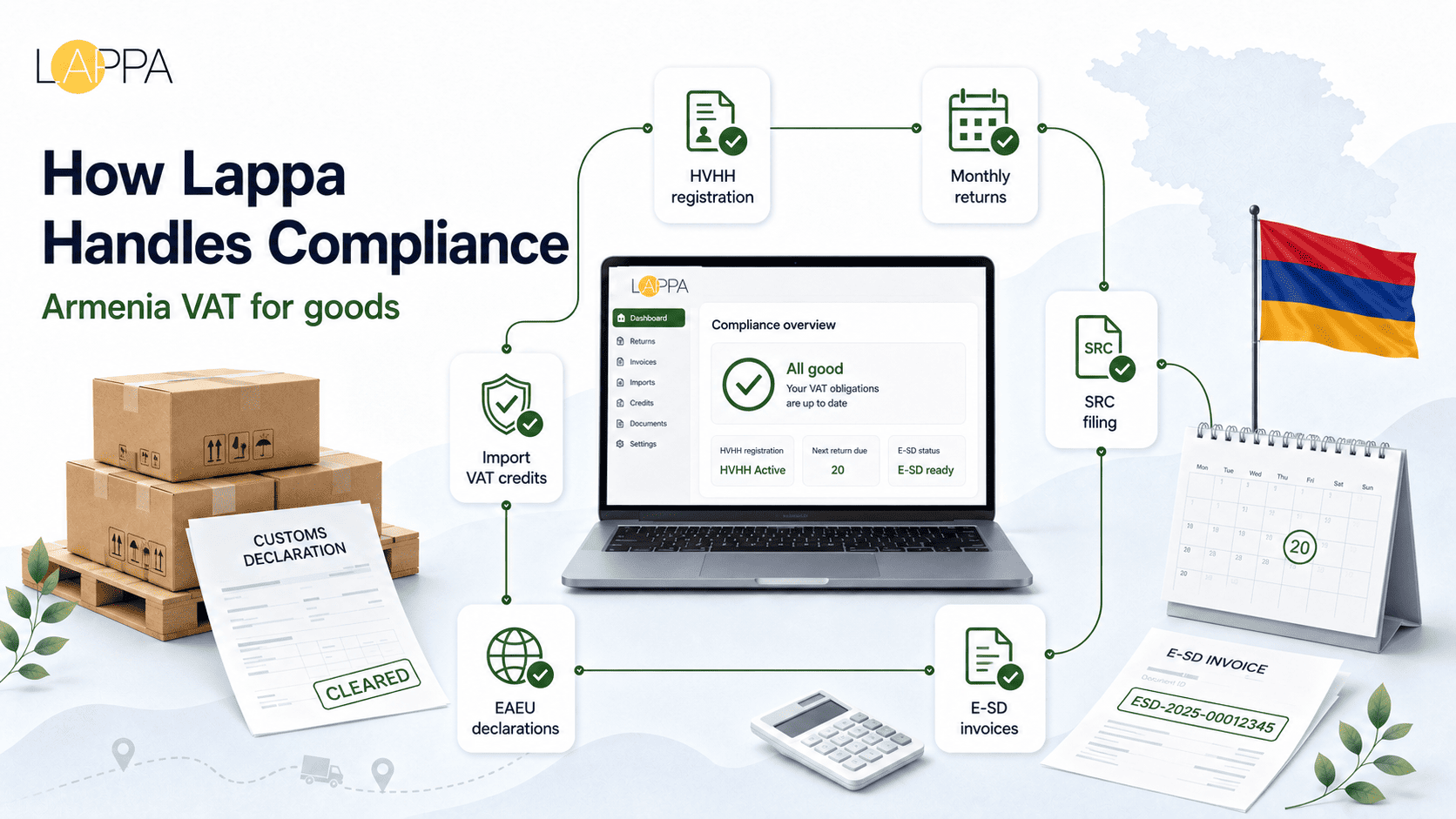 Lappa supports goods businesses operating in Armenia across the full compliance cycle — from initial registration through monthly return management, EAEU import declaration support, and SRC audit representation.
For physical goods companies, the team covers:
Lappa supports goods businesses operating in Armenia across the full compliance cycle — from initial registration through monthly return management, EAEU import declaration support, and SRC audit representation.
For physical goods companies, the team covers:
- HVHH registration and VAT status activation for Armenian and foreign businesses
- Authorised representative appointment and ongoing SRC portal management for non-resident entities
- Monthly VAT return preparation and SRC e-services filing
- EAEU import VAT declaration preparation for goods arriving from Russia, Belarus, Kazakhstan, and Kyrgyzstan
- Standard customs import VAT documentation for non-EAEU goods
- E-SD invoicing system setup and SRC API integration
- Input VAT recovery analysis and proportional deduction calculation
- Voluntary disclosure preparation for businesses with unregistered trading periods
- SRC audit representation and query response management
FAQ for Armenia VAT
What is the VAT rate in Armenia
- The standard vat rate in armenia is 20%, applied to all domestic goods sales, most services, and goods imported into Armenia. There is no reduced domestic rate — unlike many European systems, Armenia doesn't maintain lower rates for food, medicine, or other essential goods. Exported goods apply at zero rate, which means no VAT on the outbound sale but full input tax recovery rights are retained on related costs. Financial services, accredited education, licensed healthcare, and specific cultural activities are exempt from VAT entirely.
Who needs to register for VAT in Armenia
- Armenian-resident businesses must register once taxable turnover in any consecutive twelve-month period exceeds AMD 115 million (approximately USD 290,000). Foreign companies with physical goods in Armenia at the point of domestic sale carry a registration obligation regardless of annual revenue. Importers from non-EAEU countries typically handle VAT through Armenian customs at the border rather than through direct SRC registration, provided the Armenian buyer is the importer of record. Voluntary registration below AMD 115 million is available for businesses that benefit from input IVA recovery or that serve primarily VAT-registered customers.
What is the VAT number format in Armenia
- The VAT identifier in Armenia is the HVHH — Taxpayer Registration Number — an eight-digit numeric code assigned by the State Revenue Committee at registration. The Armenia VAT number format carries no embedded classification information: the same eight-digit sequential pool covers individuals, companies, and foreign entity branches alike. Entity type is recorded in the SRC registry separately. The HVHH appears on all E-SD invoices, VAT returns, EAEU import declarations, and SRC correspondence, and can be verified through the SRC's public taxpayer register.
How often are VAT returns filed in Armenia
- Monthly. Each return covers a calendar month and is due by the 20th of the following month. Payment of any net VAT owed is due on the same date — no separate payment deadline applies. The return is filed through the SRC's e-services portal, and output VAT figures are automatically cross-referenced against E-SD invoice records the SRC already holds. There is no quarterly filing option for standard VAT-registered businesses in Armenia.
Do foreign companies need a tax representative in Armenia
- Foreign entities without an Armenian registered establishment need an authorised representative — an Armenian-resident individual or entity — to manage SRC portal access, file registration applications and returns, and handle official SRC correspondence. The representative acts as a mandated agent rather than a financial guarantor; unlike some European jurisdictions, Armenian law doesn't impose joint and several financial liability on the local representative for the foreign entity's VAT debts. But the appointment is a practical prerequisite for registration: without Armenian-resident credentials to access the SRC portal, the foreign company cannot complete its registration independently.
VAT Calculator
At 20%, the calculation is clean. Adding 20% to a net goods price: Net × 1.20 = gross. Gross minus net = IVA. Extracting 20% from a VAT-inclusive price: Gross ÷ 1.20 = net. Gross minus net = IVA.| Net price (AMD) | Rate | VAT amount (AMD) | Gross price (AMD) |
| 100,000 | 20% | 20,000 | 120,000 |
| 500,000 | 20% | 100,000 | 600,000 |
| 1,000,000 | 20% | 200,000 | 1,200,000 |
| 2,500,000 | 0% (export) | 0 | 2,500,000 |
VAT Standard rate
20%
VAT Reduced rate
0%
Thresholds
AMD 115,000,000 annual turnover