


Austria VAT Registration and Compliance Guide
This guide is for e-commerce companies that sell online via web stores or at marketplaces
Provinces
Goods
Provinces
Goods
About
Goods
About
Goods
Goods
Goods
Introduction to VAT in Austria — What Is VAT in Austria
Austria has collected value-added tax since 1973. The current statute is the Umsatzsteuergesetz 1994 (UStG). The Bundesministerium für Finanzen (BMF) sits at the top; local Finanzämter handle day-to-day assessment and correspondence; FinanzOnline is the digital portal where almost everything — registration, returns, payment — now takes place. VAT in Austria carries the German name Umsatzsteuer, shortened to USt on invoices and official filings. Austria joined the EU in 1995 and adopted the EU VAT Directive on the same date, so the full framework of intra-community rules, place-of-supply determinations, and reverse-charge mechanisms applies here without carve-outs. The question of what is VAT in Austria has a short answer: a consumption tax charged at each link in the supply chain, with registered businesses collecting it from buyers and deducting the VAT they've paid on their own inputs — that deductible amount is called Vorsteuer. The difference goes to the Finanzamt. Conceptually simple. Operationally demanding, once three active rates, Kleinunternehmer thresholds, and strict UVA deadlines enter the picture. Three features set Austrian VAT apart from a generic EU setup. First, the country runs 20%, 13%, and 10% rates simultaneously — correct classification isn't always obvious. Second, the Kleinunternehmerregelung exemption catches a meaningful slice of domestic micro-businesses and sole traders. Third, the FinanzOnline system is entirely in German, and it handles everything from initial registration to recapitulative statements. Non-German-speaking finance teams regularly underestimate that last point. This compliance guide covers rates, registration thresholds, the ATU number structure, e-invoicing obligations, return types and deadlines, input VAT deductibility, record retention, and the penalty regime — in that order.Austria VAT Rates — How Much Is VAT in Austria
Three active tiers. One zero rate for cross-border qualifying transactions.| Rate | Category | Typical Supplies |
| 20% | Standard | Electronics, clothing, professional services, software, most B2B services |
| 13% | Reduced | Wine from producers, cultural events, domestic flights, zoo admissions |
| 10% | Reduced | Food, books, newspapers, medicines, accommodation, public transport |
| 0% | Zero-rated | Intra-EU exports dispatched from Austria, qualifying international freight |
- Restaurant meals: 10%. Alcohol served at the same table: 20%. Same venue, same bill, two different rates.
- Short-term accommodation (Airbnb-style lets): 10%. Parking or breakfast invoiced separately at the same property may be 10% or 20% depending on pricing structure.
- E-books: 10% since the 2020 EU rate alignment with physical books. Software on a USB stick or disc: 20%.
- Cut flowers sold by a florist: 10%. The same flowers arranged and delivered as event décor, invoiced as a decoration service: 20%.
VAT Registration Threshold in Austria
For Local Businesses
The Kleinunternehmerregelung exempts Austrian-established entities from charging VAT while annual net turnover stays below EUR 42,000. That threshold rose from EUR 35,000 on 1 January 2025. Under the exemption: no VAT charged to customers, no Vorsteuer recovered on purchases. The trade-off is deliberate — simpler bookkeeping, no input tax. Voluntary VAT registration below EUR 42,000 is available and commonly used. A business launching with substantial startup expenditure — construction, machinery, IT infrastructure — often registers from day one to recover Vorsteuer before the mandatory threshold is reached. Opting in binds the entity to VAT obligations for a minimum of five calendar years. That five-year lock-in catches companies that register early and then want to drop back to the exemption after a slow first year. One grace rule: if turnover exceeds EUR 42,000 by no more than 15% in a given calendar year, the exemption may be retained — but only once in any five-year window. A single contract spike won't force immediate registration if this provision is correctly applied and documented from the start.For Remote Sellers
EU-based sellers dispatching goods to Austrian consumers fall under the EU OSS (One Stop Shop) distance-selling framework. Threshold: EUR 10,000, calculated across all combined intra-EU B2C goods and digital services — not per destination country. Cross it and the choice is OSS registration in the home EU member state, or local registration in Austria and every other destination separately. Local Austrian registration is also triggered by holding stock inside Austria — a warehouse, fulfilment centre, or consignment arrangement creates a VAT nexus regardless of sales value. Non-EU sellers have no threshold at all. The first taxable supply to an Austrian customer requires compliance from that transaction forward.For Remote Digital Services
The same EUR 10,000 EU-wide threshold applies. Below it, an EU supplier may apply home-country VAT rules. Above it: OSS or local Austrian registration. Non-EU digital suppliers register for non-Union OSS or appoint a fiscal representative in Austria from the first supply. No grace period.Who Must Register for VAT in Austria — Austrian VAT Obligations
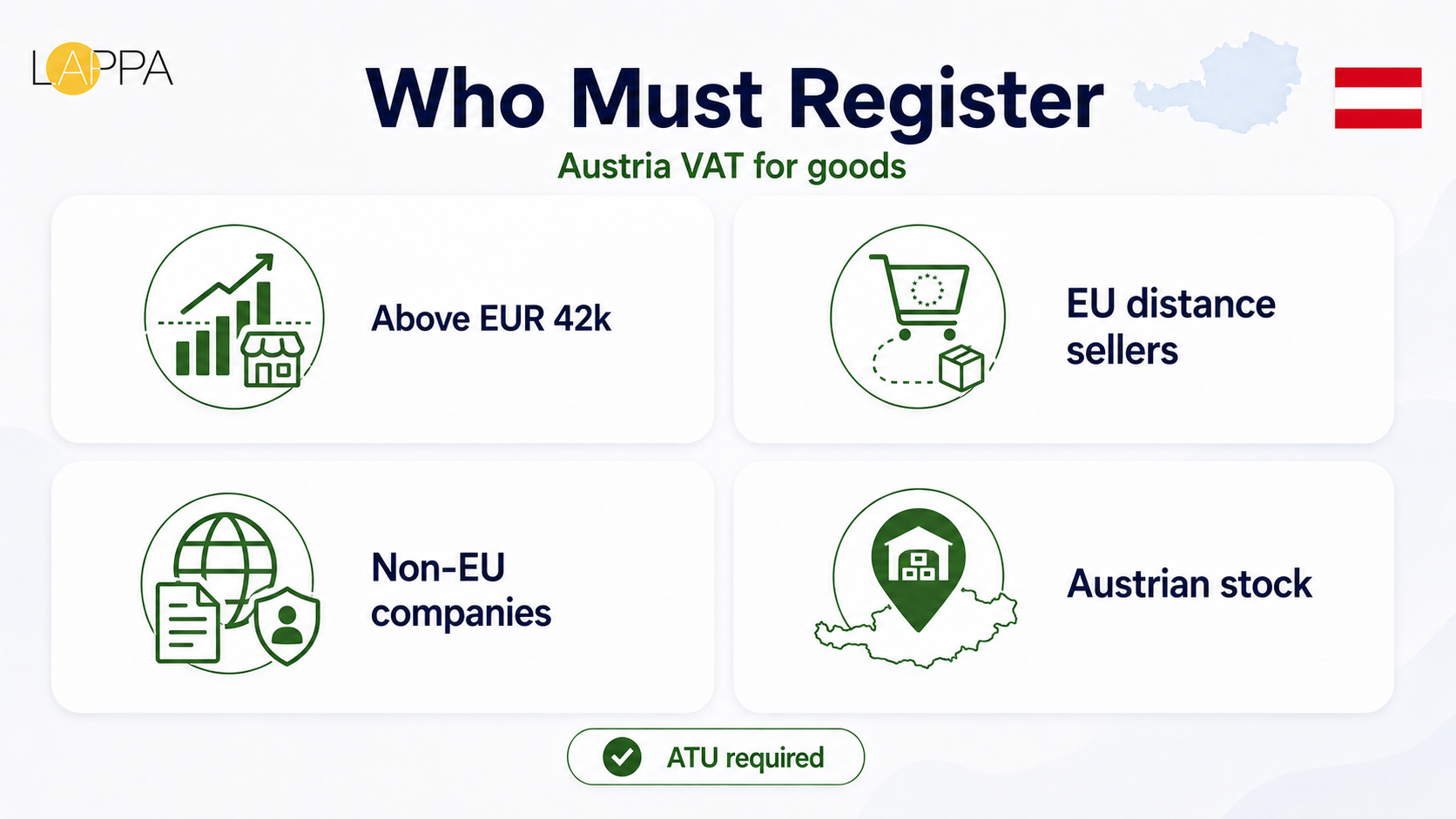 Austrian VAT registration is mandatory for:
- Austrian-established entities with annual net turnover above EUR 42,000.
- Entities making intra-community acquisitions in Austria above EUR 11,000 per year.
- Non-EU companies supplying goods or services in Austria without a local establishment — regardless of volume.
- EU companies holding goods in Austrian warehouses, fulfilment centres, or consignment stock arrangements.
- Any entity voluntarily opting out of the Kleinunternehmer exemption, committing to five years of VAT compliance.
VAT Number in Austria — ATU Format and VAT Registration Number Structure
Austria's VAT number Austria has one fixed format: AT + U + 8 digits. Example: ATU12345678. "AT" is the ISO country code. "U" stands for Umsatzsteuer. Eight digits follow, assigned by the Finanzamt on registration. The full 11-character string is the VAT registration number used on intra-community invoices, VIES lookups, and recapitulative statements. Don't shorten it — a truncated ATU on a cross-border invoice creates a Vorsteuer claim problem for the recipient in their home jurisdiction. Separate from the ATU: Austrian entities also hold a Steuernummer formatted XX/XXX/XXXX, assigned at district level. That number handles domestic income and corporate tax. The ATU handles cross-border VAT. Using one where the other belongs is a compliance defect that auditors and counterparty finance teams catch quickly. Validation of an Austrian VAT number runs through the EU VIES portal at ec.europa.eu/taxation_customs/vies. New ATU numbers take 24–48 hours to propagate into VIES after Finanzamt activation. A failed VIES search immediately after registration doesn't mean the number is invalid — wait one business day and recheck.VAT Registration Procedure in Austria — VAT Austria Filing Steps
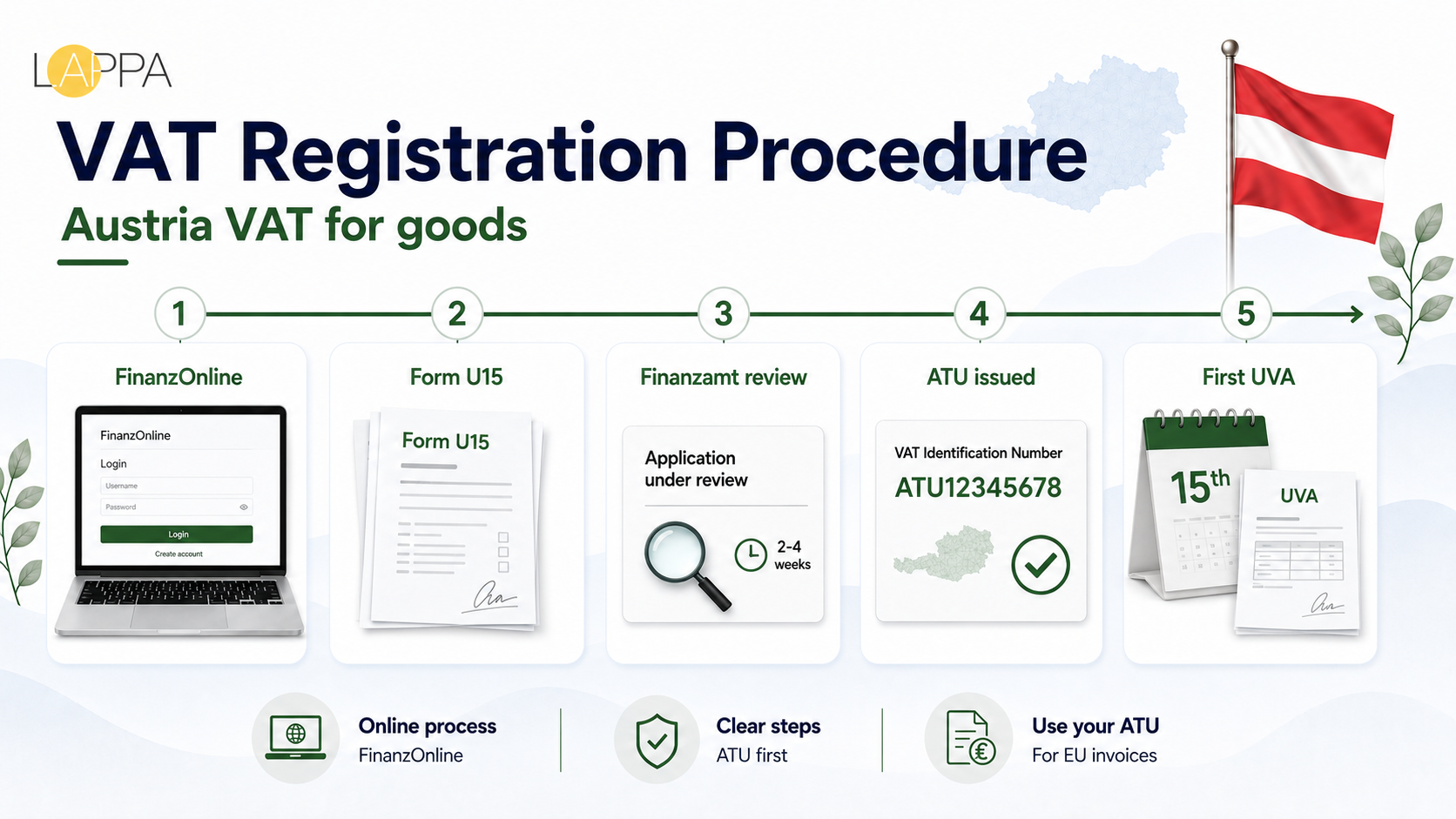 VAT Austria registration for Austrian-established entities runs through FinanzOnline at finanzonline.bmf.gv.at.
Steps:
VAT Austria registration for Austrian-established entities runs through FinanzOnline at finanzonline.bmf.gv.at.
Steps:
- Access or create a FinanzOnline account. Entities already filing income or corporate tax there use the same account — no separate setup needed.
- Submit Form U15 (Antrag auf Vergabe einer Umsatzsteuer-Identifikationsnummer).
- The local Finanzamt processes the application. Standard cases: 2–4 weeks. Complex ownership structures or non-resident components take longer.
- The ATU number appears in the FinanzOnline dashboard once approved.
- First UVA is due by the 15th of the second month after the first reporting period ends.
- Certificate of incorporation or equivalent company extract, apostilled or notarised
- Proof of Austrian activity — contracts, invoices, or an explanatory letter describing planned transactions
- Fiscal representative appointment letter (non-EU businesses)
- Bank account details for refund processing
Tax Representative in Austria
Non-EU businesses with Austrian VAT obligations must appoint a Fiskalvertreter before or at registration. It's a statutory requirement — the Finanzamt won't accept a non-EU registration application that doesn't name one. The Fiskalvertreter takes on joint and several liability for all Austrian VAT obligations of the foreign entity. They file returns, receive Finanzamt correspondence, and hold full powers of attorney over the tax account. Only Austrian-qualified Steuerberater or equivalent professionals can serve in this role. EU-established businesses don't face the mandatory requirement. But engaging a local Austrian Steuerberater is standard practice for any EU company without local finance staff. FinanzOnline is in German. Deadlines are firm and non-negotiable. The UVA calculation has enough technical nuance — mixed supplies, partial Vorsteuer, ZM reconciliations — that outsourcing to a specialist pays off once transaction volumes justify it. Annual cost for fiscal representation in a standard import or distribution setup: EUR 2,000–5,000. Volume, filing frequency, and whether ZM statements or OSS reconciliations are included all move that figure.VAT E-Invoices in Austria — Timeline for Different Business Sizes
Austria's B2G (business-to-government) e-invoicing mandate came in phases. Federal level: April 2014. State and municipal authorities completed rollout by 2016–2017. All invoices to Austrian public-sector entities must use ebInterface (Austria's native XML format, version 5.0) or the pan-European EN16931 standard, submitted via the Unternehmensserviceportal (USP). B2B e-invoicing follows the EU ViDA (VAT in the Digital Age) directive phase-in :which directly affects VAT in Austria obligations going forward| Business Segment | B2G Obligation | B2B Mandate |
| Federal suppliers | In force since April 2014 | ViDA est. 2027–2028 |
| State/municipal suppliers | In force since 2016–2017 | ViDA est. 2027–2028 |
| Large enterprises | Covered under B2G scope | Likely 2027–2028 |
| SMEs | Covered under B2G scope | Likely 2028–2029 |
| Micro businesses and sole traders | Voluntary B2B | Voluntary until national mandate |
VAT Returns in Austria — Types of Report and JPK File
Two instruments: the UVA (Umsatzsteuer-Voranmeldung) and the annual Umsatzsteuererklärung on Form U1. UVA frequency by prior-year VAT liability:- Monthly — liability exceeded EUR 100,000 in the prior calendar year
- Quarterly — liability fell between EUR 1,500 and EUR 100,000
- Annual only — liability was below EUR 1,500
Deductible VAT in Austria
Vorsteuer deduction is available on purchases that connect directly to taxable output supplies. Three conditions apply simultaneously: purchase from a VAT-registered supplier; a valid Austrian-format Rechnung; and use of the expense in taxable business activity. Non-deductible categories:- Passenger cars (PKW): Input VAT on purchase price and all running costs is fully blocked unless the vehicle is used exclusively for commercial hire, driving instruction, or ambulance purposes. Mixed-use personal and business vehicles don't qualify for partial deduction — it's all or nothing under Austrian rules.
- Customer entertainment: Broadly blocked. Austrian auditors draw the hospitality line tightly, and they push back on anything that looks like client entertaining rather than genuine working meetings.
- Mixed-use assets: The private-use proportion is excluded from deduction. The split must be calculated and documented each year.
VAT Record-Keeping Requirements in Austria
Seven years. That's the minimum retention period under §132 Bundesabgabenordnung (BAO). The clock starts from the end of the calendar year in which the document was created or received. An invoice dated March 2025 must survive until at least 31 December 2032. Documents within the obligation:- All outgoing invoices (Ausgangsrechnungen) with sequential numbering maintained
- All incoming invoices (Eingangsrechnungen) supporting Vorsteuer claims
- Import and export documents, customs declarations
- Bank statements showing VAT payments and receipts
- All UVA and U1 filings, including the FinanzOnline submission confirmations
- Contracts with ongoing VAT implications — lease agreements, service contracts, distribution arrangements
VAT Penalties in Austria — VAT Austria Non-Compliance Costs
Austrian enforcement runs across two frameworks: the Bundesabgabenordnung (BAO) for administrative surcharges and the Finanzstrafgesetz (FinStrG) for criminal sanctions. Both can apply simultaneously to the same failure when a calculation error is accompanied by deliberate concealment. Late filing surcharge (Verspätungszuschlag): Up to 10% of the unpaid VAT attributable to the late return. The Finanzamt has discretion. A first-time delay on a small balance rarely hits the maximum. A pattern of late filing does. Late payment surcharges (Säumniszuschläge):- 2% of the outstanding VAT on the due date
- A further 1% if the balance remains unpaid after 3 months
- Another 1% after a further 3 months
How Lappa Can Help with VAT Compliance in Austria
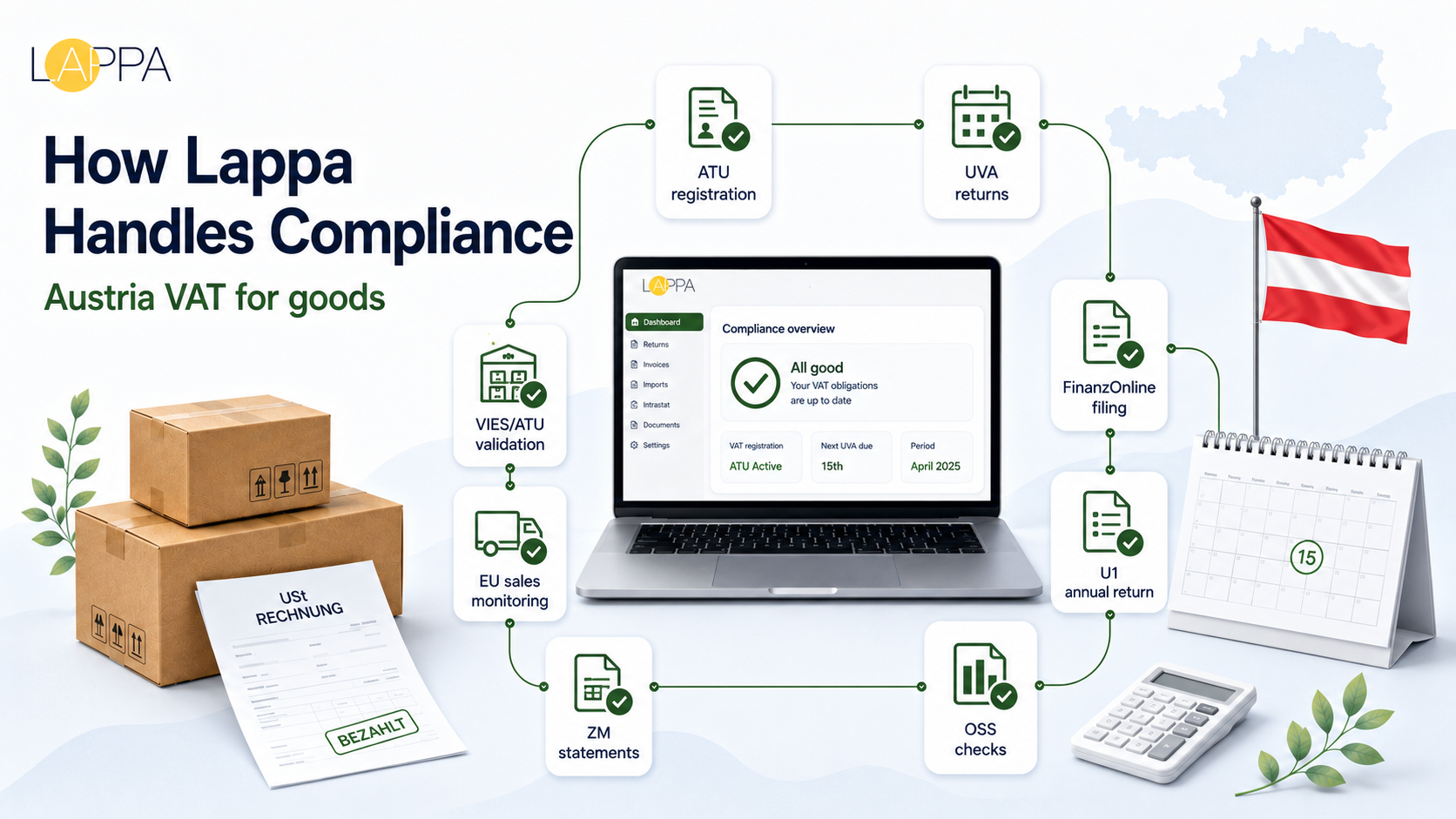 Lappa covers the full Austrian VAT cycle. Services include FinanzOnline account setup, ATU registration, UVA preparation and submission on monthly or quarterly schedules, annual U1 filing, and ZM recapitulative statements for intra-EU supplies.
For non-EU companies entering the Austrian market, Lappa provides Fiskalvertreter services under Austrian law — taking on the representative role and joint liability the Finanzamt requires before approving non-EU registrations. That removes the need to find and vet an independent Austrian Steuerberater before operations begin.
The platform also handles OSS registration for companies using an EU member state as their base, and manages the boundary between OSS-reported supplies and local Austrian obligations outside OSS scope — B2B reverse-charge services, goods delivered from Austrian warehouse stock, and similar cases requiring parallel local registration alongside the OSS filing.
Lappa covers the full Austrian VAT cycle. Services include FinanzOnline account setup, ATU registration, UVA preparation and submission on monthly or quarterly schedules, annual U1 filing, and ZM recapitulative statements for intra-EU supplies.
For non-EU companies entering the Austrian market, Lappa provides Fiskalvertreter services under Austrian law — taking on the representative role and joint liability the Finanzamt requires before approving non-EU registrations. That removes the need to find and vet an independent Austrian Steuerberater before operations begin.
The platform also handles OSS registration for companies using an EU member state as their base, and manages the boundary between OSS-reported supplies and local Austrian obligations outside OSS scope — B2B reverse-charge services, goods delivered from Austrian warehouse stock, and similar cases requiring parallel local registration alongside the OSS filing.
FAQ for VAT Austria Goods
What Is the VAT Rate in Austria
- Austria applies three active VAT rates. Twenty percent covers most goods and services. Thirteen percent applies to wine sold directly by producers, cultural event tickets, and domestic flights. Ten percent covers food, books, prescription medicines, public transport, and accommodation. Zero-rating applies to exports and intra-EU goods dispatches from Austria. No rate below 10% is in use.
Who Needs to Register for VAT in Austria
- Austrian-established businesses must register once annual net turnover exceeds EUR 42,000 — the Kleinunternehmer threshold raised from EUR 35,000 in January 2025. EU-based remote sellers register or use OSS once the EUR 10,000 EU-wide B2C threshold is crossed. Non-EU businesses have no threshold: the first taxable supply to an Austrian customer triggers the obligation regardless of value.
What Is the VAT Number Format in Austria
- Austrian VAT numbers follow the format ATU plus eight digits — for example, ATU12345678. "AT" is the country code; "U" stands for Umsatzsteuer. This 11-character string appears on all intra-EU invoices and in VIES. It's separate from the Steuernummer, which handles domestic tax filings and carries a different format entirely.
How Often Are VAT Returns Filed in Austria
- Filing frequency depends on the prior-year VAT liability. Monthly UVA applies when last year's liability exceeded EUR 100,000. Quarterly applies between EUR 1,500 and EUR 100,000. Below EUR 1,500, annual filing only. The UVA is due by the 15th of the second month after the period closes. The annual U1 return is due 30 June via FinanzOnline — 30 April for paper.
Do Foreign Companies Need a Tax Representative in Austria
- Non-EU companies with Austrian VAT obligations must appoint a Fiskalvertreter before the Finanzamt will process their registration. The representative assumes joint and several liability for all Austrian VAT obligations and handles all filings and correspondence. EU-established businesses face no mandatory representative requirement, though engaging a local Austrian Steuerberater is standard for companies without local finance staff.
VAT Calculator
Net to gross at 20%: multiply net by 1.20. To extract VAT from a gross price at 20%, divide gross by 1.20 and subtract. For 10%: divisor is 1.10. For 13%: 1.13. Austrian invoices must show the net amount, applicable rate, and tax figure as separate line items. A gross-only figure on a B2B invoice is a compliance defect — the recipient can't reclaim Vorsteuer without seeing those fields laid out explicitly.
VAT Standard rate
20%
VAT Reduced rate
10%, 13%
Thresholds
€55,000 (resident businesses); €0 (non-residents); €10,000 EU OSS threshold for cross-border B2C sales.