


Barbados VAT Registration and Compliance Guide
Provinces
Goods
Provinces
Goods
About
Goods
About
Goods
Goods
Goods
Introduction to VAT in Barbados — The Barbados VAT Act and BRA Framework
1 January 1997. That's when Barbados switched on its value-added tax system — one of the earlier Caribbean adopters, arriving ahead of many regional neighbours and well before the wave of emerging-market VAT implementations that came in the 2010s. The legal foundation is the Value Added Tax Act, Cap. 87, still the primary statute governing the system today. The Barbados VAT act has been amended repeatedly since 1997, but the architecture has stayed consistent: a broad-base consumption tax with standard and reduced rates, zero-rating for exports and specified essentials, and a set of exempt categories covering financial services, healthcare, and education. Administration sits with the Barbados Revenue Authority — the BRA — which handles registration, returns, audit, and enforcement. The BRA operates from Weymouth Corporate Centre in Bridgetown, with field offices and an e-Services portal at bra.gov.bb that handles the majority of routine compliance digitally. VAT Barbados covers most goods and services supplied within the country. Registered businesses collect VAT from their customers, deduct the VAT they've paid on their own business inputs, and remit the net balance to the BRA on a monthly or quarterly cycle. The mechanism is standard. What isn't standard — relative to European or Australian systems — is the combination of a 17.5% standard rate, a specific 7.5% concession for tourism accommodation, and a relatively high registration threshold of BBD 200,000 that keeps many smaller Barbadian businesses outside the system entirely. For foreign businesses, Barbados presents specific compliance considerations. The country doesn't participate in any regional VAT harmonisation framework like the EU's. Each foreign business must assess its own nexus independently. Non-resident suppliers of goods and services into Barbados face registration obligations with no de minimis grace period once taxable supplies begin, and the BRA's capacity to detect non-compliant cross-border service providers has grown alongside the country's digital tax infrastructure. This compliance guide covers the complete operational picture: rates, thresholds under the VAT Act, the TIN-based registration number format, e-filing procedures, return types, input tax recovery rules, record-keeping obligations, and the penalty framework.Barbados VAT Rate — Standard Rate and Zero-Rated Supplies
Barbados VAT rate runs at 17.5% as the standard charge on most taxable supplies of goods and services. One reduced rate sits below it — 7.5% for accommodation and related services in the tourism sector. Below that: zero-rating for exports and specified essential categories. Then a block of exempt supplies where no VAT applies in either direction.| Rate | Category | Examples |
| 17.5% | Standard | Professional services, retail goods, construction, telecoms, entertainment, food service |
| 7.5% | Reduced | Hotel and guesthouse accommodation, some tourism-related services |
| 0% | Zero-rated | Exports of goods, international transport, basic food items, prescription drugs, agricultural inputs |
| Exempt | No VAT | Financial services, insurance, residential property rental, education, healthcare, public passenger transport |
VAT Registration Threshold in Barbados — VAT Threshold Barbados Rules
For Local Businesses
VAT threshold Barbados for mandatory registration sits at BBD 200,000 annual taxable turnover. Reach that figure in any twelve-month period — not necessarily a calendar year — and registration with the BRA becomes compulsory. The obligation to register applies from the date the threshold is crossed, not at the start of the next accounting period. Voluntary registration below BBD 200,000 is available for businesses that want to recover input VAT on purchases before their turnover reaches the mandatory threshold. A startup investing heavily in equipment, fit-out, or imported materials has a clear financial incentive to register voluntarily: the input tax on those early-stage purchases becomes recoverable rather than a cost. The BRA accepts voluntary applications — there's no minimum turnover floor on the voluntary side. One nuance that catches businesses during growth phases: the BBD 200,000 threshold is assessed on taxable supplies, not total revenue. Exempt supplies — residential rent, financial services income, healthcare revenue — don't count toward it. A business mixing taxable and exempt activities needs to track its taxable turnover separately to know where it sits relative to the registration trigger.For Remote Sellers
Non-resident businesses supplying taxable goods into Barbados are required to register from the point those supplies begin. The BRA doesn't publish a formal distance-selling threshold equivalent to the EU's cross-border mechanism. A non-resident importer supplying goods to Barbadian customers — even on a single-transaction basis — is in scope from the first supply. The importation itself triggers VAT at the customs stage, but ongoing local sales after importation create a separate VAT registration obligation in the supplier's own name if they're trading as a principal.For Remote Digital Services
Barbados has moved to bring non-resident digital service providers into the VAT net. Streaming platforms, SaaS businesses, online marketplaces, and digital content providers supplying Barbadian consumers are required to register. The BRA's approach aligns with the broader Caribbean trend of taxing the digital economy as consumption-based, with registration obligations falling on the non-resident supplier rather than on the Barbadian consumer. Non-resident digital providers without a local establishment must register directly with the BRA or appoint a local fiscal agent to discharge the obligation.Who Must Register for VAT in Barbados — VAT Registration Barbados Criteria
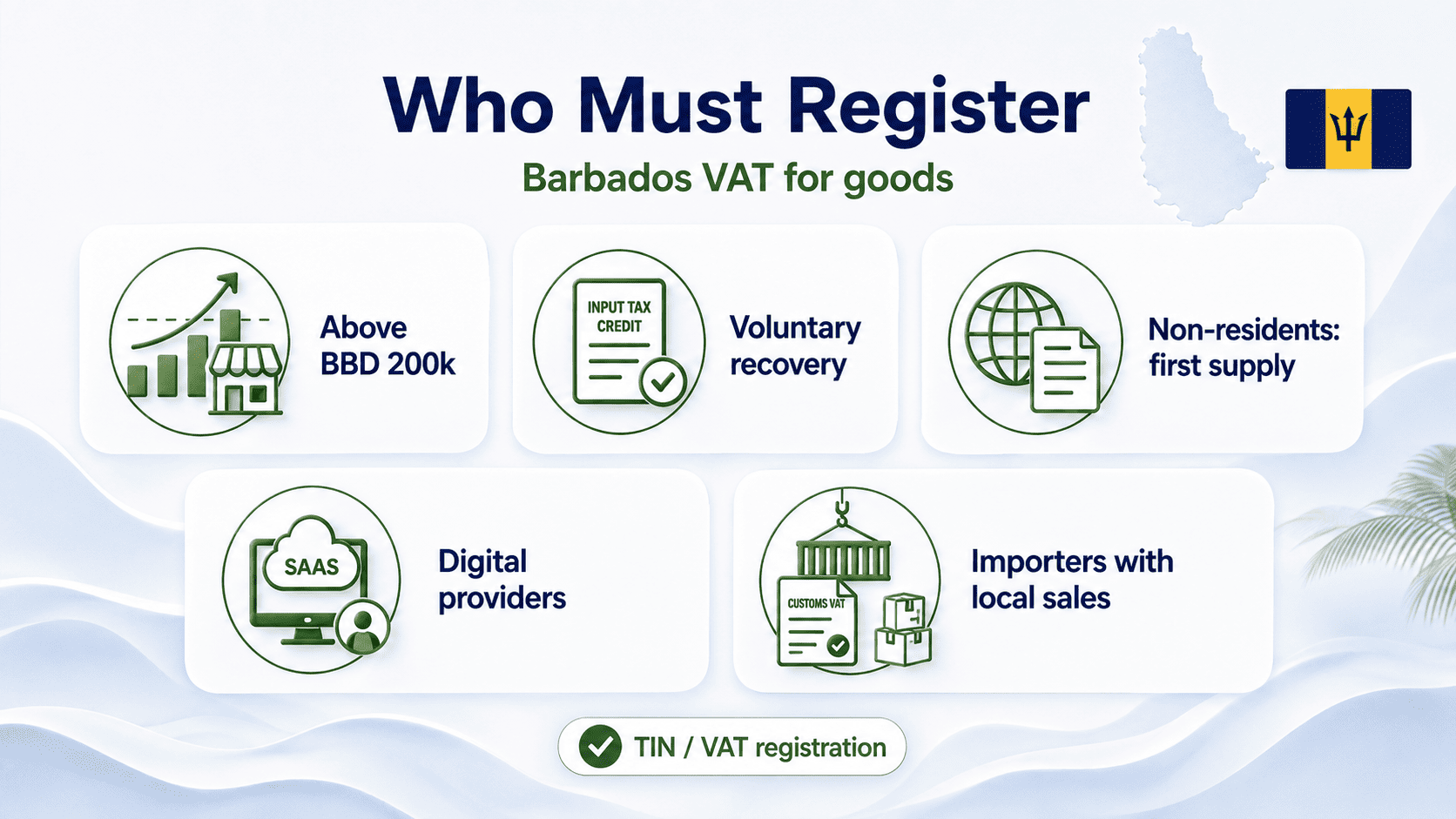 VAT registration Barbados requirements apply to:
- Barbados-established businesses whose annual taxable turnover reaches or exceeds BBD 200,000.
- Businesses voluntarily registering below BBD 200,000 to access input tax recovery on significant capital or operating expenditure.
- Non-resident suppliers making taxable supplies of goods or services in Barbados — from the first supply, regardless of value.
- Non-resident digital service providers supplying Barbadian consumers — from the first supply.
- Importers bringing taxable goods into Barbados who are conducting ongoing commercial activity — the customs VAT collected at importation is separate from, not a substitute for, VAT registration.
VAT Number in Barbados — TIN Format and Registration Structure
The Barbados Revenue Authority uses the Tax Identification Number — TIN — as the core taxpayer identifier. When a business registers for VAT, its VAT registration is linked to its TIN record in the BRA system. The TIN is numeric, assigned upon initial registration with the BRA, and used across all tax types — corporate tax, personal income tax, VAT, and other levies — in a unified taxpayer account. VAT Barbados registration certificates show the TIN alongside the specific VAT registration reference. Both appear on VAT invoices, return submissions, and BRA correspondence. The TIN is what counterparties use to verify a supplier's registration status and what appears on the BRA's public taxpayer verification tools. For businesses that were already registered with the BRA for income tax or corporate tax before adding VAT, the VAT registration attaches to the existing TIN. No new taxpayer number is issued. The BRA's system flags the account as VAT-registered from the registration date, and the VAT filing history becomes part of the same taxpayer record. Counterparty TIN verification matters for input tax purposes. A valid VAT invoice supporting an input tax claim must come from a currently registered supplier. The BRA's online registry allows buyers to confirm whether a supplier's TIN is active and VAT-registered before processing a claim. Invoices from unregistered suppliers — or suppliers whose registration has lapsed — expose the input tax claim to disallowance on audit.VAT Registration Procedure in Barbados — VAT Barbados Online Filing Steps
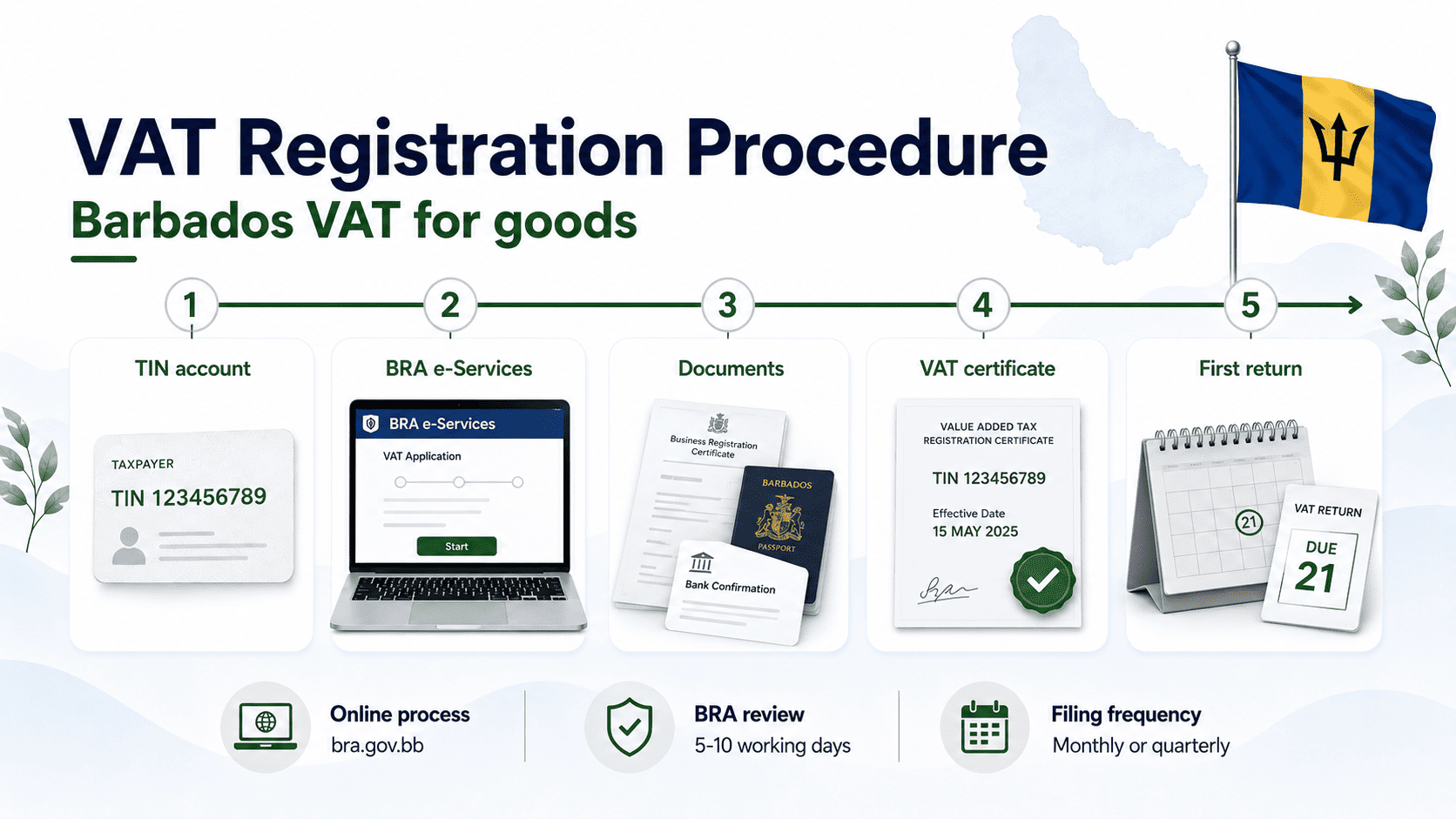 VAT Barbados online registration runs through the BRA's e-Services portal at bra.gov.bb. For most applicants — Barbados-established businesses with an existing TIN — the e-Services route is the primary channel. New businesses without an existing BRA taxpayer record may need to complete both TIN registration and VAT registration in sequence.
Steps for a Barbados-established entity:
VAT Barbados online registration runs through the BRA's e-Services portal at bra.gov.bb. For most applicants — Barbados-established businesses with an existing TIN — the e-Services route is the primary channel. New businesses without an existing BRA taxpayer record may need to complete both TIN registration and VAT registration in sequence.
Steps for a Barbados-established entity:
- Log into the BRA e-Services portal at bra.gov.bb using existing credentials, or create a new account if first-time.
- Navigate to the VAT registration application form and complete all sections: business details, nature of taxable supplies, anticipated annual turnover, banking details.
- Upload supporting documents: certificate of incorporation or business registration certificate, proof of business address, national identification or passport for directors, bank account confirmation.
- Submit the application. The BRA processes routine applications within 5–10 working days. Applications involving non-resident ownership or complex supply arrangements take longer.
- VAT registration certificate issued to the e-Services account on approval, showing the TIN and registration effective date.
- First VAT return due at the end of the month or quarter following the first trading period, depending on assigned filing frequency.
- Certificate of incorporation or equivalent from the home jurisdiction, notarised if required
- Proof of planned taxable activities in Barbados — contracts, letters of engagement, or a description of planned operations
- Fiscal representative appointment letter with the representative's BRA-registered TIN
- Bank account details for refund processing
Tax Representative in Barbados — Service Requirements for Foreign Entities
Non-resident businesses must appoint a local fiscal representative before their VAT registration application is submitted to the BRA. Not at the same time — before. The representative's name and BRA TIN go into the application form as mandatory fields. The fiscal representative handles all compliance on behalf of the foreign entity: return preparation and submission, BRA correspondence, payment management, and audit responses. The service level of the appointed representative directly affects the foreign entity's compliance standing — a representative who misses a filing deadline, submits an incorrect return, or fails to respond to a BRA query on time creates penalties that the foreign principal then has to address. There's no prescribed professional qualification for fiscal representatives in Barbados in the way some jurisdictions (Germany, Austria) require a licensed Steuerberater. In practice, the BRA expects the representative to be a qualified accountant or tax adviser operating in Barbados — typically a member of the Institute of Chartered Accountants of Barbados (ICAB) or an equivalent professional body. Selecting a representative from a credible, locally operating firm reduces the risk of the representative relationship itself becoming a compliance problem. Barbadian-established businesses don't face a mandatory representative requirement. But businesses with complex structures — mixed taxable-exempt supplies, import-heavy operations, group VAT arrangements — commonly retain a Barbadian tax adviser to manage the filing calendar, handle BRA queries, and ensure the input tax apportionment calculations are defensible. The BRA's audit team is experienced at finding apportionment errors in mixed-supply businesses, and the cost of getting it wrong typically exceeds the cost of professional support.VAT E-Invoices in Barbados — Timeline for Different Business Sizes
Barbados hasn't mandated a clearance-model e-invoicing system of the kind being rolled out in Brazil, Saudi Arabia, or across the EU under the ViDA directive. The BRA's digitalisation focus has been on e-filing of returns and payments rather than on structured invoice data exchange. VAT invoices in Barbados remain paper or PDF documents meeting the format requirements of the VAT Act, without a requirement for real-time transmission to the BRA. The BRA introduced mandatory e-filing for VAT returns in phases, with large taxpayers moved onto the e-Services platform first. Current e-filing and invoice status by business size:| Business Segment | Return Filing | Invoice Format | E-Invoicing Mandate |
| Large taxpayers (above BBD 1,000,000 annual turnover) | e-Filing via BRA portal — mandatory | Paper or electronic, VAT Act format | Not currently mandated |
| Medium taxpayers (BBD 200,000–1,000,000) | e-Filing available and encouraged | Paper or electronic | Not currently mandated |
| Small taxpayers — voluntary registrants | e-Filing available | Paper or electronic | Not currently mandated |
| Non-resident registered suppliers | e-Filing via BRA portal | Paper or electronic | Not currently mandated |
- Sequential invoice number
- Issue date
- Supplier name and TIN
- Customer name and address (for B2B transactions above specified values)
- Description of goods or services supplied
- Taxable amount
- Applicable VAT rate (17.5%, 7.5%, or 0%)
- VAT amount
- Total invoice amount
VAT Returns in Barbados — Types of Report
Barbados VAT tax returns are filed on a monthly or quarterly schedule, determined by annual taxable turnover.- Monthly filing: required when annual taxable supplies exceed BBD 500,000
- Quarterly filing: required when annual taxable supplies are BBD 500,000 or below (but above the BBD 200,000 registration threshold)
- Total output VAT by rate category (17.5% standard, 7.5% reduced, zero-rated, exempt)
- Total input VAT claimed on purchases and imports
- Adjustments for credit notes, bad debt relief, and prior-period corrections
- Net VAT payable, or credit balance to be carried forward or refunded
Deductible VAT in Barbados
Input tax credit is available for VAT paid on purchases that relate directly to making taxable supplies. The standard conditions apply: the purchase is from a VAT-registered supplier with a valid TIN; a proper VAT invoice is held showing the required fields; and the purchase is used in the course of making taxable (standard or zero-rated) supplies. Categories that block or restrict input recovery:- Purchases used for making exempt supplies — no recovery on attributable costs
- Entertainment and hospitality — input VAT on client entertainment is non-recoverable
- Personal consumption by employees or owners
- Motor vehicles used partly or wholly for private purposes — recovery restricted to the business-use fraction
- Purchases from unregistered suppliers — no valid TIN on the invoice means no recoverable input tax
VAT Record-Keeping Requirements in Barbados
The VAT Act Cap. 87 requires VAT-registered businesses to retain records for six years from the end of the accounting period to which they relate. The six-year clock runs from period end, not from when the document was created or received. A VAT invoice from a purchase made in October 2024 must be retained until at least the end of the accounting period ending in 2030 — which in practice means keeping 2024 records until at least 2031 under a calendar-year accounting period. Records within the retention obligation:- All issued VAT invoices with sequential numbering maintained
- All received VAT invoices supporting input tax claims
- Import entry documents and customs assessment notices
- Credit notes and debit notes, each referencing the original invoice
- Monthly or quarterly VAT return submissions and BRA e-Services confirmation receipts
- Annual VAT return filings
- Input tax apportionment calculations and working papers (for mixed-supply businesses)
- Bank statements showing VAT payments and refund receipts
- Contracts, purchase orders, and agreements with VAT implications
- Bad debt write-off documentation where bad debt relief has been claimed
VAT Penalties in Barbados — VAT Barbados Non-Compliance Costs
The BRA administers VAT penalties under the authority of the VAT Act Cap. 87. The penalty regime separates registration failures, return and payment delays, incorrect filings, and deliberate evasion. Failure to register when required: A business that crosses the BBD 200,000 threshold and fails to register faces a penalty for each period of non-registration, plus the full VAT liability — output tax minus allowable input credits — backdated to the date registration was required. The BRA doesn't limit the backdated assessment to the discovery date; the full unregistered period is assessed. Late return filing: A penalty of BBD 500 per month applies for each month (or part thereof) that a return is outstanding after the 21st due date. Additional interest accrues on any tax owed but unpaid. Late payment: Interest at the rate prescribed by the BRA — historically in the range of 1–2% per month — applies from the payment due date on any unpaid net VAT. Interest compounds monthly. A BBD 20,000 unpaid VAT liability accumulating for six months at 1.5% monthly generates approximately BBD 1,850 in interest alone, before any late filing penalty. Incorrect returns: Where a return understates output tax or overstates input tax, the BRA assesses the underpaid amount plus interest from the original due date. For negligent errors, an additional penalty applies based on the quantum of the underpayment. Deliberate misstatement carries a higher penalty rate and, for serious cases, can be referred for criminal prosecution under the VAT Act. VAT Barbados evasion — fabricated invoices, suppressed sales records, inflated input claims on non-existent purchases — carries criminal penalties including fines and imprisonment. The BRA has cross-referencing tools that compare VAT return data against income tax filings, customs records, and third-party data. Discrepancies that surface through this matching process generate audit notifications with short response windows. Businesses that receive a BRA audit query and can't produce the underlying documentation within the specified timeframe face automatic assessments based on the BRA's own estimates — which invariably exceed what a documented return would have shown. Voluntary disclosure is the lower-risk exit for identified errors. A business that finds a prior-period error and discloses it to the BRA proactively — before any audit notification arrives — receives more favourable penalty treatment than one where the same error is discovered during a BRA-initiated review. The BRA's voluntary disclosure programme is available and the BRA uses it. Don't wait.How Lappa Can Help with VAT Compliance in Barbados
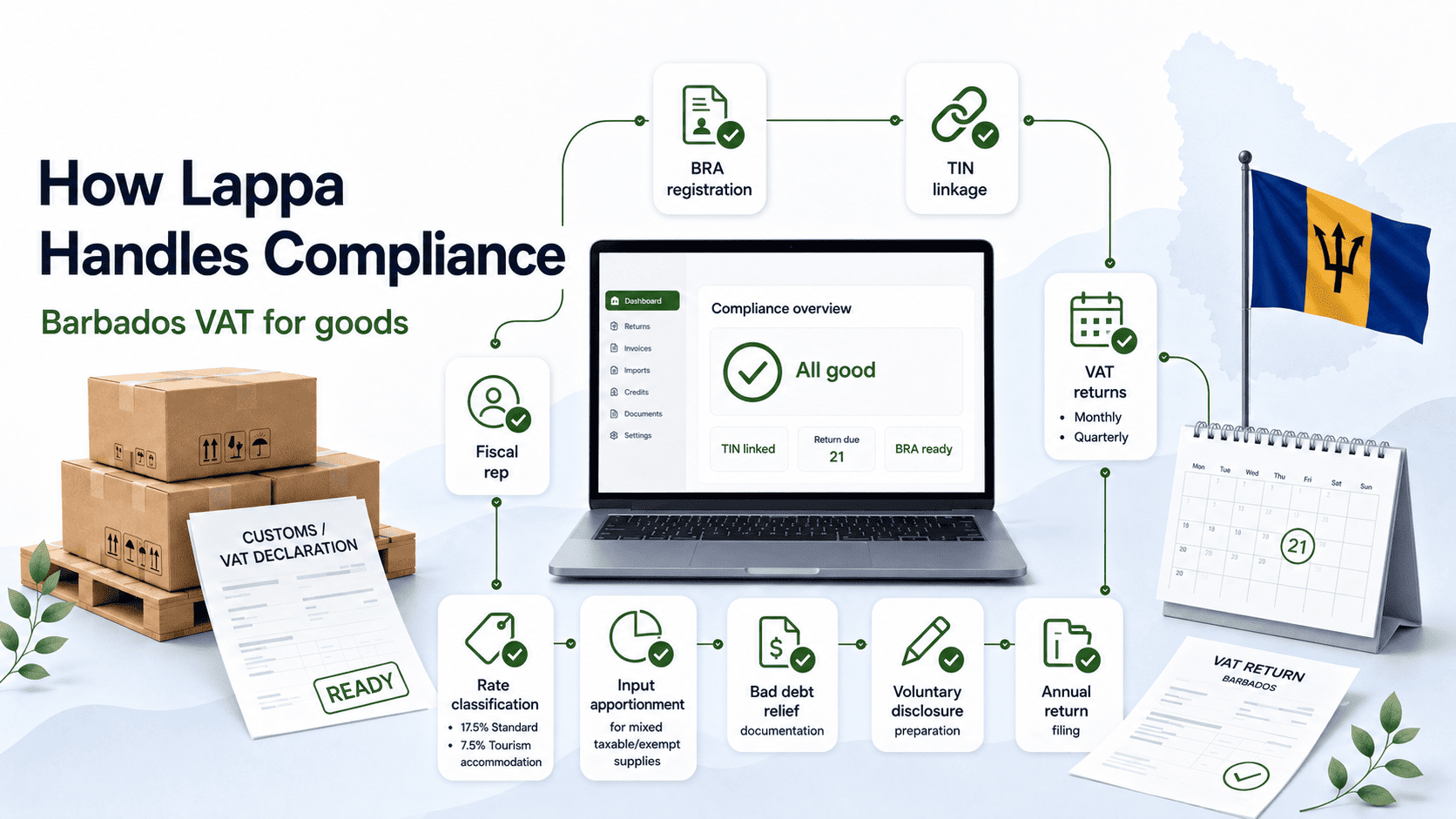 Lappa's platform covers the full Barbados VAT compliance cycle: BRA registration, TIN linkage, monthly and quarterly return preparation and submission via the e-Services portal, annual return filing, and ongoing compliance calendar management.
For non-resident businesses entering the Barbadian market, Lappa provides fiscal representative services as required by the BRA — taking on the local representative role, managing BRA correspondence, and handling return filings on behalf of the overseas entity. That removes the need to independently source and vet a Barbadian fiscal representative before operations begin.
The platform supports input tax apportionment calculations for businesses with mixed taxable and exempt supplies, manages bad debt relief claims with the documentation the BRA requires, and provides voluntary disclosure preparation services for businesses that have identified prior-period errors before a BRA audit is initiated.
For businesses supplying both goods and accommodation services, Lappa handles the rate classification between the 17.5% standard and 7.5% reduced rate — a determination that affects every sales invoice and every return, and that the BRA's audit teams specifically examine in hospitality and tourism businesses.
Lappa's platform covers the full Barbados VAT compliance cycle: BRA registration, TIN linkage, monthly and quarterly return preparation and submission via the e-Services portal, annual return filing, and ongoing compliance calendar management.
For non-resident businesses entering the Barbadian market, Lappa provides fiscal representative services as required by the BRA — taking on the local representative role, managing BRA correspondence, and handling return filings on behalf of the overseas entity. That removes the need to independently source and vet a Barbadian fiscal representative before operations begin.
The platform supports input tax apportionment calculations for businesses with mixed taxable and exempt supplies, manages bad debt relief claims with the documentation the BRA requires, and provides voluntary disclosure preparation services for businesses that have identified prior-period errors before a BRA audit is initiated.
For businesses supplying both goods and accommodation services, Lappa handles the rate classification between the 17.5% standard and 7.5% reduced rate — a determination that affects every sales invoice and every return, and that the BRA's audit teams specifically examine in hospitality and tourism businesses.
FAQ for Barbados VAT Goods
What Is the VAT Rate in Barbados
- Barbados applies a standard VAT rate of 17.5% to most goods and services. A reduced rate of 7.5% applies to hotel and guesthouse accommodation and related tourism services. Zero-rating covers exported goods, international transport, basic food items, prescription drugs, and specified agricultural inputs. Financial services, insurance, residential rental, healthcare, education, and public passenger transport are exempt from VAT.
Who Needs to Register for VAT in Barbados
Barbados-established businesses must register once annual taxable turnover reaches BBD 200,000. Voluntary registration is available below that threshold. Non-resident businesses making any taxable supply in Barbados must register from the first supply — no threshold applies. Non-resident digital service providers supplying Barbadian consumers face the same zero-threshold registration obligation.What Is the VAT Number Format in Barbados
Barbados uses the Tax Identification Number (TIN) issued by the Barbados Revenue Authority as the VAT registration identifier. When a business registers for VAT, its VAT registration links to its existing TIN in the BRA system. The TIN is numeric and appears on VAT invoices, return submissions, and all BRA correspondence. Counterparty TINs can be verified through the BRA's online taxpayer registry at bra.gov.bb.How Often Are VAT Returns Filed in Barbados
Filing frequency depends on annual taxable turnover. Monthly returns apply when taxable supplies exceed BBD 500,000. Quarterly returns apply for businesses between BBD 200,000 and BBD 500,000. Returns and payment are both due by the 21st of the month following the reporting period. An annual VAT return reconciling all periodic returns is also required.Do Foreign Companies Need a Tax Representative in Barbados
Yes. Non-resident businesses registering for VAT in Barbados must appoint a local fiscal representative before submitting their registration application to the BRA. The representative handles return filing, BRA correspondence, and ongoing compliance management. The BRA will not process a non-resident registration application that doesn't name a local representative.VAT Calculator
At 17.5%: multiply net by 1.175 for the gross amount. To extract VAT from a gross price: divide gross by 1.175 and subtract. A BBD 1,000 net supply carries BBD 175 VAT; the customer pays BBD 1,175. At 7.5%: multiply net by 1.075. Extract from gross: divide by 1.075 and subtract. A BBD 500 net accommodation charge carries BBD 37.50 VAT; the guest pays BBD 537.50. Barbadian VAT invoices must show the taxable amount, the applicable rate, and the VAT component as separate items. A single gross figure without the breakdown is a defective invoice — the customer can't process an input tax claim from it, and the BRA audit team flags missing breakdowns as a documentation failure.
VAT Standard rate
17.5%
VAT Reduced rate
7.5%, 10%, 0%
Thresholds
BBD 200,000 annual taxable turnover (mandatory VAT registration)