


Albania VAT Registration and Compliance Guide
Provinces
Goods
Provinces
Goods
Digital services
About
Goods
About
Goods
About
Digital services
About
Digital services
Goods
Digital services
Goods
Digital services
Introduction to VAT in Albania
Albania started taxing digital services supplied by foreign companies to local consumers back when most countries were still debating whether they should. The current framework — Law No. 92/2014 "On Value Added Tax in the Republic of Albania," amended several times since — treats electronically supplied services as taxable in Albania the moment the end consumer is located there. Where the supplier operates from is irrelevant. What matters is where the customer sits. That's the destination principle, and Albania applies it consistently. The logic mirrors the EU's VAT on Digital Services regime, but Albania isn't in the EU. No One Stop Shop applies here. No EU registration thresholds carry over. A foreign platform that handles its EU digital VAT through a single OSS return still needs a separate Albanian registration if it's selling to Albanian consumers — and that obligation starts from the very first transaction. The threshold for non-resident B2C digital suppliers is zero. One subscriber in Tirana and you're in scope. This creates a compliance situation that catches businesses off guard more often than physical goods obligations do. At least with goods, registration is triggered by stock location — a visible, deliberate decision. Digital services cross borders invisibly, and many platforms don't know how many Albanian consumers they have until someone looks. TAMATE has been developing cross-border data matching capabilities since 2022, working with payment processors and app store operators to identify unregistered foreign suppliers. The window for voluntary regularisation before enforcement contact is narrowing. This guide covers the full lifecycle: which supplies are in scope, how registration works for non-resident businesses, what the filing and invoicing requirements look like in practice, and what happens when obligations have been missed.VAT Rates in Albania
Digital services slot into the same Albanian VAT rate structure as physical goods, with one narrow exception for certain content.| Rate | Percentage | Application to digital services |
| Standard | 20% | SaaS, streaming, apps, cloud, online advertising |
| Reduced | 6% | Some e-books and digital educational content |
| Zero | 0% | B2B reverse charge supplies — zero from the supplier's side |
| Exempt | — | Rarely applicable to digital services |
VAT in Albania Registration Threshold
For Local Businesses
An Albanian-resident digital business — legal seat or operational headquarters registered inside Albania — follows the same threshold as any other sector. Once taxable turnover in any rolling twelve-month period clears ALL 10 million (around EUR 96,000 at current rates), registration is compulsory. Albanian-resident digital companies manage their compliance through the standard e-Albania portal and the same monthly filing cycle as physical goods businesses.For Remote Sellers
The remote seller concept in the goods context — a foreign company triggering registration by holding stock in Albania — doesn't translate directly to digital services, which have no physical component. Digital service providers supplying from abroad fall under the zero-threshold category below.For Remote Digital Services
No threshold. The first sale to an Albanian private consumer creates an immediate registration obligation. Not after the tenth subscriber. Not once you've hit a revenue floor. The first one. Three things together establish that the zero threshold applies:- The service is electronically delivered — automated, minimal human intervention required
- The customer is an Albanian private individual, not a VAT-registered Albanian business
- Evidence confirms the customer's location as Albania at the time of supply
Who Must Register for VAT Albania
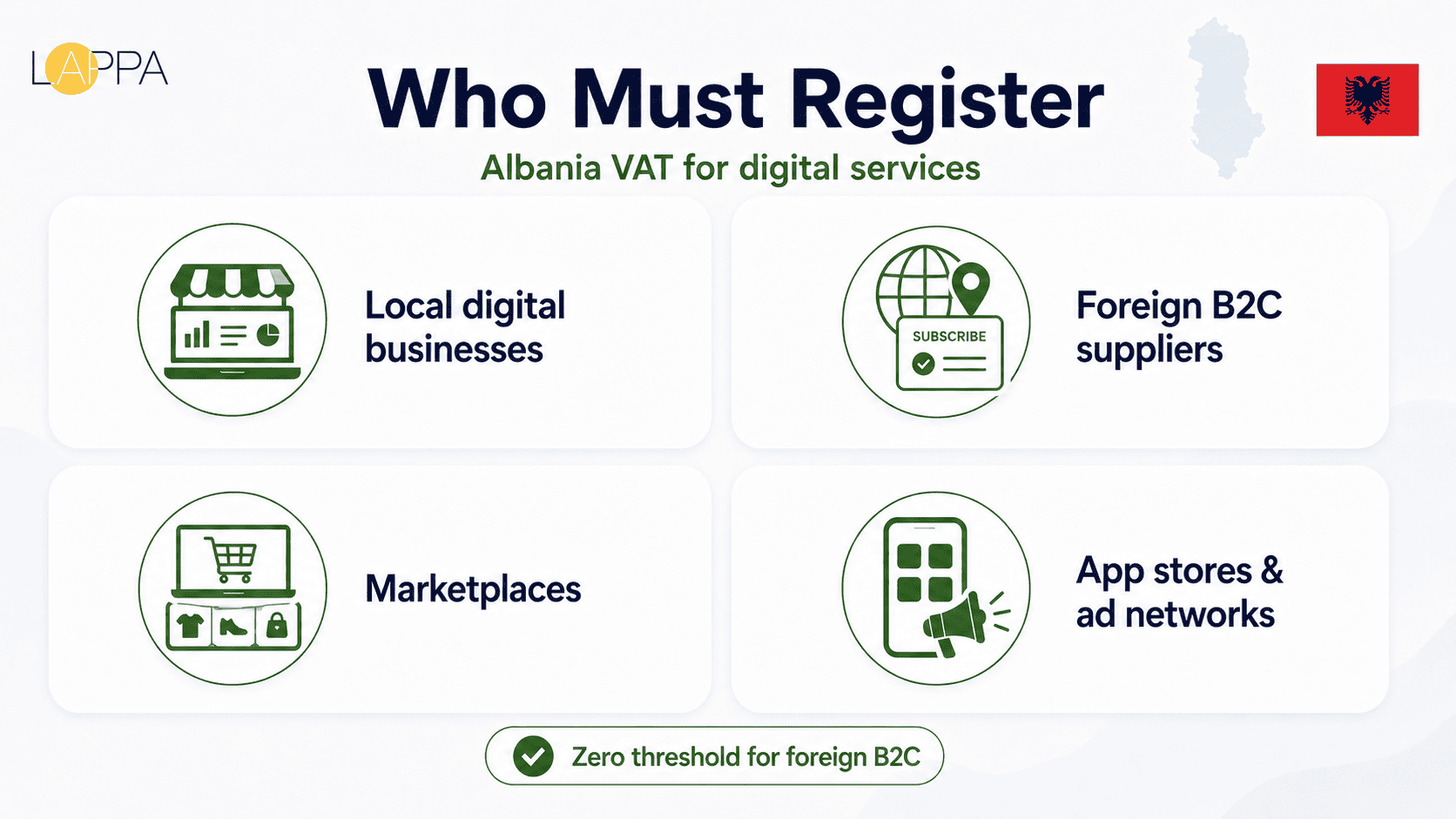 The categories that carry an Albanian VAT registration obligation for digital services:
- Albanian-resident digital businesses with annual turnover above ALL 10 million
- Any foreign business supplying electronically delivered services to Albanian private consumers — from the first transaction, regardless of value
- Online marketplace operators and platform intermediaries who collect payment from Albanian consumers on behalf of underlying digital content sellers
- Foreign app stores, cloud platform operators, and online advertising networks where Albanian consumers are the end users
VAT Number in Albania
The VAT number Albania for foreign digital service providers registered in Albania is the same NIPT format used across all sectors: one uppercase letter followed by eight alphanumeric characters. Different letters indicate different entity types — the letter a foreign company receives typically corresponds to its classification as a branch or foreign-incorporated entity rather than a domestically formed company. The NIPT is issued in the foreign company's name, not the fiscal representative's. The representative manages the account; the number belongs to the non-resident entity. This distinction matters when Albanian business customers request documentation for reverse charge purposes. They need to see the foreign company's NIPT and legal name on the invoice, not the representative's. Platforms billing Albanian B2B customers need their invoicing systems configured accordingly. For businesses determining whether a given customer qualifies for reverse charge treatment, TAMATE's public NIPT validation tool on the e-Albania portal verifies status in real time. High-volume platforms typically integrate this check into their checkout or billing flow — calling the validation API before applying reverse charge treatment and logging the response as part of the transaction record.Understanding what is VAT number in Albania is therefore essential not only for registration but for accurate B2B transaction processing.VAT Number Registration Procedure in Albania
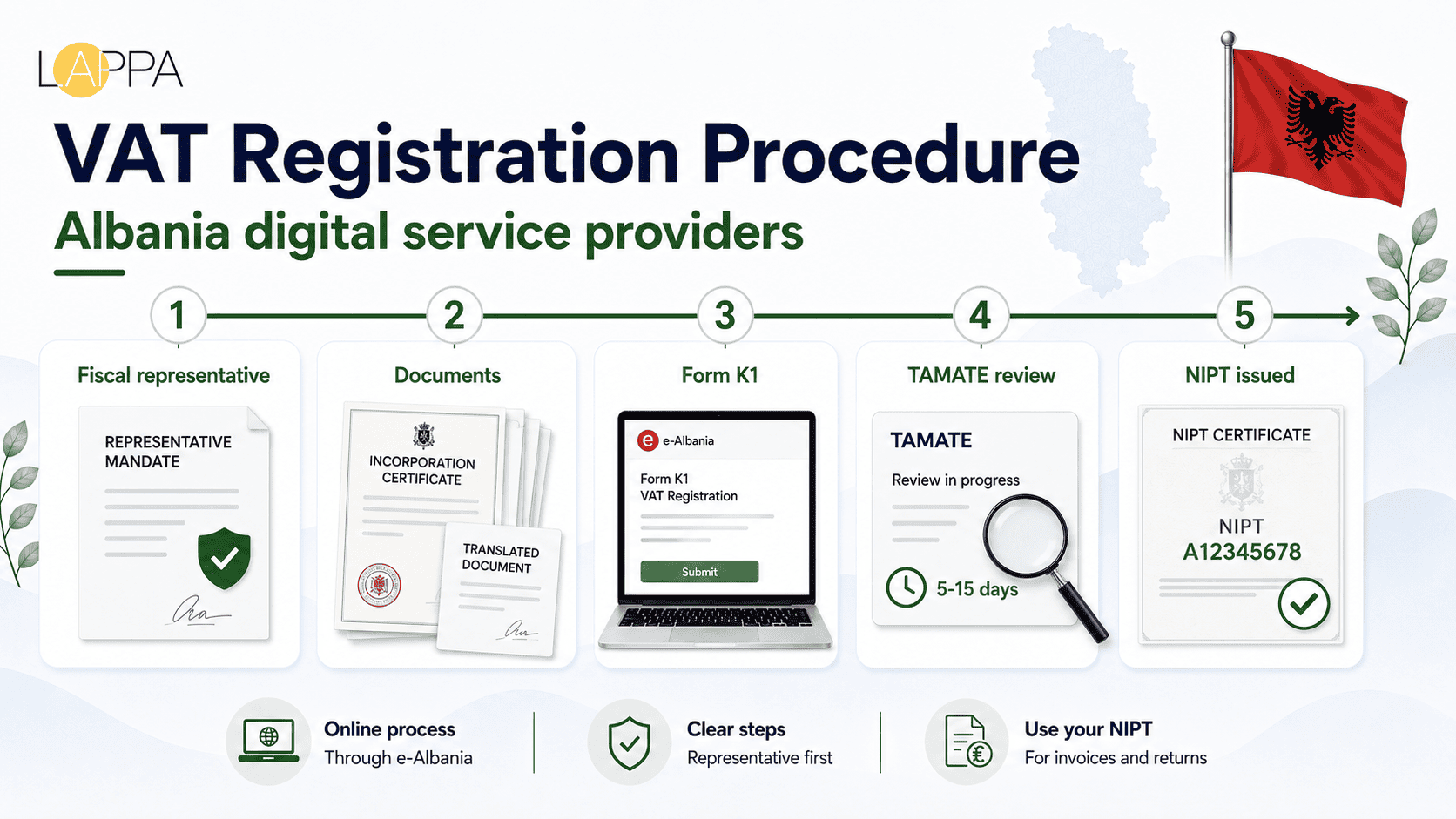 Foreign digital businesses need to appoint a fiscal representative before the registration application can be submitted. That's step one, not an afterthought.
- Step 1 — Appoint a TAMATE-authorised fiscal representative Find an Albanian-resident entity or individual holding current TAMATE authorisation to act for non-resident businesses. Execute a mandate agreement covering data sharing, reporting responsibilities, liability management, and the process for handling TAMATE queries. Don't start the registration process without a signed mandate — the representative's details are required on the application form.
- Step 2 — Prepare registration documents The representative collects on the foreign company's behalf: certificate of incorporation with certified Albanian translation, evidence of the foreign business address, a description of the digital services being supplied to Albanian consumers, and the executed appointment mandate.
- Step 3 — Submit Form K1 through the representative's e-Albania account The foreign company's details go in as the registrant. The representative's credentials populate the designated representative fields. All documentation attaches at submission.
- Step 4 — TAMATE review Standard processing: 5 to 15 working days. For digital service providers, TAMATE sometimes requests additional information about the service model — specifically how customer location is determined and the expected volume of Albanian B2C transactions. Respond promptly; delayed responses extend the review period.
- Step 5 — Receive NIPT and start compliant billing The NIPT certificate is issued to the foreign company through the representative. From the effective registration date, Albanian VAT at the applicable rate must be added to all B2C supplies to Albanian consumers, and those amounts reported and remitted on the monthly return.
Tax Representative in Albania
For digital service providers without an Albanian fixed establishment, the fiscal representative isn't optional — it's a legal condition of registration. TAMATE won't process a non-resident application without one. The representative takes on three things that aren't separable:- Administration — registration application, all periodic VAT returns, payments, and every piece of formal correspondence with TAMATE on the foreign company's behalf
- Financial liability — joint and several liability for any Albanian VAT the foreign business doesn't pay, enforceable by TAMATE directly against the representative
- Record management — maintaining the transaction records and customer location evidence required under Albanian VAT law, in Albanian, producible to auditors within 30 days
VAT E-Invoices in Albania
Albania's fiscalisation system was built primarily around B2B physical goods transactions. Its application to digital services varies depending on who the supplier is and who the customer is. Albanian-resident digital businesses billing other Albanian businesses must fully fiscalise — real-time transmission to the TAMATE server, fiscal code returned and added to each invoice. This has applied since July 2022. Foreign digital service providers billing Albanian consumers directly on a B2C basis operate differently. TAMATE accepts aggregate return reporting for non-resident businesses rather than requiring individual invoice fiscalisation. Consumer-facing receipts or invoices from the platform's own billing system satisfy the customer documentation requirement. The transaction data doesn't need to go through the TAMATE fiscalisation server — but it does need to sit in the platform's records, available on audit request. Invoicing obligations by digital business type| Business type | Customer | Fiscalisation required |
| Albanian-resident digital business | Other Albanian businesses | Yes — since July 2022 |
| Albanian-resident digital business | Albanian consumers | Yes — fiscalised receipt |
| Foreign digital provider via fiscal rep | Albanian consumers (B2C) | No — aggregate return reporting |
| Foreign digital provider | Albanian businesses (B2B reverse charge) | No — standard invoice citing customer NIPT |
VAT Returns in Albania
Monthly returns, filed through the e-Albania portal by the fiscal representative for foreign businesses. Each return covers a calendar month and is due by the 14th of the following month. Payment accompanies the return on the same deadline. There's no quarterly option for foreign digital service providers — the monthly cycle applies regardless of how few Albanian subscribers you have.VAT Control Report
Each monthly return is a summary declaration covering:- Total Albanian B2C revenue from electronically supplied services during the period, by applicable rate
- Total output VAT at each rate
- Any Albanian-sourced input VAT (limited for most foreign digital platforms)
- Net amount payable to TAMATE
Deductible VAT in Albania
Most foreign digital service providers operating through an Albanian fiscal representative incur very little Albanian-sourced input VAT. Their primary costs — engineering, content, marketing, office space — are in their home country and carry that country's tax. But some cost categories generate Albanian input VAT and are worth tracking:- Fiscal representative fees where those fees carry Albanian VAT
- Local marketing, translation, or Albanian-language content services
- Any Albanian technology or software vendors
- Office costs if the business ever establishes any physical Albanian presence
VAT Record-Keeping Requirements in Albania
Digital service providers carry a record-keeping obligation with a dimension that physical goods businesses don't: location evidence. For each B2C supply to Albanian consumers, TAMATE requires at least two non-contradictory pieces of evidence confirming the customer was in Albania at the time of the transaction. Acceptable evidence includes:- Billing address provided by the customer at registration
- IP address recorded at the moment of purchase or login
- Country of the SIM card for mobile transactions
- Issuing country of the customer's payment card
- Customer self-declaration of country of residence
VAT Penalties in Albania
| Violation | Penalty |
| No registration despite B2C sales | ALL 50,000 fixed + daily penalties + full backdated VAT + 0.06%/day interest |
| Late monthly return | ALL 10,000/month (max ALL 50,000 per period) |
| Late payment | 0.06%/day from original due date |
| Understated output VAT | 25% of underpaid amount (first offense) |
| Repeated understatement | 50% of underpaid amount |
| Missing location evidence | Estimated assessment treating all revenue as B2C taxable at 20% |
How Lappa Can Help with Gloval VAT Compliance in Albania
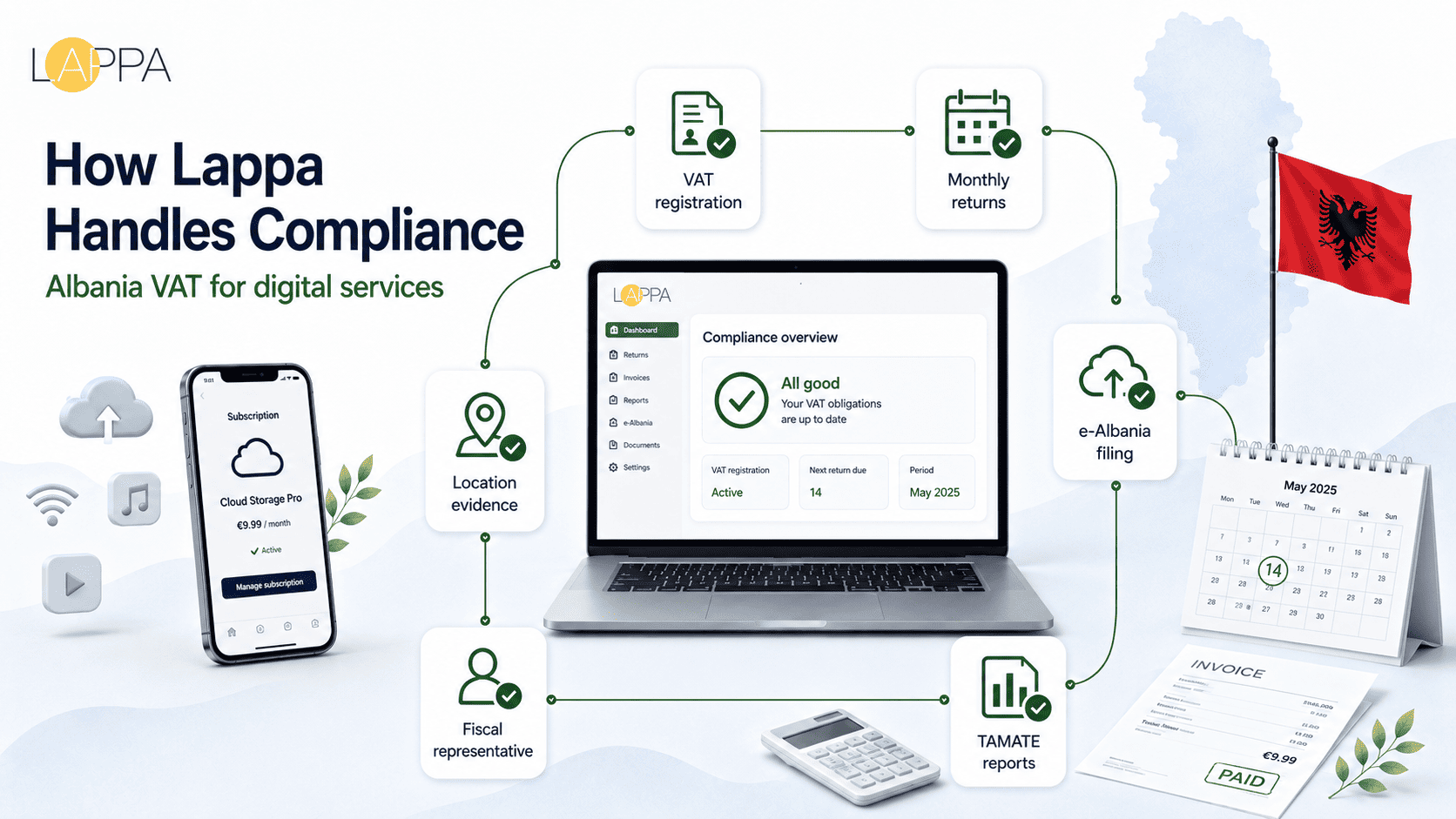 Lappa works with digital service providers on Albanian VAT from initial exposure analysis through to ongoing compliance and, where needed, voluntary regularisation for companies that have identified an unregistered period.
For digital businesses, the team covers:
Lappa works with digital service providers on Albanian VAT from initial exposure analysis through to ongoing compliance and, where needed, voluntary regularisation for companies that have identified an unregistered period.
For digital businesses, the team covers:
- Obligation assessment — analysis of your service model, customer base composition, and transaction structure against Albanian VAT rules to confirm what you actually owe and when
- Fiscal representative services — Lappa provides TAMATE-authorised fiscal representation for foreign digital businesses, including registration, all monthly returns, payment coordination, and TAMATE correspondence
- Rate classification — guidance on which services qualify for 6% and which require 20%, with formal ruling requests to TAMATE where classification is uncertain
- Location evidence review — assessment of your current customer data practices against the two-evidence standard, with recommendations for closing gaps before they become an audit issue
- Return preparation — monthly return production from billing system transaction data, cross-referenced against payment processor figures before filing
- Voluntary disclosure — for businesses with an unregistered period, Lappa quantifies the liability, prepares the corrective filing, and manages the TAMATE process to minimise the total settlement
FAQ
- What is the VAT rate in Albania?
- The standard rate for digital services in Albania is 20%, covering the large majority of electronically supplied services — subscription platforms, SaaS products, cloud services, apps, and online advertising. A reduced rate of 6% applies to a narrow category of digital content that directly corresponds to a physically published equivalent, such as certain e-books, though TAMATE scrutinises these classifications and platforms should confirm eligibility before applying the lower rate. B2B supplies to Albanian VAT-registered businesses with a confirmed NIPT operate under reverse charge, meaning the Albanian customer accounts for the 20% and the foreign supplier charges nothing — the VAT still enters the Albanian system, just not through the supplier's return.
- Who needs to register for VAT Albania?
- Any foreign business supplying electronically delivered services to Albanian private consumers must register for Albanian VAT from the first transaction — there is no minimum revenue threshold for non-resident B2C digital suppliers. Albanian-resident digital businesses follow the standard ALL 10 million annual turnover threshold that applies across all sectors. Online marketplace operators and platform intermediaries collecting payment from Albanian consumers on behalf of underlying sellers are treated as the supplier for VAT purposes under Albanian law and carry the registration obligation directly.
- What is VAT number format in Albania?
- The Albanian VAT number — the NIPT — consists of one uppercase letter followed by eight alphanumeric characters. The opening letter indicates the legal entity type, with different letters assigned to different company forms including locally formed companies and foreign entities operating branches in Albania. For foreign digital businesses, the NIPT is issued in the foreign company's own name rather than the fiscal representative's name, which matters when the platform needs to include the NIPT on invoices issued to Albanian B2B customers for reverse charge documentation.
- How often are VAT returns filed in Albania?
- Monthly, without exception for foreign digital service providers. Each return covers a calendar month and is due by the 14th of the following month, with payment on the same date. Unlike physical goods businesses that can apply for quarterly filing if their turnover is low, non-resident digital businesses have no quarterly option — the monthly cycle runs regardless of how small the Albanian subscriber base is.
- Do foreign companies need a tax representative for global VAT compliance Albania?
- Yes, and there's no route around it. Foreign digital businesses without an Albanian fixed establishment cannot register for VAT without a TAMATE-authorised fiscal representative in place first. The representative submits all registrations, monthly returns, and TAMATE correspondence, and accepts joint and several liability for any Albanian VAT the foreign company doesn't remit — meaning TAMATE can pursue the representative directly for unpaid amounts. This liability exposure is real and drives the due diligence that serious fiscal representatives apply before accepting digital platform clients. A detailed mandate agreement covering data-sharing obligations, reporting deadlines, and liability management should be executed before any registration application is filed.
VAT Calculator
For B2C supplies where you're adding VAT to your prices: Adding 20% to a net amount: Net × 1.20 = gross. Gross minus net = VAT. Extracting 20% from a price already inclusive of VAT: Gross ÷ 1.20 = net. Gross minus net = VAT.| Transaction (ALL) | Customer type | Treatment | VAT (ALL) | Supplier remits |
| 1,200/month subscription | Albanian consumer | 20% standard | 200 | 200 to TAMATE |
| 6,000/month subscription | Albanian consumer | 20% standard | 1,000 | 1,000 to TAMATE |
| 12,000/month enterprise licence | Albanian business + valid NIPT | Reverse charge | 2,400 (customer pays) | 0 from supplier |
| 600/month e-book | Albanian consumer | 6% if qualified | 34 | 34 to TAMATE |
| 50,000 one-off SaaS setup | Albanian consumer | 20% standard | 8,333 | 8,333 to TAMATE |
Introduction to VAT in Albania
VAT in Albania is called TVSH -- Tatimi mbi Vlerën e Shtuar (Tax on Added Value). TATIME (Drejtoria e Pergjithshme e Tatimeve -- the General Directorate of Taxes) administers it. Albania is an EU candidate country, not an EU member -- that distinction matters significantly for digital service providers. There's no OSS (One Stop Shop) route for Albanian supplies. No IOSS. No union-wide simplification scheme. Every foreign digital business supplying Albanian consumers registers directly with TAMATE and files its own Albanian returns. The Albanian VAT framework was established under Law No. 92/2014 On Value Added Tax and has been amended several times since, most significantly to capture non-resident digital service providers under the TVSH net. Albania adopted the destination principle for digital services: if your customer is an Albanian consumer, Albanian TVSH applies, regardless of where your business is based. The obligation lands on you, the provider, not on the Albanian consumer. VAT Albania compliance for digital businesses is administratively distinct from EU-country compliance. You can't use existing EU OSS registrations to cover Albanian supplies. You can't fold Albanian revenue into a Polish or German VAT return and call it done. Albania requires a separate registration, a fiscal representative on the ground, and monthly returns filed through its own e-Albania portal. For businesses that already manage EU digital VAT through OSS, Albania is an additional, separate compliance track.VAT Albania and the DPH Framework for Digital Commerce
VAT Albania amendments covering non-resident digital service providers came into force progressively between 2019 and 2021, aligning Albania's approach with OECD guidelines on taxing the digital economy. Under these rules, streaming platforms, SaaS providers, cloud storage services, online gaming companies, e-learning platforms, and digital download businesses are all required to register and account for TVSH on B2C sales to Albanian consumers. Albania doesn't offer a simplified non-resident registration portal equivalent to EU OSS -- the process runs through the standard TATIME registration system with a fiscal representative as the intermediary. For B2B digital services -- where the customer is an Albanian business with a valid NIPT (Numri i Identifikimit te Personit Tatimpagues) -- the reverse charge mechanism applies. The Albanian business accounts for TVSH on the invoice. The non-resident digital service provider invoices without TVSH and doesn't register for Albanian purposes solely because of those B2B supplies. But the moment your Albanian customer base includes consumers -- individuals without a business NIPT -- the B2C registration obligation applies to those transactions.VAT Rates in Albania
| Rate Tier | Rate | Applies to Digital Services | Notes |
| Standard | 20% | SaaS, cloud platforms, streaming (video, audio, gaming), digital downloads, e-learning, hosting, online advertising, data analytics, API access, digital consultancy | Default rate for all digital services not explicitly reduced or exempt. Applies to B2C sales to Albanian consumers. |
| Reduced | 6% | Hotel accommodation services (including digital booking platforms where the accommodation itself is in Albania); pharmaceutical products; some basic food and agricultural goods | The 6% rate generally does not apply to core digital services. Software, SaaS, and streaming remain at 20%. |
| Zero rate | 0% | Digital services supplied B2B to Albanian-registered businesses (reverse charge applies to the Albanian buyer); services exported to non-Albanian clients used entirely outside Albania | B2B digital services to an Albanian business with a valid NIPT: the Albanian buyer self-assesses TVSH. Non-resident provider does not charge TVSH on those supplies. |
| Exempt | Exempt | Certain financial services provided digitally; insurance and reinsurance; specific healthcare-related digital services; some educational digital content where the service qualifies as formal education | Exempt supplies carry no input TVSH recovery right on related costs. Confirm exemption basis with a local adviser before applying. |
Albania VAT Rate for Digital Services
Albania VAT rate on digital services is 20% -- the standard rate. Software subscriptions (SaaS), cloud infrastructure access, streaming platforms, online gaming, digital downloads, e-learning systems, API services, online advertising networks -- all 20%. There's no special reduced rate for digital products in Albania. The 6% reduced rate covers accommodation, certain pharmaceuticals, and some agricultural goods. Digital is not on that list. If you're selling anything in the digital services category to Albanian consumers, budget for 20% TVSH on every sale. The 20% standard rate applies to Albanian B2C digital sales from the first day of your TVSH registration. For revenue generated before registration -- if you were supplying Albanian consumers without being registered -- TAMATE can assess TVSH on historical unregistered B2C supplies, plus penalties and interest from the point the obligation arose. The safest position is to register before the first Albanian B2C sale and price the 20% TVSH into your consumer pricing from day one.Albania VAT Rate 2026 - Current Rates for Non-Resident Digital Providers
Albania VAT rate 2026 remains at 20% for the standard rate. No rate change has been announced or implemented for digital services as of the time of this guide's preparation. Albania's 20% standard rate has been stable for several years and is expected to remain so into 2026. The 6% reduced rate also remains unchanged. For SaaS businesses, streaming providers, cloud platforms, and other digital service companies, the 20% rate you're planning around in 2025 is the same rate you'll be accounting for in 2026 unless TAMATE announces a change. Albania VAT rate 2026 planning for non-resident digital businesses should account for the currency dimension too. Albanian TVSH is payable in Albanian Lek (ALL), even if your subscription revenue is collected in EUR or USD. You'll need to convert at the exchange rate applicable at the time of supply, report in ALL in your returns, and maintain records showing the conversion basis. TAMATE accepts the Bank of Albania official exchange rate for conversion purposes. The Albania VAT rate affects how you price to consumers. A EUR 9.99 monthly subscription that you're selling to Albanian consumers carries TVSH at 20%, meaning the tax-inclusive price is ALL equivalent of EUR 11.99 (if you're absorbing the tax) or you charge EUR 9.99 and remit 1/6th of that as TVSH on top of your margin. Most B2C digital platforms charge a unified consumer price across markets and absorb the tax as a cost of market entry -- verify your pricing model includes the Albanian TVSH burden before launching.VAT Registration Threshold in Albania
| Provider Category | Threshold | Key Notes |
| Albanian resident business | ALL 10,000,000 annual turnover (approx. EUR 90,000) | Threshold under the Albanian VAT Act. Below it, voluntary registration is available. Above it, registration is mandatory from the first day of the month following the month in which the threshold is exceeded. |
| Foreign digital service provider (B2C -- any country) | No threshold -- from first B2C supply to an Albanian consumer | Albania does not operate an OSS equivalent. Non-resident providers must register directly with TATIME for each Albanian B2C supply, regardless of volume. Fiscal representative required. |
| Foreign digital service provider (B2B -- Albanian-registered buyer) | No registration needed for those specific B2B supplies | The Albanian-registered buyer applies the reverse charge. The non-resident provider invoices without TVSH for verified B2B supplies. If the same provider also has B2C supplies, full TVSH registration applies for those. |
For local businesses
Albanian resident businesses providing digital services register for TVSH when annual turnover exceeds ALL 10,000,000 (approximately EUR 90,000 at current exchange rates). The obligation triggers at the end of the month in which the threshold is crossed -- registration must be filed by the 15th of the following month. Voluntary registration below ALL 10,000,000 is available and worth doing if you're incurring input TVSH on servers, software, or other business costs and want to recover it. For Albanian digital businesses building out infrastructure, voluntary early registration can significantly improve cash flow on capital expenditures.For remote sellers
Albania doesn't have a separate distance selling threshold for digital services. The concept of a turnover-based safe harbour for non-resident providers -- as exists in the EU with the EUR 10,000 B2C threshold -- doesn't apply in Albania. Any B2C digital supply from any foreign provider to any Albanian consumer triggers the registration obligation, regardless of whether it's the first sale or the millionth. This is Albania's explicit policy choice: capture digital service revenue from foreign providers from the first Albanian consumer transaction.For remote digital services
The obligation to register is immediate and unconditional for non-resident B2C digital service providers. Assess whether your current customer base includes Albanian consumers. If you're a streaming platform, SaaS provider, or gaming company with global reach, you almost certainly have Albanian B2C users. Map them, quantify the Albanian revenue, register with TAMATE, and begin charging and remitting 20% TVSH on those sales. Don't wait for TAMATE to find you -- Albania's TVSH authority has been actively identifying non-compliant non-resident digital providers.Who Must Register for VAT in Albania
TVSH registration in Albania is mandatory for: Albanian resident businesses above ALL 10,000,000 annual turnover; all non-resident businesses making B2C digital service supplies to Albanian consumers from the first supply; non-resident businesses making taxable supplies of physical services in Albania (construction, real estate, events); and Albanian businesses acting as reverse-charge recipients for imported services above relevant thresholds. This guide focuses on digital services, so the first-supply rule for non-resident providers is the critical trigger.Albania VAT Obligations for Non-Resident Digital Service Providers
Albania VAT obligations for non-resident digital service providers are clear and unconditional. Register before the first B2C digital supply to an Albanian consumer. Appoint a fiscal representative established in Albania who will act as co-responsible agent with TAMATE. File monthly TVSH returns through the e-Albania portal (e-albania.al). Remit TVSH in ALL by the 14th of the month following each reporting period. Maintain customer location evidence to distinguish Albanian B2C (TVSH applicable) from Albanian B2B (reverse charge -- no TVSH from you) and non-Albanian (outside scope). Customer location evidence is a recurring audit question for digital service providers in Albania, as in all VAT jurisdictions applying the destination principle. For non-resident providers, TAMATE expects you to use at least two non-contradictory location indicators per customer to determine Albanian consumer status. Acceptable indicators include: billing address, IP address at time of purchase, bank country of the payment method, declared country of residence, and SIM card country (for mobile services). Document what data you collect and how you apply it to your Albanian customer classification.Global VAT Compliance Albania and Non-EU Service Providers
Global VAT compliance Albania sits in a category alongside other non-EU jurisdictions that have adopted destination-based digital services VAT -- countries like the United Kingdom, Australia, Canada, Norway, and South Korea. Albania's rules parallel this global trend but without the simplification mechanisms available in EU member states. Managing Albanian TVSH alongside EU OSS filings, UK VAT returns, Australian GST, and other jurisdictions is operationally complex. Each requires separate registration, separate returns, and separate payment in local currency. A centralised digital VAT compliance function -- or a partner that manages these across jurisdictions -- is essential for digital businesses with global reach. Albanian VAT treatment of marketplace platforms follows a similar logic to EU deemed supplier rules: if a platform facilitates digital service sales to Albanian consumers and the platform meets the conditions for deemed supplier status under Albanian law, TAMATE may treat the platform rather than the underlying seller as the TVSH-responsible party. The rules are still developing in Albanian regulatory guidance. If you operate as a platform facilitating third-party digital content sales to Albanian consumers, get specific advice on your deemed supplier exposure before your Albanian compliance structure is finalised.VAT Number in Albania
Albania's tax identification system uses the NIPT (Numri i Identifikimit te Personit Tatimpagues -- Taxpayer Identification Number). The NIPT format is: a letter (L for legal entities, K for older registrations) followed by 8 digits and a final check letter, giving 10 characters total. Example: L61928004O. For non-resident businesses registering for Albanian TVSH, TAMATE assigns a NIPT as part of the registration process. This NIPT appears on all Albanian invoices, all TVSH returns, and all TAMATE correspondence.VAT Number Albania -- NIPT Format and Verification
VAT number Albania is the NIPT -- a 10-character identifier in the format [L/K] + 8 digits + [check letter]. Example: L12345678A. TAMATE maintains a public NIPT lookup at the e-Albania portal where you can verify any Albanian taxpayer's registration status. Always validate a customer's NIPT before applying the B2B reverse charge and invoicing without TVSH -- if their NIPT isn't active in the TAMATE registry, they're not a registered business and your supply is B2C, attracting 20% TVSH from you. The NIPT verification matters operationally. A customer claiming to be an Albanian business without a verifiable NIPT is, from a TVSH perspective, a consumer. The reverse charge only applies when the Albanian buyer is a verified taxable person registered with TAMATE. Running a NIPT check at the time of sale -- ideally built into your checkout or billing flow for Albanian customers -- prevents misclassification errors that accumulate into TVSH liabilities.What is VAT Number in Albania for Foreign Digital Businesses
What is VAT number in Albania for a foreign digital business? It's the NIPT assigned by TAMATE to your Albanian TVSH registration. The same 10-character format applies: L (for legal entities) + 8 digits + check letter. Non-resident businesses don't receive a different identifier format -- you get a standard Albanian NIPT, the same as a locally-incorporated Albanian company. That NIPT goes on every Albanian invoice you issue, on your monthly TVSH return, and on any TAMATE correspondence. Your Albanian fiscal representative uses it when filing on your behalf. What is VAT number in Albania used for in practice? It identifies your registration in the TAMATE system, appears on every invoice you issue for Albanian B2C digital sales, and is the reference number for all payments you make to the Albanian tax treasury. Customers receiving your invoices use it to verify your registered status. TAMATE uses it to cross-reference invoice data between your returns and your customers' records. It's the operational core of your entire Albanian TVSH compliance.VAT Registration Procedure in Albania
Non-resident digital service providers register for Albanian TVSH through the e-Albania portal (e-albania.al). The registration requires a fiscal representative -- an Albanian-resident person or entity authorised to act on your behalf with TAMATE. The representative signs the registration application as co-responsible agent and will be your primary interface with TAMATE for all submissions, queries, and correspondence throughout the registration period. Documents required for a non-resident digital service provider TVSH registration:- Certificate of incorporation or equivalent business registration document from the provider's home country, with a certified Albanian translation where TAMATE requires it
- Proof of digital service provision to Albanian consumers -- screenshots of the platform, subscription data showing Albanian users, or documentation of planned Albanian B2C supply
- Completed TVSH registration application form, submitted through the e-Albania portal by the fiscal representative
- Fiscal representative appointment agreement: the representative's NIPT, full contact details, and the signed power of attorney authorising them to act for your business with TAMATE
- Bank account details for TVSH payments -- TAMATE requires payments in Albanian Lek (ALL)
- Description of the digital services provided, including service category, primary markets, and estimated annual Albanian B2C revenue at the time of application
Tax Representative in Albania
Albania requires a fiscal representative for all non-resident businesses registering for TVSH. This isn't optional and there's no waiver process for established foreign companies. The representative must be an Albanian-resident legal entity or individual, registered with TAMATE and authorised to act as a fiscal intermediary. They sign your monthly returns, hold your registration documents, and are co-responsible for your TVSH obligations -- meaning TAMATE can pursue them directly for unpaid TVSH if you default. For global VAT compliance Albania and similar non-EU jurisdictions, the fiscal representative function is often managed by international tax advisory firms with local Albanian partnerships. The representative needs to understand digital service TVSH mechanics -- customer location evidence, B2B versus B2C classification, invoice format requirements, and the Albanian e-invoicing (fiscalization) system. A representative who handles only Albanian domestic corporate tax without digital TVSH experience is a mismatch for this type of registration. Changing fiscal representatives after registration is permitted but requires notifying TAMATE and submitting updated authorisation documentation. The transition must be managed carefully to avoid any gap in monthly return filing. Plan representative changes at the start of a filing period and ensure the incoming representative is fully onboarded before the outgoing one's authorisation ends.VAT E Invoices in Albania
Albania introduced mandatory e-fiscalization (electronic invoicing) through the EIS (Electronic Invoice System) operated by TAMATE. All registered businesses in Albania -- including non-resident TVSH-registered providers -- are required to issue invoices through the Albanian fiscal system. Invoices are uploaded to the TAMATE platform, validated, and assigned a fiscal identifier. A non-compliant invoice -- one not processed through the Albanian fiscal system -- is not legally valid for TVSH purposes. For non-resident digital service providers, invoice issuance through the Albanian fiscal system is managed either directly through the e-Albania portal or through your fiscal representative's certified invoicing integration. Each invoice issued to an Albanian B2C consumer must carry a TVSH identifier, your NIPT, the applicable TVSH rate and amount, and a QR code generated by the fiscal system. Albanian consumers can verify invoices through the TAMATE portal using the QR code.Timeline for different business sizes
- January 2021 -- B2G mandatory e-invoicing launched. All Albanian businesses supplying goods and services to central government entities must use the TAMATE electronic invoice system. Non-resident businesses with Albanian government contracts fall within scope from this date.
- September 2021 -- Mandatory e-invoicing extended to all taxpayers supplying the public sector, including local government. TAMATE begins onboarding large taxpayers to the full EIS platform.
- January 2022 -- B2B mandatory e-invoicing for large taxpayers. All B2B invoices between large Albanian businesses must be issued through the EIS. Non-resident providers classified as large taxpayers (based on Albanian supply volume) are included.
- July 2022 -- B2B e-invoicing extended to medium taxpayers. Coverage now includes the majority of Albanian-registered businesses and non-resident registrations.
- January 2023 -- All Albanian-registered businesses covered by mandatory e-invoicing, including non-resident TVSH registrations. B2C fiscalization (fiscal receipts through connected devices) operational for consumer-facing businesses. Non-resident digital providers must ensure their invoice generation process produces EIS-compliant fiscal documents.
VAT Returns in Albania
Types of reports
Albanian TVSH-registered businesses manage the following periodic reporting obligations:- Monthly TVSH return (Deklarata e TVSH-se): covers all Albanian B2C sales (output TVSH) and qualifying input TVSH on costs incurred for taxable supplies. Filed through the e-Albania portal. Deadline: 14th of the month following the reference period. Payment due the same day. Non-resident digital providers must file even in months with no Albanian B2C revenue -- a nil return is required.
- Annual TVSH summary (Deklarata vjetore): some categories of taxpayer must also submit an annual TVSH summary reconciling the twelve monthly returns. Non-resident providers should confirm with their fiscal representative whether this applies to their registration category.
- Supporting invoice data: Albania's e-fiscalization system means TAMATE already holds the transaction-level data through the EIS. Monthly returns reconcile against this data. Discrepancies between the EIS records and the return figures generate TAMATE queries.
Deductible VAT in Albania
Input TVSH recovery for digital service providers follows the standard principle: TVSH incurred on costs directly related to Albanian taxable supplies is recoverable as input tax. TVSH on costs for exempt supplies is not. Most non-resident digital service providers have limited Albanian input TVSH to recover because their primary costs -- development, hosting, bandwidth, marketing -- are incurred in their home country, outside Albanian TVSH. Where Albanian input TVSH does arise -- Albanian legal fees, Albanian adviser costs, local Albanian marketing spend, participation in Albanian events -- it's recoverable in the monthly TVSH return. Keep the original Albanian fiscal invoices from your Albanian suppliers. They must be EIS-compliant fiscal invoices with your NIPT recorded as the buyer. A fiscal invoice addressed to a generic 'foreign company' without your NIPT won't support input TVSH recovery -- your fiscal representative should ensure Albanian suppliers address invoices correctly to your NIPT. Non-resident providers with no Albanian establishment have no passenger vehicle or entertainment deduction issues -- those arise from Albanian physical operations. The deductible TVSH question for digital-only providers is simpler: identify costs with Albanian TVSH, confirm they relate to Albanian taxable supplies (your B2C digital sales), and include them as input tax in the monthly return. Proportion input tax for any costs shared between Albanian and non-Albanian supplies. Global VAT compliance in Albania represents one compliance track among many for internationally operating digital service providers. Albania, unlike EU member states, doesn't share information through the EU VAT Information Exchange System (VIES) or participate in Eurofisc. However, TAMATE does cooperate with tax authorities in other countries under bilateral tax treaties and OECD information exchange frameworks. Underreporting Albanian B2C revenue is a risk that information exchange can surface over time.VAT Record Keeping Requirements in Albania
Albania's VAT Act requires records to be retained for five years from the end of the tax period to which they relate. For non-resident digital providers, this means five years of: all Albanian B2C invoices issued through the EIS, all monthly TVSH returns filed, all payment confirmations from the Albanian treasury, customer location evidence supporting the Albanian versus non-Albanian classification, and exchange rate documentation supporting the ALL conversion for each period. The VAT number in Albania's filing system -- your NIPT -- appears on every document in the five-year retention set. Retain the original TAMATE registration letter confirming the NIPT permanently. It's the foundational document for your Albanian compliance file and will be requested in any TAMATE inspection. Digital copies are acceptable if they're complete, legible, and stored in a format accessible throughout the retention period. Customer location evidence deserves a dedicated retention file. For each Albanian B2C customer, retain: the location indicators collected at the time of sale (IP address, billing country, payment method country), the date those indicators were collected, and any customer-provided corrections or updates to location data. Organise this by tax period so TAMATE auditors can match specific periods' customer location evidence to the revenue reported in those periods' returns.VAT Penalties in Albania
Late registration -- supplying Albanian B2C digital services without a TVSH registration -- attracts penalties of ALL 50,000 to ALL 250,000 (approximately EUR 450 to EUR 2,250) per violation, plus TVSH liability on all unregistered sales with interest. TAMATE has been actively identifying non-compliant non-resident digital providers through information from payment processors, app stores, and bilateral tax data exchanges. The risk of detection is real and increasing. Late filing of the monthly TVSH return carries a fixed penalty of ALL 5,000 per return (approximately EUR 45), plus interest on any unpaid TVSH from the 14th of the month. The interest rate is set by TAMATE regulation and currently runs at approximately 5-6% per year on outstanding TVSH amounts. A six-month delay on a significant TVSH balance becomes material -- and the accumulation of monthly fixed penalties on top makes it more expensive to delay than to file. Albania's VAT rate for 2026 remains at 20% standard, and the penalty structure has been stable for several years with no announced changes. However, TAMATE has been increasing its focus on digital services enforcement -- more resources, more cross-border data requests, and more detailed audits of non-resident digital registrations. Filing accurately and on time is the lowest-risk position, even for periods where Albanian revenue is small. Non-compliant e-invoices -- those not processed through the Albanian EIS -- carry separate penalties of ALL 10,000 per invoice (approximately EUR 90) plus potential disallowance of input TVSH recovery for the buyer. For digital providers issuing hundreds or thousands of B2C invoices monthly, non-EIS-compliant invoice generation would generate very large accumulated penalties quickly. Get the invoicing infrastructure right before you start issuing.How Lappa Can Help with VAT Compliance in Albania
Albania's TVSH compliance for digital service providers involves more moving parts than most clients expect: fiscal representative appointment, e-Albania portal registration, EIS e-invoicing integration, monthly returns in Albanian Lek, customer location evidence management, and a five-year retention programme. Lappa handles all of it. We provide fiscal representative services for non-resident digital businesses, manage the TAMATE registration process, and integrate with your billing systems to extract Albanian B2C data for monthly return filing.Global VAT Compliance Albania -- Lappa's Cross-Border Service
Lappa's global VAT compliance Albania practice covers digital businesses at every stage of Albanian market entry. Pre-registration: we assess your Albanian B2C revenue exposure, advise on the registration timeline, and identify the right fiscal representative from our Albanian partner network. Registration: we manage the TAMATE application, document preparation, and NIPT issuance. Ongoing: monthly return preparation from your transaction data, EIS invoice generation, TAMATE query management, and annual retention file maintenance. For businesses already supplying Albanian consumers without registration -- a common situation given how recently Albania's non-resident digital TVSH rules came into practical enforcement -- Lappa manages voluntary regularisation. That means quantifying the historical Albanian B2C TVSH liability, negotiating a settlement timeline with TAMATE, and implementing the full compliance structure going forward. Voluntary disclosure before TAMATE identifies the non-compliance consistently results in lower penalties than a TAMATE-initiated assessment. Lappa also provides Albanian VAT readiness assessments for digital businesses that aren't yet sure whether their Albanian customer volume crosses a meaningful threshold. The legal threshold is zero -- first sale, you're in -- but the practical question is: at what Albanian revenue level does the compliance cost become proportionate? We model that for you and recommend the right registration timing for your business.FAQ for Albania VAT Digital Services
What is the VAT rate in Albania
The standard TVSH rate in Albania is 20%. This applies to all digital services -- SaaS, streaming, cloud, gaming, digital downloads, e-learning, online advertising, API access. There is no reduced rate for digital services in Albania. The 6% reduced rate covers accommodation, certain pharmaceuticals, and some agricultural goods -- not the digital services categories. For any non-resident digital business supplying Albanian B2C consumers, 20% is the rate that applies from the first sale. Zero-rated supplies in Albania cover exports to non-Albanian businesses -- specifically, digital B2B services where the Albanian customer is a verified TAMATE-registered business applying the reverse charge. Export zero-rating also applies to services consumed entirely outside Albania. Exempt categories -- financial services, insurance, some educational services -- require specific assessment against Albanian tax law to confirm the exemption applies to your particular digital service offering.Who needs to register for VAT in Albania
Every non-resident digital service provider supplying B2C digital services to Albanian consumers must register for Albanian TVSH from the first supply. No turnover threshold applies. Albanian resident businesses register when annual turnover exceeds ALL 10,000,000 (approximately EUR 90,000). Voluntary registration below that threshold is available. Non-resident providers have no threshold -- the obligation is immediate, unconditional, and applies to any digital business with Albanian consumer users. B2B digital service supplies to Albanian-registered businesses with valid NIPTs don't trigger registration by themselves -- the Albanian business self-assesses TVSH under the reverse charge. But if you have both Albanian B2C and Albanian B2B customers, the B2C side triggers registration and your Albanian TVSH number then appears on all Albanian invoices, B2C and B2B alike.What is the VAT number format in Albania
Albanian tax identification numbers (NIPTs) follow a 10-character format: one letter (L for legal entities, K for some older registrations), followed by 8 digits, followed by a final check letter. Example: L61928004O. Every TVSH-registered entity in Albania -- resident and non-resident alike -- uses this same NIPT format. Non-resident digital providers receive a NIPT when TAMATE processes their TVSH registration. Verify a customer's NIPT through the TAMATE e-Albania portal before applying B2B reverse charge treatment. Albania VAT numbers issued to non-resident digital providers are permanent for the duration of the registration. The NIPT doesn't expire or renew. If you de-register (for example, because you've withdrawn from the Albanian market), TAMATE marks the NIPT as inactive in its registry. An inactive NIPT no longer supports valid Albanian B2B reverse charge claims by your customers -- inform Albanian B2B customers immediately if you de-register.How often are VAT returns filed in Albania
Monthly. All TVSH-registered businesses in Albania -- resident and non-resident -- file monthly TVSH returns. There's no quarterly filing option. The deadline is the 14th of the month following the reference period: the January return is due February 14. Payment is due the same day. Zero returns must be filed for months with no Albanian B2C revenue. Missing even a nil return triggers a late filing penalty. Non-resident digital providers file returns through the e-Albania portal, accessed via their fiscal representative's account or through a direct non-resident portal account. The return covers: total Albanian B2C sales for the period, the 20% TVSH on those sales, any deductible input TVSH on Albanian-sourced costs, and the net payable amount. Include the Bank of Albania exchange rate used for each period's conversion from billing currency to ALL.Do foreign companies need a tax representative in Albania
Yes, always. Albania requires all non-resident businesses registering for TVSH to appoint an Albanian-resident fiscal representative. This applies to EU businesses, non-EU businesses, US businesses, and all other foreign operators. There is no direct registration path without a representative. The representative holds co-responsibility for TVSH obligations and is TAMATE's primary contact for your registration. Choose a representative with genuine Albanian digital TVSH experience, not just general tax advisory capability. Albania's VAT representative requirement differs from some EU countries where EU businesses can register directly. If you're already self-managing EU OSS and UK VAT returns, you can't replicate that direct self-service approach in Albania. The fiscal representative is legally embedded in the registration structure. Budget for representative fees as an ongoing compliance cost -- they're not a one-time appointment cost but an annual commitment that runs for the life of your Albanian TVSH registration.VAT Calculator
Standard rate for Albanian digital services: multiply the net price by 1.20 to add TVSH, or divide the gross consumer price by 1.20 to extract the tax component. For a EUR 10 net subscription: EUR 12.00 gross (EUR 2.00 TVSH at 20%). To extract TVSH from a EUR 12.00 gross price: EUR 12.00 / 1.20 = EUR 10.00 net; EUR 2.00 TVSH. Albania has no intermediate or regional rate -- one rate schedule, the whole country. Currency conversion for TVSH calculations uses the Bank of Albania's official exchange rate on the date of supply. If you invoice in EUR, convert the EUR net amount to ALL using the applicable rate, calculate 20% TVSH in ALL, and report the ALL figure in your monthly TVSH return. Keep conversion records per transaction -- TAMATE auditors check the rate applied during inspections.
VAT Standard rate
20%
VAT Reduced rate
10%, 6%
Thresholds
Domestic: ALL 10,000,000 annual turnover Foreign businesses: No registration threshold