


Cameroon VAT Registration and Compliance Guide
Provinces
Goods
Provinces
Goods
About
Goods
About
Goods
Goods
Goods
Introduction to VAT in Cameroon — CGI Framework and How VAT in Cameroon Works
- That's the year it changed. Cameroon replaced a cascading turnover tax — the kind that compounds distortions all the way down the supply chain — with a proper value-added tax system anchored in the Code Général des Impôts, CGI. The switch came through CEMAC harmonisation. Cameroon, Central African Republic, Chad, Congo, Equatorial Guinea, Gabon — one regional framework, one approach. What Cameroon adopted back then is essentially what runs today, with annual Finance Law amendments layered on top.
VAT Rate in Cameroon — Cameroon VAT Rate and VAT Rate Cameroon 2026
Nineteen point twenty-five percent. Not a round number. Not an error. The VAT rate in Cameroon is 19.25% because it's built from two stacked components: a 17.5% base TVA rate, then a 10% surtax on that base. The arithmetic: 17.5% × 1.10 = 19.25%. The surtax came in through the 2005 Finance Law as a budget revenue measure. That was two decades ago. It stayed.| Rate | Category | Typical Supplies |
| 19.25% | Standard | Professional services, telecoms, retail, construction, most manufacturing |
| 0% | Zero-rated | Exports, international freight, qualifying cross-border services |
| Exempt | No TVA | Financial services, healthcare, education, certain agricultural inputs |
VAT Registration Threshold in Cameroon — Local Businesses, Remote Sellers and Digital Services
For Local Businesses
XAF 50,000,000. Below: outside the VAT system. Above: CIME registration is mandatory. Above XAF 3 billion: DGE registration is mandatory. No voluntary early registration exists. That's a sharp difference from EU systems where a startup can elect TVA registration before hitting the threshold to recover input tax on initial costs. In Cameroon — if turnover is below XAF 50 million, the VAT in Cameroon system simply doesn't apply to that entity. The input TVA that business pays on purchases stays with the DGI. No mechanism to claw it back. Timing is where businesses consistently misjudge the rules. The obligation doesn't wait for year-end. The moment annual taxable turnover crosses XAF 50 million — mid-month, mid-quarter, whenever — a 14-day registration window opens. Miss it, and the unregistered period becomes a penalty exposure.For Remote Sellers
Non-residents shipping goods into Cameroon usually meet TVA at the customs border. Import TVA is collected by the DGI on incoming shipments. But a non-resident operating from stock physically held in Cameroon, or through a dependent agent acting on its behalf, triggers a direct registration obligation — regardless of how the entity is legally structured elsewhere. CEMAC member state transactions run under a separate regional framework; third-country rules apply to everyone else.For Remote Digital Services
2020 is when enforcement started tightening on digital services. Non-resident suppliers of B2C electronic services to Cameroonian consumers fall within scope of Cameroonian TVA. The foreign supplier is responsible. No passing it to the local customer, no reverse-charge exit. B2B digital supplies can shift under reverse charge to the Cameroonian business recipient — but B2C stays with the supplier, full stop. Platforms that sidestepped this between 2020 and 2023 are discovering the DGI has a long memory and detailed records.Who Must Register for VAT in Cameroon
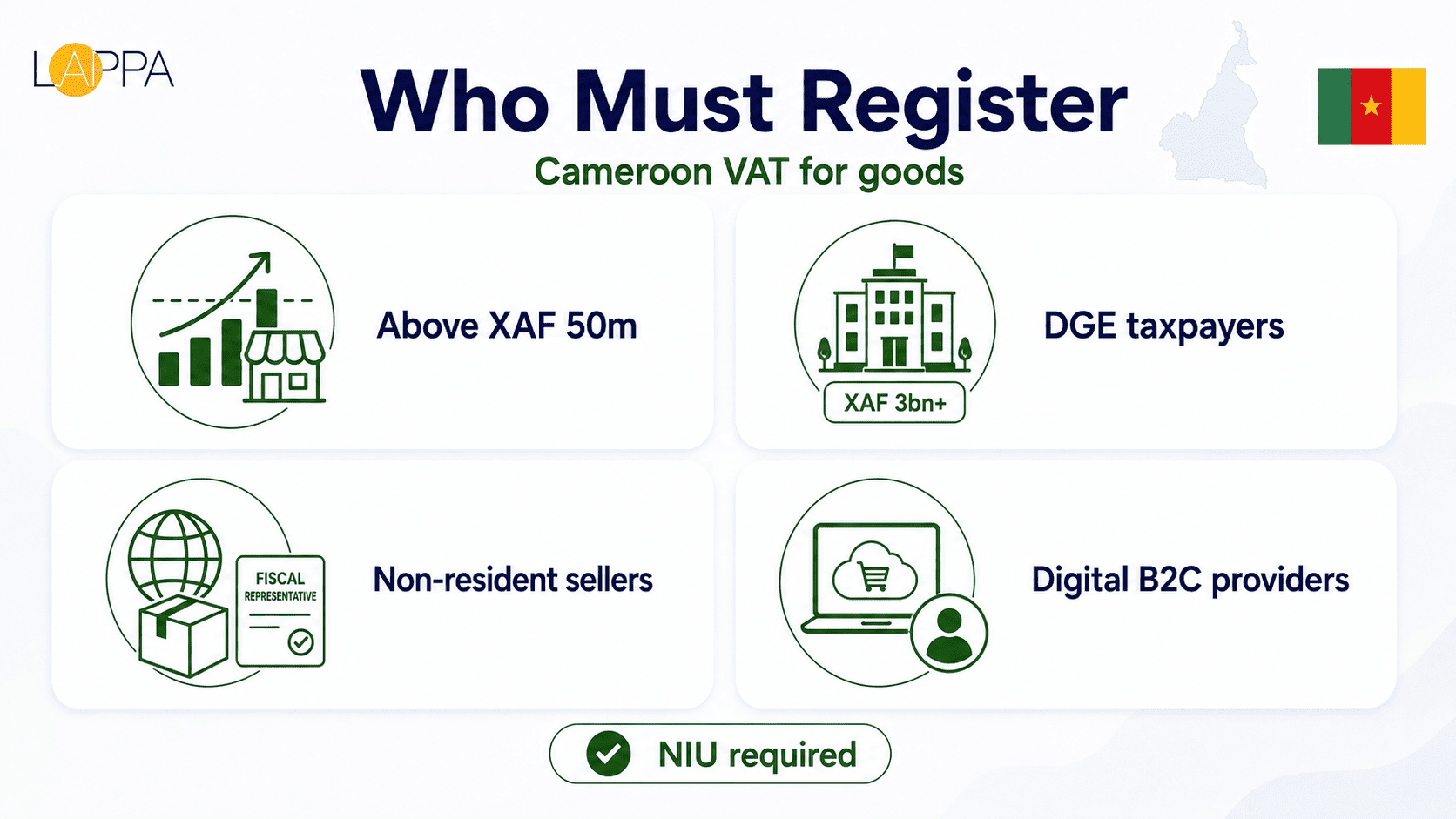 Registration falls on:
- Businesses with annual taxable turnover exceeding XAF 50,000,000 — mandatory, through the relevant CIME or DGE.
- Non-resident businesses with a permanent establishment in Cameroon — from the moment that establishment exists.
- Non-residents regularly supplying goods from Cameroonian stock or operating through dependent agents on local soil.
- Non-resident digital service providers supplying B2C electronic services to Cameroonian consumers — from the first supply.
- CEMAC-based businesses supplying into Cameroon outside the intra-CEMAC simplified framework.
VAT Registration Number Cameroon — NIU Format and Structure
The NIU — Numéro d'Identifiant Unique — is what Cameroon issues to every registered taxpayer. Fourteen alphanumeric characters. One number covers all tax types: TVA, corporate income tax, payroll, customs. There's no separate VAT-only identifier. The VAT registration number Cameroon businesses put on invoices is the NIU. That's it. No ATU prefix like Austria, no BG like Bulgaria, no FR like France. Cameroon didn't build a parallel VAT identification layer on top of its general tax registry. The NIU is universal. It appears on every DGI document, every declaration submission, every facture normalisée the business issues. One number to recognise everywhere.| Taxpayer Type | Identifier | Character Count | Issuing Authority |
| Local legal entity | NIU | 14 alphanumeric | DGI / MINFI |
| Individual trader | NIU | 14 alphanumeric | DGI / MINFI |
| Non-resident with Cameroonian establishment | NIU | 14 alphanumeric | DGI |
Cameroon VAT Registration Procedure — DGI Steps and Requirements
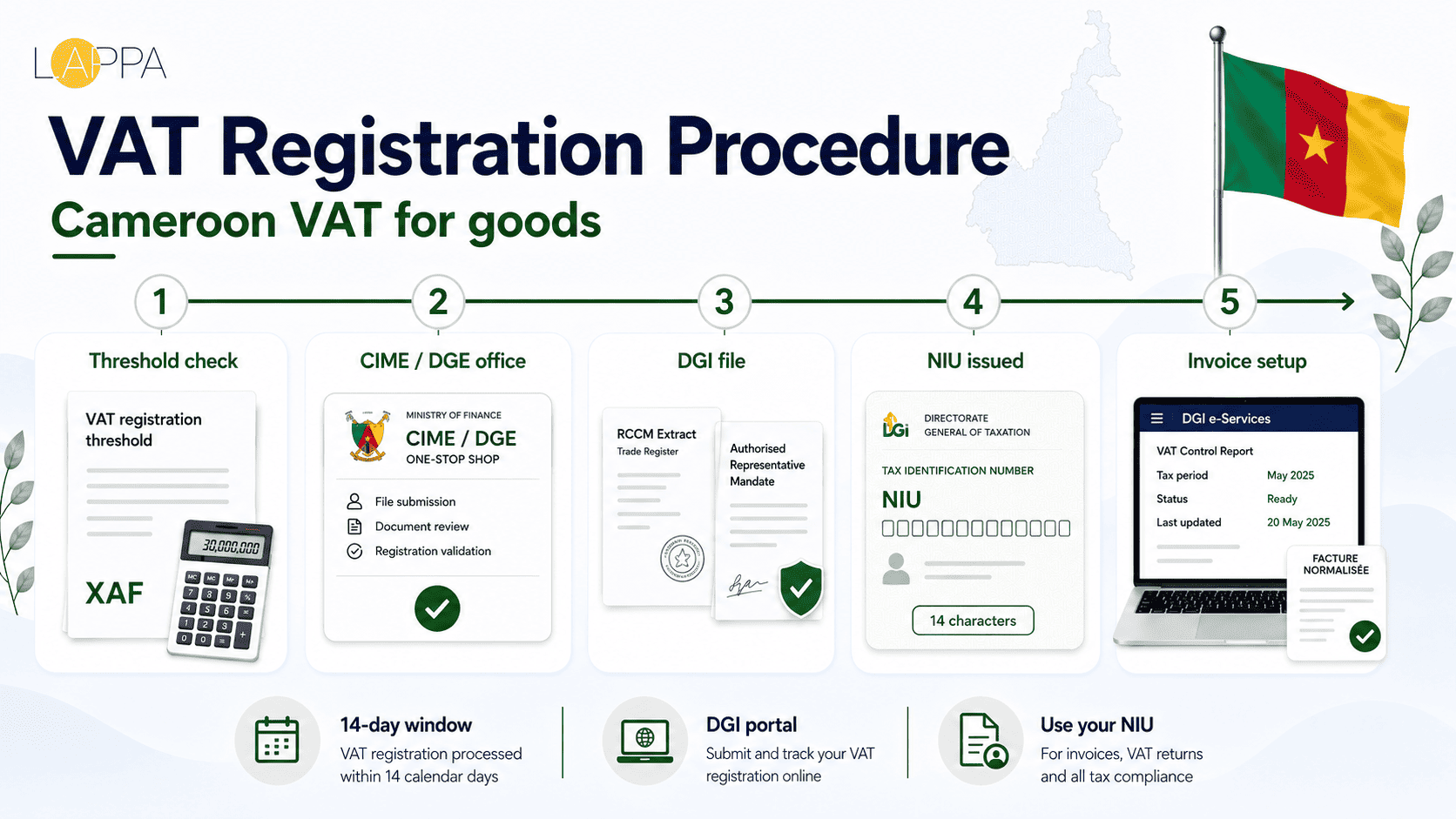 Cameroon VAT registration for locally established businesses runs through physical DGI offices. CIME for medium taxpayers, DGE in Yaoundé for large ones. There's an online portal at impots.cm, but the initial registration for most entity types still involves presenting documents in person at the relevant office. Not exclusively digital. Not fast.
For a Cameroonian-established company:
Cameroon VAT registration for locally established businesses runs through physical DGI offices. CIME for medium taxpayers, DGE in Yaoundé for large ones. There's an online portal at impots.cm, but the initial registration for most entity types still involves presenting documents in person at the relevant office. Not exclusively digital. Not fast.
For a Cameroonian-established company:
- Prepare the application: RCCM extract (Registre du Commerce et du Crédit Mobilier), proof of business address, identification documents for shareholders and directors, and a description of taxable activities.
- Submit to the right office — CIME for turnover between XAF 50 million and 3 billion, DGE for above.
- DGI issues the NIU and opens the taxpayer account. TVA registration is embedded in this — no separate VAT-only filing exists.
- Receive the attestation de conformité fiscale, confirming active status and the assigned NIU.
- The first TVA return covers the period from registration date — not from a clean quarter or month start.
Tax Representative in Cameroon
Non-residents without a local entity need an accredited fiscal representative in place before DGI registration is completed. Not at the same time. Before. The représentant fiscal accrédité's details are mandatory fields on the application. Without them — automatic hold, indefinite. What the representative does: files TVA returns, handles all DGI correspondence, manages audit requests, receives tax notices, and maintains the compliance calendar on the foreign entity's behalf. And there's an exposure that stops firms from taking on every mandate: Cameroonian law creates joint liability in specific circumstances. The firm accepting the mandate is agreeing that if the foreign client vanishes with unpaid TVA, the representative stands behind it. That shapes who takes mandates, at what fee level, and under what contractual conditions. Foreign businesses with irregular trading profiles, prior compliance problems, or high-risk supply types have a harder time finding a firm willing to act. Worth sorting this out before incorporation, not after a DGI notice arrives. Businesses with a Cameroonian subsidiary or registered branch go through the standard domestic registration directly — no fiscal representative required. But even with a local entity, the volume of DGI-specific process knowledge, Finance Law updates, and CEMAC cross-border nuance means remote management from London or Brussels consistently creates avoidable problems. Local expertise isn't just useful. It usually pays for itself.VAT E-Invoices in Cameroon — Timeline for Different Business Sizes
Mandatory e-invoicing in Cameroon started taking shape in 2020. The system is built around the facture normalisée — invoices generated through DGI-certified billing software or, for large taxpayers, processed directly through the DGI's e-tax platform. Large taxpayers in the DGE segment have had mandatory electronic invoicing and declarations since the e-tax platform launched. Medium CIME taxpayers are partway through a transition — electronic filing is required, mandatory invoice standards are rolling out progressively. The DGI is working through the segments in order.| Business Segment | E-Invoicing Status | Platform |
| Large taxpayers — DGE (above XAF 3bn) | Mandatory electronic invoicing and declarations | DGI e-tax platform |
| Medium taxpayers — CIME (XAF 50m–3bn) | Electronic filing required; invoice mandate transitional | DGI portal or certified software |
| Small entities (below XAF 50m) | Outside VAT system — impôt libératoire | N/A |
| Non-resident registered entities | Per DGI requirements at registration date | DGI guidance applies |
VAT Returns in Cameroon — VAT Control Report and Filing Types
DGE taxpayers: monthly. Due by the 15th of the following month. January return and payment: 15 February. Both on the same date. Miss the return date — you've also missed the payment deadline. CIME taxpayers: quarterly. Due the 15th of the month after each quarter closes. Q1 (January–March) → 15 April. Q2 → 15 July. Q3 → 15 October. Q4 → 15 January. Same rule: return and payment on the same day. Returns go through the DGI portal. They capture output TVA broken down by rate category, input TVA on purchases and imports claimed for that period, and any adjustments for credit notes or prior-period corrections. Net TVA due goes with the return. A credit position can be carried forward to the next period or submitted as a refund claim — but refund processing through the DGI moves slowly. Most businesses with consistent credits carry forward rather than wait. VAT control report: Cameroon doesn't require a separate transaction-level data file alongside the summary declaration. The return contains summary figures. Full invoice detail lives in the business's records and gets produced when the DGI issues an audit notice with a document request deadline. JPK file: The JPK — Jednolity Plik Kontrolny — is Poland's Standard Audit File for Tax. It's a structured XML file with invoice-level data submitted monthly to Polish tax authorities. Cameroon has nothing equivalent. Companies filing in both jurisdictions run entirely separate systems. No shared format, no crossover, no shortcut.Deductible VAT in Cameroon
Three conditions must hold simultaneously for input TVA to be deductible: the supplier is TVA-registered, the facture normalisée they issued carries a valid NIU, and the purchase serves taxable TVA activity. Always blocked, no exceptions:- Entertainment and hospitality above the DGI's published statutory norms
- Passenger vehicles not used exclusively for business purposes
- Inputs directly tied to TVA-exempt supplies
- Anything for personal use or unconnected from taxable activity
VAT Record-Keeping Requirements in Cameroon
Ten years. That's the statutory minimum under the CGI, running from the end of the financial year the records relate to. Longer than most West African equivalents. The EU's standard floor is typically five years. Cameroon doubles it. Records that must be kept:- Every issued and received facture normalisée, plus credit notes and debit notes
- Import customs declarations and clearance certificates
- TVA declarations as submitted, with DGI portal confirmation receipts
- Accounting ledgers showing TVA account movements
- Contracts with ongoing TVA implications
- Bank statements confirming TVA payments and any refund receipts
VAT Cameroon — Penalties and Non-Compliance Costs
VAT Cameroon penalty rules sit in the CGI and are enforced through the DGI's audit and recovery departments. The numbers are serious. Unregistered operation: Up to 100% of TVA that should have been declared during the unregistered period, plus the full backdated TVA liability on all qualifying turnover since the threshold was crossed. Both. At the same time. The DGI treats operating above threshold without registration as material evasion — not an administrative slip. Late return: 25% surcharge on net TVA due for the missed period, plus a minimum flat penalty regardless of the balance owed. Filing a return late when you have a large payable isn't just embarrassing. It's the original TVA plus 25%. Late payment: 1.5% per month from the due date. On XAF 50 million unpaid: XAF 750,000 every month in running interest. Six months: XAF 4.5 million in interest, before you've touched the underlying liability. Deliberate understatement: Up to 100% of the understated amount. Voluntary disclosure before an audit notice is issued reduces exposure. Once that notice arrives — the voluntary window is closed. VAT Cameroon audit risk concentrates in predictable places: first-year registrants, large capital goods input TVA claims, persistently low prorata recovery rates, and non-resident entities where the fiscal representative's oversight has been inconsistent. The Cameroon VAT rate misapplication — treating a standard-rated supply as zero-rated — triggers automatic reassessment of the rate difference plus 1.5% monthly interest from the original filing date. Cameroonian TVA enforcement has hardened since the e-declaration platform started cross-referencing return data with customs records and banking flows. The gap between an error and its detection is shorter than it was five years ago. Much shorter.How Lappa Can Help with VAT Compliance in Cameroon
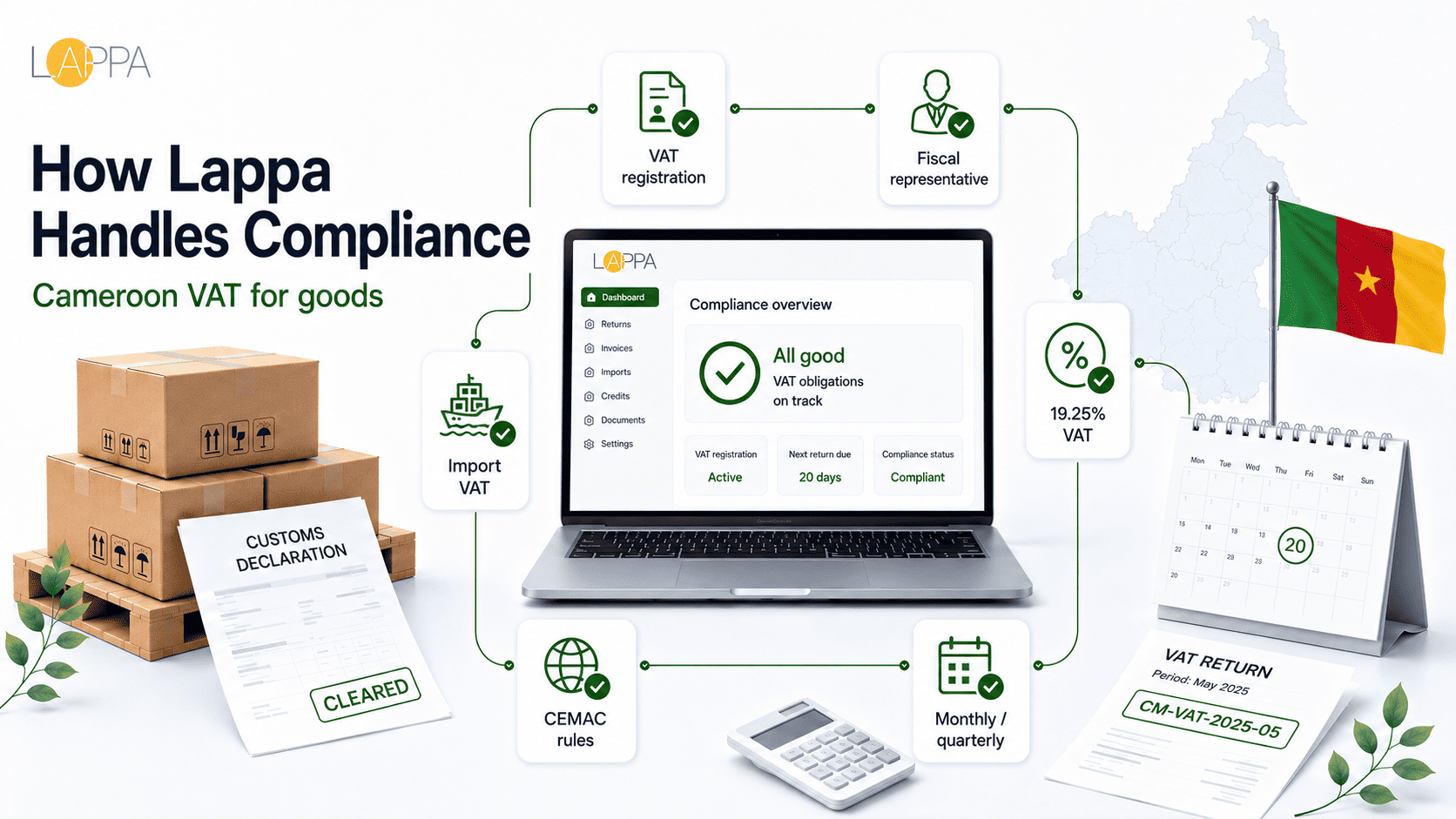 Lappa handles the full Cameroon TVA cycle — DGI registration, NIU setup, monthly and quarterly return preparation and filing for both DGE and CIME schedules, and compliance calendar management throughout the year.
For non-resident businesses, Lappa provides accredited fiscal representative services: building the DGI registration file, managing the accreditation process, and taking on the ongoing TVA compliance obligations that come with operating in Cameroon without a local entity.
Prorata calculations for mixed taxable-and-exempt operations, voluntary disclosure submissions for prior-period corrections, and parallel TVA management across multiple CEMAC member states — all handled through a single workflow.
Lappa handles the full Cameroon TVA cycle — DGI registration, NIU setup, monthly and quarterly return preparation and filing for both DGE and CIME schedules, and compliance calendar management throughout the year.
For non-resident businesses, Lappa provides accredited fiscal representative services: building the DGI registration file, managing the accreditation process, and taking on the ongoing TVA compliance obligations that come with operating in Cameroon without a local entity.
Prorata calculations for mixed taxable-and-exempt operations, voluntary disclosure submissions for prior-period corrections, and parallel TVA management across multiple CEMAC member states — all handled through a single workflow.
FAQ for Cameron VAT Goods
What Is the VAT Rate in Cameroon
- 19.25%. That's the standard rate. The VAT rate in Cameroon is built from a 17.5% base TVA rate with a 10% surtax on top of that base — 17.5% × 1.10 = 19.25%. It's been that figure since the 2005 Finance Law and is unchanged for 2026. Exports: zero-rated, no TVA charged and input TVA fully recoverable. Financial services, healthcare, education, and certain agricultural inputs: exempt from TVA entirely.
Who Needs to Register for VAT in Cameroon
- Annual taxable turnover above XAF 50,000,000 means mandatory TVA registration. Below that floor, the entity sits under the impôt libératoire regime and sits completely outside the VAT system — no registration, no returns, no input TVA recovery. Non-resident businesses with a Cameroonian establishment register regardless of turnover. So do non-resident digital service providers supplying B2C consumers in Cameroon.
What Is the VAT Number Format in Cameroon
- Cameroon issues a NIU — Numéro d'Identifiant Unique — 14 alphanumeric characters, assigned by the DGI through the MINFI registry. No separate VAT-only number exists alongside this. The NIU covers all tax types and is the number that goes on every facture normalisée, every DGI declaration, every piece of official correspondence. Status is verifiable at impots.cm.
How Often Are VAT Returns Filed in Cameroon
- DGE taxpayers file monthly — return and payment due by the 15th of the following month. CIME taxpayers file quarterly — return and payment due by the 15th of the month following each quarter-end. Both groups pay on the same date the return is submitted.
Do Foreign Companies Need a Tax Representative in Cameroon
- Non-residents without a Cameroonian entity must appoint an accredited fiscal representative — représentant fiscal accrédité — before DGI registration completes. The representative files returns, handles DGI correspondence, and manages audit proceedings. Joint liability applies in specific circumstances.
VAT Calculator
19.25% applied: multiply the net by 1.1925. To extract TVA from a gross figure: divide by 1.1925, then subtract. XAF 1,000,000 net → XAF 192,500 TVA → XAF 1,192,500 gross. That's the arithmetic. Straightforward enough. At 0% (exports): no TVA on the invoice, but input TVA on the exporter's costs is fully recoverable from the DGI. That's not nothing — for manufacturers exporting to EU or Asian markets, those refund claims are real operating cash. Factures normalisées — the official Cameroonian tax invoice — must show three separate figures: net amount, TVA rate, TVA amount. A gross-only total won't hold up. The DGI doesn't interpret; it disallows. A deduction claim without a fully itemised compliant facture normalisée gets rejected outright. Not reduced. Rejected.
VAT Standard rate
19.25%
VAT Reduced rate
0%
Thresholds
XAF 50 million annual turnover (mandatory VAT registration)