


United Arab Emirates VAT Guide for Businesses
Provinces
Goods
Provinces
Goods
About
Goods
About
Goods
Goods
Goods
Introduction to VAT in United Arab Emirates
VAT in United Arab Emirates started on January 1, 2018 -- and the UAE moved fast. It was one of the first two Gulf states to go live, alongside Saudi Arabia, both launching on the same date under the GCC VAT framework. The Federal Tax Authority (FTA) runs the system. The rate is 5% -- one of the lowest anywhere in the world -- and that low number doesn't mean you should relax. UAE VAT has teeth: Designated Zone rules, strict invoice requirements, a growing e-invoicing mandate, and an FTA that actively audits and assesses penalties. A 5% rate with real enforcement is still a real compliance obligation. The GCC framework means the UAE isn't operating in isolation. Six Gulf Cooperation Council states (UAE, Saudi Arabia, Bahrain, Oman, Kuwait, and potentially Qatar) agreed on a common VAT treaty. Cross-border supplies between GCC countries follow specific rules -- some treated as exports, some as domestic supplies, depending on registration status and supply type. If your business ships goods between UAE and Saudi Arabia or Bahrain, get clear on the GCC inter-state rules. They're not the same as EU intra-community rules. VAT United Arab Emirates compliance runs entirely through EmaraTax (emaratax.ae). That's the FTA's online portal -- registration, return filing, payment, refund applications, correspondence. It replaced the older FTA e-Services platform in 2023. Non-resident businesses use the same portal as UAE-resident ones. There's no separate foreign-entity system. Create your EmaraTax account, complete the registration form, upload your documents, and wait for FTA approval. All of it online, all of it in EmaraTax. This guide covers goods and digital services. Both attract the 5% standard rate when supplied to UAE customers. The place of supply rules differ -- goods go by physical delivery location, services by customer location or establishment -- but the rate, the TRN format, and the quarterly return mechanics are the same. What changes is whether the reverse charge applies, how exports are treated, and whether specific exemptions carve out your supply type.VAT Rates in United Arab Emirates
| Category | Rate | What It Covers | What You Need to Know |
| Standard rate | 5% | Most goods and services: retail, professional fees, SaaS and digital services, advertising, hospitality, electronics, non-residential real estate, construction | Default. If a supply isn't zero-rated, exempt, or outside scope, it's 5%. Applies equally to a physical goods shipment and a cloud software subscription billed to a UAE customer. |
| Zero-rated | 0% | Exports of goods out of the GCC, international transport, healthcare services and medicines, education, investment-grade precious metals, first supply of residential buildings, crude oil and natural gas | You're still VAT-registered and file returns. Input VAT on costs for zero-rated supplies is fully recoverable. Zero-rated is not the same as exempt -- that difference matters a lot for your input tax position. |
| Exempt | Exempt | Financial services (margin-based, not fee-based), life insurance, residential property subsequent sales and leases, bare land, local passenger transport | Input VAT on costs for exempt supplies isn't recoverable. Mixed taxable and exempt activities? You'll need a partial exemption calculation to split your input tax correctly. |
| Out of scope | N/A | Supplies made outside the UAE, some government activities, certain supplies within Designated Zones between businesses | Designated Zones are one of the trickiest areas of UAE VAT. Being in a free zone doesn't automatically make your supply out of scope -- the rules depend on supply type, consumption location, and registration status of both parties. |
VAT United Arab Emirates -- Standard, Zero-Rated, and Exempt Categories
VAT United Arab Emirates at 5% is the rate for the vast majority of transactions. Your SaaS subscription to a UAE customer: 5%. A shipment of electronics delivered to a Dubai business: 5%. A consulting invoice to an Abu Dhabi client: 5%. The zero-rated categories are the exceptions, and they're meaningful ones. Healthcare -- hospitals, doctors, medicines, medical devices -- is zero-rated, not exempt. So is education. That distinction isn't trivial: zero-rated suppliers stay VAT-registered and recover input VAT on their costs. Exempt suppliers don't. For a hospital buying medical equipment, being zero-rated rather than exempt is worth real money. Designated Zones deserve a separate paragraph because they trip up a lot of businesses. The FTA designates specific free zone areas -- JAFZA (Jebel Ali Free Zone), DAFZA (Dubai Airport Free Zone), Khalifa Industrial Zone, and others -- as being outside UAE for VAT in certain circumstances. But here's the catch: being physically inside a Designated Zone doesn't automatically make your supplies out of scope. It depends on what you're supplying, whether goods are consumed inside the zone, and the VAT registration status of both parties. Get this wrong and you've got unexplained gaps in your output VAT that the FTA will ask about. VAT in United Arab Emirates for digital services follows the destination principle. A German SaaS company billing a UAE-registered business (one with a valid TRN) doesn't charge UAE VAT -- the UAE business self-assesses 5% under the reverse charge, claims it back as input tax, and the net position is zero. But that same German SaaS company billing a UAE consumer -- someone without a TRN -- must charge 5% UAE VAT and hand it over to the FTA. Non-resident digital service providers with UAE B2C sales are caught from the first sale. No threshold. No grace period.VAT Registration Threshold in United Arab Emirates
| Registration Type | Threshold | What This Means in Practice |
| Mandatory (UAE resident business) | AED 375,000 taxable supplies in prior 12 months or forecast next 30 days | Once you cross AED 375,000, you've got 30 days to register. The 30-day trigger also applies if you expect to hit the threshold in the next month alone -- not just looking backward. Miss the deadline and you're looking at an AED 20,000 late registration penalty. |
| Voluntary (UAE resident business) | AED 187,500 taxable supplies or taxable expenses | Useful if you're spending heavily on VAT-bearing costs before revenue kicks in. You can register voluntarily using your taxable expenses (not just your revenue) as the qualifying figure. Recovering input VAT on setup costs is often the main motivation. |
| Non-resident (any business) | No threshold -- register before your first taxable UAE supply | No turnover minimum. If you're making a taxable supply in the UAE and you're not established there, you register before you start. Doesn't matter if it's one sale or a thousand. Digital service providers selling to UAE consumers are caught from supply number one. |
For local businesses
If you're incorporated in the UAE -- mainland or free zone -- you hit mandatory registration when your taxable supplies in the last 12 months exceed AED 375,000, or when you expect the next 30 days alone to push you above that number. Both tests exist independently. Cross either one and you have 30 days to register. Late registration penalty: AED 20,000. There's no soft launch period, no amnesty for first-timers. The FTA checks registration status against turnover data, and the penalty sticks.For remote sellers
Selling physical goods to UAE customers from abroad? If those goods are delivered in the UAE -- whether you ship from overseas or hold stock in a UAE warehouse -- the place of supply is the UAE. You register for UAE VAT before your first taxable sale. No turnover threshold for non-residents. Importing goods into the UAE also creates a VAT event at the border (import VAT), and recovering that import VAT requires an active TRN. No TRN, no recovery. That's a cost you carry until you're registered.For remote digital services
If you're a non-resident providing electronic services to UAE consumers -- streaming, gaming, downloads, SaaS, cloud platforms, digital advertising -- you register before your first B2C sale. Full stop. For B2B digital services to UAE-registered businesses, the reverse charge applies and you don't need to register just for those. But if your UAE customer base includes both businesses with TRNs and consumers without, the B2C side forces registration. And once you're registered for the B2C customers, all your UAE supplies go on the same return.Who Must Register for VAT in United Arab Emirates
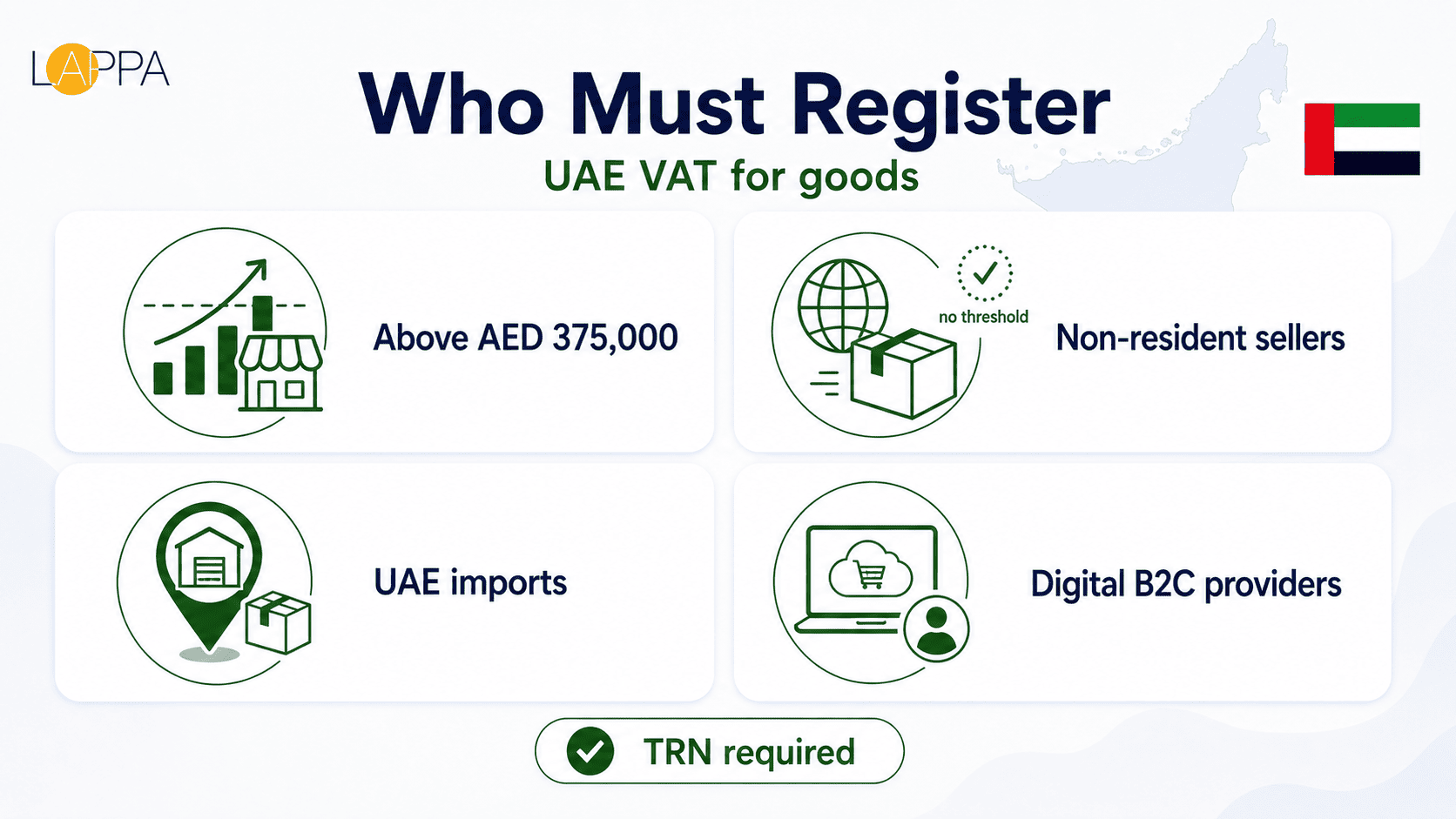 You need UAE VAT registration if you're a UAE-resident business above AED 375,000 taxable turnover, a non-resident business making any taxable UAE supply, a business importing goods into the UAE for onward sale, or a digital service provider with UAE B2C customers. The common logic: taxable supply with a place of supply in the UAE means you register. Residency doesn't get you out of it -- if anything, residency mainly affects which threshold applies.
United Arab Emirates VAT Registration for Residents and Non-Residents
United Arab Emirates VAT Registration for non-resident businesses goes through EmaraTax, just like for UAE residents. The UAE doesn't mandate a fiscal representative -- there's no joint-liability local agent required the way some EU countries or Albania demand. Non-residents can register directly. In practice, many appoint a UAE-registered Tax Agent (licensed by the FTA) to handle the submission and ongoing compliance. The Tax Agent doesn't share liability -- you're still the responsible party -- but they handle the EmaraTax mechanics on your behalf. It's a practical arrangement, not a legal requirement. Free zone companies have a nuance worth flagging. If you're incorporated in a UAE free zone, you're a UAE-resident business for VAT purposes -- you register as a UAE entity, not as a non-resident. But your Designated Zone status (if your free zone is a Designated Zone) affects how specific supplies are treated. A JAFZA company selling to mainland UAE customers is making UAE-taxable supplies at 5%. The same company supplying goods to another JAFZA company, within the zone, where the goods stay in the zone -- that may be out of scope. The distinction needs analysis, not assumption. United Arab Emirates VAT registration is completed through EmaraTax. No paper option, no walk-in registration at an FTA office. You create an EmaraTax account, complete the registration form, attach supporting documents, and submit. UAE-resident businesses typically get TRN confirmation in three to five business days. Non-resident applications can take up to ten working days if documentation is complete. Incomplete applications get returned -- and the clock on penalties runs from the date you were first obliged to register, not the date you eventually complete it. UAE VAT registration de-registration is also an EmaraTax process. If your taxable supplies have been below AED 375,000 for 12 consecutive months and you don't expect to exceed the threshold in the next 30 days, you can apply to de-register. But it's not automatic -- you apply, the FTA reviews, and they grant or refuse. Don't let a dormant registration sit indefinitely. Outstanding quarterly return obligations don't pause just because you're not active.VAT Number in United Arab Emirates
The UAE VAT identifier is the TRN -- Tax Registration Number. Fifteen digits, always starting with 100. For example: 100123456789001. You get one TRN per registration, covering all your UAE VAT obligations regardless of which emirate you operate in. The TRN goes on every B2B tax invoice you issue, appears in all FTA correspondence, and is the reference number for your EmaraTax account. The FTA publishes a public TRN verification tool at tax.gov.ae. Use it before you process a supplier invoice for input VAT recovery.VAT Number United Arab Emirates -- TRN Format and Verification
VAT number United Arab Emirates registration assigns through the EmaraTax portal and the 15-digit format is consistent across all entity types -- free zone companies, mainland companies, branches, and non-resident registrations all get the same structure starting with 100. Always verify a supplier's TRN through the FTA checker before you submit an input VAT claim on their invoice. An invalid or inactive TRN means you can't recover the VAT -- it's a non-compliant invoice. The supplier may have de-registered, been administratively removed by the FTA, or simply typed their own number wrong. Verify first, pay later. What does TRN verification actually tell you? It confirms the TRN is active and registered. It shows the registered entity name. It doesn't tell you whether the supplier is up to date with their returns or has outstanding FTA debts -- that's private information. But an active TRN confirming the entity name matches your supplier's invoice is the minimum check you need before processing input VAT.United Arab Emirates VAT number Verification Through the FTA Portal
United Arab Emirates VAT number confirmation comes from the FTA in the form of a Tax Registration Certificate, downloadable through EmaraTax once registration is approved. The certificate shows your TRN, your entity name, the registration effective date, and your assigned tax period (quarterly or monthly). Save it. When you start trading with a new UAE supplier, ask for their TRN and verify it on the FTA checker before the first invoice. Build TRN verification into your supplier onboarding process -- it prevents input VAT problems from accumulating across dozens of invoices before anyone notices. United Arab Emirates VAT number changes are unusual. Your TRN stays with you for the life of the registration. Restructure, merge, or change legal form and you may need a new registration -- which means a new TRN. When that happens, tell your suppliers and customers immediately. Update your invoicing system. A tax invoice carrying an old, deactivated TRN is non-compliant. Your customer can't recover the input VAT on it, and they won't be happy about it.VAT Registration Procedure in United Arab Emirates
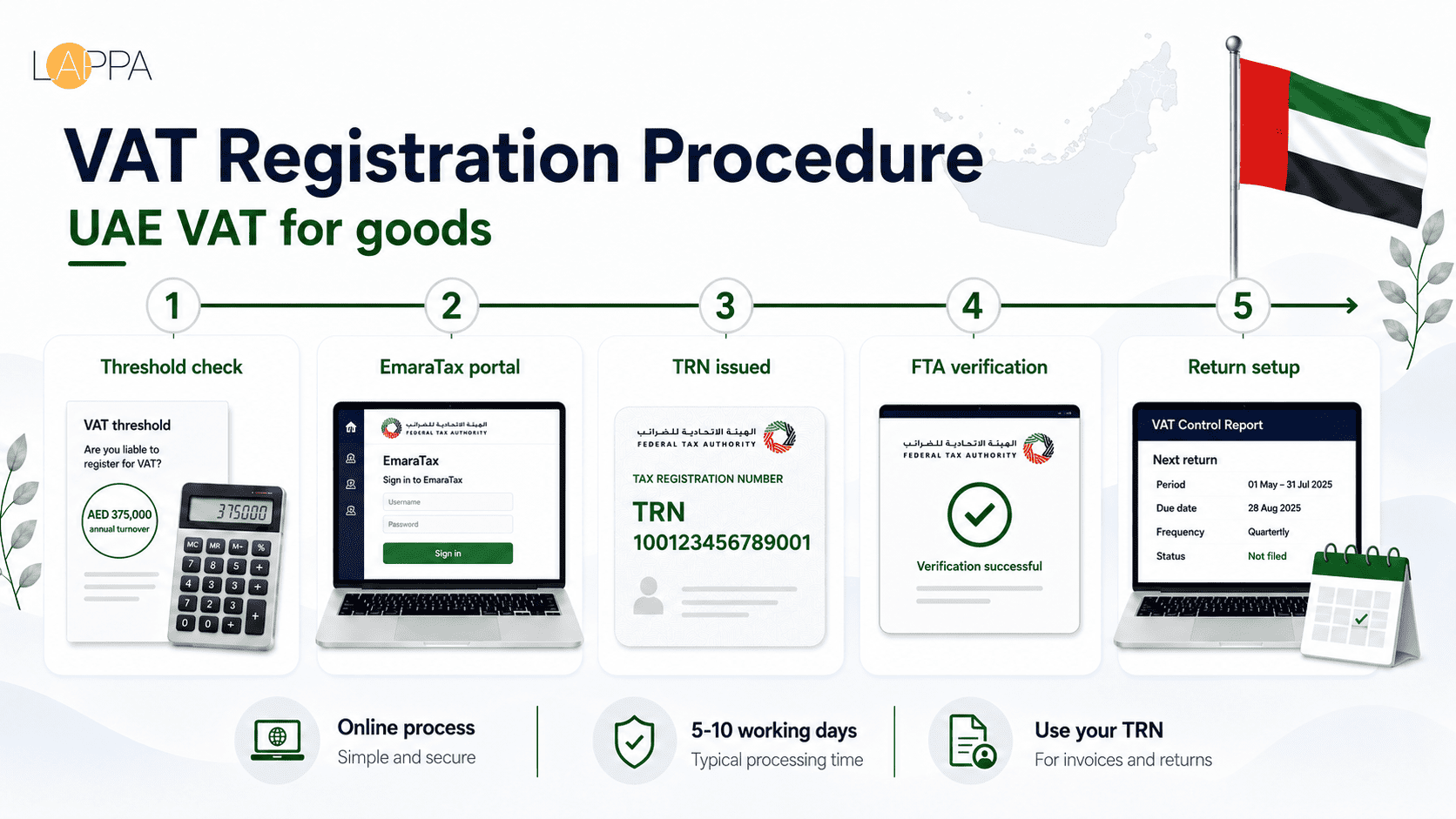 VAT number United Arab Emirates assignment happens at the end of the registration process, once the FTA approves your EmaraTax application. The process starts with creating an EmaraTax account -- linked to your Emirates ID if you're a UAE resident, or your passport if you're a non-resident. Then you complete the VAT registration form: entity details, business activities, estimated taxable turnover, the date your UAE taxable supplies started, and your supporting documents.
Documents you'll need as a non-resident registrant:
VAT number United Arab Emirates assignment happens at the end of the registration process, once the FTA approves your EmaraTax application. The process starts with creating an EmaraTax account -- linked to your Emirates ID if you're a UAE resident, or your passport if you're a non-resident. Then you complete the VAT registration form: entity details, business activities, estimated taxable turnover, the date your UAE taxable supplies started, and your supporting documents.
Documents you'll need as a non-resident registrant:
- Certificate of incorporation or equivalent registration document from your home country -- in English or Arabic, or with a certified translation attached
- Passport copies for each authorised signatory on the EmaraTax application
- Evidence that you're actually making taxable supplies in the UAE -- contracts with UAE customers, purchase orders, freight records, or platform transaction data showing UAE-customer sales
- Bank account details -- a UAE AED-denominated account is recommended for receiving FTA refunds, though the FTA will accept foreign accounts
- If you're appointing a UAE Tax Agent: their FTA licence number, a power of attorney authorising them to act on your EmaraTax account, and their contact details for FTA correspondence
Tax Representative in United Arab Emirates
No mandatory fiscal representative in the UAE. That sets it apart from many EU countries and from markets like Albania, where non-residents must appoint a joint-liability local representative before they can register. In the UAE, you register directly through EmaraTax. But the absence of a legal requirement doesn't mean appointing a UAE Tax Agent is a bad idea -- especially if you're managing quarterly returns, FTA correspondence, and potentially refund applications from outside the UAE. UAE Tax Agents are FTA-licensed professionals who act on behalf of businesses in VAT matters. They handle EmaraTax submissions, prepare returns, respond to FTA queries, manage refund applications, and represent you if the FTA initiates an audit or assessment. Unlike EU fiscal representatives, UAE Tax Agents don't carry joint liability for your VAT debts. The liability stays with you. The Tax Agent relationship is about operational capacity and representation, not shared financial exposure. The UAE's VAT system allows Tax Agents to hold multiple client authorisations simultaneously on EmaraTax. When picking an agent, make sure their expertise matches your supply type. A Tax Agent experienced mainly with UAE retail and hospitality clients may not have the depth needed to handle Designated Zone analysis for a goods business or place of supply questions for a digital services provider. Ask specifically about their experience with clients in your sector. For non-resident businesses with minimal UAE revenue -- say, a handful of B2C digital subscriptions -- the cost of a full-service Tax Agent engagement may not be proportionate. Some agents offer lighter arrangements where they handle submissions on a per-period basis for an agreed fee per return. That's often enough for businesses with straightforward UAE VAT positions and low transaction volumes.VAT E Invoices in United Arab Emirates
The UAE is building mandatory e-invoicing. The FTA's framework is based on PEPPOL international standards and uses a clearance model -- invoices go to the FTA platform for digital validation and signature before reaching your customer. Once cleared, the invoice is FTA-certified. After the mandate deadlines pass, an uncleared invoice won't support input VAT recovery for the recipient. That's a hard consequence. Your customer won't be able to recover the VAT on your invoice if you haven't cleared it through the system. Businesses won't submit invoices directly to the FTA. The mechanics run through FTA-certified e-invoicing service providers who integrate with your ERP or invoicing platform and handle clearance submissions transparently in the background. You invoice as normal; the integration handles the FTA transmission. Choosing the right service provider -- one that supports your ERP, your invoice volume, and your supply types -- takes time. Procurement, technical integration, testing, parallel running: plan for months, not weeks.Timeline for different business sizes
- 2023 -- EmaraTax launches, consolidating all FTA VAT services: registration, filing, payment, refunds, correspondence. Existing registrations migrate from the legacy FTA e-Services portal. This sets the technical foundation for the e-invoicing infrastructure that follows.
- 2024 -- FTA publishes detailed e-invoicing technical specifications. Certification process opens for e-invoicing service providers. Businesses begin assessing readiness and selecting service providers. Voluntary adoption available for early movers.
- October 2026 (Phase 1 -- planned) -- Mandatory e-invoicing for large businesses with annual taxable turnover above AED 150 million. All B2B tax invoices must be cleared through an FTA-certified service provider from this date. If your UAE revenue puts you in this tier, integration planning should already be underway.
- April 2027 (Phase 2 -- planned) -- Mandatory e-invoicing extends to all remaining UAE VAT-registered businesses. All B2B tax invoices go through clearance. B2C receipts are expected to come within scope in later phases.
VAT Returns in United Arab Emirates
Types of reports
Your UAE VAT reporting obligations are:- Quarterly VAT return (standard): covers output VAT on taxable supplies and input VAT on business costs for a three-month period. The UAE VAT quarters are January-March, April-June, July-September, October-December. Deadline: 28 days after the quarter ends. Q1 due April 28. Q2 due July 28. Q3 due October 28. Q4 due January 28. Filed and paid through EmaraTax simultaneously -- the FTA doesn't accept one without the other.
- Monthly VAT return: the FTA assigns monthly filing to certain businesses based on turnover or risk profile. Monthly filers have 28 days from month-end. You don't choose monthly filing -- the FTA assigns it. If you're on monthly, you stay on monthly until the FTA changes the assignment. Late filing is AED 1,000 first occurrence, AED 2,000 for repeats within 24 months.
- Refund applications: if your input VAT consistently exceeds your output VAT -- common for exporters making zero-rated supplies -- you apply for a refund through EmaraTax. Refunds aren't automatic. Each application goes through FTA review. Processing times range from several weeks to several months depending on the amount and the FTA's current query volume.
- Voluntary disclosure: if you've identified an error in a previously filed return, you can correct it through EmaraTax before the FTA spots it. The voluntary disclosure penalty is 5% of the VAT correction -- significantly lower than the standard assessment penalty for FTA-discovered errors. Don't sit on a known error.
Deductible VAT in United Arab Emirates
Input VAT recovery in the UAE follows a straightforward principle: VAT on costs for your taxable (standard or zero-rated) business activities is recoverable. VAT on costs for exempt activities is blocked. For businesses with both taxable and exempt activities -- a financial services firm with fee-based taxable advisory and margin-based exempt lending -- a partial exemption calculation determines what proportion of input VAT you can recover. The FTA's standard method is a turnover-based ratio. Motor vehicles available for personal use: input VAT is 50% blocked. The test is availability, not actual use. A company car that an employee could theoretically drive home is a 50% recovery vehicle even if they never do. Pure commercial vehicles -- delivery trucks, goods vans, vehicles with no plausible private use -- recover 100%. Document the commercial use restriction clearly. FTA auditors look at vehicle input tax claims and ask for justification. Entertainment expenses sit in a grey area. Business hospitality for clients -- a working lunch, a customer dinner -- generally qualifies if the business purpose is genuine and documented. Staff entertainment is more restrictive. The FTA's guidance is: apply the purpose test. If it's genuinely for a business purpose and not primarily a personal benefit, the input VAT is recoverable. Write the business purpose on the expense record at the time. Trying to reconstruct justification during an audit two years later is much harder. For non-resident digital service providers with UAE B2C customers and no physical UAE presence: your UAE input VAT is probably minimal. Most of your costs are incurred outside the UAE without UAE VAT. The UAE return is primarily an output VAT return -- you collect 5% from UAE consumers and pay it to the FTA quarterly. Recoverable UAE input VAT might just be the FTA-registered adviser you're paying to manage your compliance.VAT Record Keeping Requirements in United Arab Emirates
UAE VAT records must be retained for five years from the end of the tax year to which they relate. Real estate records get a longer treatment: 15 years. The five-year rule covers all issued and received tax invoices, your VAT return working papers, import and export documentation, bank statements showing VAT payments and collections, and all FTA correspondence including your original TRN certificate. Five years from the end of the tax year -- not from the date of the transaction, not from the filing date. The UAE's VAT number -- the TRN -- must appear on every tax invoice you issue for B2B transactions. For invoices above AED 10,000 (roughly), your customer's TRN is also required. An invoice missing the supplier TRN isn't a tax invoice. Your customer can't recover input VAT on it. You can issue a corrected invoice, but doing so after a return has been filed creates a correction process that neither party wants. Check your invoice template has the TRN field and that it's populated correctly before you send the first invoice to a UAE client. EmaraTax keeps your submitted returns and FTA-issued documents within the portal, but this doesn't substitute for your own records. Original invoices, contracts, customs entries, bank statements -- keep them in your own systems in a format that stays legible and complete for the full five years. If the FTA requests documentation during an audit or information request, you've got five business days to produce it. Inability to produce records is itself a penalty exposure, separate from whatever the underlying compliance issue might be.VAT Penalties in United Arab Emirates
Late registration: AED 20,000. That's the opening penalty before any tax assessment. Late return filing: AED 1,000 for the first instance, AED 2,000 for any repeat within 24 months. These apply per return period -- a business that files four consecutive quarterly returns late accumulates AED 1,000 + AED 2,000 + AED 2,000 + AED 2,000 = AED 7,000 in filing penalties before the FTA even looks at whether the returns were correct. Late VAT payment carries a layered penalty structure. 2% of the unpaid VAT applies immediately on the day after the deadline. 4% applies after seven days. Then 1% per day from there, capped at 300% of the unpaid amount. That 300% ceiling is a theoretical maximum -- in practice, the FTA pursues collection well before a debt reaches that level. But the 1% daily rate makes any significant unpaid balance grow fast. Settle late payments as soon as you can, and apply the voluntary disclosure mechanism if the underlying return needs correcting. The UAE's VAT penalty for incorrectly claimed input tax is 100% of the overclaimed amount. Claim AED 50,000 in input tax that the FTA determines you weren't entitled to and you owe AED 50,000 in repayment plus AED 50,000 in penalty. For invoice-level non-compliance -- issuing an invoice missing a required field, incorrect TRN, wrong amount -- the penalty is AED 5,000 per invoice. Businesses running high invoice volumes with a systematic error (wrong TRN format in their billing system, for example) can accumulate substantial per-invoice penalties before the error is caught. The voluntary disclosure route cuts the penalty significantly. An error voluntarily disclosed before FTA audit initiation: 5% penalty on the VAT correction. The same error discovered by the FTA during audit: standard assessment penalties, substantially higher. If you identify a past return error, disclose it. The savings from voluntary disclosure versus assessment are significant, and the FTA does treat proactive disclosure as a compliance positive.How Lappa Can Help with VAT Compliance in United Arab Emirates
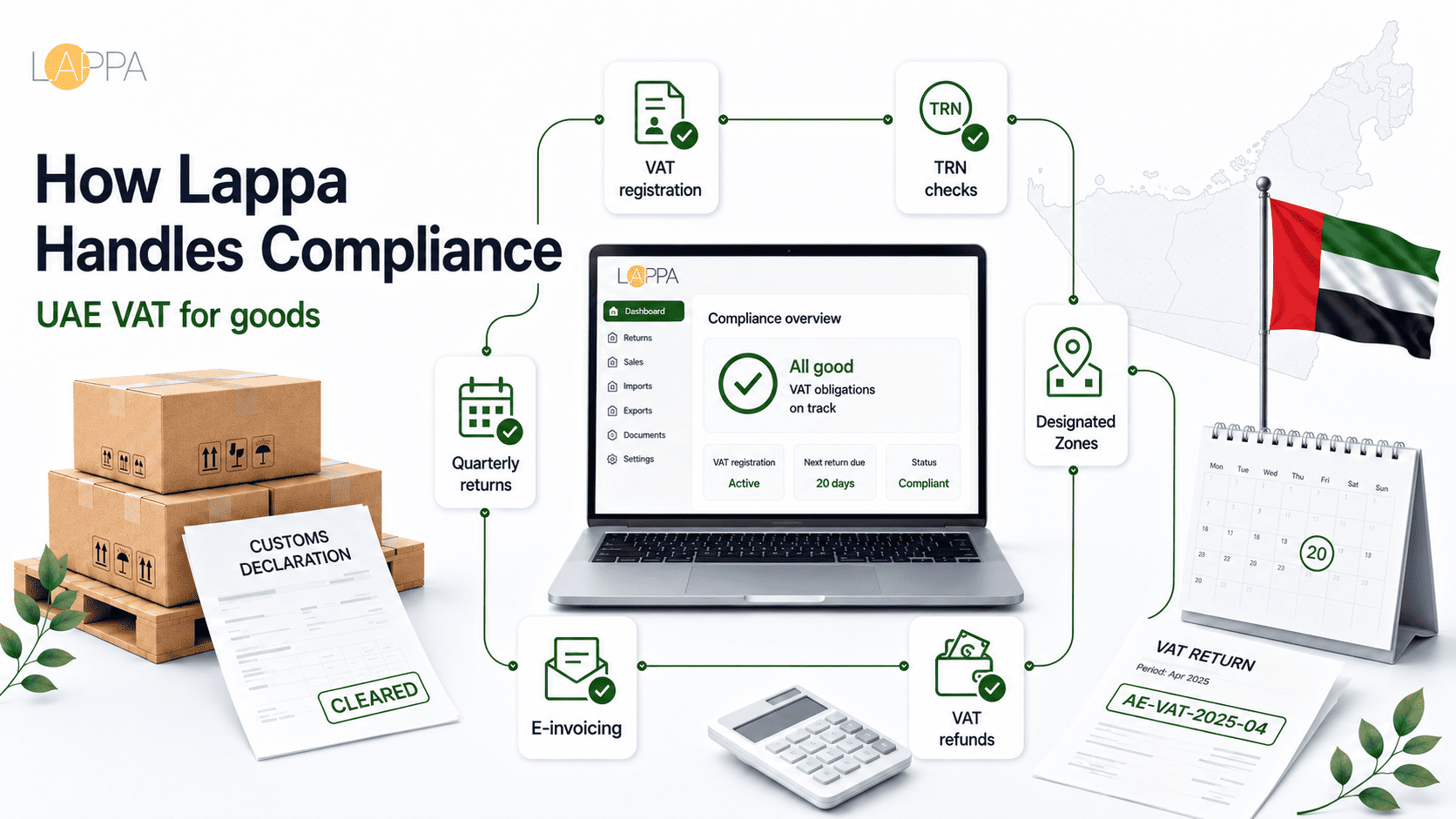 The UAE's VAT obligations are operationally leaner than many European jurisdictions -- single federal rate, single registration, quarterly returns, no intra-state registration complexity -- but Designated Zone analysis, place of supply for digital services, partial exemption for mixed-activity businesses, and the incoming e-invoicing mandate create real complexity. Lappa handles UAE VAT registration through EmaraTax, Tax Agent services for quarterly compliance, return preparation, and refund applications.
For non-resident businesses entering the UAE market for the first time, Lappa manages the full registration workflow: EmaraTax account creation, documentation review, application submission, and TRN confirmation. We also verify TRN visibility in the FTA checker before you issue your first invoice to a UAE buyer -- so your customer can verify your TRN immediately and recover input VAT without any back-and-forth.
For the e-invoicing mandate, Lappa advises on service provider selection and integration planning. Phase 1 (October 2026 for businesses above AED 150 million annual revenue) is closer than it looks. If your UAE turnover puts you in that tier, integration planning needs to start now. Procurement alone -- selecting and contracting a certified service provider -- can take months. Add technical integration and testing, and the runway to October 2026 is genuinely tight for businesses starting from scratch.
The UAE's VAT obligations are operationally leaner than many European jurisdictions -- single federal rate, single registration, quarterly returns, no intra-state registration complexity -- but Designated Zone analysis, place of supply for digital services, partial exemption for mixed-activity businesses, and the incoming e-invoicing mandate create real complexity. Lappa handles UAE VAT registration through EmaraTax, Tax Agent services for quarterly compliance, return preparation, and refund applications.
For non-resident businesses entering the UAE market for the first time, Lappa manages the full registration workflow: EmaraTax account creation, documentation review, application submission, and TRN confirmation. We also verify TRN visibility in the FTA checker before you issue your first invoice to a UAE buyer -- so your customer can verify your TRN immediately and recover input VAT without any back-and-forth.
For the e-invoicing mandate, Lappa advises on service provider selection and integration planning. Phase 1 (October 2026 for businesses above AED 150 million annual revenue) is closer than it looks. If your UAE turnover puts you in that tier, integration planning needs to start now. Procurement alone -- selecting and contracting a certified service provider -- can take months. Add technical integration and testing, and the runway to October 2026 is genuinely tight for businesses starting from scratch.
FAQ for UAE VAT Goods
What is the VAT rate in United Arab Emirates
5%. Standard rate, effective since January 1, 2018. Applies to most commercial goods and services -- retail, professional services, SaaS, advertising, hospitality, non-residential real estate, construction. Zero-rated categories include exports out of the GCC, international transport, healthcare, education, first supply of residential buildings, and investment-grade precious metals. Exempt categories include financial services (margin-based), subsequent residential property sales and leases, bare land, and local passenger transport. The 5% rate is genuinely low by global standards. Lower than any EU member state's standard rate, lower than the UK's 20%, lower than Singapore's 9% GST. But low rate doesn't mean low enforcement. The FTA actively audits, consistently applies the penalty regime, and has been expanding its data-matching capabilities. Don't confuse a simple rate with simple compliance.Who needs to register for VAT in United Arab Emirates
UAE-resident businesses above AED 375,000 taxable turnover (mandatory). UAE-resident businesses above AED 187,500 (voluntary, if you want to recover input VAT early). Non-resident businesses making any taxable UAE supply, from the first supply. Businesses importing goods into the UAE for onward sale. Free zone companies selling to UAE mainland customers. Non-resident digital service providers with UAE B2C customers. One pattern: taxable supply in the UAE, you register. For non-resident digital businesses: if your UAE customers are all registered businesses with active TRNs, they apply the reverse charge and you don't need to register. If any UAE customer is a consumer without a TRN, you register and charge 5% from the first B2C sale. Check your UAE customer mix before assuming the reverse charge covers you.What is the VAT number format in United Arab Emirates
VAT number United Arab Emirates format: 15 digits starting with 100. Example: 100123456789001. One TRN per registration, covering all seven emirates. Verify any supplier TRN at tax.gov.ae before you process their invoice for input VAT recovery. Active TRN, entity name matches invoice -- that's your minimum check. Don't skip it, even for long-standing suppliers. TRNs can be deactivated if a business de-registers or gets removed by the FTA. The TRN on your invoice needs to be exactly right -- all 15 digits, correct format, matching the entity name on your EmaraTax registration. A transposed digit, a missing digit, or a TRN that belongs to a different entity in your corporate group makes the invoice non-compliant. Your customer can't recover the input VAT and you'll be issuing a corrected invoice. Check the invoice template before go-live.How often are VAT returns filed in United Arab Emirates
Quarterly by default. The four UAE VAT quarters: January-March, April-June, July-September, October-December. Deadline: 28 days after quarter end. Q1 due April 28, Q2 due July 28, Q3 due October 28, Q4 due January 28. Payment is due at the same time as the return -- same EmaraTax session, same deadline. File the return but don't pay? Penalty. Pay but don't file? Penalty. Both are due together. Monthly filing is FTA-assigned, not business-chosen. If you're on monthly, you don't get to switch back to quarterly without FTA approval. Refund positions aren't automatically processed with returns -- you submit a separate refund application through EmaraTax and wait for FTA review. If you're consistently in a refund position (zero-rated exporter, for example), build the refund application timing into your cash flow planning. Refunds can take weeks or months.Do foreign companies need a tax representative in United Arab Emirates
No mandatory fiscal representative. VAT United Arab Emirates registration is open to non-residents registering directly through EmaraTax. Appointing a UAE Tax Agent (FTA-licensed) is practical but not legally required. The Tax Agent doesn't carry joint liability -- you do. They handle EmaraTax mechanics on your behalf. For low-volume non-resident registrations, some businesses manage directly. For meaningful UAE turnover and regular returns, an experienced UAE Tax Agent is worth the cost. Registering for VAT in the UAE as a non-resident: start at emaratax.ae, create your account, gather your incorporation documents and evidence of UAE supply activity, and submit the registration form. Budget five to ten business days for FTA review of a complete non-resident application. If your registration is approved with an effective date backdated to your first supply, you may already have past tax periods that need returns. Check the effective date on your TRN certificate immediately and work out what periods you owe.VAT Calculator
At 5%, the maths are about as simple as VAT gets. Adding VAT: multiply your net price by 1.05. Extracting VAT from a gross price: divide by 1.05. A product priced at AED 1,000 net carries AED 50 VAT and totals AED 1,050 gross. To go the other way: AED 1,050 / 1.05 = AED 1,000 net, AED 50 tax. Your UAE invoices need to show these figures per line -- the net amount, the VAT amount (clearly labelled at 5%), and the gross. Both TRNs (yours and your customer's) are required on B2B invoices. Missing any of those fields makes it a non-compliant invoice. Invoice currency: your return is filed in AED, so if you invoice in USD, GBP, or EUR, you convert at the UAE Central Bank exchange rate on the date of supply. Keep those exchange rate records. The FTA verifies conversion methodology during audits -- applying the wrong rate or the rate on payment date (rather than supply date) is a common error that auditors flag.
VAT Standard rate
5%
VAT Reduced rate
No reduced VAT rate
Thresholds
UAE-resident businesses must generally register when taxable supplies and imports exceed AED 375,000 during the previous 12 months or are expected to exceed this amount within the next 30 days.