


United Kingdom VAT Registration and Compliance Guide
Provinces
Goods
Provinces
Goods
About
Goods
About
Goods
Goods
Goods
Selling goods across the Channel or just down the road? Either way, United Kingdom VAT touches almost every sale once a certain turnover is reached. This guide sticks to goods, skips services entirely, and works through rates, thresholds, sign-up, invoicing, returns and fines in plain terms. Get the basics sorted early and the paperwork stops being a surprise later. United Kingdom VAT isn't complicated once you see the shape of it: a chain, not a single flat charge. In official language, the UK's value added tax runs through that chain, with each registered link accounting for its own slice.
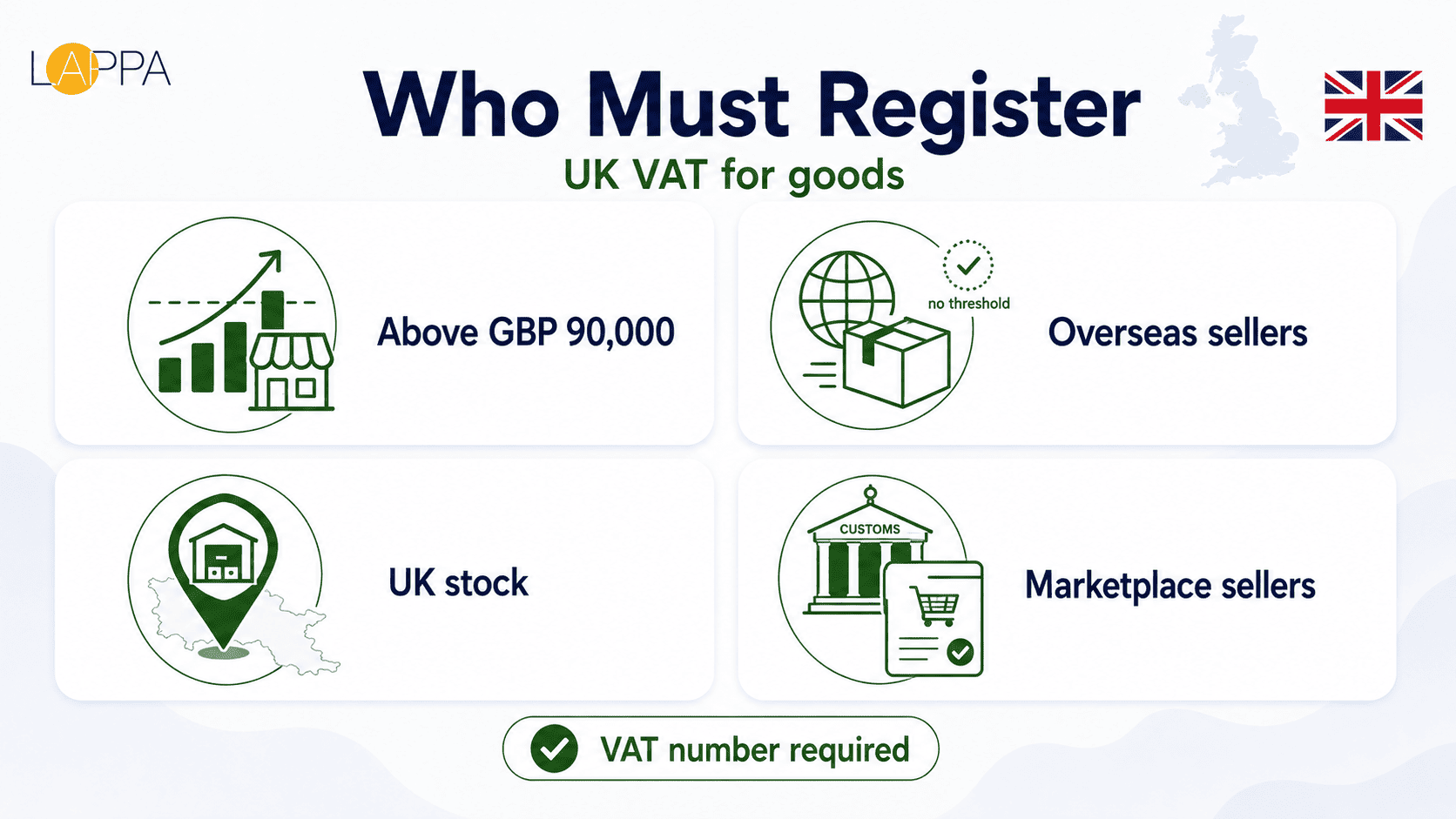 Passing £90,000, or simply expecting to within the next 30 days, triggers the requirement. Non-resident sellers holding stock domestically, certain importers, and anyone buying an already-registered trading entity are pulled in too, regardless of their own turnover. Charities selling goods play by the same rules as any ordinary trader.
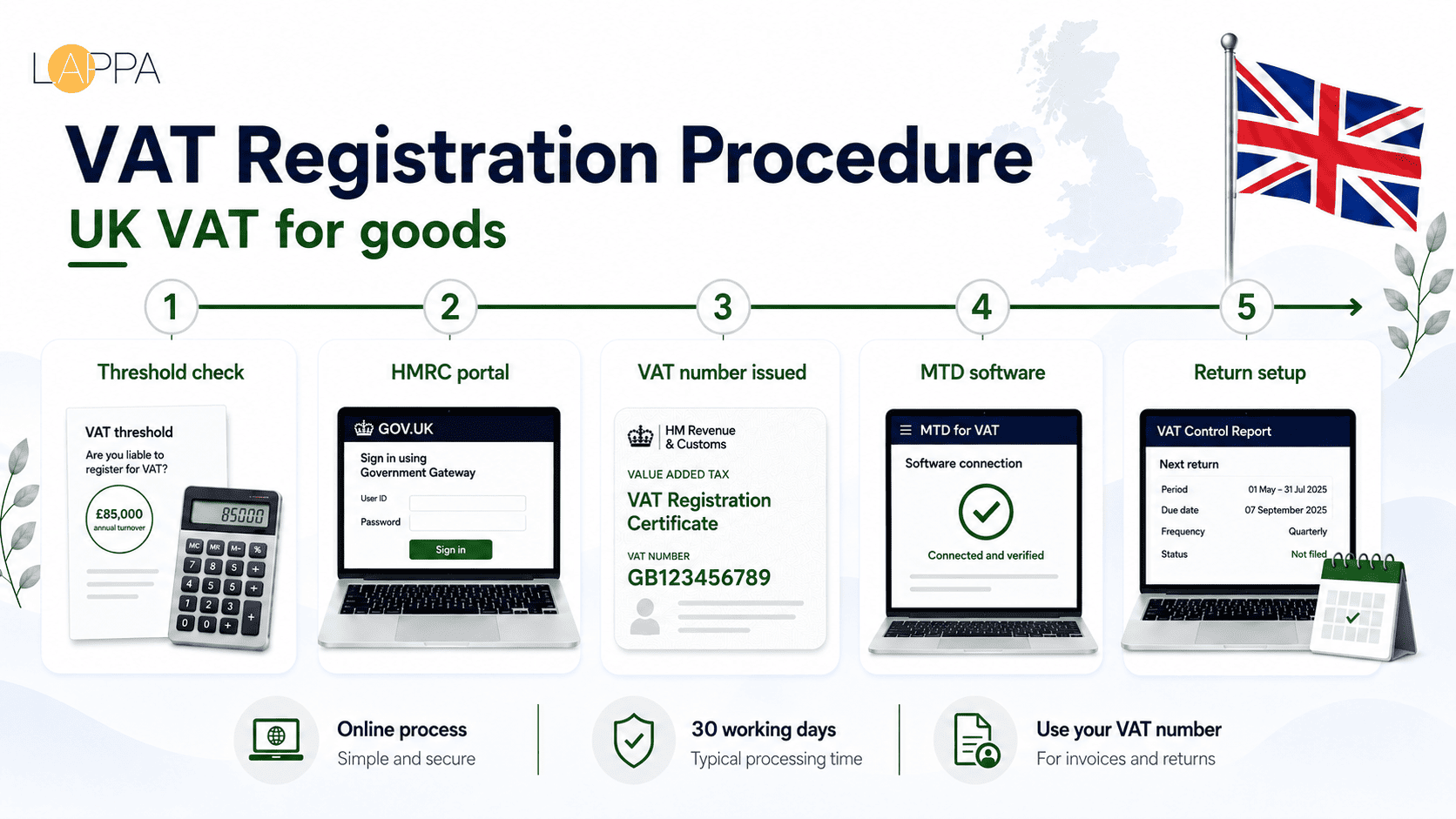 VAT registration in the United Kingdom runs through the Government Gateway portal, either handled directly or via an appointed agent. Trading details, bank information and an estimate of expected turnover all go into the application. Signing up for tax purposes across the United Kingdom voluntarily works the same way, and suits a smaller trader keen to reclaim tax before the threshold forces the issue. Turnaround sits between two and eight weeks typically, though anything involving overseas directors can drag on longer. Whether someone applies out of obligation or by choice, VAT registration in the United Kingdom doesn't split into separate tracks depending on the reason.
Approval brings a certificate spelling out the effective date, the first filing period, and whichever accounting scheme applies. Most delays trace back to something simple, like a company name that doesn't quite match official records. A quick check against Companies House before hitting submit saves that headache entirely.
VAT registration in the United Kingdom runs through the Government Gateway portal, either handled directly or via an appointed agent. Trading details, bank information and an estimate of expected turnover all go into the application. Signing up for tax purposes across the United Kingdom voluntarily works the same way, and suits a smaller trader keen to reclaim tax before the threshold forces the issue. Turnaround sits between two and eight weeks typically, though anything involving overseas directors can drag on longer. Whether someone applies out of obligation or by choice, VAT registration in the United Kingdom doesn't split into separate tracks depending on the reason.
Approval brings a certificate spelling out the effective date, the first filing period, and whichever accounting scheme applies. Most delays trace back to something simple, like a company name that doesn't quite match official records. A quick check against Companies House before hitting submit saves that headache entirely.
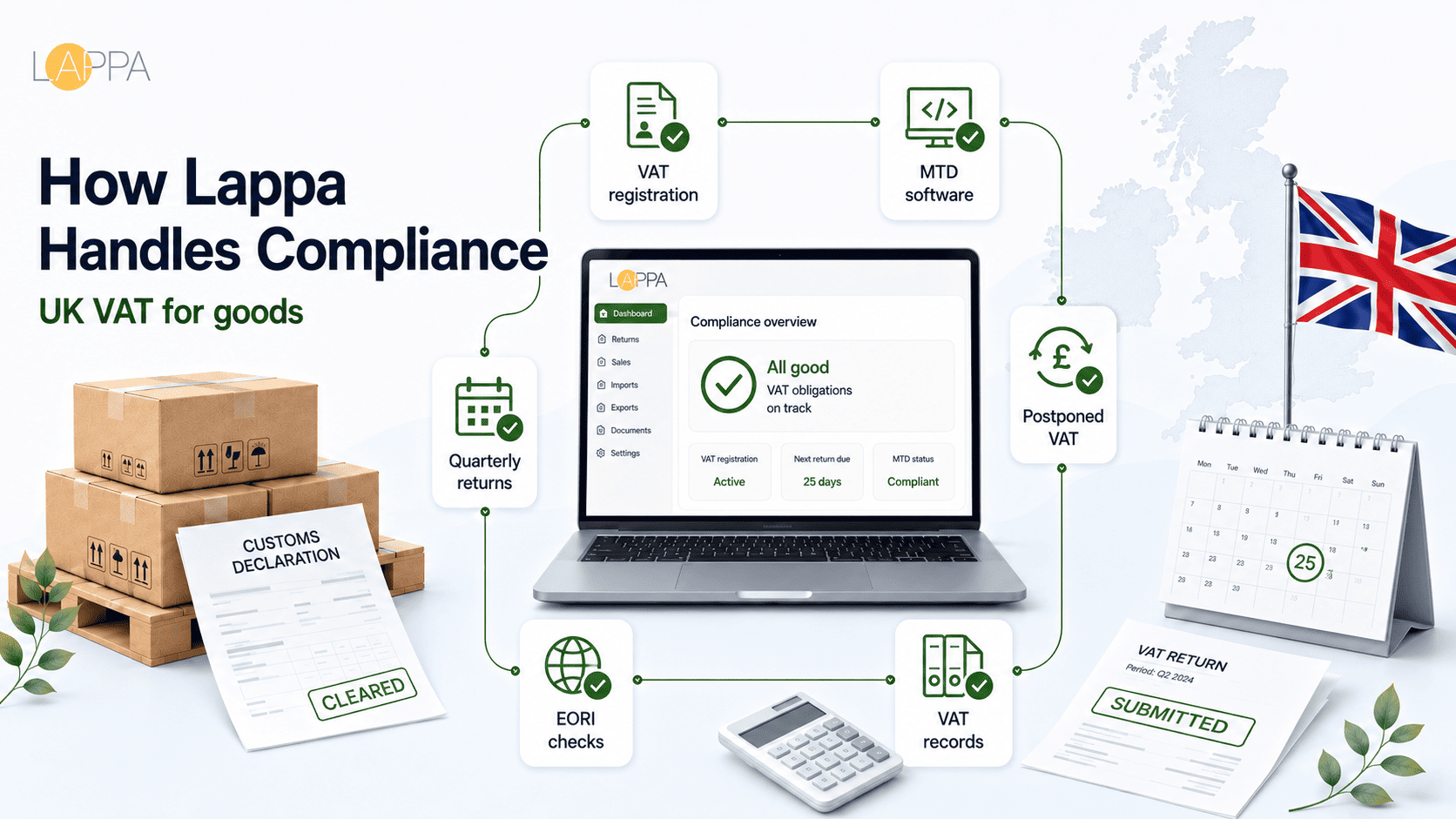 Lappa handles goods sellers through every stage, from checking whether the threshold is already close to submitting the application itself. Ongoing quarterly filing, digital records that stay aligned with Making Tax Digital, and deadline tracking so penalty points never quietly build up — that's the day-to-day work. Overseas sellers get cross-border paperwork sorted too, with Lappa liaising directly with HMRC wherever an agent relationship helps. Get in touch for a proper look at where your registration and filing calendar currently stand.
Introduction to VAT in United Kingdom
This is a consumption tax, meaning the buyer ultimately carries the cost, not the seller. Anyone trading in taxable goods here needs at least a working grasp of how it flows. VAT in United Kingdom law traces back to the Value Added Tax Act 1994, and HMRC is the body that enforces it day to day. Tax rules across the United Kingdom don't distinguish between something made locally and something shipped in. The charge lands at every step between raw material and till receipt. A shop takes payment from a shopper, then hands a share to HMRC once it has subtracted whatever it already paid suppliers. Sell abroad, import stock, or run entirely online: tax in the United Kingdom follows the same chain regardless. Cross a set threshold from anywhere in the world and the same obligations apply, since VAT in United Kingdom law makes no exception for distance.United Kingdom VAT Rate and Rate Categories
Three rates cover goods here. Standard, at 20%, is the default and catches most things: electronics, clothing for adults, furniture, alcohol. Reduced, at 5%, is a short, specific list — domestic gas and electricity, children's car seats among them. Zero, unsurprisingly 0%, covers most food, kids' clothing, books and newspapers. Which United Kingdom VAT rate applies comes down to what's being sold, never how big the seller is. A handful of items sit outside the system altogether — postage stamps, certain financial products — and sellers dealing only in those can't register or reclaim anything on their own purchases. Britain's VAT rate bands haven't shifted since 2011, so at least pricing sits on solid ground. Get the right United Kingdom VAT rate sorted before setting a price, because a wrong classification is expensive to unwind later.VAT United Kingdom Rates by Goods Category
Every product lands in one of four bands, and VAT United Kingdom classification decides which one applies to a given item. Getting the category right the first time avoids a repricing headache further down the line. HMRC publishes and refreshes VAT United Kingdom guidance for each band as the rules shift.| Category | Rate applied | Typical examples |
| Standard rate | 20% | Electronics, adult clothing, furniture, alcohol |
| Reduced rate | 5% | Domestic gas and electricity, children's car seats |
| Zero rate | 0% | Most food, children's clothing, books, newspapers |
| Exempt | None charged | Postage stamps, some financial instruments |
United Kingdom VAT Registration Threshold
Sign-up becomes compulsory at £90,000 of taxable turnover in any rolling twelve-month window — not a fixed calendar year. That figure hasn't moved since April 2024 and stays put through 2026/27. Cross it and HMRC needs notifying within 30 days. Cancelling is a separate line: £88,000, so dipping just under £90,000 alone doesn't let anyone deregister on the spot.For local businesses
Every taxable sale counts toward that rolling total — standard, reduced and zero-rated alike. Exempt sales don't. Sign-up below the threshold is still allowed, and plenty of small firms do it anyway just to reclaim what they've paid on stock and kit.For remote sellers selling goods
Store stock in a UK warehouse from overseas, and the usual threshold disappears — it's zero from the very first sale. No grace period, no easing in. First-time exporters are often the ones caught out here, so it pays to check this rule well before shipping anything.Who Must Register for VAT
Passing £90,000, or simply expecting to within the next 30 days, triggers the requirement. Non-resident sellers holding stock domestically, certain importers, and anyone buying an already-registered trading entity are pulled in too, regardless of their own turnover. Charities selling goods play by the same rules as any ordinary trader.
- UK businesses whose rolling twelve-month turnover exceeds £90,000
- Overseas sellers holding goods in UK-based warehouses or fulfilment centres
- Businesses acquiring an existing VAT-registered trade as a going concern
- Any trader that expects to cross the threshold within the next 30 days
United Kingdom VAT Number
A United Kingdom VAT number is the unique code HMRC hands over once an application clears. The format is GB plus nine digits — GB123456789, say. Northern Ireland firms trading with the EU get an XI prefix on the same nine digits instead. Once issued, that United Kingdom VAT number has to sit on every invoice a registered seller raises. It also needs to line up with the VAT identification number issued to businesses in Britain as recorded against the trading name, or a buyer's accounts team may well flag the paperwork. Anyone can run a quick check through HMRC's free online tool to confirm a number is genuinely live. A mismatch between the number shown and the registered name is a classic early sign of invoice fraud, so it's worth checking from the buyer's side too.VAT Number United Kingdom Format at a Glance
Whatever the VAT number United Kingdom businesses hold, it always follows this fixed nine-digit shape, with no regional exceptions. The tax number for United Kingdom companies shows up on the certificate HMRC issues once approval comes through. Running a check on the VAT number United Kingdom supplier gives you before paying an invoice is a sensible habit to build.| Element | Great Britain | Northern Ireland |
| Prefix | GB | XI |
| Digits | 9 numbers | 9 numbers |
| Example | GB123456789 | XI123456789 |
| Used for | Domestic and international invoices | EU trade in goods |
VAT Registration in the United Kingdom
VAT registration in the United Kingdom runs through the Government Gateway portal, either handled directly or via an appointed agent. Trading details, bank information and an estimate of expected turnover all go into the application. Signing up for tax purposes across the United Kingdom voluntarily works the same way, and suits a smaller trader keen to reclaim tax before the threshold forces the issue. Turnaround sits between two and eight weeks typically, though anything involving overseas directors can drag on longer. Whether someone applies out of obligation or by choice, VAT registration in the United Kingdom doesn't split into separate tracks depending on the reason.
Approval brings a certificate spelling out the effective date, the first filing period, and whichever accounting scheme applies. Most delays trace back to something simple, like a company name that doesn't quite match official records. A quick check against Companies House before hitting submit saves that headache entirely.
Appointing a Tax Representative
A fiscal representative isn't required here for most overseas sellers, unlike the setup in several EU countries. HMRC will happily deal straight with a non-resident business or its agent. Even so, plenty of sellers appoint a UK-based agent anyway, purely because it smooths communication and keeps quarterly deadlines from slipping. That agent can file returns, take calls, and answer HMRC's questions without the seller needing to be involved directly.VAT Electronic Invoicing
Nothing mandates electronic invoicing for private-sector goods sales yet, unlike the position in several EU member states. Most registered sellers already send digital invoices anyway, mainly because Making Tax Digital pushed them that way, not because of any invoicing law as such. Consultations on a broader e-invoicing mandate have already happened, so this is worth watching over the next couple of years rather than assuming it stays static. Digital record keeping and software-based filing already apply to every registered business regardless of size. A parallel rollout covers Income Tax reporting for sole traders and landlords, staged by income level rather than switched on all at once.Timeline by Business Size
| Business size or income | Digital requirement start | What changes |
| Any VAT-registered business | Already in force | Digital VAT records and software-based returns |
| Sole traders/landlords over £50,000 | April 2026 | Quarterly digital updates begin |
| Sole traders/landlords over £30,000 | April 2027 | Quarterly digital updates begin |
| Sole traders/landlords over £20,000 | April 2028 | Quarterly digital updates begin |
VAT Returns and Filing
Quarterly filing is the norm for goods sellers, though monthly and annual schemes suit particular situations. A return sets out tax collected on sales, tax reclaimed on purchases, and whatever balance is owed or due back. Both filing and payment land on the same deadline: a month and seven days after the period closes. A handful of records sit behind every submission, and HMRC can ask to see any of them during a check.- The quarterly or monthly return itself, filed through compatible software
- Import documentation, including postponed accounting statements
- Electronic sales invoices issued to customers
- Purchase records and supplier invoices backing input claims
- Local files such as stock records and adjustment workings
Deductible VAT for Goods Sellers
Tax paid on stock, packaging, delivery vehicles and equipment can generally be clawed back by a registered seller. The purchase has to connect directly to taxable sales, and a valid invoice needs to back the claim up. Where something is used partly for private purposes, only the business share of the tax is recoverable. Some costs stay blocked no matter what, though. Client entertaining and most cars bought outright typically don't qualify. A clean paper trail from purchase through to sale is the easiest way to defend a claim if HMRC comes asking later.VAT Record Keeping Requirements
Every sale, purchase and adjustment needs a digital record kept for at least six years. Making Tax Digital rules mean compatible software, not a loose spreadsheet on its own, unless it's linked through approved bridging tools. Whatever gets kept needs enough detail that HMRC could rebuild any return from scratch if it chose to.- Sales and purchase invoices, including credit notes
- A running summary of output and input tax for each period
- Import and export documentation for cross-border movements
- Records of anything taken for personal or non-business use
VAT Penalties and Fines
Late submission now runs on points rather than an automatic fine. Miss a deadline and one point lands; hit the threshold — four points for most quarterly filers — and a flat £200 penalty follows. Every late return after that adds another £200, until a clean run resets the count. Late payment is a separate matter entirely. Nothing gets charged inside 15 days of the deadline. Past that, a percentage penalty kicks in, stepping up again at 30 days, on top of daily interest set at the Bank of England base rate plus a fixed margin. File late and pay late together, and both penalties can land on the same return. Miss the £90,000 mark altogether and fail to tell HMRC, and a backdated tax bill is only part of the story — a separate failure-to-notify penalty follows too, worked out as a percentage of what should have been paid.How Lappa Can Help with VAT Compliance
Lappa handles goods sellers through every stage, from checking whether the threshold is already close to submitting the application itself. Ongoing quarterly filing, digital records that stay aligned with Making Tax Digital, and deadline tracking so penalty points never quietly build up — that's the day-to-day work. Overseas sellers get cross-border paperwork sorted too, with Lappa liaising directly with HMRC wherever an agent relationship helps. Get in touch for a proper look at where your registration and filing calendar currently stand.
FAQ for United Kingdom VAT Goods
What is the VAT rate in United Kingdom
Standard sits at 20% and covers most goods sold nationally. Reduced, at 5%, is reserved for a short list — domestic energy and children's car seats among them. Zero, at 0%, applies to most food, books, newspapers and kids' clothing. A few supplies are exempt outright, meaning no charge at all and no input tax to reclaim against them either.Who needs VAT registration in United Kingdom
Cross £90,000 of taxable turnover in any rolling twelve months, and registration stops being optional. Overseas sellers storing stock in a UK warehouse are in from their very first sale, threshold or no threshold. Voluntary sign-up below that line is also fine, and often sensible if reclaiming input tax makes the numbers work. Once registered, filing and digital record obligations start straight from the effective date, no delay.What is the VAT number format in United Kingdom
The usual shape is GB followed by nine digits, like GB123456789. Northern Ireland firms trading with the EU use XI instead, attached to the same nine-digit structure. HMRC allocates the number once an application is approved, and it then sits on the certificate. From that point it has to appear on every invoice raised for taxable goods.What is the current VAT rate in United Kingdom
Standard has held at 20% since January 2011, with no change since. Reduced-rate goods sit at 5%, and zero-rated goods carry no charge at the point of sale. These three bands have stayed put for years now, which at least gives sellers something stable to price against. Any shift would typically be flagged well ahead of time at a Budget statement, not sprung without warning.How often are VAT returns filed in United Kingdom
Quarterly is standard for most goods sellers, each covering a three-month stretch. Some opt for monthly filing instead, usually because they reclaim more than they collect on a regular basis. An annual scheme also exists, aimed at smaller, steadier businesses that would rather file less often and make interim payments along the way. Whichever frequency applies, both filing and payment fall due a month and seven days after the period ends.VAT Calculator
Working out the charge on a sale is just arithmetic once the rate is known. A standard-rated item at £120 including tax: divide by 1.2, and £100 is the net price, leaving £20 as tax. A reduced-rated item at 5%: divide the gross figure by 1.05 instead. Most accounting software does this instantly, so manual sums are really only useful for a quick sanity check.- Adding tax: net price × (1 + rate) = gross price
- Removing tax: gross price ÷ (1 + rate) = net price
- Tax portion only: gross price − net price = tax due
VAT Standard rate
20%
VAT Reduced rate
5%
Thresholds
VAT registration is mandatory when taxable turnover exceeds £90,000 during any rolling 12-month period, or when the business expects taxable turnover to exceed £90,000 within the next 30 days. Businesses below the threshold may register voluntarily.