


Romania VAT Guide for Businesses
Provinces
Goods
Provinces
Goods
About
Goods
About
Goods
Goods
Goods
Introduction to VAT in Romania
VAT in Romania is called TVA -- Taxa pe Valoarea Adaugata. ANAF (Agentia Nationala de Administrare Fiscala) runs it. Romania joined the EU in 2007 and adopted the standard EU VAT framework, but built its own reporting stack on top: D406 (the Romanian SAF-T), a mandatory e-invoicing system called RO e-Factura, and D394, an informative declaration that sits alongside the standard VAT return. Three layers most foreign businesses don't anticipate until they're already registered. Romania applies three active TVA rate tiers: standard at 19%, reduced at 9%, and super-reduced at 5%. No regional rate variations, no intermediate tier. The rate is the rate -- the same across the whole country. What you need to know is which products and services fall into each tier, because some of the category assignments differ from what you'd expect based on other EU states. This guide covers physical goods and digital services separately. Goods sellers moving stock into or through Romania usually need direct Romanian TVA registration. Digital service providers can often handle EU B2C sales through the One Stop Shop instead. Read the registration threshold section before choosing -- your turnover, your location, and the nature of your supply determine the right route.VAT Rates in Romania
| Rate Tier | Rate | Common Examples |
| Standard | 19% | Professional services, software, electronics, clothing, telecoms, advertising, most commercial goods and services not covered by a reduced rate |
| Reduced | 9% | Basic foodstuffs, non-alcoholic beverages, medicines, hotel accommodation, some agricultural inputs, restaurant services, water supply |
| Super-reduced | 5% | Books, newspapers, magazines, access to museums, cinemas, sports events, cultural events, thermal baths, social housing (first home, under 120 sqm, under RON 600,000) |
| Zero / Exempt | 0% / Exempt | Exports to non-EU destinations, intra-EU B2B supplies to buyers with valid VAT numbers, healthcare services, financial services, educational services |
VAT Registration Threshold in Romania
| Seller Category | Threshold | Key Notes |
| Romanian resident business | RON 300,000 annual turnover | Small business exemption under Article 310 of the Fiscal Code. Below the threshold, issuing invoices without TVA is permitted. Voluntary registration is available at any time. |
| EU-based distance seller (goods) | EUR 10,000 EU-wide B2C turnover | Combined B2C cross-border sales across all EU member states. Above EUR 10,000: charge Romanian TVA directly, or use OSS from your home member state. |
| Non-EU seller (goods or services) | No threshold -- from first taxable supply | Register with ANAF before your first Romanian taxable supply. A fiscal representative is required for non-EU businesses with direct registration. |
| Digital service provider (EU or non-EU) | EUR 10,000 EU-wide B2C turnover | SaaS, streaming, gaming, e-learning platforms. Non-union OSS covers all EU B2C digital revenue from one registration -- no separate Romanian TVA number needed for covered supplies. |
For local businesses
Romanian resident businesses are exempt from TVA registration below RON 300,000 annual turnover under Article 310 of the Fiscal Code (Codul Fiscal). Below the threshold, you don't charge TVA and you don't recover input TVA on costs. Invoices must reference the exemption basis. Exceed RON 300,000 mid-year and you register from the first day of the following month -- not the following year. Voluntary registration is always available, which makes sense if you're incurring significant input TVA on capital purchases.For remote sellers
EU-based businesses selling physical goods to Romanian consumers apply the EUR 10,000 EU-wide distance selling threshold against combined B2C turnover across all 27 member states. Under EUR 10,000 across the EU: charge your home-country VAT rate. Over EUR 10,000: either register for TVA in each destination country, Romania included, or file OSS returns from your home member state. Non-EU sellers face no threshold -- the Romanian TVA obligation starts from the first B2C supply.For remote digital services
Digital service providers -- SaaS, streaming, gaming, cloud, e-learning -- apply the same EUR 10,000 EU-wide threshold against B2C digital sales. Over it, Romanian TVA at 19% applies to supplies to Romanian consumers. Non-union OSS covers all EU B2C digital revenue from one registration in any EU member state. No separate Romanian TVA number is needed for supplies covered by OSS. That changes only when a provider has non-OSS-scope supplies in Romania -- domestic warehousing, B2B sales, or physical goods transactions.Who Must Register for VAT in Romania
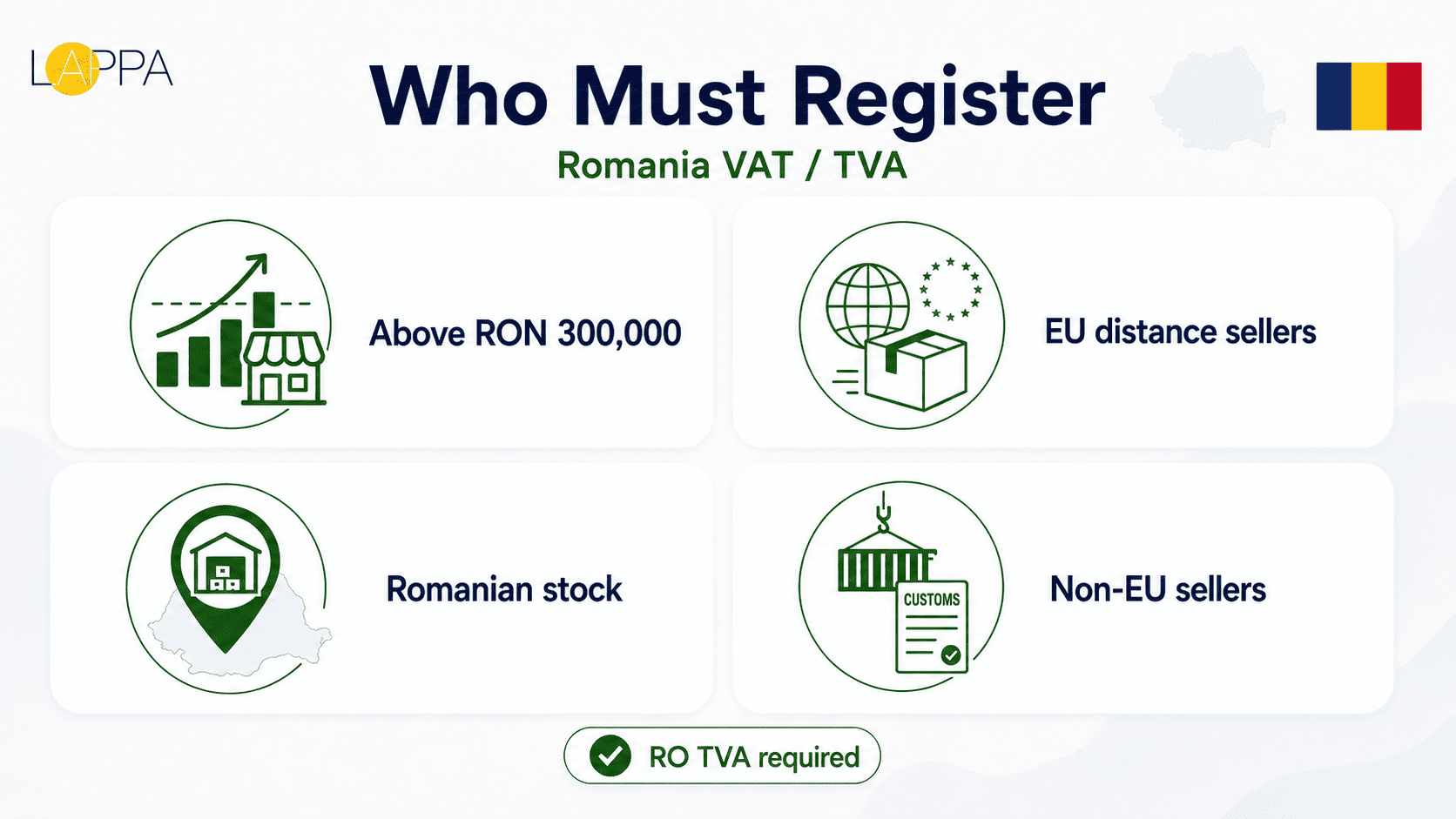 Direct Romanian TVA registration is mandatory for: resident businesses above RON 300,000 turnover; non-resident businesses making taxable Romanian supplies outside the OSS or IOSS scope; businesses receiving B2B services subject to reverse charge from foreign suppliers; and businesses making intra-EU goods acquisitions in Romania above EUR 10,000 annually. That last category catches foreign companies importing goods from other member states and moving them into Romanian warehouses -- a situation increasingly common with EU-based logistics and fulfilment operations.
Romania VAT Obligations for Foreign and Ecommerce Businesses
Romania VAT obligations for marketplace sellers fall under the EU deemed supplier rules in force since July 1, 2021. Platforms facilitating B2C goods sales from non-EU sellers, or goods shipped from outside the EU with a value up to EUR 150, are treated as the TVA-responsible supplier. The platform charges and remits TVA; the underlying seller makes a zero-rated supply to the platform. But if that non-EU seller is warehousing goods in Romania -- at a Romanian fulfilment centre -- direct TVA registration remains necessary for import TVA and B2B transactions. Deemed supplier rules don't eliminate import obligations. The reverse charge on B2B services bought from non-Romanian suppliers applies automatically when the Romanian buyer is TVA-registered. A Romanian-registered company purchasing consulting or software licences from a German firm self-assesses TVA at 19% on that invoice. The German firm doesn't need to register in Romania for those specific transactions. But if the German firm is also making direct B2C sales to Romanian consumers above the EUR 10,000 threshold, that's a separate registration trigger entirely. Romanian VAT treatment of construction and real estate depends on whether the property is new or old, commercial or residential. New commercial buildings sold by a developer are taxable at 19%. Older buildings, and residential property not qualifying for the 5% social housing rate, may be exempt but with an option to tax. Get the classification wrong and you've either undercharged TVA or created an irrecoverable output TVA liability. Real estate transactions in Romania warrant specific local tax advice before any agreement is signed.VAT Number in Romania
Romania's TVA number uses the RO prefix followed by the CIF (Codul de Identificare Fiscala) -- the company's fiscal identification code. The CIF is 2 to 10 digits, making the full EU TVA number RO + 2 to 10 digits, between 4 and 12 characters total. Unlike Germany's fixed-length format or Portugal's fixed 9-digit NIPC, Romania's variable-length CIF means not all RO-prefix numbers are the same length. Validation tools account for this.VAT Number Romania -- RO Prefix and CIF Format
VAT Number Romania is the RO-prefixed EU identifier built on the CIF. The CIF itself is assigned by ANAF when a business registers for tax purposes. For most Romanian companies, the CIF has the same numerical value as the CUI (Codul Unic de Inregistrare), the registration code issued by the Trade Register (Oficiul Registrului Comertului). The two identifiers share the same digits -- the CIF is the fiscal one, the CUI is the commercial one. The EU VAT number uses the CIF with the RO prefix, not the CUI. The CIF can be as short as two digits for very old registrations and as long as ten digits for more recently registered entities. When validating a Romanian supplier's TVA number in VIES, the variable length is expected -- a five-digit RO number and an eight-digit RO number are both structurally valid. What matters is that VIES returns a valid status.Romania VAT number for EU and Non-EU Operators
Romania VAT number for a non-resident EU business is issued by ANAF following a direct registration application. EU companies apply using form 013 (Declaration for the registration and de-registration as a TVA taxpayer for non-resident taxpayers established in EU member states). The process doesn't require a fiscal representative for EU operators. ANAF processes the application, assigns the CIF, and issues the RO-prefix EU TVA number. The number propagates to VIES within a few days of issuance. Non-resident businesses -- whether EU or non-EU -- that register for Romanian TVA receive a CIF distinct from any home-country tax identifier. Your German USt-IdNr or French SIREN doesn't carry over. The Romanian CIF is a new number, specific to your Romanian registration, and the RO-prefix TVA number built on it is what you put on Romanian invoices and what your customers validate through VIES.EU VAT Number Romania and VIES Confirmation
EU VAT number Romania registrations appear in VIES at ec.europa.eu/taxation_customs/vies within one to three business days of ANAF confirming the registration. Validate any RO-prefix number in VIES before zero-rating a cross-border B2B invoice. VIES returns the registration status, the business name, and the registered address. If the number doesn't appear yet -- normal in the first days after registration -- wait and re-check rather than zero-rating on the assumption it's coming. An unconfirmed zero-rated invoice creates a TVA liability for you if the status isn't confirmed. ANAF also maintains a national TVA register searchable through its portal (anaf.ro). Useful for verifying domestic Romanian suppliers where you want to confirm both TVA registration status and their registered address before processing an invoice. The ANAF portal lookup and VIES are complementary -- use both for due diligence on new Romanian counterparties.VAT id Romania and VIES Lookup
VAT id Romania follows the RO + CIF structure. The format lookup in VIES checks not just structural validity but active registration status. A CIF that was previously active may appear invalid in VIES if the business de-registered for TVA -- possible if Romanian turnover fell below RON 300,000 and the business opted out voluntarily, or if ANAF cancelled the registration for non-compliance. Always run VIES validation at the time of invoicing, not just when you first add a supplier or customer to your system. Non-EU businesses registering for Romanian TVA through a fiscal representative receive the same RO-prefix CIF as EU direct registrants. The CIF is the same type of number regardless of how the registration was filed. What differs is the application form (015 for non-EU businesses with a fiscal representative), the presence of the representative in the file, and the joint liability structure that comes with it.Numar VAT Romania -- the Local Tax Identifier
Numar VAT Romania is the Romanian-language term for the TVA registration number -- the RO-prefix identifier you'll see on Romanian invoices and in ANAF correspondence. Romanian businesses and their accountants refer to it as the numar de TVA or numar de identificare fiscala in day-to-day use. When checking a Romanian supplier's registration status through their local accounting software or asking a Romanian partner about their VAT identifier, this is the phrase you'll encounter. It maps directly to the RO + CIF format. Romanian invoices must display both the issuer's numar de TVA (RO-prefix CIF) and the customer's TVA number for B2B transactions. For B2C invoices where the customer is a private individual, the seller's number appears but the buyer's doesn't. Invoices missing the issuer's RO-prefix TVA number are non-compliant -- the customer can't recover input TVA on them, and ANAF flags them in D406 cross-referencing.VAT Registration Procedure in Romania
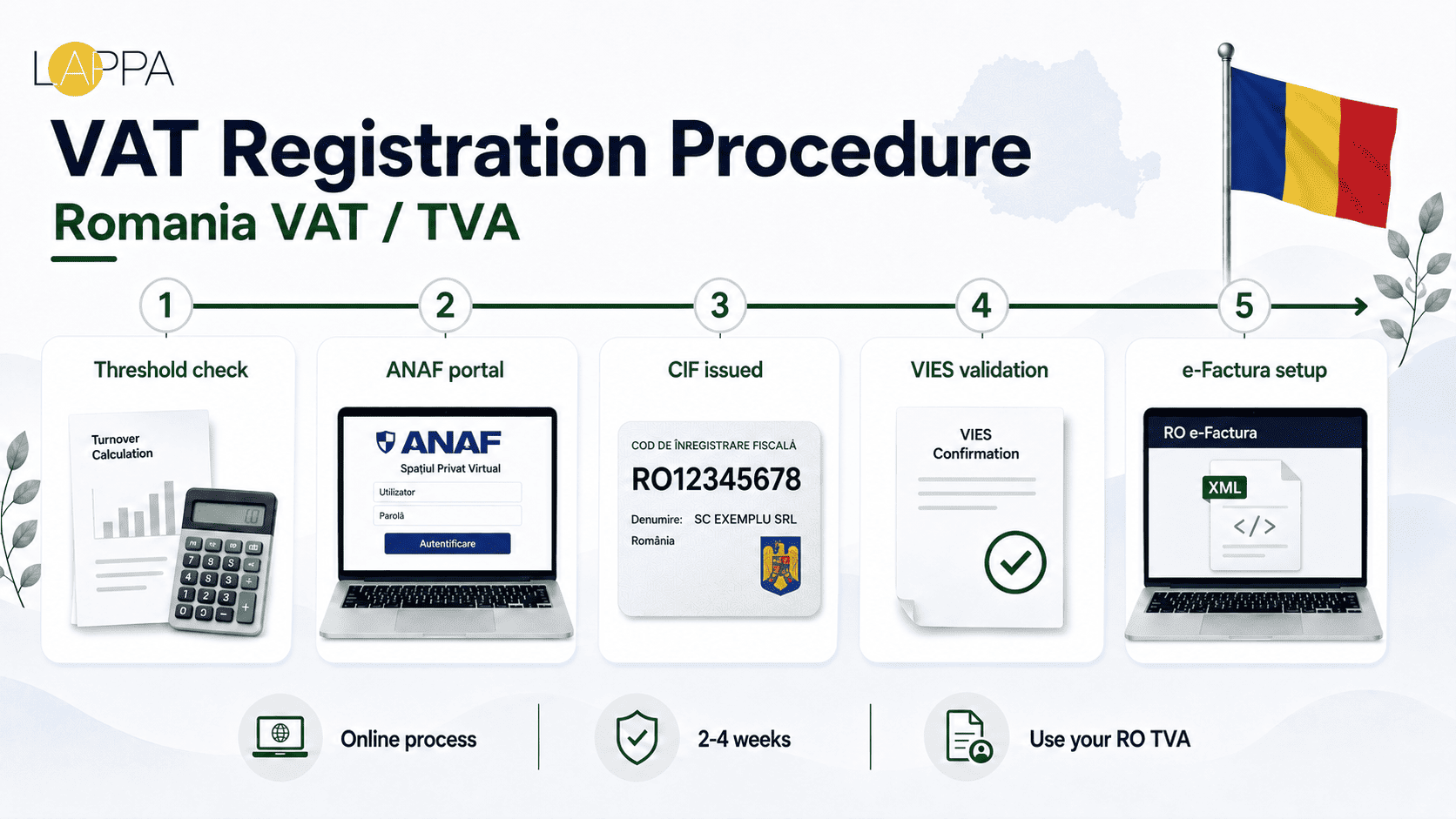 The Romania VAT number registration process runs through ANAF. Resident companies apply using form 010 -- the registration, modification, and de-registration form for Romanian legal entities. Non-resident EU companies use form 013. Non-EU companies applying through a fiscal representative use form 015. Individual non-resident traders use form 030. Each form covers TVA registration and other applicable taxes in one submission.
Documents required for a non-resident EU company registration with ANAF:
The Romania VAT number registration process runs through ANAF. Resident companies apply using form 010 -- the registration, modification, and de-registration form for Romanian legal entities. Non-resident EU companies use form 013. Non-EU companies applying through a fiscal representative use form 015. Individual non-resident traders use form 030. Each form covers TVA registration and other applicable taxes in one submission.
Documents required for a non-resident EU company registration with ANAF:
- Certificate of incorporation or equivalent business registration document from the home country, with a Romanian translation if ANAF requests one
- Evidence of taxable activity in Romania -- signed contracts, purchase orders, Romanian property lease agreements, or other documentation of planned supply
- Completed form 013, signed by an authorised signatory or power of attorney holder
- Bank account details for TVA refund payments from ANAF
- Power of attorney if the application is filed by an agent or adviser rather than the company's own officer
Tax Representative in Romania
EU and EEA businesses register with ANAF directly using form 013. No fiscal representative needed. Non-EU businesses making taxable Romanian supplies -- goods in Romanian warehouses, construction services on Romanian projects, or other direct-supply situations outside OSS scope -- must appoint a fiscal representative authorised by ANAF. The representative is jointly and severally liable for the client's TVA. ANAF has direct recourse against the representative for unpaid amounts. The EU VAT number Romania assigns to a non-EU business registered through a fiscal representative is the same RO-prefix CIF format as a direct EU registration. The route to the number differs; the number itself doesn't. What does differ is the ongoing relationship: the representative handles all ANAF communications, signs declarations, and remains on the hook for TVA accuracy. Choosing a representative with actual Romanian TVA compliance experience -- not just someone willing to sign the authorisation -- matters for the quality of ongoing filings. Businesses whose Romania VAT number was issued through a fiscal representative arrangement can change representatives by notifying ANAF and filing updated authorisation documentation. The CIF and RO-prefix TVA number don't change when the representative changes. But the transition period -- while ANAF processes the new authorisation -- creates a window where filing responsibilities can fall between two parties. Plan representative changes at the start of a filing period, not mid-month. Non-EU businesses whose entire Romanian exposure sits within non-union OSS coverage don't need ANAF registration or a fiscal representative for those supplies. OSS from any EU member state covers all EU B2C digital services and qualifying distance goods. Direct Romanian TVA registration -- and the fiscal representative requirement for non-EU operators -- only applies when supplies fall outside OSS scope.VAT E Invoices in Romania
Romania introduced the RO e-Factura system as the national mandatory e-invoicing infrastructure. It's operated by ANAF and works by receiving uploaded XML invoice files, validating them, applying a digital stamp, and returning the stamped file as the legally valid invoice. The process is: you generate the invoice, upload the XML to the ANAF RO e-Factura portal, ANAF validates and stamps it, and then you send the stamped version to your customer. A physically signed paper invoice without going through RO e-Factura is not a legally valid B2B invoice in Romania. The upload window is five calendar days from the invoice issue date. Upload later and you're non-compliant -- penalties apply from the sixth day. If ANAF rejects the XML (malformed file, missing mandatory fields, invalid TVA number), you fix and re-upload within the five-day window. A rejected file that isn't corrected in time means no valid invoice for that supply.Timeline for different business sizes
- November 2021 -- RO e-Factura launched as mandatory for B2G (business-to-government) supplies. All businesses supplying goods or services to Romanian public sector bodies must use the platform. B2B remained voluntary at this stage.
- January 2022 -- D406 (Romanian SAF-T) mandatory for large taxpayers (contribuabili mari). Monthly XML submission to ANAF covering assets, customers, suppliers, general ledger, purchases, sales, and payments. Deadline: 20th of the second month following the reference period.
- July 2022 -- D406 extended to medium taxpayers (contribuabili mijlocii). Same monthly submission and deadline structure.
- January 2023 -- D406 extended to small taxpayers (contribuabili mici). All TVA-registered businesses now submit D406 monthly.
- January 2024 -- RO e-Factura mandatory for all B2B transactions between Romanian TVA-registered businesses. Any B2B invoice not processed through ANAF e-Factura is non-compliant. The five-day upload deadline became enforceable.
VAT Returns in Romania
Types of reports
Romanian TVA-registered businesses manage the following regular reporting obligations:- D300 (Decontul de TVA -- TVA Return): the main periodic TVA return covering output and input TVA. Monthly for businesses with prior-year turnover above EUR 100,000, or any business with intra-EU transactions. Quarterly for businesses below EUR 100,000 with no intra-EU transactions. Deadline: 25th of the month following the reference period. Filed electronically through the ANAF Spatiu Privat Virtual portal.
- D390 (Declaratia recapitulativa -- EC Sales List): covers intra-EU B2B goods supplies and cross-border reverse-charge services. Monthly, due 25th of the following month. Filed electronically through ANAF.
- D394 (Declaratie informativa -- Informative Declaration): covers domestic Romanian B2B supplies and acquisitions above certain thresholds. Monthly or quarterly depending on TVA filing frequency. Due 30th of the month following the reference period. Unique to Romania -- most EU states don't have an equivalent domestic B2B declaration.
- D406 (Fisierul Standard de Control Fiscal -- Romanian SAF-T): monthly XML file with transaction-level accounting data covering all invoices issued and received, general ledger entries, and asset movements. Due 20th of the second month following the reference period. Filed electronically to ANAF.
- Intrastat: statistical declaration for goods physically crossing Romanian borders within the EU. Current threshold approximately EUR 200,000 for dispatches and EUR 200,000 for arrivals. Filed monthly by the 15th of the following month through the Institutul National de Statistica (INS) portal.
Deductible VAT in Romania
Input TVA recovery follows standard EU direct attribution rules. Costs directly related to taxable supplies: recoverable. Costs for TVA-exempt supplies: not recoverable. Mixed-use costs go through a pro-rata calculation based on the ratio of taxable to total turnover. The pro-rata is estimated at the start of the year using prior-year data and reconciled in the final return of the year. Passenger vehicles with fewer than nine seats: input TVA on purchase, lease, and related running costs is 50% deductible for mixed personal and business use. One hundred percent recovery applies only where the vehicle is used exclusively for a specific taxable commercial purpose -- taxis, driving instruction, vehicle rentals, or goods transport. 'Exclusively for business' requires documentation and is defensible at ANAF audit. An employee using a company car to commute home: 50%. Fuel for passenger cars follows the same split: 50% for mixed-use vehicles, 100% for commercially exclusive ones. Business entertainment and hospitality costs are 50% deductible for TVA purposes, provided they're incurred for business reasons and properly documented. That 50% rule for entertainment differs from Portugal's outright block -- in Romania you recover half. Romanian VAT input recovery for restaurant meals with business guests is 50% deductible -- the same rate as entertainment generally. Meals without a documented business purpose or without a proper fiscal receipt are not deductible at all. ANAF auditors check entertainment and hospitality costs closely. Proper documentation -- the business purpose, the attendees, the receipt from a Romanian fiscal cash register -- is the difference between 50% recovery and zero.VAT Record Keeping Requirements in Romania
Romanian legislation requires TVA records to be retained for five years from the end of the year in which the obligation arose. Accounting records generally require ten years under Romanian accounting law. The practical approach: keep everything for ten years and don't try to segregate TVA from accounting records for retention purposes. D406 XML files must be retained in original format -- exporting to PDF and discarding the XML is non-compliant. The D406 SAF-T file is the primary audit data source. ANAF can and does request D406 files during tax inspections to cross-reference declared TVA figures against transaction-level data. A business that filed D300 returns but failed to keep D406 XML in the original structured format loses the ability to reconcile its own records against what it submitted. That's a risk position you don't want to be in during an ANAF inspection. Romania's VAT number appears in every D406, D394, and D300 filing. ANAF systems link every return to the RO-prefix CIF automatically. If the CIF changes -- for example, following a legal restructuring -- the historical returns under the old CIF and the new returns under the new CIF must both be retained for the full retention period. Don't delete records tied to a de-registered CIF just because the number is no longer active.VAT Penalties in Romania
Late filing of the D300 carries a fixed penalty (amenda contraventionala) ranging from RON 250 to RON 5,000 per declaration, depending on the taxpayer category -- micro-enterprise, small, medium, or large. Late filing after an ANAF demand carries higher penalties than voluntary late submission. If you know you're going to miss the 25th, file late on your own initiative rather than waiting for an ANAF notice. Late TVA payment generates interest (dobanda) at 0.03% per day from the day after the payment deadline. From day 31, an additional penalty (penalitate de intarziere) of 0.02% per day applies on top of the interest. The combined daily cost is 0.05% from day 31 onwards -- roughly 18% annualised. A two-month payment delay on a significant TVA balance becomes expensive fast. Non-submission of D406 (SAF-T) has its own separate penalty structure, independent of D300 penalties. Missing both D300 and D406 in the same period generates two separate fine processes. ANAF tracks each obligation independently and issues separate notices. The D394 informative declaration failure has its own penalty band as well. Four separate reporting obligations means four separate penalty exposures. Using an incorrect Romanian VAT number on invoices -- whether your own or a customer's -- creates cascading problems. Your customer can't recover input TVA on a correctly charged invoice that carries a wrong TVA number. ANAF's D406 cross-referencing matches invoice-level data and flags mismatches. Corrective invoices (facturi de stornare) fix the error, but they add administrative load and can trigger ANAF review of the surrounding period's filings.How Lappa Can Help with VAT Compliance in Romania
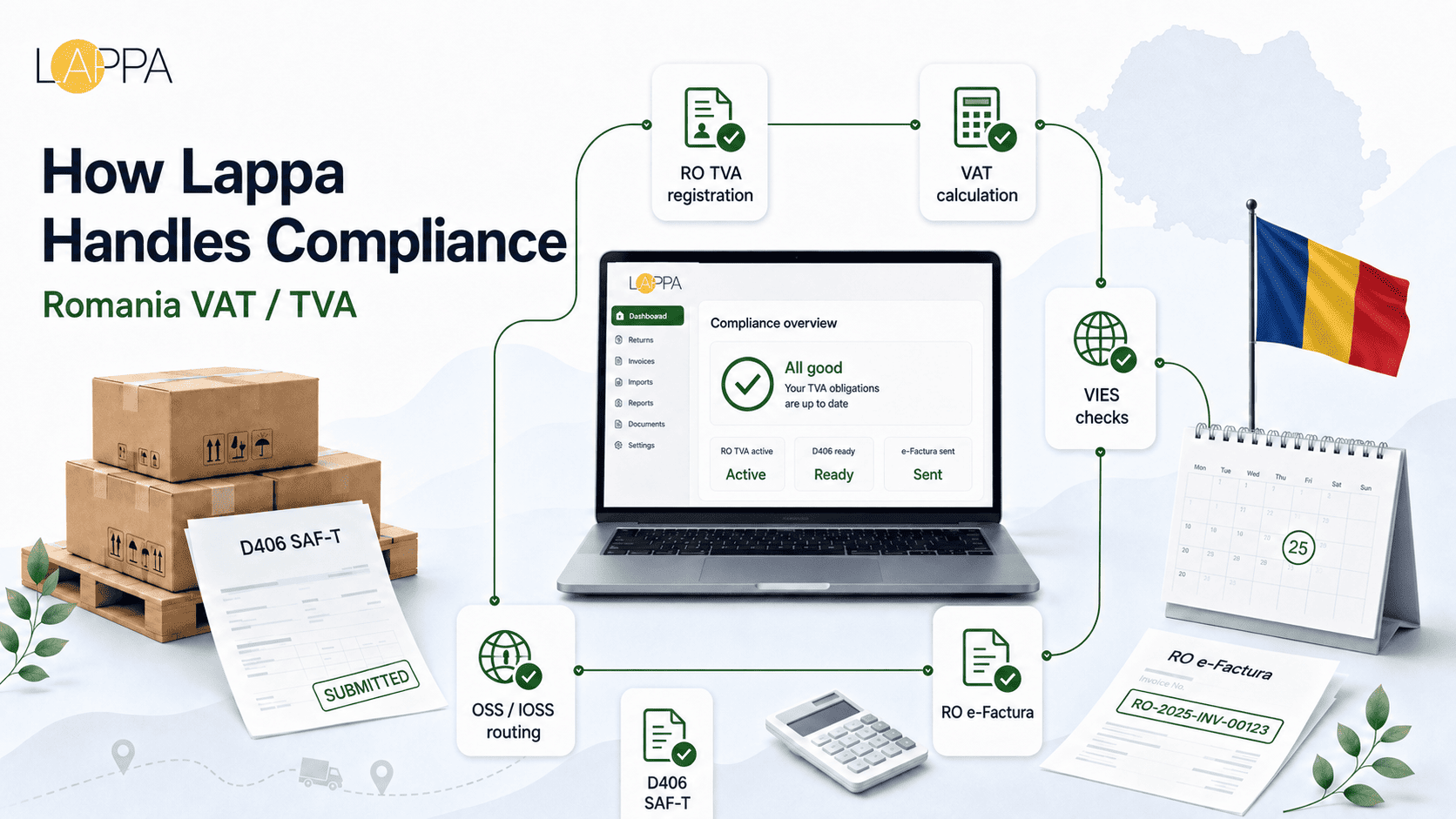 Romania's TVA compliance stack is more layered than most EU markets. D406 SAF-T monthly submissions, RO e-Factura mandatory B2B e-invoicing since January 2024, D394 informative declarations, D390 EC Sales Lists, and a D300 return -- five separate filing streams, each with its own deadline and penalty structure. Lappa manages all of them for your Romanian entity.
For businesses entering Romania for the first time, Lappa handles ANAF registration through the correct form for your entity type -- 013 for EU companies, 015 for non-EU operators with a fiscal representative. Lappa provides the fiscal representative service for non-EU clients, including the joint liability authorisation and all ANAF correspondence. The RO-prefix TVA number and VIES registration are confirmed before your first Romanian invoice is issued.
Romania's VAT ID obligations under RO e-Factura require XML-format invoices submitted to ANAF before they reach the customer. Lappa supports RO e-Factura compliance from day one -- generating UBL-format XML, submitting through the ANAF Spatiu Privat Virtual, and retrieving the ANAF-stamped invoice for transmission to your customer. Getting the e-invoicing infrastructure right before the first invoice is faster and cheaper than retroactively correcting a stack of non-compliant invoices.
Lappa's Romania team generates monthly D406 SAF-T files from your transaction data, handles D300 and D394 filings, and manages D390 EC Sales List submissions. For businesses already registered in Romania but struggling with the reporting obligations, Lappa offers a compliance review and takeover service. We assess where you stand, correct any outstanding filings, and set up the ongoing monthly compliance process.
Romania's TVA compliance stack is more layered than most EU markets. D406 SAF-T monthly submissions, RO e-Factura mandatory B2B e-invoicing since January 2024, D394 informative declarations, D390 EC Sales Lists, and a D300 return -- five separate filing streams, each with its own deadline and penalty structure. Lappa manages all of them for your Romanian entity.
For businesses entering Romania for the first time, Lappa handles ANAF registration through the correct form for your entity type -- 013 for EU companies, 015 for non-EU operators with a fiscal representative. Lappa provides the fiscal representative service for non-EU clients, including the joint liability authorisation and all ANAF correspondence. The RO-prefix TVA number and VIES registration are confirmed before your first Romanian invoice is issued.
Romania's VAT ID obligations under RO e-Factura require XML-format invoices submitted to ANAF before they reach the customer. Lappa supports RO e-Factura compliance from day one -- generating UBL-format XML, submitting through the ANAF Spatiu Privat Virtual, and retrieving the ANAF-stamped invoice for transmission to your customer. Getting the e-invoicing infrastructure right before the first invoice is faster and cheaper than retroactively correcting a stack of non-compliant invoices.
Lappa's Romania team generates monthly D406 SAF-T files from your transaction data, handles D300 and D394 filings, and manages D390 EC Sales List submissions. For businesses already registered in Romania but struggling with the reporting obligations, Lappa offers a compliance review and takeover service. We assess where you stand, correct any outstanding filings, and set up the ongoing monthly compliance process.
FAQ for Romania VAT Goods
What is the VAT rate in Romania
Romania has three active TVA rates. Standard is 19% and covers most goods and services: software, electronics, clothing, professional services, advertising, telecoms. The reduced 9% rate applies to basic food, non-alcoholic beverages, medicines, hotels, and restaurant services. The super-reduced 5% covers books, newspapers, digital publications, museums, cinemas, sports and cultural events, and qualifying social housing for first-home buyers. Export supplies to non-EU countries are zero-rated. Intra-EU B2B supplies to buyers with valid EU VAT numbers are also zero-rated, with the buyer self-assessing TVA in their own country. Healthcare, financial services, and education are TVA-exempt -- no TVA charged, no input TVA recovery on related costs. The distinction between zero-rated and exempt matters for input TVA recovery: zero-rated supplies preserve the right to recover input TVA, exempt supplies don't.Who needs to register for VAT in Romania
Romanian resident businesses above RON 300,000 annual turnover. Non-resident businesses making taxable supplies in Romania that fall outside OSS or IOSS coverage. Businesses making intra-EU goods acquisitions in Romania above EUR 10,000 annually. Businesses receiving B2B services from non-Romanian suppliers where the Romanian reverse charge applies. Voluntary registration is available for resident businesses below RON 300,000 -- useful if you're recovering significant input TVA on capital purchases. EU-based distance sellers apply the EUR 10,000 EU-wide threshold. Over it, either register in Romania or use OSS. Digital service providers use the same threshold. Non-EU sellers of physical goods have no threshold -- Romanian TVA registration applies from the first taxable supply, with a fiscal representative required.What is the VAT number format in Romania
RO followed by the CIF (Codul de Identificare Fiscala) -- between 2 and 10 digits. Variable length, unlike most EU member states with fixed formats. Examples: RO12345 (five digits), RO1234567890 (ten digits). Validate any RO-prefix number through VIES at ec.europa.eu/taxation_customs/vies before zero-rating a cross-border invoice. The ANAF portal (anaf.ro) also supports CIF lookup for domestic verification. The Numar VAT in Romania -- the RO-prefix EU identifier -- is assigned by ANAF as part of the TVA registration process. For Romanian resident companies, it's built on the CIF which matches the CUI (company registration code) numerically. For non-resident registrations, ANAF assigns a new CIF specific to the Romanian TVA registration. Either way, the RO-prefix number is what goes on invoices and into VIES for customer validation.How often are VAT returns filed in Romania
Monthly D300 returns apply if prior-year turnover exceeded EUR 100,000 or if any intra-EU transactions occurred. Deadline: 25th of the following month. Quarterly D300 applies for businesses below EUR 100,000 with no intra-EU activity -- deadline is 25th of the month following the quarter. D406 SAF-T runs monthly for all TVA-registered businesses regardless of D300 frequency, due 20th of the second month following. D390 EC Sales List is monthly, due 25th. D394 (the uniquely Romanian informative declaration on domestic B2B transactions) is monthly for monthly D300 filers and quarterly for quarterly filers, due 30th of the following period. Intrastat is monthly for businesses above the EUR 200,000 threshold, due 15th through the INS portal. In practice, monthly D300 filers have major filing obligations across five different forms on four different deadlines each month.Do foreign companies need a tax representative in Romania
EU and EEA companies don't need a fiscal representative -- they apply directly using form 013. Non-EU companies making taxable Romanian supplies must appoint an ANAF-authorised fiscal representative before filing for registration. The representative takes on joint and several liability for TVA. No appointment, no registration for non-EU operators. This isn't a documentation formality -- it's an enforceable financial commitment by the representative. Non-EU businesses whose Romanian exposure consists entirely of B2C digital services or distance goods covered by OSS don't need direct Romanian TVA registration or a fiscal representative. OSS from any EU member state handles those supplies. Only when supplies fall outside OSS -- domestic warehousing, B2B transactions not covered by OSS, real estate, construction -- does the registration and representative requirement apply. Romania's VAT ID for OSS registrations is the OSS number from the member state of identification -- not an RO-prefix CIF. An Irish company filing OSS for EU B2C digital sales uses its Irish OSS number for those supplies. Don't put an OSS number on a Romanian direct-supply invoice -- it won't validate through VIES and your customer's input TVA recovery fails. The two systems serve different purposes and produce different identifier formats.VAT Calculator
Standard rate: multiply the net price by 1.19 to add TVA, or divide the gross by 1.19 to extract it. Reduced rate: multiply by 1.09, divide by 1.09. Super-reduced: 1.05 in both directions. Romanian invoices must show the net amount, the applicable rate, the TVA amount, and the gross total for each line item. No regional rate complications here -- unlike Portugal or Italy, Romania applies the same rates nationwide. One rate schedule, one country. Your invoicing system needs to pull the right rate based on product category, not customer location within Romania. Getting the category right is the critical step; the maths follows automatically.
VAT Standard rate
21%
VAT Reduced rate
11%
Thresholds
Foreign businesses have no turnover threshold when carrying out taxable transactions for which they must charge Romanian VAT