


Portugal VAT Guide for Registration and Compliance
Provinces
Goods
Provinces
Goods
About
Goods
About
Goods
Goods
Goods
Introduction to VAT in Portugal
VAT in Portugal is called IVA -- Imposto sobre o Valor Acrescentado. The AT (Autoridade Tributaria e Aduaneira) runs it. Here's the thing most foreign businesses miss: Portugal isn't one VAT territory. It's three. Mainland Portugal, the Azores, the Madeira archipelago -- each one has its own rate set. Your customer's location determines which rates apply, not yours. Portugal VAT has a three-tier structure on the mainland: standard at 23%, intermediate at 13%, reduced at 6%. That middle tier -- the 13% intermediate rate -- is what catches most operators off guard. France doesn't have it. Germany doesn't. Portugal does, and it covers a wide list: restaurant food, wine, beer, olive oil, pasta, coffee. Invoicing those at 6% (the reduced rate for basic foods) instead of 13% is a common, expensive mistake. What is VAT in Portugal for a busineаss that's never operated here? It's a consumption tax collected at every link in the supply chain, with businesses charging IVA on sales and recovering it on eligible purchases. But Portugal adds a mandatory digital layer most EU countries don't have: SAF-T PT. That's a monthly XML file with invoice-level detail that goes to the AT. Every IVA-registered business files it. Miss it and you're in trouble before your VAT return is even due. This guide covers goods and digital services. Goods sellers usually need a direct Portuguese IVA registration. Digital service providers can often route everything through the EU's One Stop Shop instead. Read the thresholds section before deciding -- your turnover, your location, and what you're selling all affect which route is right.VAT Rates in Portugal
| Rate Tier | Mainland | Azores | Madeira | Common Examples |
| Standard | 23% | 16% | 22% | Electronics, clothing, software, consulting, telecoms, advertising, most professional services |
| Intermediate | 13% | 9% | 12% | Restaurant food, wine, beer, olive oil, pasta, coffee, catering services, certain agricultural products |
| Reduced | 6% | 4% | 5% | Basic foodstuffs, books, newspapers, medicines, hotel accommodation, passenger transport, cultural services |
| Zero / Exempt | 0% / Exempt | 0% / Exempt | 0% / Exempt | Exports outside the EU, intra-EU B2B supplies with valid VAT numbers, healthcare, education, financial services |
VAT Registration Threshold in Portugal
| Seller Category | Threshold | Key Notes |
| Portuguese resident business | EUR 13,500 annual turnover | Regime de isencao under Article 53 CIVA. Below this you can skip charging IVA entirely. Voluntary registration is always open if you want to recover input IVA on your costs. |
| EU-based distance seller (goods) | EUR 10,000 EU-wide B2C turnover | Combined cross-border B2C across all 27 member states. Above EUR 10,000: charge Portuguese IVA directly, or use OSS from your home member state. |
| Non-EU seller (any supply) | No threshold -- from first taxable supply | Register before your first Portuguese B2C or taxable B2B supply. A fiscal representative is required -- no exceptions for non-EU operators. |
| Digital service provider (EU or non-EU) | EUR 10,000 EU-wide | SaaS, streaming, gaming, e-learning. Non-union OSS lets you cover all EU B2C digital revenue from one registration -- no separate Portuguese number needed. |
For local businesses
Portuguese residents below EUR 13,500 annual turnover can use the Article 53 CIVA exemption. You issue invoices without IVA and don't recover input IVA on your costs. The invoice has to state the exemption basis. Cross EUR 13,500 mid-year? You register from the start of the following month. You can't finish the year on the exemption after you've broken through. Voluntary registration below the threshold is always available -- worth doing if you've got heavy capital purchases with significant input IVA to recover.For remote sellers
EU distance sellers apply the EUR 10,000 threshold across combined B2C sales in all 27 member states. Under EUR 10,000 total: charge your home-country VAT. Over EUR 10,000: either register in each destination country or file via OSS from home. Non-EU sellers don't get a threshold. First Portuguese B2C sale, you're in. No grace period, no first-transaction forgiveness.For remote digital services
Digital service providers -- SaaS, streaming, gaming, e-learning, cloud -- use the same EUR 10,000 EU-wide threshold. Above it, you're charging Portuguese IVA on B2C sales to Portuguese consumers. Non-union OSS covers all EU B2C digital revenue from a single member state. No Portuguese IVA number, no Portuguese fiscal representative. If you're non-EU with EU B2C digital sales, this is almost certainly your route.Who Must Register for VAT in Portugal
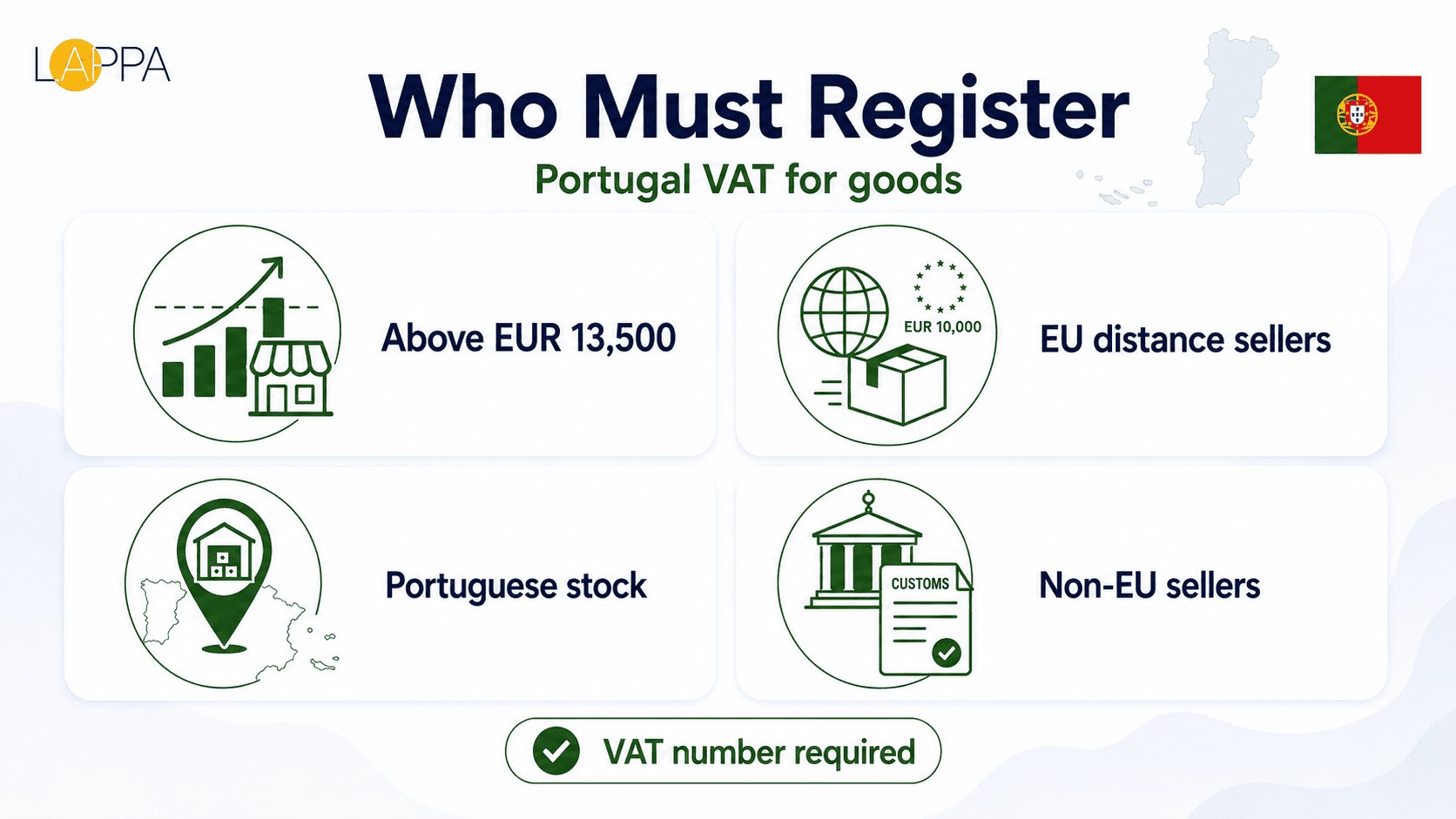 Portugal VAT registration applies to: resident businesses above EUR 13,500 turnover; non-residents making taxable Portuguese supplies outside OSS or IOSS scope; businesses receiving B2B services from foreign suppliers where the reverse charge applies; and businesses making intra-EU goods acquisitions in Portugal above EUR 10,000 per year. That last one catches companies importing goods from other EU member states and moving them into Portugal -- they often don't realise the acquisition triggers a registration obligation.
VAT Portugal Obligations for International and Ecommerce Sellers
VAT Portugal obligations for marketplace sellers shifted on July 1, 2021. Under EU deemed supplier rules, platforms became the IVA-responsible party for B2C goods sold through them by non-EU sellers, or goods shipped from outside the EU. The platform charges and remits IVA; the underlying seller makes a zero-rated supply to the platform. But if that seller is warehousing goods in Portugal -- FBA in Lisbon, for example -- they still need Portuguese IVA registration for imports and B2B sales. Deemed supplier relief covers B2C. Import IVA obligations are separate. Getting VAT Portugal obligations right from the first supply avoids back-dated IVA liability plus AT interest -- a combination that accumulates faster than most businesses expect when registrations come in retrospectively. Non-residents selling B2B into Portugal generally don't need to register. Their Portuguese customer self-assesses IVA under the reverse charge, the net tax position is usually zero, and you don't appear in the transaction at all. The moment you're making B2C sales or physically moving goods through Portugal, that changes. Portugal's VAT treatment of real estate has its own logic. A developer selling new commercial property charges IVA at 23%. A private individual selling an old residential property doesn't -- they pay IMT (transfer tax) instead, and IVA is exempt. Foreign companies buying and reselling commercial property in Lisbon register before the first taxable supply. AT doesn't offer retrospective start dates as a favour.VAT Number in Portugal
Portugal's IVA system uses two nine-digit identifiers. The NIF (Numero de Identificacao Fiscal) is for individuals and sole traders. The NIPC (Numero de Identificacao de Pessoa Coletiva) is for companies. The EU VAT number is PT + nine digits -- the NIPC or NIF depending on entity type. Company NIPCs start with 5, 6, 7, 8, or 9. Individual NIFs start with 1, 2, or 3. Twelve characters total.VAT id Portugal -- NIF Format and Verification
VAT id Portugal puts the two-letter prefix PT in front of the nine-digit NIF or NIPC. PT500000001 is the format. Before zero-rating any cross-border B2B invoice, validate the PT number through VIES at ec.europa.eu/taxation_customs/vies. It returns valid or invalid, plus the registered business name and address. The AT's Portal das Financas also offers NIF lookup -- useful if you want to verify a Portuguese counterparty's details before you commit to a zero-rated invoice and then have to chase them down when it falls apart. The NIF is Portugal's universal tax identifier. It follows a business or individual for its entire existence -- income tax, IVA, property, social contributions, bank accounts. You don't operate commercially in Portugal without one. Foreign businesses registering for IVA get a NIPC as part of the process. That NIPC is the base for the PT-prefix EU number. They don't change.VAT id number Portugal and VIES Confirmation
VAT id number Portugal registrations propagate to VIES within one to three working days of AT issuing the confirmation. Don't zero-rate intra-EU B2B invoices before your PT number shows as active in VIES. Your customer runs a VIES check before processing your invoice -- if your number isn't visible yet, their input IVA claim stalls. You'll get the call asking you to reissue, and it's an avoidable friction that damages the relationship from day one. VAT id Portugal registrations for non-resident entities produce a NIPC that doubles as both the domestic tax identifier and the base for the EU number. Non-resident sole traders receive a NIF instead. Either way, the AT registration confirmation letter shows both the nine-digit code and the full PT-prefix EU number. Keep that letter. Permanently. VAT id number Portugal assignments to foreign branches go to the branch's own NIPC -- not the parent company's number in another country. A UK company's Lisbon branch has its own nine-digit NIPC and its own PT-prefix EU number. Using the UK parent's VAT number on a Portuguese branch invoice is wrong. The customer can't validate it through VIES and their input IVA recovery fails on that invoice.VAT Registration Procedure in Portugal
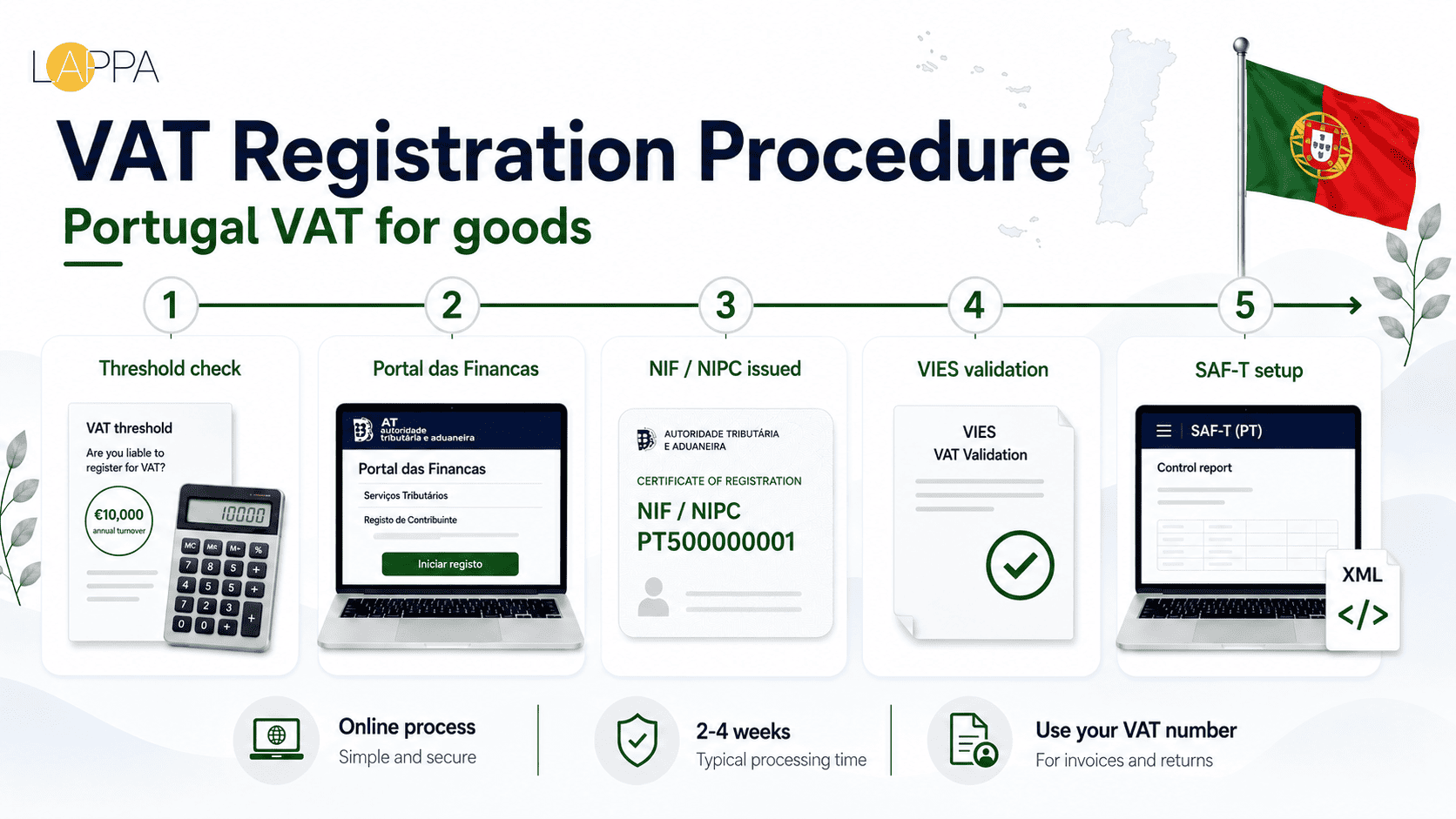 Registering for IVA as a non-resident goes through the AT -- specifically the Servico de Financas assigned to foreign taxpayers, or through your fiscal representative if you need one. Resident Portuguese businesses register through the Portal das Financas at company formation. The Registo Comercial (Business Register) triggers the NIF assignment, and IVA registration follows from there.
The form is the declaracao de inicio de atividade -- declaration of commencement of activity. It covers IVA, income tax, and other applicable taxes in one submission. You don't file separate forms for each tax. One submission, one set of supporting documents, one AT case file.
Documents you'll need for a non-resident registration:
Registering for IVA as a non-resident goes through the AT -- specifically the Servico de Financas assigned to foreign taxpayers, or through your fiscal representative if you need one. Resident Portuguese businesses register through the Portal das Financas at company formation. The Registo Comercial (Business Register) triggers the NIF assignment, and IVA registration follows from there.
The form is the declaracao de inicio de atividade -- declaration of commencement of activity. It covers IVA, income tax, and other applicable taxes in one submission. You don't file separate forms for each tax. One submission, one set of supporting documents, one AT case file.
Documents you'll need for a non-resident registration:
- Certificate of incorporation from your home country, with a certified Portuguese translation if the AT requires it -- ask before assuming they don't
- Proof of taxable activity in Portugal: signed contracts, confirmed purchase orders, a lease for Portuguese premises, or other concrete evidence of planned supply
- Completed declaracao de inicio de atividade
- Fiscal representative appointment letter with the representative's Portuguese NIF -- required for non-EU businesses, not required for EU/EEA operators
- Bank account details for IVA refund payments from the AT
- Identification documents for the authorised signatory, or a power of attorney if you're filing through a representative
Tax Representative in Portugal
EU and EEA businesses register with the AT directly. No fiscal representative required. Non-EU businesses making taxable Portuguese supplies -- goods in Portuguese warehouses, construction projects, real estate transactions -- must appoint a representante fiscal resident in Portugal. The representative is jointly and severally liable for the client's IVA. AT can and does pursue them directly for unpaid amounts. That liability is real, and it's reflected in what they charge you and the financial security they demand. There's no government accreditation scheme for representantes fiscais the way there is in France. They just need to be Portugal-resident and willing to take on the joint liability. Most non-EU businesses use Portuguese tax advisers (consultores fiscais) or local law firms with tax practices. The appointment letter goes in with your registration application. No letter, no registration. Portugal's IVA identification setup means the representative handles your declaracoes de IVA, monthly SAF-T PT submissions, and all AT correspondence. SAF-T PT is a monthly XML file with invoice-level data -- not a summary, actual invoice records. Your representative needs the technical capability to generate it. Someone who's willing to sign your appointment letter but has never built a SAF-T file is a problem you'll discover at the first monthly deadline, not at the interview stage. Non-EU businesses whose entire Portuguese exposure is covered by non-union OSS don't need direct Portuguese IVA registration and don't need a representante fiscal for those supplies. OSS from any EU member state covers all EU B2C digital services and qualifying distance goods. Only direct Portuguese supplies -- physical goods in Portugal, B2B services to Portuguese-registered customers that fall outside the reverse charge -- bring the representative requirement back into play.VAT E Invoices in Portugal
Portugal's mandatory invoicing infrastructure has been building since 2013. Every IVA-registered business must use AT-certified invoicing software (software certificado pela AT). AT certifies the software, not your business -- you pick from their approved list. Using uncertified software means non-compliant invoices. Your customers can't recover input IVA on a non-compliant invoice, and you get the penalties. Neither outcome is good. Since January 1, 2023, every invoice must carry an ATCUD -- Codigo Unico de Documento, or Unique Document Code. You get this from an AT-validated series code combined with a sequential document number. It looks like: [AT-series-prefix]-[sequential-number]. No ATCUD on a post-January 2023 invoice means a non-compliant invoice, full stop. For B2G -- suppliers to government bodies -- mandatory e-invoicing through the ESPAP platform has applied since 2021.Timeline for different business sizes
- 2013 -- Certified invoicing software first required. Initial rollout covered businesses above a turnover threshold; the requirement expanded in waves to all IVA-registered businesses over subsequent years.
- 2019 -- SAF-T PT mandatory for all IVA-registered businesses. Monthly XML file with invoice-level data due to AT by the 5th of the second month following the invoicing period. Not optional, not threshold-gated.
- 2021 -- B2G mandatory e-invoicing. All suppliers to Portuguese public sector bodies -- central government, municipalities, state enterprises -- must invoice electronically through the ESPAP platform.
- January 1, 2023 -- ATCUD mandatory on all invoices. Unique Document Code required, generated from an AT-validated series. Every compliant invoice issued after this date carries one.
- 2024 onwards -- QR code requirements expanding across more business sizes. AT continues adding technical requirements as part of a broader digital tax administration programme.
VAT Returns in Portugal
Four separate reporting streams. Four separate deadlines. Here's what you're managing:- Declaracao periodica de IVA (periodic VAT return) -- monthly if your prior-year turnover was above EUR 650,000; quarterly below that. Deadline: last day of the second month after the reference period. January monthly return: due March 31. Q1 quarterly return (January to March): due May 31. Filed through the Portal das Financas.
- SAF-T PT -- monthly XML file with full invoice-level data for all invoices issued in the period. Due by the 5th of the second month following. January SAF-T: due by March 5. This runs separately from the declaracao periodica, on its own schedule, regardless of whether you're a monthly or quarterly filer.
- Declaracao recapitulativa (EC Sales List) -- intra-EU B2B goods supplies and reverse-charge services. Monthly if your intra-EU supplies exceed EUR 50,000 per quarter; quarterly otherwise. Due by the 20th of the month following the reference period.
- Intrastat -- statistical report for goods physically crossing Portuguese EU borders. Threshold around EUR 600,000 for dispatches and arrivals (INE reviews annually). Monthly, due by the 15th through the INE portal.
Deductible VAT in Portugal
Input IVA recovery starts with direct attribution. Costs that directly relate to taxable supplies: recoverable. Costs for exempt supplies: blocked. Mixed-use costs go through a pro-rata coefficient (coeficiente de deducao) -- the ratio of your taxable turnover to total turnover. You use a provisional coefficient at the start of the year, based on the prior year's data, then reconcile against actual figures in your final return. Passenger cars. This is where most businesses get it wrong. Input IVA on the purchase or lease of a vehicle with fewer than nine seats is 50% deductible for mixed personal and business use. Claim 100% only if the vehicle is used exclusively for business -- taxis, driving schools, goods transport vehicles, rental cars. 'Exclusively for business' means documented, demonstrable, and defensible at audit. A company car that goes home with an employee at night is 50%. Fuel for passenger cars follows the same rule: 50% for mixed-use vehicles, 100% for vehicles used exclusively in commercial operations. Diesel for trucks and vans doing goods runs: 100%. No ambiguity there.VAT Calculator
The maths is simple. Mainland: add 23% by multiplying net by 1.23; extract it from a gross by dividing by 1.23. Same logic for 1.13 (intermediate) and 1.06 (reduced). Azores: 1.16, 1.09, 1.04. Madeira: 1.22, 1.12, 1.05. Every Portuguese invoice must show net amount, rate applied, IVA amount, and gross total -- per line. Regional precision matters on every order. A hotel in Funchal (Madeira) charges 5% IVA on accommodation. That same group's property in Lisbon charges 6%. One system, two correct answers. If your invoicing tool applies one blanket rate to all Portuguese supplies, it's already wrong for at least two of the three territories. Meals, drinks, and entertainment are non-deductible under Article 21 CIVA. That client lunch where you closed a deal -- the restaurant IVA is blocked. Hospitality businesses that supply catering as their core taxable service are an exception. For everyone else, budget your meals as a cost with no IVA recovery, because that's what they are.VAT Record Keeping Requirements in Portugal
Ten years. That's the retention period in Portugal -- longer than most EU member states. The clock starts at the end of the year when the obligation arose. A Q2 2024 declaracao periodica has to be kept until December 31, 2034. The ten years covers every issued invoice, every received invoice, customs declarations, bank records for IVA payments, and all SAF-T PT XML files. SAF-T PT files must be retained in XML format. Exporting to PDF and deleting the XML source doesn't meet the requirement. AT requests original XML files during audits. A non-producible XML gets treated the same as missing paper records -- which is not a position you want to be in. Your certified invoicing software should automatically export and archive SAF-T XML. Verify it actually does, and that you're storing the structured files, not just PDFs. Switching invoicing software during the ten-year period? You either migrate historical data in AT-compliant format to the new system, or you keep the old system accessible in a readable state for the full retention window. The second option sounds cheap until you're paying for a legacy software licence in 2030 because you didn't think about the migration in 2024.VAT Penalties in Portugal
Late filing of the declaracao periodica or the SAF-T PT carries a fixed fine -- coima -- ranging from EUR 375 to EUR 22,500, depending on entity size and whether you filed late voluntarily or AT had to nudge you first. Voluntary late filing costs less than filing after an AT demand. If you're going to be late, at least go voluntarily. Late IVA payment generates compensatory interest (juros compensatorios) at 4% per year plus a penalty rate on top. Moratoria interest applies separately when AT moves to enforced collection. Both run at the same time on different bases. A three-month payment delay costs more than the 4% headline figure suggests -- add them up before you decide to defer. Fraud is a different category entirely. Fictitious invoices, carousel schemes, deliberate underreporting -- these fall under the Regime Geral das Infracoes Tributarias (RGIT) and can result in criminal prosecution and custodial sentences. Portugal cooperates with Europol and OLAF on cross-border fraud cases. Cross-border carousel investigations have resulted in prosecutions across multiple EU member states simultaneously. Missing SAF-T PT and the declaracao periodica in the same period generates two separate penalty processes, not one combined fine. AT tracks each obligation independently. Two separate notices, two separate fines, two separate appeal processes if it comes to that.How Lappa Can Help with VAT Compliance in Portugal
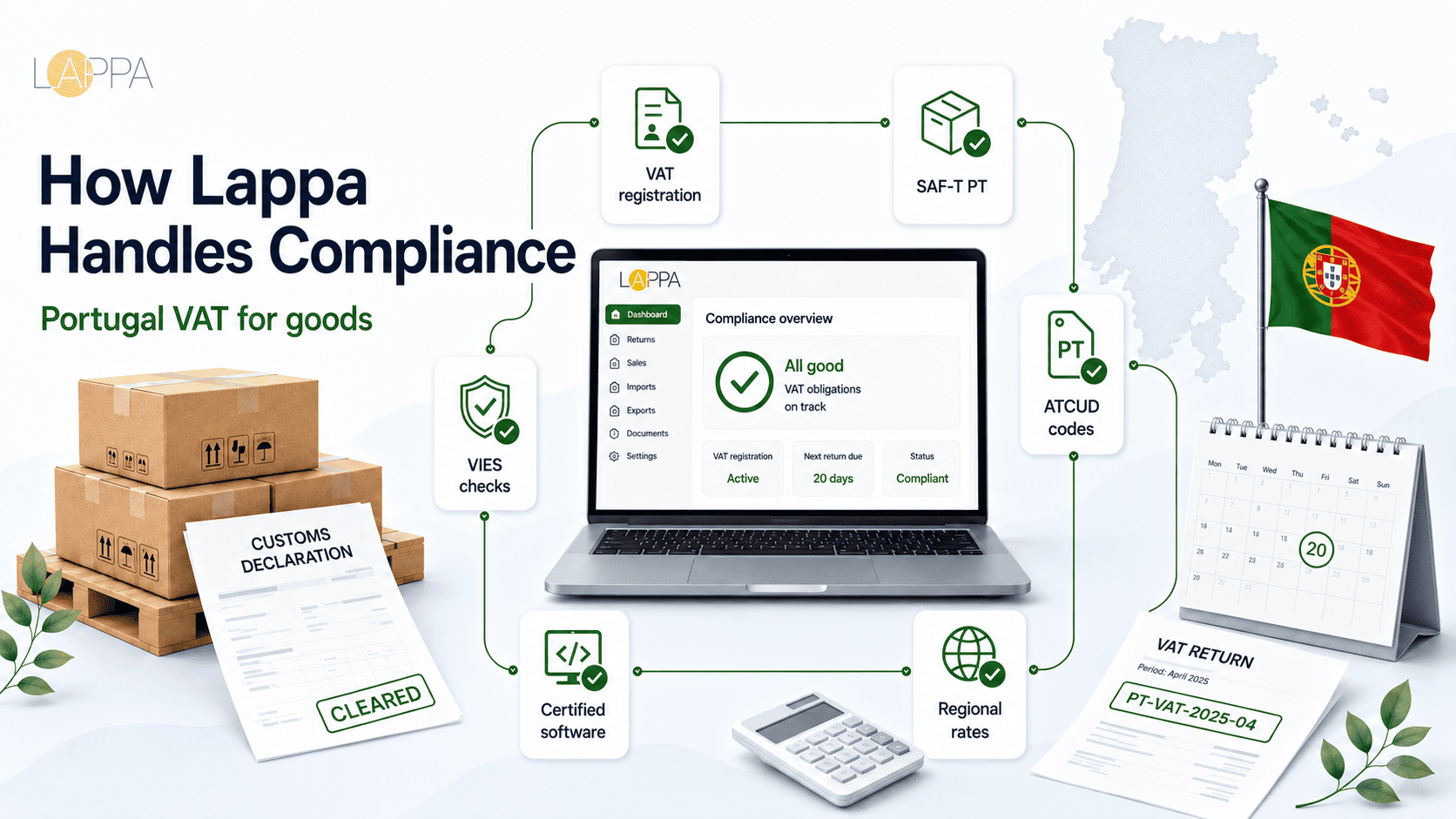 Portugal's IVA compliance stack is genuinely more technical than most EU markets. Monthly SAF-T PT XML filings. ATCUD code management. AT-certified invoicing software selection. Three regional rate sets. A ten-year retention obligation. Each element needs specific local knowledge, and the penalties for getting them wrong are concrete.
Lappa handles Portuguese IVA registration through the AT, fiscal representative services for non-EU clients, and full ongoing compliance: declaracoes periodicas, SAF-T PT monthly XML submissions, and declaracoes recapitulativas. For non-EU businesses, Lappa manages the representante fiscal appointment from the outset -- the right appointment letter, the right AT office, the right timeline relative to your first Portuguese supply.
Lappa's Portugal team has the technical SAF-T PT capability to generate compliant monthly XML from your transaction data, regardless of which accounting system you're running. We handle AT portal submissions and all AT correspondence -- including the automated queries their cross-referencing generates. Getting the setup right before the first invoice is faster and cheaper than six months of retrospective corrections.
Portugal's IVA compliance stack is genuinely more technical than most EU markets. Monthly SAF-T PT XML filings. ATCUD code management. AT-certified invoicing software selection. Three regional rate sets. A ten-year retention obligation. Each element needs specific local knowledge, and the penalties for getting them wrong are concrete.
Lappa handles Portuguese IVA registration through the AT, fiscal representative services for non-EU clients, and full ongoing compliance: declaracoes periodicas, SAF-T PT monthly XML submissions, and declaracoes recapitulativas. For non-EU businesses, Lappa manages the representante fiscal appointment from the outset -- the right appointment letter, the right AT office, the right timeline relative to your first Portuguese supply.
Lappa's Portugal team has the technical SAF-T PT capability to generate compliant monthly XML from your transaction data, regardless of which accounting system you're running. We handle AT portal submissions and all AT correspondence -- including the automated queries their cross-referencing generates. Getting the setup right before the first invoice is faster and cheaper than six months of retrospective corrections.
FAQ for VAT Goods Portugal
What is VAT in Portugal
What is VAT in Portugal? It's IVA -- Imposto sobre o Valor Acrescentado. A multi-stage consumption tax collected at each point in the supply chain. Businesses charge IVA on sales, recover it on eligible purchases, and pay the net to the AT. Three active rate tiers on the mainland: 23%, 13%, 6%. The Azores has its own set (16%, 9%, 4%); Madeira has its own (22%, 12%, 5%). The CIVA -- Codigo do Imposto sobre o Valor Acrescentado -- is the legislation. AT administers it. What is VAT in Portugal for a foreign digital business? If you're EU-based and over EUR 10,000 in combined EU B2C sales, Portuguese IVA at 23% applies to your Portuguese consumer sales. File via non-union OSS from your home member state and you don't need a separate Portuguese registration. Non-EU providers follow the same OSS route. Physical goods in Portuguese warehouses, though -- that's a direct registration, no OSS workaround. Portugal's reverse charge applies on B2B services bought from non-Portuguese suppliers. A Portuguese-registered company buys consulting from a Swedish firm. The Portuguese buyer self-assesses IVA at 23% on the invoice. The net tax position is zero in most cases, but the reporting obligation is real. The Swedish firm doesn't need a Portuguese registration for that transaction -- the buyer handles it.How Much is VAT in Portugal
How much is VAT in Portugal on a given product depends on what it is and which region your customer is in. Standard rate on the mainland: 23%. Electronics, software, professional services, telecoms -- all 23%. Intermediate: 13%. Restaurant food, wine, beer, olive oil, coffee. Reduced: 6%. Basic foodstuffs, books, hotels, medicines, transport. In the Azores: 16%, 9%, 4%. In Madeira: 22%, 12%, 5%. Nine rates. One country. How much is VAT in Portugal on imports from outside the EU? Same rate as the equivalent domestic supply. Standard goods enter at 23%. Reduced-rate goods at 6%, intermediate at 13%. Import IVA is collected through customs at entry and recoverable as input IVA on the next declaracao periodica -- assuming the goods are for taxable business use. Portugal's mainland IVA rates have been stable in recent years, but the regional rates in the Azores and Madeira are set separately and can diverge when the mainland rates stay fixed. Your certified invoicing software should update rates automatically when they change. Verify that it does -- and that it's applying the right regional rate based on customer location, not a single blanket rate for all Portuguese orders.What is the VAT number format in Portugal
PT + nine digits. Twelve characters total. The nine-digit section is your NIPC (for companies) or NIF (for individuals). Company NIPCs start with 5, 6, 7, 8, or 9. Individual NIFs start with 1, 2, or 3. Validate through VIES before zero-rating cross-border B2B invoices. The AT's Portal das Financas offers a separate NIF lookup for domestic verification. The NIF is Portugal's universal tax identifier. IVA, income tax, property, bank accounts -- it appears everywhere. You can't operate commercially in Portugal without one. Foreign businesses get a NIPC issued as part of the IVA registration process. That NIPC feeds directly into the PT-prefix EU VAT number. They don't expire, they don't change, and they're unique per legal entity. OSS registrants who've named Portugal as their member state of identification receive a separate OSS number -- not the PT + NIPC format. The two serve different purposes. Don't put your OSS number on a Portuguese direct-supply invoice or your customer's input IVA claim will fail VIES validation.How often are VAT returns filed in Portugal
Monthly declaracoes periodicas apply if your prior-year turnover was above EUR 650,000. Due the last day of the second month after the reference period. January return: due March 31. Quarterly below EUR 650,000: Q1 (January-March) due May 31. Both routes file through Portal das Financas. SAF-T PT runs monthly for every IVA-registered business, regardless of whether you file declaracoes monthly or quarterly. Due the 5th of the second month after the invoicing period. January SAF-T: due March 5. It runs on its own clock, independent of your declaracao schedule. Quarterly filers have one reporting deadline every three months for the declaracao and a monthly deadline every month for SAF-T PT. The declaracao recapitulativa (EC Sales List) comes due by the 20th of the following period -- monthly or quarterly depending on your intra-EU supply volumes. Intrastat follows its own calendar: monthly, due by the 15th through the INE portal for businesses above the threshold. Four different obligations, four different deadline structures, one AT and INE portal to log into.Do foreign companies need a tax representative in Portugal
EU and EEA companies: no. Register directly with the AT. Non-EU companies making taxable Portuguese supplies: yes, always. A representante fiscal resident in Portugal must be appointed before AT will register you. They're jointly and severally liable for your IVA. That's not a technicality -- AT can chase them directly for your unpaid tax. No appointment letter, no registration. Simple. Non-EU businesses whose entire Portuguese exposure sits within non-union OSS coverage don't need a Portuguese IVA registration and don't need a fiscal representative. OSS from any EU member state covers all EU B2C digital services and qualifying distance goods sales. Only supplies outside OSS -- goods warehoused in Portugal, B2B supplies that fall outside the reverse charge, real estate transactions -- put you back in the direct registration and representative camp. Post-Brexit, UK businesses are non-EU for Portuguese IVA purposes. A UK company starting Portuguese activities after January 1, 2021 follows the non-EU registration route: AT application, Portuguese fiscal representative, the full process. UK businesses that held Portuguese IVA registrations before Brexit generally kept them intact -- but any change to their Portuguese supply profile is worth reviewing with a local adviser to make sure the existing registration is still correctly scoped.
VAT Standard rate
23%
VAT Reduced rate
13%,6%
Thresholds
There is no turnover threshold for a non-established business carrying out taxable transactions for which it must account for Portuguese VAT