


Poland VAT Guide for Registration and Compliance
Provinces
Goods
Provinces
Goods
About
Goods
About
Goods
Goods
Goods
Introduction to VAT in Poland
VAT in Poland goes by its Polish name -- Podatek od towarow i uslug (PTU) -- but every business in the country uses the English abbreviation. The Krajowa Administracja Skarbowa (KAS) administers it under a 2004 act that's been amended many times since. Foreign businesses land at a dedicated national office -- the II Urzad Skarbowy Warszawa-Srodmiescie -- rather than dealing with regional Finanzamt-style offices the way they would in Germany. Poland VAT runs on three live rates: 23%, 8%, and 5%. Three tiers is unusual for the EU -- most member states manage with two. That extra tier makes product classification more demanding than in neighbouring countries, and KAS auditors know it. They check invoice-level rate accuracy on every JPK file you submit. Two things make Poland stand out beyond the rate structure. First: the JPK system. Every VAT return here is a structured XML file containing invoice-by-invoice data, not a summary form. Second: the split payment mechanism (MPP). For supplies above PLN 15,000 covering Annex 15 goods -- steel, fuel, electronics, phones, game consoles, precious metals, construction services -- your buyer must send VAT to a dedicated VAT bank account (rachunek VAT), not your regular account. Get either of these wrong and you're looking at penalties and KAS queries within weeks. This guide covers both physical goods and digital services. The paths diverge early: goods typically need direct Polish VAT registration, while digital providers can often use the EU's One Stop Shop instead. Read the threshold section carefully before deciding which route applies to your situation.VAT Rates in Poland
Poland VAT Rate - Standard and Reduced Categories
The Poland VAT rate sits at 23% for the bulk of commercial transactions -- one of the highest standard rates in the EU. Drop into the 8% bracket and you're in Annex 3 territory: restaurant food, hotels, some residential construction, passenger transport, and select medical equipment. The 5% tier is narrower still -- basic unprocessed food, bread, print and digital books, and children's products listed in Annex 10. Three tiers, three annexes. Know which annex governs your product before you invoice.| VAT Rate | Category | Common Examples |
| 23% (standard) | All goods and services not assigned to a reduced or zero tier | Electronics, clothing, software, consulting, telecoms, advertising, most B2B services |
| 8% (reduced) | Selected categories under Annex 3 to the VAT Act | Restaurant and catering food, hotels, some residential construction, passenger transport, certain medical equipment |
| 5% (super-reduced) | Basic food products and books under Annex 10 | Unprocessed meat, dairy, cereals, fruit, vegetables, bread, print and e-books, children's products |
| 0% (zero-rated) | Exports and intra-EU B2B goods supplies to registered buyers | Goods exported outside EU, intra-community B2B supplies, international transport |
| Exempt | Outside the VAT system -- no input VAT recovery on related costs | Healthcare, education, public postal services, most financial and insurance services |
VAT Registration Threshold in Poland
| Seller Category | Threshold | Key Notes |
| Polish resident business | PLN 200,000 annual turnover | Below PLN 200,000: zwolnienie podmiotowe exemption available. First-year businesses apply a proportional limit. Crossing the threshold mid-year means registering before the next supply. |
| EU-based distance seller (goods) | EUR 10,000 EU-wide B2C turnover | Covers all 27 member states combined. Above EUR 10,000: charge Polish 23% VAT or file via OSS in your home member state. |
| Non-EU seller (any supply) | No threshold -- from the first taxable supply | Register before you sell. No turnover buffer. Fiscal representative required for domestic supplies. |
| EU/non-EU digital service provider | EUR 10,000 EU-wide | SaaS, streaming, e-learning, gaming. Non-union OSS covers all EU B2C digital revenue from one member state registration -- no separate Polish number needed. |
For local businesses
VAT Registration in Poland for Polish resident businesses kicks in at PLN 200,000 of annual taxable turnover. Below that, you can use the zwolnienie podmiotowe -- the subjective exemption -- and trade without charging VAT at all. You also can't recover input VAT, so for businesses buying significant stock or equipment, voluntary registration often makes more financial sense even under the threshold. Voluntary registration binds you for at least twelve months. Start a new business mid-year and the threshold is prorated. Launch on July 1 and your limit for that calendar year is roughly PLN 100,000 -- not PLN 200,000. Cross it and you must register before the next taxable supply. There's no grace period or buffer. Missing the moment means back-dated VAT liability from the date you exceeded the limit.For remote sellers
EU-based distance sellers sit under the EUR 10,000 EU-wide combined B2C threshold. That's total cross-border B2C sales across all 27 member states -- not just Poland. Under EUR 10,000: charge your home-country VAT rate. Over EUR 10,000: either register in each destination country or go through OSS. One OSS registration, one quarterly return, all EU B2C sales covered. Non-EU sellers have no threshold at all. A US business making its first Polish B2C sale needs Polish VAT registration in place before that transaction happens.For remote digital services
Digital services -- SaaS, streaming, e-learning, gaming, cloud storage -- run on the same EUR 10,000 EU-wide threshold as goods. Above it, Polish B2C sales attract 23% VAT. Non-union OSS is available for non-EU providers: pick one EU member state, register there for OSS, file a quarterly return covering all EU B2C digital revenue. No Polish VAT number required. No Polish fiscal representative needed. OSS handles everything for covered supplies.Who Must Register for VAT in Poland
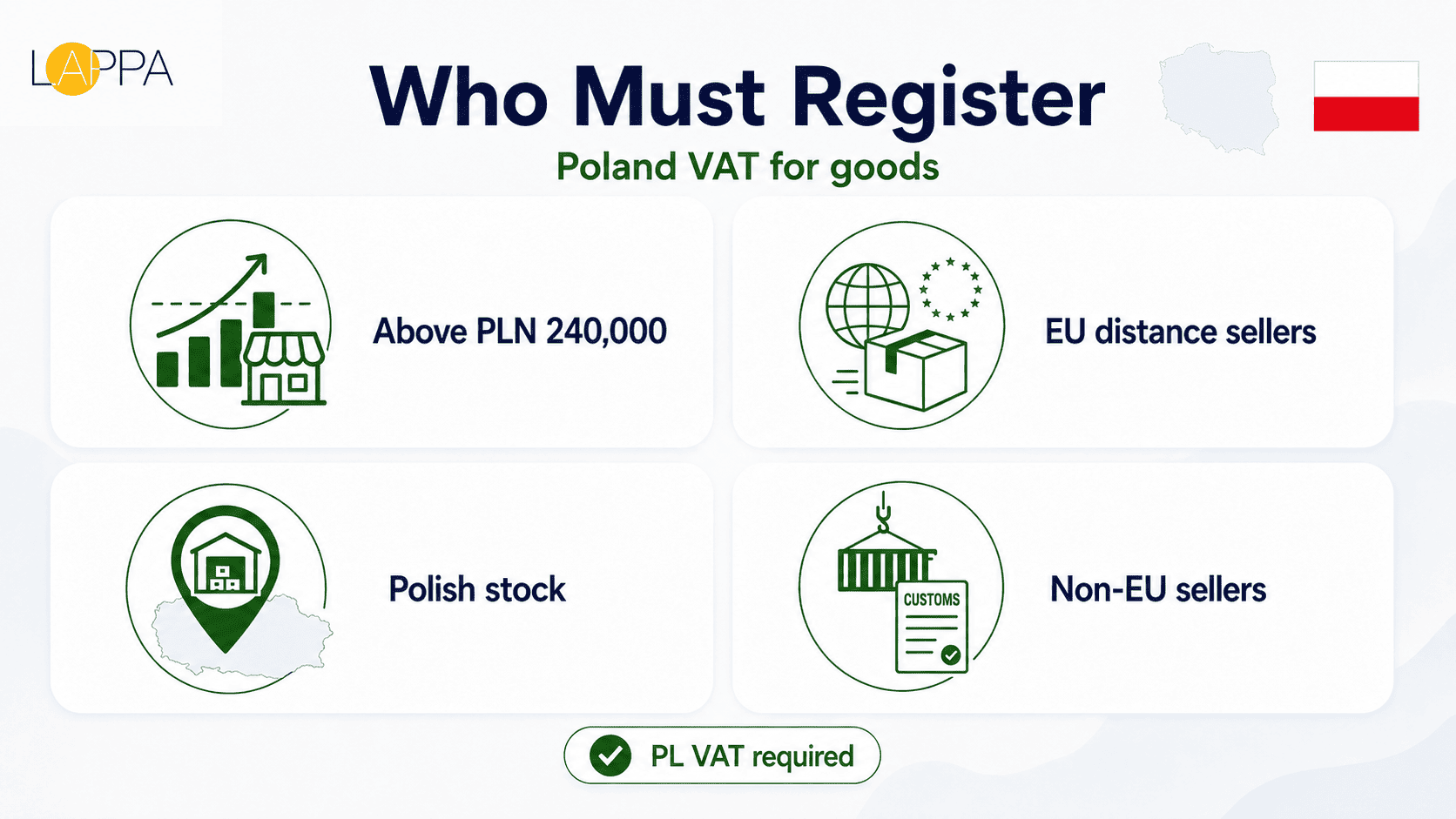 VAT Poland registration is mandatory for: Polish residents above PLN 200,000 turnover; non-resident businesses making taxable Polish supplies outside OSS or IOSS; businesses making intra-EU goods acquisitions in Poland above EUR 10,000 a year; businesses receiving reverse-charge services from foreign suppliers; and marketplace operators who become the deemed supplier under EU facilitator rules. Voluntary registration's always open for businesses below the threshold.
VAT Poland Obligations for Ecommerce and Digital Sellers
VAT Poland rules for marketplace sellers changed on July 1, 2021, when EU deemed supplier rules arrived. Platforms facilitating goods from non-EU businesses to EU consumers are now the supplier for VAT. The platform charges and remits it -- the underlying seller makes a zero-rated supply to the platform. But a non-EU seller warehousing goods in Poland still needs Polish VAT registration for imports and any B2B sales made outside the marketplace. Deemed supplier rules cover B2C. They don't cancel your import VAT obligations. Selling real property in Poland? That triggers mandatory registration depending on the seller's status and the property type. New commercial property from a developer is 23%. Old residential sold by a private individual is usually exempt. A foreign company buying and reselling Polish commercial real estate registers before the first taxable supply. Poland's VAT obligations split neatly by supply type. A UK business providing B2B consulting to Polish clients doesn't charge Polish VAT -- the Polish client self-assesses under the reverse charge. Same UK business shipping goods to Polish consumers? Polish VAT applies from the first sale. Know which side of that line you're on before invoicing.VAT Number in Poland
Every VAT-registered entity gets a VAT number Poland in two forms. The NIP (Numer Identyfikacji Podatkowej) is your ten-digit domestic tax number. Add the country prefix PL and it becomes your EU VAT number: PL + ten digits. Example: PL1234567890. The NIP carries a check digit validated by a modulus-11 algorithm. The PL-prefix version is what goes on intra-EU B2B invoices and what counterparties check in VIES.VAT Number Poland Format and Verification
VAT number Poland validation has two tools, not one. VIES (ec.europa.eu/taxation_customs/vies) confirms whether a PL-prefix number is active and returns the business name and address. But Poland adds a second, domestic layer: the Biala Lista (White List) at podatki.gov.pl. The White List doesn't just confirm VAT registration status -- it also shows which bank accounts are registered with KAS for that NIP. Why does that matter? Send a payment above PLN 15,000 to a bank account not listed on the White List for that supplier's NIP and you're jointly and severally liable for unpaid VAT. Both buyer and seller suffer. That White List check is mandatory before paying any invoice above PLN 15,000 to a Polish supplier. This is uniquely Polish within the EU. Even if the supplier's own account, but not listed with KAS, receives the payment -- you lose the income tax deduction and inherit a VAT liability risk. Most Polish accounting systems now automate the check. If yours doesn't, do it manually before every significant payment. Polish VAT numbers issued to foreign branches use that branch's own NIP -- not the parent company's foreign tax number. Each Polish-registered entity gets its own NIP and PL-prefix number. Put the parent's UK or German VAT number on a Polish branch invoice and the customer's input VAT recovery gets blocked.EU VAT Number Poland and VIES Confirmation
EU VAT number Poland format is simple: PL + ten digits. Twelve characters total. No B-suffix like the Netherlands, no alphanumeric prefix like France. Just PL and ten numbers. VIES validates it and returns the registration status plus registered name and address. The propagation to VIES typically takes one to three working days after KAS issues the registration. Don't zero-rate intra-EU B2B invoices until you've confirmed the number's live in VIES -- if your customer can't validate it, their input VAT recovery fails. EU VAT number Poland registrations for non-residents don't always hit VIES immediately. KAS issues the NIP first. The PL-prefix EU number is confirmed separately, and VIES visibility can lag a few extra days compared with domestic Polish registrations. New registrants should confirm VIES status before they issue their first zero-rated cross-border invoice. EU-format VAT numbers in Poland serve specific functions: intra-EU B2B invoices, VAT-UE (EC Sales List) filings, and intra-community acquisition declarations. Domestic Polish supplies use the plain ten-digit NIP on invoices. Cross-border B2B uses the PL-prefix. Mix them up -- use NIP alone on a cross-border invoice that needs PL -- and your customer hits a VIES validation wall.VAT Registration Procedure in Poland
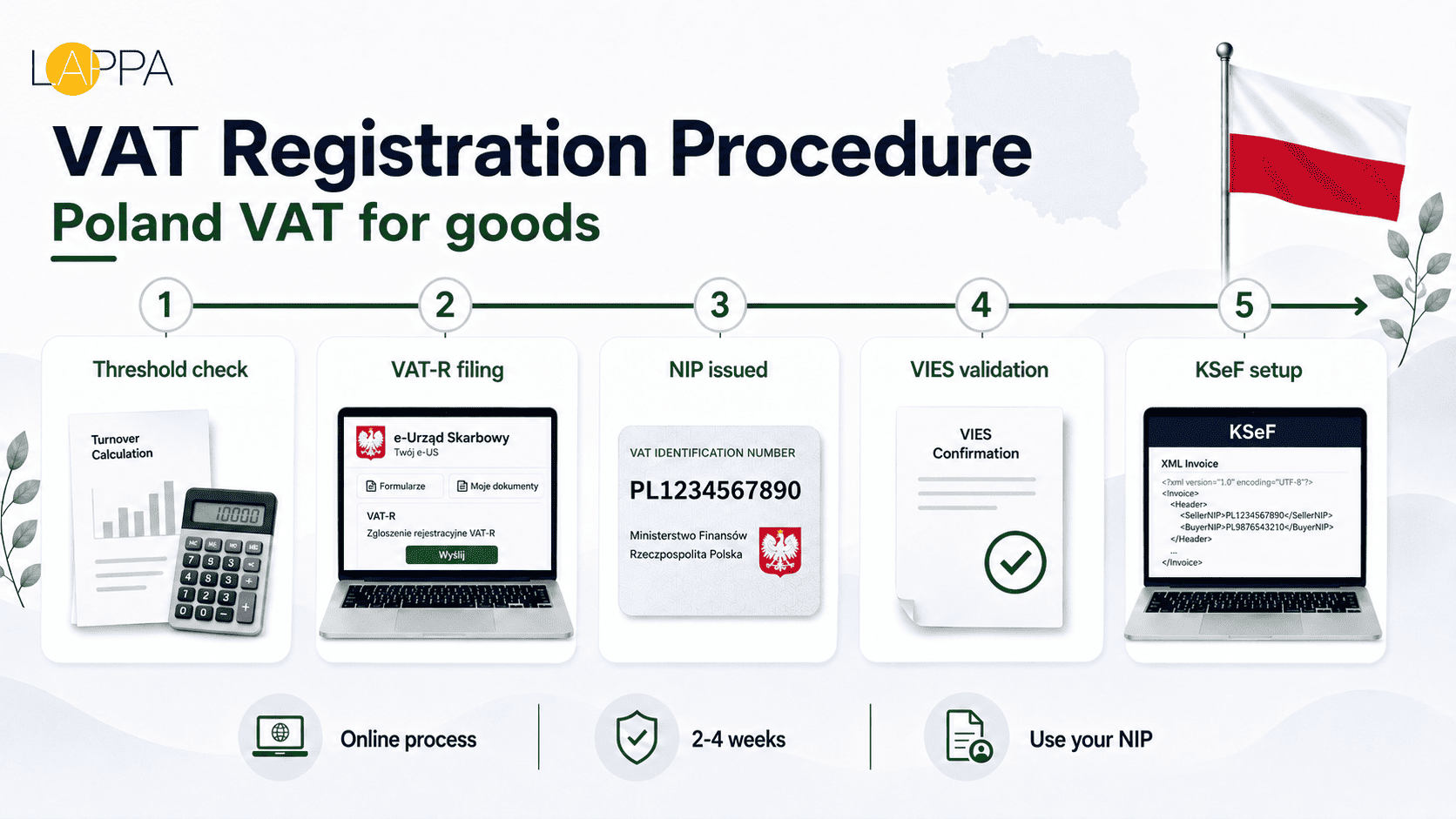
VAT Registration in Poland for Non-Resident Businesses
VAT Registration in Poland for non-residents goes through one specific office: II Urzad Skarbowy Warszawa-Srodmiescie. That's the nationally competent tax office for foreign VAT registration. You submit the VAT-R form there. The same form Polish residents use -- but completed with your foreign entity's details and, for non-EU businesses, accompanied by a fiscal representative appointment letter. Everything goes to Warszawa-Srodmiescie. Polish resident businesses register at company formation -- through CEiDG for sole traders and partnerships, through the KRS (National Court Register) for limited companies. That triggers a tax questionnaire from KAS. Fill it in correctly and the NIP and PL-prefix number arrive within four to six weeks of filing the VAT-R.VAT Registration Poland - Documents and Processing Time
VAT registration Poland applications for non-residents must be complete on arrival. KAS doesn't process them partially. Missing one document and the whole application comes back. For EU businesses, expect two to four weeks for a clean submission. Non-EU businesses with a fiscal representative involvement run four to eight weeks. Budget time accordingly -- don't plan your first Polish supply before the number's confirmed. Documents required for a non-resident registration:- Certificate of incorporation or equivalent business registration from your home country -- apostilled or with a sworn Polish translation if you're from outside the EU
- Proof of taxable activity in Poland -- contracts, confirmed purchase orders, a warehouse agreement, or documentation of your first planned supply
- Completed VAT-R form
- Fiscal representative appointment letter with the representative's Polish NIP -- mandatory for non-EU businesses making domestic Polish supplies
- Bank account details for VAT refund payments
- Authorised signatory ID and a power of attorney if a representative is submitting on your behalf
- For non-EU companies: proof of legal existence from a competent authority in your home country, issued within the last three months
Tax Representative in Poland
EU and EEA businesses register directly with II US Warszawa-Srodmiescie. No representative needed. Non-EU businesses making domestic Polish supplies must appoint a przedstawiciel podatkowy (fiscal representative) -- a Polish legal entity, typically a licensed tax advisory firm (doradca podatkowy) or registered law firm. The representative is jointly and severally liable for your VAT. That's not a formality. KAS can pursue them directly for your unpaid tax. Being VAT-registered in Poland as a non-EU business without appointing a representative isn't possible for domestic supply activities. KAS requires the appointment letter as part of the VAT-R submission. No appointment, no registration. Full stop. Your representative submits all JPK_V7 returns, handles KAS correspondence, and owns the technical filing process. Given the complexity of the JPK structure -- invoice-level XML with GTU codes, procedural markers, and split payment flags -- you want a representative who's done this before, not one learning alongside you. UK businesses are non-EU post-Brexit for Polish VAT purposes. A UK operator starting Polish activities after January 1, 2021 needs the full non-EU registration route. UK businesses that held Polish VAT numbers before Brexit generally kept them. But if your supply profile changes -- new warehousing, new domestic supply categories -- confirm the representative arrangement is still in place and properly scoped.VAT E Invoices in Poland
KSeF -- Krajowy System e-Faktur (National e-Invoice System) -- is Poland's structured invoicing platform. It's been running voluntarily since January 2022. Every invoice issued through KSeF gets a unique KSeF number assigned in real time by the Ministry of Finance server. Use the FA_VAT XML schema. And here's the catch: once a KSeF number is issued, the invoice is locked. No modifications. Corrections need a separate correction invoice. That's a workflow change most businesses aren't expecting. B2G e-invoicing is already mandatory through the PEF platform (Platforma Elektronicznego Fakturowania). You've been required to invoice Polish public entities through PEF via the PEPPOL network since November 18, 2019 for central government, and across all public sector since then. If you're supplying any Polish government body and not using PEPPOL, fix that now.Timeline for different business sizes
- January 2022 -- KSeF voluntary platform live. Any VAT-registered business can issue and receive KSeF invoices. Incentive: if you use KSeF voluntarily, VAT refunds arrive in 40 days instead of 60.
- February 1, 2026 (planned) -- Mandatory KSeF for active VAT payers with prior-year sales above PLN 200 million. Paper and PDF invoices to domestic B2B Polish buyers will no longer be accepted for these businesses.
- April 1, 2026 (planned) -- Mandatory KSeF extends to all other active Polish VAT payers making domestic B2B supplies. Full rollout across all sizes.
- October 1, 2026 (planned) -- Mandatory KSeF for VAT-exempt businesses. Complete scope.
- Cross-border and B2C -- Outside KSeF scope. Foreign buyers and Polish B2C consumers get standard invoices. Reverse-charge invoices from foreign suppliers also stay outside KSeF.
VAT Returns in Poland
Electronic VAT Reporting in Poland and the JPK File System
Electronic VAT reporting in Poland means the JPK_V7 -- Jednolity Plik Kontrolny (Standard Audit File for Tax). Since October 1, 2020, this XML file is your VAT return. Not a summary. Not a form with totals. It's a line-by-line record of every sales invoice you issued and every purchase invoice you're claiming input VAT on, plus a declaration block with the period's aggregated position. Every VAT-registered business in Poland files it electronically. JPK_V7 splits by filing frequency. Monthly filers use JPK_V7M -- transaction records and VAT declaration together, filed by the 25th of the following month. Quarterly filers use JPK_V7K -- monthly transaction records (ewidencja only) filed by the 25th each month, with a full declaration added quarterly. The deadlines are firm. KAS has the system data by the 26th and starts cross-referencing immediately. That cross-referencing is the part businesses underestimate. KAS matches every invoice you report on your JPK_V7 against the same invoice on your counterparty's JPK_V7. Different amounts, different dates, missing entries -- the algorithm flags them automatically. Query letters can hit your inbox within weeks of a period close. High transaction volumes need invoice data quality checks before JPK submission, not after.Types of reports
- JPK_V7M (monthly): full SAF-T plus VAT declaration, due 25th of the following month. Required for large taxpayers (prior-year sales above EUR 1.2 million equivalent) and all businesses in their first two years of VAT registration.
- JPK_V7K (quarterly): monthly transaction records (ewidencja) due 25th of each month; full declaration submitted quarterly by the 25th of the month after the quarter. Available for smaller businesses after the first two years.
- VAT-UE (Informacja podsumowujaca -- EC Sales List): covers intra-EU B2B goods and reverse-charge services. Monthly, due 25th of the following month. Filed separately through the e-Deklaracje portal.
- Intrastat: statistical declaration for goods crossing Polish borders within the EU. Threshold approximately PLN 6,200,000 for arrivals and PLN 2,700,000 for dispatches (reviewed annually by GUS). Filed monthly by the 10th through the PUESC customs system.
Deductible VAT in Poland
Input VAT in Poland is deductible when it relates to taxable supplies. Standard direct attribution: costs for taxable activities recover input VAT; costs for exempt supplies don't. Mixed-use costs use a wspolczynnik (pro-rata ratio) based on taxable versus total turnover. VAT in Poland on passenger cars used for both business and private purposes is 50% deductible -- regardless of how much you actually use the car for work -- unless you register it as exclusively business-use. Exclusive business-use registration for cars means three things. First, file a VAT-26 notification with KAS within seven days of first using the vehicle. Second, maintain a detailed mileage log (ewidencja przebiegu pojazdu) recording every trip. Third, don't let any personal use slip in. One undocumented trip or a late VAT-26 and the exclusivity claim collapses back to 50% for the entire ownership period. KAS auditors check mileage logs against fuel receipts and GPS data where available. Business meals and catering are flatly non-deductible in Poland under Article 88 of the VAT Act. Restaurant lunches with clients, catering at the office, food at a corporate event -- input VAT blocked, full stop. This is stricter than Germany or France. There's no documentation you can produce to rescue a food-related VAT claim. Budget for it as an irrecoverable cost. Fuel for passenger cars mirrors the car purchase rule: 50% deductible for mixed-use vehicles, 100% for commercially registered vehicles used exclusively for business. Delivery vans and trucks aren't affected by the passenger car restrictions. Keep fuel receipts matched to the vehicle registration and mileage log.VAT Record Keeping Requirements in Poland
VAT compliance in Poland requires five-year record retention. The clock starts from the end of the calendar year when the VAT obligation arose -- a Q1 2024 return must be kept until December 31, 2029. That covers issued invoices, received invoices, customs documentation, bank records for VAT payments, and the JPK files themselves. Commercial property records typically run ten years under broader commercial law. JPK files must be kept in their original XML format. Export to PDF and delete the XML and you've failed the retention requirement. KAS can request the original structured file during an audit -- and an unproducible XML is treated the same as a missing paper invoice. Cloud-based systems that auto-archive JPK exports solve this cleanly. Proprietary formats that become unreadable a decade later don't. Paper invoices can be scanned and originals destroyed under Polish law, provided the scan covers all invoice fields and is stored immutably in a searchable format. That means proper document management -- not a folder of JPEGs. The scan format must be readable and exportable in a way KAS systems can process.VAT Penalties in Poland
Poland runs two penalty tracks: administrative through KAS and criminal fiscal through the Kodeks karny skarbowy. On the administrative side, a VAT understatement discovered during audit triggers a 20% additional assessment on the underpaid amount. Self-correct before the audit starts and that drops to 10%. Wait until KAS finds it and stay at 20%. After KAS formally identifies the discrepancy, it jumps to 30%. Late payment interest (odsetki podatkowe) sits at approximately 14.5% per year as of 2024, tied to the Finance Minister's benchmark rate. Voluntary prompt corrections get a reduced rate of around 7.25%. Deliberate understatements above 25% of the correct amount, or cases involving fraudulent invoices, attract a punitive rate of around 21.75%. These rates change -- always check the current Ministry of Finance schedule. Poland's VAT system treats fictitious invoices (faktury fikcyjne) as the most serious offence in the fiscal penal code. Issuing invoices for supplies that never happened is a tool of VAT carousel fraud, and Polish courts have handed down sentences of up to 25 years in aggravated cases. KAS coordinates with OLAF on cross-border carousel investigations. The JPK cross-matching system makes this kind of fraud significantly harder to sustain than it was before 2020. Non-submission of JPK_V7 draws a fixed fine of up to PLN 5,000 per violation under the fiscal penal code. Repeat non-submission escalates quickly. KAS has statutory authority to reconstruct transactions from bank records and customs data without entering your premises. The JPK matching algorithm means large-scale underreporting gets flagged systemically -- not just through audits.How Lappa Can Help with VAT Compliance in Poland
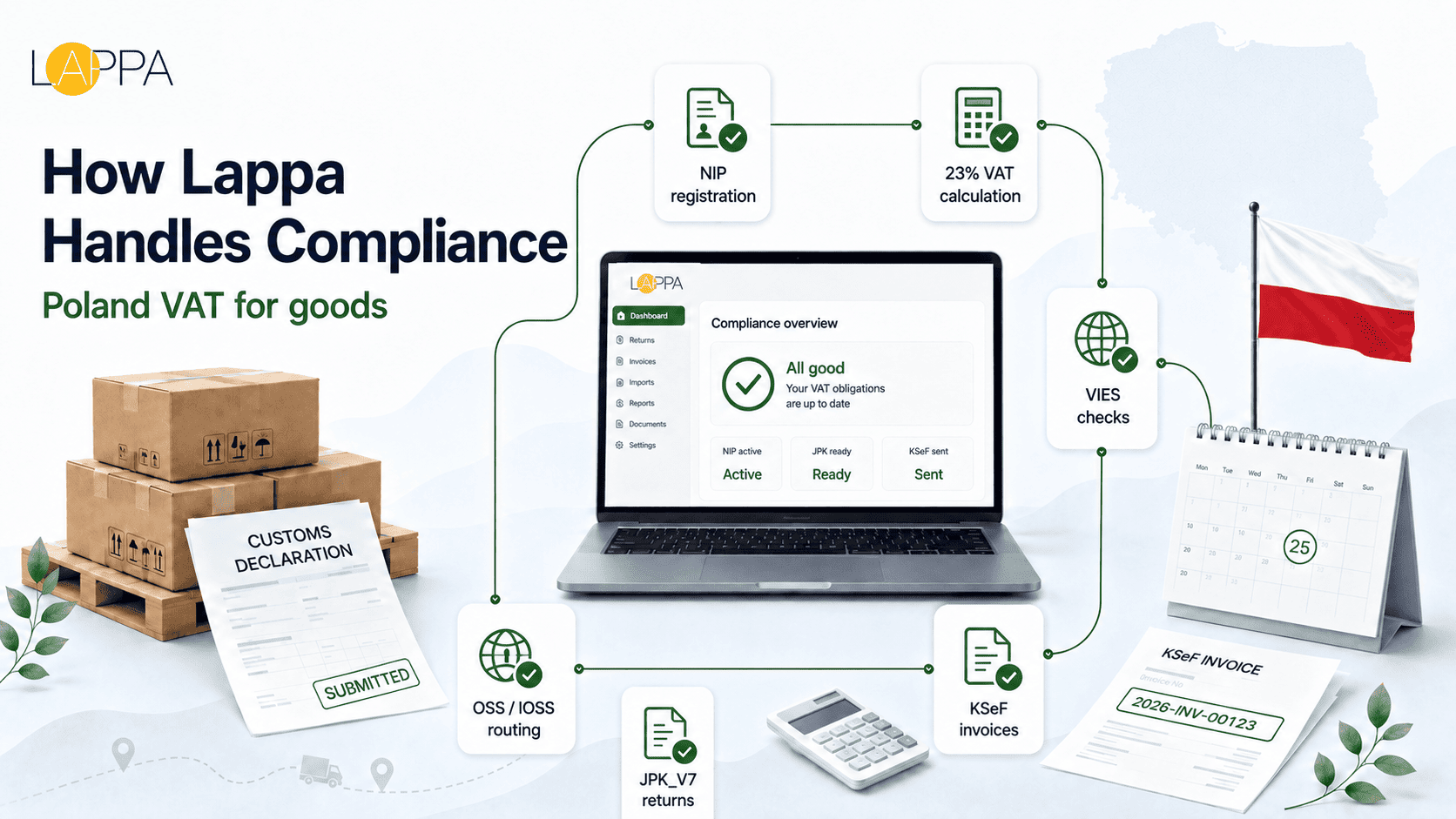 VAT compliance in Poland is among the most technically demanding in the EU. The JPK_V7 structure, GTU codes, split payment requirements, White List verification, and the KSeF mandate all need specialist knowledge to get right. Lappa handles Polish VAT registration through the II US Warszawa-Srodmiescie, fiscal representative services for non-EU clients, and full JPK_V7 preparation and submission -- both monthly ewidencja and quarterly declarations.
Lappa's Poland team prepares JPK_V7 files with complete invoice-level data, correct GTU code assignment, and all required procedural markers. For clients with intra-EU supplies, Lappa files the monthly VAT-UE EC Sales List. Above the Intrastat threshold, Lappa handles the monthly PUESC declaration too. Every filing is tracked against KAS acknowledgements. KAS queries are managed as part of the standard service.
Remaining VAT-compliant in Poland through the KSeF transition takes preparation that starts now, not in 2025. Lappa's KSeF readiness advisory covers FA_VAT format integration with your ERP or accounting system, KSeF API connectivity testing, and the workflow changes you'll need for real-time invoice numbering and the no-modification rule after KSeF issuance. Clients who start in 2025 avoid the February 2026 large-business deadline crunch.
VAT compliance in Poland is among the most technically demanding in the EU. The JPK_V7 structure, GTU codes, split payment requirements, White List verification, and the KSeF mandate all need specialist knowledge to get right. Lappa handles Polish VAT registration through the II US Warszawa-Srodmiescie, fiscal representative services for non-EU clients, and full JPK_V7 preparation and submission -- both monthly ewidencja and quarterly declarations.
Lappa's Poland team prepares JPK_V7 files with complete invoice-level data, correct GTU code assignment, and all required procedural markers. For clients with intra-EU supplies, Lappa files the monthly VAT-UE EC Sales List. Above the Intrastat threshold, Lappa handles the monthly PUESC declaration too. Every filing is tracked against KAS acknowledgements. KAS queries are managed as part of the standard service.
Remaining VAT-compliant in Poland through the KSeF transition takes preparation that starts now, not in 2025. Lappa's KSeF readiness advisory covers FA_VAT format integration with your ERP or accounting system, KSeF API connectivity testing, and the workflow changes you'll need for real-time invoice numbering and the no-modification rule after KSeF issuance. Clients who start in 2025 avoid the February 2026 large-business deadline crunch.
FAQ for Poland VAT Goods
What is the VAT rate in Poland
Three rates. The 23% standard covers most commercial supplies -- electronics, professional services, software, telecoms, advertising. The 8% reduced covers restaurant food, hotel accommodation, some residential construction, passenger transport, and certain medical equipment. The 5% super-reduced hits basic unprocessed food, bread, books (print and digital), and children's products. Zero rating applies to exports outside the EU and intra-EU B2B goods supplies to VAT-registered buyers. Exempt supplies -- healthcare, education, most financial and insurance services -- carry no VAT and generate no input VAT recovery right on related costs. Getting the rate right has cascading effects. Rate drives the GTU code on your JPK_V7 line. Some GTU codes trigger mandatory split payment (MPP) for invoices above PLN 15,000. All three -- rate, GTU code, and MPP flag -- must align on every transaction. One error in the chain creates a JPK mismatch that KAS flags automatically.Who needs to register for VAT in Poland
Polish residents above PLN 200,000 annual turnover register. Below that, the subjective exemption is available -- but voluntary registration often makes financial sense if you're recovering significant input VAT. Non-resident businesses making taxable Polish supplies outside OSS or IOSS register before the first supply, no turnover buffer. EU distance sellers use the EUR 10,000 EU-wide threshold; above it, OSS or direct Polish registration. Specific supply types force registration regardless of turnover: supply of new buildings, certain precious metals, and Annex 12 goods. B2B cross-border services from a foreign business to a Polish VAT-registered client typically don't need Polish VAT registration -- the client reverse-charges. Physical goods to Polish consumers do. Know which side of that line you're on. Online sellers need to check the deemed supplier rules before deciding on registration. If a marketplace handles B2C sales and is the deemed supplier, your direct VAT exposure for those B2C transactions is reduced. But warehousing goods in a Polish fulfillment centre creates an import VAT registration requirement that exists regardless of whether the marketplace is your B2C supplier.What is the VAT number format in Poland
Polish VAT numbers are PL + ten digits. Twelve characters total. Example: PL1234567890. The ten-digit NIP carries a modulus-11 check digit. The same NIP without the PL prefix is your domestic tax number for income tax, social security, and all non-VAT administrative purposes. Validate PL-prefix numbers through VIES before zero-rating a cross-border invoice. Also run any Polish supplier through the Biala Lista before paying invoices above PLN 15,000 -- the White List confirms both registration status and the bank accounts registered with KAS. Wrong bank account, even a legitimate one for the same business, and you're jointly liable for unpaid VAT. Non-resident businesses receive a NIP as part of the Polish VAT registration. It's sufficient for filing and invoicing from registration day. The PL-prefix EU number is used specifically for intra-EU B2B invoices and VAT-UE filings. Both are confirmed in the KAS approval letter.How often are VAT returns filed in Poland
Monthly JPK_V7M for large taxpayers (prior-year sales above EUR 1.2 million equivalent) and all businesses in their first two years. Deadline: 25th of the following month. Smaller businesses after year two can switch to JPK_V7K: monthly transaction records by the 25th, full quarterly declaration by the 25th of the month after the quarter. VAT-UE (EC Sales List) files monthly for all businesses with intra-EU B2B supplies, due 25th of the following month. Intrastat files monthly through PUESC by the 10th, for businesses above the statistical threshold. These run on their own schedules -- missing the Intrastat deadline draws a customs authority fine, not a KAS fine. Different office, same pain. There's no standalone annual Polish VAT return -- the JPK_V7 covers the full year through periodic submissions. Annual reconciliation of the wspolczynnik (deductibility ratio) for mixed-supply businesses goes into the first JPK_V7 of the following year. Future KSeF integration may pre-populate JPK data from real-time invoice records, but that's a future-state discussion.Do foreign companies need a tax representative in Poland
EU and EEA businesses: register directly with II US Warszawa-Srodmiescie, no representative needed. Non-EU businesses making domestic Polish supplies: mandatory fiscal representative appointment before KAS will process the registration. The representative is jointly and severally liable. That's not a paperwork detail -- it's a real financial obligation that your representative takes on. The representative must be a Polish legal entity authorised to provide tax advisory services -- a licensed doradca podatkowy or a registered Polish law firm. The appointment document goes in with the VAT-R. No appointment, no registration. Non-EU businesses whose entire Polish exposure is covered by OSS or IOSS don't need Polish VAT registration or a representative. Non-union OSS in any EU member state covers all EU B2C digital revenue. IOSS covers sub-EUR 150 imported goods. If your Polish supplies fit entirely within those frameworks, direct Polish registration and the representative requirement both drop away.VAT Calculator
The maths is straightforward. Add 23%: multiply net by 1.23. Strip 23% from a gross: divide by 1.23. At 8%: multiply by 1.08 or divide by 1.08. At 5%: 1.05 either way. Every Polish invoice must show the net amount, VAT rate, VAT amount, and gross separately -- for each supply line if rates differ. Quick examples. A PLN 10,000 software licence carries PLN 2,300 VAT, grossing PLN 12,300. A PLN 500 hotel stay has PLN 37.04 VAT baked in (PLN 500 / 1.08 = PLN 462.96 net). Invoices in foreign currency? You can issue them in euros or dollars -- but you still have to state the VAT amount in PLN, converted at the NBP (National Bank of Poland) rate from the business day before the invoice date. That's the PLN figure KAS uses.
VAT Standard rate
23%
VAT Reduced rate
8%,5%
Thresholds
Foreign businesses do not have a standard registration threshold when carrying out taxable transactions for which they must account for Polish VAT.Foreign businesses generally do not have a standard registration threshold when carrying out taxable transactions for which they must account for Polish VAT.