


Netherlands VAT Registration and Compliance Guide
Provinces
Goods
Provinces
Goods
About
Goods
About
Goods
Goods
Goods
Introduction to VAT in Netherlands
Netherlands VAT is formally called Belasting over de Toegevoegde Waarde (BTW). The Belastingdienst (Dutch Tax and Customs Administration) administers it under the Wet op de omzetbelasting 1968 (Wet OB). Foreign businesses deal with the Belastingdienst's specialist unit for international affairs, based in Heerlen. The standard rate is 21%. The reduced rate is 9%. VAT in Netherlands covers both goods and digital services, though the compliance path differs for each. Goods sellers -- physical products, imports, warehouse-based fulfilment -- typically need a direct Dutch BTW number. Digital service providers can often use the EU's One Stop Shop (OSS) instead of a country-specific registration. This guide covers both routes. The Kleineondernemersregeling (KOR) is the Netherlands' small-business BTW exemption. Businesses with Dutch taxable turnover below EUR 20,000 per year can elect KOR and trade without charging BTW. They can't recover input BTW either. Since January 1, 2025, EU-resident businesses making Dutch supplies under EUR 20,000 can also apply for KOR. Non-EU businesses don't qualify. The reverse charge (verlegging) applies on B2B cross-border services. A Dutch-registered business receiving a foreign supplier's invoice self-assesses BTW on that supply. Output and input BTW cancel for fully taxable businesses. The reporting obligation is real -- ignoring a return because no net tax is due is treated as a late filing by the Belastingdienst.VAT Rates in Netherlands
The VAT rate Netherlands structure has two active tiers. The 21% standard rate applies to most commercial supplies -- electronics, software, professional services, telecoms, advertising, and most B2B transactions. The 9% reduced rate targets categories listed in Table I of the Wet OB: food, medicines, books, hotel stays, hairdressers, bicycle repairs. There's no super-reduced tier.VAT Rate Netherlands -- Standard, Reduced, and Zero
| BTW Rate | Category | Common Examples |
| 21% (standard) | All goods and services not assigned to a lower tier | Electronics, clothing, software, consulting, telecoms, advertising, most B2B supplies |
| 9% (reduced) | Essential goods and selected services defined under Table I of the Wet OB 1968 | Basic foodstuffs, non-alcoholic drinks, medicines, books, newspapers, hotel accommodation, hairdressers, bicycle repairs, some agricultural supplies |
| 0% (zero-rated) | Exports outside the EU and intra-EU B2B goods supplies to registered counterparties | Goods exported to non-EU destinations, intra-community supplies to VAT-registered EU buyers, international freight |
| Exempt | Supplies outside the BTW system -- no tax charged and no input BTW recovery on related costs | Healthcare, education, financial services, insurance, certain residential property transactions |
VAT Tax Netherlands on Specific Supply Categories
VAT tax Netherlands on restaurant food depends on the service element. Takeaway food -- bread, pastries, sandwiches packaged to go -- is 9%. Food consumed on premises attracts 21%. A bakery selling the same sandwich both ways must apply the right rate to each transaction. The Belastingdienst publishes detailed category guidance; when in doubt, request a written ruling before invoicing at the wrong rate. Construction services on new commercial buildings are 21%. Renovation and repair on existing residential property qualifies for 9% -- a significant benefit for the home improvement sector. New residential property sold by a developer is 21% on first supply. Subsequent sales of the same property are BTW-exempt but subject to transfer tax (overdrachtsbelasting) instead. VAT rate Netherlands charges 9% on hotel accommodation. Restaurant food at the same hotel is 21%. A combined room-and-breakfast package must be invoiced with accommodation at 9% and breakfast at 21%, or the full package defaults to 21%. Most Dutch hotels separate the two on the invoice. VAT tax Netherlands applies at 9% to digital books and registered digital press publications with a print equivalent. Standard software, SaaS subscriptions, streaming, and gaming attract 21%. Platform operators must categorise digital publications separately from software in their checkout systems -- the wrong rate creates either a BTW undercharge or an irrecoverable input BTW overcharge for the customer.VAT Registration Threshold in Netherlands
| Seller Category | Threshold | Key Notes |
| Dutch resident business | EUR 20,000 annual turnover (KOR exemption limit) | Kleineondernemersregeling (KOR): businesses below EUR 20,000 can opt out of BTW entirely. Above this limit, mandatory registration applies. |
| EU-based distance seller (goods) | EUR 10,000 EU-wide combined B2C turnover | Threshold covers all EU member states combined. Above EUR 10,000: charge Dutch BTW or register for OSS in the home member state. |
| Non-EU seller (goods or services) | No threshold -- from first taxable supply | Mandatory Dutch BTW registration before first B2C or taxable B2B supply. General fiscal representative required for domestic Dutch supplies. |
| EU/non-EU digital service provider | EUR 10,000 EU-wide (same threshold as goods) | Digital services (streaming, SaaS, e-books, online gaming) to Dutch B2C customers. OSS removes the need to register separately in the Netherlands. |
For local businesses
Dutch resident businesses below EUR 20,000 turnover can elect KOR and trade without BTW. The election is made by notifying the Belastingdienst -- it applies from the start of the following quarter. Once elected, KOR applies until the business actively switches. Businesses that incur significant input BTW on purchases often benefit from voluntary registration even below the threshold: a startup buying EUR 50,000 of inventory absorbs EUR 10,500 in irrecoverable BTW if it stays in KOR. Voluntary registration binds the business for at least three years. Deregistering back to KOR requires a formal request and is only approved after that period. Most growing businesses register voluntarily as soon as meaningful input BTW starts accruing on purchases.For remote sellers
EU-based distance sellers are measured against the EUR 10,000 EU-wide threshold -- total cross-border B2C turnover across all 27 member states. Below EUR 10,000: charge home-country VAT on all B2C sales. Above EUR 10,000: OSS registration in the home member state covers all EU B2C sales in a single quarterly return, removing the need to register separately in the Netherlands. Non-EU sellers have no threshold -- they register before the first Dutch B2C supply.For remote digital services
Digital service providers follow the same EUR 10,000 EU-wide threshold as goods sellers. The threshold combines all cross-border EU B2C revenue from digital services regardless of type. An EU provider below EUR 10,000 charges its home country's VAT on Dutch sales. Above EUR 10,000, Dutch BTW at 21% applies. Non-union OSS lets non-EU digital businesses register in one EU member state and file a single quarterly return covering all EU B2C digital revenue.Who Must Register for VAT in Netherlands
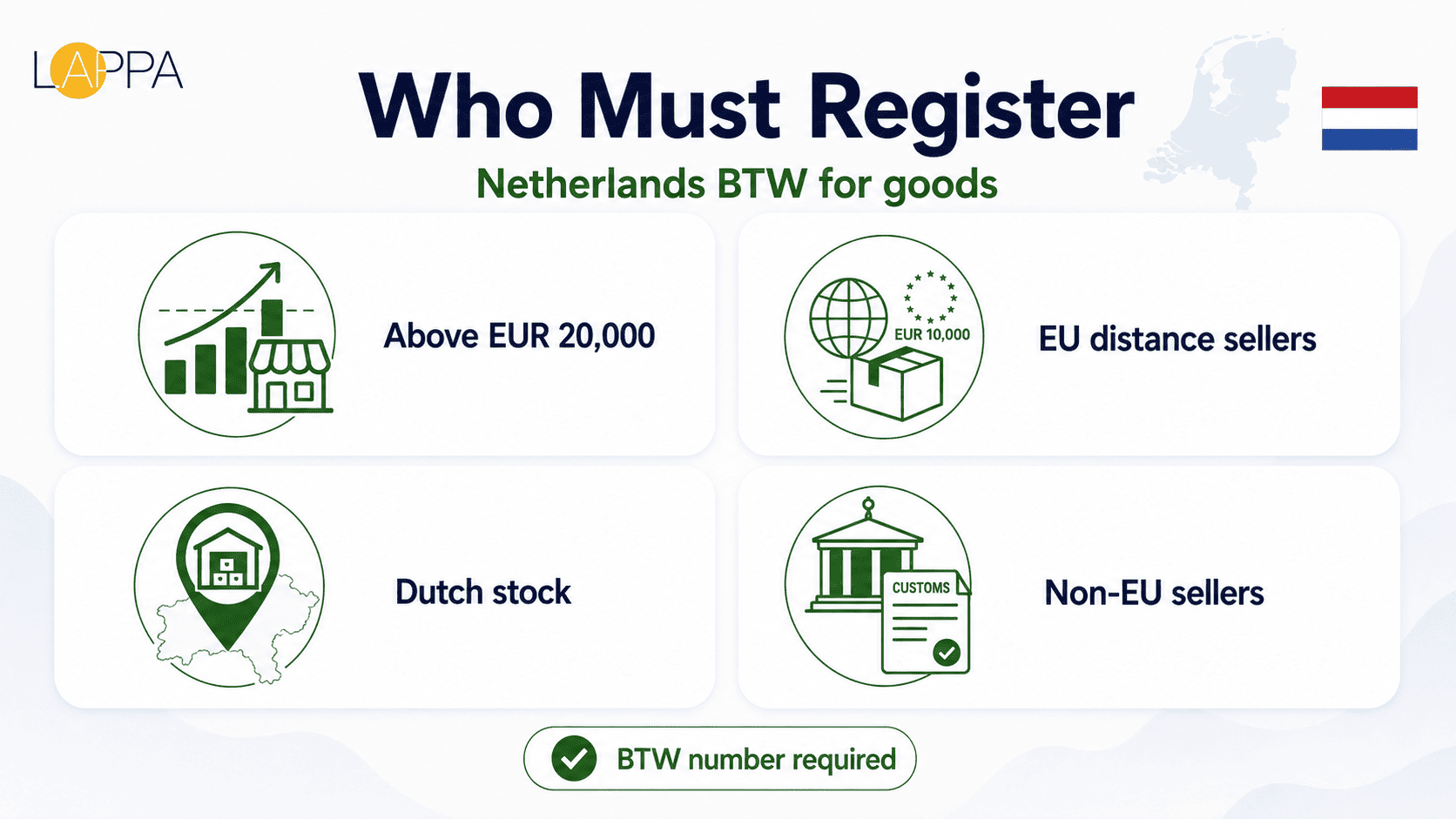 Netherlands VAT registration is mandatory for: Dutch resident businesses above the EUR 20,000 KOR threshold; non-resident businesses making taxable Dutch supplies outside OSS or IOSS; businesses making intra-EU goods acquisitions in the Netherlands above EUR 10,000 annually; businesses receiving reverse-charge services from non-Dutch suppliers; and Dutch marketplace operators deemed the supplier under EU marketplace facilitator rules.
VAT Netherlands Obligations for Online Sellers
VAT Netherlands rules for marketplace sellers changed on July 1, 2021, when EU deemed supplier rules took effect. Platforms facilitating goods sales from non-EU businesses to EU consumers -- or from any seller when goods ship from outside the EU -- are now deemed the supplier for BTW. The platform charges and remits BTW. The underlying seller makes a zero-rated supply to the platform. A non-EU business selling goods from a Dutch warehouse through a marketplace may not be the BTW-registered party for those B2C sales under deemed supplier rules. But it still needs Dutch BTW registration for other reasons -- imports, B2B sales, or goods sold outside the marketplace. Deemed supplier relief for B2C doesn't create a general exemption from Dutch BTW registration.VAT Number in Netherlands
Every BTW-registered entity receives a VAT number Netherlands authorities issue in the format NL + 9 digits + B + 2 digits. Total: 14 characters. Example: NL123456789B01. The nine-digit section is the RSIN (Rechtspersonen en Samenwerkingsverbanden Identificatie Nummer) for legal entities, or a modified BSN for sole traders. The B01 suffix makes Dutch numbers immediately distinguishable from every other EU member state's format.VAT Number Netherlands Format and Verification
VAT Netherlands registrations produce two identifiers simultaneously: the BTW-nummer (EU format, NL-prefix, used on cross-border invoices and VIES) and the OB-nummer (domestic identifier used on BTW returns and Belastingdienst correspondence). Both are needed; using the wrong one in the wrong context creates processing errors for counterparties. VAT number Netherlands validation works through VIES at ec.europa.eu/taxation_customs/vies -- enter the full 14-character string. VIES returns a valid/invalid result plus the registered name and address. The Belastingdienst also offers OB-nummer lookup through the mijn.belastingdienst.nl portal. Always validate before zero-rating a cross-border B2B invoice. Dutch BTW numbers issued to non-resident businesses follow the same NL + RSIN + B + 2 format. Non-resident sole traders receive a temporary RSIN during registration. This RSIN forms the middle nine digits of the BTW-nummer and is Netherlands-specific -- it doesn't derive from any home-country tax identifier.VAT Registration Procedure in Netherlands
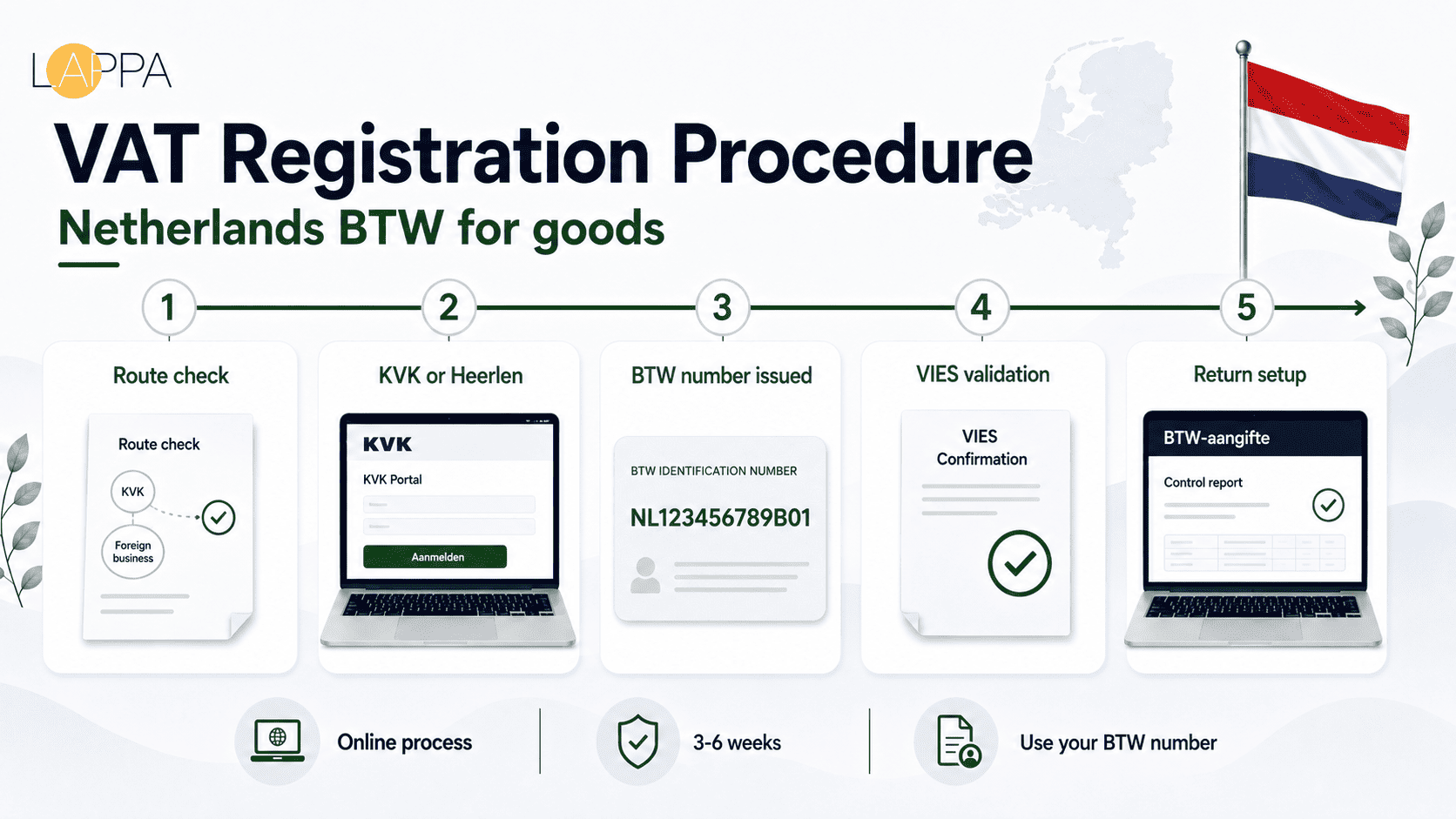 Registering to charge Netherlands' BTW rates starts with the correct application route. Dutch resident businesses register through the KVK (Kamer van Koophandel) at company formation. The KVK notifies the Belastingdienst, which sends a Startersvragenlijst (questionnaire) to establish the BTW position. The BTW-nummer is issued after processing -- typically four to six weeks from company formation.
Non-resident businesses apply directly to Belastingdienst Buitenland in Heerlen. The registration questionnaire for foreign operators is submitted by post or through a registered fiscal representative. Processing runs three to six weeks for a complete application. Incomplete submissions are returned, resetting the clock.
Documents required for a foreign business registration:
Registering to charge Netherlands' BTW rates starts with the correct application route. Dutch resident businesses register through the KVK (Kamer van Koophandel) at company formation. The KVK notifies the Belastingdienst, which sends a Startersvragenlijst (questionnaire) to establish the BTW position. The BTW-nummer is issued after processing -- typically four to six weeks from company formation.
Non-resident businesses apply directly to Belastingdienst Buitenland in Heerlen. The registration questionnaire for foreign operators is submitted by post or through a registered fiscal representative. Processing runs three to six weeks for a complete application. Incomplete submissions are returned, resetting the clock.
Documents required for a foreign business registration:
- Certificate of incorporation or equivalent registration document from the home country
- Proof of Dutch taxable activity -- contracts, confirmed orders, warehouse or lease agreements in the Netherlands
- Completed BTW registration questionnaire for foreign businesses
- Fiscal representative appointment letter (required for non-EU businesses making domestic Dutch supplies)
- Bank details for BTW refund payments
- Authorised signatory identification documents
Tax Representative in Netherlands
EU and EEA businesses register directly with Belastingdienst Buitenland -- no representative required. Non-EU businesses making domestic Dutch supplies must appoint an Algemeen Fiscaal Vertegenwoordiger (AFV -- General Fiscal Representative) before registration. The AFV holds joint and several liability for the client's BTW obligations. The Belastingdienst can pursue the representative directly for unpaid BTW. This real liability is reflected in AFV fees and the financial security the representative requires from clients. The AFV route also unlocks Article 23 licences. An Article 23 licence (BTW-verlegging bij invoer) defers import BTW from the customs payment to the BTW return -- eliminating the cash-flow cost of paying BTW at the Dutch border and waiting to recover it. The AFV typically holds the licence on the client's behalf. This import deferral mechanism is one of the primary commercial reasons non-EU businesses choose to work with an AFV even when it isn't strictly mandatory. Netherlands' BTW compliance for non-EU digital service providers is lighter. An Australian SaaS company selling to Dutch B2C consumers doesn't need Dutch BTW registration if it uses non-union OSS. It registers in one EU member state of its choice and files a single quarterly return covering all EU B2C digital revenue. No Dutch fiscal representative required. No Dutch BTW-nummer needed. OSS replaces all individual member state registrations for covered supplies.VAT E Invoices in Netherlands
The Netherlands' VAT e-invoicing adoption leads the EU for public procurement. Mandatory B2G e-invoicing through the PEPPOL network has applied to central government suppliers since 2017 and extended to all public sector entities by 2019. Any supplier to Dutch national or local government must issue invoices in UBL NL-CIUS format through a PEPPOL access point. Paper invoices to public-sector clients are rejected. B2B e-invoicing is not yet mandatory in the Netherlands. The Belastingdienst encourages voluntary adoption through the Dutch Peppol Authority, which certifies PEPPOL access point providers. Businesses can already exchange structured e-invoices voluntarily. The infrastructure is in place. The B2B mandate depends on EU ViDA (VAT in the Digital Age) framework transposition into Dutch law.Timeline for different business sizes
- 2017 -- Central government (Rijksoverheid): mandatory e-invoice reception and issuance for all direct suppliers via PEPPOL NL-CIUS format.
- 2019 -- All Dutch public sector entities (municipalities, provinces, public institutions): mandatory B2G e-invoicing extended across all government tiers.
- 2024-2025 -- ViDA preparation: large businesses encouraged to go live on PEPPOL voluntarily; Dutch Peppol Authority certifying additional access point providers.
- Post-2030 (expected) -- Mandatory B2B e-invoicing and digital VAT reporting aligned with EU ViDA, once transposed into Dutch law. Exact dates pending final EU legislation adoption.
VAT Returns in Netherlands
Types of reports
Dutch BTW-registered businesses manage up to four periodic reporting obligations. Each runs on its own schedule, to a different authority.- BTW-aangifte (VAT return): quarterly for most businesses (or monthly for large businesses). Due the last day of the month following the period -- April 30 for Q1, July 31 for Q2, October 31 for Q3, January 31 for Q4. Filed through Mijn Belastingdienst Zakelijk or certified accounting software.
- ICP-opgave (EC Sales List): covers intra-EU B2B goods supplies and services subject to the reverse charge in the customer's country. Monthly if intra-community supplies exceed EUR 50,000 per quarter; otherwise quarterly. Due 25th of the following period. Filed through the Belastingdienst portal.
- Intrastat: statistical declaration for goods physically crossing Dutch borders within the EU. Filed monthly with CBS (Centraal Bureau voor de Statistiek) through the CBS IDEP-NL portal. Threshold approximately EUR 800,000 to EUR 900,000 per year for dispatches and arrivals (reviewed annually).
- Annual BTW reconciliation: required if the proportion of taxable versus exempt supplies shifted during the year, affecting the deductibility coefficient. Reported in the last quarterly BTW-aangifte of the year.
Deductible VAT in Netherlands
Input BTW recovery follows direct attribution. Costs relating to taxable supplies generate recoverable input BTW. Costs relating to exempt supplies do not. The Besluit Uitsluiting Aftrek omzetbelasting (BUA) lists categories where input BTW is excluded -- primarily goods and services provided for private use. VAT collected in Netherlands on mixed-use costs is apportioned by the ratio of taxable to total turnover. Business meals at Dutch restaurants carry 21% BTW. Full recovery is permitted when the expense is documented as a genuine business purpose -- client name, business reason, date, and venue. The income tax rule disallowing 20% of meal costs for CIT purposes doesn't apply to BTW. Full input BTW recovery on a documented client meal is allowed even where the income tax deduction is partially blocked. Passenger cars present the most complex BTW deductibility question. Input BTW is recoverable to the extent the car is used for taxable business purposes. The private-use fraction is established through mileage records (rittenregistratie). The Belastingdienst publishes an annual lump-sum Privecorrectie for company car private use -- a percentage of the catalogue value added to output BTW in the final quarterly return. Businesses using actual mileage records instead of the lump sum must document every journey.VAT Record Keeping Requirements in Netherlands
Netherlands' BTW taxes generate a seven-year record retention obligation (Article 52 AWR). The clock runs from December 31 of the year the document relates to -- a Q2 2024 BTW return must be retained until January 1, 2032. Real property records (purchase contracts, option agreements, land registry extracts, and all BTW documentation for immovable property) carry a ten-year retention requirement. Digital records are fully accepted. The Belastingdienst requires records to be producible in a readable format on request. This means preserving structured data files (XML, CSV, or database exports) alongside any PDF representation. Scanned paper invoices are allowed provided the scans are complete and legible -- the originals can then be destroyed. Cloud-based retention must include a guarantee that files remain accessible and exportable for the full retention period. For PEPPOL e-invoices, both the UBL XML file and any PDF rendering must be retained. The XML carries the legally binding structured data. If your e-invoicing provider stores files on third-party infrastructure, confirm that retention guarantees extend to ten years for property-related invoices and seven years for everything else.VAT Penalties in Netherlands
The Belastingdienst applies a tiered fine structure for BTW non-compliance. Late filing of a BTW-aangifte triggers a fixed Verzuimboete of EUR 68 for a first offence, rising to EUR 136 for repeat offences. Serious late filing -- only submitted after a Belastingdienst demand -- carries a Vergrijpboete of up to 100% of the BTW due. The Vergrijpboete requires evidence of intent or gross negligence; pure oversight typically attracts only the Verzuimboete. Late payment generates Invorderingsrente at the current Belastingdienst rate -- approximately 4% per year as of 2024, running from the day after the payment deadline. Belastingrente also accrues when a BTW assessment produces tax due after the return deadline. Both interest types compound on the unpaid principal and add to the base underpayment. Deliberate underreporting or non-reporting of BTW can escalate to criminal prosecution by the FIOD (Fiscale Inlichtingen en Opsporingsdienst -- Dutch tax police). The FIOD investigates BTW carousel fraud, systematic input tax fraud, and serious underreporting. Conviction carries significant fines and custodial sentences. Self-disclosure before FIOD initiates an investigation reduces penalties but doesn't guarantee immunity from prosecution.How Lappa Can Help with VAT Compliance in Netherlands
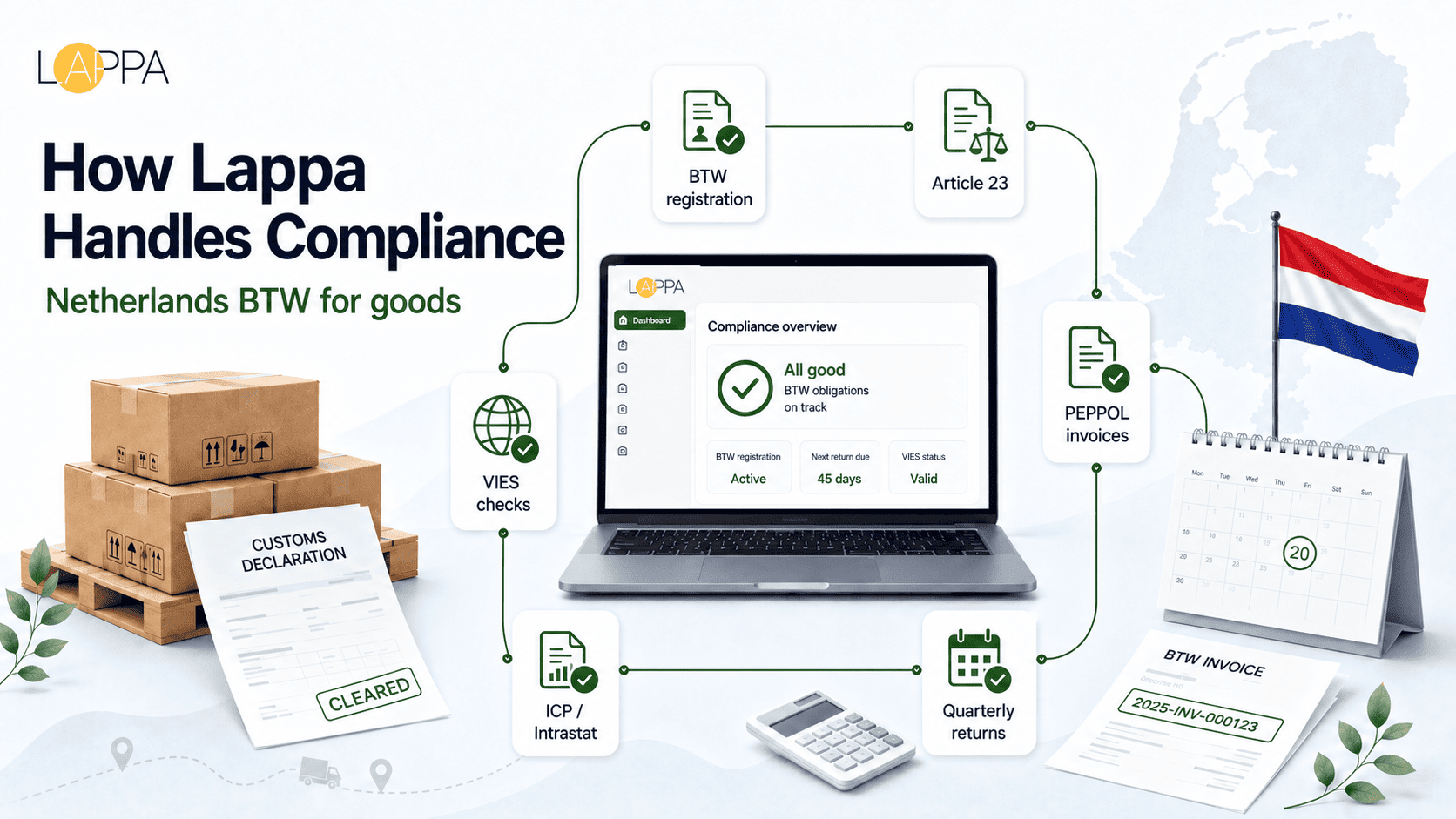 Lappa provides end-to-end BTW compliance for foreign businesses entering the Dutch market. Registration services cover the Belastingdienst Buitenland application, document preparation, and correspondence management during the approval period. For non-EU clients, Lappa holds general fiscal representative (AFV) status and manages Article 23 licence applications for import BTW deferral.
Ongoing compliance from Lappa covers quarterly BTW-aangifte preparation and submission, ICP-opgave EC Sales List filings by the 25th of each period, and Intrastat monthly reports to CBS for clients above the statistical threshold. All records are stored digitally for the full seven-year statutory period, with ten-year coverage for property-related documentation.
Lappa's PEPPOL readiness advisory helps businesses prepare for the current B2G mandate and forthcoming B2B obligation under the EU ViDA framework. Lappa advises on UBL NL-CIUS format compliance, PEPPOL access point selection, and ERP integration. Starting the e-invoicing setup before a mandate deadline is significantly cheaper than emergency retrofitting when large-enterprise customers begin requiring it from their supply chains.
Lappa provides end-to-end BTW compliance for foreign businesses entering the Dutch market. Registration services cover the Belastingdienst Buitenland application, document preparation, and correspondence management during the approval period. For non-EU clients, Lappa holds general fiscal representative (AFV) status and manages Article 23 licence applications for import BTW deferral.
Ongoing compliance from Lappa covers quarterly BTW-aangifte preparation and submission, ICP-opgave EC Sales List filings by the 25th of each period, and Intrastat monthly reports to CBS for clients above the statistical threshold. All records are stored digitally for the full seven-year statutory period, with ten-year coverage for property-related documentation.
Lappa's PEPPOL readiness advisory helps businesses prepare for the current B2G mandate and forthcoming B2B obligation under the EU ViDA framework. Lappa advises on UBL NL-CIUS format compliance, PEPPOL access point selection, and ERP integration. Starting the e-invoicing setup before a mandate deadline is significantly cheaper than emergency retrofitting when large-enterprise customers begin requiring it from their supply chains.
FAQ for VAT in Neterlands Goods
What is the VAT rate in Netherlands
The Netherlands applies two active BTW rates. The 21% standard rate covers most goods and services -- electronics, professional services, software, advertising, telecoms. The 9% reduced rate applies to essential categories: basic foodstuffs, non-alcoholic drinks, medicines, books, newspapers, hotel accommodation, hairdressers, and bicycle repairs, as listed in Table I of the Wet OB 1968. Exports outside the EU and intra-EU B2B supplies to VAT-registered counterparties are zero-rated -- taxable at 0%. Exempt supplies (healthcare, education, financial services, insurance, certain real estate) fall entirely outside the BTW system: no BTW charged, no input BTW recovered on related costs. The 21%/9% structure has been stable since 2012. Misclassifying a supply between 21% and 9% creates either a BTW undercharge -- you owe the Belastingdienst the difference -- or a BTW overcharge that your customer can't recover as input tax because you weren't entitled to charge it. The Belastingdienst publishes category guidance per supply type. When classification is genuinely ambiguous, a written ruling request (vooroverleg) is available.Who needs to register for VAT in Netherlands
Dutch resident businesses above EUR 20,000 KOR turnover must register. Non-resident businesses making taxable Dutch supplies outside OSS or IOSS must register regardless of turnover. EU distance sellers above the EUR 10,000 EU-wide threshold must charge Dutch BTW -- either through Dutch registration or OSS. Non-EU businesses have no threshold and register before the first Dutch taxable supply. Specific triggers also apply. A non-EU business storing goods in a Dutch warehouse creates a Dutch BTW registration requirement. A business acquiring goods from an EU supplier and routing them through the Netherlands typically triggers an intra-community acquisition registration. A marketplace seller whose goods sit in the Netherlands isn't automatically exempt from registration just because the marketplace is the deemed B2C supplier. Businesses uncertain whether a specific activity creates a Dutch BTW registration obligation can request a binding ruling from the Belastingdienst (vooroverleg procedure). This is usually done through a registered tax adviser and can prevent inadvertent non-registration -- which carries retrospective BTW assessments, penalties, and interest from the date the obligation should have started.What is the VAT number format in Netherlands
Dutch BTW numbers follow a unique EU format: NL + 9 digits + B + 2 digits, totalling 14 characters. Example: NL123456789B01. The nine-digit central section is the RSIN for legal entities or a modified BSN for sole traders. The B + 2 suffix -- typically B01, sometimes B02 for a second registration linked to the same entity -- makes Dutch numbers immediately identifiable. Validate any NL-prefix number through VIES before zero-rating a cross-border B2B invoice. VIES returns a valid/invalid result plus the registered name and address. If a number is valid in the Belastingdienst system but not yet live in VIES, propagation typically takes two to three working days after approval. Non-resident businesses receive the same NL-format BTW number as Dutch resident businesses. The format doesn't indicate residency. Non-resident registrations are held in the Belastingdienst Buitenland records rather than the domestic register, which can occasionally add one to two working days to the VIES propagation timeline compared with domestic registrations.How often are VAT returns filed in Netherlands
Quarterly filing is standard for most BTW-registered businesses. Deadlines fall on the last day of the month after the quarter: April 30 for Q1, July 31 for Q2, October 31 for Q3, January 31 for Q4. Large businesses and those requesting monthly filing submit returns monthly. The Belastingdienst notifies businesses when monthly filing is required based on prior-year BTW liability. Monthly filing is also available on request -- useful for businesses that regularly accumulate large input BTW positions and want faster refunds. Businesses with ongoing construction, high stock acquisition, or significant capital expenditure often elect monthly filing to accelerate cash recovery. Annual-only filing applies to businesses with BTW liability below EUR 1,883 per year. The Belastingdienst identifies and notifies eligible businesses. ICP-opgave (EC Sales List) runs on its own schedule independently of the BTW-aangifte: quarterly for most, monthly if intra-community supplies exceed EUR 50,000 per quarter.Do foreign companies need a tax representative in Netherlands
EU and EEA businesses register directly with Belastingdienst Buitenland without a representative. Non-EU businesses making domestic Dutch supplies -- physical goods warehoused in the Netherlands, Dutch construction, real estate transactions -- must appoint an AFV (Algemeen Fiscaal Vertegenwoordiger) before registration. The AFV is jointly and severally liable for the client's BTW. That liability is reflected in AFV fees and the financial security the representative requires. Non-EU businesses whose Dutch exposure is limited to cross-border digital services or distance goods sales don't necessarily need Dutch registration at all. OSS (for EU-bound digital services and goods) or IOSS (for imported goods under EUR 150) may cover the full scope of Dutch B2C supplies. Assess the supply type first -- if OSS or IOSS covers everything, Dutch registration and an AFV may both be unnecessary. Post-Brexit UK businesses are non-EU for Dutch BTW purposes. New UK operators starting Dutch activities after January 1, 2021 follow the non-EU route. UK businesses that held Dutch BTW registrations before Brexit generally kept them without disruption, but changes to their Dutch supply profile -- new warehousing or new supply types -- may require a formal AFV appointment if they haven't already made one.VAT Calculator
Adding 21% BTW: multiply net by 1.21. Extracting 21% from gross: divide by 1.21. Adding 9%: multiply by 1.09. Extracting 9%: divide by 1.09. Dutch invoices must show the net amount, BTW rate, BTW amount, and gross total on separate lines. At 21%: a EUR 1,500 software invoice carries EUR 315 BTW, grossing EUR 1,815. At 9%: EUR 200 hotel stay contains EUR 16.51 BTW (EUR 200 / 1.09 = EUR 183.49 net; EUR 16.51 tax). Multi-rate invoices list each line at its correct rate -- no blended rate averaging.
VAT Standard rate
21%
VAT Reduced rate
9%
Thresholds
There is no registration threshold for a foreign business making taxable supplies for which it must charge Dutch VAT.