


Understanding Croatia VAT for Local and Foreign Companies
Provinces
Goods
Provinces
Goods
About
Goods
About
Goods
Goods
Goods
Introduction to VAT in Croatia
Croatia joined the EU on July 1, 2013, and from day one VAT in Croatia -- called PDV locally, short for Porez na Dodanu Vrijednost -- fell under Directive 2006/112/EC. The standard rate landed at 25%. That ties Croatia with Hungary for the highest in the bloc. Porezna uprava, the Tax Administration body inside the Ministry of Finance, handles everything from registration to enforcement. There's something worth flagging upfront. Croatia's fiscalization system has been running since 2012 -- a full year before EU accession. Every invoice your business issues, paper or digital, must hit Tax Administration's servers in near-real time and receive a verification code before the customer sees it. Skip that step and fines come fast. There's no warning letter first. VAT in Croatia works on the EU's credit-invoice model. You charge output PDV on sales, subtract input PDV on qualifying purchases, and send the difference to Porezna uprava. Filing is monthly or quarterly, depending on turnover.What Is VAT in Croatia and Who Administers It
What is VAT in Croatia -- precisely? The PDV Act (Zakon o PDV-u) defines it as a consumption tax applied at every stage of the supply chain, with each business paying only on the value it personally added. Porezna uprava collects it, cross-checks your declared figures against the centralized fiscalization database, and issues binding rulings when supply classifications get contested. What is VAT in Croatia for a foreign company? Structurally identical to what a local business faces. If you're making taxable B2C supplies to Croatian consumers above the relevant threshold, you collect PDV at Croatian rates, file returns with Porezna uprava, and pay -- whether that's through direct registration, OSS, or a local fiscal representative. Knowing what Croatia's VAT framework exempts matters just as much as knowing what it taxes. Financial services, insurance, most healthcare, education, and residential real estate sit outside the PDV net entirely. No output PDV on those supplies -- and no input PDV recovery on costs tied to them either.VAT Rates in Croatia
Croatia VAT Rate -- Standard, Reduced, and Zero
The Croatia VAT rate breaks into three live tiers: 25%, 13%, and 5%. Exports and intra-EU B2B goods supplies sit at 0%. Exempt status applies to finance, insurance, and a handful of other sectors. Most day-to-day commercial transactions hit the 25% standard bracket by default -- and getting the tier wrong on an invoice isn't something Porezna uprava corrects for you.| PDV Rate | Category | Common Examples |
| 25% (standard) | All goods and services not assigned to a reduced tier | Electronics, clothing, software, advertising, consulting |
| 13% (reduced) | Accommodation, restaurant food, utilities, events, transport | Hotel stays, restaurant meals, natural gas, electricity, concerts, rail tickets |
| 5% (reduced) | Basic foodstuffs, medicines, printed and digital books | Bread, milk, prescription drugs, textbooks, scientific journals, baby diapers, edible oils |
| 0% / Exempt | Exports, intra-EU B2B supplies, and specific exempt sectors | Export goods, financial services, insurance, healthcare, education |
The Croatia Standard VAT Rate 25 Percent in Practice
The Croatia standard VAT rate 25% catches the widest range of supplies. Professional services, telecoms, most SaaS subscriptions, advertising, general retail, electronics, clothing, most software -- all 25%. When a category isn't explicitly reduced, that's your rate. Assume 25% first, then look for the exception. The Croatia VAT rate at 13% is mostly where travel and hospitality businesses sit. Hotel stays, food and non-alcoholic drinks prepared and served in restaurants, natural gas, district heating, household electricity, entry to concerts, museums, and sporting events -- all 13%. This tier landed in Croatian law on EU accession day in 2013 and has grown in scope over the years, particularly on energy products. The 5% bracket is for basic necessities. Bread, milk, prescription medicines, textbooks, scientific publications, baby food, edible oils, baby diapers -- all qualify. Croatia's 5% list is longer than most EU counterparts, which reflects a deliberate policy choice to keep essential costs down. For most B2C online retailers shipping into or selling digitally to Croatia, the Croatia standard VAT rate 25% is simply the applicable rate. Check the PDV Act schedules before billing Croatian consumers. Don't assume a product qualifies for reduced treatment without verifying it line by line. Croatia's 25% standard has been stable since accession in 2013, and there's no live proposal to cut it. The Croatian VAT rate for the 13% reduced bracket has quietly expanded, though -- energy products joined the tier in 2023, a response to spiking household heating costs.VAT Registration Threshold in Croatia
Croatia's VAT registration rules split into three separate tracks. One for resident Croatian businesses, one for EU-based remote sellers, and one for everyone outside the EU. The thresholds are very different. And the penalties for missing registration can include back-assessed PDV from the date you should have started -- not from when Porezna uprava caught it.| Seller Category | Registration Threshold | Key Notes |
| Croatian resident business | EUR 40,000 per year | Notify Porezna uprava within 8 days of crossing the limit; voluntary registration allowed below threshold |
| EU-based distance seller (goods) | EUR 10,000 EU-wide | Combined B2C turnover across all EU states; OSS removes the need to register country by country |
| EU-based digital service provider | EUR 10,000 EU-wide | Same EU-wide threshold as distance selling; OSS covers digital services too |
| Non-EU seller (any goods or services) | No threshold -- from first sale | Fiscal representative required before applying; IOSS available for goods under EUR 150 |
For Local Businesses
Cross EUR 40,000 in taxable annual turnover and you've got eight days to notify Porezna uprava and apply. That's not eight working days -- eight calendar days. From the effective registration date, all your supplies carry output PDV. You can't back-bill PDV on invoices issued before that date, so planning the timing carefully matters. Voluntary registration is available if you're under EUR 40,000. It makes sense when you're paying significant input PDV to suppliers and want to recover it. But it's a commitment -- once you're registered voluntarily, you're locked in for at least two full calendar years before you can deregister.For Remote Sellers
EU-based businesses selling goods B2C into Croatia hit the EUR 10,000 EU-wide distance selling threshold first introduced in July 2021. That's not EUR 10,000 to Croatia specifically -- it's your combined B2C total across all 27 EU member states. Once you breach it, you either register in each destination country or use OSS and file one quarterly return covering all of them. Most sellers with meaningful EU reach go OSS. It's significantly less admin. UK businesses are non-EU post-Brexit and don't get the OSS option in the same way -- they fall into the non-EU track with its own set of requirements.For Remote Digital Services
SaaS, streaming, e-books, online gaming, app subscriptions -- all digital services follow the same EUR 10,000 EU-wide threshold as physical goods sellers. Under that, you charge your own country's rate. Over it, you charge 25% Croatian PDV on sales to Croatian consumers. OSS handles the filing. IOSS is specifically for goods under EUR 150, not for services.Who Must Register for VAT in Croatia
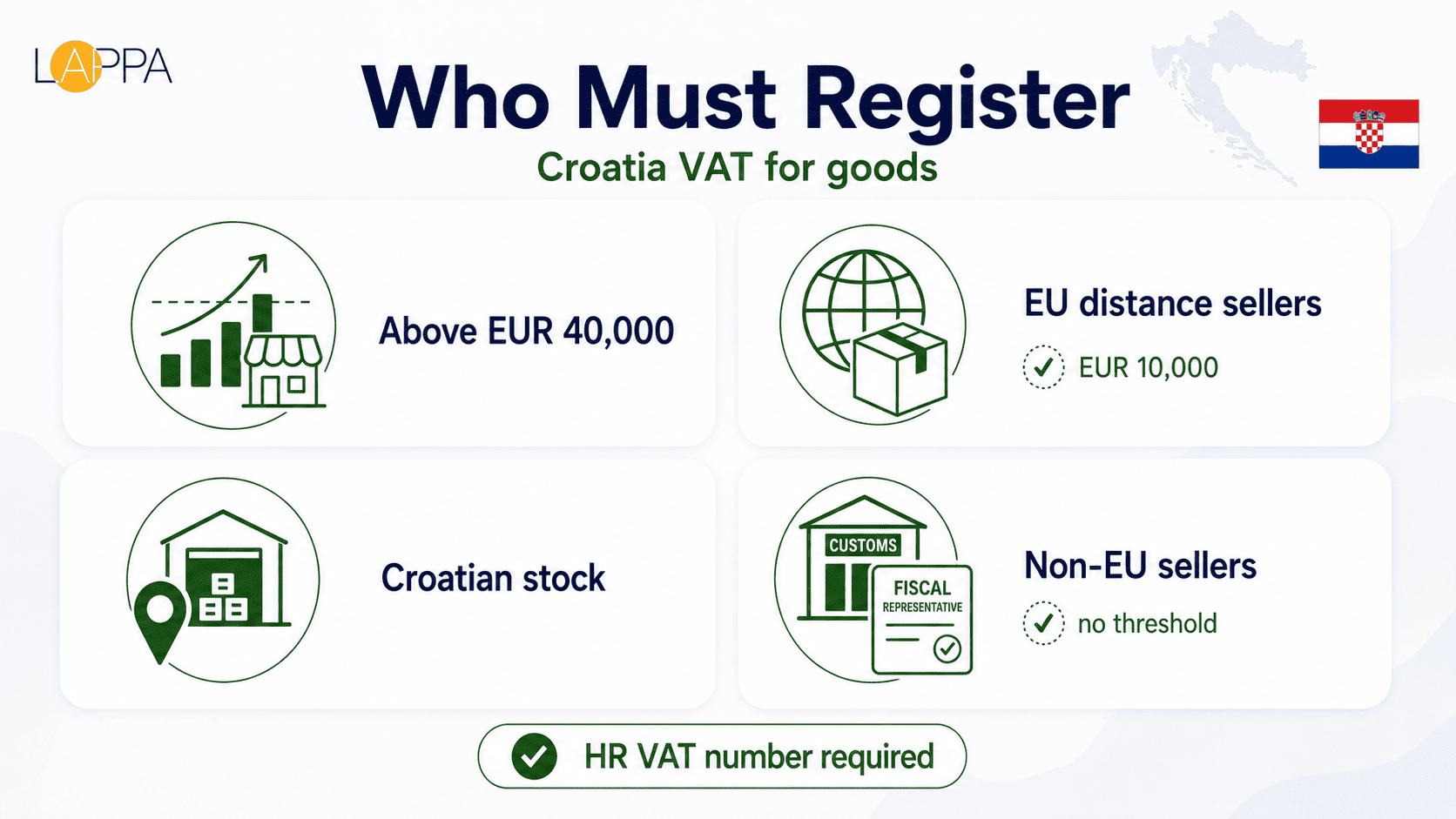 Four categories trigger mandatory registration. First, Croatian entities whose taxable annual turnover tops EUR 40,000. Second, non-resident businesses making taxable Croatian supplies without routing through OSS or IOSS. Third, businesses receiving reverse-charge B2B services above a minimal amount. Fourth, entities acquiring intra-EU goods above EUR 10,000 per year.
Some transactions also force immediate registration no matter the size. Real estate disposals, going-concern asset transfers, taking over a PDV-registered business -- these can push you into registration from day one. If you're doing a one-off transaction in Croatia and it looks at all unusual, check with a local tax adviser before the supply happens, not after.
Four categories trigger mandatory registration. First, Croatian entities whose taxable annual turnover tops EUR 40,000. Second, non-resident businesses making taxable Croatian supplies without routing through OSS or IOSS. Third, businesses receiving reverse-charge B2B services above a minimal amount. Fourth, entities acquiring intra-EU goods above EUR 10,000 per year.
Some transactions also force immediate registration no matter the size. Real estate disposals, going-concern asset transfers, taking over a PDV-registered business -- these can push you into registration from day one. If you're doing a one-off transaction in Croatia and it looks at all unusual, check with a local tax adviser before the supply happens, not after.
VAT Number in Croatia
Every business approved for PDV gets a VAT number Croatia authorities issue as HR followed by eleven digits. Those eleven digits are the entity's OIB -- Osobni Identifikacijski Broj -- Croatia's universal national tax ID that every legal entity and individual already holds. So there's no separate identifier to apply for. Tax Administration simply activates the HR-prefixed version of the OIB you already have. A Croatian VAT number looks like this: HR12345678901. HR is the country code. The rest is the OIB. Because that OIB pre-exists the VAT application, Croatian registration tends to move faster than most EU countries where a new identifier has to be created and assigned from scratch.Croatia VAT Number Format and Croatia VAT ID Structure
Croatia VAT number format: HR + eleven digits, no spaces or separators. That's it. Run every counterparty's number through VIES before issuing a zero-rated intra-EU invoice -- an invalid VIES result means the zero rate isn't safe to apply, and the risk falls on you, not your customer. The Croatia VAT ID and the OIB are the same number in two different contexts. Inside Croatia, on domestic invoices and tax filings, the OIB appears alone. For EU cross-border transactions and VIES lookups, you add the HR prefix. The ePorezna portal and Porezna uprava documentation use both formats interchangeably depending on the form. A valid Croatia VAT number also passes an OIB modulus-11 check. Accounting software built for the Croatian market usually includes this validation automatically. If a supplier gives you a number that fails it, don't post the input PDV claim -- request a corrected invoice first. A Croatia VAT ID issued to a Croatian subsidiary is separate from the parent company's number. Each legal entity in Croatia has its own OIB and its own HR-prefixed registration. A foreign parent can't umbrella its Croatian subsidiary under its own PDV registration -- each entity files and pays independently. VIES validation is free and near-instant. A Croatian VAT number that shows as invalid on VIES will block zero-rating on intra-EU invoices until it's resolved. If an active, registered supplier keeps failing VIES, the issue is usually a short propagation lag -- the supplier registered with Porezna uprava but the central EU database hasn't synced yet. Porezna uprava can push the sync when contacted. Croatia's VAT identifier system doesn't change often. The OIB -- and therefore the VAT number -- only shifts when a business merges, splits, or closes. In normal operations, most businesses use the same HR-prefixed number their entire active life. That makes long-term counterparty management clean. [IMAGE 2: Screenshot of the EU VIES validation portal with a Croatian HR-prefix VAT number verification result | Source: Google Creative Commons]VAT Registration Procedure in Croatia
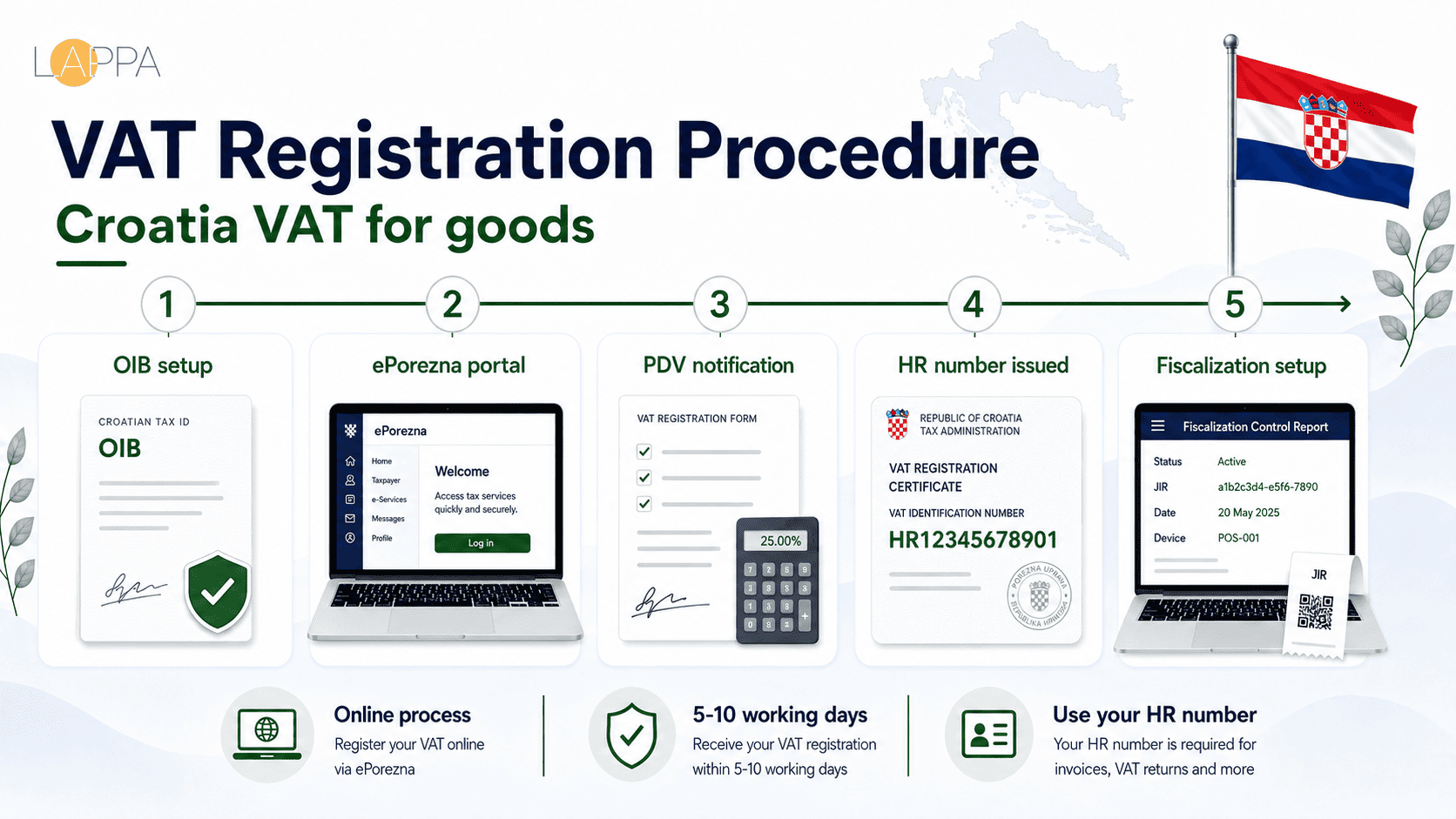 To get a VAT number Croatia businesses submit a PDV Registration Notification -- Obavijest o upisu u registar obveznika PDV-a -- through the ePorezna portal at eporezna.porezna-uprava.hr. Most applications go through without a physical visit. Non-EU companies need to appoint a fiscal representative before they can even start the application.
Documents you'll typically need:
To get a VAT number Croatia businesses submit a PDV Registration Notification -- Obavijest o upisu u registar obveznika PDV-a -- through the ePorezna portal at eporezna.porezna-uprava.hr. Most applications go through without a physical visit. Non-EU companies need to appoint a fiscal representative before they can even start the application.
Documents you'll typically need:
- Completed and signed PDV registration notification form
- Certificate of incorporation or equivalent business registration document -- apostilled if you're a non-EU entity
- Evidence of taxable activity in Croatia: contracts, pre-invoices, a Croatian premises lease
- OIB confirmation -- Croatian companies already have one; foreign entities get a Croatian OIB from the Ministry of Public Administration first, before anything else
- Bank account details for any potential PDV refunds
- Fiscal representative appointment document -- non-EU companies only
Tax Representative in Croatia
Non-EU businesses must appoint a Croatian fiscal representative -- porezni zastupnik -- before submitting the PDV registration application. The representative is jointly and severally liable for your PDV debt. That's a real legal exposure, not a formality. Croatian firms willing to serve as representatives are selective for exactly this reason. EU businesses register directly with Porezna uprava, no representative needed. EEA countries are in the same position. UK companies lost that direct-registration privilege on January 1, 2021 -- post-Brexit, they're treated as non-EU and need a representative. Some UK operators discovered this when their first Croatian customer invoiced them. That's not a good time to find out. A Croatian representative handles registration logistics, monthly or quarterly filings through ePorezna, Porezna uprava correspondence, and audit escalation. Fees vary: expect a setup charge plus a monthly retainer scaled to how many filings you generate. Some providers bundle entity management, fiscal rep, and accounting together.VAT E Invoices in Croatia
Croatia's invoice controls are stronger than most EU neighbours. The fiscalization system (fiskalizacija), live since January 2013, requires every invoice to reach Tax Administration's servers and receive a unique JIR code before it's handed to the customer. No code means an invalid invoice. There's no grace period for that rule. B2G e-invoicing has been mandatory since 2019. Send an invoice to any Croatian public body, government institution, or state enterprise and it must arrive in UBL 2.1 XML format through the official infrastructure -- the FINA e-racun platform. Paper invoices to public sector clients haven't been accepted since that mandate landed.Timeline for Different Business Sizes
B2B e-invoicing remains voluntary as of mid-2025. But the EU's ViDA regulation -- VAT in the Digital Age -- will impose mandatory structured e-invoicing across member states, with 2028 as the likely first-wave target. Large Croatian businesses and multinationals with Croatian operations are already upgrading their invoicing infrastructure. Waiting until the mandate is close rarely goes well.- 2012 -- Fiscalization law enacted
- January 2013 -- Real-time invoice reporting mandatory for all businesses
- July 2019 -- B2G e-invoicing mandate live; UBL 2.1 format required
- January 2023 -- Euro replaces Croatian Kuna (HRK) at rate 7.5345; PDV thresholds converted to EUR
- 2025 -- B2B voluntary e-invoicing via FINA e-racun; EU ViDA negotiations ongoing
- 2028 (expected) -- EU-wide mandatory structured e-invoicing, Croatia in scope
VAT Returns in Croatia
VAT Croatia Return Types and Reporting Obligations
VAT Croatia returns use the PDV form (Obrazac PDV), submitted electronically through ePorezna. Monthly filing applies to new taxpayers in their first year and to any business with annual taxable turnover above EUR 800,000. Everyone else files quarterly. Deadline is the 20th of the month after the period ends -- for both groups, no exceptions. VAT Croatia obligations don't stop at the main PDV form if you're trading across EU borders. Two separate reports also apply: the EC Sales List and Intrastat. Both have their own deadlines and their own penalty regimes. Missing one while getting the other right doesn't help you. The EC Sales List -- the ZP form, or Zbirna prijava -- covers B2B supplies of goods and services to VAT-registered buyers in other EU member states. It lists each customer's VAT number, total supply value, and supply type (goods, services, or triangular). ZP frequency matches your PDV return: monthly for large filers, quarterly for others. Errors on ZP forms create VIES mismatches that can freeze counterparties' refund claims. Intrastat kicks in when goods physically crossing Croatian EU borders exceed the statistical thresholds -- approximately EUR 400,000 per year for arrivals, approximately EUR 250,000 for dispatches. Thresholds are reviewed annually. The ODO form covers both directions. Getting PDV right but skipping Intrastat still produces administrative fines. Croatian VAT filings go through ePorezna only -- there's no paper option for the main PDV form anymore. The portal is in Croatian. Non-resident businesses without Croatian-speaking staff typically handle submissions through their fiscal representative or a local accounting partner. It's one of those things that looks straightforward until you're actually trying to navigate the portal in a language you don't speak.Deductible VAT in Croatia
Input PDV is recoverable on purchases made for taxable business purposes. The basic rule is clean: taxable supply, recover the input tax. Exempt supply, you can't. Mixed-use purchases need a proportional split using the partial exemption ratio for that period. Company vehicles are where most businesses run into restrictions. Mixed business-and-personal-use vehicles: you recover 50% of the input PDV on the purchase, fuel, repairs, and insurance. Exclusively business-use vehicles -- a delivery van, a car in a commercial hire fleet, a manufacturer's test vehicle -- get full recovery. You'll need documentation proving exclusive use. Porezna uprava does check. Entertainment and hospitality costs face a 50% recovery cap too. Business meals, client events, gifts above EUR 20 per recipient per year -- all restricted to half. The cap is categorical. It doesn't matter how commercial the event actually was. Real estate is its own world. New commercial property usually sells with 25% PDV attached, recoverable by the buyer. Old commercial property -- past two years from first use -- is exempt by default: no PDV on the sale, no input recovery for the buyer. Both parties can opt to tax the transaction if they're both fully taxable entities, which opens up the input recovery again.VAT Record Keeping Requirements in Croatia
Croatian law sets a ten-year minimum retention period for PDV records, running from the end of the accounting period they relate to. That covers issued invoices, received invoices, import documents, VAT books, and any bank records tied to PDV transactions. Ten years is longer than most EU countries require. VAT books must show output PDV by rate, input PDV by category, the net payable or refundable for each period, and cumulative year-to-date figures. Digital records are fully accepted. Paper invoices that exist must be kept physically until the retention period runs out. There's no option to dispose of paper early just because you've scanned it. Fiscalization records are a third layer on top of the normal accounting archive. Every invoice your business issues gets a JIR code from Porezna uprava's system. That code, and the invoice it relates to, must be preserved and cross-referenceable. Inspectors compare your records against the central fiscalization database. Gaps show up immediately.VAT Penalties in Croatia
Late filing of a PDV return costs companies between EUR 665 and EUR 26,544 in fines. The responsible individual within the entity -- director, CEO, CFO -- faces a separate personal fine of EUR 265 to EUR 13,272 on top of that. Both can land at the same time. For a small business, that's a serious hit. Late payment adds statutory interest from the deadline to the payment date. No grace period. The annual rate is currently around 3 to 6 percent depending on the reference rate in force at the time. It compounds. Leaving a PDV balance unpaid while you sort out a dispute costs more each month it sits there. Serious violations -- understated turnover, fake invoices, deliberate manipulation of the fiscalization system -- can reach EUR 66,360 in fines for legal entities, and criminal prosecution in the worst cases. The fiscalization system makes large-scale invoice suppression much harder than it was before 2013. Tax Administration can see your entire invoice history. They compare it against your declared turnover. Voluntary correction is the right move if you catch an error before Porezna uprava does. File an amended return, pay the shortfall. The penalty reduction for proactive correction is significant compared to what happens when an inspector finds the same error. Getting there first almost always costs less.How Lappa Can Help with VAT Compliance in Croatia
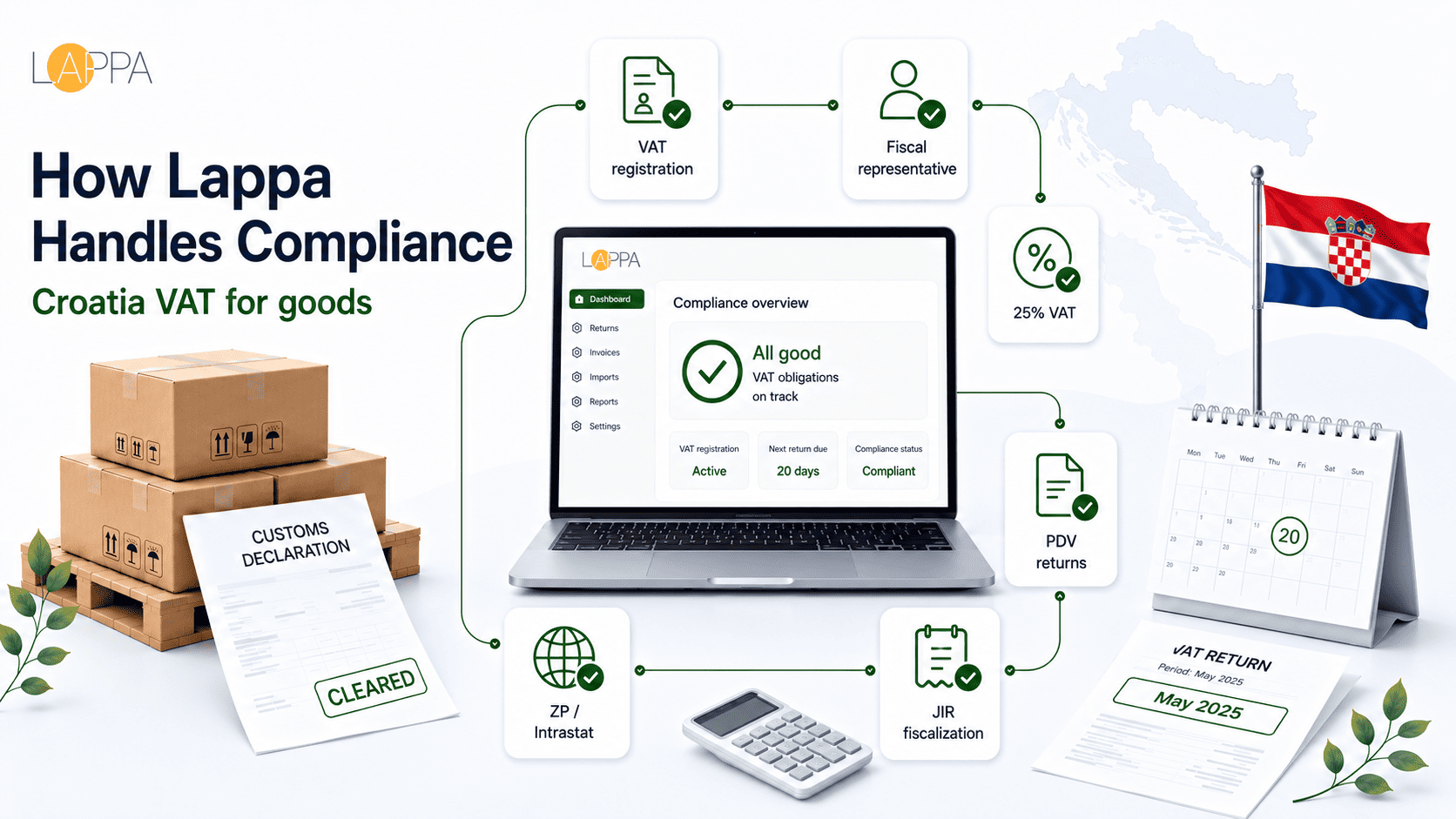 Lappa handles VAT registration, fiscal representation, and ongoing compliance for businesses entering Croatia. Registration covers OIB acquisition for foreign entities, preparation and submission of the PDV notification through ePorezna, and monitoring VIES until the HR-prefixed number goes live.
For active filers, Lappa pulls transaction data automatically, prepares the monthly or quarterly PDV form, and submits it through ePorezna. ZP (EC Sales List) and Intrastat submissions are included for clients with intra-EU supply chains. All documentation is stored in a client portal with ten-year retention built in.
Non-EU clients that need a Croatian fiscal representative can use Lappa's fiscal representation service. That includes joint liability acceptance, Croatian-language correspondence with Porezna uprava, audit support, and escalation handling if enforcement steps in. You retain full access to your own filing records throughout.
Lappa handles VAT registration, fiscal representation, and ongoing compliance for businesses entering Croatia. Registration covers OIB acquisition for foreign entities, preparation and submission of the PDV notification through ePorezna, and monitoring VIES until the HR-prefixed number goes live.
For active filers, Lappa pulls transaction data automatically, prepares the monthly or quarterly PDV form, and submits it through ePorezna. ZP (EC Sales List) and Intrastat submissions are included for clients with intra-EU supply chains. All documentation is stored in a client portal with ten-year retention built in.
Non-EU clients that need a Croatian fiscal representative can use Lappa's fiscal representation service. That includes joint liability acceptance, Croatian-language correspondence with Porezna uprava, audit support, and escalation handling if enforcement steps in. You retain full access to your own filing records throughout.
FAQ for Croatia VAT Goods
What Is the VAT Rate in Croatia
Standard rate is 25% -- one of the two highest in the EU. Reduced rates: 13% for accommodation, restaurant food, utilities, and event tickets; 5% for basic foodstuffs, medicines, and books. Exports and intra-EU B2B goods supplies go at 0%. Finance, insurance, healthcare, and most education are exempt -- no PDV charged and no input recovery allowed.Who Needs to Register for VAT in Croatia
Croatian resident businesses above EUR 40,000 annual taxable turnover must register. EU-based remote sellers register once EU-wide B2C sales cross EUR 10,000 total, or they use OSS. Non-EU sellers register from their first Croatian taxable supply -- there's no threshold. Voluntary registration is open to Croatian businesses under EUR 40,000 but carries a two-year minimum commitment.What Is the VAT Number Croatia Format
HR plus eleven digits -- the company's OIB. Example: HR12345678901. It's Croatia's national tax ID with the EU country prefix added. Validate any number you receive at ec.europa.eu/taxation_customs/vies before zero-rating an intra-EU invoice. VIES results are near real time.How Often Are VAT Returns Filed in Croatia
Monthly for new registrants and businesses above EUR 800,000 annual turnover. Quarterly for everyone else. Deadline is the 20th of the following month in both cases. ZP (EC Sales List) and Intrastat follow the same monthly or quarterly cycle.Do Foreign Companies Need a Tax Representative in Croatia
Non-EU companies do -- a Croatian fiscal representative (porezni zastupnik) is mandatory before applying. EU and EEA businesses register directly without one. UK companies lost direct-registration status after Brexit on January 1, 2021, and now need a representative. The representative goes on the application form and is jointly liable for the PDV obligations.VAT Calculator
Quick PDV arithmetic: multiply the pre-tax price by 0.25 for the standard rate, 0.13 for the first reduced rate, or 0.05 for the second. Working backward from a gross price? Divide by 1.25 (or 1.13, or 1.05) and subtract to isolate the tax amount. Online calculators exist, but honestly the math isn't the hard part -- identifying the right rate is. At 25%: a EUR 1,000 consulting invoice carries EUR 250 in PDV. Gross total, EUR 1,250. At 13%: a EUR 900 hotel booking contains EUR 103.54 in embedded PDV when you're working backward from gross. The arithmetic is fast. The classification work is where businesses actually spend time.
VAT Standard rate
25%
VAT Reduced rate
13%, 5%
Thresholds
EUR 60,000 annual turnover