


Brazil VAT Compliance and Registration Guide
Provinces
Goods
Provinces
Goods
About
Goods
About
Goods
Goods
Goods
Introduction to VAT Brazil
Brazil runs one of the most complex indirect tax systems globally. Unlike single-rate jurisdictions, it stacks multiple consumption taxes across federal, state, and municipal levels — each with its own registration, reporting, and payment cycle. The term VAT Brazil is widely used by international businesses, even though the country's framework technically consists of several distinct levies rather than one unified value-added tax. The main state-level tax on goods and some services is ICMS. At the federal level, IPI applies to manufactured and imported goods, while PIS and COFINS target gross revenue. Municipal ISS covers services. Together, these taxes function as a collective VAT Brazil equivalent that international compliance teams must manage simultaneously across different authorities. The constitutional amendment EC 132/2023 is reshaping this structure with a phased dual-VAT reform: CBS (federal) and IBS (state and municipal) are replacing the existing levies between 2026 and 2033. Companies entering the Brazilian market in mid-2026 must navigate both the legacy system and the new transitional framework in parallel, making early compliance planning critical. Update — June 2026: The CBS pilot rate is active in several goods sectors. Monitoring Receita Federal guidance on the phased-in CBS roll-out is essential for new market entrants.VAT Tax Brazil — Rates Overview
Because Brazil does not apply a single consolidated rate, quantifying the effective VAT tax Brazil burden requires looking at each tax layer separately. Rates differ by product category, direction of trade (interstate vs. intrastate), and the type of company involved.| Tax | Administered by | Typical Rate Range | Applies to |
| ICMS | State governments | 7% – 25% | Goods, transport, communications |
| IPI | Federal (Receita Federal) | 0% – 300% | Manufactured and imported goods |
| PIS / COFINS | Federal | 3.65% – 9.25% | Gross revenue; import of goods and services |
| ISS | Municipal | 2% – 5% | Services |
| CBS (transition) | Federal | 0.9% (2026 pilot) | Goods and services (phase-in) |
| IBS (transition) | State / Municipal | 0.1% (2026 pilot) | Goods and services (phase-in) |
Brazil Indirect Tax Estimator
Estimates the approximate indirect tax load on a transaction. For precise compliance advice, consult a qualified local tax adviser. Net amount (BRL) Transaction type Goods — interstate Goods — intrastate (SP) Digital services — B2C Services (ISS only) CalculateVAT Registration Threshold in Brazil
For Local Businesses
Brazilian resident companies are automatically registered for the relevant taxes upon incorporation through the CNPJ process with the Receita Federal. There is no separate turnover threshold for ICMS or IPI — registration is built into the corporate setup itself. Companies above BRL 4.8 million in annual revenue are excluded from Simples Nacional and must operate under Lucro Presumido or Lucro Real, both of which carry full indirect tax obligations.For Remote Sellers of Goods
Non-resident companies selling physical goods into Brazil must import through a licensed importer of record (importador por conta e ordem) or register a local subsidiary. There is no de minimis import threshold for commercial shipments — every import is subject to II (Import Duty), IPI, ICMS-Importação, and PIS/COFINS-Importação. ICMS is levied at destination state rates (7%–25%) regardless of shipment value above the personal-use threshold of USD 50.For Remote Sellers of Digital Services
Since Receita Federal Normative Instruction RFB 1.888/2019 and subsequent amendments, non-resident digital platforms with Brazilian B2C revenue above BRL 120,000 per year are required to register and remit PIS/COFINS and, where applicable, CIDE-Royalties. Enforcement has intensified since 2022, with authorities requiring major platforms to appoint local representatives within 60 days of crossing the threshold.Who Must Register for VAT in Brazil
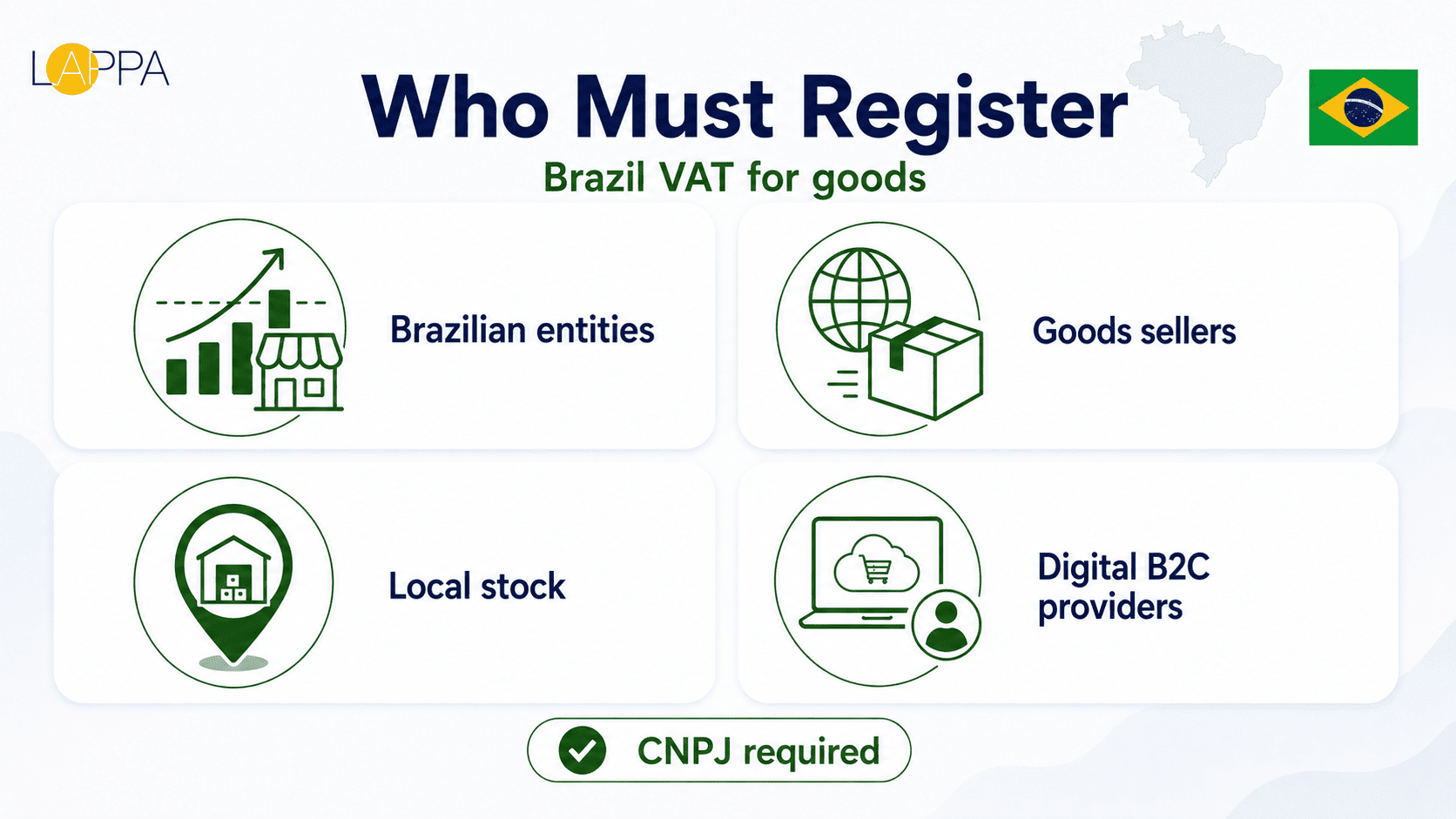 The following categories of businesses carry mandatory registration obligations under current rules as of June 2026. Meeting VAT Brazil compliance requirements is not optional — penalties apply from the first day of taxable activity.
- Brazilian-resident companies of any size engaged in manufacturing, trade, or service provision
- Foreign companies with a permanent establishment or subsidiary in Brazil
- Non-resident digital platforms and marketplaces with B2C revenue exceeding BRL 120,000 per year
- Non-resident platforms operating under the Programa de Estímulo à Conformidade Tributária (Confia) framework that process Brazilian card payments
- Marketplace operators deemed liable for seller compliance under Receita Federal guidance issued in 2024
- Companies participating in the CBS/IBS pilot program in designated sectors
VAT Number Brazil
Brazil VAT Number Format
Brazil does not have a dedicated VAT number Brazil system in the European sense. Tax identity is established through the CNPJ for legal entities and the CPF for individuals — both issued by the Receita Federal do Brasil. When foreign investors or compliance teams ask for the vat number Brazil equivalent, the CNPJ is the correct answer in almost every practical scenario.| Identifier | Who It Applies To | Format | Function |
| CNPJ (Cadastro Nacional da Pessoa Jurídica) | All legal entities (resident and non-resident) | XX.XXX.XXX/XXXX-XX (14 digits) | Primary business tax ID; used on all invoices and filings |
| CPF (Cadastro de Pessoas Físicas) | Individual taxpayers | XXX.XXX.XXX-XX (11 digits) | Individual income and consumption tax ID |
| IE (Inscrição Estadual) | ICMS-registered entities | Varies by state (8–14 digits) | State-level tax registration for goods trade |
| IM (Inscrição Municipal) | ISS-liable service providers | Municipal format | Municipal tax registration for service providers |
VAT Registration Number Brasil — Federal and State IDs
The VAT registration number Brasil equivalent at the federal level is the CNPJ. At the state level, the Inscrição Estadual (IE) serves as the state-specific VAT registration number Brasil identifier for ICMS purposes. Both numbers must appear on NF-e invoices and relevant import and export documentation. Unlike EU VAT numbers, Brazilian tax identifiers are not validated through a single public API. Verifying a CNPJ requires querying the Receita Federal's public lookup tool directly, while IE validation must be done through individual state SEFAZ portals. Brazilian VAT numbers assigned to branches carry the same root 8-digit CNPJ prefix, with a unique 4-digit branch code in the ninth through twelfth positions.Company VAT registration number Brasil and Business Identifiers
Understanding which identifier functions as the company VAT registration number depends on the tax being analysed. For federal purposes — IPI, PIS, COFINS, and the new CBS — the CNPJ is the sole company VAT registration number required on all documentation. For state ICMS, a separate IE number must accompany every invoice involving goods. A company operating across multiple Brazilian states may need a distinct IE in each state where it maintains a physical presence or warehousing operation, even if it holds only a single CNPJ. This multiplied identifier structure is one of the most common compliance gaps for foreign companies entering the market.| Tax Scope | Relevant Identifier | Issued by | Mandatory on Invoice |
| Federal (IPI, PIS/COFINS, CBS) | CNPJ | Receita Federal | Yes — all NF-e |
| State ICMS | IE (Inscrição Estadual) | State SEFAZ | Yes — goods NF-e |
| Municipal ISS | IM (Inscrição Municipal) | City Secretaria de Finanças | Yes — NFS-e |
| Digital services (non-resident) | CNPJ (simplified regime) | Receita Federal | Yes — NFS-e Nacional |
VAT Registration Procedure in Brazil
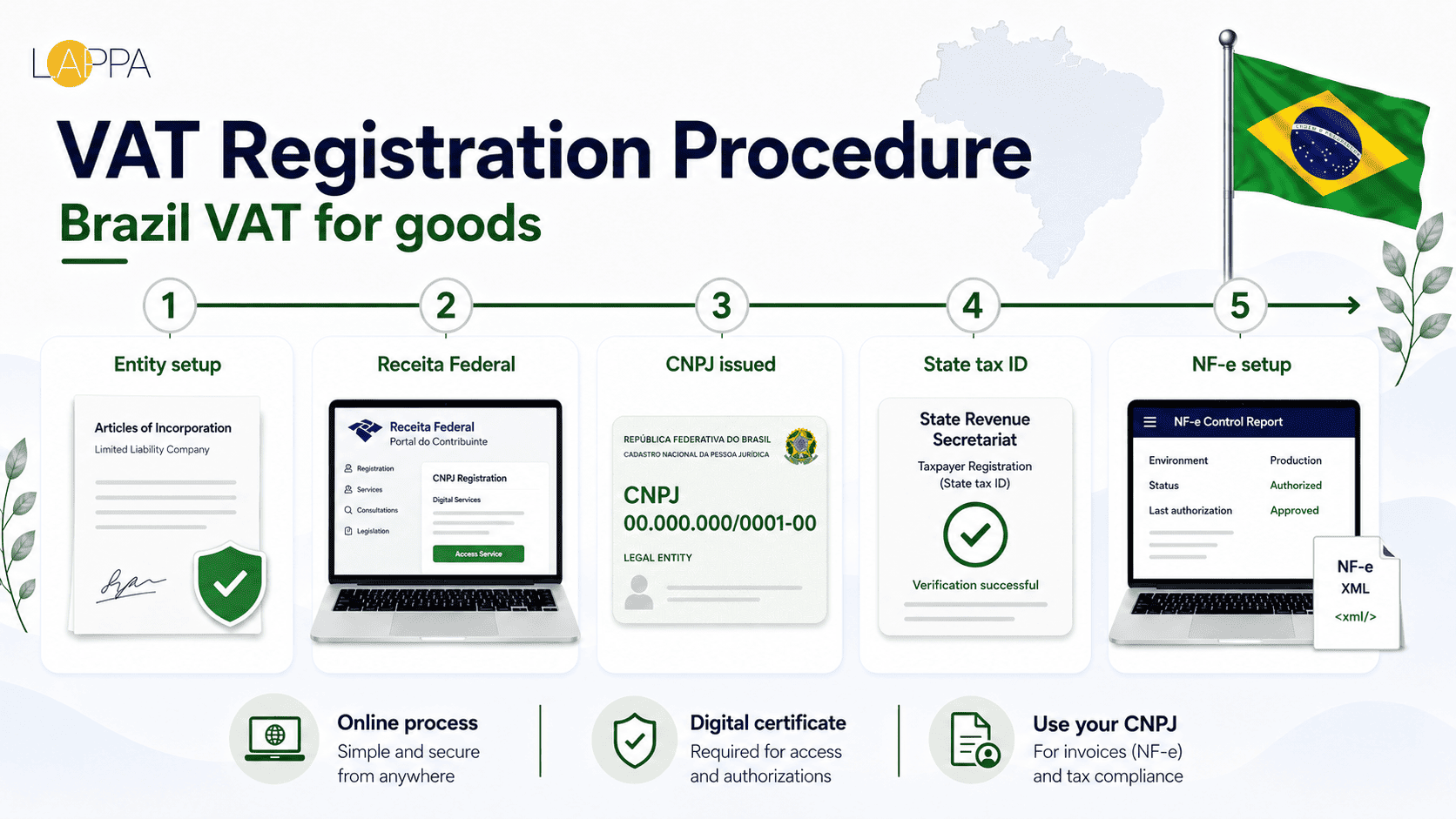 The process for obtaining a company's VAT registration numbers in Brazil runs in parallel across federal, state, and municipal authorities. The following sequence applies to a foreign company establishing operations or registering under the non-resident digital services regime:
- Federal CNPJ registration via the Receita Federal's Portal Único das Empresas (REI). Non-resident entities applying under the simplified digital services regime submit a reduced document set. Required items include articles of association, representative identity documents, and proof of foreign incorporation with apostille.
- State IE registration through the relevant SEFAZ portal if the business involves goods subject to ICMS. Each state maintains its own registration interface — São Paulo, Minas Gerais, and Rio de Janeiro each have distinct document requirements and processing timelines.
- Municipal IM registration at the local Secretaria de Finanças for service providers subject to ISS. In São Paulo, this is completed via the NFS-e portal integrated with the national NFS-e Nacional system.
- Digital certificate (e-CNPJ) from an ICP-Brasil-accredited certifying authority. This certificate is mandatory for issuing NF-e invoices electronically and for accessing the e-CAC portal of the Receita Federal.
- NF-e issuer credentials activated in SEFAZ's production environment, either through ERP-integrated certified software or a licensed NF-e service provider.
Tax Representative in Brazil
Foreign companies without a local legal entity are required to appoint a Brazilian-resident tax representative (representante legal) to interact with the Receita Federal and state and municipal authorities. This representative must hold a valid CPF, be domiciled in Brazil, and hold notarized power of attorney covering all tax matters. Unlike simplified fiscal agent arrangements available in certain European countries, Brazil's representative model places direct compliance responsibility — and in some cases joint liability — on the appointed individual or firm. For companies registered under the non-resident digital services regime, the representative handles monthly DCTF submissions, NFS-e issuance oversight, and correspondence with tax authorities. They are also responsible for maintaining the active status of the VAT registration number Brasil held by the foreign entity — suspension of a CNPJ by the Receita Federal for non-compliance blocks all imports, card payment processing, and invoice issuance in Brazil until the issue is resolved. Failure to appoint a representative at all, or appointing one who lacks the relevant authority, is treated as a structural compliance failure and can trigger penalties equivalent to those applied for late registration. Selecting a representative with sector-specific experience in indirect taxes is strongly advisable.VAT E-Invoices in Brazil
Brazil's e-invoicing infrastructure is among the most mature worldwide. Every invoice must be issued electronically in XML format, digitally signed with an e-CNPJ certificate, and authorised by the relevant SEFAZ before it reaches the recipient. Four primary document types cover the full range of taxable transactions:- NF-e (Nota Fiscal Eletrônica) — for goods transactions; mandatory since 2010 for virtually all trading companies
- NFS-e (Nota Fiscal de Serviços Eletrônica) — for services subject to ISS; issued via the NFS-e Nacional platform since 2023
- NFC-e (Nota Fiscal de Consumidor Eletrônica) — for B2C retail point-of-sale transactions
- CT-e (Conhecimento de Transporte Eletrônico) — for transport and logistics services
| Business Size (Annual Revenue) | NF-e Mandate | NFS-e Mandate | NFC-e Requirement |
| Below BRL 360,000 (MEI / Simples micro) | Voluntary or simplified | Municipal rules apply | Optional in most states |
| BRL 360,000 – BRL 4.8 million (Simples Nacional) | Mandatory | Mandatory in major municipalities | Mandatory for retail (most states) |
| Above BRL 4.8 million (Lucro Presumido / Lucro Real) | Mandatory | Mandatory | Mandatory |
| Non-resident (digital services regime) | Not applicable | Mandatory — NFS-e Nacional | Not applicable |
VAT Returns in Brazil
Brazil has no single consolidated indirect tax return. Businesses must file multiple electronic submissions each month across different systems. Key reporting obligations include:- EFD-ICMS/IPI (SPED Fiscal) — monthly structured XML file submitted to SEFAZ, containing all NF-e data, ICMS and IPI debits and credits, and inventory movements. This is Brazil's functional equivalent of a VAT control report or SAF-T/JPK file.
- EFD-Contribuições — monthly file covering PIS and COFINS credits and debits at the federal level.
- DCTF (Declaração de Débitos e Créditos Tributários Federais) — monthly declaration of all federal tax obligations, including PIS, COFINS, and IPI balances.
- GIA (Guia de Informação e Apuração do ICMS) — monthly state-level ICMS return; format and deadline vary by state.
- PGDAS-D — simplified monthly return for companies in the Simples Nacional regime, covering all applicable taxes in a single calculation.
Deductible VAT in Brazil
Brazil operates a credit-offset mechanism for most indirect taxes. The constitutional principle of não-cumulatividade (non-cumulativity) prevents cascading taxation by allowing businesses to deduct input tax credits from output tax liabilities. The rules differ substantially between tax types. For ICMS, companies can credit tax paid on purchases of goods for resale or raw materials used in production. The practical problem is that interstate rate differentials create structural credit mismatches — a purchase from a 7%-rate state generates a smaller credit than the rate at which the sale is taxed in a higher-rate state. Exporters accumulate unreimbursed ICMS credits over time because exports are exempt, yet input credits continue to build. What does VAT tax in Brazil mean for input recovery under PIS/COFINS? Under the Lucro Real regime, non-cumulative PIS/COFINS at 9.25% allows credits on a broad input base including services, energy, and fixed-asset depreciation. Under Simples Nacional or Lucro Presumido, PIS/COFINS is cumulative at 3.65% with no input credit mechanism at all. IPI follows similar non-cumulative principles but is limited to industrialized goods. ISS does not carry any credit mechanism.VAT Record-Keeping Requirements in Brazil
Brazil's VAT taxation rules impose strict document retention obligations across all tax levels. Key requirements include:- All NF-e and NFS-e XML files must be retained for a minimum of 5 years — the general tax statute of limitations under the CTN (Código Tributário Nacional). SEFAZ retains its own copies, but companies are independently responsible for maintaining their own records.
- SPED fiscal files (EFD-ICMS/IPI, EFD-Contribuições) must be preserved for 5 years from the date of submission.
- Import documentation — including DI (Import Declaration), LI (Import Licence), and Comprovante de Importação — must be retained for 5 years.
- Commercial books and accounting records are subject to a 10-year retention period under commercial law (Lei das Sociedades Anônimas and Código Civil).
- Transfer pricing documentation and intercompany agreements carry special retention rules under the updated TP framework (Law 14,596/2023), applicable from tax year 2024.
VAT Penalties in Brazil
The Brazilian penalty regime for indirect tax violations is substantial and operates on both a financial and a structural level. Late payment carries a 0.33% daily penalty up to a cap of 20%, plus interest at the SELIC rate (currently 10.5% per annum as of June 2026). Procedural penalties for late or incorrect EFD-ICMS/IPI SPED filings range from BRL 500 per month for small companies to 3% of the total transaction value for omitted or inaccurate records, with no upper limit in cases of deliberate fraud. Foreign sellers who fail to meet their VAT Brazil obligations for digital services PIS/COFINS face penalties of up to 75% of the unpaid tax, plus applicable interest. Card acquirers and payment processors can be designated as substitutos tributários — meaning Brazilian payment gateways may withhold taxes at source directly from non-compliant foreign sellers' settlements. Challenging a penalty assessment through the Conselho Administrativo de Recursos Fiscais (CARF) is possible but slow — proceedings typically run 3 to 5 years. Since the 2023 reform, a guarantee deposit of 30% of the disputed amount is required to maintain an active appeal, tying up significant working capital for the duration of the dispute.How Lappa Can Help with VAT Compliance in Brazil
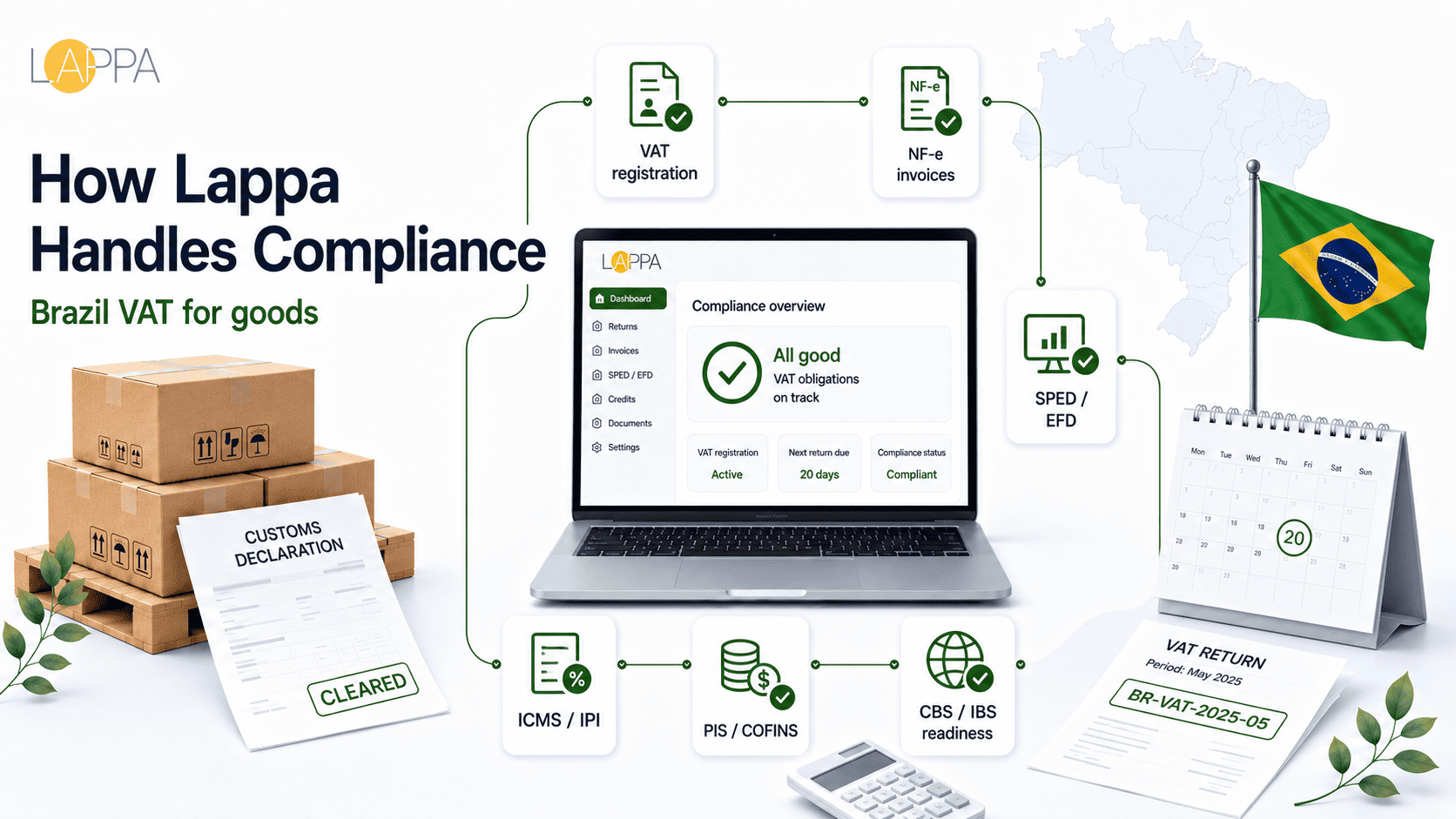 Brazil's indirect tax complexity — spanning multiple authorities, real-time e-invoicing mandates, and a decade-long reform transition — demands specialist support. Lappa provides end-to-end compliance services for international companies entering the Brazilian market, from initial CNPJ registration through monthly SPED filing, audit defence, and CBS/IBS transition advisory.
Our service scope covers state IE and municipal IM setup, appointment of tax representatives for non-resident entities, NF-e and NFS-e technical integration, and EFD-Contribuições reconciliation. We work with large multinationals and growth-stage e-commerce businesses alike.
Companies that need a properly maintained company VAT registration number — together with all supporting state and municipal identifiers — can engage Lappa as a single point of accountability for their full Brazilian indirect tax footprint. The company VAT registration number process, combined with ongoing compliance, is delivered as a managed service with transparent monthly reporting.
Brazil's indirect tax complexity — spanning multiple authorities, real-time e-invoicing mandates, and a decade-long reform transition — demands specialist support. Lappa provides end-to-end compliance services for international companies entering the Brazilian market, from initial CNPJ registration through monthly SPED filing, audit defence, and CBS/IBS transition advisory.
Our service scope covers state IE and municipal IM setup, appointment of tax representatives for non-resident entities, NF-e and NFS-e technical integration, and EFD-Contribuições reconciliation. We work with large multinationals and growth-stage e-commerce businesses alike.
Companies that need a properly maintained company VAT registration number — together with all supporting state and municipal identifiers — can engage Lappa as a single point of accountability for their full Brazilian indirect tax footprint. The company VAT registration number process, combined with ongoing compliance, is delivered as a managed service with transparent monthly reporting.
FAQ for Brazil VAT Goods
What is the VAT rate in Brazil There is no single unified VAT rate in Brazil — instead, the system layers several taxes that collectively function as a consumption tax. ICMS (the main state-level goods tax) ranges from 7% to 25% depending on the product and the state. At the federal level, PIS and COFINS apply at a combined rate of 9.25% under the non-cumulative regime or 3.65% under the cumulative regime, while IPI varies from 0% to over 300% for certain manufactured goods. For non-resident digital service providers selling B2C, the total effective tax burden typically falls between 9% and 16% once all applicable levies are stacked. The CBS and IBS transitional taxes introduced during the 2026 pilot phase carry nominal rates of 0.9% and 0.1% respectively, rising progressively through 2033. Who needs to register for VAT in Brazil Any Brazilian-resident legal entity engaged in manufacturing, trade, or service provision is automatically registered for indirect taxes upon incorporation through the CNPJ process. Foreign companies without a local subsidiary must register if their Brazilian B2C revenue from digital services exceeds BRL 120,000 per year, or if they sell physical goods commercially into Brazil regardless of value. Marketplace platforms are increasingly treated as liable for seller tax compliance under Receita Federal guidance first issued in 2024 and since expanded in scope. As the CBS/IBS reform progresses, registration obligations for non-resident businesses are expected to broaden further by 2027, making proactive planning advisable for companies currently below existing thresholds. What is the company vat registration number in Brazil The Brazil VAT number equivalent for legal entities is the CNPJ, formatted as XX.XXX.XXX/XXXX-XX — a 14-digit identifier that includes a 4-digit branch code. Individual taxpayers use the CPF (XXX.XXX.XXX-XX, 11 digits). For goods trade, the Inscrição Estadual (IE) is the state-level registration number, and its format varies by state — São Paulo uses 12 digits while other states may use between 8 and 14. Unlike EU VAT numbers, the Brazil VAT number equivalents are not centrally verifiable through a single pan-national API; the CNPJ must be checked via the Receita Federal lookup tool, and the IE via the relevant state SEFAZ portal. How often are VAT returns filed in Brazil Most indirect tax filings in Brazil follow a monthly cycle. The EFD-ICMS/IPI (SPED Fiscal) must be submitted by the 15th of the month following the reporting period; EFD-Contribuições by the 10th; and the DCTF by the 15th. State-level GIA returns are also generally monthly, with deadlines varying by state. Companies in the Simples Nacional regime file the PGDAS-D monthly, which consolidates all applicable taxes in a single simplified calculation. Annual reconciliation filings — DEFIS for Simples Nacional companies and ECF (Escrituração Contábil Fiscal) for others — are also required, as is the new DCTF-Web module for the CBS pilot if a business falls within the applicable sector groups. Do foreign companies need a tax representative in Brazil Yes — any non-resident company registering for Brazilian indirect taxes, including the digital services PIS/COFINS regime and the Remessa Conforme import programme, must appoint a Brazilian-resident legal representative with notarized power of attorney. This representative is responsible for all tax filings, responses to Receita Federal correspondence, and maintaining the validity of VAT registration numbers in Brasil held by the foreign entity. The VAT registration numbers in Brasil can be suspended by the Receita Federal if the representative fails to file returns on time or if contact with the authority is not maintained — a suspension blocks imports, card payment processing, and all invoice issuance until the CNPJ is reinstated. Unlike simplified fiscal representation models available in EU countries, Brazil's framework can expose the representative to joint liability in cases of negligence or fraud.
VAT Standard rate
26.5%
VAT Reduced rate
0%, 40%, 60% and 100%
Thresholds
No VAT registration threshold