


Belgium VAT Compliance and Registration Guide
Provinces
Goods
Provinces
Goods
About
Goods
About
Goods
Goods
Goods
Introduction to VAT in Belgium
VAT in Belgium is governed by the Belgian VAT Code (Wet BTW / Code TVA — full title Wetboek van de Belasting over de Toegevoegde Waarde / Code de la Taxe sur la Valeur Ajoutée), which implements EU Directive 2006/112/EC into domestic law. This legislation covers all taxable transactions: goods supplies, services, intra-Community acquisitions, and imports. The federal authority responsible for administration is SPF Finances (Service Public Fédéral des Finances) in French, or FOD Financiën (Federale Overheidsdienst Financiën) in Dutch. Foreign businesses interact with this authority mainly through two systems: MyMinfin for registration and account management, Intervat for periodic return filing. For domestic companies, indirect taxation here operates on a standard self-assessment basis. For foreign entities — EU or non-EU — the obligations vary considerably. Supply type matters. Customer category (B2B or B2C) matters. Whether goods physically move through Belgian territory matters. Non-EU companies carry an additional statutory burden: mandatory fiscal representation, addressed in a dedicated section below. EU place of supply rules determine whether a given transaction falls within Belgian indirect tax jurisdiction. Goods sold to local consumers trigger this charge once sellers exceed applicable thresholds. Electronically supplied services are always taxed where the consumer sits — a Belgian customer means Belgian liability, regardless of seller location.VAT Rates in Belgium
Belgium applies four bands. The Belgium VAT rate structure follows EU parameters, with specific category assignments under domestic law.Standard and Reduced Belgium VAT Rate
The Belgium VAT rate stands at 21% for all goods and services not explicitly assigned to a lower band. Two reduced rates exist: 12% and 6%. Zero applies to specific cross-border transactions. The 12% band is narrow: certain food products (margarine is the standard example), specific coal-based products, restaurant meals excluding drinks, and phytopharmaceutical products. The 6% band is broader — food in general, medicines, books, hotel accommodation, renovation of residential buildings at least 10 years old. Zero covers exports outside the EU and intra-Community goods supplies to registered recipients in other member states.| Rate | Band | Typical Examples |
|---|---|---|
| 21% | Standard | Electronics, clothing, professional services, cloud software |
| 12% | Reduced | Restaurant meals (excl. drinks), margarine, phytopharmaceuticals |
| 6% | Reduced | Food, medicines, books, hotel stays, residential renovation |
| 0% | Zero | Exports, intra-EU goods supplies to registered businesses |
VAT Registration Threshold in Belgium
No single threshold figure covers every scenario. The relevant number depends on establishment status, supply type, and customer category.For Local Businesses
Belgian-established entities with annual turnover below €25,000 qualify for the small enterprise scheme (kleineondernemingsregeling / régime de la franchise de la taxe), which exempts them from charging the levy and filing periodic returns. The trade-off is a complete block on input tax recovery — purchases carry no recoverable credit. Once turnover crosses €25,000 in any calendar year, registration becomes mandatory from the transaction that breaks the threshold. No grace period applies. The small enterprise scheme is unavailable to non-resident foreign companies. Non-established entities face registration triggers based on separate rules, with no equivalent turnover relief.For Remote Sellers of Goods
Cross-border goods sales to local consumers fall under the EU-wide distance selling threshold of €10,000 — a combined figure across all EU member states, not per country. A seller in the United Kingdom with customers in Belgium, France, and the Netherlands adds all three markets to assess whether €10,000 has been crossed. Once it has, that seller must either register locally in each relevant EU state or use Union OSS. The indirect tax charge on supplies to Belgian consumers applies from the moment the combined threshold is exceeded — not from the start of the following year.For Remote Sellers of Digital Services
Electronically supplied services to EU consumers follow the same €10,000 combined pan-EU threshold. Services in scope: streaming subscriptions, cloud software, e-books, downloadable games, digital training content, and anything delivered electronically with minimal human intervention. Belgian customers receiving these services trigger local taxation at 21% once the threshold passes. OSS is the standard compliance route for cross-border digital sellers — one registration, one quarterly return covering all EU member states. Direct local registration remains available but adds administrative burden the OSS was designed to eliminate. Direct registration in Belgium makes practical sense where the country represents the dominant market or where other local obligations — imports, stock, B2B supplies — already exist and require a separate registration.Who Must Register for VAT in Belgium
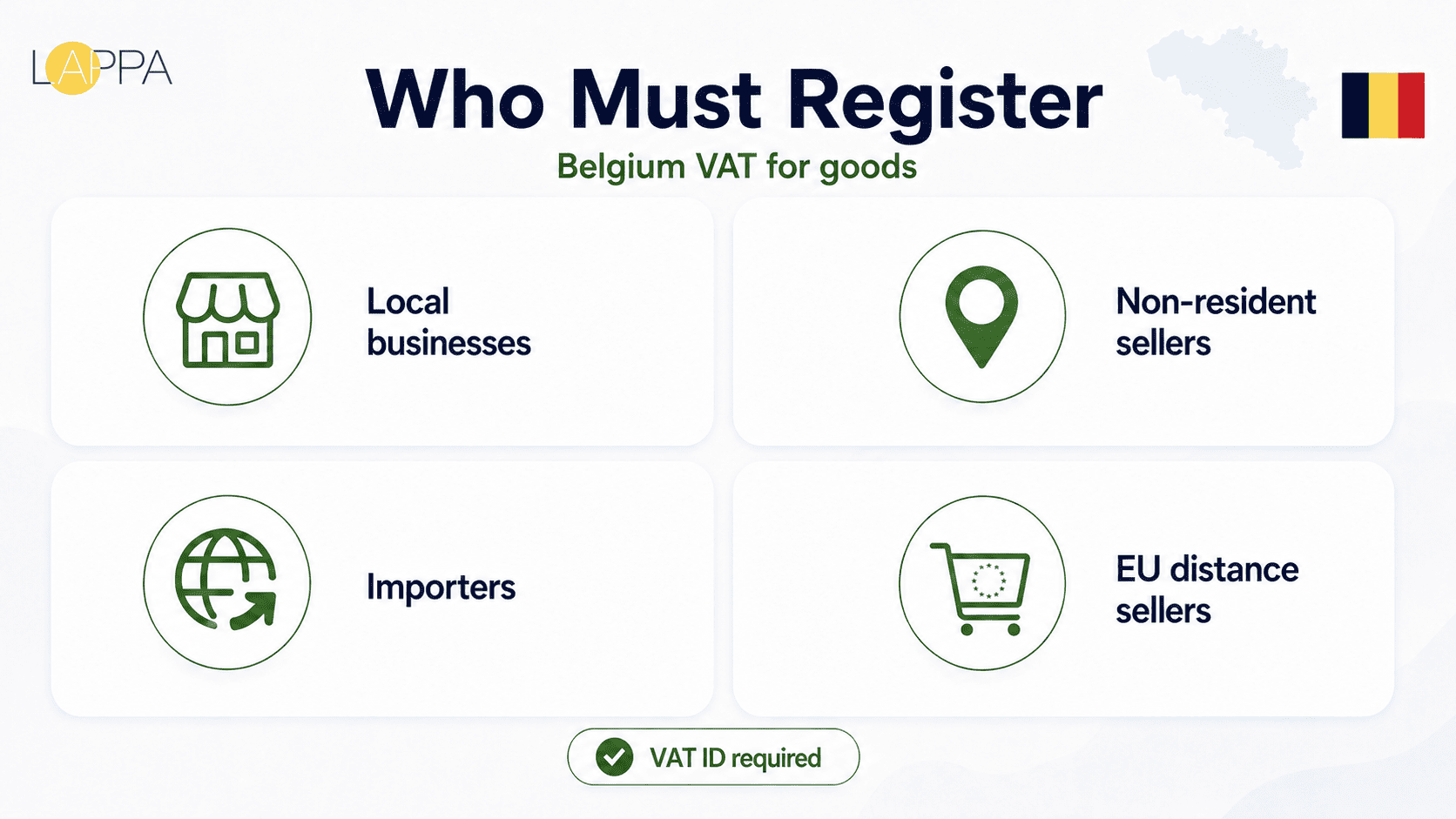 Mandatory registration covers the following categories:
- Belgian-established taxable persons with annual turnover above €25,000, or those opting out of the small enterprise scheme voluntarily.
- Non-established EU companies making taxable supplies in Belgium outside the reverse charge mechanism — B2C goods sales above threshold, local service supplies to private consumers, or specific transaction types that the customer cannot self-assess.
- Non-established non-EU companies conducting any taxable activity domestically, including importation through Belgian customs. Obligation attaches from the first taxable transaction.
- Marketplace sellers using Belgian fulfillment centres or third-party logistics warehouses on Belgian territory. Physical stock creates a local nexus regardless of where the seller is incorporated.
- OSS-registered businesses with Belgian obligations outside OSS scope — imports, B2B supplies, local goods sales. OSS covers B2C distance sales only; mixed-activity businesses often need both OSS and a direct domestic registration simultaneously.
| Criterion | Belgian-Established | EU-Established, Non-Resident | Non-EU Established |
|---|---|---|---|
| Registration threshold | €25,000 (small enterprise scheme) | No threshold for direct local supplies | No threshold; first taxable supply triggers obligation |
| Fiscal representative | Not required | Not required | Mandatory by statute |
| Voluntary fiscal agent | N/A | Permitted | Permitted alongside mandatory representative |
| OSS eligibility | No | Yes | Yes |
| Bank guarantee | No | No | Yes (via fiscal representative) |
VAT Number in Belgium
Format and Structure
Every registered taxable person receives a VAT Number Belgium issued by SPF Finances. Format: country prefix "BE" followed by exactly 10 digits — for example, BE0123456789. For Belgian legal entities, the VAT Number Belgium is not an independently generated reference. It derives directly from the company's enterprise number in the Crossroads Bank for Enterprises (CBE / BCE — Banque-Carrefour des Entreprises / Kruispuntbank van Ondernemingen). A company registered under CBE number 0123.456.789 holds Belgium VAT number BE0123456789 — the "BE0" prefix is added, and otherwise the numbers are identical. This linkage applies only to Belgian-incorporated entities. Foreign businesses registered here receive a BE-format identifier without any corresponding CBE enterprise entry.Usage of the VAT Registration Number Belgium
The VAT registration number Belgium must appear on every invoice issued, on periodic returns, EC sales lists, Intrastat declarations, and in all official correspondence with SPF Finances. Belgian commercial law also requires it on company letterheads and websites. For intra-Community transactions — zero-rated goods supplies, B2B services under reverse charge — verifying counterparty numbers before transacting is standard due diligence. The EU VIES system (VAT Information Exchange System) at ec.europa.eu/taxation_customs/vies confirms whether any given Belgium VAT number is currently active and linked to a registered taxable person. Checking a counterparty's VAT number in Belgium before intra-EU transactions is a routine compliance step.VAT Registration Procedure in Belgium
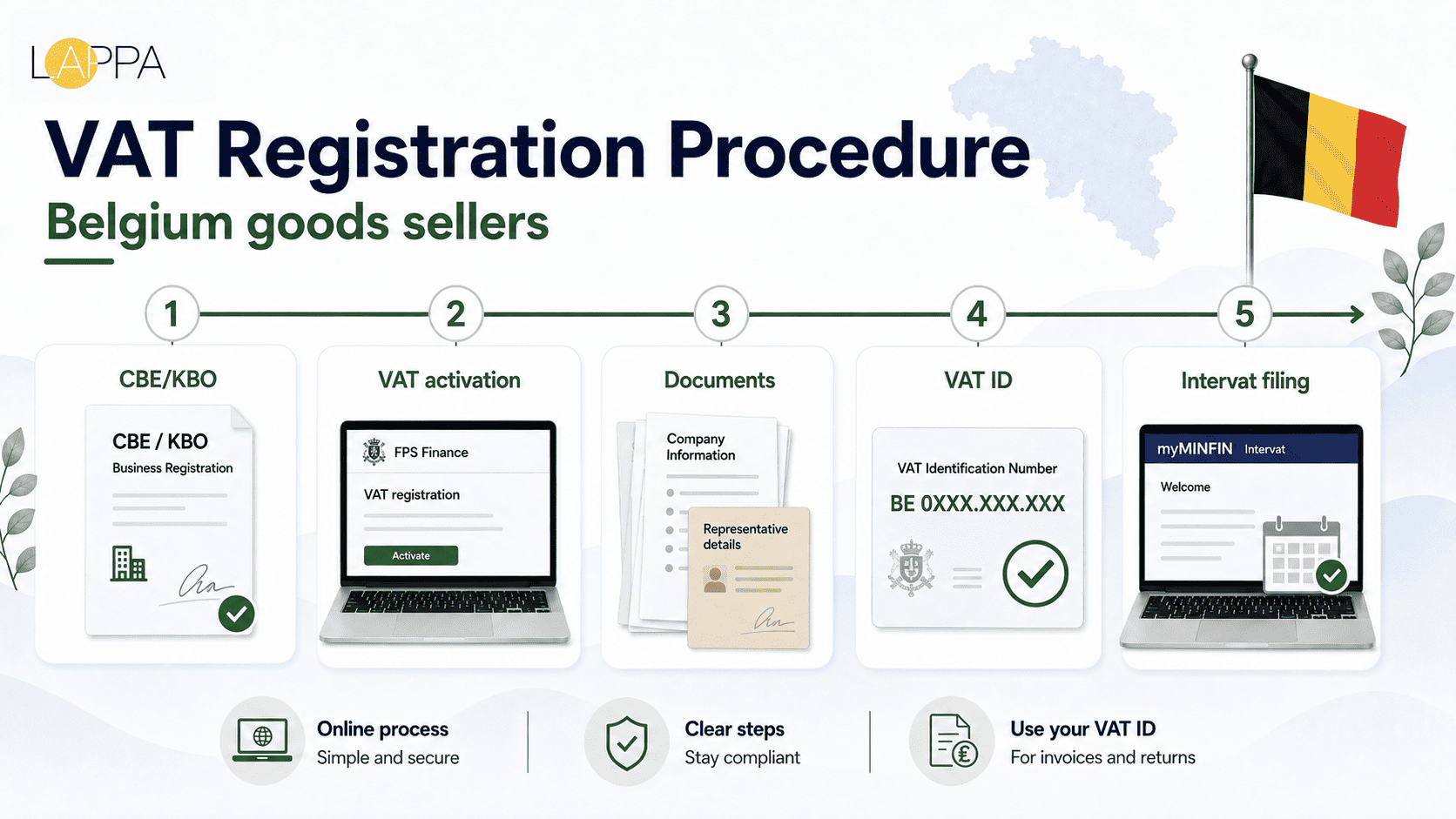
Step-by-Step Process
- Assess the obligation first. Establish clearly why registration is required: goods sales, digital services, imports, Belgian stock? Does OSS cover the activity, or is direct registration needed? Getting this right upfront avoids filing under the wrong category.
- Appoint a fiscal representative before anything else (non-EU only). SPF Finances will not process any application from a non-EU entity that has not yet arranged its representative. This step precedes everything — not in parallel, not after submission.
- Submit Form 604A. The commencement form for new taxable activity. Filed electronically via MyMinfin or by paper to the competent local office. EU companies file directly; non-EU companies file through their representative.
- Completed Form 604A (or electronic equivalent via MyMinfin)
- Certificate of incorporation from the home country — apostilled or notarised as required
- Proof of the company's registered address in its home jurisdiction
- Description of the taxable activities: what is being supplied, to whom, in what form
- Sample invoice, contract, or purchase order evidencing a local supply
- For non-EU companies: signed mandate from the representative and documentary proof of bank guarantee
- Power of attorney if a third party handles the application
Tax Representative in Belgium
Mandatory Requirement for Non-EU Companies
Any company established outside the European Union with Belgian taxable obligations must appoint a fiscal representative. Not optional — mandatory by statute. The representative must be a Belgian-incorporated legal entity accredited by SPF Finances. The size of the Belgian operation is irrelevant. A small US-based e-commerce seller importing goods through Antwerp needs one. A Singapore-headquartered SaaS company that opted for direct local registration instead of OSS needs one. No non-EU company is exempt.Liability and Bank Guarantee
The fiscal representative assumes joint and several liability for all Belgian indirect tax obligations of the foreign company it represents. SPF Finances can pursue the representative directly for unpaid amounts, interest, and penalties — without first exhausting remedies against the foreign entity. Given that exposure, every accredited representative requires a bank guarantee from clients. The guarantee is sized at three to six months of estimated local tax liability, reviewed periodically as the operation grows.Fiscal Agent for EU Companies
EU-established companies are not required to appoint any intermediary. They may engage a fiscal agent (mandataire fiscal / fiscaal mandataris) to handle return filing and correspondence on their behalf. Unlike a fiscal representative, the agent carries no personal liability — they act as an administrative intermediary only. The EU company itself remains solely responsible. That contrast is the precise reason Belgian law imposes the mandatory representative requirement on non-EU companies specifically.VAT E-Invoices in Belgium
Mandatory B2B E-Invoicing from 2026
Belgium made structured B2B electronic invoicing compulsory from 1 January 2026 for all registered taxable persons — domestic and foreign. Any B2B transaction between two Belgian-registered parties must be invoiced in a machine-readable structured format. A PDF sent by email does not qualify. An XML file sent outside the correct network does not qualify either. The mandated standard is Peppol BIS Billing 3.0, transmitted via the Peppol network (Pan-European Public Procurement Online), conforming to European standard EN 16931. Both sender and receiver must be connected to the Peppol network. The invoice must be processable at the data level — not merely readable as a document.Implementation Timeline
Belgium adopted a single-date mandate. No phased rollout by company size, unlike France (2026–2027) or Germany.| Business Category | Must Send Structured Invoices | Must Receive Structured Invoices |
|---|---|---|
| Large enterprises | 1 January 2026 | 1 January 2026 |
| SMEs | 1 January 2026 | 1 January 2026 |
| Micro-enterprises | 1 January 2026 | 1 January 2026 |
Implications for Foreign Registrants
Foreign companies holding a local registration are within scope. A US-based company with a Belgian tax number invoicing a registered Belgian customer must transmit that invoice via Peppol in BIS Billing 3.0 format from 2026. The company's invoicing system — or that of its fiscal agent or representative — must be Peppol-enabled. Non-compliant invoices create risk on both sides: penalties for the issuer, and potential difficulties claiming input credit for the recipient.VAT Returns in Belgium
Filing Frequency and Deadlines
All registered entities file periodic returns through Intervat, SPF Finances' online portal.- Monthly filing is mandatory above €2.5 million annual turnover (inclusive), and optionally available to any entity below that threshold. Due date: 20th of the following month.
- Quarterly filing is the default below €2.5 million. Deadlines: 20 April, 20 July, 20 October, 20 January.
Annual Client Listing
Beyond periodic returns, every registered entity must file the annual Klantenlisting (Listing des assujettis à la TVA) — a list of all Belgian-registered customers to whom supplies were made during the calendar year. Deadline: 31 March of the following year. Any registered customer with total annual purchases of €250 or more must be included. Belgium has no SAF-T or JPK-equivalent file requirement. The annual client listing fills a comparable cross-checking function: SPF Finances matches declared output against what recipients claimed as input credit. Discrepancies across those datasets flag audit targets.EC Sales List and Intrastat
Businesses making intra-Community supplies to registered EU customers must file an EC Sales List (Intracommunautaire opgave) via Intervat — monthly for goods, quarterly for services. Significant intra-EU goods movements also trigger Intrastat statistical declarations; thresholds are revised annually and differ for arrivals and dispatches. Standard return forms: Form 825 for monthly filers, Form 826 for quarterly filers. Both capture output tax, input credit, net position, and intra-Community transaction data. SPF Finances cross-references these against the annual client listing, Intrastat, and EC Sales Lists — mismatches across those four data sources are a routine audit trigger.Deductible VAT in Belgium
Conditions for Input Credit Recovery
Registered taxable persons recover input tax as a matter of right, subject to three conditions simultaneously met: the purchase must serve a taxable business purpose; the supplier must have issued a valid invoice in the required format; and the charge must correspond to a genuinely taxable supply under domestic law. Two out of three does not suffice.Pro-Rata for Mixed Businesses
Where a company makes both taxable and exempt supplies — a financial firm offering fee-based advisory (taxable) alongside loan interest income (exempt) — input credit is deductible only in proportion to taxable turnover. The pro-rata equals taxable turnover divided by total turnover. During the year, a provisional ratio applies; at year end, the actual figures produce a definitive calculation, and an adjustment entry is required in the final periodic return.Blocked Input Categories
Certain categories are non-deductible by statute regardless of business purpose:- Mixed-use vehicles: input credit on car purchase, leasing, fuel, maintenance, and insurance is subject to a fixed 50% deduction cap where a vehicle is used partly privately. Belgian law sets this as a flat cap — demonstrating higher actual business use does not change it for most entities. Full credit applies only to vehicles genuinely 100% dedicated to business: taxis, driving school cars, rental fleet vehicles.
- Restaurant and entertainment: input on meals and client hospitality is blocked entirely.
- Private fuel: fuel for private journeys in company cars falls under the same 50% cap as the vehicle itself.
- Certain accommodation costs: hotel stays for business owners or directors may attract deduction limitations depending on specific circumstances.
VAT Record-Keeping Requirements in Belgium
Retention Periods
Minimum retention obligations under Belgian indirect tax law:- Standard records — invoices issued and received, filed returns, accounting journals: 7 years from the close of the relevant calendar year.
- Immovable property records — construction, renovation, and real estate purchase documents: 15 years from first use, matching the revision period applicable to property-related input credit.
- Structured e-invoices from 2026: Peppol XML files must be retained in their original structured format. Converting to PDF for archiving and deleting the XML does not satisfy the obligation.
What Must Be Kept
- All sales invoices, credit notes, and debit notes issued
- All purchase invoices and supplier credit notes received
- Import and export documents: customs declarations (SAD), proof of export, CMR notes, airway bills
- General ledger, purchase journal, sales journal, reconciliation workings
- All periodic returns submitted via Intervat
- Correspondence with SPF Finances — rulings, audit letters, registration decisions
Format and Accessibility
Paper or electronic format is acceptable, provided records remain readable, accessible, and unaltered throughout the retention period. SPF Finances may demand production during an audit — storage in a decommissioned or inaccessible system is not a valid reason for non-production. E-invoices from 2026 carry the additional obligation to retain the XML itself, not only a visual representation of it.VAT Penalties in Belgium
Non-compliance triggers a structured penalty framework:- Late filing of periodic returns: administrative fines starting at €100 per return for a first occurrence, rising to €1,000 per return for repeated lateness. Systematic late filing is treated as a systemic compliance failure and typically draws closer scrutiny from SPF Finances.
- Late payment: interest at 0.8% per month on outstanding amounts from the day after the due date, compounding monthly. A €100,000 liability paid four months late accrues roughly €3,200 in interest alone before administrative penalties are added.
- Errors and understatements: where SPF Finances identifies a shortfall resulting from genuine error rather than deliberate evasion, proportionate fines apply based on the underpaid amount. Errors self-corrected before audit attract reduced treatment. Voluntary disclosure is consistently preferable to discovery.
- Fraud and deliberate evasion: falsified invoices, suppressed sales, fabricated input claims — fines up to 200% of the evaded amount apply alongside principal tax and compounded interest. Criminal referral is available in severe cases.
- Failure to register: operating on Belgian territory without registration triggers penalties calculated on the tax that should have been collected throughout the unregistered period, plus administrative fines. Voluntary late registration before SPF Finances makes contact receives better treatment than registration prompted by audit.
- E-invoicing non-compliance from 2026: specific penalties for failure to issue or receive compliant Peppol-format invoices were being finalised at the time of writing. Enforcement is expected to escalate progressively through 2026.
How Lappa Can Help with VAT Compliance in Belgium
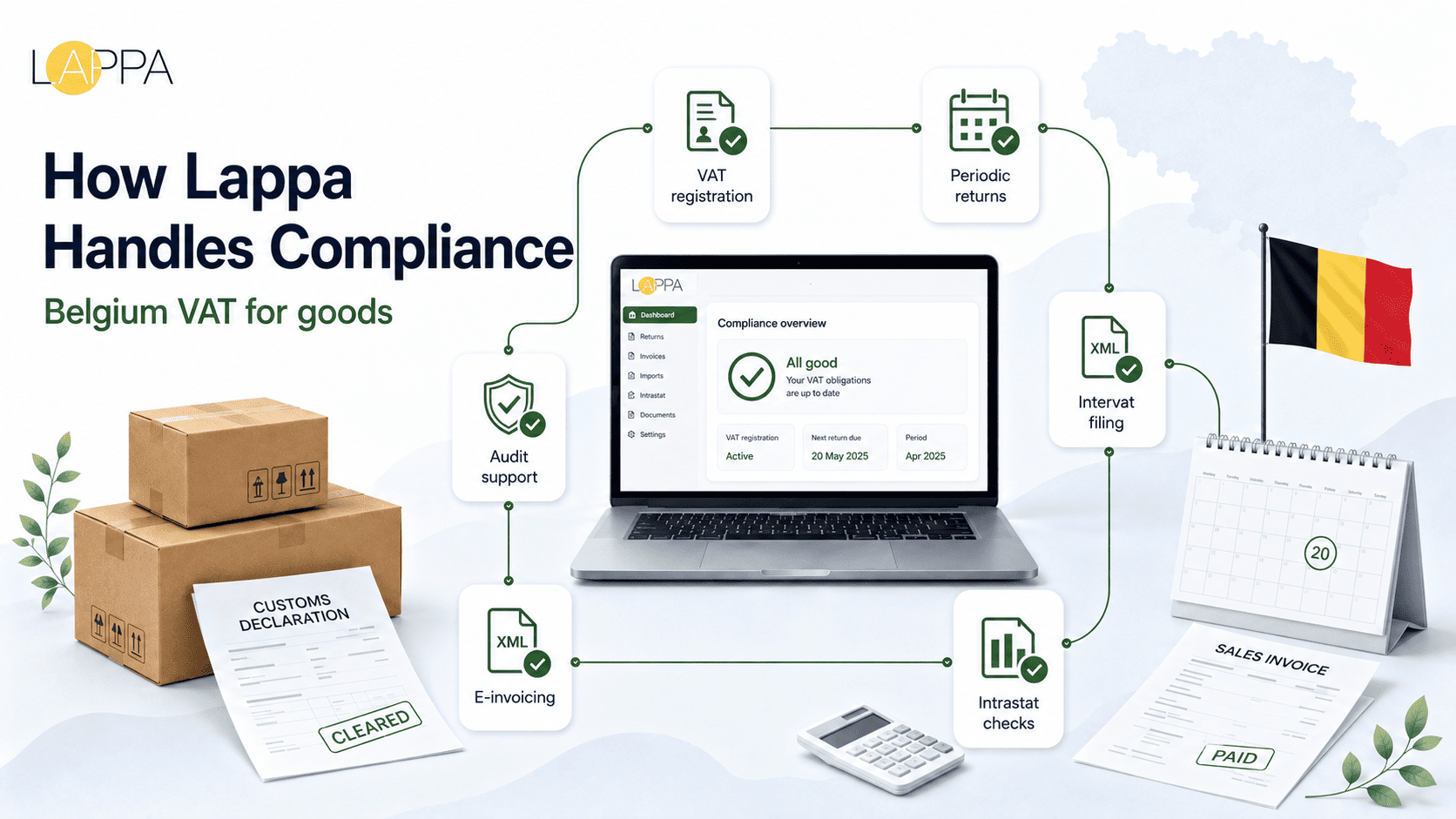 Lappa (formerly Lovat) provides indirect tax compliance services for foreign businesses operating in Belgium and across the EU. Services available:
- VAT registration in Belgium: preparation of Form 604A and supporting documentation for EU and non-EU companies, submission to SPF Finances, and follow-through on authority queries.
- Fiscal representation: for non-EU companies requiring an accredited Belgian fiscal representative, Lappa arranges or directly provides the service, including bank guarantee coordination.
- Return preparation and filing: periodic returns prepared, reviewed, and submitted via Intervat — monthly and quarterly cycles, plus the annual client listing due each 31 March.
- OSS compliance: registration and ongoing management of Union OSS declarations for businesses selling goods or digital services B2C across multiple EU states, including Belgium.
- E-invoicing readiness: gap analysis of existing invoicing infrastructure against Peppol BIS Billing 3.0 requirements and implementation support for foreign registrants preparing for the 2026 B2B mandate.
- Indirect tax advisory: analysis of specific questions — place of supply determination, input credit eligibility on mixed-use purchases, intra-Community transaction structuring, import tax optimisation.
VAT Standard rate
21%
VAT Reduced rate
6%, 12%, 0%
Thresholds
€25,000 (small business exemption for resident businesses); €0 (non-resident businesses); €10,000 EU OSS threshold for cross-border B2C sales