


Australia VAT Registration and Compliance Guide
The local name for VAT: Goods and Services Tax (GST)
Provinces
Goods
Provinces
Goods
About
Goods
About
Goods
Goods
Goods
Introduction to the GST Framework
Short answer: yes, under a different name. Australia calls it GST — Goods and Services Tax. It launched on 1 July 2000 under the A New Tax System (Goods and Services Tax) Act 1999, replacing a patchwork of state and federal consumption taxes. Functionally, VAT in Australia operates through this GST framework with nearly identical mechanics to European VAT — businesses charge tax on sales, recover tax on purchases, and remit the net difference to the tax office periodically. The Australian Taxation Office (ATO) administers the whole thing. Registration runs through the Australian Business Register. The identifier used for GST and every other business tax purpose is the ABN — Australian Business Number.Whether you does Australia have VAT questions as a new market entrant or as an established importer, the answer begins here. One rate. No reduced tiers. That's the structural simplicity that Australia chose. The relief mechanism works differently from Europe: instead of reducing the rate on food or medicine, Australia classifies those supplies as "GST-free." The supplier charges 0% but keeps full input credit rights — functionally identical to zero-rating but described differently. Residential accommodation and financial services sit in a separate "input-taxed" bucket where no GST is charged and no input tax recovery is available. Getting those distinctions right is where the real compliance work lives. Australia VAT obligations vary considerably depending on whether you're a domestic manufacturer, a foreign retailer shipping goods directly to Australian consumers, or a platform collecting on behalf of third-party sellers. The single 10% rate masks a classification exercise that catches businesses off guard routinely.Australia VAT Rate — the 10 Per Cent GST Standard
Ten percent. Flat. Unchanged since July 2000. The australia vat rate is the same whether you're selling machinery to a Brisbane manufacturer or novelty socks to a consumer in Perth. No reduced domestic rate for food, medicine, or essential goods — that's the key structural difference from most comparable economies. Australia handles essentials through classification rather than rate variation. Fresh food: GST-free. Processed, packaged, or prepared food: generally taxable at 10%. The line between those categories has generated more ATO rulings and tax tribunal decisions than almost any other GST question. A bag of plain nuts is GST-free. The same nuts sold salted and packaged become taxable. The ATO food classification flowchart exists for a reason.| Supply type | GST treatment | Effective rate |
|---|---|---|
| Standard domestic goods | Taxable | 10% |
| Exported goods | GST-free | 0% — full input credits retained |
| Basic unprocessed food | GST-free | 0% — full input credits retained |
| Healthcare and education | GST-free | 0% — full input credits retained |
| Residential rent | Input-taxed | 0% — no input credits available |
| Financial services (most) | Input-taxed | 0% — no input credits available |
| Imported goods above AUD 1,000 | Taxable at border | 10% on customs value |
| Goods | GST status | Key condition |
|---|---|---|
| Manufactured goods — domestic sale | Taxable — 10% | Standard |
| Alcohol, confectionery, soft drinks | Taxable — 10% | Excluded from food GST-free provisions |
| Fresh unprocessed food | GST-free | ATO food classification criteria apply |
| Medical devices — qualifying | GST-free | Specific health goods definition required |
| Goods exported from Australia | GST-free | Must physically leave; export evidence required |
| Low-value imports under AUD 1,000 | Taxable — 10% | Vendor collection model since July 2018 |
VAT Calculator
Divide by 11. That's the GST extraction shortcut every Australian bookkeeper knows. It comes directly from the mathematics: GST at 10% represents exactly 1/11 of the GST-inclusive price. Faster than dividing by 1.10 and subtracting, and less prone to rounding error on mental calculations. Adding 10% to a net price: Net × 1.10 = GST-inclusive price. Difference = GST. Extracting GST from an inclusive price: Inclusive price ÷ 11 = GST amount. Inclusive price − GST = net.| Net price (AUD) | GST (AUD) | GST-inclusive price (AUD) |
|---|---|---|
| 100 | 10 | 110 |
| 750 | 75 | 825 |
| 5,000 | 500 | 5,500 |
| 20,000 | 2,000 | 22,000 |
| 200,000 — export | 0 | 200,000 |
Australia VAT Registration Threshold — Local and Foreign Business Rules
For Local Businesses
The registration threshold is AUD 75,000 in annual GST turnover. "GST turnover" means the gross value of taxable and GST-free supplies — net of GST, not the inclusive amount. Not-for-profits get a higher threshold of AUD 150,000. One category has no threshold at all: taxi drivers and rideshare operators must register regardless of earnings. The threshold works on a rolling 12-month basis, not a calendar year. If your turnover in any 12-month period has exceeded AUD 75,000, or you reasonably expect it to exceed AUD 75,000 in the next 12 months, registration is required. The "reasonable expectation" test catches businesses that sign a large contract and should register before the revenue arrives, not after. Voluntary registration below AUD 75,000 is straightforward — the ATO accepts applications from any entity carrying on an enterprise. Many small goods businesses register voluntarily because their corporate customers are GST-registered and want tax invoices with an ABN to claim input credits. A supplier without an ABN creates a document problem for the buyer.For Remote Sellers
Before July 2018, a foreign business shipping goods directly to Australian consumers only encountered GST at the border for high-value shipments. The ATO collected it there through standard customs clearance. Low-value packages sailed through untaxed. That changed. Now foreign retailers, electronic distribution platforms, and re-deliverers operating the vendor collection model must register for GST and charge 10% on sales of low-value goods — individual consignments at or below AUD 1,000 — to Australian consumers. The threshold for registration: AUD 75,000 in annual Australian consumer sales. Above that, you register and collect. The goods arrive in Australia having already had GST collected, which speeds customs clearance.For Remote Digital Services
Non-resident digital service providers — streaming platforms, app stores, software-as-a-service businesses — have been inside the Australian GST system since July 2017. The same AUD 75,000 threshold applies. But given how quickly digital revenues accumulate even from a moderate user base, treating that threshold as protective isn't realistic. A platform with 2,000 Australian subscribers at AUD 50 per month is already at AUD 1.2 million annually — well past the registration point.Who Must Register for VAT in Australia
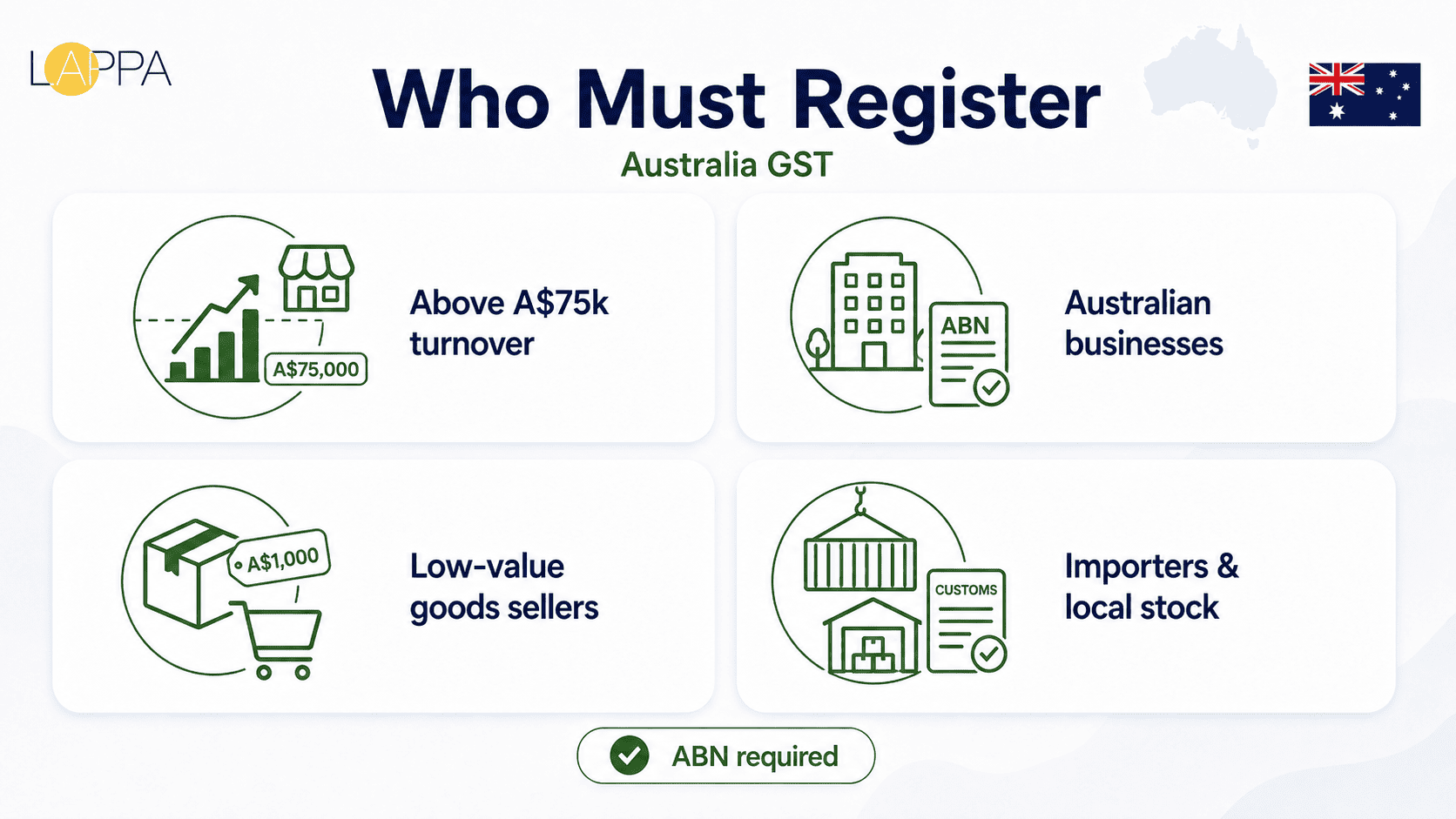 GST registration is mandatory for:
- Australian businesses with current or projected annual GST turnover at or above AUD 75,000
- Not-for-profit organisations with GST turnover at or above AUD 150,000
- Taxi drivers and rideshare operators — no turnover threshold applies
- Foreign retailers and platforms selling low-value goods (under AUD 1,000 per consignment) to Australian consumers at or above AUD 75,000 annually
- Foreign businesses supplying digital services to Australian consumers at or above AUD 75,000 in Australian annual revenue
- Businesses intending to claim fuel tax credits (registration activates both GST and fuel credit entitlements)
VAT Number in Australia — ABN Format and Structure
No separate VAT number exists. The identifier used for GST — and income tax, customs, payroll, and everything else — is the ABN. That's the VAT number in Australia functionally. Eleven digits, displayed in groups: XX XXX XXX XXX. For companies, the ABN derives from the nine-digit Australian Company Number (ACN). The ATO applies a two-digit prefix calculated by a specific algorithm — which is why you can sometimes reverse-engineer an ACN from an ABN. For sole traders, partnerships, trusts, and foreign entities, ABNs are assigned directly without an ACN base. What the ABN does beyond GST identification:- A supplier without an ABN quoted on an invoice may have 47% withheld from payments under the PAYG withholding rules — a significant commercial incentive to obtain one
- The ABN signals GST registration status to buyers checking the ABN Lookup tool
- It appears on all tax invoices — a valid tax invoice must show the supplier's ABN
- Customs import entries reference the importer's ABN
VAT Registration Procedure in Australia
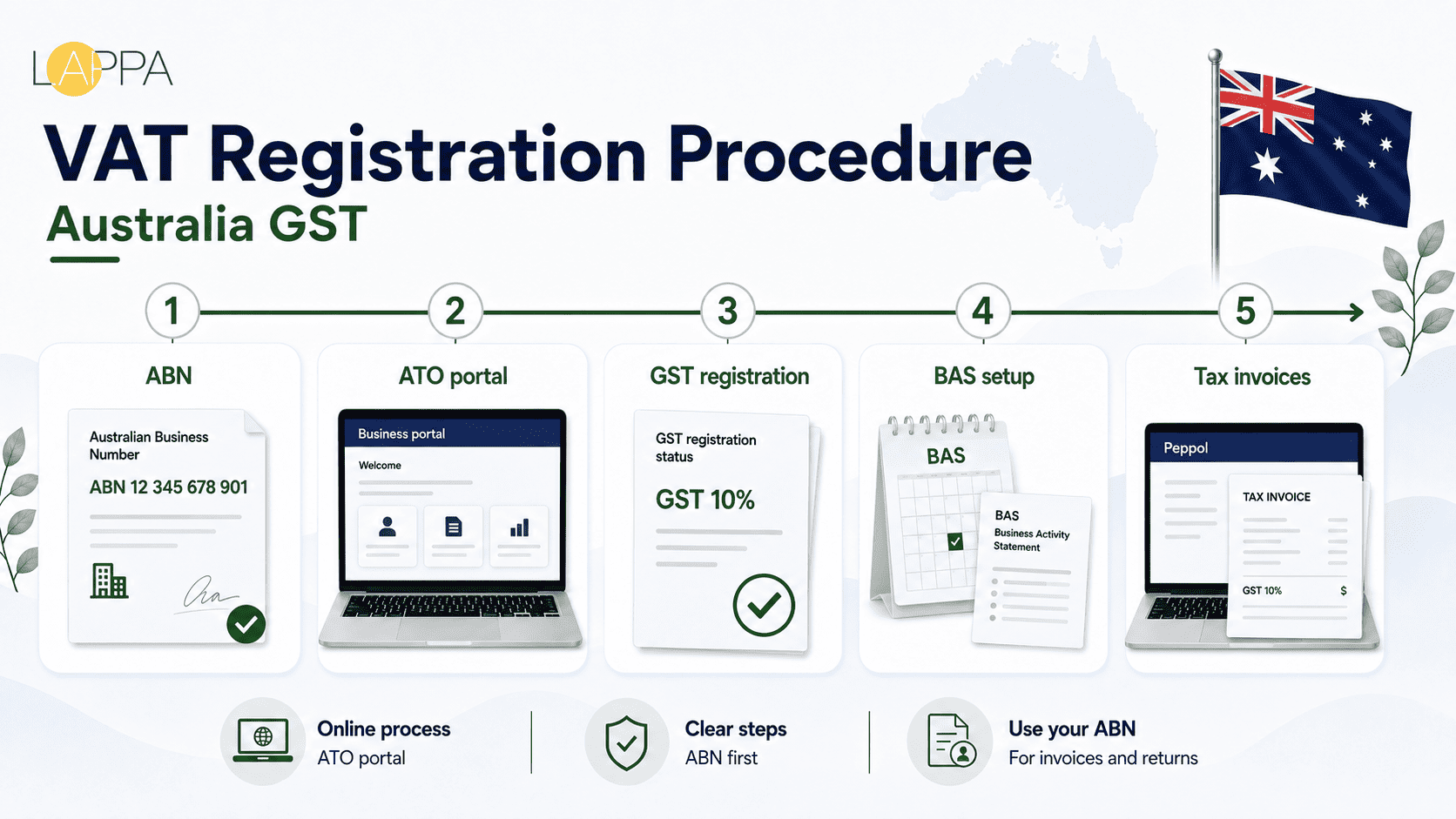 For resident businesses, the registration process is one of the simpler ones you'll encounter in any country. The ABR's online system at abr.gov.au handles both ABN application and GST registration in a single flow.
Steps:
For resident businesses, the registration process is one of the simpler ones you'll encounter in any country. The ABR's online system at abr.gov.au handles both ABN application and GST registration in a single flow.
Steps:
- Complete the ABN application at abr.gov.au — enter business structure, activity description, address, and identity verification details
- During the ABN application, elect to register for GST simultaneously, or return to the ABR portal to add GST registration after the ABN is issued
- Select the GST reporting period: quarterly (default for most), monthly (mandatory above AUD 20 million; optional below), or annual (only for voluntarily registered businesses under AUD 75,000)
- Choose the accounting basis: cash (GST reported when payment is received or made) or accruals (GST reported when invoices are issued or received)
- The ATO issues ABN and GST registration confirmation — for straightforward applications this often processes within minutes
- Set up tax invoice templates and accounting software to separate GST from net amounts correctly
- Apply through the ATO's dedicated foreign business portal
- Provide entity details, evidence of enterprise activity, and expected Australian GST turnover
- Elect simplified accounting where eligible — this means reporting total Australian sales and remitting 10% without claiming ITCs on Australian costs
Tax Representative in Australia VAT
Australia imposes no mandatory fiscal representative requirement for foreign businesses. Non-residents register directly with the ATO through the foreign business portal. No joint-and-several liability arrangement, no locally resident guarantor required. But in practice, most foreign businesses appoint a local registered tax agent or BAS agent anyway. Not because the law requires it — because the ATO's processes are considerably smoother when managed by someone with direct portal experience. The ATO's internal systems, the procedural requirements for refund claims, and the specific responses expected during a compliance review all have nuances that a local professional navigates far more efficiently than a foreign compliance team working across time zones. Australian tax agents and BAS agents are regulated by the Tax Practitioners Board under the Tax Agent Services Act 2009. They're legally authorised to lodge returns and receive ATO correspondence on behalf of clients. The agent doesn't assume financial liability for the client's unpaid GST — that's the client's obligation. What the agent provides is professional competence and accountability to a regulatory body. For non-residents on the simplified GST registration, the question of whether to appoint a local agent usually comes down to volume and complexity. Low-volume businesses with straightforward Australian consumer sales can often manage the simplified BAS themselves. High-volume operations, or those with Australian warehousing arrangements, benefit from local professional support.VAT E-Invoices in Australia
Australia's e-invoicing rollout runs on the Peppol network — a global framework for structured electronic invoice transmission between business systems. The model replaces PDF-attachment invoicing with machine-readable documents transmitted directly between accounting software platforms. It's not fully mandatory yet. For the private sector, e-invoicing in VAT Australia remains voluntary as of 2026. But the government sector moved first, and it's moved firmly. E-invoicing timeline — Australian rollout by sector| Sector | Status | Date |
|---|---|---|
| Commonwealth agencies — must receive Peppol invoices | Mandatory | 1 July 2022 |
| Commonwealth agencies — must send via Peppol | Mandatory | 1 July 2023 |
| State governments — varies by jurisdiction | Mixed | 2023–2025 |
| Private sector | Voluntary | No mandate date set as of 2026 |
- The words "tax invoice" prominently displayed
- The supplier's ABN
- Date of issue
- Description of the goods or services
- GST amount, or a statement that the total price includes GST
- The GST-inclusive price
VAT Australia Returns — BAS Filing and Reporting Obligations
GST is reported through the Business Activity Statement — the BAS. VAT Australia compliance lives and dies on BAS accuracy. And BAS covers more than just GST: PAYG withholding, PAYG instalments, fuel tax credits, and wine equalisation tax all appear on the same form. Reporting periods:- Monthly — mandatory for businesses with annual GST turnover above AUD 20 million; optional by election below that threshold
- Quarterly — the default for most businesses
- Annual — available only for voluntarily registered businesses below AUD 75,000
VAT Control Report
The BAS functions as Australia's equivalent of the VAT control report. Each label on the BAS is a specific calculation:- G1: total sales (GST-inclusive value of all supplies)
- 1A: GST on sales (the output tax component)
- G11: non-capital purchases used for business purposes
- 1B: GST credits on purchases (the input tax credit component)
- Net GST: 1A minus 1B — payable to the ATO or refundable
Deductible VAT in Australia
Input tax credits — ITCs — are how Australian businesses recover GST paid on purchases. The mechanics are the same as deductible VAT in any other system: credits offset output tax, and the net is what you pay or get back. Four conditions for a creditable acquisition:- You're registered for GST
- You acquired something for a creditable purpose — use in carrying on the enterprise
- The supply to you was taxable (GST was actually charged)
- You hold a valid tax invoice
- Anything bought for private or domestic use only
- Acquisitions used exclusively for input-taxed supplies
- Entertainment costs captured under FBT entertainment rules
- Purchases from non-registered suppliers (no GST was paid, nothing to recover)
VAT Record-Keeping Requirements in Australia
Five years. From the date the record was prepared, obtained, or the transaction happened. The ATO can audit within that window without advance notice beyond what the law requires — and does. What needs to be kept:- Every tax invoice issued (showing ABN, GST amount, description)
- Every tax invoice received for ITC claims
- BAS lodgements with ATO lodgement confirmation receipts
- Customs entry documents and border GST payment receipts for imports
- Bank records showing GST payments to the ATO
- Contracts, purchase orders, and delivery records for significant transactions
- Documentation supporting whatever apportionment method is being applied for mixed acquisitions
Australia VAT Tax Penalties and Consequences of Non-Compliance
The Australia VAT tax penalty system operates through two main mechanisms: the failure to lodge (FTL) penalty and the general interest charge (GIC) on overdue amounts. Both are automatic — they don't require the ATO to make a discretionary penalty decision. Failure to lodge penalty applies when BAS isn't filed on time. The calculation: AUD 222 per 28-day period (or part period) the lodgement is overdue. The maximum varies by entity size:- Small entities (annual turnover under AUD 1 million): five penalty units maximum — AUD 1,110
- Medium entities: ten penalty units — AUD 2,220
- Large entities: twenty penalty units — AUD 4,440
- Shortfall with no culpability: no penalty — just GIC
- Shortfall due to lack of reasonable care: 25% of the shortfall
- Recklessness: 50% of the shortfall
- Intentional disregard of tax law: 75% of the shortfall
How Lappa Can Help with VAT Compliance in Australia
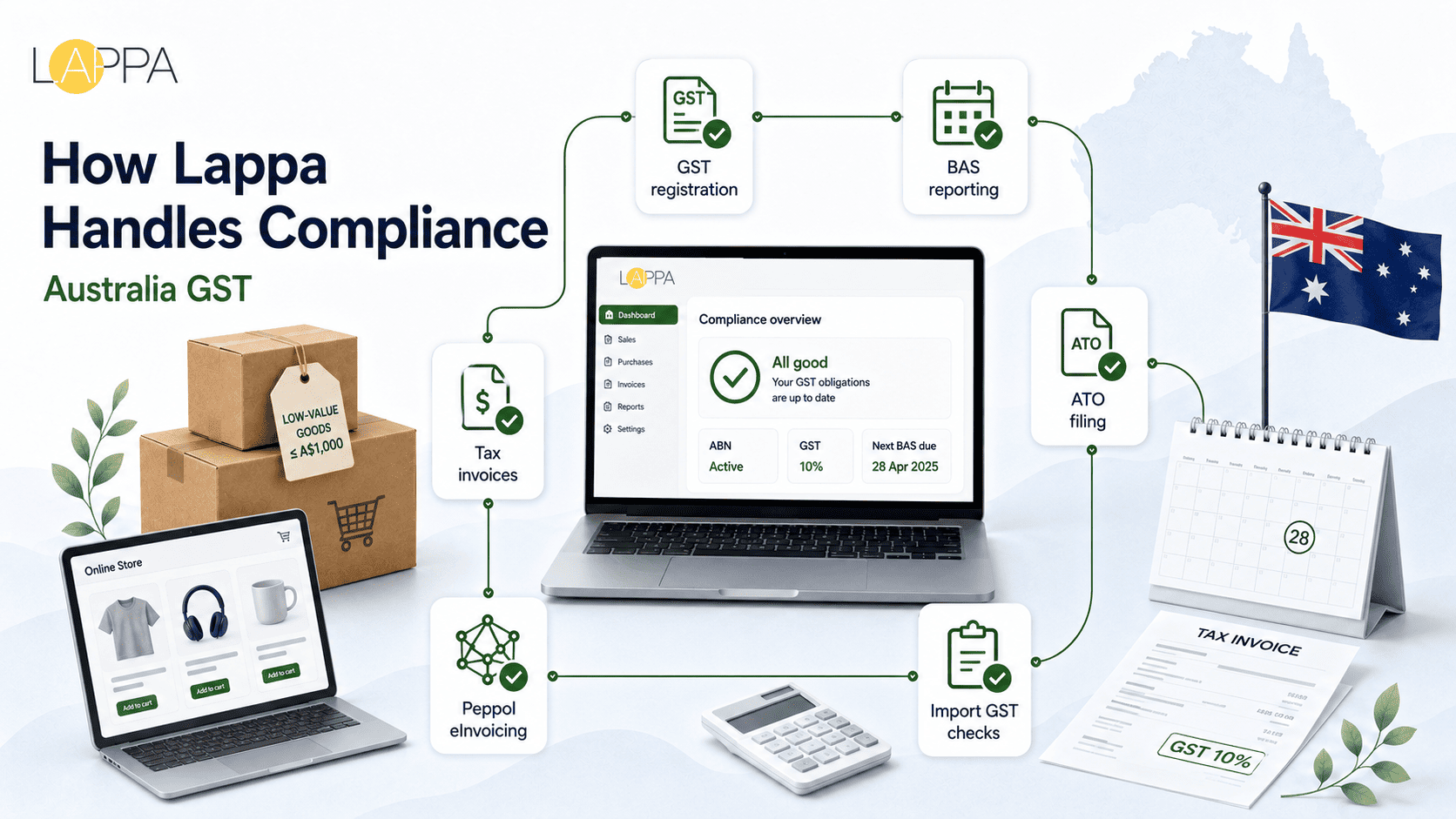 Lappa works with goods businesses operating in Australia across the full GST compliance cycle — from initial ABN and GST registration through BAS preparation, ITC recovery, import GST management, and ATO audit support.
For goods companies specifically, the team covers:
Lappa works with goods businesses operating in Australia across the full GST compliance cycle — from initial ABN and GST registration through BAS preparation, ITC recovery, import GST management, and ATO audit support.
For goods companies specifically, the team covers:
- ABN registration and GST activation for Australian-resident and foreign businesses
- Structural assessment — standard registration vs. simplified non-resident registration and the ITC trade-off between the two
- Monthly and quarterly BAS preparation and ATO lodgement
- Import GST analysis — customs value calculations, border GST, ITC recovery through BAS
- Low-value goods vendor collection model registration and ongoing reporting for foreign retailers
- ITC apportionment method design, documentation, and annual review for mixed-use businesses
- Voluntary disclosure preparation for businesses with historical GST filing gaps
- ATO audit correspondence and formal review management
FAQ
What is the VAT rate in Australia
- Australia's equivalent of VAT is called GST, and the australia vat rate expressed as the GST rate is a flat 10%. One rate applies to all taxable supplies — no reduced domestic tiers for food or medicine. Instead, specific categories like basic food, healthcare services, education, and exports are classified as "GST-free," meaning the supplier charges 0% while retaining full input credit rights. Residential accommodation and most financial services are "input-taxed" — no GST charged, but no input tax recovery either. The 10% rate has been unchanged since GST launched on 1 July 2000.
Who needs to register for VAT in Australia
- Australian businesses must register for GST once annual GST turnover reaches AUD 75,000 — or AUD 150,000 for not-for-profit organisations. Taxi and rideshare operators must register regardless of earnings. Foreign retailers selling low-value goods (under AUD 1,000 per shipment) to Australian consumers must register when annual Australian sales reach AUD 75,000. Foreign digital service providers face the same AUD 75,000 threshold. Voluntary registration below the threshold is available to any entity carrying on a business enterprise in Australia, and many smaller businesses register to access input tax credit recovery.
What is the VAT number format in Australia
- The VAT number in Australia is the ABN — Australian Business Number — an eleven-digit identifier displayed in three groups (XX XXX XXX XXX). For incorporated companies, the ABN derives from the nine-digit Australian Company Number using a two-digit calculated prefix. For other entity types, ABNs are assigned directly by the Australian Business Register. The same ABN covers all tax purposes — GST, income tax, customs, and PAYG. It must appear on every tax invoice and is publicly verifiable through the ABN Lookup tool at abr.gov.au in real time.
How often are VAT returns filed in Australia
- GST is reported through the Business Activity Statement (BAS). Businesses with annual GST turnover above AUD 20 million lodge monthly, with each BAS due on the 21st of the following month. Most businesses lodge quarterly — due on the 28th of the month following each quarter end. Businesses voluntarily registered under AUD 75,000 may elect annual lodgement, with the return due 31 October. BAS lodgements cover GST alongside PAYG withholding and other obligations on the same document. Businesses using registered tax agents receive extended lodgement deadlines for most reporting periods.
Do foreign companies need a tax representative in Australia
- No mandatory fiscal representative requirement exists. Foreign businesses register for GST directly through the ATO's online systems without appointing a local intermediary. Non-resident businesses are eligible for the simplified GST registration regime, which reduces reporting requirements in exchange for forgoing input tax credit recovery on Australian costs. In practice, most foreign businesses appoint a local registered tax agent or BAS agent for practical reasons — the ATO's processes, refund claim procedures, and audit responses are considerably easier to manage with local professional support. But the appointment is a commercial decision, not a legal requirement, and the agent bears no financial liability for the client's GST obligations.
VAT Calculator
VAT Standard rate
10%
VAT Reduced rate
0%
Thresholds
AUD 75,000 (businesses); AUD 150,000 (non-profit entities); Non-resident digital services: AUD 75,000