


Sweden EPR
- Ordinance (2022:1274) on Producer Responsibility for Packaging
- In force since 1 January 2023
- Supervised by Naturvårdsverket (Swedish Environmental Protection Agency – Swedish EPA)
Does this apply to e-commerce & online sales?
Yes — explicitly. Sweden includes distance sellers in its producer definition. You are considered a producer if you:- Sell packaged goods from another country directly to end users in Sweden
- Operate an online shop shipping goods to Swedish consumers
- Sell via marketplaces and ship directly to Sweden
Who is the Producer in Sweden
Under Ordinance (2022:1274), a producer is any entity acting professionally that:- Fills or uses packaging to protect/present products
- Manufactures packaging in Sweden
- Imports empty packaging into Sweden
- Imports packaged goods into Sweden
- Sells packaged goods or packaging from abroad directly to Swedish end users
Who Must Register for EPR Packaging in Sweden
Any producer must:- Register with Naturvårdsverket
- Join a Producer Responsibility Organization (PRO)
- NPA (Näringslivets Producentansvar AB)
- TMR (Tailor-Made Responsibility)
- Fee collection
- Reporting aggregation
- Operational recycling responsibilities
Sweden EPR Packaging – Registration Threshold
Under the current Swedish packaging EPR system, there is no formal de minimis packaging volume threshold that exempts a business from having to register as a producer if it places packaging on the Swedish market. In other words:
-
If you place packaging on the Swedish market, regardless of the amount (kg/tonnes), you are considered a producer and required to register with the Swedish Environmental Protection Agency (Naturvårdsverket) and comply with producer obligations (e.g., affiliate with a PRO, report volumes).
External expertise for all your EPR needs
Start EPR reporting within 24 hours

Packaging Covered (and Excluded)
Covered Packaging
Sweden’s EPR applies to:- Household (consumer) packaging
- Non-household (commercial/industrial) packaging
- Primary, secondary and transport packaging
- Service packaging
- E-commerce shipping packaging
- Paper & cardboard
- Plastic
- Metal
- Glass
- Wood
- Composite materials
Prohibited / Restricted Packaging (Single-Use Plastics)
Sweden implements EU Single-Use Plastics rules. Key restrictions include:- EPS (expanded polystyrene) beverage containers – banned
- EPS food containers and cups – banned
- Single-use cups containing more than 15% plastic – banned since 1 January 2024
- Tethered caps requirement for beverage containers – effective 3 July 2024
- Recycled plastic content requirement for PET bottles – effective 1 January 2025
Producer Responsibility Organization (PRO)
A PRO is an approved compliance scheme responsible for:- Organizing national collection systems
- Managing recycling operations
- Charging eco-fees
- Reporting to authorities
EPR Registration in Sweden – Step-by-Step
- Determine if you qualify as a producer
- Register in the Swedish EPA EPR portal
- Join an approved PRO
- Submit packaging data
- Pay eco-fees
- Maintain reporting compliance
Authorized Representative
If you are not established in Sweden, you may appoint a producer representative (producentombud) established in Sweden. Requirements:- Written power of attorney
- Representative must be legally established in Sweden
What Data Must Be Reported
Producers must report packaging placed on the Swedish market by: Material Type- Plastic
- Paper/cardboard
- Glass
- Metal
- Wood
- Composite
- Household vs non-household
- Single-use plastic categories (if applicable)
- Recycled plastic content (for certain PET bottles)
- Data required under littering-fee categories
First Reporting Period
- Ordinance effective: 1 January 2023
- First major PRO reporting to authority: 31 March 2025 (for 2024 data)
- Monthly or quarterly
- Typically by the 25th day after reporting period
EPR Reporting Deadlines
| Obligation | Deadline |
| Registration | Before placing packaging on market |
| Producer → PRO reporting | Monthly/Quarterly (often by 25th) |
| PRO → Swedish EPA | Annually by 31 March |
| PET recycled content report | 31 March annually |
Labels & Marketing Claims
Sweden does not require mandatory recycling labels on general packaging. However, material-specific sorting labels are widely used voluntarily by producers to help consumers dispose of packaging correctly.An example of what a label looks like on packaging for Sweden

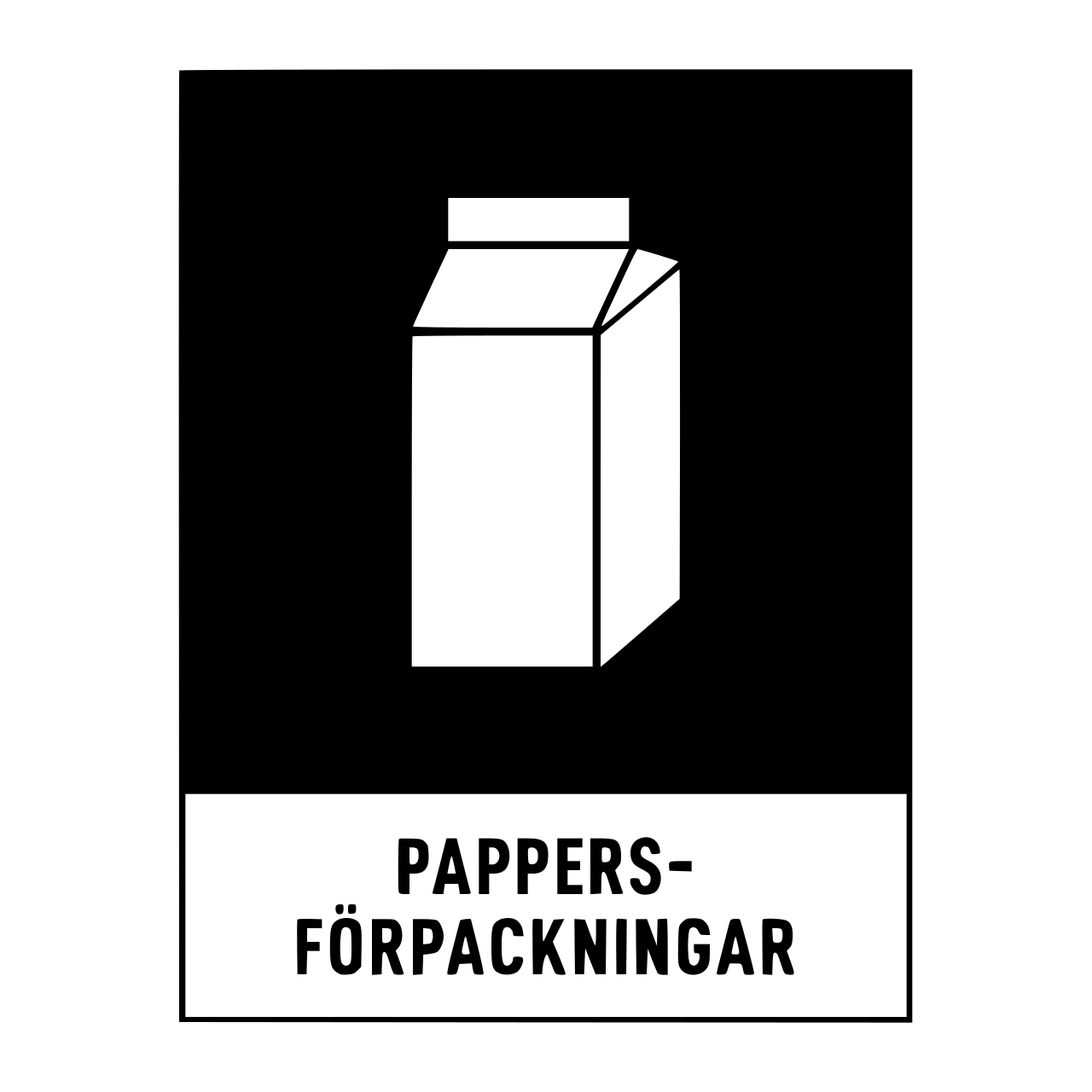
This packaging shows a "Pappersförpackningar" (paper packaging) sorting label — a black square pictogram with a carton icon. It indicates that the packaging should be placed in the paper packaging collection stream, and is commonly found on beverage cartons and food boxes.
📎 Download the Pappersförpackningar label: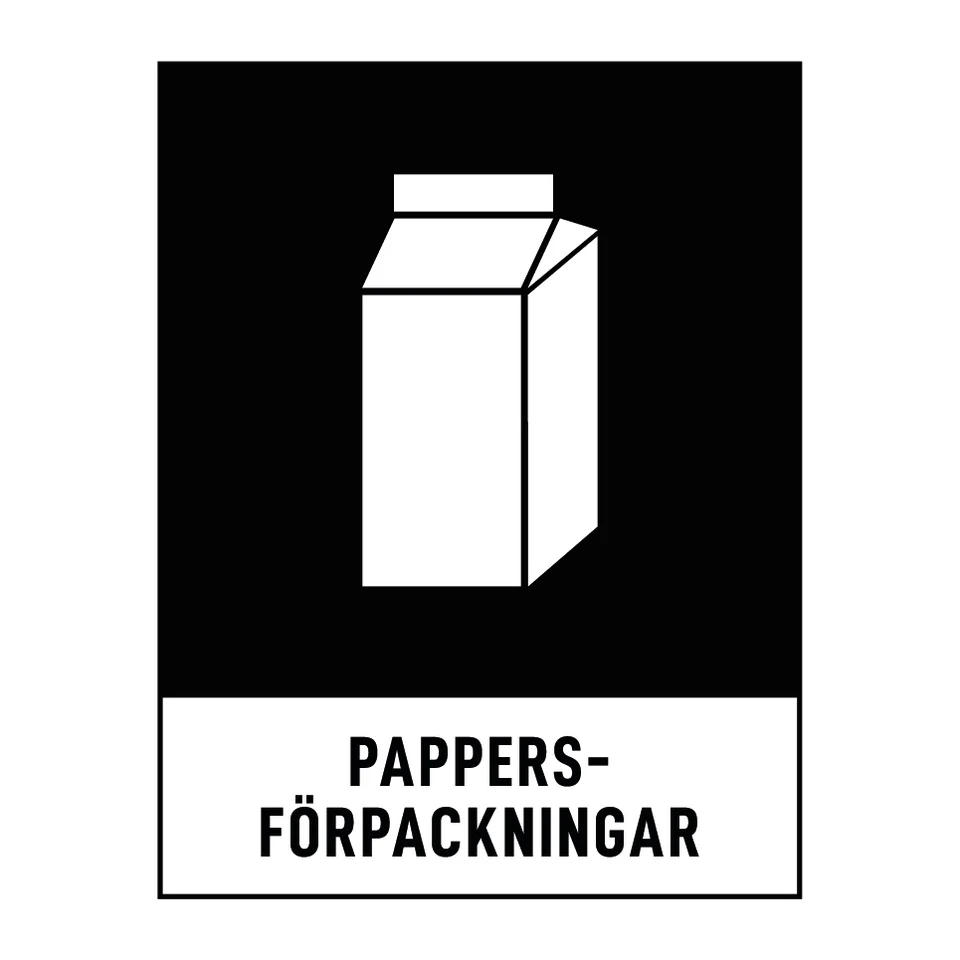
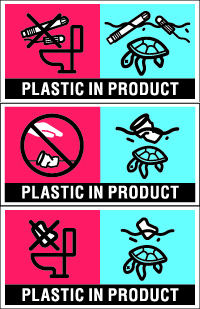
Single-use plastics mandatory label

This packaging shows two mandatory symbols required under the EU Single-Use Plastics Directive. The red symbol indicates the product should not be flushed down the toilet. The blue symbol with a turtle warns that the product contains plastic. The text "Produkten innehåller plast" ("This product contains plastic") is mandatory in Sweden for wet wipes and similar single-use plastic products.
📎 Download the the Single-Use Plastics labels:- PNG – best for digital use.
EPR Eco-Fees & Eco-Modulation
PRO Eco Fees Fees are based on:- Weight (kg/tonnes)
- Material type
- Recyclability
- Environmental performance
- More recyclable packaging = lower fees
- Hard-to-recycle packaging = higher fees
Enforcement Fee (Authority Fee)
Producers must pay:- SEK 1,250 per year
- Producers placing less than 1 tonne per year are exempt (except littering-fee categories).
Littering Fees
Apply to certain single-use plastic packaging categories. Structure:- Fixed annual fee (since 2023)
- Variable product-based fee (since 2024)
Risks, Penalties & Common Mistakes
Environmental Sanction Fees| Violation | Penalty |
| Late registration | Sanction fee (from 1 Jan 2024) |
| Not joining PRO | SEK 30,000 |
| Late reporting | SEK 10,000 |
| Missing SUP labeling | SEK 10,000 |
| Tethered caps non-compliance | SEK 10,000 |
Common Mistakes by E-commerce Sellers
- Assuming importer is responsible
- Failing to register before selling
- Not joining a PRO
- Underreporting packaging weight
- Ignoring single-use plastic restrictions
- Missing reporting deadlines
What E-commerce Sellers Should Do Now
- Map supply chain responsibility
- Confirm producer status
- Register before selling
- Join PRO (NPA or TMR)
- Collect packaging weight data
- Check single-use plastic compliance
- Prepare internal compliance calendar
When does PPWR apply
From 12 August 2026, EU-wide packaging reforms begin applying.Register online
Start your EPR Reporting within 24 hours
FAQ
Do small sellers need to comply?- Yes. Even small sellers must register and join a PRO. The enforcement fee may be exempt under 1 tonne.
- Not mandatory, but recommended if not established in Sweden.
- Only for specific single-use plastic items.
What is Sweden EPR Batteries
Extended Producer Responsibility (EPR) for batteries in Sweden requires producers to take financial and operational responsibility for the collection, treatment, and recycling of batteries placed on the Swedish market.
The legal framework is primarily based on:
- Ordinance (2008:834) on Producer Responsibility for Batteries
- The transposition of the EU Batteries Directive (2006/66/EC) into Swedish law
The rules apply to:
- Portable batteries
- Industrial batteries
- Automotive batteries
- Batteries used in electric vehicles (EV) and light mobility transport (LMT)
The system is supervised by the Swedish Environmental Protection Agency (Naturvårdsverket), which oversees compliance, registration, and reporting obligations.
Producers must:
- Register before placing batteries on the market
- Ensure collection and recycling of waste batteries
- Report volumes and categories
- Finance waste management systems
Does this apply to e-commerce & online sales
Yes, Swedish battery EPR rules apply to e-commerce and distance selling.
The legislation explicitly covers:
- Foreign companies selling directly to Swedish consumers
- Online sellers shipping batteries into Sweden
- Businesses supplying via marketplaces or digital platforms
Distance sellers are considered producers if they:
- Place batteries on the Swedish market without an established entity in Sweden
Online marketplaces:
- Are not typically classified as producers
- May require sellers to provide proof of EPR compliance
Who is the producer under Sweden EPR?
Under Ordinance (2008:834), a "producer" is any entity that places batteries on the Swedish market for the first time, including:
- Manufacturers established in Sweden
- Importers bringing batteries into Sweden
- Companies selling batteries under their own brand (private label)
- Distance sellers (including foreign businesses) supplying directly to Swedish end users
This definition applies whether batteries are:
- Sold separately
- Integrated into electrical or electronic equipment
Who must register for EPR batteries in Sweden
All producers must register with the Swedish Environmental Protection Agency (Naturvårdsverket) before placing batteries on the market.
Obligations include:
- Submitting company details and product information
- Registering in the national EPR system
- Ensuring participation in an approved collection system
- Reporting annual battery volumes
Unlike some other countries, Sweden requires all producers to register directly with the authority.
Sweden EPR Battery Registration Threshold
Sweden does not provide a minimum exemption threshold for battery producers:
- All producers must register regardless of volume
- No turnover-based exemptions apply
- Obligations apply from the first unit placed on the market
However, reporting complexity and operational requirements may vary depending on the scale of activity.
-guide" variations="3"]
Batteries Covered (and Excluded)
Covered categories
- Portable batteries
- Typically sealed and under 5 kg
- Used in consumer electronics
- Industrial batteries
- Used in industrial or professional applications
- Includes stationary energy storage systems
- Automotive batteries
- Used for starting, lighting, or ignition
- EV / LMT batteries
- Batteries used in electric vehicles and micromobility devices
Exclusions
The following are generally excluded:
- Batteries used in military equipment
- Batteries used in space equipment
- Equipment essential for national security interests
Producer Responsibility Organization (PRO)
In Sweden, producers must ensure the collection and recycling of batteries, typically by joining an approved Producer Responsibility Organization.
The main PRO is:
- El-Kretsen AB
Key responsibilities of PROs:
- Organizing nationwide collection systems
- Managing recycling and treatment processes
- Reporting compliance data to authorities
- Ensuring achievement of EU recycling targets
Participation in a PRO is the most common way to fulfill obligations.
EPR Registration in Sweden
The registration process includes:
- Registering with Naturvårdsverket via the official EPR register
- Providing company identification and contact details
- Declaring battery categories and expected volumes
- Joining a PRO or setting up an individual compliance system
- Paying applicable administrative or service fees
- Receiving confirmation of registration
Registration must be completed before selling batteries in Sweden.
Authorized Representative
Foreign companies without a Swedish establishment must appoint an Authorized Representative based in Sweden.
The Authorized Representative:
- Acts on behalf of the foreign producer
- Handles registration and reporting
- Ensures compliance with Swedish regulations
- Serves as the contact point for authorities
This requirement is critical for cross-border e-commerce sellers.
What Data Must Be Reported
Producers must submit detailed reports to Naturvårdsverket or via their PRO, including:
- Total weight of batteries placed on the market (kg or tonnes)
- Battery category (portable, industrial, automotive)
- Chemical composition (e.g. lithium-ion, lead-acid, NiCd)
- Number of units (where applicable)
- Collected and recycled quantities
Accurate reporting is essential for compliance and monitoring recycling targets.
First Reporting Period & EPR Reporting Deadlines
Key timelines include:
- Registration must occur before placing products on the market
- Reporting is typically conducted annually
- Deadlines are set by Naturvårdsverket or the PRO
Producers should confirm exact reporting schedules with their compliance scheme.
Labels & Marketing Claims
Battery labeling requirements in Sweden follow EU standards and include:
- Crossed-out wheeled bin symbol
- Chemical symbols (Pb, Cd, Hg) where applicable
- Capacity labeling for portable and automotive batteries
- Clear disposal and recycling instructions
Environmental claims must comply with Swedish marketing laws and must not be misleading.
EPR Eco Fees & Eco-Modulation
EPR fees in Sweden are generally managed through PROs and are based on:
- Weight of batteries placed on the market
- Battery chemistry and recyclability
- Operational costs of collection and recycling systems
Eco-modulation principles may:
- Encourage design for recyclability
- Penalize hazardous or hard-to-recycle materials
Fees are typically calculated per kilogram.
Risks, Penalties & Common Mistakes
Non-compliance may lead to enforcement actions by Naturvårdsverket.
Common mistakes include:
- Failure to register before market entry
- Not appointing an Authorized Representative (for foreign sellers)
- Incorrect reporting of battery volumes
- Missing reporting deadlines
- Non-compliant labeling
Penalties may include:
- Administrative fines
- Sales restrictions
- Enforcement orders
What E-Commerce Sellers Should Do Now
- Determine if you qualify as a producer in Sweden
- Register with Naturvårdsverket before selling
- Appoint an Authorized Representative if based outside Sweden
- Join a recognized PRO such as El-Kretsen
- Set up internal systems for tracking battery data
- Ensure labeling compliance on all products
- Monitor reporting deadlines and maintain records
-guide" variations="4"]
FAQ
- Is battery EPR mandatory in Sweden?
Yes, it is mandatory under Ordinance (2008:834). - Do foreign sellers need to comply?
Yes, distance sellers must comply and appoint an Authorized Representative. - Are there any registration thresholds?
No, all producers must register regardless of volume. - What labels are required on batteries?
The crossed-out wheeled bin symbol, chemical symbols, and capacity marking are required. - Do marketplaces take responsibility for EPR?
No, the legal responsibility remains with the producer or seller.
What is Sweden EPR for EEE
Sweden has one of the most established Extended Producer Responsibility (EPR) frameworks in Europe for electrical and electronic equipment (EEE). The system predates the EU's harmonised approach and has been continuously refined since the early 2000s. Any company that places EEE on the Swedish market — regardless of where it is established — carries full producer responsibility under Swedish law.
The primary national legislation is the Ordinance (2022:1276) on producer responsibility for electrical and electronic equipment, which is Sweden's transposition of EU Directive 2012/19/EU on waste electrical and electronic equipment (WEEE). This ordinance replaced the older Ordinance (2014:1075) and entered into force with updated scope definitions aligned to the EU open-scope framework adopted in 2018.
Supporting legislation includes:
- Ordinance (2020:614) on waste, which sets general waste management requirements
- Ordinance (2012:861) on hazardous substances in electrical and electronic equipment, transposing the RoHS Directive 2011/65/EU
- EU Regulation (2023/1542) on batteries and waste batteries, relevant for all EEE products with integrated batteries
- Regulation (NFS 2018:11) by the Swedish Environmental Protection Agency (Naturvårdsverket / EPA) on pretreatment of WEEE
- Regulation (NFS 2022:12) on determining compensation for EEE regarding hazardous substance content
- Ordinance (2012:259) on environmental sanction charges, governing penalties for non-compliance
The producer responsibility requires any person or entity that places EEE on the Swedish market to: accept returned products when they become waste, cover the management costs of waste electrical and electronic equipment (WEEE), and meet financial responsibility for these activities.
Sweden's EPR framework distinguishes between two primary equipment streams. Household EEE (B2C) refers to products whose construction and normal area of use means they would ordinarily be found in private households. Other EEE (professional or B2B) refers to equipment used exclusively in commercial or industrial settings. Importantly, being used professionally does not automatically exclude an EEE product from being classified as household EEE — it is the product's construction, function, and normal area of use that determines its classification. For example, a personal computer is household EEE regardless of whether it is used professionally or in a household. Naturvårdsverket
Does This Apply to E-Commerce and Online Sales
Yes. Distance selling and cross-border e-commerce are explicitly within scope of Sweden's EEE producer responsibility framework.
The fourth criterion for being classified as a producer explicitly covers companies that "sell EEE by means of distance communication directly to users in an EU Member State where the seller is not established." This means any foreign company selling EEE online directly to Swedish end users — whether from within the EU or from a third country outside the EU — is subject to Swedish EPR obligations. Naturvårdsverket
Internet distributors that sell EEE by distance communication cannot collect WEEE in the same way as a physical store. Nevertheless, internet distributors are expected, as far as possible, to meet their obligation to accept WEEE — for example, by informing end users about their nearest recycling centre and, where possible, accepting WEEE at a site the distributor possesses, such as a sales office or storage facility. Naturvårdsverket
Online marketplaces are not currently classified as producers in Sweden in the same manner as under the UK's 2025 WEEE amendments. The obligation for marketplace-facilitated sales by non-established sellers remains with the individual foreign seller. If that seller is not established in Sweden, they must either register directly with the Swedish EPA or appoint an Authorised Representative in Sweden to fulfil the registration and reporting obligations on their behalf. There is no general marketplace operator liability mechanism comparable to the UK model under current Swedish law.
For e-commerce businesses selling into Sweden from another EU member state or from outside the EU, the practical implications are clear: registration, annual reporting, product labelling, and membership in an approved collective system (for household EEE) are all mandatory before the first sale, regardless of sales volume.
Who is the Producer Under Sweden EPR?
Under the Ordinance (2022:1276), a producer of EEE is any natural or legal person who:
- Is established in Sweden and manufactures EEE or has EEE designed or manufactured, subsequently marketing it within Sweden under their name or trademark.
- Is established in Sweden and resells equipment under their own name or trademark which is produced by other suppliers, provided that the original manufacturer's brand does not appear on the product.
- Is established in Sweden and places EEE from a third country or another EU Member State onto the Swedish market (i.e., importers).
- Sells EEE by means of distance communication directly to users in an EU Member State where the seller is not established. Naturvårdsverket
This definition captures a broad set of business models relevant to foreign companies:
- Manufacturers based outside Sweden who supply products under their own brand directly to Swedish consumers or businesses
- Importers of EEE into Sweden from any third country or from within the EU who place products on the Swedish market under their own name
- Private label owners who commission the manufacture of EEE and sell it under their own brand name
- Distance sellers (online retailers) who sell EEE by remote means directly to Swedish end users without physical establishment in Sweden
- Brand owners who rebrand third-party manufactured equipment and market it in Sweden
A company that buys an item of EEE abroad and brings it into Sweden for its own use is not a producer. The trigger is commercial placement on the Swedish market, not personal importation. Naturvårdsverket
Who Must Register for EPR EEE in Sweden
A producer is obliged to register with the Swedish Environmental Protection Agency (EPA), known in Swedish as Naturvårdsverket. Registration is mandatory regardless of whether or not the producer has joined a collective WEEE collection scheme.
Registration is conducted through the EEB register (Register of electrical and electronic equipment and batteries), which is the national database maintained by Naturvårdsverket. All producers — whether Swedish-established or foreign — must be registered in this system before placing EEE on the Swedish market.
The competent authority responsible for registration, oversight, and enforcement is Naturvårdsverket (Swedish Environmental Protection Agency). There are no devolved regional authorities with separate competence for EEE producer registration — the system is administered centrally at the national level.
For household EEE producers, registration with the Swedish EPA must be combined with membership in one of the two approved collective WEEE collection systems. For professional (other) EEE producers, registration with the EPA is required, but membership in a collective scheme is not mandatory.
Sweden EPR EEE Registration Threshold
There is no de minimis threshold for registration under Sweden's EEE producer responsibility framework. All manufacturers and companies that produce or sell electrical and electronic equipment in Sweden are subject to registration — there is no minimum volume or turnover exemption.
This distinguishes Sweden from several other jurisdictions (such as the UK, which maintains a 5-tonne threshold below which a simplified "small producer" registration applies). In Sweden, the obligation to register is triggered the moment a company first places any EEE on the Swedish market commercially, regardless of quantity.
The only relevant distinction is operational rather than threshold-based: the annual supervisory enforcement fee charged by Naturvårdsverket is 1,000 SEK per producer responsibility stream, with EEE and batteries billed separately. This fee applies uniformly to all registered producers. There is no reduced fee tier for small or low-volume producers under the EEE framework.
Detailed EPR Guidance for each Jurisdiction
We support 36 jurisdictions
EEE Categories Covered (and Excluded)
Sweden transposed the open-scope provisions of the EU WEEE Directive as of 15 August 2018. Following the regulation change introduced in 2018, the previous ten product categories were replaced by six new categories: Naturvårdsverket
- Temperature exchange equipment — refrigerators, freezers, air conditioning units, heat pumps, and other equipment using refrigerants
- Screens, monitors, and equipment containing screens having a surface area greater than 100 cm² — televisions, monitors, laptops, tablets, and similar display-equipped products
- Lamps — fluorescent lamps, LED lamps (excluding filament bulbs and luminaires in households), gas discharge lamps
- Large equipment — any equipment with at least one external dimension exceeding 50 cm, including large household appliances (washing machines, dishwashers, cookers, large printing machines, large photovoltaic panels); this category excludes equipment already covered in categories 1–3
- Small equipment — any equipment with all external dimensions at or below 50 cm, including small household appliances, consumer electronics, small IT equipment, power tools, toys, leisure equipment, and small medical devices; this category excludes equipment covered in categories 1, 2, 3, and 6
- Small IT and telecommunication equipment — equipment with all external dimensions at or below 50 cm, including mobile phones, routers, personal computers, printers, and similar devices
These six categories apply to both household (B2C) and professional (B2B) equipment. Producers must identify all applicable categories for their product range and report placed-on-market volumes by category.
Exclusions from scope under the Swedish ordinance include:
- Equipment designed and sold exclusively to be part of another EEE product that is itself outside scope
- Equipment necessary for the protection of essential national security interests, including arms, munitions, and war material intended specifically for military purposes
- Filament bulbs and luminaires in households
- Medical devices and in vitro diagnostic medical devices where such devices are expected to be infective prior to end of life, and active implantable medical devices
- Large-scale stationary industrial tools
- Large-scale fixed installations
Additionally, space equipment designed specifically for space use is excluded, as is equipment designed exclusively for research and development purposes and made available only on a B2B basis.
Producer Responsibility Organization (PRO)
Sweden operates a competitive PRO market rather than a single mandatory national scheme. Most PROs in Sweden operate as not-for-profit companies, owned by individual producers or trade organisations within their respective EPR streams. None of the organisations hold a legislative monopoly — all operate in an open market.
For household EEE specifically, the regulatory framework requires membership in an approved collective scheme with nationwide coverage. There are two collective systems for household WEEE in Sweden with a permit from the Swedish EPA: El-Kretsen AB and Recipo Ekonomisk förening.
El-Kretsen AB is the larger and longer-established of the two. Founded in 2001 and initiated by 20 trade associations, El-Kretsen operates as a not-for-profit service organisation serving importers and manufacturers subject to producer responsibility. The scheme operates over 2,600 collection points across Sweden and uses 20 certified logistics partners. Products are sorted into seven fractions at collection sites. El-Kretsen also conducts annual reporting of collected and recycled WEEE volumes to Naturvårdsverket and carries out analysis of collected waste to inform treatment procurement.
Recipo Ekonomisk förening is the second approved collective system. Recipo owns a recycling plant specialising in WEEE and plastics from electronics, and its fee structure includes an annual administration fee and a per-unit fee based on reported sales.
For professional (other) EEE, membership in a collective system is not obligatory. Producers of professional EEE must organise their own take-back and treatment arrangements and must be in a position to report the collected and treated volumes to Naturvårdsverket.
Naturvårdsverket maintains oversight of both PROs and conducts compliance audits. The agency issues permits to collective systems and can withdraw those permits if the system fails to meet its obligations.
EPR Registration in Sweden
The registration process for foreign EEE producers in Sweden proceeds as follows:
- Determine producer status. Assess whether your company meets any of the four producer criteria under Ordinance (2022:1276) — manufacturer, brand owner/reseller, importer, or distance seller to Swedish end users.
- Classify your products. Identify which of the six EEE categories your products fall within and determine whether they constitute household EEE, professional EEE, or both.
- Appoint an Authorised Representative (if applicable). If your company is not established in Sweden, you must either register directly (for third-country companies) or appoint an Authorised Representative established in Sweden who will take on the producer obligations on your behalf.
- Register in the EEB register. Access the e-service for producer responsibility via the Naturvårdsverket portal. Registration requires submitting business details, contact information, product categories, and an initial declaration of whether products constitute household or professional EEE.
- Join an approved collective system (household EEE only). If your products are household EEE, you must affiliate with either El-Kretsen AB or Recipo Ekonomisk förening. Select the scheme and execute the membership agreement.
- Obtain your registration confirmation. Upon successful registration, Naturvårdsverket issues a registration confirmation. This should be made available to your distributors in Sweden as evidence of compliant producer status.
- Establish reporting systems. Set up internal weight-tracking systems to record EEE placed on the Swedish market by category, in kilograms, for annual reporting purposes.
- Pay the annual supervisory fee. The EPA issues notices in the autumn. The current fee is 1,000 SEK per EPR stream (EEE and batteries are billed separately).
Registration must be completed before the first EEE product is placed on the Swedish market. There is no grace period for new entrants.
Authorised Representative
The Authorised Representative (AR) mechanism is a critical compliance route for foreign EEE producers without physical establishment in Sweden.
For a producer selling EEE by means of distance communication from another EU member state to Swedish users, it is mandatory under the WEEE Directive to appoint an Authorised Representative in Sweden. The same obligation applies to a branch office, since a branch is part of a foreign-based company. Producers established in a third country outside the EU that sell by distance communication to Swedish users must also register, either directly or through an Authorised Representative. Naturvårdsverket
Swedish rules allow a producer not established in Sweden to appoint a producer representative established in Sweden via written power of attorney. The representative must notify Naturvårdsverket with the required details. ComplyMarket
The Authorised Representative assumes the following responsibilities on behalf of the foreign producer:
- Registering the producer in the EEB register and maintaining the registration
- Joining and liaising with the approved collective scheme (for household EEE)
- Submitting annual placed-on-market reports and collected/treated WEEE data by the 31 March deadline
- Receiving and responding to regulatory correspondence and audit requests from Naturvårdsverket
- Ensuring product labelling obligations are conveyed to the producer
It is important to understand that appointing an AR does not transfer legal liability from the producer itself to the representative. The producer retains ultimate responsibility for the accuracy of reported data and for meeting substantive obligations. The AR facilitates the administrative and procedural compliance.
Producers inside the EU that sell to a Swedish producer — but wish to report on behalf of that Swedish producer — must also appoint an Authorised Representative in Sweden. Naturvårdsverket
Foreign companies should ensure that their AR agreement clearly sets out the scope of services, data provision obligations, and protocols for managing regulatory correspondence. Lappa (formerly Lovat) provides Authorised Representative services for EEE producers entering the Swedish market.
What Data Must Be Reported
All registered producers must submit annual reports via the EEB register to Naturvårdsverket. The report covers the previous calendar year. Required data fields include:
- Placed on market (POM) volumes — the total weight in kilograms of EEE placed on the Swedish market in the previous year, broken down by the six product categories
- Household vs. professional distinction — all volumes must be separated into household EEE and other (professional) EEE where relevant to the producer's product range
- Collected and treated WEEE volumes (professional EEE producers only) — producers of professional (other) EEE must describe how much waste from other EEE has been collected and treated. The recycler receiving the waste must provide the producer with this data to enable reporting.
- Battery data (where applicable) — for EEE products with integrated batteries, the battery weight must be included in two separate reports: the total weight of the product including the battery appears in the EEE report, and the weight of the battery alone must also appear separately in the battery report. Integrated battery quantities must therefore be reported twice.
- Product category mapping — volumes must be allocated correctly to each of the six WEEE categories in Appendix 1 of the ordinance, including all components, equipment parts, and consumables as parts of the complete product weight
For household EEE producers, reporting of collected and treated WEEE volumes is handled by the approved collective system (El-Kretsen or Recipo) rather than by the individual producer. The producer's reporting obligation is limited to placed-on-market quantities.
Producers should maintain internal records — purchase invoices, shipment data, import declarations — to substantiate the reported figures. Naturvårdsverket may request supporting documentation during compliance audits.
First Reporting Period and EPR Reporting Deadlines
The obligation to register arises before the first EEE product is placed on the Swedish market. There is no start-of-year or calendar-aligned trigger: registration must precede market entry.
Once registered, the following deadlines govern ongoing compliance:
- 31 March each year — Annual report for the previous calendar year must be submitted to Naturvårdsverket through the EEB register. The report covers placed-on-market volumes (all producers) and collected/treated WEEE (professional EEE producers only). The quantity is expressed in kilograms by product category.
- Autumn each year — Naturvårdsverket issues notices for the annual supervisory enforcement fee (1,000 SEK per EPR stream). Payment is due upon receipt of the notice.
- Within one year of commencing sale — Producers must provide information on product contents to waste management operators. This includes details on materials, hazardous substances, and preparation for disassembly.
For producers joining a collective scheme such as El-Kretsen or Recipo, the scheme may set internal reporting schedules (monthly or quarterly) for placed-on-market data in order to calculate each member's fee obligations. Producers should confirm the PRO's internal reporting calendar at the time of membership.
Late annual reporting may result in an environmental sanction charge under the Ordinance (2012:259) on environmental sanction charges. Naturvårdsverket will generally enable the producer to comment before a final decision on any sanction charge is issued.
Labels and Marketing Claims
Sweden requires EEE products placed on the Swedish market to carry specific labelling in accordance with the WEEE Directive requirements, as implemented through national law.
- Crossed-out wheeled bin symbol — All EEE must be marked with the crossed-out wheeled bin symbol in accordance with the standard prescribed in the Ordinance. For equipment placed on the market after 13 August 2005, the symbol must be accompanied by a date mark (a solid bar beneath the bin symbol) indicating that the product entered the market after the financial responsibility provisions of the WEEE system came into effect. The symbol must be of appropriate size relative to the product and must be printed in a legible and indelible manner.
- Hazardous substance compliance (RoHS) — Under Ordinance (2012:861) and the underlying RoHS Directive 2011/65/EU, EEE must not exceed maximum concentration values for restricted hazardous substances (including lead, mercury, cadmium, hexavalent chromium, polybrominated biphenyls, and polybrominated diphenyl ethers). Products must carry the CE marking, which implicitly attests to RoHS conformity for in-scope products.
- Battery removal instructions — EEE with built-in batteries must be designed so that batteries can be easily removed by the consumer or by independent professionals, and must be accompanied by an instruction manual clarifying which type of battery is incorporated.
- Product content information — Within one year of commencing sale of a new EEE product on the Swedish market, producers must provide waste management operators with information on the product's contents. This covers materials, dangerous substances, and preparation for disassembly and recycling. This information should be made available in a durable and accessible format.
- Sustainability and recyclability claims — Any marketing claims regarding recyclability, sustainability, or environmental performance of EEE products must be substantiated and must not mislead consumers. Sweden enforces EU-level provisions on green claims, and producers should ensure that claims are accurate, verifiable, and consistent with the product's actual end-of-life management characteristics. Vague or unsubstantiated environmental marketing claims carry reputational and regulatory risk.
- Visible eco-fees — Unlike some EU member states, Sweden does not permit producers to display a separate visible EPR eco-fee on household EEE invoices or product listings directed at consumers. The fee is not allowed to be shown for sales to households. However, the regulations are silent on using visible fees for professional channels — meaning this is permitted for B2B sales to non-household end users. Recolight
EPR Eco Fees and Eco-Modulation
Sweden's WEEE contribution fee system is market-based rather than centrally fixed. Fees are set by the approved collective schemes (El-Kretsen and Recipo) and calculated based on a producer's proportionate share of the market. The fundamental principles are as follows:
- Fee structure for household EEE producers — Fees are charged per kilogram of EEE placed on the Swedish market by product category. The collective system allocates collection and treatment costs among its producer members according to market share within each category. A producer placing a higher volume in a category carries a proportionally higher financial obligation for that category's WEEE management costs.
- Fee structure for professional EEE producers — Producers of professional EEE who do not join a collective scheme must organise and finance their own take-back and treatment arrangements. Costs are driven by actual collection, transport, pretreatment, recycling, and disposal activities conducted by certified waste management operators.
Eco-modulation based on hazardous substance content
From 1 January 2024, Naturvårdsverket introduced requirements for producer responsibility fees for electronics to be differentiated based on the chemical content of products. The fee differentiation works as follows:- Electronic products where any component contains 0.1 weight percent or more of substances from the candidate list in the REACH Regulation are charged at the regular (standard) price.
- A discount of 10 percent is applied for products for which the producer already pays the full chemical tax, provided that the product does not contain any other candidate list substance.
- If the producer already pays the full chemical tax and the product also contains another candidate list substance not covered by the chemical tax, the standard price applies without discount.
- Annual supervisory fee — In addition to treatment cost contributions paid to the collective scheme, all registered producers pay an annual enforcement fee to Naturvårdsverket of 1,000 SEK per EPR stream. For a company with both EEE and battery obligations, two separate fees apply.
Producers should request a detailed fee schedule from their chosen collective scheme at the time of membership, as rates vary by product category and are subject to periodic revision.
Risks, Penalties and Common Mistakes
Sweden has an active enforcement programme. Naturvårdsverket has authority to issue environmental sanction charges, impose fines, and refer serious violations for prosecution. The following risks and penalties are most relevant to foreign EEE producers:
- Failure to register before placing EEE on the market. This is the most common compliance failure for foreign companies. All producers must register in the EEB register prior to their first Swedish sale. Operating without registration constitutes a breach of the Ordinance (2022:1276) and triggers environmental sanction charges.
- Late annual reporting. Producers that fail to report in time may receive an environmental sanction charge under the Ordinance (2012:259). The sanction is applied per infringement. Naturvårdsverket provides the producer with an opportunity to comment before a formal decision is issued, but there is no general discretion to waive the charge for late submissions.
- Failure to join an approved collective scheme (household EEE). Household EEE producers who do not affiliate with El-Kretsen or Recipo are in material breach of their producer obligations. This is a separately enforceable requirement from EPA registration.
- Incorrect product categorisation. Misclassifying EEE into the wrong product category affects the accuracy of placed-on-market reporting and may result in underpayment of collective scheme fees and incorrect market share calculation. Producers should verify category allocations carefully and retain documentation of their classification decisions.
- Incorrect battery reporting. Products with integrated batteries require weight data to be submitted in both the EEE report (total product weight including battery) and the battery report (battery weight only). Failure to report in both registers is a compliance error that may trigger Naturvårdsverket enquiries.
- Non-compliant product labelling. Absence of the crossed-out wheeled bin symbol, missing date marks, or failure to provide product content information to waste management operators within one year of commencing sale are all enforceable obligations.
- Assuming marketplace operator covers the obligation. Unlike the UK under the 2025 WEEE amendments, Swedish law does not currently transfer producer obligations to the online marketplace operator for non-Swedish sellers. Foreign sellers must comply individually.
- Misapplying the household/professional distinction. Classifying products as professional EEE when they are household EEE reduces the producer's collective scheme obligations. Naturvårdsverket's position is that classification is based on the product's design and normal area of use, not the identity of the buyer.
Penalties for failing to comply with producer responsibility regulations include fines, and these reflect the severity of the offence. For serious or repeated violations, referral for prosecution is possible. Enforcement activity is supported by audits of the EEB register, cross-referencing of trade data, and complaints from compliant producers about free-rider competitors.
What E-Commerce Sellers Should Do Now
Foreign e-commerce companies selling EEE to Swedish consumers should take the following steps immediately:
- Conduct a product scope review. Verify whether your products fall within the definition of EEE under Ordinance (2022:1276) by checking against the six product categories and reviewing the exclusions list.
- Classify products by category and end-user type. Determine whether products are household EEE, professional EEE, or both, using the construction-and-use test rather than customer type.
- Assess your producer status. Confirm whether your business model — distance selling, brand ownership, importation — triggers producer responsibility under Swedish law.
- Appoint an Authorised Representative. If your company is not established in Sweden, engage a qualified AR that is physically established in Sweden to register on your behalf, join a collective scheme, and manage ongoing reporting obligations.
- Register in the EEB register via the Naturvårdsverket e-service for producer responsibility before placing the first product on the Swedish market.
- Join El-Kretsen or Recipo (for household EEE). Contact both organisations to compare fee structures and service offerings relative to your product categories and volumes.
- Implement weight-tracking systems. Set up internal processes to record the weight in kilograms of each EEE product sold to Swedish customers, categorised correctly for annual reporting by 31 March.
- Review product labelling. Ensure the crossed-out wheeled bin symbol with date mark is present on all in-scope products and that product content information is prepared for delivery to waste management operators within one year of first sale.
- Check REACH candidate list substance content. Evaluate whether any component of your products contains 0.1% or more of REACH candidate list substances, as this determines your fee tier under the eco-modulation rules effective from 1 January 2024.
- Budget for annual fees. Anticipate the 1,000 SEK annual supervisory fee to Naturvårdsverket and the separate collective scheme membership and treatment cost contributions.
Register online
Start your EPR Reporting within 24 hours
FAQ
- Is EPR registration for EEE mandatory in Sweden, even for small sellers?
- I am a non-EU company selling electronics directly to Swedish consumers online. Do I need to comply?
- Does the online marketplace I sell through take responsibility for my WEEE obligations in Sweden?
- What is the labelling requirement for EEE sold in Sweden?
- What happens if I miss the annual reporting deadline of 31 March?
What is Sweden EPR Textile
Extended Producer Responsibility (EPR) for textiles in Sweden is based on national legislation introduced following the government inquiry SOU 2020:72 and aligned with the EU Waste Framework Directive (2008/98/EC).
The Swedish textile EPR framework entered into force on 1 January 2022, with a transition period leading to full operational obligations from 1 January 2025.
The legislation requires producers to finance and organize the collection, reuse, and recycling of textile waste. It also includes strict measures such as the prohibition on destruction of unsold textiles (with limited exceptions).
The scope includes:
- Clothing and apparel
- Household textiles
- Textile accessories
The overarching objective is to reduce textile waste and increase reuse and recycling rates in line with Sweden’s circular economy strategy.
Does this apply to e-commerce & online sales
Yes, Sweden explicitly applies textile EPR obligations to cross-border and online sales.
The following are in scope:
- Foreign companies selling textiles directly to Swedish consumers
- Distance sellers and e-commerce platforms
- Online marketplaces (depending on their role in placing products on the market)
Companies selling into Sweden without a local establishment are still considered producers and must comply.
Who is the “producer” under Sweden EPR?
A “producer” is any entity that places textile products on the Swedish market for the first time on a professional basis.
This includes:
- Manufacturers established in Sweden
- Importers bringing textiles into Sweden
- Brand owners selling under private label
- Distance sellers and foreign e-commerce companies
The definition ensures that responsibility lies with the entity introducing products into the Swedish market, regardless of location.
Who must register for EPR textiles in Sweden
All producers must comply with registration and reporting obligations.
The competent authority is the Swedish Environmental Protection Agency (Naturvårdsverket).
Obligations include:
- Registering as a textile producer
- Ensuring participation in an approved textile collection system (mandatory from 2025)
- Reporting volumes of textiles placed on the market
- Financing collection and recycling operations
Proof of participation in a licensed system is required for compliance.
Sweden EPR Textile Registration Threshold
There is no minimum threshold for textile EPR obligations in Sweden.
Key points:
- All producers are obligated, regardless of turnover
- No exemption for small businesses
- Obligations apply from the first product placed on the market
- Micro-enterprises may receive limited timing flexibility under EU rules, but are still in scope
Make your first declaration within 24 hours
Easy to use EPR Software
Textiles Covered (and Excluded)
Covered categories
The Swedish EPR scheme applies to:
- Clothing (apparel)
- Household textiles – bed linen, curtains, towels
- Textile accessories – bags and similar items
Exclusions
Certain products are excluded from scope:
- Technical and industrial textiles
- Furniture and mattresses
- Fabrics sold by the meter
- Some footwear categories (depending on classification under national scope)
Producer Responsibility Organization (PRO)
Sweden is developing a system of licensed textile collection organizations.
Key characteristics:
- Producers must join or finance an approved collection system from 1 January 2025
- Systems must ensure nationwide accessibility for textile waste collection
- Collection, sorting, reuse, and recycling operations must meet regulatory standards
Unlike more mature systems (e.g. France), Sweden’s PRO landscape is still evolving, with a strong role for municipalities and charitable collection networks.
EPR Registration in Sweden
The registration process includes:
- Assessing producer status under Swedish law
- Registering with Naturvårdsverket
- Joining an approved textile collection system (mandatory from 2025)
- Declaring expected annual textile volumes
- Setting up internal tracking for reporting
Registration must be completed before placing textiles on the Swedish market.
Authorized Representative
Foreign companies are allowed to appoint an Authorized Representative.
Key points:
- Facilitates compliance for non-resident producers
- Handles registration, reporting, and communication with authorities
- Recommended for all cross-border sellers
The representative assumes operational responsibility, but legal liability remains with the producer.
What Data Must Be Reported
Producers must report data related to textiles placed on the market, including:
- Total weight (kg) of textiles
- Product categories
- Estimated textile waste volumes
- Data related to reuse and recycling (via collection systems)
Accurate reporting is essential for meeting national targets and audit requirements.
First Reporting Period & EPR Reporting Deadlines
Key milestones:
- 1 January 2022 – legislation enters into force
- 1 January 2025 – mandatory participation in collection systems begins
- Annual reporting obligations apply thereafter
Deadlines are determined by Naturvårdsverket and the approved collection systems.
Labels & Marketing Claims
Textile products in Sweden must comply with EU labeling requirements.
Key obligations:
- Fiber composition labeling under EU Textile Regulation
- Substantiated environmental claims
- Compliance with upcoming EU Green Claims Directive
Misleading claims regarding recyclability, sustainability, or circularity are subject to enforcement.
EPR Eco Fees & Eco-Modulation
EPR fees in Sweden are expected to follow EU-aligned principles.
Key elements:
- Contributions based on weight or volume of textiles placed on the market
- Administrative and supervisory fees payable to authorities
- Eco-modulation expected based on:
- Durability
- Recyclability
- Material composition
Eco-modulation will incentivize sustainable product design.
Risks, Penalties & Common Mistakes
Common mistakes
- Not registering with Naturvårdsverket
- Ignoring obligations for cross-border e-commerce
- Failing to join a licensed collection system
- Incorrect or incomplete reporting
- Assuming exemptions based on small volumes
Penalties
Non-compliance may result in:
- Administrative fines
- Enforcement actions by authorities
- Market access restrictions
- Reputational risks
What E-Commerce Sellers Should Do Now
- Confirm whether you qualify as a producer in Sweden
- Register with Naturvårdsverket
- Prepare to join a licensed textile collection system (from 2025)
- Appoint an Authorized Representative if based outside Sweden
- Implement systems for tracking product volumes and categories
- Prepare for reporting and fee payments
Register online
Start your EPR Reporting within 24 hours
FAQ for Sweden textile EPR
- Is textile EPR mandatory in Sweden?
Yes, it has been in force since 2022, with full operational requirements from 2025. - Do foreign e-commerce sellers need to comply?
Yes, cross-border sellers placing textiles on the Swedish market are fully in scope. - Is there a minimum threshold?
No, all producers must comply regardless of volume. - What products are covered?
Clothing, household textiles, and textile accessories are included. - Are marketplaces responsible for compliance?
Generally, the seller is responsible, though EU-level rules may expand marketplace obligations.