


Ireland EPR
What is Ireland EPR Packaging
Extended Producer Responsibility (EPR) in Ireland is a regulatory framework that mandates producers to take financial and physical responsibility for the management of packaging waste. This system is governed by the European Union (Packaging) Regulations 2014 (as amended) and is currently transitioning under the new EU Packaging and Packaging Waste Regulation (PPWR), which becomes directly applicable on August 12, 2026. The Department of the Environment, Climate and Communications oversees the policy, while the Environmental Protection Agency (EPA) and local authorities enforce compliance.
Does this apply to e-commerce & online sales
Yes. Distance sellers, including non-resident e-commerce businesses and online marketplaces, are subject to EPR rules if they supply packaged goods to the Irish market. Under the PPWR 2026 updates, fulfillment service providers and online platforms are legally required to verify that their sellers have a valid registration and an Authorized Representative in Ireland.
Who is the “producer” under Ireland EPR?
A "producer" in Ireland is defined as any legal entity that, regardless of the sales technique used, first places packaged products on the Irish market. This includes:
-
Manufacturers based in Ireland.
-
Importers of packaged products into Ireland.
-
Distance sellers based outside Ireland selling directly to Irish consumers (B2C).
-
Brand owners who have goods packaged under their own name.
Who must register for EPR packaging in Ireland
All producers must register their activities. Companies typically fulfill their obligations by joining Repak, the sole government-approved Producer Responsibility Organization (PRO) in Ireland. Alternatively, a company can choose to "self-comply" by registering directly with their Local Authority, though this is rarely practical for foreign companies due to the complex collection and recovery targets involved.
Ireland EPR Packaging Registration Threshold
Historically, Ireland operated with a "Major Producer" threshold. A company was only considered a "Major Producer" if it had an annual turnover exceeding €1,000,000 and placed more than 10 tonnes of packaging on the market. However, under the PPWR rules effective from August 12, 2026, the threshold for basic registration and the appointment of an Authorized Representative is essentially zero for foreign distance sellers. All entities placing packaging on the market must be registered, though fee structures may vary based on volume.
Make your first declaration within 24 hours
Easy to use EPR Software

EPR and PPWR for Ireland
Ireland's packaging EPR has run through the European Union (Packaging) Regulations 2014 for over a decade, with Repak as the sole approved PRO most producers join, and the EPA and local authorities handling enforcement. PPWR doesn't replace that structure — Repak membership, eco-fee payment, and recovery-target funding all continue exactly as before. What changes is the layer sitting on top: technical documentation, an EU declaration of conformity, and the authorised representative requirement under Article 45(3), which applies to any seller without a local presence, not only non-EU ones.
Worth flagging on that last point: a Commission proposal from December 2025 would suspend the AR requirement for EU-established producers until 2035, but it hasn't been adopted — Council talks stalled in mid-2026 and Parliament is still negotiating a narrower version. Until something passes, the obligation stands as written for everyone.
The bigger practical shift is who it now catches. Ireland's old "Major Producer" threshold — €1 million turnover and 10 tonnes of packaging — used to exempt a real number of smaller sellers from full obligations. PPWR's producer definition doesn't carry that exemption forward, so companies that never had to build documentation processes under the 2014 regime now face PPWR's full technical-file requirement for the first time, a steeper jump for them than for producers already reporting through Repak at scale.
One thing Ireland doesn't need to worry about: PPWR requires a deposit-return system for beverage containers by 2029 unless 80% separate collection is hit earlier. Ireland's Re-turn scheme has been running since February 2024, so this particular PPWR deadline arrives on infrastructure that already exists.
PPWR Labels for Ireland
Irish beverage containers already carry the mandatory Re-turn deposit label — the circular arrow symbol with "Return Me" and the deposit value — alongside standard EU material identification codes and the required SUP warning labels on relevant single-use plastic items. That's a fairly complete labelling picture already, well before PPWR's own requirements arrive.
Because none of those existing marks function as an EPR-fee contribution symbol, Ireland sits outside the friction some other EU markets face from PPWR's ban on using national symbols for that purpose, which takes effect 12 February 2027. There's no Green Dot-style licence to unwind here — Repak doesn't operate an equivalent mandatory logo, so that transition simply isn't relevant on the Irish market.
What does land is the harmonised EU sorting pictogram, mandatory from 12 August 2028. It adds a new layer rather than displacing anything: the Re-turn mark is a deposit-scheme symbol, not a sorting instruction, so the two continue side by side the same way Austria's Pfand or Denmark's Pant system coexists with the incoming EU pictogram.
France's Triman dispute, referred to the CJEU in July 2025, remains the case that will decide how much room national labelling schemes get once PPWR's pictogram exists everywhere — Ireland has no comparable scheme at stake, but the outcome still sets the ceiling for what any member state can require.
PPWR Product Rules for Ireland
The PFAS restriction has applied since 12 August 2026: food-contact packaging on the Irish market can't exceed 25 ppb for any single measured PFAS substance, 250 ppb summed, or 50 ppm total including polymeric PFAS. A food-contact coating that crosses that line doesn't get corrected after the fact — it stops moving, and Ireland's enforcement regime, which already allows fines up to €500,000 or imprisonment for packaging offences, leaves little room to treat that lightly.
Recyclability lands on 1 January 2030, requiring packaging to sit in Design for Recycling Performance Grade A, B, or C, with Grade C losing market access from 2035. Recycled content thresholds for contact-sensitive plastic packaging arrive the same year, rising again by 2040. Packaging minimisation follows on the same date, capping empty space in grouped, transport, and e-commerce packaging at 50%. Reuse and refill targets for beverage, grouped, and transport packaging phase in from 2030 too.
Ireland has a genuine head start on the grading side specifically: the eco-modulation Repak already applies — charging more for hard-to-recycle or hazardous packaging — means the recyclability data producers currently supply for fee purposes overlaps substantially with what PPWR's Design for Recycling grade requires. That's less of a cold start than markets where eco-modulation is still being built from scratch, though the technical documentation PPWR demands still needs to be assembled and filed in its own right, not assumed from existing Repak reporting.
Packaging Covered (and Excluded)
The regulations cover all packaging materials and types:
-
Primary Packaging: Sales packaging (e.g., a beverage bottle).
-
Secondary Packaging: Grouped packaging (e.g., a plastic wrap for a multi-pack).
-
Tertiary Packaging: Transport packaging (e.g., pallets and shipping boxes).
Materials include glass, plastic, paper, cardboard, metals, and wood. Exclusions are minimal and typically only apply to packaging used for certain medical or chemical products that fall under separate specialized waste streams.
Producer Responsibility Organization (PRO)
The national compliance scheme is operated by Repak. By joining Repak, producers transfer their legal obligation to meet recycling and recovery targets to the scheme. Repak uses the fees collected to fund the collection and recycling of packaging waste across Ireland.
EPR Registration in Ireland
The registration process for foreign companies generally involves:
-
Appointing an Authorized Representative (mandatory for non-residents).
-
Applying for membership with Repak.
-
Providing historical or estimated data on the weight and type of packaging placed on the market.
-
Submitting the registration to the National Producer Register (if required by the specific PRO or authority).
Authorized Representative
For foreign companies with no legal seat in Ireland, the appointment of an Authorized Representative (AR) is mandatory under the PPWR starting August 12, 2026. The AR must be a natural or legal person established in Ireland who assumes the legal responsibility for registration, reporting, and payment of eco-fees on behalf of the foreign producer.
What Data Must Be Reported
Producers must report the net weight (in kilograms or tonnes) of packaging placed on the market, broken down by:
-
Material type (e.g., Plastic, Cardboard, Aluminum).
-
Waste stream (Household vs. Commercial).
-
Recyclability (linked to eco-modulation fees).
First Reporting Period & EPR Reporting Deadlines
Reporting is usually done bi-annually or annually.
-
Large Producers: Must submit data twice a year (typically April 1 and October 1).
-
Small Producers: Annual reporting is required by April 1 of each year for the previous calendar year's data.
-
PPWR 2026: Transition to a harmonized EU reporting format is expected by February 12, 2026.
Labels & Marketing Claims
In Ireland, beverage containers must carry a mandatory Re-turn deposit label, and all packaging must display standard EU material identification codes. Single-use plastic products also require mandatory EU plastic warning labels.
An example of what a label looks like on packaging for Ireland
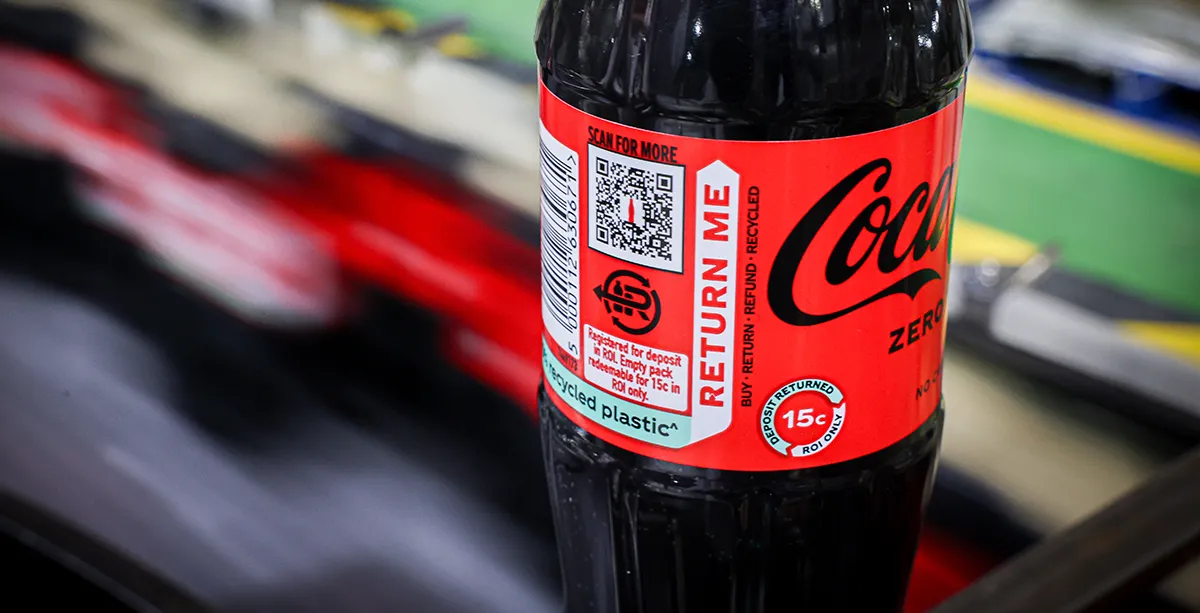
This Coca-Cola bottle shows the mandatory Re-turn deposit label used in Ireland since February 2024. The label includes the Re-turn logo — a circular arrow symbol — with the text "Return Me" and the slogan "Buy · Return · Refund · Recycled". The "Deposit Returned 15c ROI Only" badge indicates the deposit value and confirms the container is registered for the Irish market only. The bottle also carries a QR code for additional information and a note that it is made from recycled plastic.
📎 Download the Re-turn symbol:
- PNG – best for digital use.
EPR Eco Fees & Eco-Modulation
Fees are based on the weight of materials. Ireland is implementing eco-modulation, meaning fees are "modulated" based on the recyclability of the packaging. Packaging that is difficult to recycle or contains hazardous substances will face higher surcharges, while easily recyclable designs may qualify for lower rates.
Risks, Penalties & Common Mistakes
Failure to comply with Irish EPR regulations can result in:
-
Fines: Up to €500,000 or imprisonment for serious or repeat offenses.
-
Sales Bans: Non-compliant products may be blocked from sale in Ireland.
-
Common Mistakes: Neglecting to report shipping/transport packaging and failing to appoint an Authorized Representative as a foreign seller.
What E-Commerce Sellers Should Do Now
-
Assess whether you meet the €1M / 10 tonne threshold (pre-2026) or prepare for the zero threshold (post-August 2026).
-
Appoint a local Authorized Representative in Ireland.
-
Apply for Repak membership to handle your recycling obligations.
-
Update your internal systems to track packaging weight by material for the 2026 harmonized reporting.
Detailed EPR Guidance for each Jurisdiction
We support 36 jurisdictions
FAQ for Ireland EPR
Is EPR registration mandatory for all sellers in Ireland?
- Yes, as of August 12, 2026, all producers regardless of size must be registered.
Do I need an Authorized Representative if I have no Irish office?
- Yes, an AR is a legal requirement for foreign distance sellers.
What is Repak?
- Repak is the only government-authorized PRO for packaging in Ireland.
- While smaller sellers may pay simplified fees, all volumes must be reported.
Can online marketplaces block me for EPR?
- Yes, marketplaces are now legally required to ensure their sellers are EPR-compliant.
What is Ireland EPR Batteries
Ireland's battery EPR framework is governed by Regulation (EU) 2023/1542 — the EU Battery Regulation — which applies directly in all EU Member States. The Regulation has applied in stages since 18 February 2024, with EPR and waste management obligations fully in force from 18 August 2025. At national level, Ireland implements battery EPR through the Waste Management (Batteries and Accumulators) Regulations (S.I. 283/2014) and related statutory instruments, which are being updated to align with the EU Battery Regulation. The Environmental Protection Agency (EPA) and the Department of the Environment, Climate and Communications oversee compliance. Producer registration in Ireland is administered through PRL — Producer Register Ltd (producerregister.ie), Ireland's national producer register for batteries and WEEE. The primary compliance scheme for batteries in Ireland is WEEE Ireland, which manages collection, recycling, and reporting obligations on behalf of its members. WEEE Ireland has updated its compliance processes to align with the EU Battery Regulation and works with EUCOBAT — the European association of battery compliance schemes — to support harmonised EPR implementation across Member States.Does This Apply to E-Commerce & Online Sales
Yes. The EU Battery Regulation explicitly captures distance sellers and e-commerce operators as producers. All businesses selling batteries or battery-containing products on the Irish market — including via online and remote sales — must comply with Irish EPR regulations. Under Regulation (EU) 2023/1542, producers not established in Ireland must appoint an authorised representative to fulfil EPR obligations on the Irish market. WEEE Ireland has confirmed this requirement and supports member producers in establishing compliant arrangements for cross-border and e-commerce sales. Zalando included Ireland in its second wave of battery EPR verification, with the Irish system scheduled for activation by 31 March 2026. Battery-containing product listings on Zalando remain suspended for Irish sellers without a valid EPR registration number until this process is complete.Who is the "Producer" under Ireland EPR?
Under Regulation (EU) 2023/1542 and Irish battery regulations, a producer is any person who, in the course of commercial activity, makes batteries available on the Irish market for the first time. This covers:- Manufacturers established in Ireland who produce and sell batteries domestically under their own brand.
- Importers bringing batteries into Ireland from non-EU countries for the first time under their own name.
- Companies introducing batteries from another EU Member State into Ireland for the first time.
- Private label owners whose brand name appears on batteries manufactured by third parties.
- Distance sellers and online retailers established outside Ireland who sell batteries or battery-containing products directly to Irish consumers.
- Economic operators who prepare batteries for re-use or repurposing — treated as producers for the second life of the battery.
Who Must Register for EPR Batteries in Ireland
All producers placing batteries on the Irish market must register annually with the PRL — Producer Register Ltd (producerregister.ie), Ireland's national producer register for batteries and WEEE. Registration is a prerequisite for placing batteries on the Irish market. Producers must also join a compliance scheme — in practice WEEE Ireland — or demonstrate individual compliance with EPR obligations. WEEE Ireland manages collection targets, reporting to the EPA, and fee collection on behalf of its members. Reporting obligations are fulfilled through PRL's Blackbox system, Ireland's digital reporting platform for monthly battery placement data.Ireland EPR Battery Registration Threshold
Regulation (EU) 2023/1542 does not establish a minimum volume or turnover threshold below which producers are exempt from EPR obligations. All producers placing batteries on the Irish market must register and comply regardless of size or volume. The only exemption in the Regulation concerns batteries used in military or space equipment, which are outside the scope entirely. For due diligence obligations, companies with annual net turnover below €150 million (as adopted under the Omnibus IV package, July 2025) may be exempt — but this does not affect EPR registration and reporting obligations.Detailed EPR Guidance for each Jurisdiction
We support 36 jurisdictions
Batteries Covered (and Excluded)
Regulation (EU) 2023/1542 defines five battery categories, all within scope for EPR in Ireland: Portable batteries Batteries under 5 kg not designed for industrial or vehicle use. Includes batteries in consumer electronics, power tools, household devices, and toys. Light Means of Transport (LMT) batteries Batteries used in e-bikes, e-scooters, e-mopeds, and similar light electric vehicles. Automotive (SLI) batteries Starting, lighting, and ignition batteries used in vehicles. Industrial batteries Batteries used in industrial applications and stationary energy storage systems. Those above 2 kWh have additional requirements including battery passports from 2027. Electric vehicle (EV) batteries Batteries used in electric cars and heavy electric vehicles. Key exclusions:- Batteries designed for military or space equipment — outside scope entirely
- Batteries in nuclear installations — excluded
- Second-life batteries where the operator performing re-use or repurposing becomes the new producer
Producer Responsibility Organization (PRO)
The primary compliance scheme for batteries in Ireland is WEEE Ireland (weeeireland.ie). WEEE Ireland is an approved compliance scheme operating under Irish waste regulations and the EU Battery Regulation, managing collection infrastructure, reporting to the EPA, and supporting members with regulatory changes. WEEE Ireland provides members with:- Compliance certification confirming EPR scheme membership
- Access to nationwide battery collection infrastructure
- Data reporting support through the PRL Blackbox system
- Regulatory updates and sector meetings on EU Battery Regulation developments
EPR Registration in Ireland
The registration process for battery producers in Ireland is as follows:- Determine whether your business qualifies as a producer under the EU Battery Regulation and Irish battery regulations.
- If established outside Ireland, appoint an authorised representative established in Ireland before registering.
- Register annually with PRL — Producer Register Ltd (producerregister.ie), providing company details, battery categories, and brand names.
- Join WEEE Ireland as a compliance scheme member, or demonstrate individual compliance with EPR obligations.
- Set up access to PRL's Blackbox system for monthly declaration of battery volumes placed on the Irish market.
- Submit monthly declarations of battery types and quantities placed on the Irish market through the Blackbox system.
- Pay applicable contributions to WEEE Ireland based on battery category and volume.
- Retain records for audit by the EPA and PRL.
Authorized Representative
Under Regulation (EU) 2023/1542, producers established outside Ireland must appoint an authorised representative — a legal or natural person established in Ireland — to fulfil EPR obligations on their behalf. WEEE Ireland has confirmed this requirement in its guidance on the EU Battery Regulation. The authorised representative is responsible for PRL registration, WEEE Ireland membership, monthly Blackbox reporting, fee payment, and communication with Irish authorities. The representative must be appointed in writing. Important development: In December 2025, the European Commission proposed suspending the authorised representative requirement for EU-established companies until 2035. This proposal has not been formally adopted as of May 2026. For non-EU producers, the requirement is not affected and continues to apply.What Data Must Be Reported
Producers registered in Ireland must submit monthly declarations through PRL's Blackbox system covering:- Types and quantities of batteries placed on the Irish market during the reporting month, broken down by battery category (portable, LMT, SLI/automotive, industrial, EV)
- Battery chemistry type where relevant to compliance reporting
- Brand names under which batteries were placed on the market
- Collection and recycling performance data, compiled and reported by WEEE Ireland to the EPA on behalf of members
- For EV and LMT batteries: number of batteries made available and amounts of waste batteries collected and delivered to treatment facilities
First Reporting Period & EPR Reporting Deadlines
Battery EPR has been in place in Ireland for many years under former statutory instruments. The new EU Battery Regulation obligations took full effect from 18 August 2025. Key dates:- 18 August 2025: EU Battery Regulation EPR obligations fully in force. All producers must be registered and compliant.
- 31 March 2026: Zalando's Irish battery EPR verification scheduled to activate — sellers without a valid Irish EPR registration number will have battery listings blocked.
- Monthly: Battery declaration submissions through PRL Blackbox system — the types and quantities of batteries placed on the Irish market during the previous month.
- Annual: PRL registration renewal — registration with the Producer Register must be renewed each year.
- 18 February 2027: Battery passports mandatory for industrial batteries (>2 kWh) and EV batteries.
- 18 August 2027: Due diligence obligations in force (delayed under Omnibus IV).
Labels & Marketing Claims
Crossed-out wheeled bin symbol From 18 August 2025, all batteries must display the separate collection symbol covering at least 3% of the area of the largest side of the battery, up to a maximum of 5 × 5 cm. Chemical symbols Batteries containing more than 0.002% cadmium must be marked Cd. Batteries containing more than 0.004% lead must be marked Pb. Capacity marking Portable and rechargeable batteries must display capacity information. QR code From 18 August 2026, all batteries must carry a QR code. For LMT, industrial (>2 kWh), and EV batteries, this links to the Digital Battery Passport from 18 February 2027. CE marking Mandatory from 18 August 2024. Language requirements Consumer-facing information on batteries sold in Ireland must be provided in English and/or Irish where required under Irish consumer protection law. Environmental claims All environmental and sustainability claims must comply with Irish consumer protection law and the Unfair Commercial Practices Directive. The Empowering Consumers for the Green Transition Directive (2024/825/EU) must be transposed by March 2026, after which unsubstantiated green claims will be prohibited across the EU including Ireland.EPR Eco Fees & Eco-Modulation
WEEE Ireland sets contribution rates for its members based on the weight and category of batteries placed on the Irish market. Specific fee schedules should be confirmed directly with WEEE Ireland at the time of membership registration. Under Regulation (EU) 2023/1542, eco-modulation — adjusting contributions based on battery environmental performance — is required across all Member States. Ireland's specific eco-modulation framework under the new Regulation has not been separately published as of May 2026.Risks, Penalties & Common Mistakes
- Failing to register annually with PRL. Registration with the Producer Register is an annual requirement — it is not a one-time registration. Lapsing registration is a compliance breach.
- Missing monthly Blackbox reporting deadlines. Unlike most EU member states where reporting is annual or quarterly, Ireland requires monthly battery placement declarations through PRL's Blackbox system. Missing monthly submissions is an active compliance risk.
- Failing to appoint an authorised representative. Non-EU and non-Irish producers must appoint an Irish-established representative before registering with PRL. Without one, registration cannot be completed.
- Assuming one EU registration covers Ireland. Battery EPR registration is national. Membership in a PRO in another EU member state does not fulfil Irish obligations.
- Missing the Zalando EPR number requirement. Ireland's battery EPR verification on Zalando is scheduled for activation by 31 March 2026. Sellers without a valid Irish registration number will have battery listings suspended.
- Missing labelling requirements. The crossed-out wheeled bin symbol and CE marking are mandatory from August 2025.
- Missing the QR code deadline of August 2026. Companies should begin QR code implementation well in advance.
What E-Commerce Sellers Should Do Now
- Confirm whether your products contain batteries and whether they are being sold to Irish consumers.
- If established outside Ireland, identify and appoint an authorised representative established in Ireland.
- Register annually with PRL — Producer Register Ltd (producerregister.ie) for batteries.
- Join WEEE Ireland (weeeireland.ie) as a compliance scheme member.
- Set up monthly Blackbox reporting through PRL for battery types and quantities placed on the Irish market.
- Pay applicable contributions to WEEE Ireland based on battery category and volume.
- Verify that all batteries carry the crossed-out wheeled bin symbol, CE marking, and capacity information as required from August 2025.
- Plan for the QR code requirement by August 2026 and the Digital Battery Passport for industrial and EV batteries by February 2027.
Register online
Start your EPR Reporting within 24 hours
FAQ
Is battery EPR mandatory in Ireland?- Yes. Battery EPR has been mandatory in Ireland for many years under Irish statutory instruments. From 18 August 2025, the new EU Battery Regulation (2023/1542) fully replaced the former Batteries Directive. All producers placing batteries on the Irish market must register annually with PRL, join WEEE Ireland or demonstrate individual compliance, submit monthly battery placement declarations through the Blackbox system, and pay applicable contributions.
- Yes. All businesses selling batteries or battery-containing products on the Irish market — including via online and remote sales — must comply with Irish EPR regulations. Non-Irish companies must appoint an authorised representative established in Ireland before registering with PRL and joining WEEE Ireland.
- Ireland requires monthly declarations of battery types and quantities placed on the Irish market, submitted through PRL's Blackbox system. This is more frequent than most EU member states, which require annual or quarterly reporting. Producers must ensure their internal data systems can generate monthly placement data by battery category.
- Yes. Registration with PRL — Producer Register Ltd — must be renewed annually. This distinguishes Ireland from some other EU member states where registration is a one-time process. Producers must ensure renewal is completed each year to maintain valid EPR compliance status.
- No. The EU Battery Regulation does not establish a minimum volume or turnover exemption for EPR registration. All producers placing batteries on the Irish market must register and comply regardless of size.
Textile EPR law in Ireland: None enacted
Ireland is not among the countries with enacted textile EPR legislation.
Want to be first to know when new EPR will issued?
Only important news!