


Czech Republic EPR
What is Czech Republic EPR packaging
Czech packaging EPR is governed by Act No. 477/2001 Coll., on Packaging (as amended). It makes persons who place packaging on the market or into circulation responsible for ensuring take-back and recovery obligations, most commonly via the authorised packaging company EKO-KOM (collective compliance).Does this apply to e-commerce & online sales
Yes. If you sell packaged goods into Czechia (including B2C e-commerce) and you are considered the party placing packaging on the market (often the importer or distance seller), EPR obligations apply.Who is the 'producer' under Czech EPR
In practice, the “producer” is the entity that places packaging on the market / into circulation—the EKO-KOM system guide summarises this as entities that fill, import, or sell to the Czech Republic.
Who must register for EPR packaging
Entities placing packaging on the market must register in the Ministry of Environment's List of Subjects unless qualifying for the small-entity exemption.Registration threshold
Exemption applies if BOTH conditions are met:- ≤ 300 kg of packaging per calendar year AND
- annual turnover ≤ CZK 25,000,000.
Detailed EPR Guidance for each Jurisdiction
We support 36 jurisdictions

EPR and PPWR for Czech Republic
Czech packaging EPR runs through Act No. 477/2001 Coll. on Packaging, and in practice that means one name: EKO-KOM, the authorised packaging company most producers join for collective compliance. Sign the Contract on Collective Compliance, report packaging quarterly, pay contributions calculated with built-in eco-modulation — the Packaging Act already factors recyclability and hazardous substances into what EKO-KOM charges, which puts Czechia ahead of several EU peers on that front. Below 300 kg a year and CZK 25 million in turnover, both conditions together, a small-entity exemption applies.
PPWR doesn't restructure any of that, but EKO-KOM itself has flagged something worth knowing: from 12 August 2026, PPWR widens who counts as a "producer" under the Czech system. Manufacturers, importers, and distributors of empty service, transport, and primary packaging — categories that weren't always captured under the national Packaging Act — may now fall within EKO-KOM's contribution base for the first time, purely because PPWR's EU-wide producer definition is broader than the Czech one. EKO-KOM has published new reporting methodologies specifically to handle this shift, which tells you it's not a theoretical concern.
The authorised representative question lands more smoothly here than in most EU markets, because Czech law already has a statutory AR mechanism — written agreement, established in the Czech Republic, assuming the producer's obligations. PPWR's Article 45 AR requirement from 12 August 2026 overlays cleanly on a structure that already existed, rather than creating something from nothing.
The genuinely distinctive piece is the deposit-return system launching in 2027 for PET bottles and cans — explicitly framed by the Ministry of Environment as preparation for PPWR's DRS mandate, not a domestic initiative running in parallel to it. Czechia is also one of the few markets where recycled-content rules preceded PPWR rather than following it: PET bottles up to 3 litres have needed at least 25% recycled plastic since 2025.
PPWR Labels for Czech Republic
Czech packaging labelling is comparatively light. There's no mandatory national sorting logo — no Triman, no compulsory Green Dot — just the standard EU material identification codes, the Möbius loop paired with a material abbreviation like PAP 20 for corrugated cardboard or PAP 21 for folding cartons. That's the entire mandatory labelling landscape at the moment.
Which means Czechia sits in a genuinely easier position than most EU countries once PPWR's harmonised sorting pictogram becomes mandatory from 12 August 2028. There's no competing national symbol to phase out, no Green Dot licensing arrangement to unwind, no CJEU case waiting to decide whether a Czech label survives. The pictogram simply adds a new layer on top of the material codes that already exist.
The real labelling change to watch isn't PPWR's pictogram at all — it's the deposit-return marking arriving with the 2027 DRS launch. Beverage containers in scope will need a deposit symbol before the harmonised pictogram even becomes mandatory, meaning Czech businesses face two new label elements landing roughly a year apart: a national deposit mark in 2027, then the EU-wide sorting pictogram in 2028.
For context on the EU-wide picture, France's Triman requirement — referred to the CJEU in July 2025 over restricting free movement of goods — is the case that will determine how much room national labelling schemes get once PPWR's pictogram exists. Czechia has no equivalent scheme at risk, but the ruling still sets the ceiling for what any member state, including this one, can require going forward. See the PPWR labelling requirements for the EU-wide pictogram rules, implementation dates and upcoming packaging label changes.
PPWR Product Rules for Czech Republic
The PFAS restriction has applied since 12 August 2026: food-contact packaging on the Czech market can't exceed 25 ppb for any single measured PFAS substance, 250 ppb summed, or 50 ppm total including polymeric PFAS. A food-contact coating that crosses that line doesn't get corrected after the fact — it stops moving, treated with the same seriousness as a CE-marking failure.
Recyclability lands on 1 January 2030, requiring packaging to sit in Design for Recycling Performance Grade A, B, or C, with Grade C losing market access from 2035. Recycled content thresholds for contact-sensitive plastic packaging arrive the same year and step up again by 2040 — though Czechia has a head start here that most EU countries don't: PET bottles up to 3 litres have already needed 25% recycled content since 2025, ahead of PPWR's own timeline, which gives suppliers already selling into Czechia a running start on the EU-wide requirement. Packaging minimisation follows on the 2030 date too, capping empty space in grouped, transport, and e-commerce packaging at 50%. Reuse and refill targets for beverage, grouped, and transport packaging phase in from 2030 as well.
For suppliers and design teams, the practical advantage in Czechia is that EKO-KOM isn't waiting for enforcement deadlines to catch up — it's already publishing PPWR-specific reporting methodologies and clarifying which packaging categories now trigger contributions under the broadened producer definition. That's a rarer position for a PRO to be in this early, and it means the documentation trail for PPWR's technical file has somewhere concrete to plug into rather than being built from scratch.
Packaging covered and excluded
Broadly, the regime covers packaging placed on the Czech market (sales/transport/group packaging, etc.). Key “special” areas include deposit returnable packaging requirements and single-use plastic packaging “littering” cost reimbursement rules (since 2023).Producer Responsibility Organization (PRO)
Czechia uses an authorised packaging company model; EKO-KOM is the main authorised packaging company providing collective compliance for take-back and recovery obligations.EPR registration process
Most companies join EKO-KOM via contract for collective compliance. Application must be submitted within 60 days from when obligations commence. Two tracks usually exist:- Collective compliance (typical) via EKO-KOM - Join by signing a Contract on Collective Compliance (EKO-KOM onboarding flow includes registration form → contract → fee payment → certificate).
- Individual compliance - The EKO-KOM guide notes collective compliance is not the only way (other ways exist under Section 13), but it’s less common in practice for most companies.
Authorized representative
Czech law explicitly allows appointing an authorised representative:- must be appointed by written agreement
- must be a business person established in the Czech Republic
- fulfils the obligations of the party placing packaging on the market/into circulation (with limited exceptions).
Data reporting requirements
At a minimum, entities in scope must keep records on packaging/packaging waste and report data from records for the previous calendar year. In collective compliance, EKO-KOM typically collects packaging data and handles system-level obligations, while you still must keep adequate records.First reporting period
In the Czech Republic, packaging reporting under EKO-KOM is generally required on a quarterly basis, with annual reporting only possible in exceptional cases depending on the contract and volumes. For businesses handling recurring EPR declarations, Lappa offers reporting plans based on waste volume, number of jurisdictions and reporting needs.EPR reporting deadlines
Quarterly reports must be submitted within 30 days after the end of each calendar quarter.Labels & marketing claims
Czech Republic follows standard EU material identification codes for packaging. There is no mandatory national EPR logo equivalent to France's Triman — the main labeling requirement focuses on material identification to support sorting and recycling.
An example of what a label looks like on packaging for Czech Republic
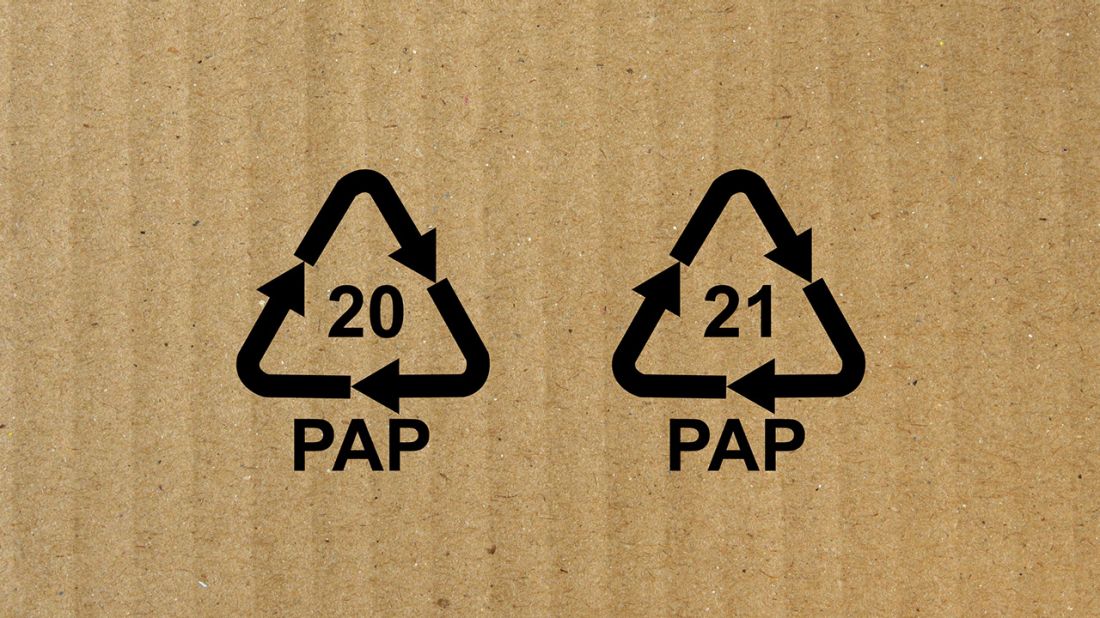
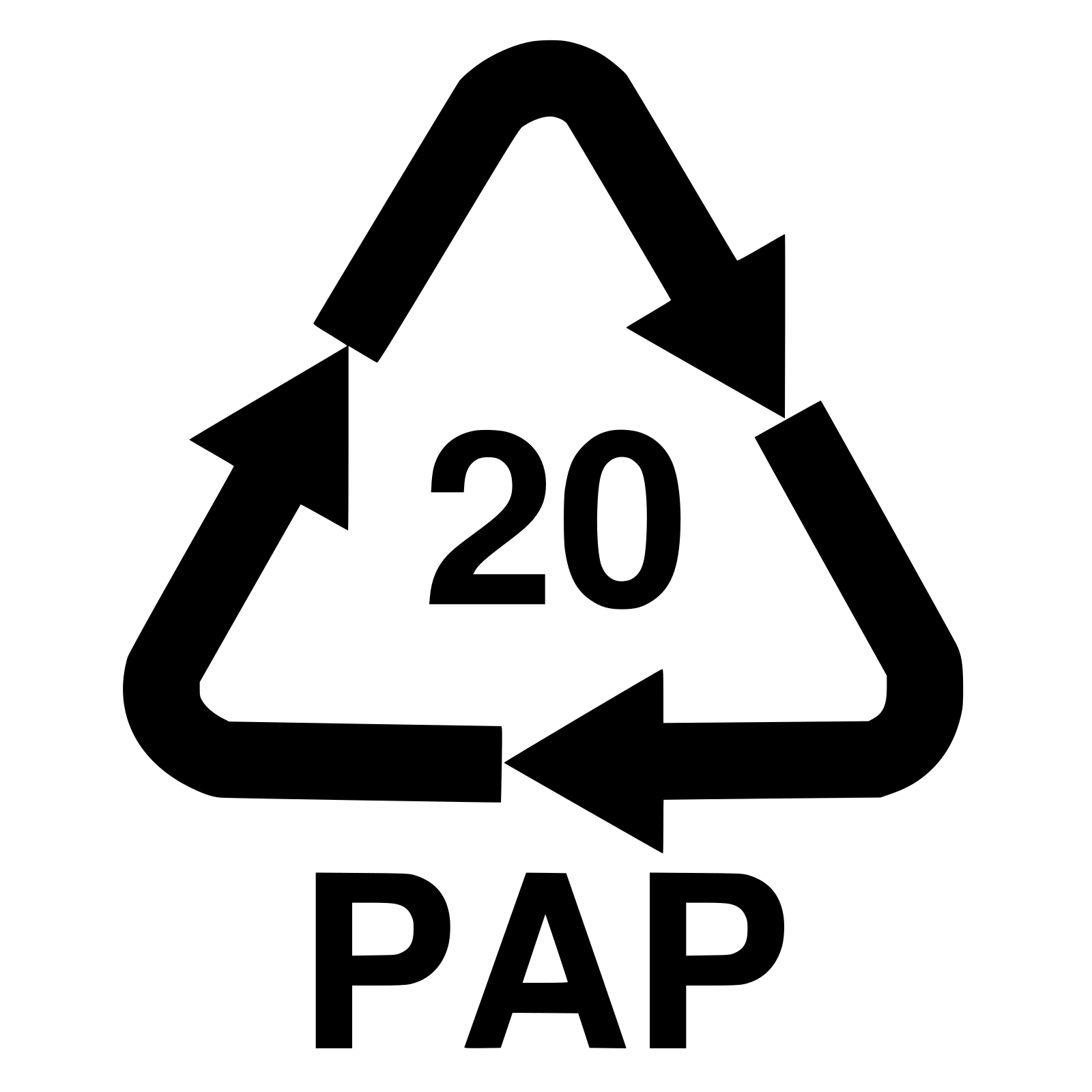
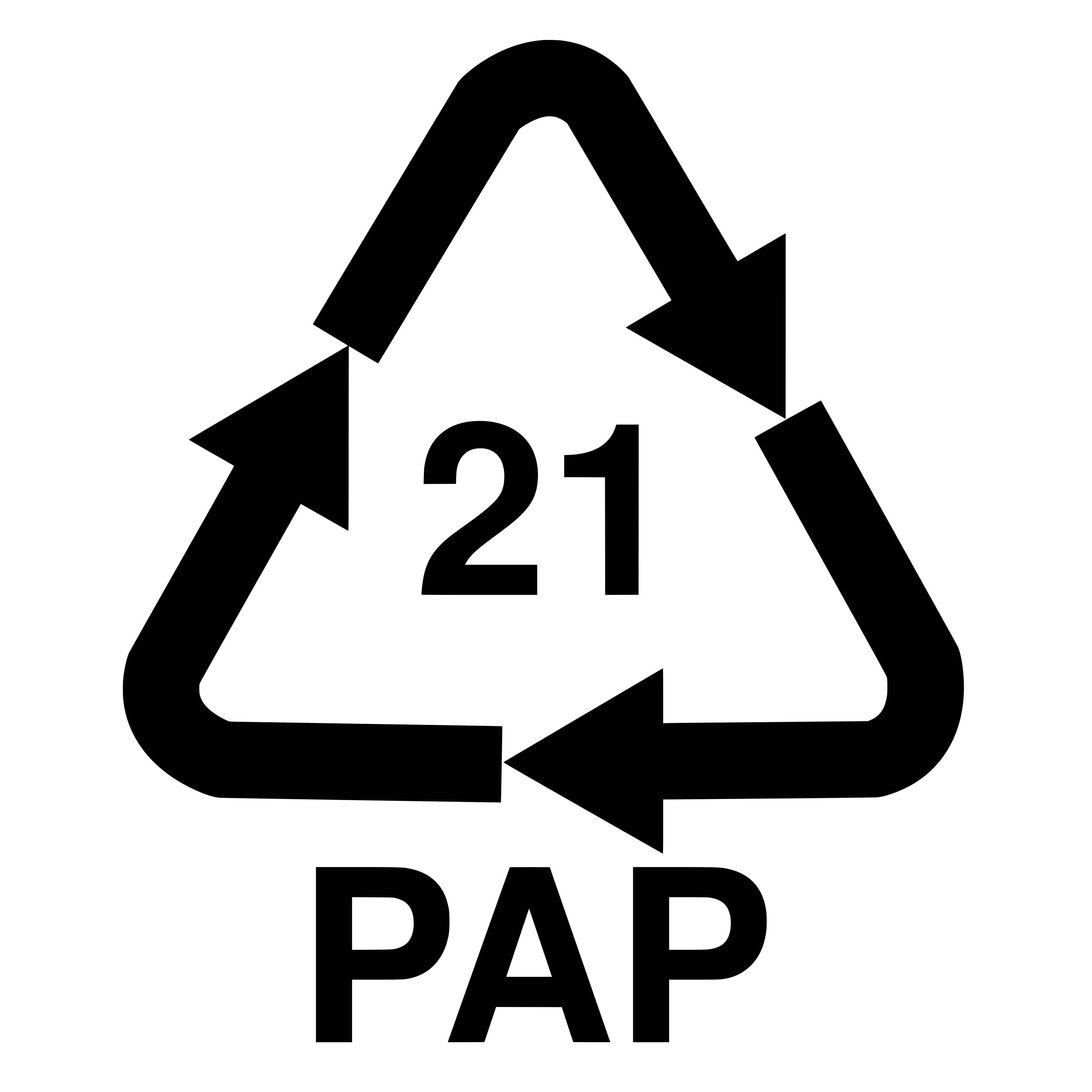
This image shows two material identification codes commonly found on paper and cardboard packaging sold in the Czech Republic and across the EU. The PAP 20 code identifies corrugated cardboard (e.g. shipping boxes), while PAP 21 identifies non-corrugated cardboard such as folding cartons and paperboard. Both use the Möbius loop triangle — the universal recycling symbol — with the material abbreviation PAP (from French papier) and the corresponding number below.
📎 Download the PAP 20 symbol:

📎 Download the PAP 21 symbol:

Eco fees & eco-modulation
- The Packaging Act defines eco-modulation as taking into account packaging’s environmental impact (e.g., reusability/recyclability, hazardous substances) when the authorised packaging company determines the contribution amount.
- In collective compliance, fees are generally linked to the amounts and materials of packaging you report (EKO-KOM collects data and payments based on reported production).
Risks & penalties
Penalties: the Packaging Act provides for fines up to CZK 10,000,000 for certain offences (with lower brackets such as CZK 50k / 500k / 1m / 5m depending on the offence category). Common mistakes (seen in practice):- assuming VAT registration = EPR compliance (it doesn’t)
- missing List registration / missing the 15 Feb annual reporting cycle
- under-reporting packaging (especially transport/e-commerce packaging)
- no authorised representative where needed for a non-established seller.
What e-commerce sellers should do now
- Map your flows: who imports / who is first placing on CZ market (incl. marketplace vs own webshop).
- Check if you qualify for the 300 kg + CZK 25m exception; document it if you rely on it.
- If in scope, choose compliance route (typically EKO-KOM) and get your contract + certificate in place.
- Set up packaging data capture by material/weight; align internal reporting calendar to 15 Feb.
- If not established in CZ, assess whether you need an authorised representative.
Get a 20 min free consultation for EPR
Find all your answers and become part of Lappa
FAQ for EPR Czech Republic
Is EKO-KOM the only option?
Collective compliance via the authorised company (EKO-KOM) is the common route, but the system guide notes it’s not the only possible compliance method under Czech law.Do I need to register even if I join EKO-KOM?
- The act requires registration in the Ministry’s “List”; in practice, collective compliance arrangements often interact with List/registration handling, but you should still confirm that your entity (or your authorised representative) is correctly covered.What is Czech Republic EPR EEE
The Czech Republic's EEE EPR framework is governed by Act No. 542/2020 Coll. on End-of-Life Products (zákon č. 542/2020 Sb., o výrobcích s ukončenou životností), which transposed the EU WEEE Directive (Directive 2012/19/EU) into Czech national law and replaced the previous Act No. 185/2001 Coll. on Waste. Implementing details are set out in Decree No. 16/2022 Coll. on the handling of certain end-of-life products. The legislation establishes rules for placing EEE on the Czech market, for take-back, treatment, and re-use of end-of-life equipment, for financing EEE waste management, and for the obligations of producers, final sellers, and distributors. The competent authority overseeing EEE EPR is the Ministry of Environment of the Czech Republic (MŽP), which maintains the Registry of EEE Producers (Seznam výrobců elektrozařízení). The enforcement body is the Czech Environmental Inspectorate (ČIŽP), which conducts inspections and verifies compliance with Act No. 542/2020. There is no de minimis threshold for EEE EPR registration in the Czech Republic — the obligation applies from the very first device placed on the Czech market.Does This Apply to E-Commerce & Online Sales
Yes. Act No. 542/2020 explicitly captures online sellers and marketplace operators supplying EEE to Czech consumers. All producers — regardless of establishment location — must comply with EEE EPR obligations when placing electrical and electronic equipment on the Czech market for the first time. Foreign companies without a physical presence in the Czech Republic must appoint an authorised representative to manage registration, reporting, and compliance on their behalf. Online marketplaces are generally not considered responsible for EEE EPR unless they act as importers or directly place products on the market under their own name. The Czech Environmental Inspectorate (ČIŽP) can cooperate with Czech Customs to enforce EEE EPR obligations, including at the point of import, against non-compliant producers.Who is the "Producer" under Czech Republic EPR?
Under Act No. 542/2020, the following entities are considered producers of EEE:- Manufacturers producing EEE in the Czech Republic for domestic or international markets.
- Importers bringing EEE into the Czech Republic from other EU or non-EU countries under their own name.
- Distributors and resellers placing EEE on the Czech market under their own brand, unless the original manufacturer or importer is already registered.
- Online sellers supplying EEE to consumers in the Czech Republic, regardless of where the seller is established.
- Private label owners whose brand name appears on EEE manufactured by third parties.
- Economic operators who prepare EEE for re-use — treated as producers for the second life of the equipment where applicable.
Who Must Register for EPR EEE in Czech Republic
All producers placing EEE on the Czech market must register in the Registry of EEE Producers (Seznam výrobců elektrozařízení), maintained by the Ministry of Environment (MŽP). Registration is a mandatory precondition for placing EEE on the Czech market. Producers must also join a licensed collective scheme (PRO) for EEE take-back and recycling, or establish their own individual take-back system subject to MŽP approval. Licensed collective schemes operating in the Czech Republic for EEE include RETELA, REMA System, Asekol, and others listed in the MŽP register of licensed collective systems (seznam kolektivních systémů OEEZ). Upon joining a collective scheme and completing registration, producers receive a unique registration number required for reporting and compliance.Czech Republic EPR EEE Registration Threshold
There is no de minimis threshold for EEE EPR registration in the Czech Republic. Act No. 542/2020 requires registration and compliance from the very first device placed on the Czech market, regardless of volume or turnover. This applies equally to small e-commerce sellers and large multinational manufacturers.Detailed EPR Guidance for each Jurisdiction
We support 36 jurisdictions
EEE Categories Covered (and Excluded)
The Czech Republic applies the open scope approach under Annex I to Act No. 542/2020, covering all EEE operating at voltages not exceeding 1,000V AC or 1,500V DC unless specifically excluded. The six open-scope categories are: Large household appliances Refrigerators, washing machines, dishwashers, cookers, electric heaters, air conditioners, and similar large appliances. Small household appliances Vacuum cleaners, toasters, coffee machines, irons, hair dryers, electric clocks, and similar small devices. IT and telecommunications equipment Computers, laptops, tablets, smartphones, printers, routers, and related devices. Consumer electronics and photovoltaic panels Televisions, radios, audio and video equipment, cameras, and photovoltaic panels. Lighting equipment Fluorescent lamps, LED lamps, high-intensity discharge lamps, and luminaires (excluding filament bulbs). Other EEE (open scope) All remaining EEE within the voltage parameters not captured in the above categories, including electrical and electronic tools, toys, medical devices, monitoring instruments, and automatic dispensers. Key exclusions:- EEE specifically designed and installed as part of another type of equipment that can only function as part of that equipment
- Large-scale fixed installations and large-scale stationary industrial tools
- Military or space equipment specifically designed for these purposes
- Implanted and infected medical devices
- EEE operating above 1,000V AC or 1,500V DC
Producer Responsibility Organization (PRO)
The Czech Republic operates a multi-PRO system for EEE. Licensed collective schemes authorised by MŽP manage take-back, recycling, and reporting on behalf of their member producers. The main licensed collective systems include: RETELA — one of the established collective schemes for EEE in the Czech Republic, managing take-back infrastructure and recycling across product categories. REMA System — a collective scheme covering EEE and batteries, part of a broader European compliance network. Asekol — a specialist collective scheme for small EEE and IT equipment, managing a nationwide network of red Asekol collection boxes in stores and public spaces. The MŽP publishes the full list of licensed collective systems (seznam kolektivních systémů OEEZ) on its website. Producers should confirm which scheme is accredited for their specific EEE categories before signing a membership agreement.EPR Registration in Czech Republic
The registration process for EEE producers in the Czech Republic is as follows:- Confirm whether your EEE falls within scope of Act No. 542/2020 based on voltage rating and open-scope category list.
- If established outside the Czech Republic, appoint an authorised representative established in the Czech Republic before initiating registration.
- Register in the Registry of EEE Producers (Seznam výrobců elektrozařízení) with the Ministry of Environment (MŽP), providing company details, EEE categories, brand names, and authorised representative information.
- Select and join a licensed collective scheme — RETELA, REMA System, Asekol, or another MŽP-licensed PRO — by signing a service agreement and submitting required documentation.
- Pay registration fees — fees vary by collective scheme and EEE category.
- Receive your unique EEE registration number upon approval — this number is required for reporting and compliance.
- Submit quarterly reports on EEE placed on the Czech market and end-of-life equipment collected and processed.
- Pay contributions to the collective scheme based on EEE weight and category.
- Maintain records for audit by ČIŽP.
Authorized Representative
Foreign companies without a physical presence in the Czech Republic must appoint an authorised representative established in the Czech Republic before any registration can be completed. The AR assumes full responsibility for all EEE EPR obligations, including registration in the MŽP registry, collective scheme membership, quarterly reporting, financial contributions, and communication with ČIŽP. Important development: In December 2025, the European Commission proposed suspending the authorised representative requirement for EU-established companies until 2035 under Proposal COM(2025) 983. This proposal has not been formally adopted as of May 2026. For non-EU producers, the requirement is not affected and continues to apply.What Data Must Be Reported
Producers must submit quarterly reports through their collective scheme and the MŽP registry system covering:- Total weight (kilograms) of EEE placed on the Czech market during the quarter, broken down by the six open-scope categories under Act No. 542/2020
- Separate reporting for household (B2C) versus non-household (B2B) EEE where applicable
- Weight of end-of-life equipment collected and processed during the reporting period
- Brand names under which EEE was placed on the market
- Projected sales volumes (provided at registration for the current and following year)
- Recycling and recovery rates for registered product groups where required
First Reporting Period & EPR Reporting Deadlines
EEE EPR has been mandatory in the Czech Republic for many years. The current framework under Act No. 542/2020 has been in place since 2021. Key recurring deadlines:- Quarterly: EEE placed-on-market and end-of-life equipment collected declarations — submitted through the collective scheme
- Annual: Summary compliance reporting to MŽP through the collective scheme
- Annual ISPOP: Required only if the company has a physical presence in the Czech Republic and exceeds waste thresholds — not applicable to most foreign e-commerce sellers
Labels & Marketing Claims
Crossed-out wheeled bin symbol All EEE placed on the Czech market must carry the crossed-out wheeled bin symbol, indicating separate collection. The symbol must be visible, legible, and indelible on the product itself. Where this is not possible due to the size or function of the product, the symbol must appear on packaging, instructions for use, or warranty documentation. CE marking Mandatory for applicable EEE categories under EU product safety legislation. RoHS compliance EEE must comply with Directive 2011/65/EU (RoHS) restricting hazardous substances. RoHS compliance in the Czech Republic is overseen by the Ministry of Industry and Trade — separately from EEE EPR administered by MŽP. Language requirements Consumer-facing information on EEE sold in the Czech Republic must be provided in Czech where required under Czech consumer protection law. Environmental claims The Empowering Consumers for the Green Transition Directive (2024/825/EU) must be transposed by March 2026, after which unsubstantiated green claims will be prohibited across the EU including the Czech Republic.EPR Eco Fees & Eco-Modulation
Czech collective schemes set contribution rates for member producers based on the weight and category of EEE placed on the Czech market. Contributions are calculated on a per-kilogram basis by EEE category and cover the costs of take-back infrastructure, collection, treatment, and recycling. The Czech Republic does not currently apply a formal eco-modulation framework adjusting EEE contributions based on product repairability, recyclability, or eco-design criteria. As the Ecodesign for Sustainable Products Regulation (ESPR) implementing regulations for specific EEE product groups are adopted, eco-design criteria may influence future contribution structures. Specific fee schedules should be confirmed with the chosen collective scheme at the time of membership registration.Risks, Penalties & Common Mistakes
- Placing EEE on the Czech market without MŽP registration. The Czech Environmental Inspectorate (ČIŽP) conducts inspections and can impose significant fines for non-compliance with Act No. 542/2020. ČIŽP can cooperate with Czech Customs to target non-compliant importers.
- Failing to appoint an authorised representative. Foreign companies without Czech establishment must appoint an AR before registration can be completed. Operating without an AR is a compliance breach.
- Missing the no-threshold rule. There is no de minimis exemption for EEE in the Czech Republic — the obligation applies from the very first device. Small e-commerce sellers often incorrectly assume they are below a registration threshold.
- Assuming one EU registration covers the Czech Republic. EEE EPR registration is national. Registration in another EU member state does not fulfil Czech obligations. A separate MŽP registration and Czech collective scheme membership are required.
- Choosing the wrong collective scheme. The MŽP publishes a list of licensed collective systems. Producers should confirm which scheme covers their specific EEE categories before signing a contract.
- Confusing ISPOP reporting with EEE EPR reporting. ISPOP is the Czech national environmental reporting platform managed by CENIA — but most foreign e-commerce sellers without a Czech physical presence do not report to ISPOP. EEE EPR reporting is handled separately through the collective scheme system.
- Missing the crossed-out wheeled bin symbol. The symbol is mandatory on all EEE. Missing or non-compliant marking is independently actionable by ČIŽP.
What E-Commerce Sellers Should Do Now
- Confirm whether your products qualify as EEE under Act No. 542/2020 based on voltage rating and product function.
- If established outside the Czech Republic, appoint an authorised representative established in the Czech Republic.
- Register in the Registry of EEE Producers (Seznam výrobců elektrozařízení) with the Ministry of Environment (MŽP).
- Select and join a licensed collective scheme — RETELA, REMA System, Asekol, or another MŽP-licensed PRO.
- Receive your EEE registration number and use it for all reporting and compliance purposes.
- Set up quarterly reporting of EEE placed on the Czech market by category and weight through your collective scheme.
- Ensure all EEE products carry the crossed-out wheeled bin symbol — visibly, legibly, and indelibly — and comply with RoHS hazardous substance restrictions.
- Maintain records for audit by ČIŽP.
Register online
Start your EPR Reporting within 24 hours
FAQ
Is EEE EPR mandatory in the Czech Republic?- Yes. EEE EPR has been mandatory in the Czech Republic for many years and is currently governed by Act No. 542/2020 Coll. on End-of-Life Products. All producers placing EEE on the Czech market must register in the MŽP Registry of EEE Producers, join a licensed collective scheme, submit quarterly reports, and pay contributions. There is no de minimis threshold — the obligation applies from the very first device.
- Yes. Act No. 542/2020 explicitly captures online sellers supplying EEE to Czech consumers, regardless of where the seller is established. Foreign companies must appoint an authorised representative established in the Czech Republic before registration can be completed. The Czech Environmental Inspectorate can cooperate with Czech Customs to enforce these obligations against non-compliant importers.
- No. There is no de minimis exemption for EEE in the Czech Republic. Registration and compliance are required from the very first device placed on the Czech market, regardless of volume or annual turnover.
- The MŽP publishes a full list of licensed collective systems for EEE. Main options include RETELA, REMA System, and Asekol. Producers should confirm which scheme covers their specific EEE categories — Asekol, for example, specialises in small EEE and IT equipment. Contact multiple schemes and compare contribution rates and service terms before signing.
- These are completely separate systems. EEE EPR reporting is handled through the collective scheme system under Act No. 542/2020. ISPOP is the Czech national environmental reporting platform for waste, emissions, and wastewater — it applies only to companies with a physical presence in the Czech Republic that exceed specific waste thresholds. Most foreign e-commerce sellers without Czech presence do not have ISPOP obligations.
Textile EPR law in Czech Republic: None enacted
Czech Republic is not among the countries with enacted textile EPR legislation.
Want to be first to know when new EPR will issued?
Only important news!