


Norway EPR
Provinces
Packaging
Provinces
Packaging
Battery
Textile
EEE
About
Packaging
About
Packaging
About
Battery
About
Battery
About
Textile
About
Textile
About
EEE
About
EEE
Packaging
Battery
Textile
EEE
Packaging
Battery
Textile
EEE
What is Norway EPR packaging
EPR (Extended Producer Responsibility) in Norway is a system under which companies placing packaging on the Norwegian market are required to finance and ensure the collection and recycling of packaging waste. The main purpose is to ensure that packaging waste management costs are not borne by the government or consumers, but instead are covered by the businesses introducing packaging into the market. In Norway, packaging EPR obligations are typically fulfilled through Producer Responsibility Organizations (PROs) (collective compliance schemes).Does this apply to e-commerce & online sales
Yes. Norway packaging EPR applies to e-commerce and online sales compliance, including:- sales through a company’s own website
- sales through marketplaces
- direct B2C deliveries into Norway
- cross-border e-commerce (sales from abroad)
Who is the “producer” under Norway EPR
In Norway, the “producer” (responsible party) is generally the company that first places packaging on the Norwegian market, for example:- a Norwegian manufacturer that packages goods
- an importer of packaged goods
- a company importing packaging materials
- a foreign company selling packaged products directly to Norwegian end consumers (in certain cases)
Who must register for EPR packaging in Norway
The obligation typically EPR registration is required to:- Importers of packaged goods
- Manufacturers that use packaging to place goods on the market
- Companies that fill/pack products into packaging (fillers/packers)
- Retailers, if they import goods themselves
- E-commerce sellers, if they act as the importer (or effectively as the “first supplier” into Norway)
Norway EPR packaging registration threshold
Norway EPR thresholds generally follows the principle: if you place packaging on the market, you must participate in a producer responsibility system. In practice, thresholds and requirements may depend on:- packaging type
- annual packaging weight
- whether the company participates through a PRO
Easy to use EPR Software to calculate Eco-fee
Manage All Countries with Lappa

Packaging covered (and excluded)
Covered packaging
Packaging EPR in Norway usually covers:- primary packaging (product box, bottle, bag)
- secondary packaging (group or multipack packaging)
- transport packaging (shipping cartons, film, pallet wrap)
- e-commerce shipping packaging (shipping boxes, mailers)
- plastic
- cardboard/paper
- glass
- metal
- composite materials
Excluded / special regimes
Some categories may be regulated separately, such as:- packaging for hazardous substances
- certain types of industrial packaging
- deposit return schemes (e.g., beverage containers)
Producer Responsibility Organization (PRO)
In Norway, packaging EPR compliance is typically managed through a PRO, an organization that:- collects producer reports
- calculates environmental fees (eco fees)
- organizes collection and recycling
- provides proof of compliance
EPR registration in Norway
The standard compliance EPR registration process usually includes:- Determining whether you qualify as a “producer”
- Identifying packaging types and materials
- Selecting the appropriate PRO
- Signing an agreement / joining the PRO
- Submitting company information
- Setting up internal packaging tracking by material and weight
- Submitting regular reports and paying eco fees
Authorized representative
For foreign companies, a common question is whether an EPR authorized representative is required. In Norway, this may be required or recommended if:- the company does not have a legal entity in Norway
- the company sells directly to Norwegian consumers (cross-border sales)
- register directly through a PRO (if possible), or
- use a local representative/importer
What data must be reported
Reporting generally requires information on: Packaging weight (kg)- plastic
- paper/cardboard
- glass
- aluminium/metal
- composite materials
- consumer packaging
- transport packaging
- e-commerce shipping packaging
- number of units (sometimes required)
- total packaging weight per year/quarter
- producer / importer / distributor
First reporting period
The first reporting period usually starts either:- from the moment the company begins sales/imports into Norway, or
- from the date of registration with the PRO
EPR reporting deadlines
Deadlines depend on the selected PRO and the reporting format. In practice, the most common reporting cycles are:- annual reporting (annual declaration)
- quarterly reporting for larger companies
- Year-end adjustments and final reconciliations may also apply.
Labels & marketing claims
Norway does not have a single mandatory recycling label for all packaging. However, beverage containers must carry the "Pant" deposit label, and producers registered with Grønt Punkt Norge may display the Green Dot symbol on their packaging.An example of what a label looks like on packaging for Norway
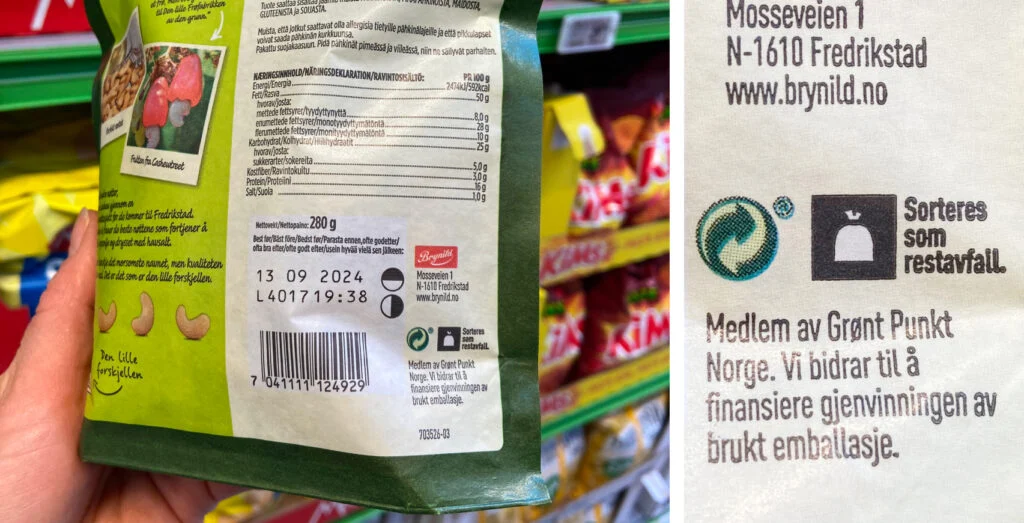
This packaging shows two labels used in Norway. The Nordic sorting symbol — a dark square with a bin icon — with the text "Sorteres som restavfall" ("Sort as residual waste") indicates that this flexible plastic packaging cannot be recycled and should be placed in general waste. Next to it is the Grønt Punkt (Green Dot) symbol, confirmed by the text "Medlem av Grønt Punkt Norge" ("Member of Green Dot Norway") — indicating that the producer financially contributes to packaging waste collection and recycling in Norway.
📎 Download the Grønt Punkt symbol:


📎 Download Nordic sorting symbol:


EPR eco fees & eco-modulation
Eco fees
Eco fees are payments made to the PRO and are usually calculated based on:- packaging weight
- material type
- recyclability
- composition (e.g., composite materials are often more expensive)
Eco-modulation
Some PRO schemes apply eco-modulation, meaning:- lower fees for packaging that is easy to recycle
- higher fees for problematic or multi-layer packaging
Risks, penalties & common mistakes
Key risks- reporting and fee obligations may be audited or reviewed
- fines may apply for non-compliance
- eco fees may be charged retroactively
- assuming “we are just an online shop” means EPR does not apply
- failing to include transport and shipping packaging
- using rough estimates instead of verified weights
- not separating materials correctly (plastic vs composite)
- applying the wrong producer/importer role
- ignoring packaging added by fulfillment/3PL partners
What e-commerce sellers should do now
Recommended compliance checklist- Review the supply chain and determine who is the importer
- Identify who qualifies as the “producer” under Norwegian rules
- Collect packaging information:
- packaging types
- materials
- weight
-
- shipping boxes
- bubble wrap
- mailer bags
- Select a PRO and prepare registration
- Implement ongoing packaging tracking (ERP or reporting templates)
- Prepare documentation to support eco-claims and marketing statements
Register online
Start your EPR Reporting within 24 hours
FAQ for Norway packaging EPR
If we sell through a marketplace, do we still need EPR?
Yes, if you are the company effectively placing the packaging on the market (especially if you act as the importer).If goods are shipped from an EU warehouse, does that count as placing packaging on the Norwegian market?
Yes. If the final delivery is to Norway, packaging waste is generated in Norway and EPR may apply.If we do not have a company in Norway, can we still register?
Usually yes, but a local representative may be required, or compliance may be handled via an importer/partner.Do we need to include shipping boxes and mailers?
Yes. Shipping packaging is part of the packaging waste generated in Norway.Can we delegate compliance to a logistics provider
Sometimes, if the logistics provider is legally the importer/producer under the documentation. However, responsibility must be clearly confirmed in contracts.What documents are needed to calculate packaging weight
Common supporting documents include:- packaging supplier specifications
- BOM (Bill of Materials)
- technical data sheets
- internal weight measurements
- data from fulfillment/3PL partners
What is Norway EPR Batteries
Norway is a member of the European Economic Area (EEA) and implements EU environmental legislation through the EEA Agreement. Regulation (EU) 2023/1542 — the EU Battery Regulation — applies in Norway through this agreement, with EPR and waste management obligations in force from 18 August 2025. At national level, Norway's battery EPR framework is governed by the Battery Regulations (batteriforskriften), administered by the Norwegian Environment Agency (Miljødirektoratet). Battery producer responsibility has been mandatory in Norway for many years under earlier legislation transposing the former Batteries Directive 2006/66/EC through the EEA Agreement. The established PRO for batteries in Norway is Batteriretur AS (batteriretur.no), a long-standing collective scheme that manages battery collection, recycling, and reporting on behalf of its members. The new EU Battery Regulation brings significantly more comprehensive, detailed, and harmonised requirements than the previous Batteries Directive — placing collection targets directly on producers rather than the state for the first time, and introducing new requirements for battery passports, carbon footprint declarations, and recycled content. A transitional arrangement is in place: municipal battery collection in Norway continued until 1 January 2026 to ensure a smooth transition to the new rules under the EU Battery Regulation. Regarding marketplace enforcement: Zalando has indicated it is "working on Norway" and will update sellers soon — no fixed activation date for Norwegian battery EPR number verification has been published as of May 2026. This reflects the fact that Norway's national producer register under the new EU Battery Regulation framework is still being formalised.Does This Apply to E-Commerce & Online Sales
Yes. The EU Battery Regulation applies in Norway through the EEA Agreement and explicitly captures distance sellers and e-commerce operators as producers. A foreign brand selling batteries or battery-containing products directly to Norwegian consumers via an online store is treated as a producer and must comply with Norwegian battery EPR obligations. The obligation applies to the product — specifically, the act of making a battery available on the Norwegian market for the first time — rather than the seller's physical location. Foreign brands without a Norwegian establishment are subject to the same producer responsibilities as Norwegian-based importers.Who is the "Producer" under Norway EPR?
Under Regulation (EU) 2023/1542 and the Norwegian Battery Regulations, a producer is any person who, in the course of commercial activity, makes batteries available on the Norwegian market for the first time. This covers:- Manufacturers established in Norway who produce and sell batteries domestically under their own brand.
- Importers bringing batteries into Norway from non-EEA countries for the first time under their own name.
- Companies introducing batteries from another EEA country into Norway for the first time.
- Private label owners whose brand name appears on batteries manufactured by third parties.
- Distance sellers and online retailers established outside Norway who sell batteries or battery-containing products directly to Norwegian consumers.
- Economic operators who prepare batteries for re-use or repurposing — treated as producers for the second life of the battery.
Who Must Register for EPR Batteries in Norway
All producers placing batteries on the Norwegian market must join an approved collective scheme or fulfil obligations individually. The established collective scheme for batteries in Norway is Batteriretur AS (batteriretur.no), which manages collection, recycling, and reporting obligations on behalf of its members. The competent authority is the Norwegian Environment Agency (Miljødirektoratet), which oversees compliance with the Battery Regulations. The formal national producer register under the new EU Battery Regulation is being developed as part of Norway's implementation of the Regulation through the EEA Agreement. Producers should contact Batteriretur AS directly to confirm current registration procedures and any updated requirements under the new framework.Norway EPR Battery Registration Threshold
Regulation (EU) 2023/1542 does not establish a minimum volume or turnover threshold below which producers are exempt from EPR obligations. Norway, as an EEA member, applies the same framework. All producers placing batteries on the Norwegian market must comply regardless of size or volume. The only exemption in the Regulation concerns batteries used in military or space equipment, which are outside the scope entirely.Detailed EPR Guidance for each Jurisdiction
We support 36 jurisdictions
Batteries Covered (and Excluded)
Regulation (EU) 2023/1542 defines five battery categories, all within scope for EPR in Norway through the EEA Agreement: Portable batteries Batteries under 5 kg not designed for industrial or vehicle use. Includes batteries in consumer electronics, power tools, household devices, and toys. Light Means of Transport (LMT) batteries Batteries used in e-bikes, e-scooters, e-mopeds, and similar light electric vehicles. Automotive (SLI) batteries Starting, lighting, and ignition batteries used in vehicles. Industrial batteries Batteries used in industrial applications and stationary energy storage systems. Those above 2 kWh have additional requirements including battery passports from 2027. Electric vehicle (EV) batteries Batteries used in electric cars and heavy electric vehicles. Key exclusions:- Batteries designed for military or space equipment — outside scope entirely
- Batteries in nuclear installations — excluded
- Second-life batteries where the operator performing re-use or repurposing becomes the new producer
Producer Responsibility Organization (PRO)
The established collective scheme for batteries in Norway is Batteriretur AS (batteriretur.no). Batteriretur has managed battery collection and recycling in Norway for many years and is the primary route for producers to fulfil their EPR obligations. Batteriretur provides members with:- Management of nationwide battery collection infrastructure
- Reporting to the Norwegian Environment Agency on collection and recycling targets
- Guidance on the transition to the new EU Battery Regulation requirements
- From 1 January 2026: reporting of quantities under the new five battery categories introduced by the EU Battery Regulation
EPR Registration in Norway
The registration process for battery producers in Norway is as follows:- Determine whether your business qualifies as a producer under the EU Battery Regulation and Norwegian Battery Regulations.
- If established outside Norway, confirm whether an authorised representative is required for your specific situation with the Norwegian Environment Agency.
- Contact Batteriretur AS (batteriretur.no) and apply for membership as a battery producer.
- Declare battery volumes placed on the Norwegian market by category and weight.
- Pay applicable contributions to Batteriretur based on battery category and volume.
- From 1 January 2026: report quantities under the new five EU Battery Regulation categories.
- Submit annual reporting to Batteriretur, which forwards compliance data to the Norwegian Environment Agency.
Authorized Representative
Under Regulation (EU) 2023/1542 (Article 57), producers not established in the relevant country must appoint an authorised representative to fulfil EPR obligations. As an EEA member, Norway applies this requirement. The authorised representative handles registration, PRO membership, annual reporting, and contact with the Norwegian Environment Agency. Foreign companies should confirm the specific AR requirements with Batteriretur AS or the Norwegian Environment Agency, as Norway's implementation details for the AR requirement under the new Regulation are being finalised. Important development: In December 2025, the European Commission proposed suspending the authorised representative requirement for EU/EEA-established companies until 2035. This proposal has not been formally adopted as of May 2026. For non-EEA producers, the requirement is not affected.What Data Must Be Reported
Producers registered through Batteriretur AS must report the following data annually:- Total weight (kilograms) of batteries placed on the Norwegian market during the reporting year, broken down by battery category (portable, LMT, SLI/automotive, industrial, EV)
- Battery chemistry type where relevant to reporting requirements
- Collection and recycling performance data, compiled and reported by Batteriretur to the Norwegian Environment Agency
First Reporting Period & EPR Reporting Deadlines
Battery EPR has been mandatory in Norway for many years. The EU Battery Regulation obligations took effect in Norway from 18 August 2025 through the EEA Agreement. Key dates:- 18 August 2025: EU Battery Regulation EPR obligations take effect in Norway through EEA Agreement. New rules apply alongside the transitional period.
- 1 January 2026: Municipal battery collection transitional period ends. New five-category reporting structure under the EU Battery Regulation comes into full effect for Batteriretur members.
- Annual: Battery volume declarations and recycling rate reporting to Batteriretur and Norwegian Environment Agency.
- 18 February 2027: Battery passports mandatory for industrial batteries (>2 kWh) and EV batteries.
- 18 August 2027: Due diligence obligations in force (delayed under Omnibus IV).
Labels & Marketing Claims
Crossed-out wheeled bin symbol From 18 August 2025, all batteries must display the separate collection symbol covering at least 3% of the area of the largest side of the battery, up to a maximum of 5 × 5 cm. Chemical symbols Batteries containing more than 0.002% cadmium must be marked Cd. Batteries containing more than 0.004% lead must be marked Pb. Capacity marking Portable and rechargeable batteries must display capacity information. QR code From 18 August 2026, all batteries must carry a QR code. For LMT, industrial (>2 kWh), and EV batteries, this links to the Digital Battery Passport from 18 February 2027. CE marking Mandatory from 18 August 2024. Language requirements Consumer-facing information on batteries sold in Norway should be provided in Norwegian where required under Norwegian consumer protection law. Environmental claims Environmental and sustainability claims on products and marketing materials must comply with Norwegian consumer protection law. EEA-incorporated EU green claims legislation will also apply as it takes effect.EPR Eco Fees & Eco-Modulation
Batteriretur AS sets contribution rates for its members based on the weight and category of batteries placed on the Norwegian market. Specific fee schedules should be confirmed directly with Batteriretur AS at the time of membership registration. Under Regulation (EU) 2023/1542, eco-modulation — adjusting contributions based on battery environmental performance — is required. Norway's specific eco-modulation framework under the new Regulation has not been separately published as of May 2026.Risks, Penalties & Common Mistakes
- Assuming Norway is not subject to the EU Battery Regulation. Norway is an EEA member and the EU Battery Regulation applies through the EEA Agreement. The obligation is real and enforceable by the Norwegian Environment Agency.
- Failing to join Batteriretur AS. Operating without a collective scheme membership or individual compliance arrangement is a breach of the Norwegian Battery Regulations.
- Assuming EU registration covers Norway. Norway is not an EU Member State. Battery EPR registration in an EU country does not fulfil Norwegian obligations. Norway requires separate compliance through Batteriretur AS.
- Missing the 1 January 2026 transition to new categories. From this date, reporting must reflect the new five EU Battery Regulation categories. Producers should update their data systems and reporting arrangements accordingly.
- Missing labelling requirements. The crossed-out wheeled bin symbol and CE marking are mandatory from August 2025.
- Missing the QR code deadline of August 2026.
What E-Commerce Sellers Should Do Now
- Confirm whether your products contain batteries and whether they are being sold to Norwegian consumers.
- Contact Batteriretur AS (batteriretur.no) and apply for membership as a battery producer.
- If established outside Norway, confirm whether an authorised representative is required with Batteriretur AS or the Norwegian Environment Agency.
- Set up reporting records for battery volumes by the five EU Battery Regulation categories from 1 January 2026.
- Monitor Zalando's Norway battery EPR verification timeline — Zalando has indicated it is working on this and will provide updates.
- Verify that all batteries carry the crossed-out wheeled bin symbol, CE marking, and capacity information as required from August 2025.
- Plan for the QR code requirement by August 2026 and the Digital Battery Passport for industrial and EV batteries by February 2027.
Register online
Start your EPR Reporting within 24 hours
FAQ
Is battery EPR mandatory in Norway?- Yes. Battery EPR has been mandatory in Norway for many years through the EEA Agreement. From 18 August 2025, the EU Battery Regulation (2023/1542) applies in Norway through the EEA Agreement, replacing the former Batteries Directive. All producers placing batteries on the Norwegian market must join Batteriretur AS or fulfil obligations individually, and comply with collection, reporting, and contribution requirements.
- Yes. The EU Battery Regulation captures distance sellers and e-commerce operators as producers. Foreign companies placing batteries on the Norwegian market must comply with Norwegian EPR obligations. Norway is not an EU Member State — registration in an EU country does not fulfil Norwegian obligations.
- As of May 2026, Zalando has indicated it is working on battery EPR verification for Norway and will update sellers when available. This reflects the fact that Norway's formal national producer register under the new EU Battery Regulation is still being developed. The legal obligation to register with Batteriretur AS exists independently of marketplace verification.
- No. The EU Battery Regulation does not establish a minimum volume or turnover exemption for EPR obligations. Norway applies the same framework through the EEA Agreement. All producers placing batteries on the Norwegian market must comply regardless of size.
- No. Norway is not an EU Member State. Battery EPR registration in an EU country does not fulfil Norwegian obligations. Norway operates its own national EPR system through Batteriretur AS, administered under the EEA Agreement. Separate registration and compliance in Norway is required.
Packaging EPR law in Norway: None enacted
Norway is not among the countries with enacted textile EPR legislation.Want to be first to know when new EPR will issued?
Only important news!