


Netherlands EPR
What is Netherlands EPR Packaging
Extended Producer Responsibility (EPR) in the Netherlands is a regulatory system where producers are held responsible for the management of packaging waste they place on the Dutch market. This framework is governed by the Packaging Management Decree 2014 (Besluit beheer verpakkingen 2014) and is currently transitioning to the EU Packaging and Packaging Waste Regulation (PPWR), which applies directly from August 12, 2026. The goal is to move toward a circular economy by shifting the costs of collection and recycling from municipalities to the businesses responsible for the packaging.
Does this apply to e-commerce & online sales
Yes, EPR compliance for online sellers apply to all forms of distance selling. Foreign online retailers and marketplaces that ship packaged goods directly to Dutch end-consumers (B2C) are legally considered producers. This includes responsibility for both the product packaging and any shipping materials (boxes, mailers, tape) used to deliver the goods. Under the PPWR 2026 rules, fulfillment service providers and marketplaces are now "gatekeepers" and must verify that their sellers are registered and compliant.
Who is the “producer” under Netherlands EPR?
A "producer" or "importer" is any entity that first places packaged products on the Dutch market. This includes:
-
Manufacturers based in the Netherlands.
-
Importers who bring packaged goods into the Netherlands.
-
Foreign online suppliers selling directly to end-users in the Netherlands without a local importer.
-
Brand owners who have goods packaged under their own name.
Who must register for EPR packaging in Netherlands
Producers must make an EPR registration with the national monitoring body and join a collective scheme to fulfill their recycling targets. In the Netherlands, this is managed through Verpact (formerly Afvalfonds Verpakkingen). Verpact acts as the central Producer Responsibility Organization (PRO). Companies must also submit data to the Human Environment and Transport Inspectorate (ILT) if they exceed certain volume limits.
Netherlands EPR Packaging Registration Threshold
The Netherlands has a split EPR packaging thresholds in Europe system. For standard packaging, there is a reporting and payment threshold of 50,000 kg per year. If you place less than 50,000 kg on the market, you are exempt from paying the waste management fee and submitting an annual declaration to Verpact. However, there is no threshold (0 kg) for packaging subject to the Single-Use Plastics (SUP) directive or for items in the Deposit Return System (Statiegeld). Starting August 12, 2026, under the PPWR, all foreign sellers must be registered regardless of volume.
Get a 20 min free consultation for EPR
Find all your answers and become part of Lappa

EPR and PPWR for the Netherlands
Verpact's basically the gatekeeper for all packaging waste in the Netherlands. You sign up, tell them what weight of stuff you're moving by material type each year, and they charge based on how recyclable it actually is. Materials that sail through sorting get discounts; things that jam up the system cost more. It's straightforward economics driving better packaging. Been working for years, keeps running, nobody's disrupting it.
Then PPWR shows up in August 2026 and it's tackling a completely different angle. Verpact's job is managing what happens after packaging gets thrown out. PPWR's focused on before it even gets sold—what chemicals are in the inks, whether you're actually putting recycled plastic back into new packaging, how the physical design helps or hurts recycling. You could sail through Verpact requirements and still violate PPWR if your packaging's designed poorly. Two separate tracks, two separate headaches.
The Dutch threshold is weird in a useful way. Under 50,000 kg per year and you might dodge the fees and detailed reporting. Except single-use plastics—those have no threshold at all, so even tiny volumes of plastic bags create obligations. From August 2026 onward, foreign sellers lose all threshold exemptions. Everyone registers. Non-Dutch companies get the added requirement of appointing someone legally responsible in the Netherlands, which formalizes what Verpact's been expecting anyway.
Businesses placing packaging on the EU market should also check their PPWR registration obligations alongside national EPR requirements.
PPWR Labels for the Netherlands
Unlike France or Spain, the Netherlands never insisted on a specific national logo. Green Dot exists and companies use it voluntarily, but there's no legal mandate saying "this symbol must appear on every package." Material codes, yes, because Brussels demands it. But no Dutch government saying pick one specific mark and put it on everything.
Mid-2028 flips that script. PPWR's harmonised pictograms become mandatory—standardised pictures showing what material the packaging is, how recyclable it scores, what percentage of recycled content it contains. The EU's still hammering out the exact designs, but the requirement's locked in. These aren't Dutch pictograms; they're EU-wide. Same symbol in Amsterdam works in Athens.
This actually works out better for Dutch companies than French ones. There's no pre-existing national logo fighting with the new EU standard. No label layout gymnastics trying to squeeze both systems into the same space. Just: update artwork in 2028, print new labels, done. The transition's cleaner. For detailed PPWR labelling requirements, consult Lappa's PPWR labelling guide.
PPWR Product Rules for the Netherlands
Four separate rules cascade in from now through 2030. Verpact's tracking everything closely, the Dutch waste system's efficient, so violations get noticed immediately and problems escalate fast.
August 2026 is live right now: PFAS gets a hard cap—25 to 250 ppb depending on which chemical and what it's touching. That's the ink printing your label, the coating making something waterproof, the film barrier in a composite package. Hit the limit and customs stops the shipment cold. Suppliers need compliant materials tested and validated today because switching inks or coatings and running new qualifications takes four to six months minimum.
January 2030: Packaging physically has to recycle in Dutch facilities. Not theoretically. Not in some imaginary perfect world. In actual Amsterdam and Rotterdam sorting plants. Material choice matters. How labels stick matters. What closures are made from matters. Whether components separate cleanly matters. Third parties certify whether it passes PPWR specs or gets rejected. Most suppliers haven't done this work. It's coming.
January 2030: Recycled content becomes floor numbers. Plastic: 30% minimum. Cardboard: 90%. Glass: 40%. Aluminium: 50%. Suppliers have to document where the recycled material came from—actual paperwork, not wishful thinking. Contracts with material companies need updating because vendors need to be ready to back it up with traceability.
January 2030: Puffy boxes, pointless air, padding that serves no purpose—all flagged. Each product category's getting different minimums worked out, but the concept's transparent: use what you actually need. Verpact members typically get hints early on what the category benchmarks will be, giving suppliers time to rethink designs.
Packaging Covered (and Excluded)
The EPR system covers:
-
Sales packaging (primary).
-
Grouped packaging (secondary).
-
Transport packaging (tertiary).
Materials include plastic, paper/cardboard, glass, metal, and wood. From August 12, 2026, new rules strictly limit "empty space" in shipping boxes to a maximum of 50%, and certain substances like PFAS in food-contact packaging are banned.
Producer Responsibility Organization (PRO)
Verpact is the primary PRO in the Netherlands. It coordinates the collection and recycling system on behalf of all registered producers. Producers pay a "Packaging Waste Management Fee" (Afvalbeheersbijdrage) to Verpact, which is used to fund the national waste infrastructure.
EPR Registration in Netherlands
The EPR registration process involves:
-
Creating an account on the Verpact portal.
-
Determining if your packaging falls under the 50,000 kg threshold or the SUP/Deposit rules.
-
Providing company information and VAT details.
-
Appointing an Authorized Representative if you are a foreign seller (mandatory from August 2026).
Authorized Representative
For foreign companies (non-residents) selling into the Netherlands, the PPWR makes it mandatory to appoint a local Authorized Representative (AR) by August 12, 2026. The AR must be based in the Netherlands and is legally responsible for the producer's registration, reporting, and payment of eco-fees.
What Data Must Be Reported
Producers exceeding the threshold or selling SUP items must make EPR report:
-
Total weight in kilograms by material type.
-
Number of units (specifically for SUP and Deposit items).
-
Recyclability classification (used for eco-modulation).
-
PPWR 2026 requires highly granular data, including the percentage of recycled content in plastic packaging.
First Reporting Period & EPR Reporting Deadlines
-
Annual Declaration (Verpact): Must be submitted by April 1st for the previous calendar year.
-
ILT Report: Large producers (over 50,000 kg) must also submit a report to the Human Environment and Transport Inspectorate (ILT) by July 31st.
-
SUP Reporting: Quarterly or annual deadlines apply depending on the specific product category.
Labels & Marketing Claims
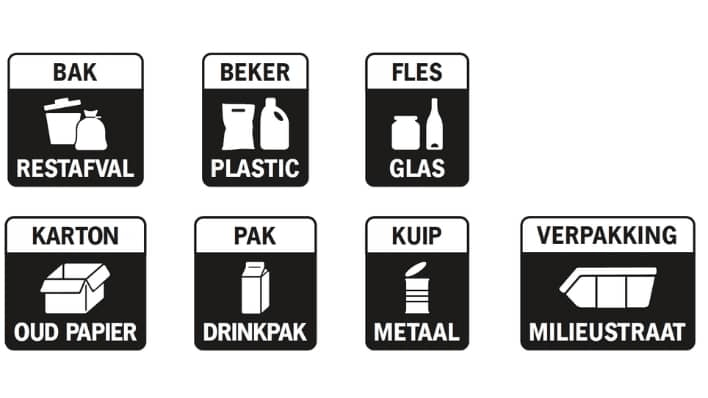
The Netherlands does not have a single mandatory recycling logo for general packaging. However, the Disposal Guide (Weggooiwijzer) system — developed by KIDV — is widely used and strongly recommended to help consumers sort packaging correctly.Companies selling across multiple EU markets can centralize country-specific marking requirements with digital compliance labels
An example of what a label looks like on packaging for the Netherlands
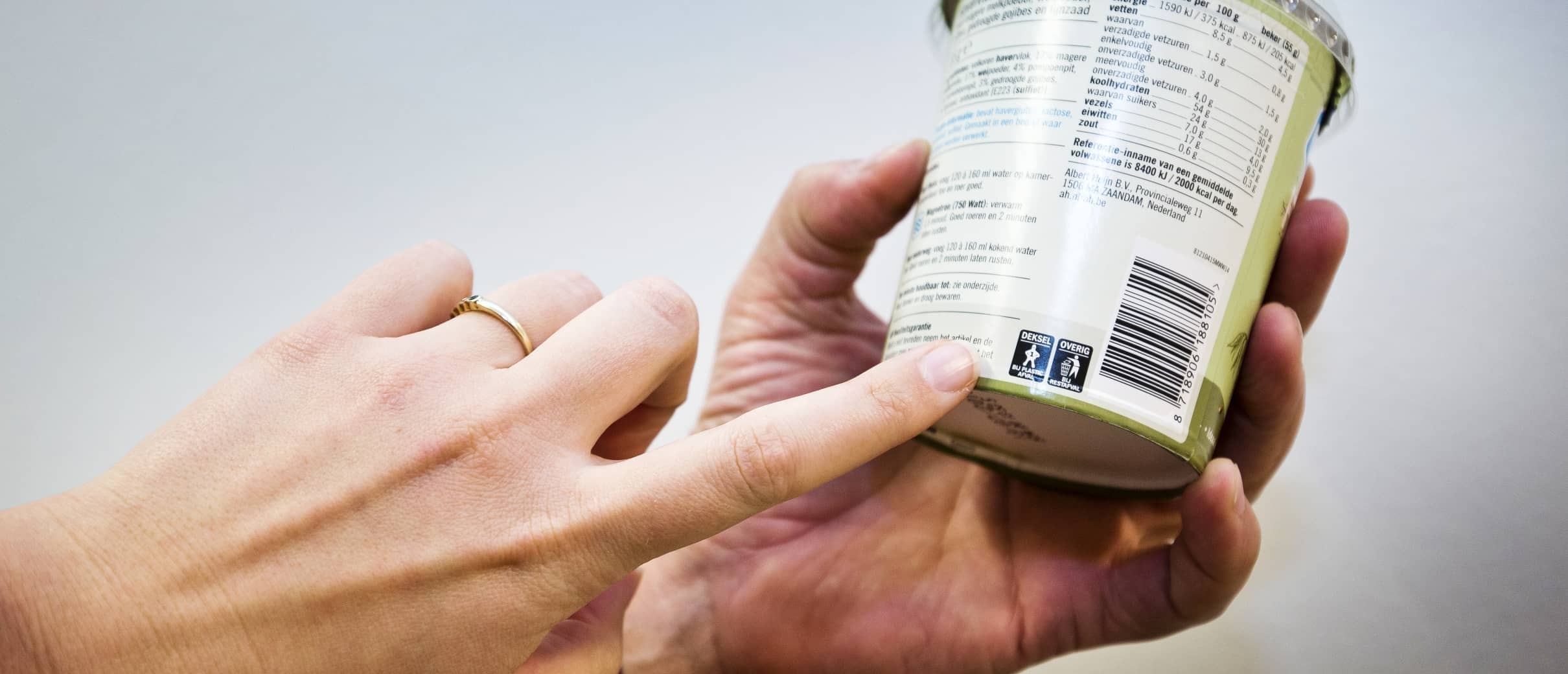
This packaging shows two Disposal Guide (Weggooiwijzer) labels applied per component. The "Deksel" ("lid") label indicates where the lid should be disposed of, and the "Overig" ("other/rest") label with a bin icon indicates that this component should be placed in residual waste. Labels are applied per packaging component, so different parts of the same product may carry different disposal instructions.
📎Download the Weggooiwijzer logos:
- PNG – best for digital use.
EPR Eco Fees & Eco-Modulation
Fees are based on the weight and type of material. The Netherlands uses a "Bonus/Penalty" system (Eco-modulation). Packaging that is "highly recyclable" (e.g., rigid mono-material plastics) receives a discount, while packaging that is difficult to recycle (e.g., multi-layer laminates) faces significant surcharges.You can estimate potential packaging compliance costs with Lappa’s EPR fee calculator.
For registration and ongoing compliance costs, see our EPR pricing overview.
Risks, Penalties & Common Mistakes
-
Fines: The ILT can impose penalty payments of €5,000 per week, up to a maximum of €100,000.
-
Sales Bans: Non-compliant businesses can face immediate sales bans.
-
Common Mistakes: Forgetting that the 50,000 kg threshold does not apply to SUP items and failing to account for shipping boxes used in e-commerce.
What E-Commerce Sellers Should Do Now
-
Check if your total packaging weight in the Netherlands exceeds 50,000 kg.
-
Register with Lappa and Verpact immediately if you sell SUP items (e.g., plastic-lined coffee cups or food containers).
-
Appoint an Authorized Representative in the Netherlands to prepare for the August 2026 deadline.
-
Audit your shipping boxes to ensure they meet the 50% maximum empty space rule.
Detailed EPR Guidance for each Jurisdiction
We support 36 jurisdictions
FAQ
Do I need to register if I sell less than 50,000 kg?- Currently, you only need to register and report if you exceed 50,000 kg OR sell SUP/deposit items. However, from August 2026, registration will be mandatory for all.
- Single-Use Plastics (e.g., certain food containers, packets, and wraps). These have zero thresholds.
- No, VAT registration is separate from EPR. You must register with Verpact and the ILT separately.
- Fees are invoiced by Verpact based on your submitted annual declaration.
- It is the Dutch deposit system for cans and bottles; sellers must ensure these carry the correct logo and pay the deposit.
What is Netherlands EPR Batteries
The Netherlands has regulated battery producer responsibility since the 1990s. The current framework is governed by Regulation (EU) 2023/1542 — the EU Battery Regulation — which applies directly in all EU Member States from 18 August 2025, supplemented by national implementing legislation. The Dutch government has been amending national legislation — the Besluit regeling voor uitgebreide producentenverantwoordelijkheid (EPR Decree) — to fully align with the EU framework, with national implementing regulations expected from 1 October 2025. The Netherlands operates a split-system for battery EPR based on battery weight and type:- Stichting OPEN manages portable batteries (up to 5 kg) and LMT batteries, including bicycle batteries through its subsidiary arrangement with Stichting EPAC
- Auto Recycling Nederland (ARN) manages automotive (SLI) batteries and electric vehicle (EV) propulsion batteries
- Rijkswaterstaat (Netherlands Ministry of Infrastructure and Water Management) is the competent authority for heavier industrial batteries and overall compliance oversight
Does This Apply to E-Commerce & Online Sales
Yes. Dutch EPR law explicitly states that foreign companies selling products directly to Dutch consumers via distance selling — including e-commerce — are considered producers and are fully liable for battery EPR compliance. Dutch regulations have applied this principle since the introduction of EPR legislation and it continues under the EU Battery Regulation framework. Foreign distance sellers must register, join the applicable PRO, and comply with all declaration, fee payment, and labelling obligations. The sales channel does not affect the obligation. Companies selling battery-containing products to Dutch consumers via their own webshop are treated identically to Dutch-established importers.Who is the "Producer" under Netherlands EPR?
Under Regulation (EU) 2023/1542 and Dutch EPR legislation, a producer is any person who, in the course of commercial activity, places batteries — whether standalone or incorporated into products — on the Dutch market for the first time. This covers:- Dutch manufacturers or brand owners that first place batteries on the Dutch market under their own name.
- Importers or intra-EU acquirers of batteries — liability attaches at customs clearance or arrival.
- Private label owners whose brand name appears on batteries manufactured elsewhere.
- Distance sellers with no Dutch establishment who make direct B2C sales in the Netherlands.
- Economic operators who prepare batteries for re-use or repurposing — treated as producers for the second life of the battery.
Who Must Register for EPR Batteries in Netherlands
Registration requirements differ by battery type: Portable batteries and LMT batteries (up to 5 kg): Must register with Stichting OPEN (stichting-open.org). Registration with Stichting OPEN includes automatic registration in the relevant national systems. Producers pay a waste management fee based on declared volumes. Automotive (SLI) batteries and EV propulsion batteries: Must register with Auto Recycling Nederland (ARN) (arn.nl). ARN manages the battery-management fee for vehicle batteries. From 1 January 2026, this fee also applies to used vehicles with propulsion batteries (hybrids, plug-in hybrids, EVs). Heavier industrial batteries (above 5 kg, not automotive/EV): Must notify Rijkswaterstaat of how they intend to collect and process batteries, and submit an annual report by 1 August each year.Netherlands EPR Battery Registration Threshold
Regulation (EU) 2023/1542 does not establish a minimum volume or turnover threshold below which producers are exempt from EPR obligations. All producers placing batteries on the Dutch market must register and comply regardless of size or volume. The only exemption in the Regulation concerns batteries used in military or space equipment, which are outside the scope entirely.Detailed EPR Guidance for each Jurisdiction
We support 36 jurisdictions
Batteries Covered (and Excluded)
Regulation (EU) 2023/1542 defines five battery categories, all within scope for EPR in the Netherlands, managed through different organisations: Portable batteries Batteries up to 5 kg not designed for industrial or vehicle use. Register with Stichting OPEN. Since August 2025, this category expanded to include batteries up to 5 kg (previously up to 3 kg for portable and 1 kg for industrial portable). Light Means of Transport (LMT) batteries Batteries used in e-bikes, e-scooters, e-mopeds, and similar light electric vehicles. Register with Stichting OPEN (bicycle batteries via Stichting EPAC arrangement). Automotive (SLI) batteries Starting, lighting, and ignition batteries used in vehicles. Register with Auto Recycling Nederland (ARN). Industrial batteries Batteries used in industrial applications not covered by other categories. Notify Rijkswaterstaat and comply with individual collection and reporting obligations. Electric vehicle (EV) batteries Propulsion batteries used in electric cars and heavy electric vehicles. Register with Auto Recycling Nederland (ARN). From 1 January 2026, importers of used vehicles with propulsion batteries also fall within scope. Key exclusions:- Batteries designed for military or space equipment — outside scope entirely
- Batteries in nuclear installations — excluded
- Second-life batteries where the operator performing re-use or repurposing becomes the new producer
Producer Responsibility Organization (PRO)
The Netherlands operates a multi-PRO system with separate organisations for different battery categories: Stichting OPEN (stichting-open.org) — the primary PRO for portable batteries and LMT batteries. Stichting OPEN operates a nationwide collection network, manages the myBatbase reporting portal for member declarations, and coordinates recycling. It reports to Rijkswaterstaat on behalf of its members on legally determined recycling targets. Stichting EPAC — manages bicycle battery (LMT) obligations under a General Binding Statement, linked to Stichting OPEN's framework. Auto Recycling Nederland (ARN) (arn.nl) — manages automotive SLI batteries and EV propulsion batteries. ARN operates through its chain of 238 partners across the Netherlands and coordinates the battery-management fee for vehicle importers.EPR Registration in Netherlands
The registration process for battery producers in the Netherlands depends on battery category: For portable and LMT batteries:- Determine whether your business qualifies as a producer under the EU Battery Regulation and Dutch EPR legislation.
- If established outside the Netherlands, appoint an authorised representative established in the Netherlands before registering.
- Register with Stichting OPEN (stichting-open.org) using the online registration form.
- Set up access to myBatbase — Stichting OPEN's reporting portal for monthly, quarterly, or annual battery placement declarations.
- Declare battery volumes placed on the Dutch market and pay the applicable waste management fee.
- Register with Auto Recycling Nederland (ARN) (arn.nl).
- Pay the battery-management fee set annually by the Stichting Autobatterij Recycling.
- Notify Rijkswaterstaat of collection and processing intentions.
- Submit an annual report to Rijkswaterstaat by 1 August covering batteries placed on the Dutch market and batteries collected and processed in the previous year.
Authorized Representative
Under Regulation (EU) 2023/1542 and Dutch EPR legislation, distance sellers with no Dutch establishment must act via an authorised representative if required under Dutch law. Foreign companies selling directly to Dutch consumers are classified as producers and must comply — typically through a Dutch-established AR. The AR handles registration with Stichting OPEN or ARN, myBatbase reporting, fee payment, and communication with Rijkswaterstaat and ILT. Important development: In December 2025, the European Commission proposed suspending the authorised representative requirement for EU-established companies until 2035. This proposal has not been formally adopted as of May 2026. For non-EU producers, the requirement is not affected and continues to apply.What Data Must Be Reported
Producers registered with Stichting OPEN must declare battery volumes through myBatbase — monthly, quarterly, or annually depending on the arrangement. Data required includes:- Total weight (kilograms) of batteries placed on the Dutch market during the reporting period, by battery category
- Battery chemistry type where relevant
- Brand names under which batteries were placed on the market
- Collection and recycling performance data, reported by Stichting OPEN to Rijkswaterstaat
- Weight of batteries placed on the Dutch market
- Weight of batteries collected and processed in the previous year
First Reporting Period & EPR Reporting Deadlines
Battery EPR has been in place in the Netherlands since the 1990s. The EU Battery Regulation obligations took full effect from 18 August 2025. Key dates:- 18 August 2025: EU Battery Regulation EPR obligations fully in force. Scope expands to include batteries up to 5 kg with Stichting OPEN (previously 3 kg for portable).
- 1 October 2025: National implementing regulations expected to take effect in the Netherlands.
- 1 January 2026: Battery-management fee for used vehicles with propulsion batteries (hybrids, plug-in hybrids, EVs) comes into force via ARN.
- 1 August (annual): Annual report deadline for heavier industrial battery producers reporting directly to Rijkswaterstaat.
- Monthly/quarterly/annual: Stichting OPEN member declarations through myBatbase — frequency depends on producer arrangement.
- 18 February 2027: Battery passports mandatory for industrial batteries (>2 kWh) and EV batteries.
- 18 August 2027: Due diligence obligations in force (delayed under Omnibus IV).
Labels & Marketing Claims
Crossed-out wheeled bin symbol From 18 August 2025, all batteries must display the separate collection symbol covering at least 3% of the area of the largest side of the battery, up to a maximum of 5 × 5 cm. The ILT checks compliance with this labelling requirement. Chemical symbols Batteries containing more than 0.002% cadmium must be marked Cd. Batteries containing more than 0.004% lead must be marked Pb. Capacity marking Portable and rechargeable batteries must display capacity information. QR code From 18 August 2026, all batteries must carry a QR code. For LMT, industrial (>2 kWh), and EV batteries, this links to the Digital Battery Passport from 18 February 2027. CE marking Mandatory from 18 August 2024. Consumer take-back information Retailers selling battery-containing products in the Netherlands must inform consumers where they can return batteries free of charge. This is an independently enforceable obligation under Dutch EPR law. Language requirements Consumer-facing information on batteries sold in the Netherlands must be provided in Dutch where required under Dutch consumer protection law. Environmental claims The Empowering Consumers for the Green Transition Directive (2024/825/EU) must be transposed by March 2026, after which unsubstantiated green claims will be prohibited across the EU including the Netherlands.EPR Eco Fees & Eco-Modulation
Stichting OPEN sets waste management fees for portable and LMT battery members based on the weight and category of batteries placed on the Dutch market. Declarations are made through myBatbase, and fees are calculated based on declared volumes. ARN sets the battery-management fee annually for automotive and EV batteries through the Stichting Autobatterij Recycling, based on expected collective costs over a five-year period. Under Regulation (EU) 2023/1542, eco-modulation — adjusting contributions based on battery environmental performance — is required across all Member States. The Netherlands' specific eco-modulation framework has not been separately published in detail as of May 2026.Risks, Penalties & Common Mistakes
- Not knowing which PRO to register with. The Netherlands has a split system: Stichting OPEN for portable and LMT batteries, ARN for automotive SLI and EV batteries, Rijkswaterstaat for heavier industrial batteries. Registering with the wrong organisation does not fulfil your obligations for other battery categories.
- Failing to register as a foreign distance seller. Dutch law explicitly captures foreign e-commerce sellers as producers. Operating without registration is a breach subject to ILT enforcement.
- Assuming the Zalando pause means no obligation exists. Zalando paused its Netherlands battery EPR number collection because there is no official public producer registry yet — but the legal obligation to register and comply exists independently of marketplace enforcement.
- Missing the 1 August annual report deadline for heavier industrial batteries. Producers reporting directly to Rijkswaterstaat must submit their annual report by 1 August covering the previous year's data.
- Missing the scope expansion from August 2025. Since 18 August 2025, batteries up to 5 kg must be reported to Stichting OPEN. The previous threshold of 3 kg for portable batteries has been expanded.
- Missing labelling requirements. The crossed-out wheeled bin symbol is mandatory from August 2025 and is actively checked by ILT.
- Missing the QR code deadline of August 2026.
What E-Commerce Sellers Should Do Now
- Confirm which battery categories your products contain and which PRO applies — Stichting OPEN (portable/LMT), ARN (automotive/EV), or Rijkswaterstaat (heavy industrial).
- If established outside the Netherlands, identify and appoint an authorised representative established in the Netherlands.
- Register with Stichting OPEN (stichting-open.org) for portable and LMT batteries, and set up access to myBatbase for declarations.
- Register with ARN (arn.nl) for automotive SLI or EV batteries if applicable.
- For heavier industrial batteries, notify Rijkswaterstaat and set up annual reporting by 1 August.
- Monitor Stichting OPEN and Rijkswaterstaat for updates on the public producer register and Zalando's Netherlands battery EPR verification timeline.
- Verify that all batteries carry the crossed-out wheeled bin symbol, CE marking, and capacity information as required from August 2025.
- Ensure retailers and distributors are informed of consumer take-back obligations.
- Plan for the QR code requirement by August 2026 and the Digital Battery Passport for industrial and EV batteries by February 2027.
Register online
Start your EPR Reporting within 24 hours
FAQ
Is battery EPR mandatory in the Netherlands?- Yes. Battery EPR has been mandatory in the Netherlands since the 1990s. From 18 August 2025, the EU Battery Regulation (2023/1542) fully applies. All producers placing batteries on the Dutch market must register with the applicable PRO — Stichting OPEN for portable and LMT batteries, ARN for automotive and EV batteries — declare volumes, and comply with collection and recycling obligations.
- Yes. Dutch EPR law explicitly defines foreign distance sellers as producers and requires them to comply with all battery EPR obligations. They must register with the applicable PRO and, if without a Dutch establishment, appoint an authorised representative. The obligation exists independently of whether Zalando or other marketplaces have activated EPR number verification for the Netherlands.
- Zalando paused technical setup for Netherlands battery EPR number collection because there is no official public registry for battery producers yet under the new EU Battery Regulation framework. This does not mean that the legal obligation to register and comply is paused — it only means that Zalando cannot yet verify registration numbers through its system. Producers must still comply and should monitor Stichting OPEN for updates on the public register.
- The Netherlands operates a split system: Stichting OPEN covers portable batteries (up to 5 kg) and LMT batteries. Auto Recycling Nederland (ARN) covers automotive SLI batteries and EV propulsion batteries. Heavier industrial batteries require direct notification to Rijkswaterstaat. Producers with multiple battery categories may need to register with more than one organisation.
- No. The EU Battery Regulation does not establish a minimum volume or turnover exemption for EPR registration. All producers placing batteries on the Dutch market must register and comply regardless of size or volume.
What is Netherlands EPR Textile
Extended Producer Responsibility (EPR) for textiles in the Netherlands is governed by the Decree on Extended Producer Responsibility for Textiles (Besluit uitgebreide producentenverantwoordelijkheid textiel), which entered into force on 1 July 2023.
The legislation requires producers placing textile products on the Dutch market to take responsibility for the collection, reuse, recycling, and waste management of those products at end-of-life.
The regulation aligns with the EU Waste Framework Directive (2008/98/EC) and forms part of the Netherlands’ transition toward a circular textile economy. It applies broadly to:
- Clothing and apparel
- Footwear
- Household textiles
The law sets legally binding targets for reuse and recycling, gradually increasing over time.
Does this apply to e-commerce & online sales
Yes, the Dutch textile EPR framework explicitly applies to distance selling and cross-border trade.
The following entities are within scope:
- Foreign companies selling textiles directly to consumers in the Netherlands via e-commerce
- Online retailers shipping goods into the Dutch market
- Marketplaces, depending on their role in placing products on the market
Non-Dutch businesses are considered producers if they are the first to place textile products on the Dutch market, even without a physical presence in the country.
Who is the “producer” under Netherlands EPR?
Under the legislation, a “producer” is any entity that first makes textiles available on the Dutch market on a professional basis.
This includes:
- Manufacturers established in the Netherlands
- Importers bringing textile products into the Netherlands
- Private label owners selling under their own brand
- Distance sellers and foreign e-commerce companies selling directly to Dutch consumers
The definition is broad and ensures that responsibility cannot be avoided through supply chain structuring.
Who must register for EPR textiles in Netherlands
All producers must register with the competent authority, which is Rijkswaterstaat (RWS), acting on behalf of the Dutch Ministry of Infrastructure and Water Management.
Obligations include:
- Registering as a producer before placing textiles on the market
- Ensuring compliance with collection and recycling targets
- Joining a Producer Responsibility Organization (PRO) or setting up an individual compliance system
- Submitting periodic reports on volumes placed on the market
Failure to register results in non-compliance regardless of actual sales volume.
Netherlands EPR Textile Registration Threshold
There is no minimum threshold for textile EPR obligations in the Netherlands.
Key points:
- All producers are obligated to register, regardless of turnover or volume
- No de minimis exemption applies
- Small and medium-sized enterprises are fully in scope
- Obligations begin from the first unit placed on the market
Detailed EPR Guidance for each Jurisdiction
We support 36 jurisdictions
Textiles Covered (and Excluded)
Covered categories
The regulation applies to a wide range of textile products, including:
- Clothing (apparel) – shirts, trousers, dresses, outerwear
- Footwear – shoes, boots, sandals
- Household textiles – bed linen, towels, curtains, tablecloths
Exclusions
Certain categories are excluded or treated differently:
- Personal Protective Equipment (PPE)
- Industrial or technical textiles not intended for consumer use
- Second-hand textiles (depending on whether they are reintroduced to the market)
Producer Responsibility Organization (PRO)
Producers are generally expected to fulfill their obligations through a collective system.
The main organization is:
- Stichting UPV Textiel – the national PRO responsible for organizing collection, reuse, and recycling systems for textiles
The PRO ensures compliance with national targets, including:
- Collection rates
- Reuse targets
- Recycling quotas
Producers joining the PRO transfer operational responsibility but retain legal accountability.
EPR Registration in Netherlands
The registration process involves the following steps:
- Determine producer status under Dutch law
- Register with Rijkswaterstaat (RWS) via the official EPR portal
- Choose compliance method:
- Join Stichting UPV Textiel, or
- Establish an individual system (rare and complex)
- Submit initial declaration of expected volumes
- Begin reporting and fee payments
Registration must be completed before placing products on the market.
Authorized Representative
Foreign companies without a legal entity in the Netherlands are strongly advised to appoint an Authorized Representative.
Key points:
- The representative acts on behalf of the producer for compliance obligations
- They handle registration, reporting, and communication with authorities
- While not always explicitly mandated, it is practically necessary for non-resident businesses
Compliance providers such as Lappa can fulfill this role.
What Data Must Be Reported
Producers must report detailed data on textiles placed on the Dutch market, including:
- Total weight (in kilograms)
- Product categories (apparel, footwear, household textiles)
- Number of items (where required)
- Material composition (if applicable)
- Reuse and recycling data (via PRO reporting)
Accurate data reporting is critical for compliance with national targets.
First Reporting Period & EPR Reporting Deadlines
The obligations became effective from 1 July 2023.
Key timelines:
- First reporting obligations applied to 2023 market activity
- Annual reporting is required
- Deadlines are typically set by Rijkswaterstaat and the PRO
Producers must ensure timely submission of data and payment of eco-fees.
Labels & Marketing Claims
Textile products in the Netherlands must comply with EU and national labeling rules.
Key requirements include:
- Fiber composition labeling under EU Textile Regulation
- Clear and accurate sustainability claims
- Avoidance of misleading environmental claims under EU Green Claims Directive (upcoming)
Claims such as “recyclable” or “sustainable” must be substantiated and verifiable.
EPR Eco Fees & Eco-Modulation
Producers must pay eco-fees to finance the collection and recycling system.
Fee structure:
- Typically calculated per kilogram of textiles placed on the market
- Fees are managed by Stichting UPV Textiel
Eco-modulation is expected to develop over time, with fees influenced by:
- Durability of products
- Recyclability
- Use of recycled fibers
- Environmental impact of materials
Risks, Penalties & Common Mistakes
Common mistakes
- Failing to register with Rijkswaterstaat
- Assuming small volumes are exempt
- Incorrect classification of textile categories
- Underreporting placed-on-market volumes
- Ignoring obligations for cross-border e-commerce
Penalties
Non-compliance may result in:
- Administrative fines
- Enforcement actions by Dutch authorities
- Sales restrictions within the Netherlands
- Reputational risk and marketplace delisting
What E-Commerce Sellers Should Do Now
- Assess whether your business qualifies as a producer under Dutch law
- Register with Rijkswaterstaat (RWS)
- Join Stichting UPV Textiel
- Appoint an Authorized Representative if based outside the Netherlands
- Implement systems to track textile volumes and categories
- Prepare for annual reporting and eco-fee payments
Register online
Start your EPR Reporting within 24 hours
FAQ for Netherlands Textile EPR
- Is textile EPR mandatory in the Netherlands?
Yes, under the Besluit uitgebreide producentenverantwoordelijkheid textiel (2023), compliance is mandatory for all producers. - Do foreign e-commerce sellers need to comply?
Yes, distance sellers placing textiles on the Dutch market are fully in scope. - Is there a minimum threshold for registration?
No, there is no exemption based on turnover or volume. - Are marketplaces responsible for EPR compliance?
Generally, responsibility lies with the seller, but marketplace obligations may evolve under EU regulations. - What labeling rules apply to textiles?
Products must comply with EU fiber composition labeling and avoid misleading environmental claims.