


Romania EPR
What is Romania EPR EEE
Extended Producer Responsibility (EPR) for Electrical and Electronic Equipment (EEE) in Romania is a legal framework that places the financial and organisational responsibility for end-of-life collection, treatment, recycling, and disposal of waste electrical and electronic equipment (WEEE) on the companies that manufacture or first introduce those products onto the Romanian market. The obligation exists throughout the full lifecycle of EEE, including the waste phase.
The Romanian legal framework for WEEE has been in place since 2006, when Romania first transposed the original EU WEEE Directive. The current operative legislation is Government Emergency Ordinance No. 5/2015 on Waste Electrical and Electronic Equipment (OUG 5/2015), which transposed EU Directive 2012/19/EU into Romanian national law. This ordinance underwent a fundamental revision through Law No. 127/2024, which entered into force on 17 May 2024 and introduced the most significant changes to Romania's WEEE framework since 2015.
Law No. 127/2024 restructured obligations for producers, collective organisations, and treatment operators, introduced per-category minimum collection rates for the first time, and tightened the conditions for licensing collective schemes. From 1 January 2025, the new provisions on collective organisation licensing and staged per-category collection rates became applicable. Romania is also required to transpose amending Directive (EU) 2024/884, which member states must implement by 9 October 2025, clarifying producer responsibility for photovoltaic panels and updating labelling standards to reference EN 50419:2022.
The broad aim of the Romanian WEEE regime is to ensure producers — not consumers or the state — finance the proper management of electronic waste, in line with the polluter pays principle embedded in EU environmental law.
Does This Apply to E-Commerce & Online Sales
Yes. Romania's WEEE legislation applies to all companies that place EEE on the Romanian market, regardless of the channel through which that supply takes place. The obligation arises from the act of first making EEE available in Romania, not from having a physical presence there.
Distance sellers and cross-border e-commerce operators that sell EEE directly to Romanian end consumers from abroad are treated as producers under OUG 5/2015 and carry the same registration, reporting, and financial obligations as domestically established manufacturers and importers. There is no carve-out for online-only or low-volume foreign sellers.
This position reflects the EU-wide interpretation of the WEEE Directive: any company using distance communication to supply EEE to consumers in a member state where it has no physical establishment is considered a producer in that member state and must either register directly (where possible) or appoint an Authorized Representative to fulfil its obligations on its behalf.
Online marketplace platforms have also come under increasing scrutiny across EU member states. Since 2023, major platforms such as Amazon have implemented verification requirements to ensure that sellers listing regulated EEE hold valid national registrations. Sellers that are not registered with the National Agency for Environmental Protection (ANPM) risk being removed from marketplace listings, in addition to facing direct regulatory penalties.
Who is the "Producer" Under Romania EPR?
Under OUG 5/2015, as amended by Law No. 127/2024, the term "producer" (producător) has a broad definition covering any entity that first places EEE on the Romanian market under its own name or trademark, regardless of the sales channel. The following categories of companies qualify as producers:
- Domestic manufacturers that produce EEE in Romania and supply it on the local market under their own brand.
- Importers that bring EEE manufactured outside Romania — whether from other EU member states or third countries — and place it on the Romanian market.
- Brand owners and private label operators that sell EEE under their own name, even where the physical manufacturing is outsourced.
- Distance sellers — including foreign e-commerce companies — that supply EEE directly to Romanian end consumers using distance communication techniques, regardless of whether they are established in Romania.
- Foreign companies selling into Romania that have no legal entity registered in the country. Such companies are required to appoint an Authorized Representative in Romania to discharge their legal obligations.
Under Law No. 127/2024, producers retain responsibility for EEE throughout the full product lifecycle, including the waste phase. Critically, a producer may not transfer responsibility for the same EEE category to more than one collective organisation. The law also clarified that when a contract between a producer and a collective organisation is terminated, the collective organisation remains liable for managing the WEEE corresponding to quantities of EEE that had already been financed by that producer during the contract period.
Who Must Register for EPR EEE in Romania
All producers of EEE must register with the National Register of EEE Producers maintained by the National Agency for Environmental Protection (ANPM — Agenția Națională pentru Protecția Mediului). Registration must take place before EEE is first placed on the Romanian market. Operating without a valid registration number is a breach of OUG 5/2015 and exposes the producer to administrative sanctions.
Upon successful registration, ANPM issues a registration number that the producer must communicate to all sales channels and distributors through which its products are sold in Romania. This number serves as proof of compliance for retailers, distributors, and marketplace platforms.
Registration is conducted through ANPM's Integrated Environmental System, accessible via the SIM-EEE application at raportare.anpm.ro. Producers must complete the application using the EEE subdomain and Annex 01 (producers) within the system.
The Environmental Fund Administration (Administrația Fondului pentru Mediu — AFM) plays a parallel role as the body that certifies compliance with collection targets and to which financial contributions (penalties) are owed when annual targets are not met. Certain reporting and financial interactions with the system are also directed through AFM.
Foreign companies without a Romanian-registered legal entity cannot register directly and must do so through an Authorized Representative established in Romania (see the Authorized Representative section below).
Romania EPR EEE Registration Threshold
Romania applies no de minimis threshold for EEE EPR. All producers placing any quantity of EEE on the Romanian market are required to register with ANPM, regardless of the volume or value of EEE placed on the market. There is no minimum weight, unit count, or turnover figure below which a company would be exempt from the registration obligation.
The absence of a threshold reflects the structure of OUG 5/2015 and its implementing provisions. Every producer, from the largest consumer electronics brand to a small specialist importer, carries the full set of registration, reporting, and financial obligations from the first unit placed on the market.
This zero-threshold approach is a significant compliance consideration for foreign e-commerce sellers who may assume that small volumes into Romania create no obligations. They do. Whether a producer manages its obligations individually or through a collective organisation, registration is mandatory and pre-market.
Detailed EPR Guidance for each Jurisdiction
We support 36 jurisdictions

EEE Categories Covered (and Excluded)
Romania's WEEE framework incorporates the EU's open-scope approach, which has applied since 15 August 2018. Under this framework, all EEE is covered unless it falls within a specific listed exclusion. The legislation uses the six-category classification structure introduced by the recast WEEE Directive:
- Temperature exchange equipment — refrigerators, freezers, air-conditioning units, heat pumps, dehumidifiers, and other equipment used for temperature exchange.
- Screens and monitors — televisions, computer monitors, laptop computers, notebooks, and tablet computers, where the screen surface exceeds 100 cm².
- Lamps — fluorescent lamps, LED lamps, high-intensity discharge lamps, compact fluorescent lamps, and other light-emitting devices (excluding incandescent bulbs where still permitted).
- Large equipment — washing machines, dishwashers, large medical imaging devices, large industrial tools, large IT and telecommunications equipment, and any equipment where at least one external dimension exceeds 50 cm.
- Small equipment — vacuum cleaners, microwaves, small tools, smoke detectors, thermostats, small medical devices, small leisure and sports equipment, and similar; all external dimensions are 50 cm or less.
- Small IT and telecommunications equipment — mobile phones, GPS devices, pocket calculators, routers, personal computers, printers, and similar equipment; all external dimensions are 50 cm or less.
Romania's national legislation also references the pre-2018 ten-category framework (large household appliances, small household appliances, IT and telecommunications equipment, consumer electronics, lighting equipment, electrical and electronic tools, toys and leisure equipment, medical devices, monitoring and control instruments, and automatic dispensers) in the context of older scheme contracts and historical reporting. However, the operative scope for new compliance purposes is the open-scope six-category approach.
Photovoltaic panels are covered under Romania's WEEE framework. Law No. 127/2024 expressly excludes photovoltaic panels from the new per-category minimum collection rate obligations introduced from 2025, but they remain regulated products subject to producer registration and take-back obligations. Directive (EU) 2024/884, which Romania must transpose by 9 October 2025, confirms that responsibility for waste from photovoltaic panels placed on the market after 13 August 2012 lies with the producer of the EEE.
Exclusions under the Romanian framework include equipment designed for military or national security purposes, equipment destined for space, large-scale fixed industrial installations and large-scale stationary infrastructure, means of transport (excluding electric two-wheel vehicles not type-approved), non-road mobile machinery available exclusively for professional use, active implantable medical devices, and equipment specifically designed for research and development purposes made available on a business-to-business basis only.
Producer Responsibility Organization (PRO)
Romania operates a collective organisation (organizație colectivă) model. Producers may fulfil their WEEE obligations either individually — by establishing their own take-back and management systems — or collectively, by contracting with a licensed collective organisation (the Romanian equivalent of a PRO). The vast majority of producers use the collective route in practice.
Collective organisations are authorised by the Ministry of Environment, Waters and Forests (Ministerul Mediului, Apelor și Pădurilor) and must meet stringent licensing conditions. Law No. 127/2024 introduced significant new requirements for collective organisations from 1 January 2025, including:
- A minimum market share of at least 5% for at least one authorised EEE category, certified by AFM.
- A financial guarantee of RON 2 million (approximately EUR 400,000) in favour of AFM, valid for the entire licence period, to secure payment of fiscal contributions to AFM when collection targets are not met.
- Financial provisions covering 100% of the management costs for all EEE financed by their producer members, regardless of when the WEEE arises.
- Founding membership and shareholding restricted exclusively to EEE producers registered with ANPM that do not themselves hold authorisations for WEEE collection and treatment.
All existing collective organisations were required to seek relicensing under these new criteria as of 1 January 2025. The principal collective organisations active in the Romanian EEE market include:
- ECOTIC — Romania's first PRO for electronic waste, founded in 2006. ECOTIC represents over 600 affiliated producers and importers and has collected and recycled in excess of 320,000 tonnes of WEEE since its establishment. ECOTIC introduced the Green® Stamp, a voluntary compliance symbol for WEEE management.
- Environ Association — a non-governmental, non-profit organisation founded in 2007. Environ manages approximately 20% market share of the Romanian EEE market, representing around 900 producers and importers.
- RECOLAMP — a collective organisation specialising in the lighting equipment category (lamps).
- ARCwaste — a newer collective scheme also active in the WEEE space.
A producer may not contract the same EEE category to more than one collective organisation simultaneously. When changing collective organisations, producers should be aware that the former scheme retains liability for managing WEEE corresponding to previously financed EEE quantities.
EPR Registration in Romania
The registration process for EEE EPR in Romania involves the following steps:
- Classify your EEE products. Identify which of the six EEE categories your products fall into. This classification determines the applicable collection targets, collective organisation selection, and eco-fee rates.
- Appoint an Authorized Representative (for foreign companies). If your company has no legal entity registered in Romania with a Romanian tax identification number, you must appoint an Authorized Representative before registration can be completed. The AR acts as your legal contact with ANPM, AFM, and the collective organisation.
- Register with ANPM via the SIM-EEE system. Access the online registration portal at raportare.anpm.ro, select the Waste domain and EEE subdomain, and complete the application using Annex 01 (producers). Upon completion, ANPM issues a user account and access credentials for the SIM-EEE reporting application. Registration must be completed before the first EEE is placed on the market.
- Obtain your ANPM registration number. Once registered, ANPM issues an official EEE producer registration number. This number must be communicated to all sales channels, distributors, and retailers in Romania.
- Select and contract with a licensed collective organisation. The producer (via the AR for foreign companies) signs a contract with an authorised collective organisation for each relevant EEE category. The collective organisation assumes responsibility for meeting collection, treatment, and recycling targets on the producer's behalf.
- Register with AFM. Interaction with the Environmental Fund Administration is required for the financial aspects of compliance — specifically, reporting quantities placed on the market and making fiscal contributions to AFM when collection targets are not met.
- Communicate eco-fees to buyers. From the date of Law No. 127/2024 entry into force, producers are required to communicate the environmental management fee (eco-fee) for each EEE category to potential buyers prior to the point of sale, in addition to displaying the fee separately on invoices and website order pages.
- Begin reporting. Ongoing reporting through the SIM-EEE system is required, covering quantities of EEE placed on the market per category and volumes of WEEE managed.
Authorized Representative
Under OUG 5/2015, foreign companies that place EEE on the Romanian market without a locally registered legal entity must appoint an Authorized Representative (reprezentant autorizat) established in Romania. This requirement is rooted in the EU WEEE Directive and has applied in Romania since the original transposition of that directive.
Importantly, Romania requires foreign companies to appoint not only an Authorized Representative for environmental compliance purposes but also a Tax Representative to fully cover their reporting and registration duties with the national producer register and with collective take-back schemes. The AR handles the environmental compliance aspects — registration with ANPM, contracting with the collective organisation, and environmental reporting — while the Tax Representative manages fiscal reporting and payments to AFM.
The Authorized Representative must be a legal entity established and registered in Romania. It assumes legal accountability for the foreign producer's compliance obligations in Romania and acts as the primary point of contact for ANPM, AFM, and the collective organisation. Key responsibilities of the AR include:
- Registering the foreign producer in ANPM's National Register of EEE Producers via the SIM-EEE system.
- Signing and maintaining a contract with a licensed collective organisation on behalf of the producer.
- Reporting quantities of EEE placed on the Romanian market through the SIM-EEE application.
- Representing the producer before Romanian authorities in administrative matters, audits, and enforcement proceedings.
- Monitoring legislative changes affecting the producer's obligations in Romania.
The AR requirement applies regardless of the volume of EEE placed on the Romanian market. There is no minimum threshold below which the requirement is waived for foreign companies.
Regarding EU-level developments: in December 2025, the European Commission proposed a suspension of the AR obligation for EU-based companies until 2035 (COM(2025) 983). If adopted, this would remove the AR requirement for, for example, a German company selling into Romania. However, this proposal had not yet been formally adopted as of the date of this guide. Until it is, the existing rules continue to apply. Non-EU companies (UK, US, and other third-country sellers) would remain subject to the AR requirement even if the proposal is adopted.
What Data Must Be Reported
Producers registered with ANPM and contracting with a collective organisation are required to collect and report the following data:
- Quantities of EEE placed on the Romanian market, reported by EEE category and measured in kilograms. This data is the basis for calculating the collective organisation's collection obligations, the producer's share of responsibility, and any fiscal contributions due to AFM.
- Annual reports via the SIM-EEE application — submitted to ANPM through the online system, covering all EEE placed on the market during the preceding calendar year, disaggregated by category.
- Quantities of WEEE managed — collected, treated, recycled, recovered, and disposed of, reported per category and in kilograms, either through the collective organisation or individually.
- Eco-fee amounts — the environmental management fees applied per category of EEE, which must be disclosed to buyers prior to the point of sale and shown separately on invoices. These must be maintained accurately in internal records.
- Documentation supporting compliance — contracts with the collective organisation, evidence of WEEE management, and records substantiating the figures reported to ANPM and AFM.
- Collective organisation reports — the collective organisation reports to ANPM and AFM on behalf of its member producers regarding total WEEE collected and managed. However, producers remain individually responsible for ensuring the accuracy of the data they supply to the collective organisation.
First Reporting Period & EPR Reporting Deadlines
Obligations begin from the first moment EEE is placed on the Romanian market. Registration with ANPM must be completed and the ANPM registration number obtained before any products are sold into Romania.
Key recurring deadlines:
- Annual report to ANPM — producers and acquirers submit annual reports on WEEE management for the preceding calendar year through the SIM-EEE application. Reports must be filed by 31 March of the following year. The collective organisation submits a joint management report to ANPM on behalf of all its member producers.
- Eco-fee disclosure — ongoing obligation to disclose the management fee per EEE category to buyers prior to sale and on invoices; there is no specific annual deadline, but the disclosure must be accurate and current at all times.
- Collection target compliance — the national collection target is 65% of the average weight of EEE placed on the Romanian market in the three preceding calendar years. Under Law No. 127/2024, additional per-category minimum collection rates apply from 1 January 2025, staged as follows: at least 15% from 1 January 2025, at least 20% from 1 January 2026, at least 30% from 1 January 2027, at least 40% from 1 January 2028, and at least 50% from 1 January 2029 (excluding photovoltaic panels). These per-category targets are in addition to — not instead of — the overall 65% national target.
- Fiscal contributions to AFM — when the annual collection targets are not met, producers and collective organisations are required to pay a contribution to AFM. The current rate is RON 2 per kg of the shortfall between the target and actual WEEE managed, with the exception of lighting equipment, for which the rate is RON 4 per kg. These contributions are assessed and collected on an annual basis by AFM.
For a foreign company that begins placing EEE on the Romanian market during the course of a calendar year, the obligation to register and appoint a collective organisation applies from the first placement. The first annual report to ANPM covers that partial year and is due by 31 March of the following year.
Labels & Marketing Claims
EEE placed on the Romanian market must comply with mandatory labelling requirements under OUG 5/2015 and the WEEE Directive:
- Crossed-out wheeled bin symbol (WEEE symbol) — all EEE must bear the crossed-out wheeled bin symbol, affixed to the product in a legible and indelible manner. If the size or intended use of the equipment makes it impractical to mark the product directly, the symbol must appear on the packaging, in the user manual, or on the warranty or guarantee document. This symbol communicates to users that the product must not be disposed of as unsorted municipal waste and is eligible for separate collection.
- Date marking — the product marking must indicate that the EEE was placed on the market after 13 August 2005, which is the reference date from which producer responsibility obligations attach. This date indication, together with the producer's name, must comply with the European standard referenced in the legislation. Following the adoption of Directive (EU) 2024/884, this standard has been updated to EN 50419:2022, which Romania must incorporate into its national labelling requirements by 9 October 2025.
- Producer identification — the producer's name must be clearly identifiable on the equipment or its labelling.
- Eco-fee disclosure — under Law No. 127/2024, producers must disclose the environmental management fee applicable to each EEE category to potential buyers prior to the point of sale. For distance sellers and e-commerce operators, this means the eco-fee must be displayed visibly on the product page or order page, separately from the product price, before the customer completes a purchase. On invoices, the eco-fee must be listed as a separate line item. This obligation was expanded by Law No. 127/2024 from applying only at the invoice stage to applying also at the pre-sale stage.
- Hazardous substance restrictions — EEE placed on the Romanian market must comply with the restrictions on hazardous substances under Directive 2011/65/EU (RoHS), implemented in Romania through corresponding national legislation. Products containing lead, mercury, cadmium, hexavalent chromium, polybrominated biphenyls (PBB), or polybrominated diphenyl ethers (PBDE) above permitted thresholds may not be placed on the market.
Green and sustainability claims made in connection with EEE are subject to general Romanian and EU rules on misleading commercial practices. Claims about recyclability or environmental performance should be substantiated and consistent with the product's actual characteristics.
EPR Eco Fees & Eco-Modulation
Romania's EEE EPR system uses a weight-based financial contribution model. Producers pay fees to their contracted collective organisation based on the quantity and category of EEE placed on the Romanian market. These fees cover the collective organisation's costs for collecting, transporting, treating, recycling, and disposing of WEEE on behalf of its member producers.
Collective organisation fees: The specific per-kg rates vary by collective organisation and by EEE category, reflecting the relative cost of managing different product types. Cooling and refrigerating equipment, for example, requires more complex and costly treatment than simple small appliances. Fee schedules are set in the contract between the producer and the collective organisation and are typically reviewed annually.
AFM fiscal contributions for non-compliance: Where the annual collection targets are not met — either at the national level or at the per-category level introduced from 2025 — a fiscal contribution is owed to AFM. Under current legislation, this contribution is RON 2 per kg of the gap between the target and the actual volume managed, except for lighting equipment, for which the rate is RON 4 per kg. This contribution is treated as a fiscal obligation with a tax character, not merely an administrative penalty. Its payment by the collective organisation does not extinguish the underlying obligation to actually collect and recycle the WEEE.
Eco-fee disclosure obligation: As noted in the labelling section, producers must separately itemise the environmental management fee on invoices and display it to potential buyers before sale. The eco-fee is not a government-mandated fixed rate but is set by each collective organisation and passed through by the producer. The fee must accurately reflect the actual management cost for the relevant EEE category.
Eco-modulation: Romania has not implemented a formal eco-modulation framework that adjusts fees based on product design attributes such as recyclability, repairability, or use of recycled materials. Fees are determined primarily by the weight and category of EEE placed on the market. Future regulatory developments at EU level — including the full review of the WEEE Directive mandated by the end of 2026 — may introduce harmonised eco-modulation requirements across member states.
Risks, Penalties & Common Mistakes
The following compliance failures are the most frequently observed among foreign companies entering the Romanian EEE market:
- Selling EEE without ANPM registration. Operating without a valid registration number is a direct breach of OUG 5/2015. Penalties include administrative fines and, in serious or repeated cases, prohibition on placing products on the Romanian market.
- Failing to appoint an Authorized Representative and Tax Representative. Foreign companies without a Romanian legal entity that register without appointing both an AR and a Tax Representative have incomplete compliance coverage. The AR handles environmental obligations; the Tax Representative handles fiscal reporting to AFM. Omitting either role creates gaps in legal coverage.
- Contracting one collective organisation for multiple EEE categories and then changing organisations. Under Law No. 127/2024, a producer may not transfer responsibility for the same EEE category to more than one organisation simultaneously. When contracts are terminated, the former organisation remains liable for previously financed WEEE. Producers should understand this before moving between schemes.
- Underreporting EEE placed on the market. Inaccurate volume reporting reduces the collective organisation's financial resources for WEEE management and distorts the calculation of the national collection target shortfall. Underreporting is a regulatory breach and can trigger audits.
- Failing to display eco-fees to buyers before sale and on invoices. Law No. 127/2024 expanded this obligation to the pre-sale stage. E-commerce operators that do not show the eco-fee separately on their product pages or order confirmation screens are in breach of the disclosure requirements applicable from May 2024.
- Missing the 31 March annual reporting deadline. Late or absent SIM-EEE reports are a direct breach of the ordinance. ANPM may apply administrative sanctions for late filing.
- Assuming the collective organisation manages all risks. Under Law No. 127/2024, producers retain responsibility throughout the EEE lifecycle, including the waste phase. Choosing a collective organisation that fails to meet its authorisation obligations or is unable to pass the relicensing process from January 2025 could expose producers to direct liability for unmanaged WEEE contributions to AFM.
- Labelling non-compliance. Products missing the crossed-out wheeled bin symbol, producer identification, or the required date indicator are non-compliant. Following Romania's transposition of Directive (EU) 2024/884 by 9 October 2025, products must also reference the updated standard EN 50419:2022.
Enforcement is carried out by the National Environmental Guard (Garda Națională de Mediu) and ANPM, with AFM responsible for the fiscal contribution mechanism. Penalties under OUG 5/2015 include administrative fines and, for more serious breaches, prohibition on placing products on the market.
What E-Commerce Sellers Should Do Now
Companies placing or planning to place EEE on the Romanian market should take the following steps as a priority:
- Determine whether your products fall within the scope of OUG 5/2015 using the six-category open-scope EEE classification.
- Appoint an Authorized Representative and a Tax Representative, both established in Romania, before placing any products on the market or initiating registration.
- Register with ANPM via the SIM-EEE system (raportare.anpm.ro) through your AR and obtain your official EEE producer registration number.
- Select a licensed collective organisation for each relevant EEE category and execute the required contracts. Verify that the organisation has successfully obtained or maintained its licence under the new conditions introduced by Law No. 127/2024 from January 2025.
- Communicate your ANPM registration number to all Romanian distributors, retailers, and marketplace partners.
- Implement processes to display eco-fees separately on product pages, order confirmations, and invoices before sale, in compliance with Law No. 127/2024.
- Set up internal volume tracking to record EEE placed on the Romanian market by category and by weight, as this data underpins annual reporting and collective organisation fee calculations.
- Schedule the 31 March annual reporting deadline in your compliance calendar and confirm with your AR which entity is responsible for SIM-EEE submission.
- Verify that all EEE products bear the crossed-out wheeled bin symbol, producer identification, and the required date marking. Prepare to update labelling to comply with EN 50419:2022 following Romania's transposition of Directive (EU) 2024/884 by 9 October 2025.
- Monitor the staged per-category minimum collection rate obligations applying from 2025 through to 2029, and assess with your collective organisation how they may affect your financial exposure under the AFM contribution mechanism.
Register online
Start your EPR Reporting within 24 hours
FAQ
Is EPR registration for EEE mandatory for all companies selling into Romania, regardless of size or volume?
- Yes. There is no minimum volume threshold or turnover exemption for EEE in Romania. All producers placing any quantity of EEE on the Romanian market must register with ANPM and obtain an EEE producer registration number before their first sale. This applies to domestic manufacturers, importers, brand owners, and foreign distance sellers alike. Operating without registration is a breach of OUG 5/2015 and subject to administrative sanctions.
Do foreign companies need a local representative to comply with Romania EEE EPR?
- Yes, and uniquely, Romania requires two distinct representatives. Foreign companies without a Romanian-registered legal entity must appoint both an Authorized Representative (for environmental compliance — registration with ANPM, collective organisation contracting, and environmental reporting) and a Tax Representative (for fiscal reporting and payments to the Environmental Fund Administration). Both roles are needed to achieve full compliance coverage. Neither requirement can be waived based on low sales volumes.
What is the eco-fee disclosure obligation introduced by Law No. 127/2024?
- Law No. 127/2024, which entered into force on 17 May 2024, extended the eco-fee disclosure obligation from invoices to the pre-sale stage. Producers must now display the environmental management fee applicable to each EEE category visibly to potential buyers before they complete a purchase — on the product page or order confirmation page of an e-commerce site. The fee must also continue to appear as a separate line item on invoices. For e-commerce operators, this means the product listing itself must include the eco-fee amount, displayed separately from the product price.
What labelling must appear on EEE products sold in Romania?
- All EEE must carry the crossed-out wheeled bin symbol, affixed directly to the product in a legible and indelible manner. Where this is impractical due to product size or intended use, the symbol may appear on the packaging, user manual, or warranty document. The product must also carry the producer's name and an indication that it was placed on the market after 13 August 2005, formatted in compliance with the applicable standard (EN 50419:2022 following Romania's transposition of Directive (EU) 2024/884 by October 2025). Products must also comply with RoHS hazardous substance restrictions.
Do online marketplaces bear compliance responsibility for WEEE in Romania, or does it rest entirely with the seller?
- The primary legal obligation for EEE EPR compliance rests with the producer — the company that manufactures or imports EEE for supply on the Romanian market. Major marketplace platforms operating in the EU, including Amazon, have since 2023 implemented verification requirements under which sellers must provide proof of WEEE compliance (including a valid ANPM registration number) to maintain listings for regulated products. While the marketplace does not bear the producer's regulatory obligations, failure to register means a seller risks losing access to these channels in addition to facing direct enforcement action from Romanian authorities. Foreign sellers should ensure their ANPM registration number is current and available for platform verification before listing regulated EEE in Romania.
What is Romania EPR Packaging
Extended Producer Responsibility (EPR) in Romania is a regulatory system that requires companies to take financial and operational responsibility for the management of packaging waste they place on the market. This framework is governed by Law 249/2015 on packaging and packaging waste, along with subsequent amendments and government ordinances. In alignment with the EU Packaging and Packaging Waste Regulation (PPWR), the Romanian system ensures that producers contribute to national recycling and recovery targets. The primary body managing environmental data and compliance is the Environmental Fund Administration (Administrația Fondului pentru Mediu - AFM).
Does this apply to e-commerce & online sales
Yes, EPR compliance for online sellers rules apply to all forms of distance selling. Foreign e-commerce companies and online marketplaces that ship packaged products directly to Romanian consumers (B2C) are considered producers. They are responsible for the packaging of the goods as well as the shipping packaging (tertiary packaging) used for delivery. Under the updated PPWR rules, marketplaces must verify that third-party sellers are registered and compliant to allow them to continue selling in the region.
Who is the “producer” under Romania EPR?
A "producer" in Romania is defined as any legal entity that first places a packaged product on the national market. This includes:
-
Manufacturers based in Romania who package their own products.
-
Importers who bring packaged products from abroad into Romania.
-
Foreign distance sellers shipping directly to Romanian end-users.
-
Service providers who package goods at the point of sale.
Who must register for EPR packaging in Romania
All entities defined as producers must EPR register with the Environmental Fund Administration (AFM). Additionally, they must fulfill their recycling and recovery obligations by either establishing an individual system or, more commonly, by contracting with a licensed Producer Responsibility Organization (PRO). Registration is mandatory regardless of whether the company is located in Romania or abroad.
Romania EPR Packaging Registration Threshold
EPR packaging thresholds in Romania operates a zero threshold policy for EPR registration and reporting. Every company placing packaging on the Romanian market must comply from the first gram of material. While there is no minimum volume to trigger the registration requirement, a punitive tax of 2 RON per kilogram is applied to the Environmental Fund for any portion of the mandatory recycling targets that a producer fails to meet.
Make your first declaration within 24 hours
Easy to use EPR Software
EPR and PPWR for Romania
Romania's packaging waste system runs through the Environmental Fund—everyone calls it AFM locally. It's a split setup, which means different waste streams get handled separately; packaging's under AFM, electronics and batteries have their own thing. If you're putting packaged goods on the Romanian market, you declare what you're shipping to AFM and pay based on what you've packaged and how heavy it is. The system works on a pay-or-perform basis: if the recovery targets get hit, your contribution stays level; if they don't, you're paying extra per kilogram. It pushes everyone in the chain to actually care about recycling working instead of just moving paper around.
Then PPWR lands on August 12, 2026, and it's a direct application—no waiting for Romania to translate it into national law. It sits on top of what you're already doing with AFM. You're still registering with AFM; that's not going anywhere. What's new is the authorized representative requirement if you're based outside the EU, plus packaging now has to meet design and labeling standards that simply didn't exist before. There's also the RetuRO system to think about if you're in beverages—that deposit scheme launched in November 2023 and it's operating alongside AFM, so container returns work differently now. Figuring out whether your product falls under AFM alone, needs to engage with RetuRO, and how to layer PPWR compliance on top of it gets tangled quickly. Lappa's centralized documentation breaks this down: Centralized EPR PPWR Compliance. The real change is that PPWR puts the ownership directly on producers—you're responsible for making sure packaging is designed right and labeled right, not AFM. AFM's still running collection and recycling, but the design responsibility lands on you.
PPWR Labels for Romania
Right now, Romania's labeling rules are pretty loose. You've got the recycling symbol—the arrows triangle—and maybe some material numbers. Beyond that, labeling is all over the place. Every manufacturer does it their own way. That changes August 12, 2028, when PPWR's harmonized labeling takes effect.
From 2028 forward, every single piece of packaging displays the same pictogram—a black container with an X through it—plus text telling people which bin it goes in. Same pictogram everywhere, Romania to Sweden to Italy. The reasoning's straightforward: uniform instructions mean fewer mistakes in sorting, which means better recycling outcomes. Romania needs this badly; recycling rates for packaging are sitting at 38%, when the EU average is 64%. Better labeling isn't going to fix everything, but it helps.
PFAS becomes another labeling consideration. If your packaging touches food and you've got per- and polyfluoroalkyl substances hanging around above 260 ppb, you label it or declare it. For Romanian companies pulling packaging from suppliers in Asia, this is happening now—getting test certificates from your suppliers before 2028 because a lot of imported inks and coatings have PFAS in them without anyone realizing it initially. Lappa's got a labeling guide that covers the mechanics and what you actually need to do: PPWR Labelling . After August 2028, non-compliant packaging doesn't hit the Romanian market. That's it.
PPWR Product Rules for Romania
Four major rules come into force on January 1, 2030. They apply to everything placed on the Romanian market, whether you manufactured it locally or imported it.
First rule: PFAS limits. No packaging gets to exceed 260 ppb, and if it's food-contact, you're staying at 260 ppb. For non-food durables, some categories have slightly different thresholds depending on what they do. For Romanian sourcing teams, this means you need PFAS testing and documentation from your suppliers right now. You can't wait until December 2029.
Second: design for recycling. Rigid plastic has to be designed so sorting equipment can actually process it. No jet-black plastics that optical readers can't see. No thick laminates glued together permanently. No mixed materials fused into one component. A label on a plastic bottle? Fine. A cap that's permanently glued to the bottle itself? Not fine. Romanian packaging designers are quietly redesigning products now because this shift from "pretty and decorative" to "functional and sortable" is real.
Third: recycled content. Plastic packaging needs to hit 30% recycled plastic. Paper and cardboard get to 90% recycled fibre. Glass has to be 40% recycled. Aluminium, 50%. For a country where recycling rates are low, this is teeth-clenching. You're either importing recycled materials from higher-performing EU countries or you're investing in your own collection and sorting infrastructure. Neither option is cheap. Lappa's registration tool helps you track certificates and documentation: PPWR Registration Guide.
Fourth: packaging minimization. You have to show your packaging is proportional to what's inside. No false bottoms. No boxes three times bigger than they need to be. Regulators look at this through density—a 500ml bottle should weigh what it actually needs to, not bloated up to look more impressive. Starting in 2030, AFM audits this against category benchmarks.
Packaging Covered (and Excluded)
The EPR system covers all types of packaging placed on the market:
-
Primary (Sales) packaging: The immediate wrap for the consumer.
-
Secondary (Grouped) packaging: Used to group products.
-
Tertiary (Transport) packaging: Used for shipping (pallets, stretch film, boxes).
Materials include plastic (including PET), paper/cardboard, glass, metals (steel/aluminum), and wood. Exclusions are only granted for specific specialized items like medical packaging or certain hazardous material containers covered by other waste streams.
Producer Responsibility Organization (PRO)
In Romania, the collective fulfillment of obligations is handled by several licensed PROs (also known as OIREP). Notable organizations include:
-
Eco-Rom Ambalaje
-
Fepra
-
Clean Recycle
-
GreenPoint Management
-
Eco Synergy
These organizations collect fees from producers to fund the national collection, sorting, and recycling infrastructure.
EPR Registration in Romania
The registration process involves:
-
Identifying packaging materials and annual volume estimates.
-
Appointing an Authorized Representative (mandatory for non-resident companies).
-
Signing a contract with a licensed PRO to transfer recovery obligations.
-
Registering with the Environmental Fund Administration (AFM) to obtain a unique producer ID.
Authorized Representative
For foreign companies (non-residents) selling into Romania, the appointment of a local Authorized Representative (AR) for packaging is mandatory. The AR must be a legal entity based in Romania that assumes the legal responsibility for the producer's registration, data reporting to the AFM, and ensuring the payment of eco-fees and potential taxes to the Environmental Fund.
What Data Must Be Reported
Producers must EPR report detailed information via their PRO or directly to the AFM:
-
Total weight (in kg) of packaging placed on the market.
-
Material composition (plastic, paper, glass, etc.).
-
Packaging type (household vs. non-household).
-
Reporting must be accurate to avoid the 2 RON/kg penalty for missed recycling targets.
First Reporting Period & EPR Reporting Deadlines
Reporting in Romania is typically performed monthly.
-
Monthly Declaration: Data must be submitted to the PRO and the AFM by the 25th day of the following month.
-
Annual Reporting: A summary report for the entire calendar year is generally finalized alongside the December submission.
Labels & Marketing Claims
In Romania, packaging must carry EU material identification codes on all components. Additionally, beverage containers are subject to a mandatory deposit return system with its own label.
An example of what a label looks like on packaging for Romania
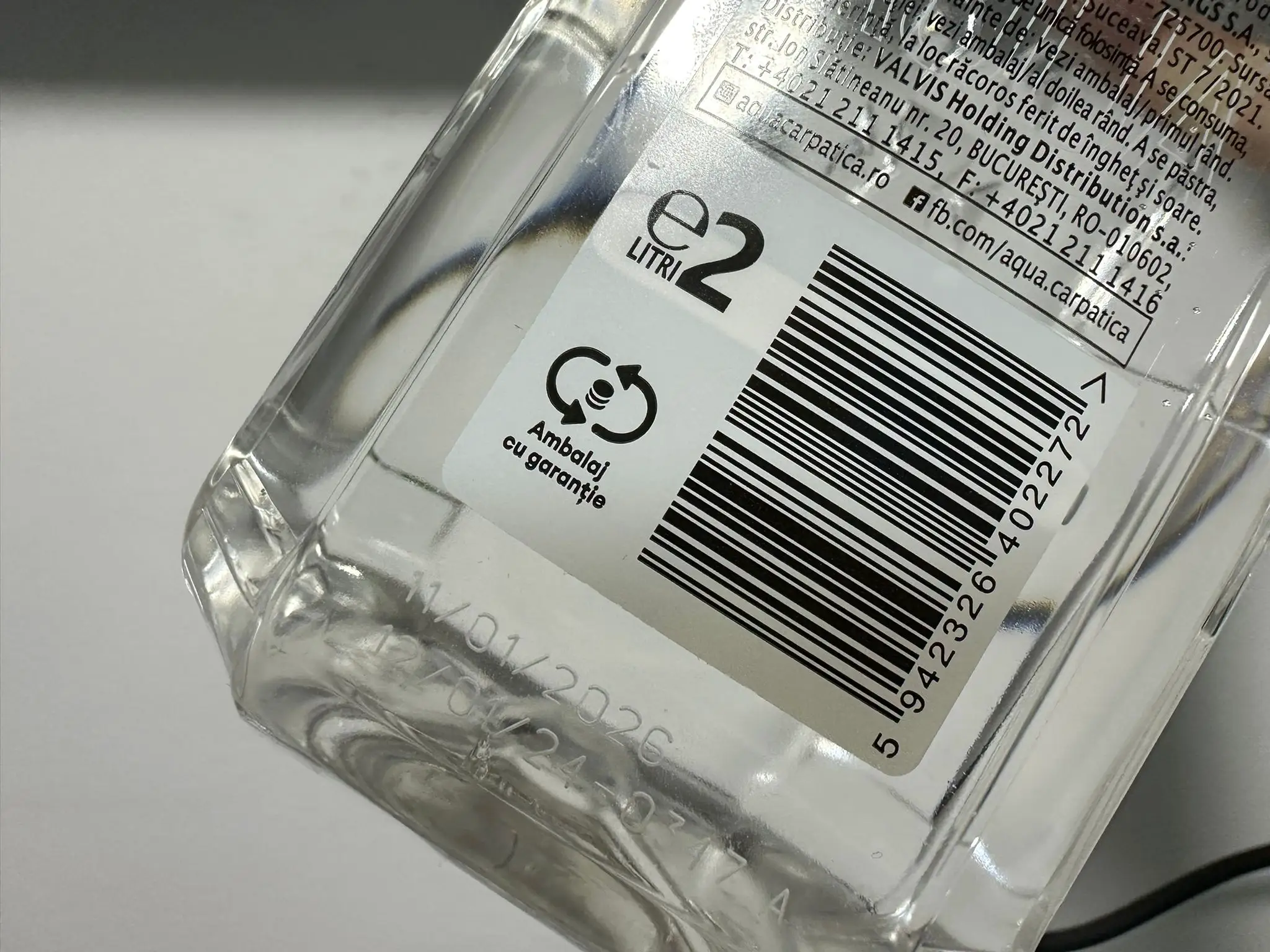
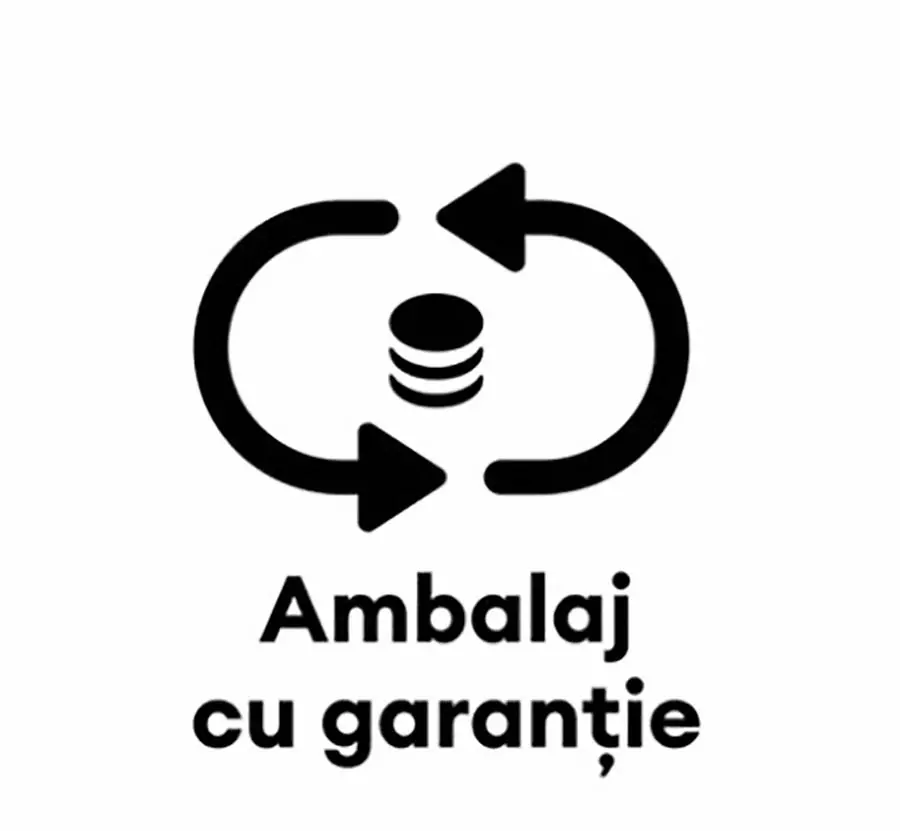
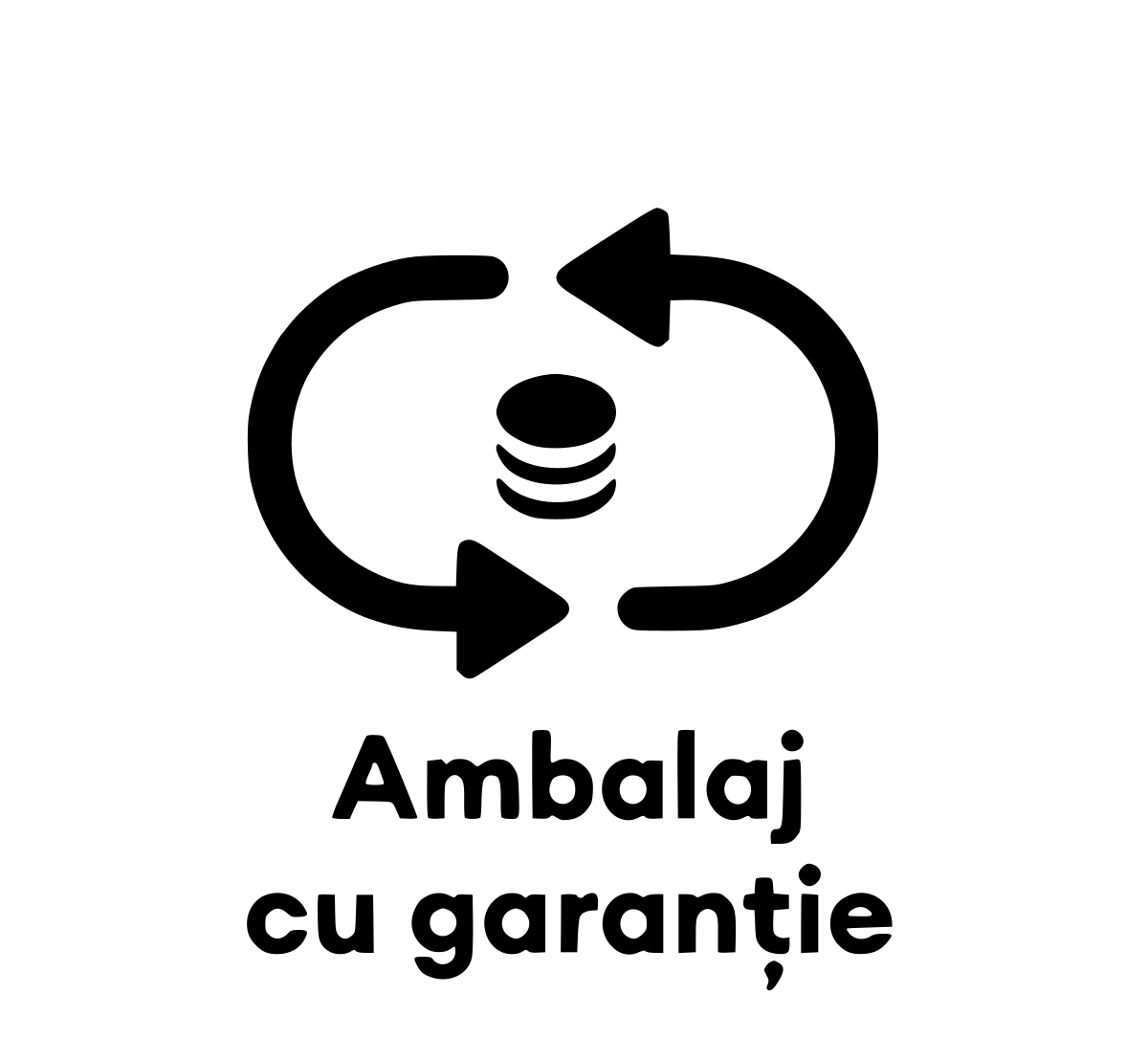
This water bottle shows the mandatory "Ambalaj cu garanție" ("Packaging with Guarantee") label — a circular recycling symbol with a coin icon in the centre. It indicates that the bottle is part of Romania's deposit return system (SGR) and can be returned to a collection point for a refund of 0.50 RON. The label must be printed directly on the packaging or label, and must be visible, legible and not overlap with other graphic elements. The barcode next to the symbol is also mandatory and is used to identify the packaging in the return system.
📎 Download "Ambalaj cu garanție" symbol:
EPR Eco Fees & Eco-Modulation
Fees paid to the PRO vary based on the material type and current recycling market rates. In accordance with PPWR 2026, Romania is implementing eco-modulation, where fees are adjusted based on the recyclability and durability of the packaging. Higher fees apply to complex, multi-material, or non-recyclable packaging.
You can estimate potential packaging compliance costs with Lappa’s EPR fee calculator based on country, material type and packaging volume.
For registration, reporting and ongoing compliance service costs, see Lappa’s EPR pricing page.
Risks, Penalties & Common Mistakes
Non-compliance with Romanian EPR laws can lead to:
-
Fines: Ranging from RON 20,000 to RON 40,000 for failure to register or report.
-
Environmental Fund Tax: A punitive fee of 2 RON per kg for any unmet recovery targets.
-
Common Mistakes: Failing to report transport packaging (pallets) and missing the strict monthly reporting deadlines.
What E-Commerce Sellers Should Do Now
-
Appoint a local Authorized Representative in Romania immediately.
-
Sign a contract with a licensed PRO (OIREP) to manage recycling targets.
-
Ensure your business is registered with the Environmental Fund Administration (AFM).
-
Establish a monthly data tracking system for all packaging weights sent to Romania.
External expertise for all your EPR needs
Start EPR reporting within 24 hours
FAQ
Is there a minimum volume for EPR in Romania?- No, the threshold is zero; you must comply from your first sale.
- Reporting in Romania is mandatory on a monthly basis.
- No, but as a foreign seller, you must appoint a local Authorized Representative.
- The AFM is the government authority that monitors the Environmental Fund and EPR compliance.
- Yes, for specific beverage containers, participation in the SGR is required in addition to standard EPR.
What is Romania EPR Batteries
Romania's battery EPR framework is governed by Regulation (EU) 2023/1542 — the EU Battery Regulation — which applies directly in all EU Member States from 18 August 2025. At national level, Romania implements battery EPR through its waste management legislation, with the National Environmental Protection Agency (ANPM — Agenția Națională pentru Protecția Mediului) serving as the competent authority for producer registration and oversight. Battery EPR has been mandatory in Romania for many years under legislation transposing the former Batteries Directive 2006/66/EC. The EU Battery Regulation replaced this Directive in full from 18 August 2025, introducing a more comprehensive and harmonised framework covering all five battery categories. Romania was included in Zalando's fourth wave of battery EPR verification, scheduled by 30 April 2026. Producers should confirm the current state of Romania's updated producer register with ANPM and approved PROs directly.Does This Apply to E-Commerce & Online Sales
Yes. The EU Battery Regulation applies to all producers placing batteries on the Romanian market, regardless of sales channel. Distance sellers and e-commerce operators selling battery-containing products directly to Romanian consumers are explicitly captured as producers. Romania has a distinctive compliance requirement for foreign companies: under Romanian legislation governing WEEE, batteries, and packaging, foreign companies fulfilling producer obligations in Romania must appoint not only an Authorised Representative but also a Tax Representative. This additional requirement covers reporting and registration duties with the national registry and take-back schemes, and results in additional costs and administrative obligations compared to most other EU member states.Who is the "Producer" under Romania EPR?
Under Regulation (EU) 2023/1542 and Romanian waste legislation, a producer is any person who, in the course of commercial activity, places batteries—whether standalone or incorporated into products— on the Romanian market for the first time. This covers:- Manufacturers established in Romania who produce and sell batteries domestically under their own brand.
- Importers bringing batteries into Romania from non-EU countries for the first time under their own name.
- Companies introducing batteries from another EU Member State into Romania for the first time.
- Private label owners whose brand name appears on batteries manufactured by third parties.
- Distance sellers and online retailers established outside Romania who sell batteries or battery-containing products directly to Romanian consumers.
- Economic operators who prepare batteries for re-use or repurposing — treated as producers for the second life of the battery.
Who Must Register for EPR Batteries in Romania
All producers placing batteries on the Romanian market must register with the National Environmental Protection Agency (ANPM) and join an approved collective management system (PRO) for batteries. Approved PROs operating in Romania for batteries and WEEE include Ecotic (ecotic.ro) and EcoTec (ecotec.ro), among others authorised by ANPM. Producers join a PRO, declare volumes placed on the Romanian market, pay contributions, and the PRO manages collection, recycling, and annual reporting to ANPM. Foreign companies must appoint both an Authorised Representative and a Tax Representative in Romania to fully cover their registration and reporting obligations.Romania EPR Battery Registration Threshold
Regulation (EU) 2023/1542 does not establish a minimum volume or turnover threshold below which producers are exempt from EPR obligations. All producers placing batteries on the Romanian market must register and comply regardless of size or volume. The only exemption in the Regulation concerns batteries used in military or space equipment, which are outside the scope entirely.Detailed EPR Guidance for each Jurisdiction
We support 36 jurisdictions
Batteries Covered (and Excluded)
Regulation (EU) 2023/1542 defines five battery categories, all within scope for EPR in Romania: Portable batteries Batteries under 5 kg not designed for industrial or vehicle use. Includes batteries in consumer electronics, power tools, household devices, and toys. Light Means of Transport (LMT) batteries Batteries used in e-bikes, e-scooters, e-mopeds, and similar light electric vehicles. Automotive (SLI) batteries Starting, lighting, and ignition batteries used in vehicles. Industrial batteries Batteries used in industrial applications and stationary energy storage systems. Those above 2 kWh have additional requirements including battery passports from 2027. Electric vehicle (EV) batteries Batteries used in electric cars and heavy electric vehicles. Key exclusions:- Batteries designed for military or space equipment — outside scope entirely
- Batteries in nuclear installations — excluded
- Second-life batteries where the operator performing re-use or repurposing becomes the new producer
Producer Responsibility Organization (PRO)
Romania operates an approved PRO system for batteries. The main approved collective organisations include: Ecotic (ecotic.ro) — one of Romania's leading collective organisations for batteries and WEEE, managing nationwide collection infrastructure and reporting to ANPM on behalf of its members. EcoTec (ecotec.ro) — another approved collective organisation covering batteries and WEEE in Romania. Producers join one of the approved PROs, which manages collection, transport, recycling, and annual compliance reporting to ANPM. The PRO calculates financial contributions based on the weight and category of batteries placed on the Romanian market.EPR Registration in Romania
The registration process for battery producers in Romania is as follows:- Determine whether your business qualifies as a producer under the EU Battery Regulation and Romanian waste legislation.
- If established outside Romania, appoint both an Authorised Representative and a Tax Representative established in Romania. Both are required for foreign companies to fulfil registration and reporting obligations under Romanian law.
- Register with ANPM (National Environmental Protection Agency) as a battery producer, submitting company details, battery categories, and representative information.
- Join an approved collective management system — Ecotic or EcoTec — by signing a membership agreement.
- Declare battery volumes placed on the Romanian market by category and weight.
- Pay applicable contributions to the PRO.
- Submit annual declarations and reporting through the PRO to ANPM.
- Retain records for audit by ANPM.
Authorized Representative
Romania has a distinctive dual representative requirement for foreign companies. Under Romanian legislation on WEEE, batteries, and packaging, foreign companies must appoint:- An Authorised Representative — responsible for EPR compliance, registration with ANPM, PRO membership, and regulatory correspondence.
- A Tax Representative — responsible for tax registration and fiscal reporting obligations in Romania.
What Data Must Be Reported
Producers registered in Romania must declare and report the following data annually through their PRO and ANPM:- Total weight (kilograms) of batteries placed on the Romanian market during the reporting year, broken down by battery category (portable, LMT, SLI/automotive, industrial, EV)
- Battery chemistry type where relevant to contribution calculations
- Brand names under which batteries were placed on the market
- Collection and recycling performance data, compiled and reported by the PRO to ANPM on behalf of members
- For EV and LMT batteries: number of batteries made available and amounts of waste batteries collected and delivered to treatment facilities
First Reporting Period & EPR Reporting Deadlines
Battery EPR has been mandatory in Romania for many years. The EU Battery Regulation obligations took full effect from 18 August 2025. Key dates:- 18 August 2025: EU Battery Regulation EPR obligations fully in force.
- 30 April 2026: Zalando's Romanian battery EPR verification scheduled to activate.
- Annual (25 January): Annual report on batteries placed on the Romanian market for the previous calendar year — submitted to ANPM through the PRO. Confirm the exact deadline directly with ANPM or the chosen PRO.
- 18 February 2027: Battery passports mandatory for industrial batteries (>2 kWh) and EV batteries.
- 18 August 2027: Due diligence obligations in force (delayed under Omnibus IV).
Labels & Marketing Claims
Crossed-out wheeled bin symbol From 18 August 2025, all batteries must display the separate collection symbol covering at least 3% of the area of the largest side of the battery, up to a maximum of 5 × 5 cm. Chemical symbols Batteries containing more than 0.002% cadmium must be marked Cd. Batteries containing more than 0.004% lead must be marked Pb. Capacity marking Portable and rechargeable batteries must display capacity information. QR code From 18 August 2026, all batteries must carry a QR code. For LMT, industrial (>2 kWh), and EV batteries, this links to the Digital Battery Passport from 18 February 2027. CE marking Mandatory from 18 August 2024. Language requirements Consumer-facing information on batteries sold in Romania must be provided in Romanian where required under Romanian consumer protection law. Environmental claims The Empowering Consumers for the Green Transition Directive (2024/825/EU) must be transposed by March 2026, after which unsubstantiated green claims will be prohibited across the EU including Romania.EPR Eco Fees & Eco-Modulation
Approved PROs in Romania set contribution rates for members based on the weight and category of batteries placed on the Romanian market. Specific fee schedules should be confirmed directly with Ecotic or EcoTec at the time of membership registration. Under Regulation (EU) 2023/1542, eco-modulation — adjusting contributions based on battery environmental performance — is required across all Member States. Romania's specific eco-modulation framework under the new Regulation has not been separately published as of May 2026.Risks, Penalties & Common Mistakes
- Appointing only an Authorised Representative without a Tax Representative. Romania requires both for foreign companies — an Authorised Representative alone is insufficient to fulfil all registration and reporting obligations under Romanian law.
- Operating without ANPM registration. Placing batteries on the Romanian market without registration is a compliance breach subject to enforcement by ANPM. Fines may apply under Romanian waste legislation.
- Assuming one EU registration covers Romania. Battery EPR registration is national. Registration in another EU member state does not fulfil Romanian obligations.
- Missing the Zalando EPR number requirement. Romania's battery EPR verification on Zalando is scheduled by 30 April 2026. Sellers should ensure their Romanian EPR registration is complete before this date.
- Failing to join a PRO. ANPM registration alone is insufficient — producers must also join an approved PRO for battery collection and recycling.
- Missing labelling requirements. The crossed-out wheeled bin symbol and CE marking are mandatory from August 2025.
- Missing the QR code deadline of August 2026.
What E-Commerce Sellers Should Do Now
- Confirm whether your products contain batteries and whether they are being sold to Romanian consumers.
- Appoint both an Authorised Representative and a Tax Representative established in Romania — both are required for foreign companies under Romanian law.
- Register with ANPM as a battery producer, providing company details, battery categories, and representative information.
- Join an approved PRO — Ecotic (ecotic.ro) or EcoTec (ecotec.ro) — and sign a membership agreement.
- Declare battery volumes by category and weight and pay applicable contributions.
- Prepare for Zalando's Romania battery EPR verification rollout (scheduled by 30 April 2026).
- Verify that all batteries carry the crossed-out wheeled bin symbol, CE marking, capacity information, and Romanian-language consumer instructions as required.
- Plan for the QR code requirement by August 2026 and the Digital Battery Passport for industrial and EV batteries by February 2027.
Register online
Start your EPR Reporting within 24 hours
FAQ
Is battery EPR mandatory in Romania?- Yes. Battery EPR has been mandatory in Romania for many years. From 18 August 2025, the EU Battery Regulation (2023/1542) fully applies. All producers placing batteries on the Romanian market must register with ANPM, join an approved PRO such as Ecotic or EcoTec, declare volumes, and comply with collection and recycling obligations.
- Yes. Distance sellers and e-commerce operators are captured as producers under the EU Battery Regulation and Romanian waste legislation. Romania has a distinctive requirement: foreign companies must appoint both an Authorised Representative and a Tax Representative established in Romania — not just one. This dual requirement creates additional administrative obligations compared to most other EU member states.
- Romanian legislation covering WEEE, batteries, and packaging requires foreign companies to appoint an Authorised Representative for EPR compliance purposes and a Tax Representative for fiscal registration and reporting obligations with Romanian tax authorities. Both are needed to fully cover registration and reporting duties with the national registry and take-back schemes.
- The main approved PROs for batteries in Romania are Ecotic (ecotic.ro) and EcoTec (ecotec.ro). Both are authorised by ANPM and manage collection, recycling, and reporting obligations on behalf of their members. Producers should contact both and compare contribution rates and service terms.
- No. The EU Battery Regulation does not establish a minimum volume or turnover exemption for EPR registration. All producers placing batteries on the Romanian market must register and comply regardless of size.
Packaging EPR law in Romania: None enacted
Romania is not among the countries with enacted textile EPR legislation.Want to be first to know when new EPR will issued?
Only important news!