


France EPR
What is France Packaging EPR
France Packaging EPR (“Responsabilité Élargie du Producteur”) is a legal framework under French environmental law requiring companies that place packaged products on the French market to finance the collection, sorting, and recycling of packaging waste. The system is overseen by public authorities and implemented through approved Producer Responsibility Organizations (PROs).Does this apply to e-commerce & online sales?
Yes. Packaging EPR fully applies to e-commerce and online sales. Companies selling packaged goods online to customers in France are considered to be placing packaging on the French market, regardless of where the company is established or from where goods are shipped.Who is the “producer” under France Packaging EPR?
The “producer” is the entity that first places packaged products on the French market. This is typically the manufacturer established in France, the importer, or a foreign distance seller selling directly to French customers. Manufacturing the product is not required to be considered the producer.Who must register for Packaging EPR in France
Any company that places packaged products on the French market must comply with Packaging EPR registration obligations. This includes French companies, EU and non-EU exporters, online retailers, importers, and distance sellers selling directly to France. Businesses that fall within scope can use Lappa's EPR registration service to manage registrations across multiple European markets.France Packaging EPR registration threshold
EPR packaging thresholds in Europe and France does not provide a general exemption threshold for packaging EPR. All companies placing packaging on the French market are subject to the obligation, regardless of volume, although simplified reporting options may exist for very small producers.Register online
Start your EPR Reporting within 24 hours

EPR and PPWR for France
Two separate legal frameworks govern packaging in France, and they run on different tracks. The national system—anchored in the AGEC Law—requires producers to register with an eco-organisme (typically Citeo), pay fees based on packaging weight and material type, and participate in France's collection and recycling infrastructure. That system has existed for years and will continue unchanged.Usage of EPR and PPWR compliance software from Lappa can make a compliance my easier
PPWR compliance is something else entirely. It's a performance mandate: packaging must be designed to recycle, cannot contain harmful substances above specific thresholds, must incorporate recycled materials, and must be labeled in a standardised way across the EU. PPWR doesn't care which eco-organisme you use or what fees you pay. It only cares whether your packaging works in a circular economy.
The tension emerges because France's historical approach treats recovery broadly—reuse matters as much as recycling, incineration with energy recovery counts, even landfill diversion gets credit. PPWR narrows that lens. From 2030 onward, recycling becomes the dominant pathway. Packaging designed to burn in an incinerator won't face the same fee benefits it once did; it may eventually be prohibited outright. Companies need to anticipate this gradual reorientation, not just react when rules change.
Non-resident producers must hire a French-based representative to handle eco-organisme relationships. This is a national requirement that predates PPWR and persists. PPWR formalizes it EU-wide from August 2026, but France already enforced it.
PPWR Labels for France
France currently mandates the Triman logo—a black triangular arrow—on all consumer packaging, accompanied by "Info-Tri" sorting instructions. This has been required since 2022 and violations cost up to €30,000. The placement rules depend on package size; larger items get prominent placement, smaller ones follow scaled rules.
Starting 12 August 2028, PPWR imposes a completely different labeling regime: harmonised EU pictograms that show what material the packaging is made from, whether it's recyclable, and how much recycled content it contains. These are not Triman; they're a fresh EU system.Get a Fee Quote for Lappa for PPWR services.
For roughly two years (2028–2030), packaging will likely need both: Triman to stay compliant with French national law, plus PPWR pictograms to meet EU requirements. This is administratively messy and drives up design and printing costs. The European Commission is suing France over Triman, claiming it restricts cross-border trade. If the Commission wins, Triman could disappear, which would simplify things—but that outcome remains uncertain. Businesses should design for both until clarity emerges.
For a broader overview of the upcoming EU system, see our guide to PPWR labelling requirements
PPWR Product Rules for France
Four concrete rules take effect between now and 2030, each with operational bite.
Immediate (August 2026): Packaging inks, coatings, and barrier layers cannot exceed 25–250 ppb of PFAS (per- and polyfluoroalkyl substances), depending on the specific chemical and application. This catches many food-contact surfaces, water-repellent finishes, and grease-resistant treatments. A single non-compliant batch shuts you out of the French market.
January 2030: Packaging must be engineered to actually recycle in French sorting facilities. That means material choice, adhesive compatibility, label removability, and closure design all matter. A beautiful design that contaminates the recycling stream fails PPWR. Proof comes via technical testing or third-party certification against PPWR's criteria—something most suppliers have not yet done.
January 2030: Plastic packaging must be at least 30% recycled content; paper/cardboard 90%; glass 40%; aluminium 50%. These are non-negotiable minimums. The recycled material must be traceable. It's not enough to claim you're using scrap; you need documentation proving origin.
January 2030: Oversized packaging gets scrutinised. Air-filled boxes, excessive padding, and non-functional material face enforcement. There's no universal formula yet—thresholds vary by product category—but the intent is clear: use what you need, nothing more. ADEME (France's environment agency) is publishing category-specific guidance, but early compliance requires engagement with suppliers and design teams now.
Packaging covered (and excluded)
Covered packaging includes primary packaging, secondary packaging, tertiary/shipping packaging, household packaging, and commercial/industrial packaging. Excluded packaging may include packaging that does not reach the French market or packaging already declared by another obligated party upstream.Producer Responsibility Organization (PRO)
Producers must comply with Packaging EPR obligations by joining an approved Producer Responsibility Organization (PRO) or, in rare cases, by establishing an individual compliance system. In France, producers must join an approved PRO, such as:- CITEO (main household packaging PRO)
- LEKO (alternative compliance scheme)
- Adelphe (for wines/spirits)
Packaging EPR registration in France
Registration generally involves identifying producer obligations, joining a PRO, obtaining a membership number, registering in national databases if required, and submitting regular packaging declarations.Authorized representative
Foreign producers selling directly into France may appoint an authorized representative to handle registration, reporting, and communication with authorities and PROs. The appointment of a representative does not transfer legal responsibility away from the producer.What data must be reported
Producers must report packaging data requirements to be placed on the French market, including sales units, packaging weight, material breakdown, household versus commercial classification, and information on reuse if applicable.First reporting period
The first reporting period usually corresponds to the first calendar year in which the company places packaging on the French market. In many cases, previous periods must be declared before access to future reporting periods is granted.Packaging EPR reporting deadlines
Reporting deadlines are set by PROs and national rules, typically requiring annual declarations in the year following the reporting period.Labels & marketing claims
Mandatory Triman label for EPR products in France
If your product falls under French EPR regulations, it must display the Triman logo. This label informs consumers about sorting and recycling requirements, and failure to include it may result in penalties.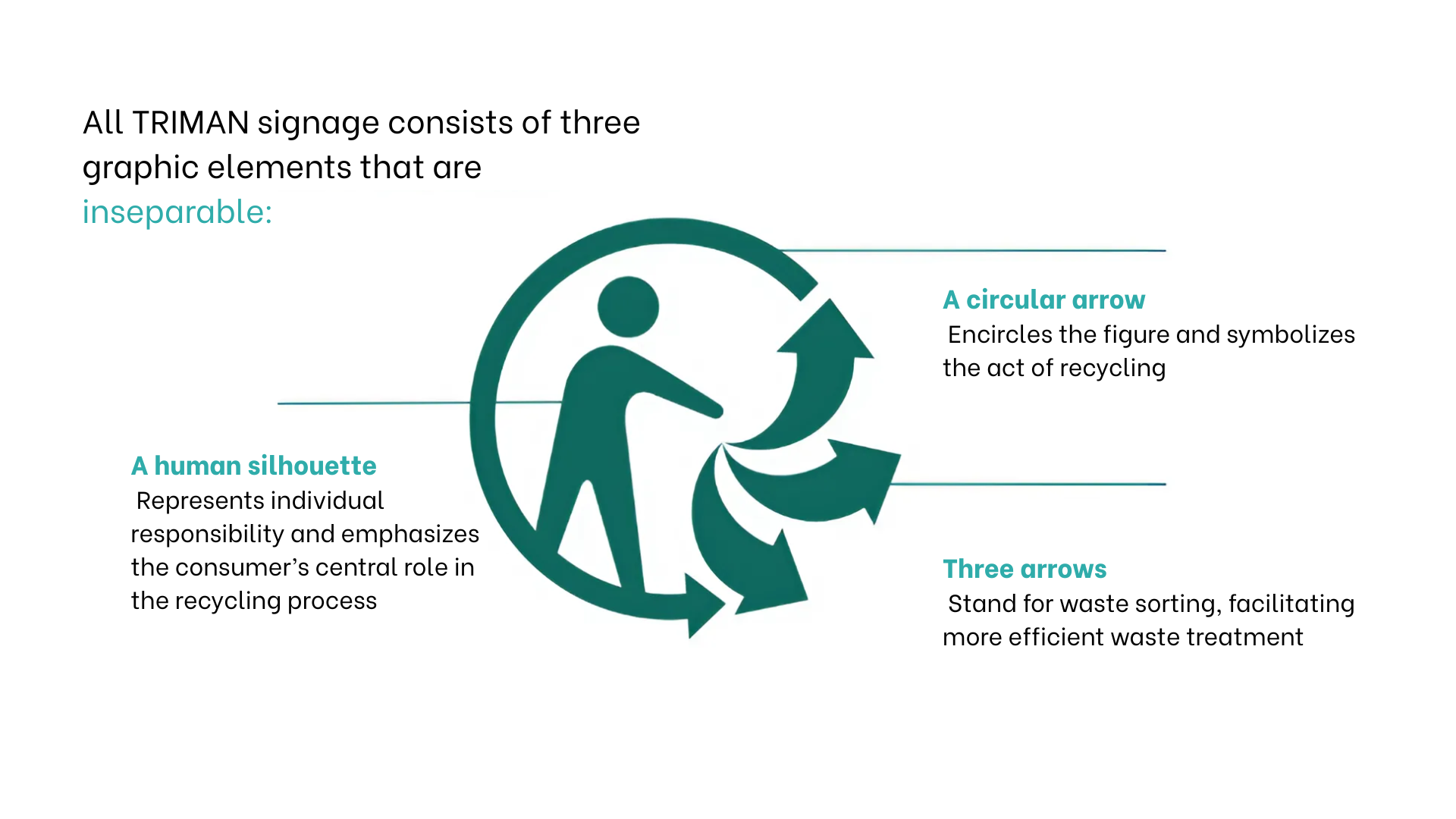
An example of what a label looks like on packaging for France
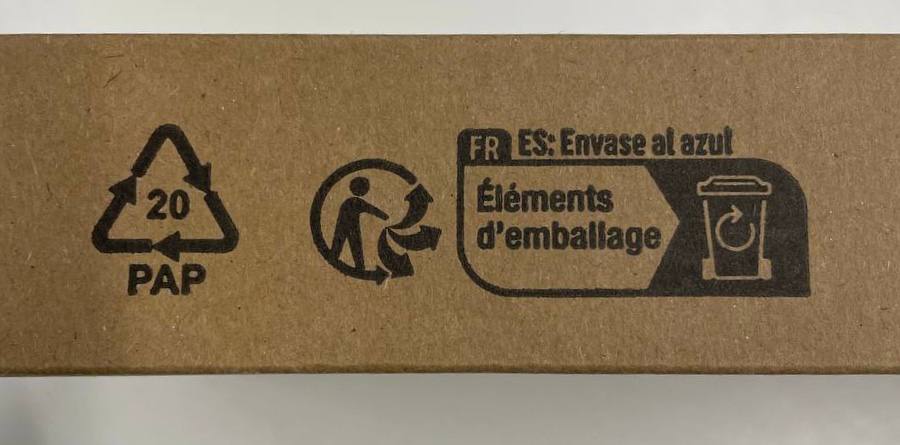 This box includes standard packaging labeling elements used across the EU as part of EPR (Extended Producer Responsibility) requirements.
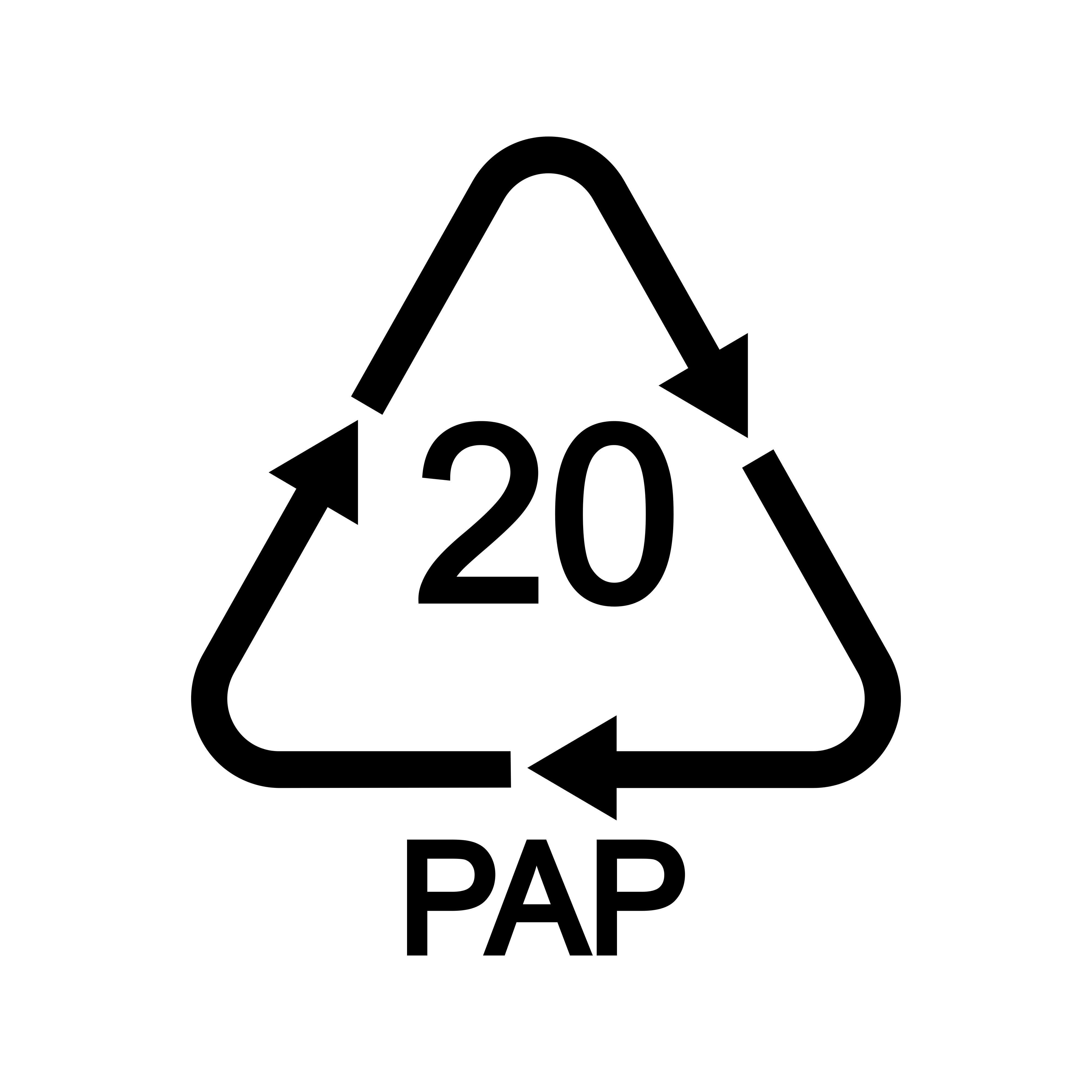
On this example, we can see the PAP 20 recycling code.
However, paper packaging materials may also be labeled under other PAP categories, such as PAP 21 or PAP 22, depending on the type of cardboard or paper used.
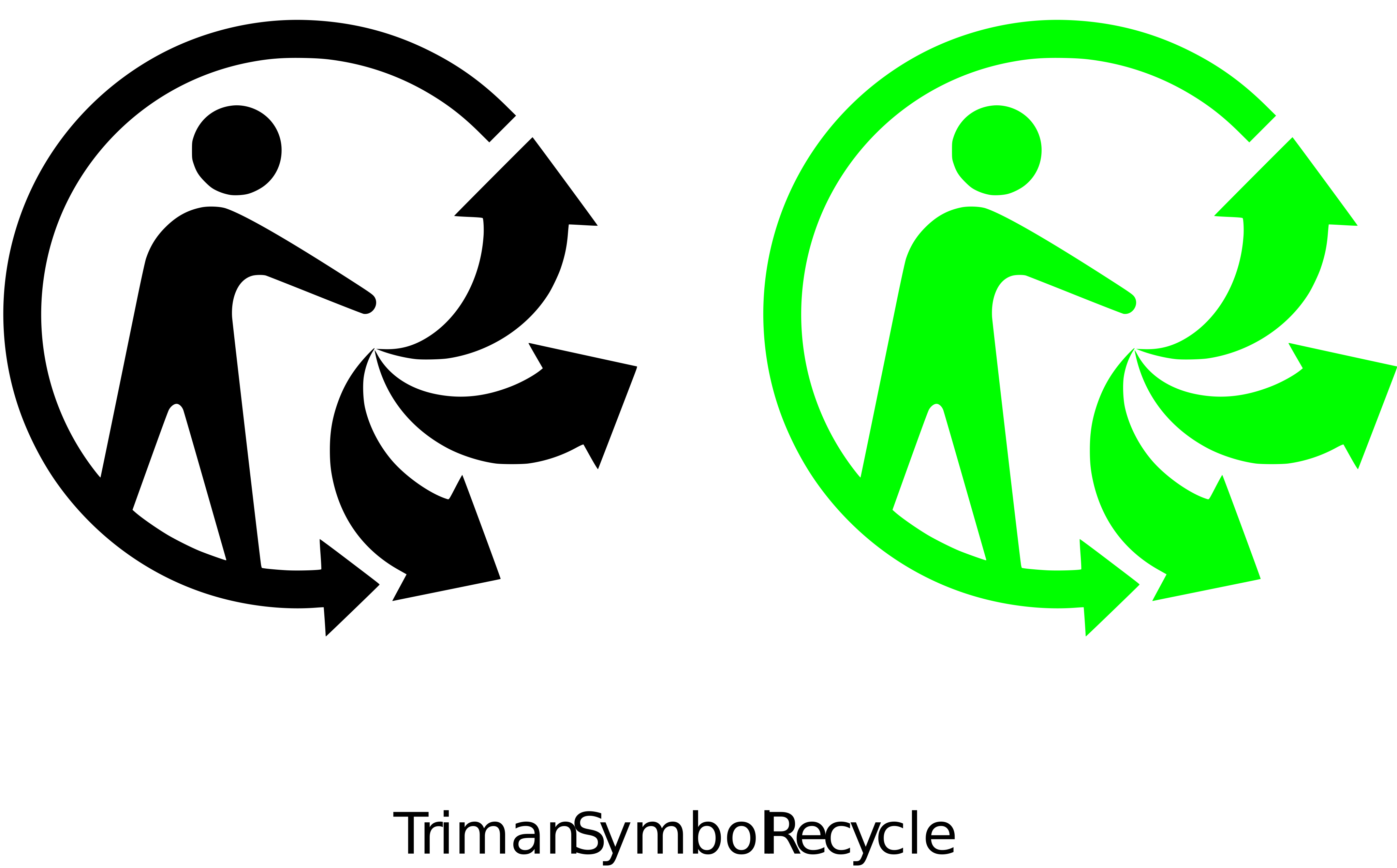
Triman logo — Mandatory in France
The Triman symbol is an mandatory label in France showing that the packaging must be sorted and recycled through the national EPR system.
📎Download the Triman Logo from Lappa:
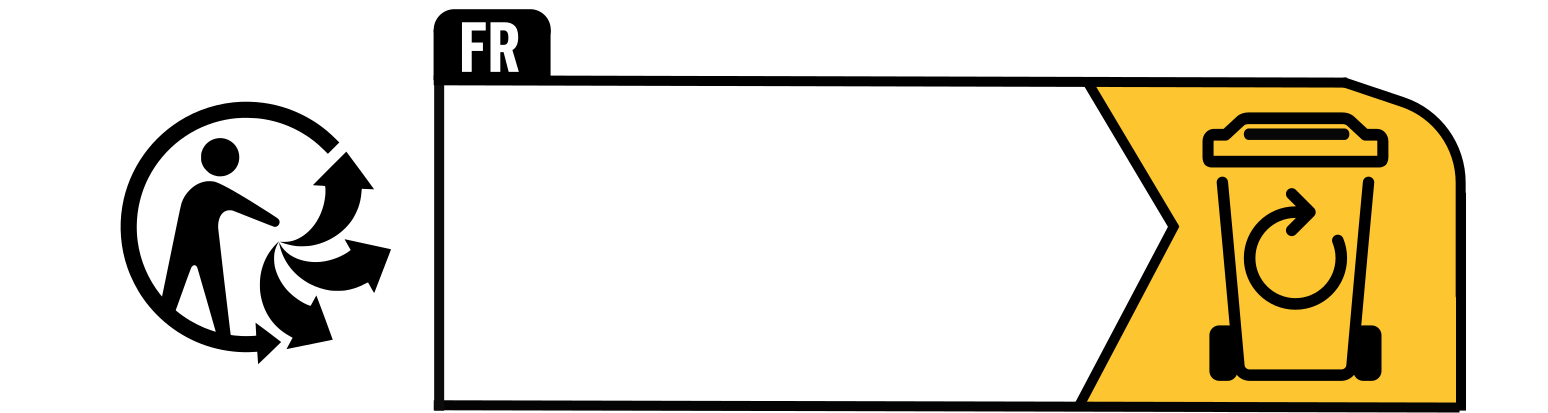
Triman + Info-tri sorting instruction
In France, producers must also display an Info-tri label (sorting guidance) next to the Triman logo to help consumers dispose of packaging correctly.
📎Download the Triman+Info-tri
PAP 20 — Corrugated Cardboard
PAP 20 is the material identification code for corrugated cardboard packaging (e.g. shipping boxes). It indicates that the packaging is made primarily of paper fibers and should be sorted for paper/cardboard recycling. 📎 Download the PAP 20 symbol from Lappa: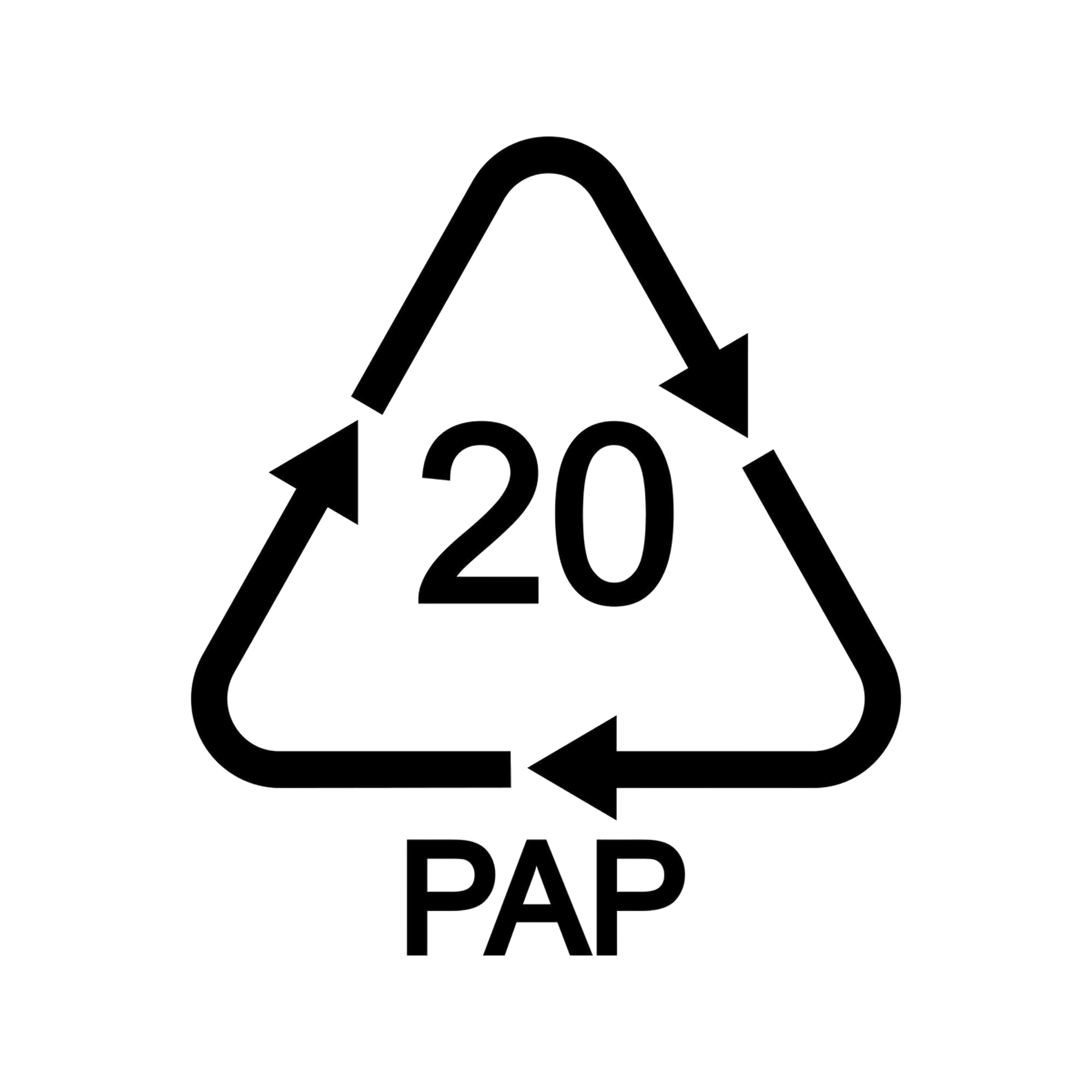
Eco-fees & eco-modulation
Eco-fees are calculated based on packaging weight, material type, and recyclability. France applies eco-modulation mechanisms that reward recyclable packaging and penalize disruptive materials. You can estimate potential compliance costs using the EPR fee calculator For registration and ongoing compliance costs, see our EPR pricing overview.Risks, penalties & common mistakes
Non-compliance may result in administrative fines, contract termination by PROs, or market surveillance actions. Common mistakes include incorrect material classification, underreporting packaging, or missing reporting periods.What e-commerce sellers should do now
E-commerce sellers should confirm their producer status, register for Packaging EPR, collect packaging data, submit required declarations, and ensure labeling compliance.Easy to use EPR Software to calculate Eco-fee
Manage All Countries with Lappa
FAQ
Frequently asked questions typically relate to producer identification, inclusion of shipping packaging, reporting methods, and treatment of small volumes.Do I need EPR if I sell from abroad?
Yes, if you sell directly to France.Can I declare detailed even if small?
Yes, detailed is always allowed.Must I declare shipping boxes?
Yes, e-commerce shipping packaging is included.Do I need to declare 2024 before 2025?
Often yes — LEKO commonly requires prior-year completion.What is France EPR EEE
France has one of the most advanced and comprehensive EEE EPR systems in Europe. The framework is grounded in Article L.541-10 of the French Environmental Code and was substantially strengthened by the AGEC Law (Anti-Waste for a Circular Economy, Law 2020-105 of 10 February 2020). France's EEE EPR covers household EEE, professional EEE, lamps, and batteries as distinct product streams — each requiring separate registration and a separate Unique Identification Number (UIN). Oversight sits with ADEME (Agence de la transition écologique) — the French Agency for Ecological Transition — which manages the SYDEREP registration and declaration database, issues UINs, publishes the public list of compliant producers, and levies fines for non-compliance. Day-to-day compliance is managed through approved Producer Responsibility Organisations (PROs) — eco-organisations accredited by the Ministry for Ecological Transition. The UIN has a specific format: beginning with "FR" followed by six numbers, an underscore, and four uppercase letters (e.g., FR239691_01VNFV). It is annually renewable and must be maintained as long as products are being placed on the French market.Does This Apply to E-Commerce & Online Sales
Yes. France's EEE EPR applies to all entities — regardless of location — that manufacture, import, sell, or place EEE on the French market. Distance sellers and e-commerce operators selling directly to French consumers are explicitly captured as producers. Companies not established in France must appoint a person or entity holding a French SIREN number to register on their behalf. Amazon.fr validates UIN numbers against the SYDEREP database. Missing or invalid UINs result in listing restrictions. On Amazon.fr, unlike Amazon.de, it is technically possible to have listings without all UIN numbers — but sellers will then be enrolled in Amazon's fee-charging service for non-compliant products. Ecosystem, one of the main EEE PROs, offers registration directly or via the pan-European network weee Europe / Pronexa AG for simplified cross-border compliance.Who is the "Producer" under France EPR?
France applies a broad definition of "producer" under the Environmental Code. A producer is any entity that:- Manufactures EEE under their own brand and places it on the French market.
- Imports EEE into France from another country under their own name.
- Sells EEE to French consumers under their own name or brand — including distance sellers without a physical establishment in France.
- Places own-brand EEE on the French market regardless of where the manufacturing takes place.
- Private label owners whose brand appears on EEE manufactured by third parties.
Who Must Register for EPR EEE in France
All producers placing EEE on the French market must register with an approved PRO (eco-organisation) for each applicable product stream. The PRO forwards registration data to ADEME via SYDEREP, which then issues the UIN. The main approved PROs for household EEE in France are Ecosystem (pro.ecosystem.eco) and Ecologic (ecologic.eu). Both are accredited by the Ministry for Ecological Transition and manage collection, recycling, and ADEME reporting on behalf of their members. Professional EEE has a separate accreditation structure. The UIN must appear on:- Invoices and sales documents
- The company's French-language website
- General Terms and Conditions of Sale in France
- Marketplace seller profiles (Amazon.fr, etc.)
France EPR EEE Registration Threshold
There is no de minimis threshold for EEE EPR registration in France. The obligation applies to all producers placing EEE on the French market regardless of volume or turnover — including small e-commerce sellers. Each EPR stream generates its own UIN. A company selling EEE that contains batteries must obtain a separate UIN for the WEEE stream and a separate UIN for the battery stream.Detailed EPR Guidance for each Jurisdiction
We support 36 jurisdictions
EEE Categories Covered (and Excluded)
France applies the open scope approach of the revised WEEE Directive through the AGEC Law. All EEE is in scope unless specifically excluded. The French system distinguishes between: Household EEE (B2C) Regulated under the main WEEE eco-organism framework. Main product groups include: Large household appliances — Refrigerators, washing machines, dishwashers, cookers, air conditioners. Small household appliances — Vacuum cleaners, toasters, coffee machines, irons, hair dryers. IT and telecommunications equipment — Computers, laptops, tablets, smartphones, printers, routers. Consumer electronics — Televisions, radios, audio and video equipment, cameras. Lighting equipment — Fluorescent lamps, LED lamps, luminaires. These form a separate EPR sub-stream in France with specific eco-organisations. Electrical and electronic tools — Power tools and similar equipment. Toys, leisure and sports equipment — Video game consoles, electric toys, sports equipment with electrical components. Medical devices — Medical equipment (excluding implanted and infected devices). Monitoring and control instruments — Smoke detectors, thermostats, measuring instruments. Automatic dispensers — Vending machines and cash dispensers. Professional EEE (B2B) Professional EEE has a separate registration structure in France, with dedicated eco-organisations and a different reporting and fee framework from household EEE. Key exclusions:- EEE designed and installed as part of another type of equipment that can only function as part of that equipment
- Large-scale fixed installations
- Military or space equipment
- Implanted and infected medical devices
Producer Responsibility Organization (PRO)
The two main approved eco-organisations for household EEE in France are: Ecosystem (pro.ecosystem.eco) — one of France's largest eco-organisations, covering household EEE, lamps, professional EEE, and batteries. Ecosystem manages formalities with ADEME on behalf of its members and provides registration directly or via the international weee Europe / Pronexa AG network for foreign companies. Ecosystem handles the full producer lifecycle from registration through to annual declarations. Ecologic (ecologic.eu) — the second major approved eco-organisation for household EEE in France, covering similar product categories with its own PRO network and collection infrastructure. Both PROs submit annual declaration data to ADEME via SYDEREP on behalf of their members. Producers should contact both and compare fees and service terms before signing.EPR Registration in France
The registration process for EEE producers in France is as follows:- Confirm which EEE product streams apply to your products — household EEE, professional EEE, lamps, batteries — as each requires a separate UIN.
- If not established in France, appoint a person or entity with a French SIREN number to act as your representative for registration.
- Select and join an approved eco-organisation — Ecosystem or Ecologic — by signing a membership contract.
- The eco-organisation registers your company and product categories with ADEME via SYDEREP.
- Receive your UIN (Unique Identification Number) from ADEME — format: FR######_XXXX.
- Display the UIN on invoices, websites (French domain), general terms and conditions, and marketplace seller profiles.
- Submit annual declarations of EEE placed on the French market through the eco-organisation's portal.
- Pay eco-contributions (eco-fees) based on declared volumes and display the eco-fee visibly and separately on invoices and product listings.
- Renew the UIN annually by fulfilling EPR obligations and maintaining PRO membership.
Authorized Representative
Foreign companies not established in France must work with a person or entity holding a French SIREN number to manage registration and EPR obligations. This is required because the French registration system operates through the SIREN/SIRET business identification framework. The representative handles PRO registration, ADEME SYDEREP submissions, annual declarations, eco-fee payments, and marketplace UIN submission. Legal responsibility for the accuracy of declarations and compliance remains with the producer. Important development: In December 2025, the European Commission proposed suspending the authorised representative requirement for EU-established companies until 2035 under Proposal COM(2025) 983. This proposal has not been formally adopted as of May 2026. For non-EU producers, the requirement is not affected.What Data Must Be Reported
Producers must declare the following data annually through the eco-organisation's portal:- Total weight (kilograms) and/or number of units of EEE placed on the French market during the previous calendar year, by product category and end-user type (B2C household versus B2B professional)
- Data supporting eco-contribution calculations by product category
- Information on products subject to other EPR streams (batteries, lamps) placed on the market — declared separately under each applicable UIN
First Reporting Period & EPR Reporting Deadlines
France's EEE EPR has been mandatory for many years. Key deadlines:- Annual: Declarations of EEE placed on the French market for the previous calendar year, submitted through the eco-organisation's portal. Specific deadlines vary by eco-organisation — confirm with Ecosystem or Ecologic at time of membership.
- Annual renewal: The UIN must be renewed annually by fulfilling EPR obligations and paying eco-contributions.
- Late declarations: Result in penalty fees from the eco-organisation and potential referral to ADEME for enforcement action.
Labels & Marketing Claims
Triman logo and Info-tri The Triman logo and consumer sorting instructions (Info-tri) must be affixed to all EEE products subject to EPR in France — on the product itself, its packaging, or its online product page. This is mandatory under the AGEC Law. Not displaying the Triman logo is a compliance gap actively detected during marketplace audits and ADEME inspections. Eco-fee display For household EEE, the eco-fee must be displayed visibly and separately from the product price on invoices, websites, and in online shopping platforms. For professional EEE, displaying the eco-fee separately is optional. The eco-fee must also appear on sales bills. Crossed-out wheeled bin symbol Mandatory on all EEE to indicate separate collection at end of life. CE marking Mandatory for applicable EEE categories under EU product safety legislation. RoHS compliance EEE must comply with Directive 2011/65/EU (RoHS) restricting hazardous substances. Maintained separately from EEE EPR registration. Language requirements All consumer-facing information — including sorting instructions, eco-fee display, and product information — must be in French for products placed on the French market. Environmental claims The Empowering Consumers for the Green Transition Directive (2024/825/EU) must be transposed by March 2026, after which unsubstantiated green claims will be prohibited across the EU including France.EPR Eco Fees & Eco-Modulation
France's EEE eco-contributions are calculated by the eco-organisation based on the weight and category of EEE placed on the French market. Eco-contributions are displayed separately from the product price and are passed through the supply chain — retailers, online shops, and marketplaces must also show the eco-fee on sales bills. France operates a bonus-malus eco-modulation system for EEE: eco-contributions are adjusted based on the environmental performance of products, including repairability, recyclability, and the presence of hazardous substances. The Repairability Index and, from 2025, the Durability Index — scored and affixed to products — influence eco-contribution levels under the French framework. Fines for missing UIN lines: up to €7,500 per unit. Fines for failure to register or comply: up to €100,000 from ADEME. Fines for missing Triman display: up to €15,000 per infraction with daily penalties up to €20,000.Risks, Penalties & Common Mistakes
- Missing or invalid UIN. Amazon.fr validates UINs against SYDEREP. Invalid or missing UINs result in listing restrictions or enrolment in Amazon's fee-charging service. ADEME fines of up to €7,500 per unit apply for missing UIN on sales documents.
- Failing to appoint a representative with a French SIREN number. Non-French companies cannot register directly without a French SIREN. Attempting to register without one results in registration failure.
- Failing to renew the UIN annually. The UIN expires if EPR obligations are not fulfilled and eco-contributions not paid. An expired UIN creates immediate marketplace compliance issues.
- Missing separate UINs for each EPR stream. Each stream (household EEE, professional EEE, batteries, lamps) requires its own UIN. A company selling battery-containing EEE needs at minimum two UINs.
- Not displaying the eco-fee separately on invoices and listings. Mandatory for household EEE — missing eco-fee display is independently actionable.
- Missing Triman and Info-tri. Mandatory on all EPR-subject products sold in France. Missing logo detected in marketplace audits triggers compliance enforcement.
- Underreporting volumes. ADEME audits declarations and can impose fines for inaccurate reporting. Producers must maintain audit records of all declarations and payments.
What E-Commerce Sellers Should Do Now
- Confirm which EEE product streams apply to your products in France — household EEE, professional EEE, lamps, batteries — each requires a separate UIN.
- Appoint a representative with a French SIREN number to manage registration if not established in France.
- Join Ecosystem (pro.ecosystem.eco) or Ecologic (ecologic.eu) and sign a membership contract.
- Receive your UIN from ADEME via your eco-organisation.
- Display the UIN on your French website, invoices, and Amazon.fr and other marketplace seller profiles.
- Apply the Triman logo and Info-tri sorting instructions to all EEE products, packaging, and online product pages.
- Display the eco-fee visibly and separately from product prices on all invoices, websites, and marketplace listings.
- Submit annual declarations of EEE placed on the French market and pay eco-contributions through your eco-organisation.
- Renew the UIN annually and monitor ADEME for any changes to eco-contribution rates or eco-modulation criteria.
Register online
Start your EPR Reporting within 24 hours
FAQ
Is EEE EPR mandatory in France?- Yes. France's EEE EPR has been mandatory for many years under Article L.541-10 of the Environmental Code, substantially strengthened by the AGEC Law in 2020. All producers placing EEE on the French market must register with an approved eco-organisation (Ecosystem or Ecologic for household EEE), obtain a UIN from ADEME via SYDEREP, and fulfil annual declaration and eco-contribution obligations. There is no de minimis threshold — the obligation applies regardless of volume.
- Yes. Distance sellers and e-commerce operators are explicitly captured as producers under French EPR law regardless of where they are established. Companies not established in France must appoint a representative with a French SIREN number to manage registration. Amazon.fr validates UINs against SYDEREP — missing or invalid UINs result in listing restrictions or enrolment in Amazon's fee-charging compliance service.
- The UIN (Unique Identification Number) is France's EEE EPR registration number, issued by ADEME via SYDEREP after registration with an approved eco-organisation. It must appear on invoices, French websites, general terms and conditions, and marketplace seller profiles. The UIN is annually renewable — it expires if EPR obligations are not fulfilled and eco-contributions not paid. Each EPR stream generates its own separate UIN.
- The eco-fee is the producer's contribution to financing EEE collection and recycling. For household EEE, it must be displayed visibly and separately from the product price on invoices, websites, and online shopping listings. It must also appear on sales bills. Retailers are also required to display the eco-fee. For professional EEE, separate display is optional. The eco-fee amount is set by the eco-organisation based on product category and eco-modulation criteria.
- No. French and German EEE EPR registrations are entirely separate. A Stiftung EAR WEEE-Reg.-Nr. is not valid in France. A French UIN from SYDEREP is required for the French market. Each EU country requires its own national registration — registration in one member state does not fulfil obligations in another.
What is France EPR Batteries
France has maintained mandatory battery EPR since 2009, when the EU Batteries Directive 2006/66/EC was transposed into French law through Decree 2009-1139 of 22 September 2009, embedding battery EPR obligations into the Environmental Code (Articles R.543-124 onwards). The framework was substantially updated by the AGEC law (Law 2020-105 of 10 February 2020) and further aligned with the new EU Battery Regulation through the law of 22 April 2024, which gave full effect to Regulation (EU) 2023/1542 in France from 18 August 2025. Oversight is provided by ADEME (Agence de la transition écologique), which manages the national EPR register SYDEREP and issues Unique Identification Numbers (UINs) to registered producers. Enforcement sits with ADEME and the DGPR (Direction générale de la prévention des risques), which approve PROs, maintain public producer lists, and impose administrative fines under Article L.541-9-5 of the Environmental Code. From 1 January 2026, battery waste management operators in France are required to contract with an approved eco-organisation or a producer with an approved individual system for the management of battery waste. Take-back of batteries at no cost by all battery distributors — regardless of their size — has also become mandatory.Does This Apply to E-Commerce & Online Sales
Yes. French battery EPR obligations apply to all producers placing batteries on the French market, including foreign brands selling directly to French consumers via e-commerce. Distance sellers with no French establishment are explicitly captured and must act through an authorised representative established in France. The UIN must appear on invoices, general terms and conditions, and the French domain of the producer's website. Online marketplaces including Amazon.fr, eBay.fr, and Zalando actively verify UINs against the SYDEREP database and restrict or block listings for sellers who cannot provide a valid UIN. Each EPR stream — batteries, WEEE, packaging, textiles — generates its own separate UIN. Amazon and eBay have required battery UINs from sellers since 2022, making practical enforcement of this obligation well established.Who is the "Producer" under France EPR?
Under the French Environmental Code and Regulation (EU) 2023/1542, a producer is any company that, in the course of commercial activity, places batteries — whether standalone or incorporated into products — on the French market for the first time. This covers:- Manufacturers or brand owners based in France that first place batteries on the market under their own name.
- Importers or intra-EU acquirers bringing batteries into France for the first time under their own name — liability attaches at customs clearance or arrival, unless the product is already registered upstream.
- Private label owners whose brand name appears on batteries manufactured by third parties.
- Distance sellers with no French establishment who sell batteries or battery-containing products directly to French consumers.
- Economic operators who prepare batteries for re-use or repurposing — treated as producers for the second life of the battery.
Who Must Register for EPR Batteries in France
All producers placing batteries on the French market must join an approved PRO (eco-organisation) and register through that organisation. The PRO registers the producer with ADEME's SYDEREP system, which then issues the UIN. The two approved PROs for portable batteries are:- Corepile (corepile.fr) — approved for 2022–2027
- Screlec / Batribox (screlec.fr) — approved status extended to 2025, with new approvals from 18 August 2025 onwards
France EPR Battery Registration Threshold
There is no de minimis threshold for battery EPR registration in France. The obligation applies from the first battery placed on the French market, regardless of company size or volume. The UIN is valid for one year only and must be renewed annually. Registration with SYDEREP is carried out exclusively through the PRO — producers cannot register directly with ADEME without a PRO. Both Corepile and Screlec require a minimum annual contribution of €200 excluding VAT, regardless of volumes placed on the market.Detailed EPR Guidance for each Jurisdiction
We support 36 jurisdictions
Batteries Covered (and Excluded)
France's battery EPR scheme covers all battery types placed on the French market, aligned with the five categories of Regulation (EU) 2023/1542 from 18 August 2025: Portable batteries Batteries under 5 kg not designed for industrial or vehicle use. Includes batteries in consumer electronics, power tools, household devices, and toys. Most commonly encountered category for e-commerce sellers. Light Means of Transport (LMT) batteries Batteries used in e-bikes, e-scooters, e-mopeds, and similar light electric vehicles. Included within the portable battery category under French EPR definitions prior to 2025; now a separate category under the EU Battery Regulation. Automotive (SLI) batteries Starting, lighting, and ignition batteries used in vehicles. Industrial batteries Batteries used in industrial applications and stationary energy storage systems. EPR for industrial batteries was extended under the EU Battery Regulation from 18 August 2025. Electric vehicle (EV) batteries Batteries used in electric cars and heavy electric vehicles. Key exclusions:- Batteries designed for military or space equipment — outside scope entirely
- Batteries in nuclear installations — excluded
- Second-life batteries where the operator performing re-use or repurposing becomes the new producer
Producer Responsibility Organization (PRO)
France's approved eco-organisations for batteries are: Corepile — one of the two approved PROs for portable batteries (agrément 2022–2027). Corepile manages nationwide collection infrastructure, issues eco-modulation discounts for batteries meeting sustainability criteria, and handles SYDEREP registration on behalf of members. Minimum annual contribution: €200 ex. VAT. Screlec / Batribox — the second approved PRO for portable batteries. Screlec was the first French eco-organisation to implement discounted fees for batteries meeting eco-criteria. Minimum annual contribution: €200 ex. VAT. Ecosystem — covers batteries alongside household EEE, lamps, and professional EEE. Ecosystem manages the SYDEREP registration on behalf of its 5,400+ members and can represent producers across multiple EPR streams through a single membership. From 18 August 2025, new approvals for eco-organisations covering industrial and EV batteries were expected to be announced. Producers in these categories should confirm current approved organisations with ADEME directly.EPR Registration in France
The registration process for battery producers in France is as follows:- Determine whether your business qualifies as a producer and identify which battery categories you place on the French market.
- If established outside France, appoint an authorised representative (mandataire) established in France with a French SIREN number, before initiating any registration.
- Select and join an approved PRO — Corepile, Screlec, or Ecosystem — and pay the one-off joining fee.
- Declare batteries placed on the French market for the last 3 years as part of the initial registration process.
- The PRO uploads your details to ADEME's SYDEREP register. ADEME issues your UIN, which serves as proof of EPR registration.
- Display the UIN on your French website, invoices, and general terms and conditions of sale.
- Submit annual declarations covering batteries placed on the French market during the previous calendar year, and pay eco-contributions accordingly.
- Renew the UIN annually — it is valid for one year only.
Authorized Representative
Foreign companies selling batteries directly to French consumers without a French legal establishment must appoint an authorised representative (mandataire) established in France. The representative must hold a French SIREN number and is responsible for maintaining the written mandate, signing the PRO contract, submitting declarations and payments, and receiving ADEME correspondence on behalf of the producer. Legal responsibility for the accuracy of declarations and compliance with the Environmental Code remains with the producer, not the representative. Important development: In December 2025, the European Commission proposed suspending the authorised representative requirement for EU-established companies until 2035. This proposal has not been formally adopted as of May 2026. For non-EU producers, the requirement is not affected and continues to apply under the French Environmental Code.What Data Must Be Reported
Producers must declare the following data to their PRO annually:- Total weight (kilograms) of batteries placed on the French market during the previous calendar year, broken down by battery category (portable, LMT, SLI/automotive, industrial, EV)
- Battery chemistry type where relevant to eco-modulation calculations
- Brand names under which batteries were placed on the market
- At initial registration: quantities placed on the market for the preceding 3 years
- Collection and recycling performance data, compiled and reported by the PRO to ADEME on behalf of members
First Reporting Period & EPR Reporting Deadlines
Battery EPR has been mandatory in France since 2009. The new EU Battery Regulation obligations took full effect from 18 August 2025. Key dates:- 2009: Battery EPR mandatory in France under Decree 2009-1139.
- 18 August 2025: EU Battery Regulation (2023/1542) fully replaces the former Batteries Directive in France. New five-category structure applies.
- 1 January 2026: Battery waste management operators required to contract with an approved eco-organisation.
- Annual: Declarations of batteries placed on the French market during the previous year, submitted to the PRO. Deadline timing is set by each PRO and typically falls in Q1.
- Annual: UIN renewal — the UIN is valid for one year only and must be renewed each year after payment of contributions.
- 18 February 2027: Battery passports mandatory for industrial batteries (>2 kWh) and EV batteries.
- 18 August 2027: Due diligence obligations in force (delayed under Omnibus IV).
Labels & Marketing Claims
Crossed-out wheeled bin symbol From 18 August 2025, all batteries must display the separate collection symbol covering at least 3% of the area of the largest side of the battery, up to a maximum of 5 × 5 cm. Chemical symbols Batteries containing more than 0.002% cadmium must be marked Cd. Batteries containing more than 0.004% lead must be marked Pb. Capacity marking Portable and rechargeable batteries must display capacity information. QR code From 18 August 2026, all batteries must carry a QR code. For LMT, industrial (>2 kWh), and EV batteries, this links to the Digital Battery Passport from 18 February 2027. CE marking Mandatory from 18 August 2024. UIN display The battery UIN must appear on the French website (.fr domain), invoices, and general terms and conditions of sale in France. This is a specific French requirement independent of the EU Battery Regulation labelling rules. Triman logo The Triman logo and consumer sorting instructions are mandatory on battery products sold in France, on their packaging, or on their online product pages, as required by the AGEC law. Language requirements Consumer-facing information on batteries sold in France must be provided in French. Environmental claims The Empowering Consumers for the Green Transition Directive (2024/825/EU) must be transposed by March 2026, after which unsubstantiated green claims will be prohibited across the EU including France.EPR Eco Fees & Eco-Modulation
France's battery eco-contribution structure is weight-based, calculated per kilogram of batteries placed on the market by category. Both Corepile and Screlec publish tariff schedules on their websites. Key fee parameters:- Minimum annual contribution: €200 excluding VAT per producer (Corepile and Screlec)
- Per-kilogram contributions: vary by battery category and chemistry — exact rates are published in each PRO's tariff (barème)
- Eco-modulation discounts: Screlec was the first French eco-organisation to implement reduced fees for batteries meeting specific eco-criteria related to sustainability characteristics. The fee reduction is relatively modest but increases for large volume producers.
Risks, Penalties & Common Mistakes
- Operating without a UIN. Selling batteries or battery-containing products in France without a valid UIN exposes companies to administrative fines under Article L.541-9-5 of the Environmental Code — up to €7,500 per unit for legal entities, plus fines of up to €100,000 for operating without registration. Amazon.fr, eBay.fr, and Zalando actively verify UINs and block non-compliant listings.
- Forgetting that the UIN expires annually. The UIN is valid for one year only. Failure to renew results in an invalid UIN, listing restrictions on marketplaces, and potential fines.
- Failing to declare the last 3 years at registration. Producers joining a PRO for the first time must declare volumes placed on the French market for the three preceding declaration years. Failure to regularise past years is a compliance breach.
- Not appointing an authorised representative. Foreign companies without a French establishment must appoint a representative with a French SIREN before any registration can proceed.
- Assuming one UIN covers all EPR streams. Each EPR stream (batteries, WEEE, packaging, textiles) generates its own separate UIN. A battery UIN does not cover WEEE obligations or vice versa.
- Missing the mandatory UIN display. The UIN must appear on the French website, invoices, and general terms. Missing display is independently sanctionable under the Environmental Code.
- Missing the 1 January 2026 obligation. Battery waste management operators must contract with an approved eco-organisation. Non-contracted operators face sanctions under the updated French decree.
What E-Commerce Sellers Should Do Now
- Confirm whether your products contain batteries — standalone or incorporated into devices — and whether they are being sold to French consumers.
- If established outside France, appoint an authorised representative (mandataire) with a French SIREN number before initiating registration.
- Join Corepile, Screlec, or Ecosystem as your approved PRO for batteries, and complete the initial declaration covering the last 3 years of volumes placed on the French market.
- Receive your battery UIN from ADEME via your PRO.
- Display the UIN on your French website (.fr), invoices, and general terms and conditions.
- Provide your battery UIN to Amazon.fr, eBay.fr, Zalando, and any other marketplace where you sell battery-containing products.
- Submit annual declarations and pay eco-contributions based on the PRO's tariff schedule. Renew the UIN annually.
- Apply the Triman logo and sorting instructions to battery products and their packaging sold in France.
- Verify that all batteries carry the crossed-out wheeled bin symbol, CE marking, capacity information, and French-language consumer information as required.
- Plan for the QR code requirement by August 2026 and the Digital Battery Passport for industrial and EV batteries by February 2027.
Register online
Start your EPR Reporting within 24 hours
FAQ
Is battery EPR mandatory in France?- Yes. Battery EPR has been mandatory in France since 2009. From 18 August 2025, the new EU Battery Regulation (2023/1542) applies in full, replacing the former Batteries Directive. All producers placing batteries on the French market must join an approved PRO, obtain a UIN via SYDEREP, file annual declarations, and pay eco-contributions. From 1 January 2026, battery waste management operators must also contract with an approved eco-organisation.
- Yes. Distance sellers with no French establishment are explicitly captured as producers under French battery EPR law. They must appoint an authorised representative with a French SIREN number before any registration can proceed. Amazon.fr, eBay.fr, and Zalando have verified battery UINs since 2022 — non-compliant sellers face listing restrictions.
- The Unique Identification Number (UIN) is issued by ADEME via the SYDEREP register after a producer joins an approved PRO and pays contributions. It serves as proof of compliance and must appear on the French website, invoices, and general terms. The UIN is valid for one year only and must be renewed annually. Each EPR stream generates its own separate UIN.
- No. There is no de minimis threshold for battery EPR in France — placing even a single battery on the French market triggers the registration obligation. The minimum annual contribution to Corepile or Screlec is €200 excluding VAT, regardless of volumes.
- Yes. At initial registration, producers must declare the quantities of batteries placed on the French market for the three preceding declaration years. This regularisation requirement applies regardless of how long the company has been operating without registration. Outstanding eco-contributions for past years must also be paid.
What is France EPR Textile
France was the first country in the world to introduce mandatory Extended Producer Responsibility for textiles. The scheme has been in force since 1 January 2007 under Article L.541-10-3 of the French Environmental Code (Code de l'environnement). It was substantially expanded by Law 2020-105 of 10 February 2020 — the AGEC law (loi anti-gaspillage pour une économie circulaire) — and operates under a renewed 2023–2028 cahier des charges (specifications).
The scheme — known as the TLC filière (Textiles, Linge de maison, Chaussures) — covers clothing, household linen, and footwear. It requires all producers placing these products on the French market to finance the collection, sorting, reuse, and recycling of end-of-life textiles. The legal responsibility remains with the producer regardless of whether obligations are fulfilled individually or through a Producer Responsibility Organisation (PRO).
ADEME (Agence de la transition écologique) and the Ministry for Ecological Transition (DGPR) oversee the scheme. Day-to-day management is handled by the sole approved PRO, Refashion (formerly Eco-TLC), which as of 2025 has over 14,000 registered members.
Does This Apply to E-Commerce & Online Sales
Yes. The French EPR scheme applies to any company that places TLC products on the French market for the first time, including foreign brands selling directly to French consumers via e-commerce, marketplace platforms, or distance selling.
Under Article R.541-87 of the Environmental Code, a "producer" is anyone who places a regulated product on the French market for the first time. This definition explicitly captures importers, foreign brand owners, and online sellers — including those with no physical establishment in France.
Online marketplaces do not automatically discharge the EPR obligation of third-party sellers listing products through their platforms. Each brand or seller placing products on the French market under their own name or trademark must hold their own registration and Unique Identification Number (UIN). Producers must also maintain a register of their third-party resellers, including those resellers' UINs, and declare volumes placed on the market by resellers who do not hold their own UIN.
Who is the "Producer" under France EPR?
Under the French Environmental Code, a producer (metteur sur le marché) is any company that, in a professional capacity, places TLC products on the French market for the first time. This covers:
- French manufacturers producing and selling clothing, footwear, or household linen domestically.
- Importers bringing TLC products into France for the first time under their own name.
- Private label owners whose brand name appears on products manufactured outside France.
- Foreign brands selling directly to French consumers via e-commerce or distance selling, with no French establishment.
- Distributors and retailers who import products under their own brand or resell products from suppliers who do not hold a UIN.
Where a foreign brand sells through a French-established importer or distributor who assumes the role of first placer on the market, that entity becomes the producer. Foreign brands selling directly retain the obligation themselves and must either register directly with Refashion or appoint an authorized representative in France.
Who Must Register for EPR Textiles in France
All producers placing TLC products on the French market must register with an approved PRO — in practice, Refashion — and obtain a Unique Identification Number (UIN). This obligation has applied since 1 January 2022 under the AGEC law.
The UIN must appear on invoices, websites, and general terms and conditions. It is issued by ADEME after registration with Refashion is validated and the regularisation procedure — registration, declaration, and initial payment — is completed.
Upon joining, producers must regularise not only the current year but also the two preceding declaration years. For example, a company joining in 2025 must declare volumes for 2025, 2024, and 2023.
Producers may alternatively establish an individual compliance system approved by the Ministry for Ecological Transition, but this is complex and used by fewer than 5% of the market.
France EPR Textile Registration Threshold
The AGEC law does not establish a minimum volume or turnover threshold below which the EPR obligation does not apply. All producers placing TLC products on the French market are obligated, regardless of size.
However, a simplified flat fee is available for small producers: companies with annual revenues under €750,000 or selling fewer than 5,000 units per year may pay a flat annual contribution of €75 instead of calculating unit-by-unit fees. This simplification applies to the financial contribution only — registration, UIN, and reporting obligations still apply.
Detailed EPR Guidance for each Jurisdiction
We support 36 jurisdictions
Textiles Covered (and Excluded)
The TLC filière covers three product categories:
Clothing (Apparel) All consumer clothing and occupational/workwear placed on the French market, including outerwear, underwear, sportswear, and professional garments.
Footwear All footwear sold to households in France, regardless of material.
Household Linen Bed linen, table linen, toilet linen (towels), and kitchen linen.
The following are outside the current TLC scope:
- Bags, belts, and blankets — not covered under the TLC decree
- Curtains — not covered under TLC (covered separately under the furniture waste stream in some interpretations)
- Single-use sanitary textiles — covered under a separate EPR stream; CITEO was approved as the eco-organisation for this category in June 2025
- Second-hand and pre-owned textiles being resold without modification
- Custom-made items produced by self-employed tailors
Producer Responsibility Organization (PRO)
Refashion is the sole approved PRO for the TLC filière in France, accredited by the Ministry for Ecological Transition. It is a not-for-profit eco-organisation governed by a consortium of manufacturers and industry federations. As of 2025, Refashion has over 14,000 registered members and manages a national network of textile collection points — approximately one drop-off point per 1,400 inhabitants.
Refashion's resources are allocated across collection, sorting, and processing of used textiles and footwear (29%); incentives for sustainable design (20%); repair and reuse programmes (23%); and research and development on sorting and recycling technologies (5%).
Producers may alternatively fulfil their obligations by setting up an individual collection system approved by the Ministry for Ecological Transition, but this requires meeting stringent technical and operational requirements and is not a practical route for most companies.
EPR Registration in France
The registration process with Refashion is as follows:
- Create an account on the Refashion extranet (pro.refashion.fr) and complete the company profile.
- Sign the membership contract with Refashion.
- Pay the one-off joining fee.
- Declare volumes placed on the French market for the current year and the two preceding declaration years (regularisation obligation).
- Pay the eco-contributions corresponding to declared volumes.
- Receive the UIN issued by ADEME, which must appear on all invoices, websites, and general terms and conditions.
- Submit annual declarations covering volumes placed on the market for the previous calendar year, between 15 January and 28 February each year.
Authorized Representative
Foreign companies without a French legal establishment may appoint an authorized representative established in France to manage their Refashion registration and EPR obligations. The representative acts on behalf of the foreign producer and takes on the administrative obligations, but legal responsibility under the Environmental Code remains with the producer.
Authorized representatives are commonly used by non-EU brands, smaller foreign e-commerce sellers, and companies without French-speaking compliance staff. Compliance service providers operating in France offer this service.
Foreign companies selling through French-established distributors who act as first placer on the market may have those distributors assume the producer role — but this must be explicitly agreed and the distributor must hold a valid UIN for the products concerned.
What Data Must Be Reported
Producers must declare the following data to Refashion annually:
- Total number of units placed on the French market during the previous calendar year, broken down by product category (clothing, footwear, household linen) and by size category where applicable
- Material composition data relevant to eco-modulation, including recycled fibre content and recyclability characteristics
- Volumes placed on the market by third-party resellers who do not hold their own UIN — producers must maintain a register of these resellers including their names and quantities
Declarations are submitted via the Refashion extranet between 15 January and 28 February for the previous calendar year. For products eligible for eco-modulation bonuses, supporting documentation must be provided through the extranet to substantiate the claim.
First Reporting Period & EPR Reporting Deadlines
The French textile EPR scheme has been in force since 1 January 2007, with the UIN requirement mandatory since 1 January 2022. Companies joining now must regularise the current year plus the two preceding declaration years.
Key recurring deadlines:
- 15 January – 28 February: Annual declaration window for volumes placed on the market in the previous calendar year
- Q1 each year: Eco-contribution payment based on the previous year's declared volumes
- Late payment: Penalties apply as defined in the Refashion membership contract
- 2028: Collection rate target of 60% of volumes placed on the market
Labels & Marketing Claims
Triman Logo and Sorting Instructions (Info-tri) The Triman logo and consumer sorting instructions are mandatory on all TLC products sold in France, or on their packaging, or on the product's online page. This requirement has been in full force since early 2023. The specific formatting and content of sorting instructions are defined in Refashion's published guidelines. Products without compliant sorting information are non-compliant.
Fibre Composition Labelling All textile products sold in France must carry fibre composition labels under EU Regulation (EU) No 1007/2011. Labels must be in French.
Ban on Destruction of Unsold Goods The AGEC law prohibits the destruction of unsold non-food consumer goods, including clothing. Producers and distributors must donate, recycle, or reuse unsold stock. This applies to goods returned by consumers as well as unsold inventory.
Environmental Claims Environmental and sustainability claims are governed by the Unfair Commercial Practices Directive and French consumer law. The Empowering Consumers for the Green Transition Directive (2024/825/EU) must be transposed by March 2026, after which unsubstantiated environmental claims — including vague terms such as "eco-friendly" or "sustainable" — will be prohibited. France has also proposed an Eco-Score (Environmental Cost label) for textiles under its Climate and Resilience Law, voluntary from October 2025 with expanding scope from October 2026.
EPR Eco Fees & Eco-Modulation
Eco-contributions are calculated per unit and vary by product category, size, and eco-modulation criteria. Average fees are approximately €0.01 per garment, with a maximum of approximately €0.06 per item for products attracting penalties.
Small producer flat fee: Companies with revenues under €750,000 or selling fewer than 5,000 units may pay €75 per year as a simplified contribution.
Eco-modulation bonuses (reduced fees) apply to:
- Products incorporating at least 15% post-consumer recycled fibres — 50% discount on the standard tariff
- Products incorporating at least 30% pre-consumer recycled fibres — 25% discount on the standard tariff
- Products certified with recognised environmental labels accepted by Refashion (e.g. GOTS, Oeko-Tex Made in Green, European Ecolabel)
- Products assessed as durable under Refashion's technical criteria
Eco-modulation penalties (increased fees) apply to:
- Products containing metalloplastic fibres or electronic components that hinder recycling
- Products classified as fast fashion under applicable criteria
Eco-modulation is not automatic. Brands must declare eligible products through Refashion's declaration process and provide supporting documentation via the extranet.
Risks, Penalties & Common Mistakes
- Operating without a UIN. The UIN has been mandatory since 1 January 2022. Selling TLC products in France without a valid UIN exposes companies to fines of up to €7,500 per unit of product concerned under Article L.541-9-5 of the Environmental Code. A fine of up to €30,000 applies for missing UIN on invoices and documentation.
- Failing to regularise past years on joining. Companies joining Refashion must declare and pay eco-contributions for the current year plus the two preceding years. Failure to regularise is a compliance breach.
- Missing the annual declaration deadline. Declarations must be submitted between 15 January and 28 February. Late declarations attract penalty interest as defined in the membership contract.
- Missing Triman and sorting information on products. This is a current, enforceable requirement since 2023. Non-compliant labelling is actionable by market surveillance authorities.
- Destroying unsold stock. The AGEC law bans destruction of unsold goods. Violations are subject to enforcement under French consumer and environmental law.
- Claiming eco-modulation bonuses without documentation. Eco-modulation reductions require submitted supporting documentation. Undocumented claims are invalid and may result in recalculation of contributions owed.
- Assuming marketplace membership covers individual sellers. Each seller placing products under their own name must hold a UIN. Marketplace membership does not discharge individual brand obligations.
What E-Commerce Sellers Should Do Now
- Confirm whether your business places TLC products on the French market for the first time under your own name — including via direct e-commerce, marketplace channels, or through French distributors.
- Register with Refashion (pro.refashion.fr) and obtain your UIN. Regularise the current year and the two preceding declaration years.
- Display the UIN on all invoices, websites, and general terms and conditions.
- Implement the Triman logo and sorting instructions on all products or their online product pages, in accordance with Refashion's published guidelines.
- If your annual revenue is under €750,000 or you sell fewer than 5,000 units, confirm eligibility for the €75 flat fee simplified contribution.
- Build product-level records for fibre composition and recycled content to support eco-modulation declarations where applicable.
- Review the ban on destruction of unsold goods and confirm your returns and inventory management process complies with the AGEC law.
- If you have no French establishment, identify and appoint an authorized representative in France to manage registration and compliance on your behalf.
Register online
Start your EPR Reporting within 24 hours
FAQ
Is the French textile EPR scheme mandatory for all brands selling in France?
- Yes. The scheme has been mandatory since 1 January 2007 and applies to all producers placing clothing, footwear, or household linen on the French market, regardless of company size or country of establishment. There is no volume or turnover threshold below which the obligation does not apply, though small producers may use a simplified €75 flat fee.
Do foreign brands selling online into France need to register?
- Yes. Foreign brands selling directly to French consumers via e-commerce are treated as producers under the French Environmental Code and must register with Refashion, obtain a UIN, and comply with all declaration and contribution obligations. They may appoint a French-established authorized representative to manage this on their behalf.
What is the UIN and why does it matter?
- The Unique Identification Number (UIN) is issued by ADEME after registration with Refashion and payment of eco-contributions. It must appear on all invoices, websites, and general terms and conditions. Operating without a UIN exposes companies to fines of up to €7,500 per unit of product concerned. It is effectively the licence to sell TLC products in France.
What labelling is required on products sold in France?
- The Triman logo and consumer sorting instructions are mandatory on all TLC products or their packaging or online product pages, in force since early 2023. Fibre composition labels must be in French under EU Regulation 1007/2011. From September 2026, unsubstantiated environmental claims will be prohibited under the transposed Green Claims Directive.
What happens if a company has not registered but has been selling in France for several years?
- Companies that join Refashion must regularise the current year and the two preceding declaration years. They must declare volumes placed on the market for those years and pay the corresponding eco-contributions. Fines for past non-compliance — up to €7,500 per unit — remain a risk under Article L.541-9-5 of the Environmental Code.