


New Zeeland EPR
What is New Zealand EPR Packaging
New Zealand does not yet operate a fully implemented nationwide packaging EPR regime in the same way as many EU countries. Instead, packaging stewardship is governed under the Waste Minimisation Act 2008, which allows the government to declare products as priority products, require accredited stewardship schemes, and introduce regulations on sale restrictions, fees, deposits, labelling and reporting. The core regulator is the Ministry for the Environment.
For packaging specifically, plastic packaging was declared a priority product under the Declaration of Priority Products Notice 2020. The declared scope covers plastic retail and wholesale consumer-goods packaging made from resin codes 1, 2, 3, 4, 5, 6 or 7, including plastic packaging combined with non-plastic materials, where it is not refilled by the producer for retail sale or refillable by the consumer at retail.
However, the full mandatory plastic-packaging stewardship scheme is still being developed. The Ministry states that, in 2025, the Packaging Forum and the New Zealand Food and Grocery Council published recommendations for a plastic packaging product stewardship scheme, and that the government is still working with stakeholders on the next stages of scheme development.
Does this apply to e-commerce & online sales
Yes, the New Zealand framework is broad enough to capture e-commerce and online sales once packaging stewardship obligations are activated for the relevant product stream. Under the Waste Minimisation Act 2008, “sale” includes not only an offer for sale but also “distribution or delivery”, whether or not for value. That means the legal concept is not limited to traditional in-store retail.
The producer definition is also broad and includes a person who manufactures a product and sells it in New Zealand under its own brand, the trademark owner or licence holder under which the product is sold in New Zealand, an importer of a product for sale in New Zealand, or a person who manufactures or imports a product for use in trade. This means foreign brand owners, importers and cross-border sellers can fall within scope if they are the entity placing packaged goods on the New Zealand market.
At present, the main compliance point for foreign e-commerce sellers is that New Zealand’s mandatory plastic packaging stewardship regime is not yet fully operational. But the legal framework clearly anticipates that producers, including importers and branded sellers, can be brought into regulated stewardship once the supporting scheme and regulations are finalised.
Who is the “producer” under New Zealand EPR
Under the Waste Minimisation Act 2008, a producer is a person who:
- Manufactures a product and sells it in New Zealand under its own brand
- Owns or holds the licence for a trademark under which a product is sold in New Zealand
- Imports a product for sale in New Zealand
- Manufactures or imports a product for use in trade by that person or its agent
The Act also expressly states that a “product” includes packaging. As a result, packaging stewardship can attach to brand owners, importers and foreign suppliers where they are the party responsible for introducing the packaging into the New Zealand market.
For foreign companies, the importer and trademark-holder limbs are especially important. If a non-New Zealand business sells packaged products into New Zealand under its own brand, or imports them for sale, it should assess whether it is the producer for stewardship purposes.
Who must register for EPR packaging in New Zealand
There is not yet a general nationwide registration obligation for all packaging producers under an active mandatory plastic-packaging EPR scheme. New Zealand law requires that, once a product is declared a priority product, a product stewardship scheme must be developed and accredited as soon as practicable. But for plastic packaging, the government is still at the scheme-development stage.
That means foreign companies do not currently have a general national packaging-producer registration step equivalent to an EU packaging register. Instead, the immediate compliance question is whether their packaging falls into a currently regulated stream, a voluntary accredited scheme, or a separate plastics restriction.
The relevant public authority is the Ministry for the Environment. The Minister accredits schemes, and the statutory framework also allows the Secretary for the Environment to monitor accredited schemes and recover monitoring charges where prescribed.
New Zealand EPR Packaging Registration Threshold
New Zealand does not currently have a published national turnover or tonnage threshold for a mandatory plastic-packaging producer registration obligation. The current law provides the framework for regulated product stewardship, but the plastic-packaging scheme itself is still being developed and there is no secondary legislation currently made under section 22 to prohibit sale except through an accredited scheme.
In practical terms, this means there is currently no general packaging EPR threshold such as a minimum turnover, quantity, or tonnage that would trigger a national packaging registration for foreign sellers. That position may change once New Zealand finalises the plastic packaging stewardship scheme and supporting regulations.
Businesses should still monitor their packaging flows into New Zealand now. The absence of a current threshold does not mean the sector is outside policy scope; it means the regulated scheme is not yet fully operational.
Easy to use EPR Software to calculate Eco-fee
Manage All Countries with Lappa

Packaging Covered (and Excluded)
The declared plastic packaging priority-product scope is focused on packaging used for consumer goods at retail or wholesale level made from plastic resin codes 1–7, whether used alone or combined with non-plastic materials. This is broad enough to cover many common forms of consumer packaging supplied into New Zealand.
As drafted in the Declaration of Priority Products Notice 2020, the scope is not limited to one packaging layer, so in practice it can extend across primary consumer packaging and other plastic packaging formats used in retail or wholesale supply, provided they fall within the declared plastic-packaging definition.
The declaration also contains an important exclusion: the priority-product scope does not cover packaging that is refilled by the producer for retail sale or able to be refilled by the consumer at a retail establishment. That carve-out matters for reuse and refill models.
Outside the future plastic-packaging stewardship regime, New Zealand also separately regulates certain plastic packaging items under the Waste Minimisation (Plastic and Related Products) Regulations 2022, including specified polystyrene food and drink packaging and plastic produce labels. Those rules are not the same as general packaging EPR, but they are packaging-related obligations already in force.
Producer Responsibility Organization (PRO)
New Zealand does not yet have a single national mandatory PRO for general packaging. Instead, it operates a stewardship model under which schemes can be accredited under the Waste Minimisation Act 2008. The Ministry for the Environment lists several accredited schemes, including Glass Packaging Forum, Soft Plastic Recycling Scheme, Cool-Safe, Tyrewise and others.
For packaging, the most relevant currently accredited packaging-related schemes are:
- Glass Packaging Forum
- Soft Plastic Recycling Scheme
These are not the same as a universal mandatory packaging PRO covering all packaging materials and all foreign sellers. For plastic packaging as a declared priority product, the government is still working on the next stages of scheme development following the 2025 industry recommendations.
EPR Registration in New Zealand
Because there is no fully operational nationwide mandatory plastic-packaging stewardship scheme yet, there is no standard producer-registration workflow comparable to EU producer registers. For now, the practical process is more limited:
- Confirm whether your packaging is within the declared plastic packaging priority-product scope
- Check whether any currently applicable plastics regulations affect the packaging format
- Assess whether the business participates in any relevant accredited voluntary scheme, such as Glass Packaging Forum or Soft Plastic Recycling Scheme
- Monitor the Ministry’s development of the future plastic-packaging stewardship scheme
- Prepare packaging data now so the business can respond quickly when formal producer obligations commence
If New Zealand moves from the current development stage to active regulation under section 22 or section 23 of the Waste Minimisation Act 2008, the government can require scheme participation, fees, labelling and reporting.
Authorized Representative
New Zealand’s current stewardship framework does not set out a packaging-specific authorized representative requirement for foreign companies comparable to many EU EPR systems. The statutory focus is on the producer role itself, such as brand owner, trademark owner or importer.
In practice, foreign businesses may still appoint a local advisor, importer, customs agent or compliance consultant to manage scheme participation, plastics restrictions, packaging data and regulatory monitoring. That is a practical compliance arrangement rather than a formal national packaging AR model under the current rules.
What Data Must Be Reported
There is not yet a published nationwide reporting dataset for a mandatory plastic-packaging stewardship scheme. However, the Waste Minimisation Act 2008 already empowers the government to require specified persons to collect and provide information about regulated products, including information tied to sale restrictions, take-back, fees or deposits.
For future readiness, foreign companies should maintain at least the following data:
- Packaging weight by material
- Plastic resin type where relevant
- Units placed on the New Zealand market
- Import volumes and importer-of-record information
- Distinction between refillable and non-refillable packaging formats
- Evidence of recyclability, compostability or other end-of-life claims
- Data on packaging affected by separate plastics restrictions, such as produce labels or banned plastic formats
This data is especially important because the Act also allows the Secretary for the Environment to obtain information from the New Zealand Customs Service about importers and importation of priority products for administration and enforcement purposes.
First Reporting Period & EPR Reporting Deadlines
There is currently no published national first reporting period or recurring reporting deadline for a mandatory plastic-packaging EPR scheme because the scheme is still under development. The Ministry’s current position is that it is working with industry and stakeholders on the next stages after the 2025 scheme recommendations.
That means foreign companies do not yet have a fixed national packaging EPR reporting calendar for general packaging. Businesses should nevertheless prepare internal records now, because once regulations are made under section 22 or section 23, New Zealand can require information collection and reporting.
One existing date to watch in the packaging area is 1 July 2028, when plastic produce labels sold in New Zealand, including labels on imported produce, must be fully home compostable, including the adhesive, subject to the stated exceptions.
Labels & Marketing Claims
New Zealand does not have mandatory recycling labels for general packaging. However, the Australasian Recycling Label (ARL) is a widely adopted voluntary labeling system used across New Zealand and Australia to help consumers dispose of packaging correctly.
An example of what a label looks like on packaging for New Zealand
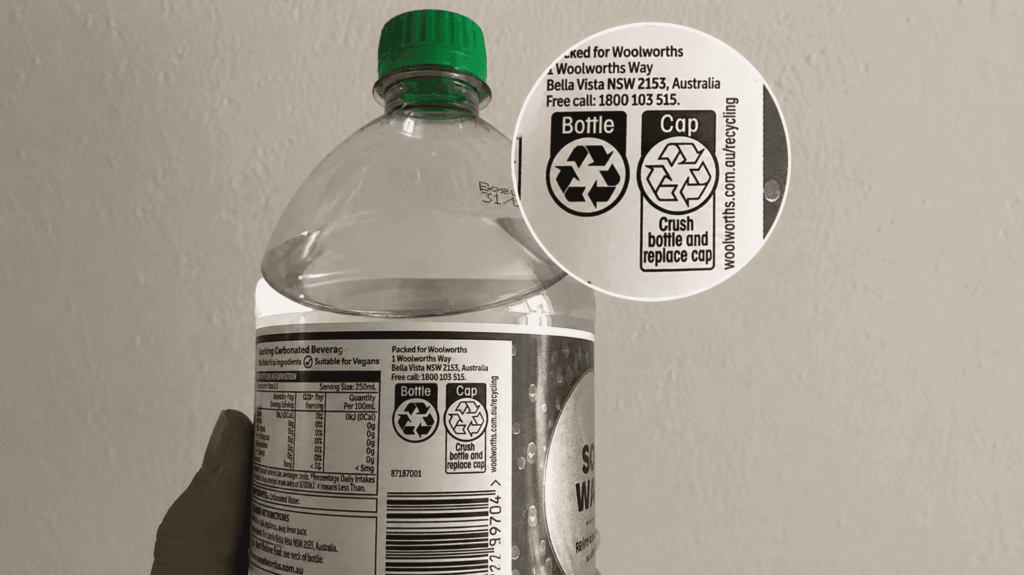
This plastic water bottle shows the ARL (Australasian Recycling Label) system applied per packaging component. The "Bottle" label shows a solid recycling symbol — indicating the bottle itself is recyclable through kerbside collection. The "Cap" label shows a dotted recycling symbol with the instruction "Crush bottle and replace cap" — meaning the cap is also recyclable but must be kept attached to the crushed bottle for it to be accepted in kerbside bins. This component-by-component approach helps consumers understand exactly how to prepare each part of the packaging for recycling.
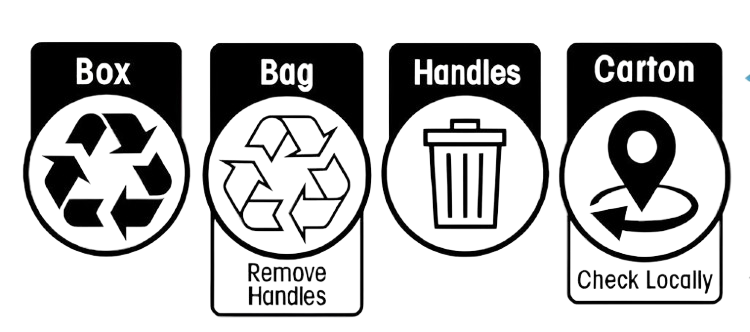
📎 Download the ARL labels:
- PNG – best for digital use.
EPR Eco Fees & Eco-Modulation
New Zealand does not yet have a published national eco-fee or eco-modulation schedule for general plastic packaging. The legal framework allows regulations to set fees payable for the management of a product and to specify who pays them, at what stage, and how they are collected. But for plastic packaging, those fee mechanisms have not yet been implemented in a live national mandatory scheme.
As a result, foreign sellers do not currently calculate New Zealand general-packaging EPR fees by material, recyclability or eco-modulation criteria in the way they would in mature EPR systems. That said, fee-based design incentives are clearly contemplated by the statute and may become part of the future packaging scheme.
Risks, Penalties & Common Mistakes
The main current compliance risk is assuming that New Zealand has no packaging regulation at all just because the full plastic-packaging stewardship scheme is not yet live. In reality, plastic packaging is already a declared priority product, and separate packaging-related plastics restrictions already apply.
Common mistakes include:
- Ignoring New Zealand because there is no EU-style producer register yet
- Failing to assess whether the foreign seller, trademark owner or importer is the “producer”
- Assuming marketplace sales are outside scope
- Missing the separate plastics rules for produce labels or banned packaging formats
- Not retaining material and import data in anticipation of the future stewardship scheme
- Treating voluntary recycling labels or claims as if they remove legal obligations
Penalty exposure already exists where regulations are in force. Under section 65 of the Waste Minimisation Act 2008, a producer that contravenes regulations made under section 22(1)(a), or a person that contravenes certain regulations made under section 23, may face a fine of up to NZD 100,000. The court may also impose an additional amount reflecting commercial gain from the contravention.
What E-Commerce Sellers Should Do Now
- Determine whether your business is the producer, trademark holder or importer for packaged goods sold into New Zealand.
- Review whether any of your packaging is within the declared plastic packaging priority-product scope.
- Check whether your packaging formats are affected by the Waste Minimisation (Plastic and Related Products) Regulations 2022.
- Build a packaging data file now, including material, resin type, weight and import volumes.
- Monitor the Ministry for the Environment for the next phase of the plastic packaging stewardship scheme.
- Review produce labels, compostability claims and recycling instructions used on New Zealand-bound goods.
- Consider whether participation in a relevant voluntary accredited scheme is appropriate for the packaging you place on the market.
Register online
Start your EPR Reporting within 24 hours
FAQ for New Zeeland EPR
Is packaging EPR already mandatory in New Zealand?- Not as a full nationwide operational scheme for general packaging. Plastic packaging has been declared a priority product, but the mandatory stewardship scheme is still being developed.
- Potentially yes. The producer definition covers brand owners, trademark holders and importers, and “sale” includes distribution or delivery.
- No general national turnover or tonnage threshold has been published for a mandatory plastic-packaging registration obligation at this stage.
- There is no general mandatory national packaging EPR label yet. But there are specific packaging-related plastics rules, especially for plastic produce labels, and the ARL is used as a disposal-instruction system.
- New Zealand law does not currently create a separate packaging-marketplace liability rule in the way some EU countries do. Responsibility follows the statutory producer role, such as importer, trademark owner or branded seller.
Battery EPR law in New Zealand: None enacted
New Zealand is not among the countries with enacted battery EPR legislation.
Want to be first to know when new EPR will issued?
Only important news!
Packaging EPR law in New Zealand: None enacted
New Zealand is not among the countries with enacted textile EPR legislation.Want to be first to know when new EPR will issued?
Only important news!