


Cyprus EPR
What is Cyprus EPR for Packaging
Extended Producer Responsibility (EPR) for packaging is a legal framework that makes companies financially responsible for the end-of-life management of the packaging they place on the market. In Cyprus, this obligation applies to any entity — local or foreign — that introduces packaged goods to Cypriot consumers or businesses. The legal foundation rests on the Packaging and Packaging Waste Act (N. 32(I)/2002), which transposes EU Directive 94/62/EC on packaging and packaging waste into Cypriot national law. This legislation has been amended several times to align with updated EU targets and is complemented by the Waste Law (L.185(I)/2011), which incorporates EU Directive 2008/98/EC on waste management and circular economy principles. The law assigns primary responsibility to the packager, producer, supplier, or importer who first places packaging on the Cypriot market. Registered producers must contribute to the costs of collection, sorting, and recycling of packaging waste — either by joining a certified collective compliance system or by establishing an individual recovery system approved by the authorities. Cyprus is also subject to the new EU Packaging and Packaging Waste Regulation (EU) 2025/40, which entered into force on 11 February 2025 and will apply from 12 August 2026. This regulation introduces harmonised EPR requirements, mandatory recyclability grading, and an obligation for non-EU companies to appoint an authorised representative in each EU country they sell into.Does This Apply to E-Commerce and Online Sales
Yes. Distance sellers and cross-border online sellers are fully within scope of Cyprus EPR packaging obligations. If your business ships packaged goods directly to customers in Cyprus — whether through your own website, a marketplace such as Amazon or Temu, or a fulfilment service — you are considered a producer under Cypriot law and must comply. The obligation arises as soon as you are the first entity to place packaging on the Cypriot market. When a local distributor imports your goods and takes full legal responsibility for them, that distributor may assume the obligation. However, in most cross-border e-commerce scenarios, the obligation falls on the seller. Online marketplaces are increasingly required to facilitate compliance on behalf of their third-party sellers. Temu, for example, has signed cooperation agreements with Green Dot Cyprus, WEEE Cyprus, and AFIS Cyprus specifically to support seller compliance. Marketplace sellers should verify whether their platform manages EPR registration on their behalf or whether individual registration is required. Businesses using warehouses or fulfilment centres in Cyprus should pay particular attention. Storing goods in Cyprus does not itself create an EPR obligation — but the act of dispatching packaged products to end customers from Cypriot territory does.Who is the "Producer" Under Cyprus EPR
Under the Packaging and Packaging Waste Act (N. 32(I)/2002), the following entities are classified as producers and bear EPR responsibility:- Manufacturers who produce and package goods sold in Cyprus.
- Importers who bring packaged goods into Cyprus for distribution or sale.
- Private label owners who commission the packaging or branding of products sold under their own name.
- Distributors and retailers who place packaged products on the Cypriot market where no other upstream entity has already assumed the obligation.
- Distance sellers (including online sellers) based outside Cyprus who sell packaged products directly to Cypriot end consumers without a local intermediary assuming EPR responsibility.
Who Must Register for EPR Packaging in Cyprus
Any company that places packaged goods on the Cypriot market is required to register under the EPR system and contribute to the costs of packaging waste management. Registration is administered through the licensed collective compliance system, Green Dot Cyprus, which operates under the supervision of the Department of Environment within the Ministry of Agriculture, Rural Development and Environment (MARDE). Both local and foreign companies are subject to registration. There is no general exemption based on company size or the country of establishment. The obligation applies regardless of whether the company has a legal presence in Cyprus, provided it is the entity placing packaging on the Cypriot market. Companies placing less than 2 tons of packaging on the market annually are subject to a reduced obligation: they must still report packaging data but are not required to meet recovery or recycling targets. All other producers must join a collective system or establish their own approved individual recovery scheme. Companies that need support with this process can manage their Cyprus EPR registration through Lappa.Cyprus EPR Packaging Registration Threshold
Cyprus currently does not apply a minimum quantity threshold that would exempt producers entirely from EPR registration. The obligation to register with Green Dot Cyprus and report packaging data applies from the first unit of packaging placed on the market. However, a reduced compliance tier exists for smaller producers:- Below 2 tons per year: Producers must register and report packaging quantities by material type but are not required to meet recovery or recycling targets and are generally not subject to full fee contributions.
- 2 tons or more per year (per material): Full obligations apply, including registration, annual reporting, payment of eco-fees, and compliance with national recovery and recycling targets.
Detailed EPR Guidance for each Jurisdiction
We support 36 jurisdictions

EPR and PPWR for Cyprus
Cyprus runs one of the simplest PRO structures in the EU for packaging — a single organisation, Green Dot Cyprus, licensed by the Department of Environment, covering both household and commercial packaging. Companies register directly with Green Dot Cyprus (there's no separate national digital registry like Germany's LUCID), declare volumes by material, and pay eco-fees. Below 2 tonnes a year, the obligation narrows to reporting only, without recovery targets attached — a lighter tier that doesn't exist in most Western EU markets.
PPWR runs alongside that structure rather than replacing it. From 12 August 2026, it adds the now-familiar EU layer: technical documentation, EU declaration of conformity, and an authorised representative requirement under Article 45. Cyprus is actually a step ahead of most member states here — the country already requires foreign companies without local representation to register through an agent rather than directly, so PPWR's AR requirement formalises something Cypriot practice already demanded rather than introducing something genuinely new.
The sharper friction sits in penalties, not process. Cyprus treats packaging EPR non-compliance as a matter that can carry up to three years' imprisonment or fines up to €85,000 — a criminal-adjacent framing well beyond the administrative fines typical elsewhere in the EU. Layer PPWR's separate conformity obligations on top, and a documentation gap in Cyprus carries materially higher personal stakes than the same gap in, say, Germany or the Netherlands.
The other genuine tension is the Green Dot logo. Cyprus is the last EU country where displaying it is effectively mandatory for scheme members. PPWR bars using a national symbol to indicate EPR-fee contribution from 12 February 2027, pushing that signal toward a QR code instead — which means Cyprus, uniquely, has to unwind a requirement no other member state still enforces this strictly.
PPWR Labels for Cyprus
Cyprus labelling today is built around two elements: the Green Dot, and the standard EU material identification code (the Möbius loop plus a resin code, like the LDPE "4" seen on flexible plastic packaging). What makes Cyprus different from every other EU market is that the Green Dot isn't just common practice here — it's treated as a membership obligation. Producers who join Green Dot Cyprus are generally expected to display it.
That's exactly what collides with PPWR. From 12 February 2027, packaging can no longer use a national symbol to signal EPR-fee contribution — the mechanism shifts to a QR code or equivalent digital marking. Every EU country with a Green Dot-style logo faces this transition, but Cyprus faces it from a stricter starting point than anywhere else, since its own system currently makes the symbol close to compulsory rather than optional branding.
Separately, from 12 August 2028, the harmonised EU sorting pictogram becomes mandatory across all member states — a second, distinct labelling layer that has nothing to do with the Green Dot's fee-contribution role and everything to do with consumer sorting instructions.
Put together, businesses selling into Cyprus are looking at three label elements on three different clocks over roughly two years: the material code that's already required, the Green Dot phasing out as a compliance symbol from 2027, and the harmonised pictogram phasing in from 2028. See the PPWR labelling requirements for the EU-wide rules, implementation dates and upcoming packaging label changes.
France's Triman dispute, now referred to the CJEU, is the case setting precedent for how much room national sorting labels get once PPWR's pictogram exists EU-wide — Cyprus isn't a party to it, but the ruling will shape what's permitted here too.
PPWR Product Rules for Cyprus
The PFAS restriction has applied since 12 August 2026: food-contact packaging on the Cypriot market can't exceed 25 ppb for any single measured PFAS substance, 250 ppb summed, or 50 ppm total including polymeric PFAS. A supplier's food-contact coating that crosses that threshold doesn't get a compliance notice — it stops moving, and given Cyprus's criminal-adjacent enforcement posture on packaging, that's not a risk worth testing.
Recyclability lands on 1 January 2030, requiring packaging to sit in Design for Recycling Performance Grade A, B, or C, with Grade C losing market access from 2035. Recycled content thresholds for contact-sensitive plastic packaging arrive the same year, rising again by 2040. Packaging minimisation follows on the same date, capping empty space in grouped, transport, and e-commerce packaging at 50%. Reuse and refill targets for beverage, grouped, and transport packaging phase in from 2030 too.
The structural shift that lands hardest on Cyprus specifically is eco-modulation. Green Dot Cyprus currently charges fees purely by material type — plastics cost more than metals, roughly, but there's no grading by actual recyclability performance. PPWR requires all member states to introduce recyclability-graded fees, which means Green Dot Cyprus has to build a modulation system from close to scratch rather than adjust one that already exists, unlike PROs in France or Belgium that have run eco-modulated rates for years.
For suppliers and design teams, that translates into a data gap worth closing early: Cyprus doesn't have a centralised digital registry to lean on, so the recyclability and recycled-content evidence PPWR's technical file requires will need to be built directly into whatever records a company already keeps for Green Dot Cyprus declarations.
Packaging Materials Covered (and Excluded)
Cyprus EPR applies to all packaging materials, regardless of the packaging format or sector. The following categories are in scope:- Paper and cardboard — including corrugated board, folding cartons, and paper bags.
- Plastic — including flexible films, rigid containers, trays, and expanded polystyrene.
- Glass — bottles, jars, and other glass containers.
- Metal — steel cans, aluminium packaging, and aerosol containers.
- Wood — wooden crates, pallets, and wine cases.
- Composite materials — multi-layer or laminated packaging composed of different materials.
- Packaging used exclusively in military applications.
- Packaging used for space equipment.
- Packaging that is considered hazardous waste under separate legislation and is managed through dedicated streams.
Producer Responsibility Organisation (PRO)
Cyprus operates a single collective compliance system for packaging waste: Green Dot Cyprus (formally Green Dot (Cyprus) Public Co. Limited). It is the only Producer Responsibility Organisation (PRO) licensed by the Department of Environment to manage household and commercial/industrial packaging waste across the island. Green Dot Cyprus was established in 2004 following an initiative by the Cyprus Chamber of Commerce and Industry (CCCI) and became fully operational in 2005. It was licensed by the authorities in 2006 and today covers over 88% of the Cypriot population through its collection network. Key facts about Green Dot Cyprus:- It is a not-for-profit organisation by law, owned by shareholders including fillers, packers, retailers, distributors, and packaging manufacturers.
- It covers both household packaging and commercial/industrial packaging waste streams.
- It represents over 1,400 member companies and cooperates with the majority of municipalities in Cyprus.
- It is a member of PRO Europe — the pan-European network of Green Dot licensing organisations — and operates under its code of conduct.
EPR Registration in Cyprus
Registration with Green Dot Cyprus is the standard route to compliance for most companies placing packaged goods on the Cypriot market. The process involves the following steps:- Contact Green Dot Cyprus directly at their Nicosia offices (Tseriou Avenue 229, P.C. 2047, Strovolos) or through their official website at greendot.com.cy to initiate a membership inquiry.
- Provide company information, including legal name, registration country, contact details, and details of any local authorised representative where applicable.
- Classify the packaging placed on the market by material type (paper, plastic, glass, metal, wood, composite) and by packaging tier (primary, secondary, tertiary).
- Estimate the total weight of packaging placed on the Cypriot market in the preceding year or a projection for the current year, broken down by material.
- Sign a membership agreement with Green Dot Cyprus outlining obligations, reporting timelines, and fee structures.
- Submit the first annual packaging declaration and pay the applicable eco-fees based on the tonnage and material composition declared.
- Maintain annual reporting obligations and update membership data when packaging volumes or material types change materially.
Authorised Representative
Foreign companies without a legal establishment in Cyprus must appoint a locally based authorised representative to manage their EPR obligations on their behalf. This representative acts as the accountable entity for registration, declarations, fee payments, and communications with Green Dot Cyprus and the Department of Environment. Under the current regime, the appointment of a local authorised representative is necessary in practice for foreign companies that cannot directly sign membership agreements or submit declarations in Cyprus. Compliance service providers, local law firms, and specialised EPR agents can act in this capacity. Lappa’s EPR authorised representative service can support foreign businesses that need local representation for their EPR obligations. From 12 August 2026, the obligation to appoint an authorised representative will be formally mandated under EU Regulation 2025/40 (PPWR) for all companies not established in an EU member state. Non-EU packaging manufacturers should also check the separate PPWR authorised representative requirements that apply to product compliance. EU-based companies selling into Cyprus may also be subject to this requirement depending on the implementing measures adopted by Cyprus. Note: The European Commission proposed in late 2024 to suspend this authorised representative obligation until 2035 for EU-based producers, but this proposal had not been formally adopted as of the date of this guide. Companies should monitor legislative developments. The authorised representative does not assume financial liability for the producer's packaging volumes in the same way as a fiscal representative for VAT, but they do hold administrative responsibility for the accuracy and timeliness of declarations submitted to Green Dot Cyprus.What Data Must Be Reported
Green Dot Cyprus members are required to report the following data in their annual declaration:- Total weight of packaging placed on the Cypriot market during the reporting year, broken down by material type: paper/cardboard, plastic, glass, metal (steel and aluminium reported separately where possible), wood, and composite/other materials.
- Classification by packaging tier: primary (consumer-facing packaging), secondary (grouped packaging), and tertiary or transport packaging.
- Distinction between household packaging (sold to private consumers) and commercial/industrial packaging (supplied to business customers).
- For single-use plastic items falling under the SUP Directive (EU) 2019/904, additional data including unit counts and weight may be required.
First Reporting Period and EPR Reporting Deadlines
The obligation to register and report arises in the first year a company places packaged goods on the Cypriot market. There is no grace period for new market entrants — registration should be completed before or at the point of first placing packaging on the market. Key reporting deadlines under Green Dot Cyprus:- Annual declaration deadline: Declarations for the preceding calendar year are due by 28 February of the following year. Some sources indicate end of February as the effective deadline; companies should confirm the exact date with Green Dot Cyprus at the time of registration.
- Fee payment: Eco-fee invoices are issued by Green Dot Cyprus following submission of the annual declaration. Payment timelines are agreed in the membership contract, typically within 30 to 60 days of invoicing.
- Quarterly or interim updates: For members with particularly high packaging volumes, more frequent interim declarations may be requested by Green Dot Cyprus.
Labels and Marketing Claims
Cyprus is unique within the EU as the last country where the Green Dot logo remains effectively mandatory for members of the Green Dot Cyprus system. Alongside this, standard EU material identification codes are required on all packaging placed on the Cypriot market.An example of what a label looks like on packaging for Cyprus
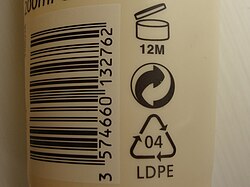
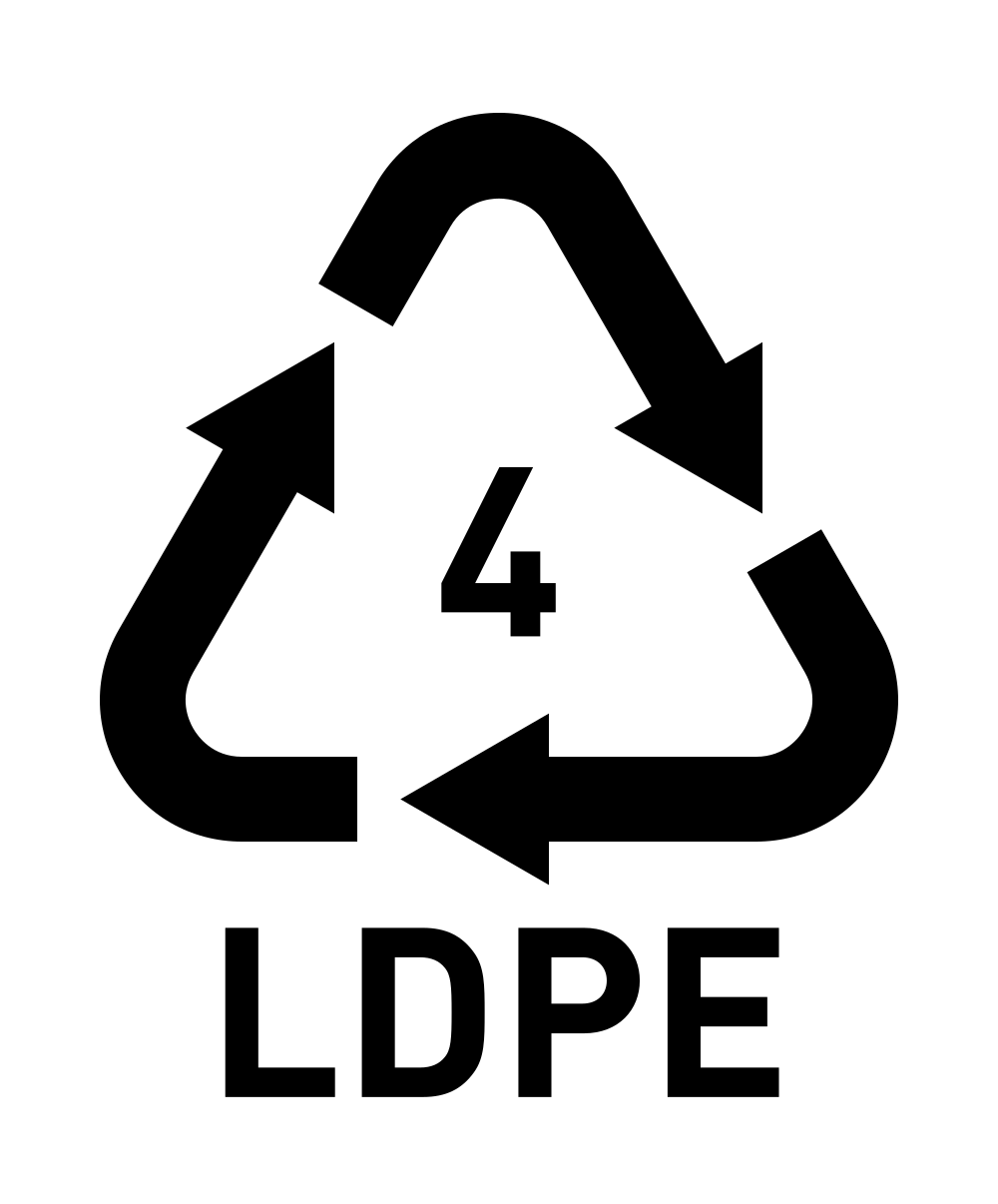
This packaging shows three labels commonly found on products sold in Cyprus and across the EU. The Green Dot — two intertwined arrows forming a circle — indicates that the producer participates in the Green Dot Cyprus collective system and has financially contributed to packaging waste collection and recycling. In Cyprus, unlike most other EU countries, displaying this symbol is effectively mandatory for system members. The 12M period-after-opening symbol — an open jar with the number 12 — indicates the product remains safe to use for 12 months after opening (a cosmetic product requirement, not an EPR label). The LDPE 04 material code — a Möbius loop triangle with the number "4" — identifies the packaging material as low-density polyethylene, commonly used for flexible tubes, squeeze bottles, and soft plastic containers.
📎 Download the Green Dot symbol:


📎 Download the LDPE 04 symbol:

EPR Eco-Fees and Eco-Modulation
Eco-fees payable to Green Dot Cyprus are calculated based on the total weight of packaging placed on the Cypriot market, broken down by material type. Fees are expressed as a rate per tonne (€/tonne) and differ across material categories. Green Dot Cyprus publishes annual fee schedules. Indicative material-specific rates published for recent years reflect the following hierarchy (from lower to higher cost per tonne): metals, glass, paper/cardboard, wood, and plastics, with plastics typically attracting the highest rates due to collection and recycling complexity. Precise current fee rates should be requested directly from Green Dot Cyprus, as these are updated annually. Eco-modulation — the adjustment of fees based on packaging design characteristics such as recyclability, the presence of hazardous substances, or the use of recycled content — is not yet formally implemented in Cyprus in the structured form found in countries like France or Belgium. Fees are currently material-based rather than recyclability-graded. From August 2026, EU Regulation 2025/40 (PPWR) requires all EU member states, including Cyprus, to introduce eco-modulated fees based on recyclability performance grades (A to C) and recycled content. Green Dot Cyprus will be required to update its fee structure accordingly. Producers designing new packaging should factor in recyclability from the outset, as fees for non-recyclable or complex multi-material packaging are expected to increase significantly. Fee modulation may also be influenced by the volume of packaging placed on the market, with smaller producers potentially benefiting from lower rates in proportion to their reported tonnage.Risks, Penalties and Common Mistakes
Penalties for non-compliance with EPR packaging obligations in Cyprus are set out in the Packaging and Packaging Waste Act (N. 32(I)/2002). Under Cypriot law, violations can result in:- Imprisonment of up to 3 years, or
- Monetary penalties of up to €85,000, or
- Both imprisonment and a monetary penalty, applied on a case-by-case basis depending on the nature and severity of the offence.
- Assuming that EPR registration in another EU country (e.g., Germany or France) satisfies the obligation in Cyprus. Each EU member state requires independent registration.
- Failing to register before placing the first packaged goods on the market. There is no grace period for new entrants.
- Underreporting packaging volumes by omitting secondary or transport packaging, or by reporting only primary consumer packaging.
- Neglecting to appoint an authorised representative when required, leaving declarations unsigned or unsubmitted.
- Missing the annual declaration deadline (end of February) due to unfamiliarity with Cyprus-specific timelines.
- Assuming the Green Dot logo is optional in Cyprus — it is effectively required for Green Dot Cyprus members and currently mandatory under Cypriot practice.
- Failing to track and correctly classify packaging by material type and tier, resulting in inaccurate fee calculations and potential audit exposure.
What E-Commerce Sellers Should Do Now
If your business ships packaged goods to consumers or businesses in Cyprus, take the following steps to achieve compliance:- Assess whether your business qualifies as a producer under Cypriot law — if you ship directly to Cypriot customers without a local distributor taking on EPR responsibility, you are likely obligated.
- Calculate your annual packaging volume placed on the Cypriot market by material type (paper, plastic, glass, metal, wood, composite). Determine whether you fall below the 2-ton reporting-only tier or are subject to full compliance obligations.
- Contact Green Dot Cyprus to initiate registration. Prepare company details, packaging data, and any documentation relating to your supply chain or local representative.
- If your company has no legal presence in Cyprus, identify and appoint a local authorised representative — a compliance agent, legal firm, or EPR specialist — to sign the membership agreement and manage declarations on your behalf.
- Review your packaging labels to ensure compliance with material identification codes under EU Decision 97/129/EC and prepare for the mandatory recyclability labelling requirements taking effect from August 2026 under the PPWR.
- Establish internal processes to track packaging volumes by material type on an ongoing basis. Annual declarations require accurate data; maintaining good records throughout the year reduces audit risk.
- If you sell through an online marketplace, clarify with your platform whether it has signed a cooperation agreement with Green Dot Cyprus and whether it will manage EPR registration and declarations on your behalf or whether you must register independently.
- Monitor upcoming changes under EU Regulation 2025/40 (PPWR) applying from 12 August 2026, including new eco-modulated fees, recyclability grading, and the authorised representative obligation.
Register online
Start your EPR Reporting within 24 hours
FAQ
Is EPR registration for packaging in Cyprus mandatory for foreign companies?- Any company — regardless of where it is incorporated — that places packaged goods on the Cypriot market is subject to EPR registration under the Packaging and Packaging Waste Act (N. 32(I)/2002). Foreign status does not create an exemption. If you sell directly to Cypriot consumers or businesses without a local distributor taking on the obligation, you must register with Green Dot Cyprus.
- Cyprus does not apply a threshold that removes the registration obligation entirely. All producers must register and report. However, companies placing less than 2 tons of packaging on the market per year are subject to a reduced obligation — reporting only, without the requirement to meet recovery and recycling targets or pay the same level of eco-fees as larger producers.
- It depends on the marketplace. Some platforms — such as Temu — have signed cooperation agreements with Green Dot Cyprus and actively support seller compliance. However, not all marketplaces assume EPR responsibility on behalf of sellers. You should confirm with your platform whether it registers and reports packaging data collectively for sellers. If it does not, you must register independently.
- Cyprus is the last EU country where mandatory use of the Green Dot logo remains in practice for members of the Green Dot Cyprus system. Members are generally expected to display the logo on their packaging as part of their membership commitment. This distinguishes Cyprus from most other EU markets where the Green Dot is optional or has been phased out as a mandatory mark.
- EPR obligations are country-specific. Each EU member state requires independent registration with its own PRO or compliance system. Your registration with a German, French, or other EU-country EPR system does not satisfy your Cyprus obligations. A Cyprus-based authorised representative can act on your behalf locally, but this appointment covers Cyprus only.
What is Cyprus EPR EEE
Cyprus's EEE EPR framework is governed by Administrative Act No. 668 of 2004 and the Waste Law (L.185(I)/2011), which transpose the EU WEEE Directive (Directive 2012/19/EU) into Cypriot national law. The legislation assigns responsibility for managing end-of-life electrical and electronic equipment to producers and, locally, to importers of first instance. The competent authority is the Cyprus Department of Environment, operating under the Ministry of Agriculture, Rural Development and Environment (MARDE). The Department licenses and supervises collective compliance organisations, oversees producer registration, and enforces compliance. Failure to comply with EEE EPR obligations in Cyprus is defined as a criminal offence and draws extra-judicial penalties. Cyprus does not use a single centralised registration platform. Instead, producers fulfil their EEE EPR obligations by joining licensed recovery organisations. For electrical and electronic equipment, the designated collective scheme is Electrocyclosis Cyprus (Ανακύκλωση Συσκευών Α.Ε.), which manages take-back, recycling, and reporting across the island.Does This Apply to E-Commerce & Online Sales
Yes, though the application to foreign e-commerce sellers requires careful attention due to a structural peculiarity in Cypriot law. When a company outside Cyprus sells B2B (to Cypriot businesses), the local Cypriot company that receives the goods must register for EEE EPR purposes. The obligation follows the local importer. For direct B2C e-commerce — foreign companies selling directly to Cypriot consumers without any domestic legal representation — the situation has historically been less clearly defined. The Cyprus Department of Environment has been working to address this gap in consultation with the European Commission. Foreign companies selling directly to Cypriot consumers via e-commerce are subject to EEE EPR obligations and must appoint a local authorised representative or agent to register on their behalf.Who is the "Producer" under Cyprus EPR?
Under Administrative Act No. 668 of 2004 and the Waste Law, responsibility is assigned to the producer and, locally, to the importer of first instance. This covers:- Manufacturers established in Cyprus who produce and sell EEE domestically under their own brand.
- Importers of first instance bringing EEE into Cyprus under their own name.
- Private label owners whose brand name appears on EEE manufactured by third parties.
- Companies introducing EEE from another EU Member State into Cyprus for the first time.
- Foreign companies selling EEE directly to Cypriot consumers via e-commerce — required to register through a local agent or representative.
- Economic operators who prepare EEE for re-use where applicable.
Who Must Register for EPR EEE in Cyprus
All producers and importers placing EEE on the Cypriot market must register with the Cyprus Department of Environment and join Electrocyclosis Cyprus — the licensed collective scheme — or apply for individual compliance approval. Foreign companies without any form of legal representation in Cyprus cannot register directly. The foreign company's local agent, distributor, or authorised representative must register on their behalf. Registration is completed after the Department of Environment conducts an investigation and assessment of each company to determine compliance. Electrocyclosis Cyprus (electrocyclosis.com.cy) is the licensed collective scheme for EEE waste management in Cyprus, operating under accreditation from the Cyprus Department of Environment.Cyprus EPR EEE Registration Threshold
Cyprus does not publish a formal de minimis exemption for EEE EPR registration. The WEEE Directive and Cypriot implementing legislation apply to all producers placing EEE on the Cypriot market regardless of volume or turnover. In practice, for very small quantities — particularly in B2C distance selling situations — the Department of Environment has historically applied a practical rule of thumb. Producers should confirm threshold applicability directly with the Cyprus Department of Environment for their specific situation.Detailed EPR Guidance for each Jurisdiction
We support 36 jurisdictions
EEE Categories Covered (and Excluded)
Cyprus applies the open scope approach of the revised WEEE Directive. All EEE falls within scope unless specifically excluded. Main categories include: Large household appliances Refrigerators, washing machines, dishwashers, cookers, electric heaters, air conditioners. Small household appliances Vacuum cleaners, toasters, coffee machines, irons, hair dryers, electric clocks. IT and telecommunications equipment Computers, laptops, tablets, smartphones, printers, routers. Consumer electronics Televisions, radios, audio and video equipment, cameras. Lighting equipment Fluorescent lamps, LED lamps, and luminaires (excluding filament bulbs). Electrical and electronic tools Drills, saws, and similar power tools (excluding large stationary industrial tools). Toys, leisure and sports equipment Video game consoles, electric toys, and sports equipment with electrical components. Medical devices Medical equipment (excluding implanted and infected devices). Monitoring and control instruments Smoke detectors, thermostats, measuring instruments, laboratory equipment. Automatic dispensers Vending machines and cash dispensers. Other EEE (open scope) All remaining EEE within voltage parameters. Key exclusions:- EEE designed and installed as part of another type of equipment that can only function as part of that equipment
- Large-scale fixed installations
- Military or space equipment
- Implanted and infected medical devices
Producer Responsibility Organization (PRO)
The licensed collective scheme for EEE management in Cyprus is Electrocyclosis Cyprus (Ανακύκλωση Συσκευών Α.Ε.), operating under accreditation from the Cyprus Department of Environment. Electrocyclosis Cyprus manages nationwide collection points, coordinates recycling and treatment, and reports compliance data to the Department of Environment on behalf of its members. Companies joining Electrocyclosis Cyprus sign a membership agreement, declare volumes of EEE placed on the Cypriot market by category, and pay contributions based on weight and type of equipment. Reporting operates on quarterly cycles, with an annual summary option in some cases. Cyprus's EPR structure covers three separate waste streams through separate organisations:- Green Dot Cyprus — packaging waste
- Electrocyclosis Cyprus — electrical and electronic equipment
- AFIS Cyprus — batteries and accumulators
EPR Registration in Cyprus
The registration process for EEE producers in Cyprus is as follows:- Determine whether your products qualify as EEE under Cypriot legislation.
- If established outside Cyprus, appoint a local authorised representative, agent, or distributor established in Cyprus — foreign companies without local representation cannot register directly.
- The local representative contacts Electrocyclosis Cyprus (electrocyclosis.com.cy) and initiates membership registration.
- The Cyprus Department of Environment conducts an investigation and assessment before registration is confirmed.
- Sign the Electrocyclosis Cyprus membership agreement and complete registration.
- Declare EEE volumes placed on the Cypriot market by category and weight.
- Pay contributions to Electrocyclosis Cyprus based on EEE weight and category — quarterly or annual.
- Submit quarterly reports (or annual summaries where permitted) on EEE placed on market and end-of-life equipment collected and processed.
Authorized Representative
Cypriot legislation requires that foreign companies without legal representation in Cyprus register through their local agent, distributor, or authorised representative. Direct registration by foreign companies without local representation is not accepted by the Cyprus Department of Environment. The local representative signs the Electrocyclosis Cyprus membership agreement and manages ongoing declarations and payments on behalf of the foreign producer. Important development: In December 2025, the European Commission proposed suspending the authorised representative requirement for EU-established companies until 2035 under Proposal COM(2025) 983. This proposal has not been formally adopted as of May 2026. For non-EU producers, the requirement is not affected.What Data Must Be Reported
Producers registered through Electrocyclosis Cyprus must declare and report the following data on a quarterly basis (or annual summary):- Total weight (kilograms) of EEE placed on the Cypriot market during the reporting period, by EEE category
- Weight of end-of-life equipment collected and processed during the reporting period
- Brand names under which EEE was placed on the market
- Collection and recycling performance data compiled and reported by Electrocyclosis Cyprus to the Department of Environment on behalf of members
First Reporting Period & EPR Reporting Deadlines
Cyprus's EEE EPR has been in place since 2004. Key recurring deadlines:- Quarterly: EEE placed-on-market and end-of-life equipment collected declarations to Electrocyclosis Cyprus
- Annual summary: Available as an alternative to quarterly reporting in some cases — confirm with Electrocyclosis Cyprus at time of registration
- Annual compliance reporting: Electrocyclosis Cyprus reports aggregated data to the Cyprus Department of Environment
Labels & Marketing Claims
Crossed-out wheeled bin symbol All EEE placed on the Cypriot market must carry the crossed-out wheeled bin symbol, indicating separate collection. The symbol must be visible, legible, and indelible on the product or — where not possible — on packaging or documentation. CE marking Mandatory for applicable EEE categories under EU product safety legislation. RoHS compliance EEE must comply with Directive 2011/65/EU (RoHS) restricting hazardous substances. RoHS compliance is maintained separately from EEE EPR registration. Language requirements Consumer-facing information on EEE sold in Cyprus should be provided in Greek where required under Cypriot consumer protection law. Environmental claims The Empowering Consumers for the Green Transition Directive (2024/825/EU) must be transposed by March 2026, after which unsubstantiated green claims will be prohibited across the EU including Cyprus.EPR Eco Fees & Eco-Modulation
Electrocyclosis Cyprus sets contribution rates for member producers based on the weight and category of EEE placed on the Cypriot market. Specific fee schedules should be confirmed directly with Electrocyclosis Cyprus at the time of membership registration. Cyprus does not currently apply a formal eco-modulation framework adjusting contributions based on product repairability or recyclability for EEE. As the Ecodesign for Sustainable Products Regulation (ESPR) implementing regulations develop, eco-design criteria may influence future contribution structures.Risks, Penalties & Common Mistakes
- Failure to comply is a criminal offence in Cyprus. Non-compliance with EEE EPR obligations draws extra-judicial penalties, in addition to administrative sanctions.
- Foreign companies attempting to register directly. Foreign companies without local representation cannot register with the Cyprus Department of Environment directly. A local agent, distributor, or authorised representative must manage registration.
- Confusion between B2B and B2C obligations. For B2B sales, the local Cypriot buyer typically assumes the registration obligation. For direct B2C e-commerce, the foreign company must ensure a local representative handles compliance.
- Assuming one EU registration covers Cyprus. EEE EPR registration is national. Registration in another EU member state does not fulfil Cypriot obligations.
- Missing quarterly reporting deadlines. Electrocyclosis Cyprus operates on quarterly reporting cycles. Late or missing submissions are a compliance breach.
- Missing the crossed-out wheeled bin symbol. The symbol is mandatory on all EEE. Missing or non-compliant marking is actionable.
- Confusing Electrocyclosis Cyprus with AFIS Cyprus or Green Dot Cyprus. Each covers a separate waste stream. Separate membership is required for each applicable stream.
What E-Commerce Sellers Should Do Now
- Confirm whether your products qualify as EEE under Cypriot legislation.
- Appoint a local authorised representative, agent, or distributor established in Cyprus to manage registration and compliance on your behalf.
- Contact Electrocyclosis Cyprus (electrocyclosis.com.cy) through your local representative and complete the membership registration process.
- Confirm registration with the Cyprus Department of Environment following their investigation and assessment.
- Declare EEE volumes by category and weight and pay applicable contributions quarterly.
- Ensure all EEE products carry the crossed-out wheeled bin symbol, comply with RoHS restrictions, and include Greek-language consumer information where required.
- If you also place packaging or batteries on the Cypriot market, register separately with Green Dot Cyprus and AFIS Cyprus as applicable.
Register online
Start your EPR Reporting within 24 hours
FAQ
Is EEE EPR mandatory in Cyprus?- Yes. Cyprus has mandatory EEE EPR in place since 2004 under Administrative Act No. 668 and Waste Law L.185(I)/2011. All producers and importers placing EEE on the Cypriot market must register with the Department of Environment and join Electrocyclosis Cyprus. Failure to comply is treated as a criminal offence under Cypriot law.
- Yes, but foreign companies without Cypriot legal representation cannot register directly — a local agent, distributor, or authorised representative must register on their behalf. For B2B sales, the local Cypriot buyer typically assumes the registration obligation. For direct B2C e-commerce, the foreign company is responsible and must act through a local representative.
- These are three separate licensed recovery organisations covering different waste streams. Electrocyclosis Cyprus covers electrical and electronic equipment. Green Dot Cyprus covers packaging waste. AFIS Cyprus covers batteries and accumulators. Producers placing multiple product categories on the Cypriot market must register with each relevant organisation separately.
- Electrocyclosis Cyprus operates on quarterly reporting cycles, with an annual summary option in some cases. Specific deadlines should be confirmed with Electrocyclosis Cyprus at the time of membership registration.
- No formal published threshold exists. The WEEE Directive and Cypriot law apply to all producers regardless of volume. For very small quantities in specific B2C e-commerce situations, producers should confirm the applicable approach directly with the Cyprus Department of Environment.
Далі — Czech Republic?
What is Cyprus EPR Batteries
Cyprus's battery EPR framework is governed by Regulation (EU) 2023/1542 — the EU Battery Regulation — which applies directly in all EU Member States without requiring national transposition. The Regulation has applied in stages since 18 February 2024, with EPR and waste management obligations fully in force from 18 August 2025.
At national level, Cyprus has transposed EU battery legislation into domestic law and implements it through the Department of Environment, which operates under the Ministry of Agriculture, Rural Development and Environment (MARDE). The Department of Environment is the competent authority responsible for the implementation of battery legislation in Cyprus, conducting inspections and enforcing compliance.
Cyprus does not use a single centralised registration platform for environmental reporting. Instead, producers fulfil their EPR obligations by joining a licensed collective recovery organisation. For batteries and accumulators, the designated collective organisation is AFIS Cyprus.
The EU Battery Regulation replaced the previous Batteries Directive 2006/66/EC in full from 18 August 2025. It covers all battery types regardless of chemistry or form, whether sold separately or incorporated into products or vehicles.
Does This Apply to E-Commerce & Online Sales
Yes. The EU Battery Regulation explicitly captures distance sellers and e-commerce operators as producers. Under Cypriot law, the term "producer" covers not only manufacturers but also importers and distance sellers who ship directly to Cypriot consumers — regardless of where the seller is established.
A foreign brand selling batteries or battery-containing products directly to consumers in Cyprus via an online store has the same obligations as a Cyprus-established importer. The obligation follows the act of making the battery available on the Cypriot market for the first time, not the physical location of the seller.
Online marketplace operators are required under the EU Battery Regulation to verify that sellers on their platforms are EPR-registered in each country where they sell batteries.
Who is the "Producer" under Cyprus EPR?
Under Regulation (EU) 2023/1542 and Cypriot legislation, a producer is any person who, in the course of commercial activity, makes batteries available on the Cypriot market for the first time. This covers:
- Manufacturers established in Cyprus who produce and sell batteries domestically under their own brand.
- Importers bringing batteries into Cyprus from non-EU countries for the first time under their own name.
- Companies introducing batteries from another EU Member State into Cyprus for the first time.
- Private label owners whose brand name appears on batteries manufactured by third parties.
- Distance sellers and online retailers established outside Cyprus who sell batteries or battery-containing products directly to Cypriot consumers.
- Economic operators who prepare batteries for re-use or repurposing — treated as producers for the second life of the battery.
Who Must Register for EPR Batteries in Cyprus
All producers placing batteries on the Cypriot market must comply with EPR obligations. In Cyprus, this is done by joining the licensed collective recovery organisation for batteries: AFIS Cyprus. There is no separate centralised government registration portal for battery producers — compliance is managed through AFIS Cyprus, which reports aggregated data to the Department of Environment on behalf of its members.
Alternatively, producers may establish an individual compliance scheme, but this is rarely chosen in practice due to the complexity involved. Most companies fulfil their obligations through AFIS Cyprus membership.
The Department of Environment conducts regular inspections to verify compliance and investigate complaints. At the end of each inspection, an inspection report is prepared, and enforcement action may follow including extrajudicial arrangements or referral to the Attorney General for criminal measures.
Cyprus EPR Battery Registration Threshold
Regulation (EU) 2023/1542 does not establish a minimum volume or turnover threshold below which producers are exempt from EPR obligations. All producers placing batteries on the Cypriot market must comply regardless of size or volume.
The only exemption in the Regulation concerns batteries used in military or space equipment, which are outside scope entirely.
For due diligence obligations, companies with annual net turnover below €150 million (as adopted under the Omnibus IV package, July 2025) may be exempt — but this does not affect EPR registration and reporting obligations.
Detailed EPR Guidance for each Jurisdiction
We support 36 jurisdictions
Batteries Covered (and Excluded)
Regulation (EU) 2023/1542 defines five battery categories, all within scope for EPR in Cyprus:
Portable batteries Batteries under 5 kg not designed for industrial or vehicle use. Includes batteries in consumer electronics, power tools, household devices, and toys. The most commonly encountered category for e-commerce sellers.
Light Means of Transport (LMT) batteries Batteries used in e-bikes, e-scooters, e-mopeds, and similar light electric vehicles.
Automotive (SLI) batteries Starting, lighting, and ignition batteries used in vehicles.
Industrial batteries Batteries used in industrial applications and stationary energy storage systems. Those above 2 kWh have additional requirements including battery passports from 2027.
Electric vehicle (EV) batteries Batteries used in electric cars and heavy electric vehicles. Subject to carbon footprint declarations, battery passports from 2027, and detailed collection obligations.
Key exclusions:
- Batteries designed for military or space equipment — outside scope entirely
- Batteries in nuclear installations — excluded
- Second-life batteries where the operator performing re-use or repurposing becomes the new producer
Producer Responsibility Organization (PRO)
The collective recovery organisation for batteries and accumulators in Cyprus is AFIS Cyprus. AFIS manages collection, recycling, and reporting obligations on behalf of its members and communicates aggregated compliance data to the Department of Environment.
Producers join AFIS Cyprus, declare the quantities of batteries placed on the Cypriot market, and pay contributions based on weight and battery category. AFIS then organises the physical collection and recycling infrastructure across Cyprus on behalf of its member companies.
For packaging, Green Dot Cyprus is the relevant organisation. For electrical and electronic equipment, WEEE Cyprus handles obligations. Battery producers selling products that also contain regulated packaging or electronics may need to engage multiple organisations.
EPR Registration in Cyprus
The registration process for battery producers in Cyprus is as follows:
- Determine whether your business qualifies as a producer under the EU Battery Regulation and Cypriot legislation.
- If established outside Cyprus, appoint an authorized representative established in Cyprus before registering.
- Contact AFIS Cyprus and apply for membership as a battery producer.
- Declare the quantities of batteries placed on the Cypriot market by battery category and weight.
- Pay the applicable contributions to AFIS Cyprus based on declared volumes.
- AFIS Cyprus reports aggregated data to the Department of Environment on your behalf.
- Retain records of declared volumes and contribution payments for inspection by the Department of Environment.
Cyprus does not issue a separate national producer registration number in the same way as some larger EU member states. Compliance is demonstrated through active AFIS Cyprus membership.
Authorized Representative
Under Regulation (EU) 2023/1542 (Article 57), producers established outside Cyprus must appoint an authorized representative — a legal or natural person established in Cyprus — to fulfill EPR obligations on their behalf. This requirement applies to all foreign producers selling batteries into Cyprus without a Cypriot establishment.
The authorized representative is responsible for joining AFIS Cyprus, submitting declarations, paying contributions, and serving as the point of contact for the Department of Environment during inspections.
Important development: In December 2025, the European Commission proposed suspending the authorized representative requirement for EU-established companies until 2035. This proposal has not been formally adopted as of April 2026. For non-EU producers, the requirement is not affected and continues to apply.
What Data Must Be Reported
Producers registered through AFIS Cyprus must declare the following data:
- Total weight (kilograms) of batteries placed on the Cypriot market during the reporting period, broken down by battery category (portable, LMT, SLI/automotive, industrial, EV)
- Battery chemistry type where relevant to contribution calculations
- Brand names under which batteries were placed on the market
- Collection and recycling performance data, compiled and reported by AFIS Cyprus to the Department of Environment on behalf of members
- For EV and LMT batteries: number of batteries made available and amounts of waste batteries collected and delivered to treatment facilities
First Reporting Period & EPR Reporting Deadlines
Battery EPR has been in place in Cyprus for many years under the former Batteries Directive. The new EU Battery Regulation obligations took full effect from 18 August 2025. Key dates:
- 18 February 2024: EU Battery Regulation begins applying. CE marking and substance restrictions in force.
- 18 August 2025: EPR registration, waste management, and labelling obligations fully in force.
- 18 February 2027: Battery passports mandatory for industrial batteries (>2 kWh) and EV batteries. Portable batteries must be removable and replaceable by end users.
- 18 August 2027: Due diligence obligations in force (delayed from 2025 under Omnibus IV).
Annual reporting schedules are set by AFIS Cyprus and the Department of Environment. Producers should confirm declaration submission timelines with AFIS Cyprus at the time of membership registration.
Labels & Marketing Claims
Crossed-out wheeled bin symbol From 18 August 2025, all batteries must display the separate collection symbol. The symbol must cover at least 3% of the area of the largest side of the battery, up to a maximum of 5 × 5 cm.
Chemical symbols Batteries containing more than 0.002% cadmium must be marked Cd. Batteries containing more than 0.004% lead must be marked Pb.
Capacity marking Portable and rechargeable batteries must display capacity information.
QR code From 18 August 2026, all batteries must carry a QR code linking to product information. For LMT, industrial (>2 kWh), and EV batteries, the QR code links to the Digital Battery Passport from 18 February 2027.
CE marking Mandatory for all batteries from 18 August 2024.
Language requirements Consumer-facing information on batteries sold in Cyprus should be provided in Greek where required under Cypriot consumer protection law. Labels and instructions available only in other languages may not satisfy Cypriot market surveillance requirements.
Environmental claims All environmental and sustainability claims must comply with the Unfair Commercial Practices Directive and Cypriot consumer protection law. The Empowering Consumers for the Green Transition Directive (2024/825/EU) must be transposed by March 2026, after which unsubstantiated green claims will be prohibited across the EU including Cyprus.
EPR Eco Fees & Eco-Modulation
AFIS Cyprus sets contribution rates for its members based on the weight and category of batteries placed on the Cypriot market. Specific published fee schedules should be confirmed directly with AFIS Cyprus at the time of membership registration, as rates may vary by battery category and are subject to annual review.
Under Regulation (EU) 2023/1542, eco-modulation — adjusting contributions based on battery environmental performance such as durability, recyclability, and recycled content — is required across all Member States. Cyprus's specific eco-modulation framework under the new Regulation has not been published as of April 2026.
Risks, Penalties & Common Mistakes
- Placing batteries on the Cypriot market without AFIS Cyprus membership. The Department of Environment conducts regular inspections and has the authority to impose penalties, issue compliance orders, or refer cases to the Attorney General for criminal proceedings.
- Failing to appoint an authorized representative. Non-EU and non-Cypriot producers must appoint a Cyprus-established representative before registering. Without one, compliance cannot be established through AFIS Cyprus.
- Assuming one EU registration covers Cyprus. Battery EPR registration is national. Membership in a PRO in another EU member state does not fulfil Cypriot obligations.
- Missing labelling requirements. The crossed-out wheeled bin symbol and CE marking are mandatory from August 2025. Labels must include Greek-language consumer information where required.
- Missing the QR code deadline of August 2026. Companies should begin QR code implementation well in advance.
- Failing to declare volumes accurately. The Department of Environment uses inspection reports to verify compliance. Inaccurate declarations may result in enforcement action.
What E-Commerce Sellers Should Do Now
- Confirm whether your products contain batteries and whether they are being sold to consumers in Cyprus.
- If established outside Cyprus, identify and appoint an authorized representative established in Cyprus.
- Contact AFIS Cyprus and apply for membership as a battery producer.
- Declare battery volumes by category and weight and pay applicable contributions to AFIS Cyprus.
- Verify that all batteries carry the crossed-out wheeled bin symbol, CE marking, and capacity information as required from August 2025.
- Ensure consumer-facing product information is available in Greek where required.
- Plan for the QR code requirement by August 2026 and the Digital Battery Passport for industrial and EV batteries by February 2027.
Register online
Start your EPR Reporting within 24 hours
FAQ
Is battery EPR mandatory in Cyprus?
- Yes. Battery EPR has been mandatory in Cyprus under the former Batteries Directive and continues under the new EU Battery Regulation (2023/1542), fully in force from 18 August 2025. All producers placing batteries on the Cypriot market must join AFIS Cyprus or establish an individual compliance scheme, declare volumes, and comply with collection and recycling obligations.
Do foreign brands selling online into Cyprus need to register?
- Yes. Distance sellers and e-commerce operators selling batteries or battery-containing products to Cypriot consumers are captured as producers under the EU Battery Regulation and Cypriot law. Non-Cypriot companies must appoint an authorized representative established in Cyprus and join AFIS Cyprus.
Is there a minimum volume threshold below which registration is not required?
- No. The EU Battery Regulation does not establish a minimum volume or turnover exemption for EPR registration. All producers placing batteries on the Cypriot market must comply regardless of size.
How does compliance work in Cyprus — is there a registration number issued?
- Cyprus does not use a centralised national producer registry with individual registration numbers in the same way as larger EU member states. Compliance is demonstrated through active membership in AFIS Cyprus. AFIS reports to the Department of Environment on behalf of its members, and membership documentation serves as proof of compliance.
What languages must battery labels be in for the Cypriot market?
- Consumer-facing information should be available in Greek where required under Cypriot consumer protection law. Labels and instructions available only in other languages may not satisfy Cypriot market surveillance requirements.
Textile EPR law in Cyprus: None enacted
Cyprus is not among the countries with enacted textile EPR legislation.
Want to be first to know when new EPR will issued?
Only important news!