


Slovenia EPR
What is Packaging EPR in Slovenia
Extended Producer Responsibility (EPR) for packaging in Slovenia requires producers and importers to:- Finance the collection and recycling of packaging waste
- Ensure proper waste management of packaging placed on the market
- Report packaging volumes introduced into Slovenia
- The Environmental Protection Act
- Decree on Packaging and Packaging Waste
- EU Packaging and Packaging Waste Directive
Does this apply to e-commerce & online sales
Yes, EPR compliance for online sellers applies on you.EPR applies if you:
- Sell packaged goods to customers in Slovenia
- Ship products in packaging to Slovenia
- Import packaged goods into Slovenia
This includes:
- B2C sales
- Marketplace sellers
- Cross-border distance selling
Who is the “producer” under Slovenian EPR
A producer is any entity that:- First places packaging or packaged goods on the Slovenian market
- Imports packaged goods into Slovenia
- Manufactures or fills packaging in Slovenia
- For cross-border e-commerce:
Who must register for packaging EPR in Slovenia
The following must comply with EPR registration:- Slovenian manufacturers
- Importers
- Foreign distance sellers
- Companies placing packaging above the legal threshold
Packaging registration threshold in Slovenia
There is a simplified regime for small quantities for EPR packaging thresholds in Europe. If a company places more than 15 tonnes of packaging per year, it must join a licensed PRO. Below this threshold:- Reporting obligations may still apply
- Simplified compliance may be possible
Easy to use EPR Software to calculate Eco-fee
Manage All Countries with Lappa

EPR and PPWR for Slovenia
ARSO—that's the environmental agency—handles packaging in Slovenia. Then there's MOPE, the environment ministry, which manages electronics through a separate portal. If you're shipping packaged goods there, ARSO is your focus. And here's the thing: there's zero threshold. One parcel to one consumer, you've got obligations. It's stricter than most EU countries.
So here's the mess. Slovenia decided they wanted a single designated packaging scheme—one organization handling everything. The Constitutional Court said okay back in January 2026. But operationally? It's not running yet. In the meantime, competing PROs are still active. If you're foreign, you need a Slovenian authorized representative. Your AR registers you with ARSO and you pick a PRO to join. You report quarterly, consolidate annually by March 31st. It's not complicated once you've got the AR in place, but there's no getting around it.
PPWR lands August 12, 2026, and it's direct application with—you guessed it—no de minimis exemptions. No threshold that lets you slide by. That AR you already need under current EPR? You're keeping that for PPWR too. What's new is the design standards and labeling requirements starting to phase in. And then there's the environmental tax on packaging—plastic gets hit 300 times harder per kilogram than other materials. PPWR doesn't change that tax, but it's part of what you're paying. Get your authorized representative sorted before August, understand which PRO makes sense for your product mix, and you're set for the overlap. Lappa breaks down how your existing obligations layer with PPWR: Centralized EPR PPWR Compliance. Slovenia's tight, but it's not incomprehensible.
PPWR Labels for Slovenia
Right now labeling on single-use plastics is just text—tell people it's plastic, explain the waste management options, warn about environmental impacts if it ends up in the wrong place. That's it. Everything else? Pretty loose.
August 12, 2028, changes that. The harmonized pictogram rolls out—black bin with an X. Every piece of packaging gets it, plus text routing it to the right waste stream. Same everywhere. Slovenia's shooting for 70% packaging waste recycling by 2030, which is ambitious, and better labeling actually helps that. People sort better when the instruction is clear and uniform.
PFAS is another thing coming. Food-contact packaging with per- and polyfluoroalkyl substances above 260 ppb? You label it or declare it. If you're sourcing packaging from Asia, you need PFAS testing from suppliers right now. A lot of coating materials and inks carry PFAS without anyone realizing it initially. Get test certificates before 2028. Lappa's got a labeling guide that walks through what's actually required: PPWR Labelling Guide. After August 2028, packaging that doesn't meet the labeling standard doesn't go on the Slovenian market. Full stop.
PPWR Product Rules for Slovenia
January 1, 2030. Four rules hit. They apply to everything sold in Slovenia, whether you made it there or imported it from somewhere else.
PFAS first. All packaging stays under 260 ppb. Food-contact materials, same limit. Non-food durables might have slightly different thresholds depending on category, but you're looking at around 250 ppb. If you're sourcing packaging, get PFAS documentation from suppliers now. Don't wait.
Design for recycling second. Rigid plastics need to work with actual sorting equipment. No jet-black plastics that optical readers can't see. No laminates fused together permanently. No mixed materials bonded in ways that won't separate. A label on a bottle separates in recycling; that's fine. A cap glued to the bottle; that's not. Designers are rethinking everything because sortability just became the priority.
Recycled content third. Plastic hits 30% recycled. Paper and cardboard go to 90% recycled fibre. Glass, 40% recycled. Aluminium, 50% recycled. Slovenia's already got tough recycling targets—70% of packaging waste recycled by 2030, 55% for plastic specifically—so this aligns with where the country's headed. You'll need supplier certificates proving recycled-content percentages. Lappa's registration tool tracks compliance documentation: PPWR Registration Guide.
Fourth rule: packaging minimization. E-commerce boxes have maybe 50% empty space before you're over the line. All packaging needs to be proportional to what's inside. No false bottoms to make it look bigger. No box three times the size it needs to be. Regulators measure this as density—a 500ml bottle should actually weigh what a 500ml bottle needs to, not inflated. Once 2030 hits, ARSO and the PROs audit this against benchmarks.
Packagingcovered (and excluded)
Covered packaging:- Primary (consumer) packaging
- Secondary (grouped) packaging
- Transport packaging
- Plastic, paper/cardboard, glass, metal, wood
- Filling materials (bubble wrap, foam, air pillows, etc.)
- Reusable industrial packaging within closed B2B systems
- Packaging that does not enter the Slovenian market
Producer Responsibility Organizations (PROs)
Slovenia operates through licensed PROs. Producers must:- Sign a contract with a PRO
- Report packaging volumes
- Pay eco-fees
- Organizes waste collection and recycling
- Submits aggregated reporting
- Calculates and invoices fees
EPR Registration Slovenia
The compliance process generally includes:- Identifying producer status
- Registering with a licensed PRO
- Signing a compliance agreement
- Starting regular reporting
Authorized representative
If a company is not established in Slovenia:- It may need to appoint an authorized representative
- The representative handles regulatory obligations
- Many companies use compliance providers or PRO-affiliated services
What data must be reported
Producers must EPR report:- Total weight of packaging (in kg)
- Breakdown by material:
- Plastic
- Paper/Cardboard
- Glass
- Metal
- Wood
- Sometimes packaging type (household vs commercial)
- Reporting frequency depends on the PRO agreement (quarterly or annually).
First reporting period
The first reporting period begins:- When packaging is first placed on the Slovenian market
- Or from the date of registration
EPR reporting deadlines
Typically EPR reporting included:- Quarterly reporting
- Annual data reconciliation
Labels & marketing claims
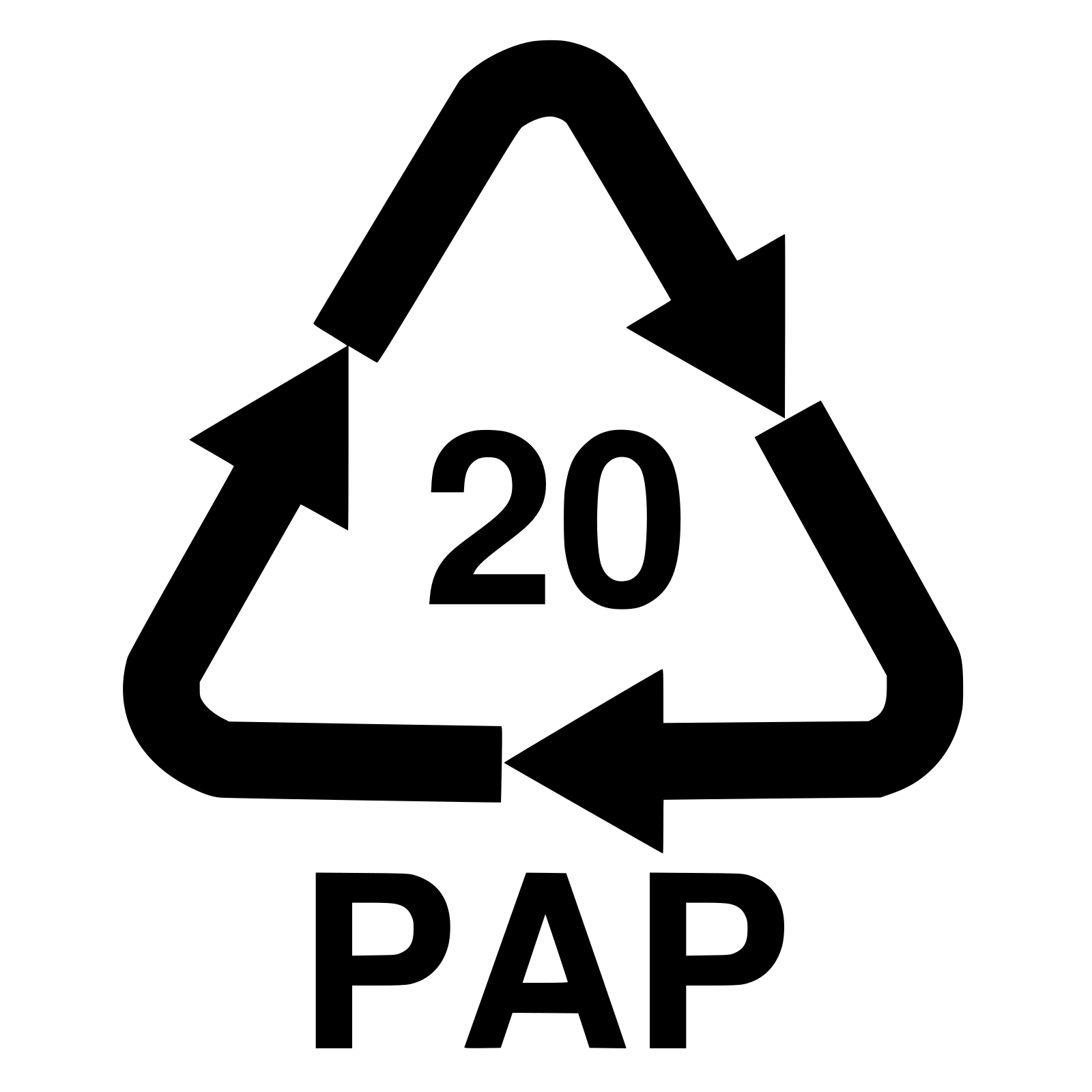
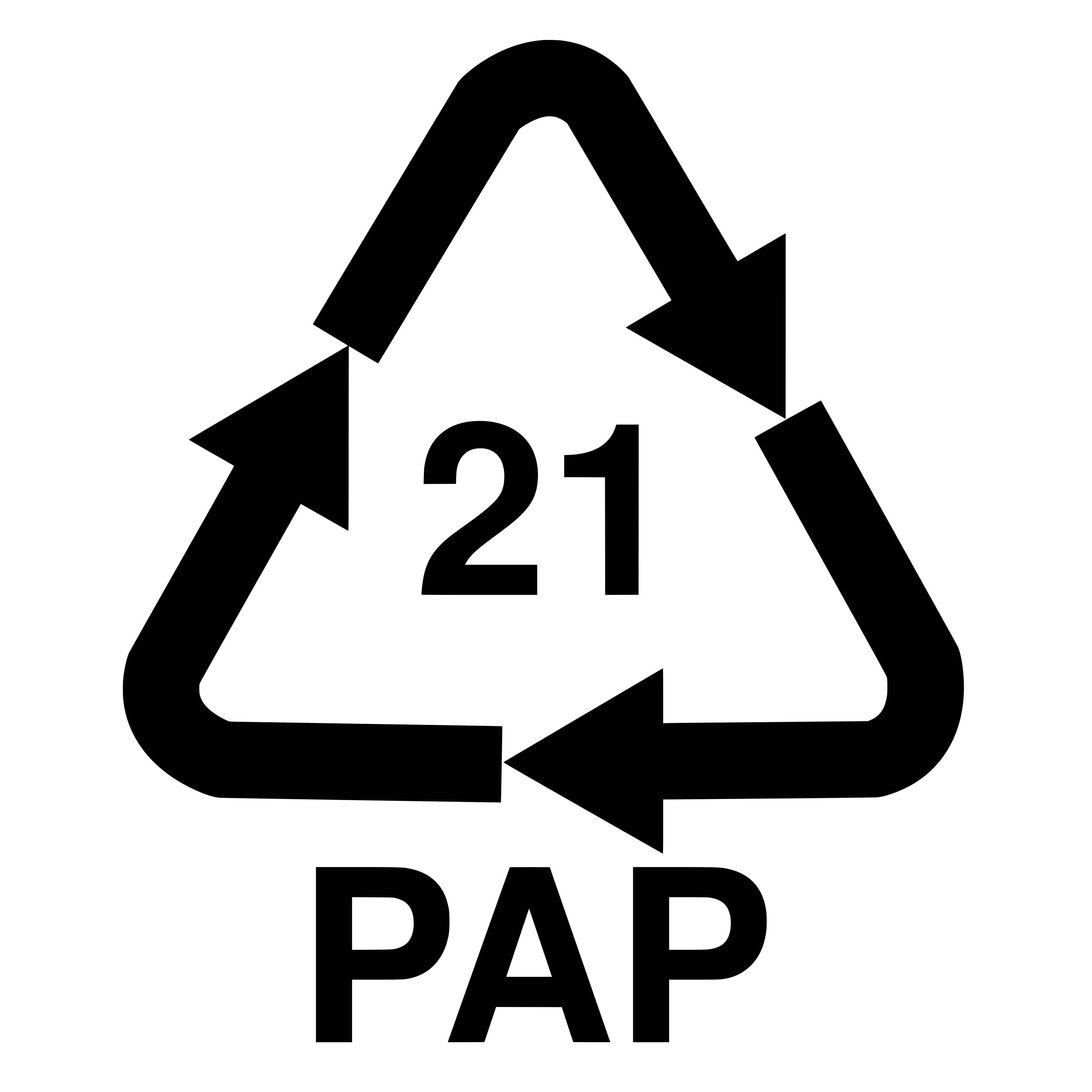
Slovenia does not require a unique national recycling label. Producers must use standard EU material identification codes on packaging, along with sorting instructions where applicable.An example of what a label looks like on packaging for Slovenia
This packaging shows two standard EU material identification codes. PAP 21 indicates that the cardboard box is made of solid board and should be placed in the paper/cardboard collection stream. PP 5 indicates that the plastic window is made of polypropylene and should be disposed of according to local plastic collection rules. Labels are applied per packaging component, so different parts of the same product may carry different codes. 📎 Download the PAP 20 symbol: 📎 Download the PAP 21 symbol:

EPR eco-fees & eco-modulation
Eco-fees depend on:- Material type
- Weight
- Recyclability
- Plastic typically carries higher fees.
- Paper, cardboard, and glass are usually lower.
- Fees are determined by PRO tariff structures.
- Eco-modulation (adjusted fees based on recyclability or environmental impact) is being strengthened in line with EU harmonization.
Risks , penalties & common mistakes
Potential penalties:- Administrative fines
- Orders to cease placing products on the market
- Environmental inspections
- Ignoring cross-border e-commerce obligations
- Failing to account for transport packaging
- Incorrect material classification
- Not appointing a representative (if required)
Whate-commerce sellers should do now
- Assess packaging volumes shipped to Slovenia
- Determine producer status
- Appoint an authorized representative (if not locally established)
- Sign a contract with a licensed PRO
- Implement packaging weight tracking by material
- Review environmental marketing claims
Register online
Start your EPR Reporting within 24 hours
FAQ
Do marketplace sellers need to register?- Yes. If you own the goods and place them on the Slovenian market, you are the producer.
- Yes. All packaging reaching the final consumer must be reported.
- Simplified rules may apply below 15 tonnes, but reporting obligations often still exist.
- Yes, if the packaging becomes waste in Slovenia.
What is Slovenia EPR EEE
Extended Producer Responsibility (EPR) for Electrical and Electronic Equipment (EEE) is a legal framework that requires companies placing electrical or electronic products on the Slovenian market to take financial and organisational responsibility for managing the resulting waste at end of life. This obligation covers collection, treatment, recycling, and recovery of Waste Electrical and Electronic Equipment (WEEE).
In Slovenia, EPR for EEE is governed primarily by the Decree on Waste Electrical and Electronic Equipment (Uredba o odpadni električni in elektronski opremi, Official Gazette of the Republic of Slovenia, No. 55/15, 47/16, 72/18, 84/18, 108/20, and 44/22 – ZVO-2). This decree transposes EU Directive 2012/19/EU (the WEEE Directive) into Slovenian national law and was last substantively amended in 2022 as part of the broader revision of the Environmental Protection Act (Zakon o varstvu okolja, ZVO-2).
The WEEE Directive was further amended at EU level by Directive (EU) 2024/884, which member states were required to transpose into national law by 9 October 2025. This amendment clarifies producer responsibility for photovoltaic panels, confirms obligations for products placed under the 2018 open-scope rules, and updates labelling standards. Slovenia is expected to incorporate these amendments into its national regulatory framework accordingly.
The overarching objective of the Slovenian EEE EPR regime is to reduce the environmental and human health impacts of WEEE by ensuring that producers — not taxpayers or municipalities — fund and organise the proper management of electronic waste. The legislation covers a broad range of product categories including household appliances, IT and telecommunications equipment, consumer electronics, lighting, and tools.
Does This Apply to E-Commerce & Online Sales
Yes. E-commerce and distance selling are explicitly covered under Slovenian WEEE rules. The obligation to comply arises from the act of placing EEE on the Slovenian market, regardless of whether this occurs through a physical store, an online shop, a marketplace platform, or any other channel.
A company that sells EEE directly to Slovenian consumers from abroad — whether from another EU member state or a third country — is classified as a distance seller under Slovenian law and carries the same producer obligations as a domestically established manufacturer or importer. There is no exemption based on the sales channel or the absence of a physical presence in Slovenia.
This means foreign e-commerce operators shipping electrical or electronic products into Slovenia must register for EPR, appoint an Authorized Representative, join an accredited compliance scheme, and report the quantities placed on the market — regardless of how small their Slovenian sales volumes may be.
Online marketplaces have also faced increasing scrutiny across the EU since 2023, with platforms such as Amazon now required to verify that third-party sellers hold valid WEEE registrations before listing products. Sellers who are not registered risk losing access to marketplace channels in addition to facing direct regulatory penalties.
Who is the "Producer" Under Slovenia EPR?
Under Slovenian WEEE law, the term "producer" (proizvajalec) has a broad and functional definition. It covers any entity that, irrespective of the sales technique used, first makes EEE available on the Slovenian market under its own name or trademark. The following categories of companies are considered producers:
- Domestic manufacturers that produce EEE in Slovenia and sell it under their own brand.
- Importers that bring EEE manufactured outside Slovenia (whether from the EU or non-EU countries) and place it on the Slovenian market.
- Private label owners that sell EEE under their own brand, even if the physical manufacturing is outsourced to a third party.
- Distance sellers and e-commerce operators (foreign and domestic) who sell EEE directly to end users in Slovenia using remote communication channels.
- Foreign companies with no legal presence in Slovenia that sell EEE to Slovenian consumers — these must fulfil their obligations through an appointed Authorized Representative.
The term "acquirer" (pridobitelj) is also used in Slovenian legislation to refer to companies that place EEE on the market but are not the original manufacturer — for example, importers or distributors acting as the first entity to introduce the product into the Slovenian market. Both producers and acquirers carry obligations under the decree.
Obligations begin at the moment EEE is first made available on the Slovenian market, meaning pre-registration is required before any products are sold or shipped to Slovenian customers.
Who Must Register for EPR EEE in Slovenia
All companies that produce, import, or otherwise place EEE on the Slovenian market are required to register for EPR. This requirement applies regardless of company size, annual turnover, or volume of EEE placed on the market. Registration must take place before the first product is made available to Slovenian buyers.
The registering authority is the Slovenian Environment Agency (ARSO – Agencija Republike Slovenije za okolje), which maintains the national producer register for EEE. ARSO operates under the supervision of the Ministry of the Environment, Climate and Energy (MOPE – Ministrstvo za okolje, podnebje in energijo).
Foreign companies that do not have a legal entity registered in Slovenia and hold a Slovenian VAT number must appoint an Authorized Representative before they can register. The Authorized Representative acts on the company's behalf for all registration, reporting, and compliance purposes.
Domestic companies — those with a registered business address and Slovenian VAT number — may register directly through their chosen compliance scheme and ARSO. However, if a foreign company has a Slovenian subsidiary, the subsidiary must itself have a registered address and Slovenian VAT number to qualify as able to register directly; most subsidiaries of foreign companies do not meet these criteria and still require an Authorized Representative.
Slovenia EPR EEE Registration Threshold
Unlike some EU member states, Slovenia does not apply a de minimis threshold or minimum volume exemption for EEE. There is no minimum weight, unit count, or turnover figure below which a company would be exempt from registration and compliance obligations.
All producers, including small online retailers and micro-businesses, that place any quantity of EEE on the Slovenian market are required to register, join a compliance scheme, report their volumes, and contribute to collection and recycling costs from the first unit placed on the market.
This zero-threshold approach means that even a company selling a single product category in very small quantities into Slovenia carries the full set of EPR obligations. There are no simplified registration procedures for very small producers in the EEE category equivalent to those available in some other EU markets.
Foreign distance sellers must additionally appoint an Authorized Representative regardless of quantity, as this is a statutory requirement under Slovenian law that cannot be waived based on low sales volumes.
Detailed EPR Guidance for each Jurisdiction
We support 36 jurisdictions
EEE Categories Covered (and Excluded)
The Slovenian WEEE decree aligns with the EU WEEE Directive's open-scope framework, which has applied since 15 August 2018. Under this framework, all EEE is covered unless it falls within a specific listed exclusion. Slovenia's classification uses six categories of equipment as defined under the revised directive:
- Temperature exchange equipment — refrigerators, freezers, air conditioning units, heat pumps, dehumidifiers.
- Screens and monitors — televisions, monitors with a surface area greater than 100 cm², laptops, tablets, notebooks.
- Lamps — fluorescent lamps, LED lamps, high-intensity discharge lamps, compact fluorescent lamps (excluding filament bulbs, where applicable).
- Large equipment — washing machines, dishwashers, large medical devices, large industrial tools, large IT equipment; any external dimension exceeds 50 cm.
- Small equipment — vacuum cleaners, microwaves, small tools, small medical devices, small leisure and sports equipment, smoke detectors, thermostats; all external dimensions are 50 cm or less.
- Small IT and telecommunications equipment — mobile phones, GPS devices, pocket calculators, routers, personal computers, printers; all external dimensions are 50 cm or less.
The pre-2018 ten-category structure (large household appliances, small household appliances, IT and telecoms equipment, consumer electronics, lighting equipment, electrical and electronic tools, toys and leisure equipment, medical devices, monitoring and control instruments, and automatic dispensers) is still referenced in older Slovenian documentation and in some compliance scheme frameworks, but the operative legal framework is the six-category open-scope approach.
Exclusions under the Slovenian decree, consistent with the WEEE Directive, include:
- Equipment designed for military or national security purposes
- Equipment designed to be sent into space
- Large-scale fixed industrial installations and large-scale stationary infrastructure
- Means of transport for persons or goods (excluding electric two-wheel vehicles not type-approved)
- Non-road mobile machinery available exclusively for professional use
- Equipment specifically designed for research and development purposes only available on a business-to-business basis
- Implanted medical devices (active implantable devices and other implanted medical devices)
Photovoltaic panels are covered under the Slovenian WEEE framework following the clarification introduced by Directive (EU) 2024/884, which confirmed that panels placed on the market after 13 August 2012 are subject to producer responsibility obligations.
Producer Responsibility Organization (PRO)
Slovenia operates a shared compliance scheme model, in which producers fulfil their WEEE obligations by joining an accredited Producer Responsibility Organisation (PRO) rather than individually organising collection and recycling. The PRO manages logistics, contracts with certified treatment facilities, monitors collection performance, and reports to ARSO on behalf of its members.
The principal PROs active in the Slovenian EEE market are:
- ZEOS d.o.o. — the largest WEEE compliance scheme in Slovenia, founded in 2005 by major Slovenian producers and retailers of EEE. ZEOS is a non-profit organisation and manages over 10,000 waste pickups annually. It operates an extensive network of collection points and treatment facilities and also has operations in Bosnia and Herzegovina. ZEOS covers WEEE as well as portable batteries, industrial batteries, and waste grave candles.
- Interzero d.o.o. — the Slovenian arm of the Interzero group, which offers EPR compliance services for both WEEE and packaging in Slovenia. Interzero also provides Authorized Representative services for foreign producers and acts as a single-provider solution for companies needing to comply with multiple EPR waste streams.
- Trigana d.o.o. — a smaller compliance scheme operator active in the Slovenian market.
Not all PROs cover both packaging and WEEE. Foreign producers that have obligations across both waste streams may need to contract with more than one organisation unless their chosen PRO covers both categories.
The Ministry of the Environment, Climate and Energy (MOPE) approves and oversees the joint management plans (skupni načrti ravnanja) submitted by PROs, while ARSO manages the official producer registry and monitors annual reporting obligations.
EPR Registration in Slovenia
The registration process for EEE EPR in Slovenia follows a defined sequence of steps. Foreign companies must complete all of these before placing EEE on the Slovenian market.
- Classify your products. Determine which EEE categories your products fall into using the six-category classification framework. This classification determines the applicable rates, collection obligations, and reporting requirements.
- Appoint an Authorized Representative (AR). If your company is not established in Slovenia with a registered address and Slovenian VAT number, you must appoint an Authorized Representative before any other registration steps can be taken. The AR must be a legal entity registered in Slovenia.
- Select and join a licensed PRO. The AR or the company itself (for domestic producers) selects an accredited compliance scheme — such as ZEOS or Interzero — and signs a licensing or membership agreement. The PRO then manages collection, treatment, and recycling obligations on your behalf.
- Register with ARSO. The PRO, via the Authorized Representative for foreign companies, submits the registration application to ARSO, the Slovenian Environment Agency. This registration creates an official entry in the national producer register. ARSO registration is mandatory for both packaging and EEE; it does not apply to other EPR categories.
- Register with FURS (financial administration). The Financial Administration of the Republic of Slovenia (FURS – Finančna uprava Republike Slovenije) administers the environmental levy (okoljska dajatev) on EEE. Registration with FURS is required to report and pay this levy on a quarterly basis.
- Register with MOPE. Certain notifications or registrations may also be required with the Ministry of the Environment, Climate and Energy, depending on the scope of products and volumes.
- Begin reporting. Once registered, the producer (via the AR and PRO) must submit quarterly volume reports and an annual consolidated report by the statutory deadline.
The entire process for foreign companies can be completed online; no physical travel to Slovenia, no hard copies, and no notarised documents are required under the current process operated by major PROs.
Authorized Representative
Under Slovenian law, any foreign company placing EEE on the Slovenian market without a locally registered legal entity must appoint an Authorized Representative (pooblaščeni zastopnik) before commencing sales. This requirement has been in force for EEE since 2006 and is derived from both EU Directive 2012/19/EU and the national WEEE decree.
The Authorized Representative must be a legal entity that:
- Has a registered office (seat) in Slovenia.
- Holds a Slovenian domestic VAT number.
- Has the legal capacity to represent the foreign producer before Slovenian authorities.
The AR assumes full legal responsibility for the foreign producer's compliance obligations in Slovenia. This includes registering the producer with ARSO, FURS, and MOPE; managing PRO membership and licensing agreements; submitting quarterly and annual reports; paying the environmental levy; and representing the producer in any interactions with Slovenian government bodies, audits, or enforcement proceedings.
The obligation to appoint an AR applies only to EEE and packaging EPR obligations in Slovenia. Other regulated waste streams — such as batteries, single-use plastics, and grave candles — do not legally require an Authorized Representative under current Slovenian legislation.
A company with a Slovenian subsidiary is not automatically exempt from the AR requirement. The subsidiary must itself have a registered Slovenian business address and Slovenian VAT number to take on the producer role; in most cases, subsidiaries of foreign companies do not meet these criteria.
Non-compliance with the AR requirement — including selling into Slovenia without having appointed a representative — can result in a fine of up to €4,000. If any company is already active in the Slovenian market without an AR, immediate appointment is required.
What Data Must Be Reported
Producers (and their Authorized Representatives on their behalf) are required to report the following categories of data:
- Quantities of EEE placed on the Slovenian market, broken down by EEE category and reported in kilograms. Reporting must reflect the actual weight of equipment delivered to Slovenian end users during the reporting period.
- Quantities of WEEE collected, by category and in kilograms, either directly or through the PRO's collective scheme.
- Quantities sent to treatment, including data on reuse, recycling, and recovery rates, reported in kilograms per EEE category.
- Brand names and product identifiers — the registration record includes the producer's name, brand names under which EEE is sold, and details of the PRO or compliance scheme through which obligations are fulfilled.
- Quarterly volume declarations submitted to the PRO, capturing the weight of EEE placed on the market in each calendar quarter.
- Annual consolidated report submitted to ARSO, summarising the full year's activity, including quantities placed on the market and quantities of WEEE managed. This report is filed by the AR or PRO on behalf of the producer.
- Environmental levy declarations submitted quarterly to FURS, with corresponding payment of the eco-contribution based on quantities placed on the market.
Accurate record-keeping at SKU level is strongly advisable. If ARSO or MOPE conduct a compliance audit, the producer must be able to demonstrate the basis for all figures submitted.
First Reporting Period & EPR Reporting Deadlines
Obligations begin from the first moment EEE is placed on the Slovenian market. There is no grace period following registration before reporting obligations commence.
The key recurring deadlines are:
- Quarterly volume reporting to the PRO — producers submit declarations of EEE placed on the Slovenian market for each calendar quarter. The specific deadlines are defined by the PRO's operating procedures but generally follow the calendar quarter end.
- Quarterly environmental levy payment to FURS — the eco-contribution is declared and paid quarterly to the Financial Administration, based on quantities of EEE placed on the market during each quarter.
- Annual report to ARSO — deadline: 31 March each year. This report covers the full preceding calendar year and must be submitted by 31 March of the following year. For foreign producers, the Authorized Representative or PRO submits this report. Domestic producers work through their PRO. ARSO receives only one submission per producer; the AR and PRO do not submit duplicate reports.
For a company commencing sales in Slovenia during the course of a calendar year, reporting begins with the first quarter in which products were placed on the market. The first annual report would then cover that partial year and would be due by 31 March of the following year.
Labels & Marketing Claims
All EEE placed on the Slovenian market must carry specific mandatory labelling in accordance with the WEEE decree and the EU Directive. The key labelling requirements are:
- Crossed-out wheeled bin symbol (WEEE symbol) — all EEE must bear the crossed-out wheeled bin symbol on the product itself in a legible and indelible manner. If the size or function of the equipment makes it impractical to place the symbol directly on the product, the symbol must appear on the packaging, the user manual, or the guarantee document. This symbol indicates that the product must not be disposed of as unsorted municipal waste.
- Date marking — the label must indicate that the equipment was placed on the market after 13 August 2005, which is the date from which producer responsibility obligations apply. This date marker, alongside the producer's name, must be formatted in accordance with standard SIST EN 50 419 (the Slovenian adoption of EN 50 419:2022, referenced in the 2024 amending directive Directive (EU) 2024/884).
- Producer identification — the producer's name must be clearly identifiable on the equipment via a fixed label or marking.
- Hazardous substance markings — EEE that contains hazardous substances subject to RoHS restrictions (under Directive 2011/65/EU on the restriction of hazardous substances) must comply with RoHS labelling and documentation requirements in parallel with WEEE labelling.
- Consumer information obligations — producers and acquirers are required to inform household users about the purpose and objectives of WEEE collection, correct handling practices, free return and take-back options, and the benefits of reuse and recycling. This information obligation may be fulfilled through product documentation, website disclosures, or other appropriate communication channels.
Sustainability or recyclability claims in marketing materials are not specifically regulated under the Slovenian WEEE decree but are subject to general EU and Slovenian rules on misleading commercial practices and, increasingly, to EU green claims legislation. Companies should avoid unsubstantiated environmental claims in connection with EEE products placed on the Slovenian market.
EPR Eco Fees & Eco-Modulation
EEE producers in Slovenia are subject to two parallel financial obligations: contributions paid to the PRO to fund collection and recycling activities, and an environmental levy paid directly to FURS.
Environmental levy (okoljska dajatev): This is a state-administered charge levied on producers placing EEE on the Slovenian market. It is regulated by the Decree on the Environmental Levy for Pollution Caused by the Generation of Waste Electrical and Electronic Equipment and Waste Portable Batteries and Accumulators (Uradni list RS, No. 84/18 and 44/22 – ZVO-2). The levy is calculated on the basis of the weight of EEE placed on the market and is declared and paid quarterly to FURS.
PRO membership fees: In addition to the state levy, producers pay fees to their chosen compliance scheme (ZEOS, Interzero, or another accredited PRO) to fund the practical organisation of WEEE collection, logistics, treatment, and reporting. These fees are typically calculated per kilogram of EEE placed on the market and vary by EEE category, reflecting the relative cost of collecting and treating each product type. For example, cooling and freezing equipment and gas discharge lamps carry higher treatment costs than simple small appliances, and this is reflected in the fee structure.
Eco-modulation: Slovenia has not implemented a formal eco-modulation scheme for EEE fees comparable to those in France, where recyclability or repairability metrics reduce the fee per unit. Slovenian PRO fees are primarily weight-based and category-based. However, the EU Commission's ongoing evaluation of the WEEE Directive — mandated to produce a full review by the end of 2026 — may lead to harmonised eco-modulation requirements across member states in future legislative revisions.
Producers should budget for both the state levy (paid to FURS) and the PRO scheme fee, as these are separate obligations that cannot offset one another.
Risks, Penalties & Common Mistakes
Foreign companies entering the Slovenian market frequently encounter the following compliance failures, each of which carries regulatory and commercial risk.
- Failure to appoint an Authorized Representative before first sale. This is the most common mistake made by foreign e-commerce sellers. Selling into Slovenia without an AR in place is a direct violation of the decree and can result in a fine of up to €4,000. It also blocks the ability to register with ARSO and join a PRO.
- Incorrect EEE category classification. Misclassifying products into the wrong EEE category leads to incorrect fee payments and inaccurate reporting. Category errors are one of the most common triggers for audit findings.
- Assuming small volumes create a threshold exemption. There is no minimum threshold in Slovenia for EEE. A single unit placed on the market creates an obligation. Companies that delay registration until they reach a perceived "significant" volume create a period of retroactive non-compliance.
- Failing to register with both ARSO and FURS. Registration with the PRO alone is insufficient. ARSO registration and FURS registration are separate mandatory steps. Omitting either creates an incomplete compliance profile.
- Missing the 31 March annual reporting deadline. Late or absent annual reports to ARSO are a breach of the decree and may result in administrative sanctions, including fines.
- Selling on marketplaces without a valid WEEE registration. Since 2023, major marketplace operators are required to verify that sellers hold valid registrations. Unregistered sellers risk removal from marketplace listings, which carries direct commercial as well as regulatory consequences.
- Labelling non-compliance. Products placed on the market without the crossed-out wheeled bin symbol, producer identification, or date marking in accordance with SIST EN 50 419 are non-compliant. Enforcement authorities may require product withdrawal or corrective labelling at the producer's expense.
Enforcement in Slovenia is carried out by ARSO and MOPE, with FURS having jurisdiction over the environmental levy component. The legal basis for penalties is the Environmental Protection Act (ZVO-2), which provides for administrative fines and, in serious or repeated cases, market access restrictions.
What E-Commerce Sellers Should Do Now
Companies placing or planning to place EEE on the Slovenian market should take the following steps without delay:
- Confirm whether your products qualify as EEE under the six-category Slovenian classification and identify the relevant categories.
- Appoint an Authorized Representative established in Slovenia before making any products available to Slovenian buyers.
- Select and contract with an accredited WEEE compliance scheme (ZEOS, Interzero, or another licensed PRO).
- Complete registration with ARSO, FURS, and MOPE through your Authorized Representative and PRO.
- Verify that all products bear the required crossed-out wheeled bin symbol and producer identification marking in accordance with SIST EN 50 419.
- Set up internal processes to track EEE volumes placed on the Slovenian market by category and by weight, on a quarterly basis.
- Confirm your marketplace listings include your Slovenian WEEE registration number where required by the platform.
- Schedule the annual ARSO report deadline — 31 March — in your compliance calendar and confirm with your AR who is responsible for filing.
- Confirm that your environmental levy (okoljska dajatev) is being declared and paid quarterly to FURS.
- Monitor updates to Slovenian national law transposing Directive (EU) 2024/884 and any further developments from the EU Commission's full WEEE Directive review expected by end of 2026.
Register online
Start your EPR Reporting within 24 hours
FAQ
Is EPR registration for EEE mandatory for all companies selling into Slovenia?
- Yes. Registration is mandatory for all companies placing EEE on the Slovenian market, regardless of company size, sales volume, or whether the company is domestic or foreign. There is no minimum threshold for EEE. Obligations arise from the first unit placed on the market.
Do foreign sellers need to appoint an Authorized Representative in Slovenia?
- Yes. Foreign companies that do not have a legal entity registered in Slovenia with a domestic address and Slovenian VAT number are required by law to appoint an Authorized Representative before they can register with ARSO or join a PRO. This requirement has applied to EEE since 2006. Failure to appoint an AR can result in a fine of up to €4,000 and blocks formal registration.
Is there a weight or turnover threshold below which a company is exempt from EEE EPR?
- No. Unlike some other EU member states, Slovenia applies no de minimis exemption for EEE. All producers, including micro-businesses and small e-commerce operators, must comply from the first product placed on the market. There is no simplified or reduced-obligation track for low-volume EEE producers.
What labelling must appear on EEE products sold in Slovenia?
- Products must bear the crossed-out wheeled bin symbol, clearly identifying that the equipment requires separate collection. The label must also include the producer's name and an indication that the product was placed on the market after 13 August 2005, formatted in accordance with standard SIST EN 50 419. If the product is too small to carry the symbol directly, it may appear on packaging, the user manual, or the guarantee document.
Do online marketplaces bear any compliance responsibility for WEEE in Slovenia?
- Marketplace platforms operating in the EU have faced growing obligations to verify that sellers hold valid WEEE registrations. Since 2023, major platforms such as Amazon require sellers to provide proof of WEEE compliance before listing products. If a foreign seller is not registered, the marketplace may remove the listing. However, the primary legal obligation for EEE EPR compliance rests with the producer or distance seller, not the marketplace. Companies relying on marketplace channels should ensure their Slovenian WEEE registration is valid and current.
What is Slovenia EPR Batteries
Slovenia's battery EPR framework is governed by Regulation (EU) 2023/1542 — the EU Battery Regulation — which applies directly in all EU Member States from 18 August 2025. At national level, battery EPR obligations are implemented through Slovenian waste management legislation, with the Slovenian Environment Agency (ARSO — Agencija Republike Slovenije za okolje) maintaining the national producer registry and the Ministry of Environment of the Republic of Slovenia overseeing the broader regulatory framework. Battery EPR has been mandatory in Slovenia for many years under legislation implementing the former Batteries Directive 2006/66/EC. The EU Battery Regulation replaced this Directive in full from 18 August 2025, introducing the comprehensive five-category framework and more stringent EPR obligations. Slovenia was included in Zalando's fourth wave of battery EPR verification, scheduled by 30 April 2026. Zalando has published an example showing where to locate Slovenian battery registry data points, confirming that Slovenia has an operational battery producer register.Does This Apply to E-Commerce & Online Sales
Yes. The EU Battery Regulation and Slovenian waste legislation apply to all producers placing batteries on the Slovenian market, regardless of sales channel. Distance sellers and e-commerce operators who sell battery-containing products directly to Slovenian consumers are considered producers. Slovenia has a distinctive feature regarding authorised representatives: for foreign manufacturers introducing batteries to the Slovenian market and selling to B2B recipients (businesses), appointing an authorised representative is not mandatory under Slovenian law. However, for companies selling to B2C consumers and for foreign companies seeking streamlined compliance, appointing a representative is strongly recommended. Compliance service providers operating in Slovenia — such as Interzero — explicitly note this distinction and recommend representation to avoid compliance risks.Who is the "Producer" under Slovenia EPR?
Under Regulation (EU) 2023/1542 and Slovenian waste legislation, a producer is any person who, in the course of commercial activity, places batteries—whether standalone or incorporated into products— on the Slovenian market for the first time. This covers:- Manufacturers established in Slovenia who produce and sell batteries domestically under their own brand.
- Importers bringing batteries into Slovenia from non-EU countries for the first time under their own name.
- Companies introducing batteries from another EU Member State into Slovenia for the first time.
- Private label owners whose brand name appears on batteries manufactured by third parties.
- Distance sellers and online retailers established outside Slovenia who sell batteries or battery-containing products directly to Slovenian consumers.
- Economic operators who prepare batteries for re-use or repurposing — treated as producers for the second life of the battery.
Who Must Register for EPR Batteries in Slovenia
All producers placing batteries on the Slovenian market must register with the competent authority and join an approved EPR scheme for battery waste management. EPR schemes for batteries and accumulators in Slovenia must be registered with the Slovenian Environment Agency (ARSO) and hold an environmental permit from the Ministry of Environment. The approved EPR providers for battery waste management in Slovenia include:- Interzero (interzero.si) — holds an environmental permit from the Ministry of Environment and has EPR schemes for batteries and accumulators registered with ARSO. Interzero offers comprehensive battery EPR services including registration, reporting, and collection management.
- ZEOS d.o.o. (zeos.si) — a national non-profit collective scheme for WEEE in Slovenia that also manages waste portable batteries and accumulators.
Slovenia EPR Battery Registration Threshold
Regulation (EU) 2023/1542 does not establish a minimum volume or turnover threshold below which producers are exempt from EPR obligations. All producers placing batteries on the Slovenian market must register and comply regardless of size or volume. The only exemption in the Regulation concerns batteries used in military or space equipment, which are outside the scope entirely.Detailed EPR Guidance for each Jurisdiction
We support 36 jurisdictions
Batteries Covered (and Excluded)
Regulation (EU) 2023/1542 defines five battery categories, all within scope for EPR in Slovenia: Portable batteries Batteries under 5 kg not designed for industrial or vehicle use. Includes batteries in consumer electronics, power tools, household devices, and toys. Light Means of Transport (LMT) batteries Batteries used in e-bikes, e-scooters, e-mopeds, and similar light electric vehicles. Automotive (SLI) batteries Starting, lighting, and ignition batteries used in vehicles. Industrial batteries Batteries used in industrial applications and stationary energy storage systems. Those above 2 kWh have additional requirements including battery passports from 2027. Electric vehicle (EV) batteries Batteries used in electric cars and heavy electric vehicles. Key exclusions:- Batteries designed for military or space equipment — outside scope entirely
- Batteries in nuclear installations — excluded
- Second-life batteries where the operator performing re-use or repurposing becomes the new producer
Producer Responsibility Organization (PRO)
Slovenia operates an approved PRO system for batteries. The main approved EPR providers with battery waste management schemes registered with ARSO are: Interzero (interzero.si) — holds an environmental permit from the Ministry of Environment of the Republic of Slovenia and has EPR schemes for batteries and accumulators registered with ARSO. By joining Interzero's EPR Waste Battery Management Plan, producers delegate all regulatory obligations — including registration, reporting, collection, recycling, and government communication — to Interzero. Interzero explicitly offers services to international clients and provides general terms and conditions for cross-border producers. ZEOS d.o.o. (zeos.si) — the national non-profit WEEE collective scheme, also covering waste portable batteries and accumulators alongside electrical and electronic equipment.EPR Registration in Slovenia
The registration process for battery producers in Slovenia is as follows:- Determine whether your business qualifies as a producer under the EU Battery Regulation and Slovenian waste legislation.
- Decide whether to appoint an authorised representative — while not mandatory for all foreign companies under Slovenian law, it is strongly recommended to avoid compliance risks and administrative difficulties.
- Join an approved EPR provider — Interzero or ZEOS — by signing a service agreement for battery waste management. The EPR provider manages registration with ARSO and the Ministry of Environment on your behalf.
- Declare battery volumes placed on the Slovenian market by category and weight through the EPR provider.
- Pay applicable contributions to the EPR provider based on battery category and volume.
- Receive your Slovenian battery EPR registration number — confirmed through the Slovenian battery registry — and provide it to Zalando and other marketplaces as required.
- Submit annual reporting obligations through the EPR provider to ARSO.
Authorized Representative
Slovenia's battery EPR framework has a distinctive feature compared to most other EU member states: for foreign manufacturers introducing batteries to the Slovenian market and selling to B2B recipients, appointing an authorised representative is not mandatory under Slovenian legislation. However, for companies selling directly to B2C consumers in Slovenia via e-commerce, and for all foreign companies seeking full compliance certainty, appointing a representative is strongly recommended. Interzero — which offers EPR services to international clients in Slovenia — explicitly recommends appointing an EPR representative to avoid problems with obligations and severe financial penalties for non-compliance. Important development: In December 2025, the European Commission proposed suspending the authorised representative requirement for EU-established companies until 2035 under the EU Battery Regulation. This proposal has not been formally adopted as of May 2026. For non-EU producers, the requirement under the EU Battery Regulation applies regardless of Slovenia's national position on AR for B2B sellers.What Data Must Be Reported
Producers registered in Slovenia must declare and report the following data annually through their EPR provider and ARSO:- Total weight (kilograms) of batteries placed on the Slovenian market during the reporting year, broken down by battery category (portable, LMT, SLI/automotive, industrial, EV)
- Battery chemistry type where relevant to reporting requirements
- Brand names under which batteries were placed on the market
- Collection and recycling performance data, compiled and reported by the EPR provider to ARSO on behalf of members
- For EV and LMT batteries: number of batteries made available and amounts of waste batteries collected and delivered to treatment facilities
First Reporting Period & EPR Reporting Deadlines
Battery EPR has been mandatory in Slovenia for many years. The EU Battery Regulation obligations took full effect from 18 August 2025. Key dates:- 18 August 2025: EU Battery Regulation EPR obligations fully in force.
- 30 April 2026: Zalando's Slovenian battery EPR verification scheduled to activate.
- Annual: Battery volume declarations and collection performance reporting to ARSO through the EPR provider. Specific deadlines should be confirmed with Interzero or ZEOS at the time of registration.
- 18 February 2027: Battery passports mandatory for industrial batteries (>2 kWh) and EV batteries.
- 18 August 2027: Due diligence obligations in force (delayed under Omnibus IV).
Labels & Marketing Claims
Crossed-out wheeled bin symbol From 18 August 2025, all batteries must display the separate collection symbol covering at least 3% of the area of the largest side of the battery, up to a maximum of 5 × 5 cm. Chemical symbols Batteries containing more than 0.002% cadmium must be marked Cd. Batteries containing more than 0.004% lead must be marked Pb. Capacity marking Portable and rechargeable batteries must display capacity information. QR code From 18 August 2026, all batteries must carry a QR code. For LMT, industrial (>2 kWh), and EV batteries, this links to the Digital Battery Passport from 18 February 2027. CE marking Mandatory from 18 August 2024. Language requirements Consumer-facing information on batteries sold in Slovenia must be provided in Slovenian where required under Slovenian consumer protection law. Environmental claims The Empowering Consumers for the Green Transition Directive (2024/825/EU) must be transposed by March 2026, after which unsubstantiated green claims will be prohibited across the EU including Slovenia.EPR Eco Fees & Eco-Modulation
Interzero and ZEOS set contribution rates for members based on the weight and category of batteries placed on the Slovenian market. The cost of service depends on the types of batteries introduced and their weight. Specific fee schedules should be confirmed directly with Interzero or ZEOS at the time of registration. Under Regulation (EU) 2023/1542, eco-modulation — adjusting contributions based on battery environmental performance — is required across all Member States. Slovenia's specific eco-modulation framework under the new Regulation has not been separately published as of May 2026.Risks, Penalties & Common Mistakes
- Missing the Zalando verification deadline of 30 April 2026. Sellers must have their Slovenian battery EPR registration number ready to submit through Zalando's zDirect system before this date. Battery-containing listings remain blocked until compliance is confirmed.
- Assuming an authorised representative is never required in Slovenia. The AR exemption in Slovenia applies specifically to foreign manufacturers selling to B2B recipients. E-commerce sellers selling to consumers are in a different position and should consider appointing a representative. Under the EU Battery Regulation, non-EU companies are required to appoint an AR regardless.
- Assuming one EU registration covers Slovenia. Battery EPR registration is national. Registration in another EU member state does not fulfil Slovenian obligations.
- Failing to join an approved EPR scheme. Registration with ARSO alone is insufficient — producers must join an approved battery waste management scheme such as Interzero or ZEOS.
- Missing labelling requirements. The crossed-out wheeled bin symbol and CE marking are mandatory from August 2025.
- Missing the QR code deadline of August 2026.
What E-Commerce Sellers Should Do Now
- Confirm whether your products contain batteries and whether they are being sold to Slovenian consumers.
- Contact Interzero (interzero.si/en) or ZEOS (zeos.si) and join their battery waste management EPR scheme by signing a service agreement.
- Declare battery volumes by category and weight and pay applicable contributions.
- Receive your Slovenian battery EPR registration number and provide it to Zalando through zDirect ahead of the 30 April 2026 activation date.
- Consider appointing an authorised representative in Slovenia — particularly if selling B2C — to manage registration, reporting, and government communication.
- Verify that all batteries carry the crossed-out wheeled bin symbol, CE marking, capacity information, and Slovenian-language consumer instructions as required.
- Plan for the QR code requirement by August 2026 and the Digital Battery Passport for industrial and EV batteries by February 2027.
Register online
Start your EPR Reporting within 24 hours
FAQ
Is battery EPR mandatory in Slovenia?- Yes. Battery EPR has been mandatory in Slovenia for many years. From 18 August 2025, the EU Battery Regulation (2023/1542) fully applies. All producers placing batteries on the Slovenian market must join an approved EPR scheme — Interzero or ZEOS — registered with ARSO, declare volumes, and comply with collection and recycling obligations.
- Yes. Distance sellers and e-commerce operators selling battery-containing products to Slovenian consumers are captured as producers. They must join an approved Slovenian battery EPR scheme. Slovenia has a distinctive feature: an authorised representative is not mandatory for all foreign companies under national law, but is strongly recommended for B2C e-commerce sellers and all companies seeking full compliance certainty.
- Under Slovenian national legislation, an AR is not mandatory for foreign manufacturers selling batteries to B2B recipients. However, under the EU Battery Regulation (2023/1542), non-EU companies must appoint an AR. For e-commerce sellers selling B2C in Slovenia, appointing a representative is strongly recommended. Compliance service providers in Slovenia, including Interzero, explicitly recommend AR appointment to avoid compliance risks.
- The two main approved battery EPR providers in Slovenia are Interzero (interzero.si), which holds an environmental permit from the Ministry of Environment and has schemes registered with ARSO, and ZEOS (zeos.si), the national non-profit scheme covering WEEE and portable batteries. Both offer comprehensive compliance services. Foreign producers should contact both and compare service terms and contribution rates.
- No. The EU Battery Regulation does not establish a minimum volume or turnover exemption for EPR registration. All producers placing batteries on the Slovenian market must register and comply regardless of size.
Packaging EPR law in Slovenia: None enacted
Slovenia is not among the countries with enacted textile EPR legislation.Want to be first to know when new EPR will issued?
Only important news!