

PPWR After 12 August 2026: What Packaging EPR Registration Data Shows Across Europe
The Packaging and Packaging Waste Regulation (PPWR) became applicable across the European Union on 12 August 2026. For companies selling packaged products across borders, the weeks around that date turned packaging compliance from a long-term preparation project into an immediate operational priority. At Lappa, we saw that shift in real time through packaging EPR consultations, registrations and onboarding activity across European markets.
The clearest conclusion from the first weeks of PPWR application is not simply that demand increased. It is that many companies still lack a clear view of which legal entity in their supply chain is responsible for packaging EPR registration, reporting and eco-fees. In Lappa's consultation data, 46% of companies that came to us for advice discovered that their eco-fee obligation was lower than expected, or that the payment obligation they were preparing for did not sit with them at all.
Registration timelines also varied enormously between countries: some registrations were completed in days, others took several months. This report summarises what Lappa observed around the first major PPWR application date: where companies got their obligations wrong, which countries registered fastest, where lead times remained longest, how registration costs differed, and which markets generated the highest demand.
46% of companies we advised found their eco-fee obligation was lower than expected, or did not apply to them
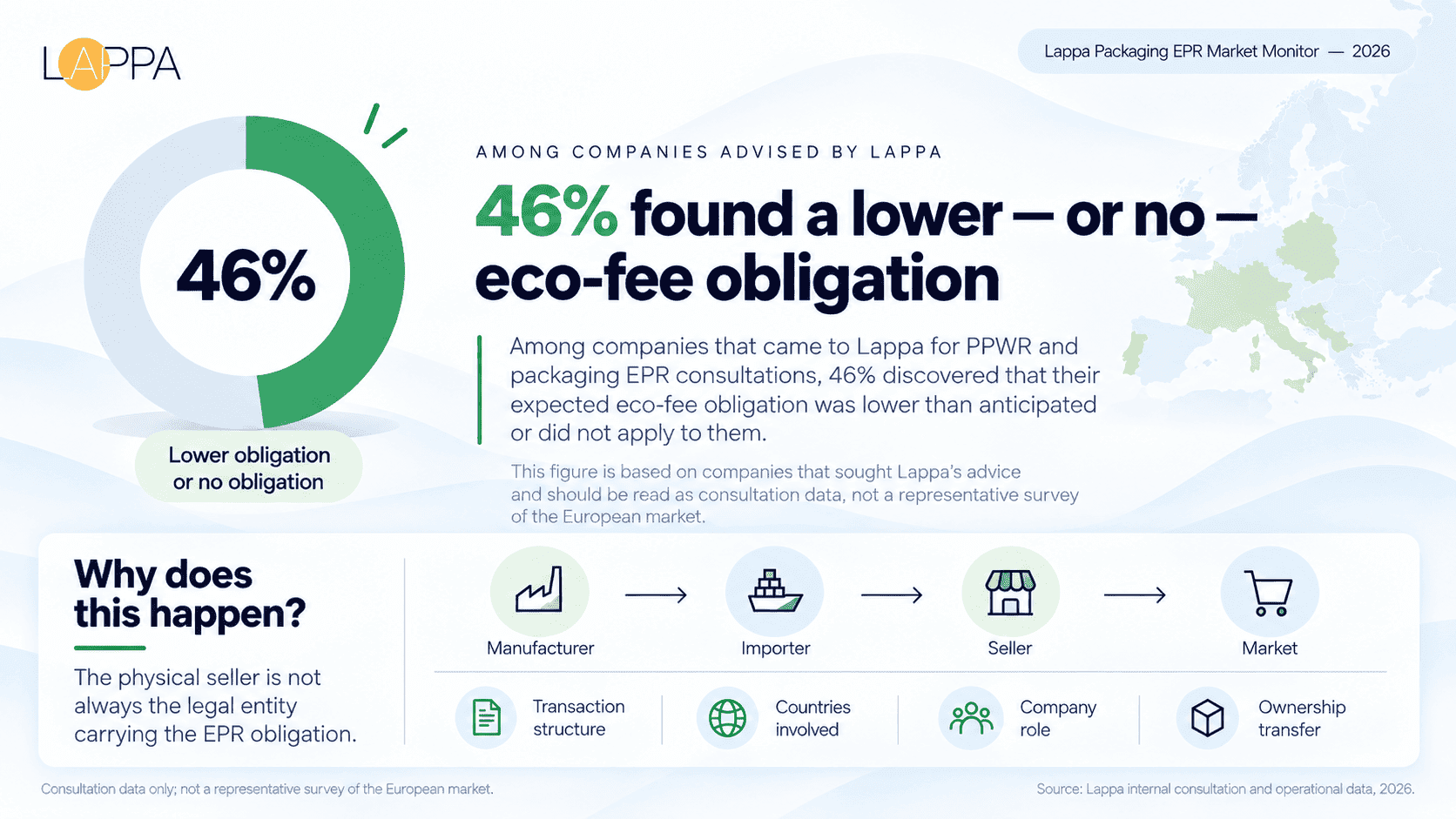
One of the most striking findings from Lappa's PPWR and packaging EPR consultations was how often businesses had misunderstood who in their supply chain was responsible for paying packaging eco-fees.
This does not mean that almost half of European companies are overpaying. The figure relates specifically to companies that sought Lappa's advice and should be read as consultation data, not a representative survey of the European market. But its size illustrates a recurring problem: identifying the responsible party is often far more complicated than identifying the packaging itself.
A business may know exactly what packaging surrounds its product and still struggle with the more important question: which legal entity is actually the producer responsible for EPR obligations in that market? The answer depends on the structure of the transaction, the countries involved, the role of each company and, critically, how ownership of the goods moves through the supply chain.
Modern cross-border supply chains rarely follow one simple model. A product may be manufactured by one entity, branded by another, imported by a third, sold through a marketplace and fulfilled from a warehouse run by a separate group company or logistics provider. The physical movement of goods and the legal transfer of ownership may follow different paths, and that distinction matters. Two companies selling apparently identical products into the same country can end up with different EPR responsibilities because their contractual and legal supply chains differ.
For businesses operating across several European countries, packaging EPR therefore cannot be managed reliably by asking only "Where are we selling?" The more useful question is: "Which entity is performing the legally relevant role when this packaging is placed on the market?" This is one reason PPWR implementation has raised so many questions even among businesses already experienced with national packaging EPR systems.
Takeaway: Lappa consultation data suggests that one of the biggest PPWR implementation risks is not failure to identify packaging, but failure to identify the correct obligated entity.
Packaging EPR registration times ranged from around two days to six months
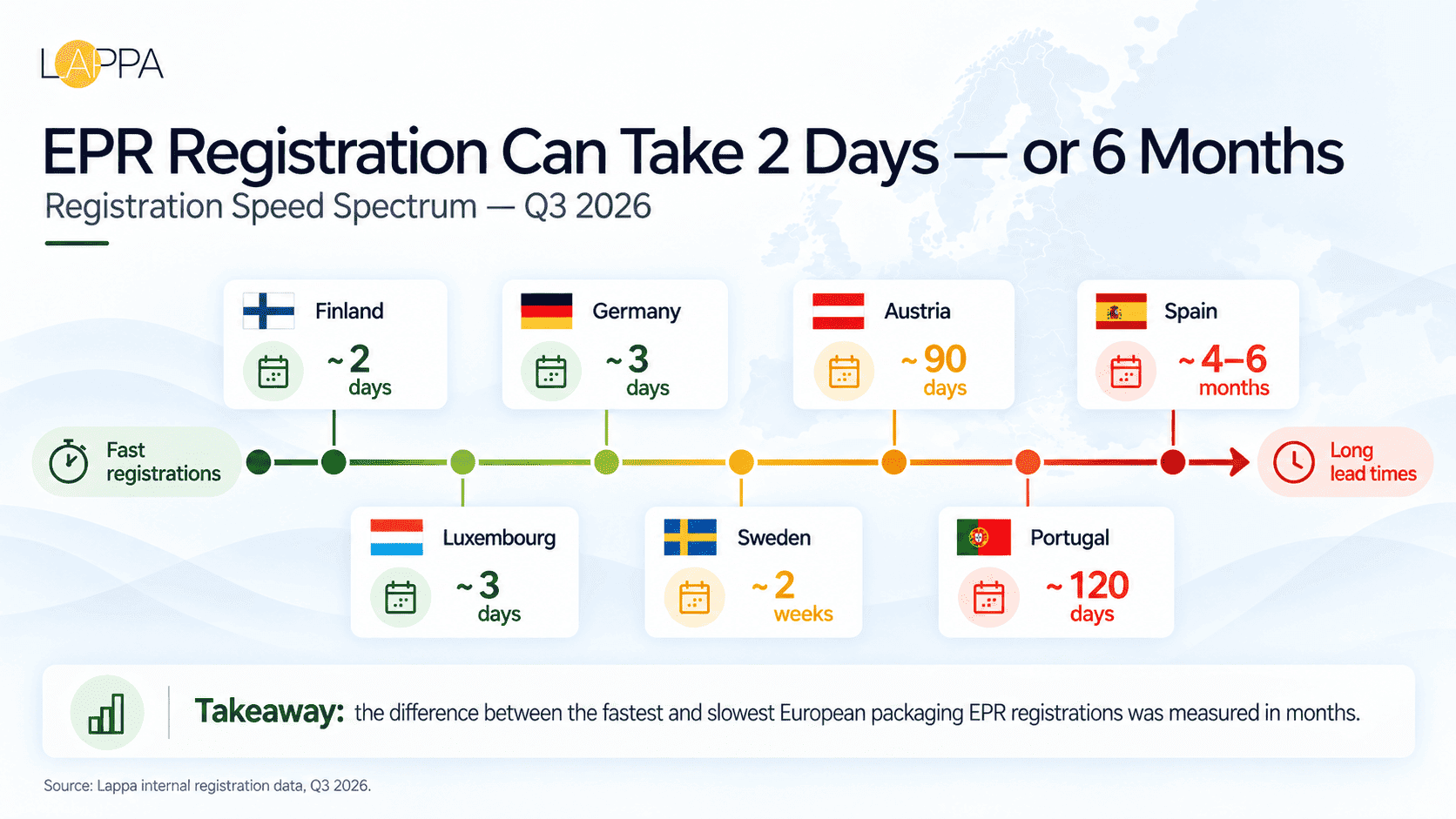
The second major difference we observed was the variation in registration timelines between countries. During August 2026, as companies rushed to complete compliance work around the PPWR application date, lead times rose sharply in a number of markets. Across registrations handled by Lappa, August timelines were in some cases close to twice their normal level. By September, many had begun to return to more typical levels, but the gap between countries remained significant.
Fastest packaging EPR registrations observed by Lappa
- Finland — approximately 2 days
- Luxembourg — approximately 3 days
- Germany — approximately 3 days
- Sweden — approximately 2 weeks
Germany is particularly notable because it is also one of the most frequently requested markets. High demand does not necessarily mean a long registration process when the national infrastructure, in Germany's case the LUCID register, is efficient. Finland and Luxembourg were among the fastest markets in the period analysed, with registrations sometimes completed within a few working days. Sweden was slower, but two weeks is still short compared with several southern European markets.
Longest packaging EPR registration timelines observed by Lappa
For companies entering these markets, the difference is commercially important. A business that starts packaging compliance work shortly before a planned launch may find that a three-to-six-month registration becomes part of the critical path for expansion. EPR registration should therefore be considered during market-entry planning rather than treated as a post-launch administrative step.
For larger organisations, this also creates a coordination issue between legal, sustainability, finance, operations and commercial teams. The department planning the launch may assume registration is quick, while the compliance team is dealing with a process that takes months.
Takeaway: In Lappa's Q3 2026 data, the difference between the fastest and slowest European packaging EPR registrations was measured not in days, but in months.
Spain, Portugal and Austria remained the slowest markets in our Q3 data
Long registration periods matter beyond compliance teams. They can affect launch dates, marketplace access, distributor onboarding and the timing of contracts with local representatives or compliance schemes.
Spain was the clearest outlier, with registration commonly requiring four to six months. Portugal was also among the longest at approximately 120 days, while Austria took around 90 days. In Portugal and Austria, companies without a local establishment also need an authorised representative, which adds another step before registration can be completed.
This leads to a simple planning rule for companies expanding in Europe: do not assume packaging EPR registration can be completed shortly before sales begin. For markets with longer processing periods, businesses should map their obligations and start registration well ahead of the commercial launch.
The pressure around August 2026 showed what happens when many businesses reach the same conclusion at once: registration systems, representatives and compliance providers all face a sudden concentration of demand. The underlying legal process does not necessarily change, but the market becomes temporarily congested. This was visible in August's lead-time spike and the partial normalisation that followed in September.
Registration costs also differ significantly between European markets
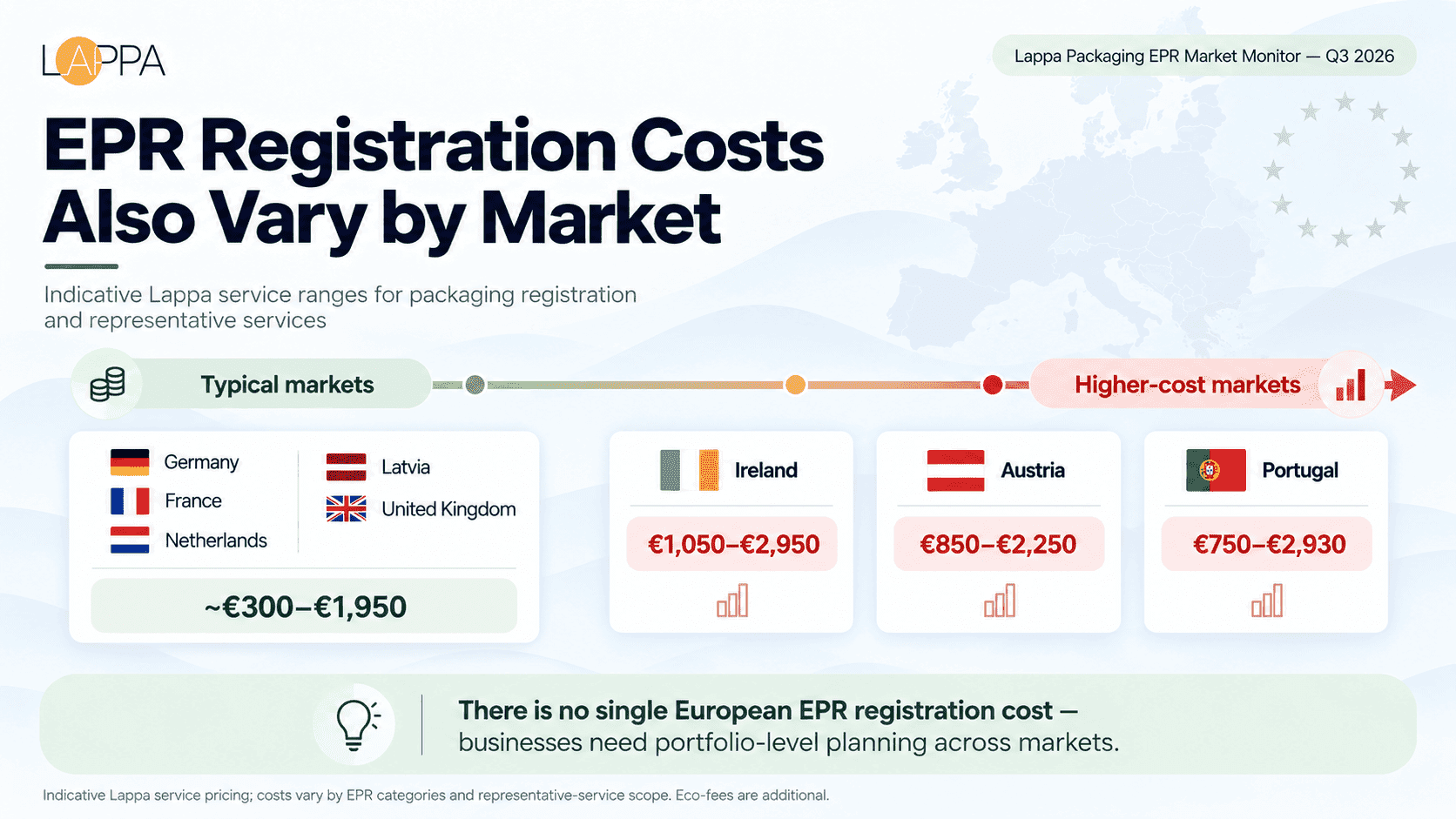
Registration time is only one dimension of the difference between national EPR systems. The cost of getting a company registered and represented also varies materially. Based on Lappa's pricing for packaging registration and representative services, some of the more expensive markets are Ireland, Austria and Portugal.
Higher-cost packaging EPR markets in Lappa's data
Indicative Lappa service ranges, depending on the number of EPR categories and the level of representative service required:
- Ireland — approximately €1,050 to €2,950
- Austria — approximately €850 to €2,250
- Portugal — approximately €750 to €2,930
These ranges are not government fees alone. They are indicative registration and representative-service costs within Lappa's service model and vary with the compliance scope required. For comparison, many other markets, including Germany, France, the Netherlands, Latvia and the United Kingdom, typically fall within a broader Lappa range of approximately €300 to €1,950, depending on registration structure and representative requirements. Material-based eco-fees come on top and can be estimated separately with the EPR fee calculator.
The difference matters most for businesses entering several countries at once. A company launching in ten European markets does not face one "European EPR registration cost". It faces a portfolio of national costs, timelines, representative requirements and reporting obligations. A market may be commercially attractive but expensive to establish from a compliance perspective; another may be cheap to register but slow. This is why companies increasingly need to model EPR compliance at portfolio level rather than country by country.
The real planning question becomes: what is the combined cost, time and operational burden of becoming compliant across the entire European footprint?
Germany, France, Poland, Spain and Italy generated the highest demand
The countries most frequently requested by Lappa customers for packaging EPR registration during the period were:
From a market-size perspective, this is no surprise: these are among the most commercially important destinations for companies selling across the EU. What is more interesting is how different their operational compliance environments are.
Germany was both one of the most popular markets and one of the fastest to register. Spain, by contrast, was among the most requested markets while showing the longest lead times. That combination is a particular challenge: companies prioritise Spain for its commercial importance, but those who start late may face a much longer timeline than expected. France, Poland and Italy remain core jurisdictions for any multi-country packaging EPR footprint.
The demand pattern suggests that businesses are not treating PPWR as a purely theoretical EU-level regulation. They are translating it into concrete national registration work in the countries where their products are actually sold.
The real PPWR challenge is the supply chain, not the form
One lesson from the first weeks after 12 August is that companies tend to focus first on registrations, forms and deadlines, because those are visible problems. The less visible problem is the legal and operational structure underneath. Before a company can register correctly, it needs to know:
- which legal entity is responsible;
- in which country the obligation arises;
- which packaging streams or categories are relevant;
- whether an authorised or EPR representative is required;
- who should report packaging volumes;
- who should pay scheme fees or eco-fees;
- how the obligation changes when goods move through a different sales or fulfilment model.
For simple domestic supply chains, these questions may be straightforward. For multinational groups, private-label structures, marketplace sellers, distributors and cross-border e-commerce businesses, they often are not.
That is why the 46% finding matters. The biggest financial error is not always failing to pay. It can also be paying under the wrong entity, paying twice within the same commercial chain, or assuming responsibility where another party actually carries the obligation. Correct EPR analysis starts with mapping the commercial chain, not with completing a registration form. It is also worth remembering that PPWR and EPR are not the same obligation: PPWR sets EU-wide rules for packaging design, labelling and conformity, while EPR registration and fees remain national.
Demand for packaging EPR support accelerated sharply after 12 August
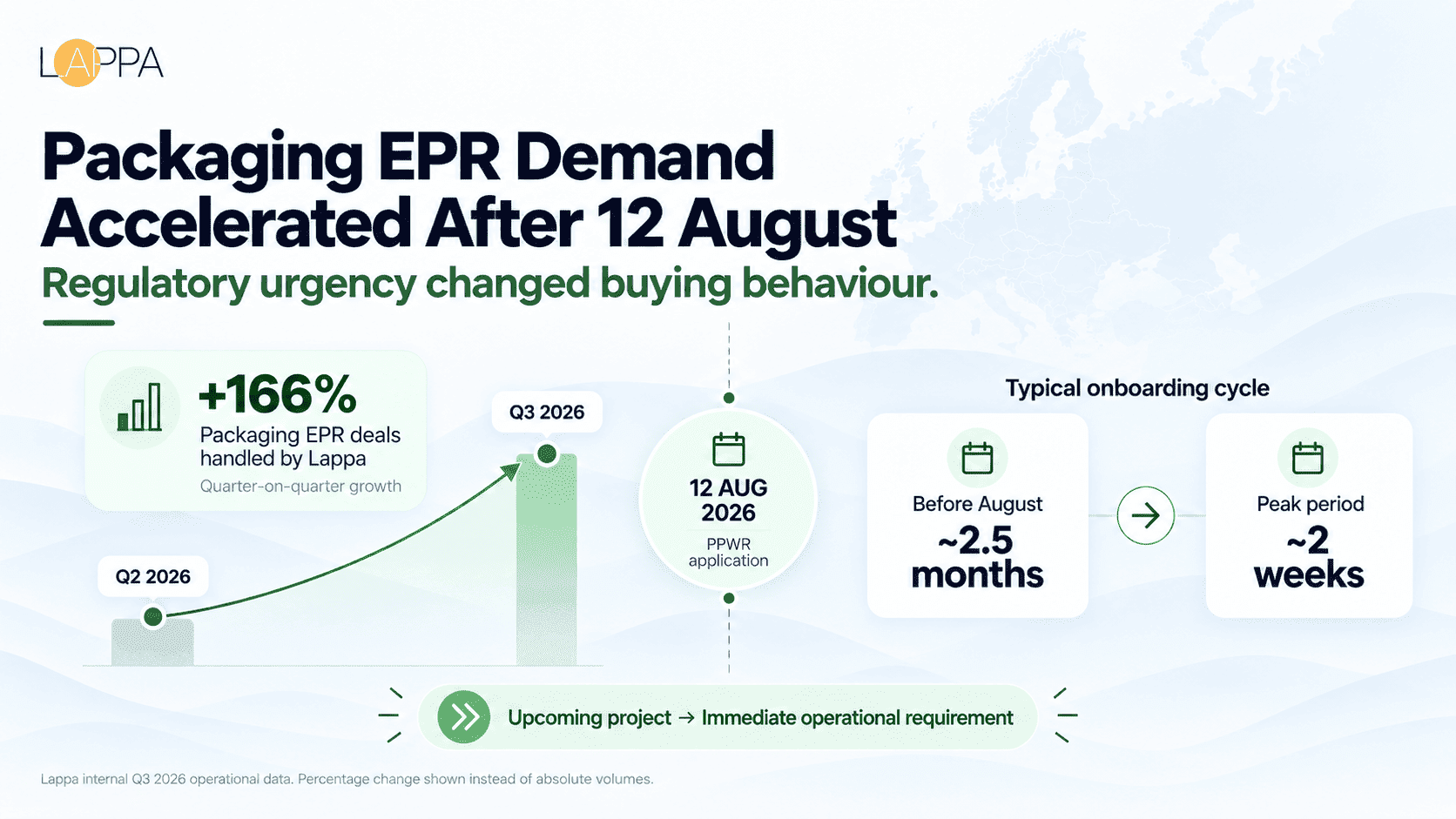
The final signal in Lappa's Q3 data was the speed at which the market moved. Quarter-on-quarter, the number of packaging EPR deals handled by Lappa grew by approximately 166% from Q2 to Q3 2026. We report the percentage change rather than absolute volumes because the useful market signal is the acceleration in demand, not Lappa's internal sales figures.
At the same time, the typical onboarding cycle shortened dramatically. Before the August deadline, onboarding could take around 2.5 months from first discussion to implementation. During the peak around PPWR application, it fell to approximately two weeks.
The reason was not a change in software or registration mechanics but a change in buying behaviour. Companies that had treated packaging EPR as an upcoming project suddenly treated it as an immediate operational requirement: internal approvals sped up, procurement cycles shortened, and legal and sustainability teams escalated the work. This is a familiar pattern in regulatory markets. Legislation may be known for months or years, but purchasing behaviour often changes only when the compliance date becomes unavoidable.
What businesses should learn from the first months of PPWR application
Determine the obligated entity before calculating fees. A packaging calculation is only useful if it is attached to the correct legal entity and supply-chain role. Once that is clear, the eco-fee calculation itself becomes straightforward.
Do not plan European EPR registration around one standard lead time. A registration that takes days in one country may take months in another.
Treat EPR registration as part of market-entry planning. For slower jurisdictions, waiting until launch creates avoidable operational risk.
Review existing EPR structures whenever the supply chain changes. A new importer, distributor, fulfilment model or group entity can change who is responsible.
Do not assume that more registrations and more eco-fees mean better compliance. The goal is not to register every entity that touches the goods, but to identify the correct obligated entity and fulfil the correct obligation once.
Methodology
The figures in this report are based on Lappa's internal packaging EPR consultation, registration and onboarding data for 2026, with particular attention to activity around the 12 August 2026 PPWR application date.
Registration timelines are observed operational timelines in Lappa-managed cases and should not be read as guaranteed processing times for every application. Pricing ranges are indicative Lappa service prices for the stated registration and representative-service configurations and do not represent government fees alone.
The 46% figure refers to companies that approached Lappa for consultation and subsequently found that their expected eco-fee obligation could be reduced or did not sit with them. It is not presented as a statistically representative sample of all European businesses.
Lappa intends to continue publishing aggregated packaging EPR and PPWR market data as registration volumes, processing times, costs and implementation practices evolve.
About Lappa
Lappa helps companies manage packaging EPR and PPWR compliance across multiple markets, including obligation analysis, registrations, reporting, representative services and packaging-data management through its EPR and PPWR compliance software.
Source for market statistics: Lappa internal consultation, registration and operational data, 2026.
Frequently asked questions about PPWR and packaging EPR registration
Regulation (EU) 2025/40 entered into force on 11 February 2025 and became generally applicable from 12 August 2026.